Tag: Sony

  • Sony to push digital platform Liv for ‘Indian Idol Junior’ auditions

    Sony to push digital platform Liv for ‘Indian Idol Junior’ auditions

    MUMBAI: It’s time for all the little ones to strengthen their vocal cords and showcase their talent as Indian Idol Junior (IIJ) is back with a bang on Sony Entertainment Television. And this time round, Sony is looking at giving its digital platform – Sony Liv a push via the show’s auditions.


    For the first time ever, IIJ will give a chance to the audience to be a part of the auditions through a digital process called Digital Ace.


    To take part, all kids have to do is upload their best audio or video performances on the Sony Liv website or the Sony Liv app. A digital jury will review all the performances and will select 12 kids who will be called to Mumbai for the Jury Round. Out of the 12 performances, the top four will get an opportunity to perform in front of the show’s judges.


    This second edition of IIJ will be judged by Vishal Dadlani, Salim Merchant and Sonakshi Sinha. Singer Shalmali Kholgade will be the special judge for the auditions. 


    The first leg of the auditions kickstarted in Kolkata on 4 April and saw outstanding participation from kids. The city also saw the show bring in a new twist to the audition process with the announcement of digital auditions.


    SET SVP and marketing head Gaurav Seth said, “After the over-whelming response received last season, we are delighted to announce the commencement of Indian Idol Junior auditions. We would like to urge all the kids to show their singing talent and be a part of the new season. Digital Ace will only help kids to give the long lines a skip and impress the judges through their audios or videos. It’s definitely an endeavor that will help aspirants all over.”


    Dadlani added, “I am thrilled to be part of Indian Idol Junior once again. Looking at such talented kids is an inspiration in itself. Kolkata has always given us some of our best contestants and this time too we were not disappointed. We are also looking forward to the performances of the winners of the Digital Ace. We are sure this season is going to be an equally exciting one.”


    After Kolkata, the audition process will move to Delhi, Chandigarh and Mumbai on 11 April, 18 April and 25 April respectively.


  • GroupM ESP lists top 10 trends for IPL season 8

    GroupM ESP lists top 10 trends for IPL season 8

    MUMBAI: Move over Cricket World Cup, welcome Indian Premier League (IPL) Season 8! 


    With the home grown league becoming a global reputable property, GroupM ESP (Entertainment & Sports Partnerships), has predicted top trends in 2015.  


    Commenting on the trends for this season, Group M ESP national director Vinit Karnik said that the sports entity has come a long way in how it addresses sponsorship sales and convergence of technology. “From selling tickets to selling an experience, IPL has come a long way. This further extends from the execution of sponsorships across major platforms — all the way to the idea/solution generation phase during the sales process,” he added.


    Karnik also stated that in 2015 teams will continue investing in the in-stadia experience content delivery. With feeds available through internet, Sony’s regional channels, mobile applications etc the content is truly taking the center stage. “It makes sense because if fans aren’t in the stadium consuming content, they’re consuming it somewhere else — work/ home/ in a cafe… wherever,” he informs.


    According to him there will be an amalgamation of technology integration and enhancement throughout the sport. The proliferation of video and statistical information backed by increased social exchange will define the popularity of teams.


    Uniquely positioned at the intersection of media and marketing, GroupM ESP has made the following predictions: 


    1) Smart talent acquisition by franchises increasing competitiveness with teams evenly matched.


    2) Enhanced broadcast production quality with regional language feeds from the broadcaster MSM.


    3) Fan Park idea will heighten interest and involvement in smaller cities and towns.


    4) Digital platforms to create sustained and deep engagement with real time analytics.


    5) Surround content to drive social conversations via social media platforms.


    6) Technology to enhance spectator interactions and engagement inside stadium.


    7) Realistic sponsorship pricing strategies resulting in repeat purchases and a stable sponsor ecosystem.


    8) Apparel as an emerging and popular sponsor category among franchises.


    9) Sponsor’s increased dependence on crowd sourcing to create excitement around their brands .


    10)  E-commerce brands will dominate ad spends on broadcast platform.


    “In all aspects, IPL offers a consumer delight by integrating newest technologies and enhanced fan experience while building affinity with future generations of fans who have moved from passive viewers to engaged amplifiers. We also see a lot of new generation brands jump onto the IPL bandwagon, making it a high spend high visibility and now high engagement business,” concluded Karnik.

  • MSM launches new pay channel in Sony Kix

    MSM launches new pay channel in Sony Kix

    MUMBAI: Multi Screen Media (MSM) has launched another sports channel called Sony Kix to complement its existing channel – Sony Six.


    Kix will be available on all the major cable and DTH platforms with a pricing of Rs 45 and Rs 18.90 in analog and digital respectively. 


    The channel will be headed by Sony Six business head Prasana Krishnan. Speaking to Indiantelevision.com, he says, “With the number of sports we have in our catalogue, a new sports channel launch was just a matter of time. Recently we saw a number of FIFA matches taking place simultaneously and we were handicapped since we could not air all of them. Moreover, we also at times had to place important matches on our GECs and that creates a lot of confusion for consumers. As the name suggests, Kix will mainly focus on football and fight sports but whenever needed it will complement Six with other sports too.”


    Speaking about his vision for the channel, Sony CEO NP Singh says, “Sports has always been a core focus for us right from our early days. Our entertainment and movie channels such as SET, Max and Pix have also, over the years, broadcast some of the landmark sports events both in India and internationally. While the resounding success of Six in less than three years was a deciding factor to launch Kix, there was also this need to cater to the clear demand seen in the market for largely, alternative sports programming. Kix promises to be a great addition to our mix of channels and will go on to complement Six in more ways than one with exciting and iconic properties such as Pepsi IPL, UFC and NFL among many others.”


    The channel will be launched during MSM’s flagship asset Indian Premier League (IPL), which is set to kick off on 8 April, 2015. Kix will carry Tamil and Telegu feeds apart from English. The channel’s major geographic target will be South India for the time being.


    “When one campaign is already on, there is no point setting up another and hence we will not launch a promotional campaign for Kix till the IPL is over. Post IPL, we might give an aggressive push but for the time being, it’s a new sports channel from Sony and will be airing IPL in three different languages. The channel will be launched in standard definition and in near future there may be another HD feed too,” Krishnan informs.


    According to Krishnan, multilingual feed is emerging as a recent trend and every big event has been following the trend. “We started it with FIFA and Sony Aath airing the Bengali feed and now no big event is complete without the multilingual feed. In the future too, we will innovate and invade into new territory,” he adds.


    In his two year stint at Sony, Krishnan has helped expand Sony Six’s portfolio and acquired new assets of international importance. Kix will be the newest channel under his tutelage. “I am happy and satisfied. It has been very significant two years and we managed to grow bigger and bigger. Being a two years old sports channel, what we are doing and have done is commendable. The end goal is to make Sony the one ultimate destination of sports broadcasting for both viewers and advertisers. We have partnered and discovered new leagues like Champions Tennis League and World Kabaddi League and in future also we will evaluate and explore something new, which will be long term entertainment for viewers,” he concludes.

  • ‘DID Super Moms 2’ clocks highest ever opening in week 13

    ‘DID Super Moms 2’ clocks highest ever opening in week 13

    MUMBAI: In week 13 of TAM TV ratings, it was Zee TV’s turn to ‘dance’ as one of its hot dancing property – DID Super Moms rated the highest ever opening episode since its inception. The show clocked around 9,441 TVTs and helped the channel boost its viewership from 394,303 GVTs to 411,915 GVTs. With this, Zee continued to hold its position on the third spot. 


    Sony was also the talking point this week, as it was the highest gainer with 221,802 GVTs, up from 200,620 GVTs. Though it continued to be at the bottom of the chart. On the other hand, Sab at number five grew from 275,000 GVTs to 282,000 GVTs in week 13.


    Talking about the losers of the week, Star Plus recorded 597,835 GVTs, down from 624,246 GVTs. Colors enjoyed its place at number two with 451,682 GVTs, down from 457,100 GVTs. Life OK at number four registered 289,000 GVTs, down from 302,000 GVTs. 


    Let’s take a look at the top 10 shows of the week – Zee TV’s Kumkum Bhagya turned out to be the highest rated show with 9,534 TVTs followed by DID Super Moms with 9,441 TVTs. 


    Moreover, Star Plus’ five shows made it to the top list chart. The channel’s Saathiya Saath at number third position clocked 9,140 TVTs followed by Diya Aut Baati Hum occupying the fourth position with 8,450 TVTs. At number five stood Star Plus’ Ye Hai Mohababtein with 8,128 TVTs followed by Yeh Rishta Kya Kehlata Hai at number six with 7,894 TVTs. 


    Colors’ Sasural Simar Ka garnered the seventh position with 7,513 TVTs followed by Sab’s Taarek Mehta with 6,289 TVTs at number eight. Zee TV’s Jamai Raja at number nine reported 6,229 TVTs followed by Star Plus’ Tu Mera Hero with 6,120 TVTs.

  • Pakistan Cricket Board renews deal with Ten Sports for next five years

    Pakistan Cricket Board renews deal with Ten Sports for next five years

    MUMBAI: The Board of Governors from the Pakistan Cricket Board (PCB) have approved awarding broadcasting rights to Ten Sports and Pakistan Television, the joint-bidders for PCB’s next rights cycle for five years.


    Ten Sports had previously bagged five-year cricket rights from PCB in 2008 reportedly for $140.5 million dollars. The current cycle of rights begins from April 2015 to early 2020. Ten Sports has been the rights holder for PCB for the last 10 years.


    The package will also include India versus Pakistan matches, besides some other strong matches. According to information available with Indiantelevision.com, among those bidding for the rights for this cycle were Sony and OSN Sports, apart from a few brokering companies. 


    As part of the arrangement, India and Pakistan matches are scheduled for the latter half of this year around November-December 2015, subject to government approvals from both sides.


    When contacted, Ten Sports CEO Rajesh Sethi said, “Ten Sports is a market leader in the sports segment in Pakistan. When it comes to cricket, we have a great partnership with PTV as they are our valued partners. Besides cricket, Moto GP and WWE too are very strong properties that are performing well in Pakistan.”

  • Spuul inks deal with MSM to stream shows from Sony and Sab

    Spuul inks deal with MSM to stream shows from Sony and Sab

    MUMBAI:  Online streaming service for Indian TV & film content, Spuul has inked a partnership with Multi Screen Media (MSM) to stream their TV shows from the Sony stable on the digital platform in India.


    Spuul users from India can now watch these shows on all second screen devices including mobile phones, tablets, web, smart TVs as well as stream to their TVs via Chromecast.


    In the current partnership, audiences from India will benefit from Spuul’s download feature, which will also allow them to download the TV shows on their devices apart from streaming. The shows from Sony Entertainment Television and SAB TV, which will be available on Spuul are AdalatCIDMaharana PratapChidiya GharTarak Mehta Ka Oolta Chasma and Hum Hai Na. These shows can be viewed for free on Spuul.


    Spuul CEO Subin Subaiah said, “India ranks fourth in world for content consumption. With 4G roll out, these numbers are expected to rise tremendously. Spuul data shows that about 80 per cent content is being consumed on mobile devices. Such partnerships reflect an increase in user figures and help us to provide content to our users on the go.”


    MSM EVP and head – digital business Uday Sodhi added, “We’re delighted to partner with Spuul to widen our reach. The second screen is quickly becoming the primary screen and it’s important for us to ensure that our content is available to all audiences across platforms and this association will certainly go a long way in making that happen.”

  • IPL is the largest reached sports event in 2014: FICCI KPMG Report

    IPL is the largest reached sports event in 2014: FICCI KPMG Report

    The global sports industry is estimated be worth of $600 – $700 billion. Revenue generated from the industry is estimated at $80 billion globally and is growing at Compound Annual Growth Rate (CAGR) of 6.5 per cent over 2009 to 2014, which includes revenues from media rights, sponsorships and ticketing.

    The market for advertising in sports in India was estimated at Rs 41 billion in 2013 growing at a CAGR of 14 per cent from Rs 21 billion in 2008. It consists of on ground advertising, team sponsorship, athlete sponsorship and media ad spends on sports. Licensing and merchandising contribute Rs 2 billion to the industry in India. Gate revenues make up another revenue stream but its contribution to the sports market in India is relatively low compared to media ad spends and sponsorship.

    Sporting events have been popular throughout history, and have gained greater viewership with bigger stadiums and TV broadcasting of domestic and global events. Annual sports viewership in India reached 276 million in 2014. But the sports genre accounts for only 2.4 per cent of total TV viewership and 4.3 per cent of AdEx (Advertisement Expenditure) revenue in the Indian TV industry, much smaller than the general entertainment genre.

    The median age in India is around 27 years and around 64 per cent of the population is expected to be in the working age group by 2020. This provides a large and growing target segment for sports in India. Moreover, an increase in percentage of middle class and rich households (households with annual income greater than Rs 2,00,000) from 6.1 per cent in 2001-02 to 14.5 per cent in 2009 -10 has increased the number of people with an appetite for sports consumption. The middle class alone is expected to increase to 41 per cent of the population by 2025. There has also been an increase in the average share of educational and recreational activities in the annual household consumption and it is estimated to increase from five per cent in 2005 to nine per cent by 2025.

    A good start to non cricket sports is one interesting to look at the growth of sports other than cricket in India. Many sports have grown well over the last half decade. A survey on the popularity of sports in the Indian online community reports that while 85 per cent of respondents followed cricket in some manner, an estimated 44 per cent followed tennis, 41 per cent followed football (soccer) and 32 per cent followed badminton. With economic development, sports viewership in a country usually moves from single sport to multi sport. Africa and the Indian subcontinent have been traditionally dominated by football and cricket respectively. However, with greater economic development, India is seeing a growth in other sports as well. 

    League formats have helped in increasing popularity of sports Globally

    The leagues system has served as an important way for companies to enter the sports sector. A sports league creates several opportunities for private companies in domains such as league management, franchisee, broadcasting and sports videos production houses, advertising, sports infrastructure such as multipurpose venues, player management, licensing and merchandising. One of India’s most successful leagues in terms of viewership and revenues has been the Indian Premier League (IPL), which is based on the English Premier League (EPL) format. The league was launched in 2008 by the Board of Control for Cricket in India (BCCI) with eight city franchisees. Though it is still small in comparison to some of the biggest leagues of the world, it has been able to achieve success in a short span of time, which other mature leagues could not manage to do. The evolution of IPL as a brand is an example of successful product innovation, which effectively combined entertainment and sports. The Twenty20 (T20) format of IPL has made the sport more popular and convenient to watch for cricket enthusiasts. The success of the IPL, which is estimated to have had a viewership of 191 million people and ad revenue of Rs 8 billion in 2014 has led to the creation of several other league-format sporting events, such as the Indian Badminton League, Hockey India League and the recently launched Pro-Kabaddi League. The inaugural season of football’s Indian Super League has been fairly successful as well. Cumulative reach of Pro Kabaddi League was 435 million compared to 560 million for IPL in 2014. Football’s Indian Super League was close with 410 million cumulative reach. The new domestic sports leagues however require significant management efforts over a period of time to get established and be successful. 

    Viewership refers to sum of weekly GVTs, which is a factor of number of viewers and frequency.

    IPL leads the cumulative reach chart amongst sporting events held in 2014
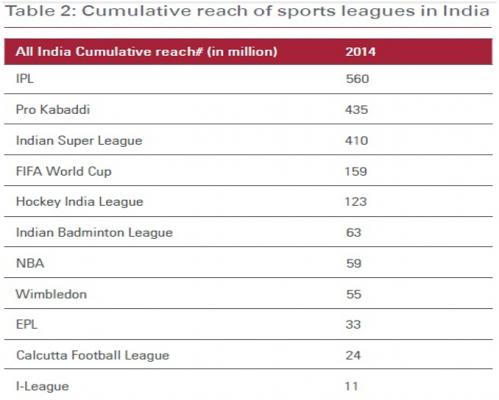
    Cumulative reach refers to the number of individuals within the target group who viewed the tournament over a certain period of time, including duplication.

    Ecosystem to support sports development in India

    However, in order to sustain the growth in sports and sports-related businesses, a flexible regulatory and policy framework that is able to realise synergies between various segments of sports needs to be developed. This in turn requires the sports ecosystem and its stakeholders to be recognised under the purview of a dedicated industry of sports which can provide impetus to an organised and professional business environment for sports in India.

    Sports Broadcasting in India

    There has been a surge in the number of sporting events broadcast in the past few years. These events include tournaments and leagues played at state, national and international levels. Several international tournaments and leagues played at the regional or global level are now telecast in India bringing in a larger and much diverse audience. Males form around 60 to 65 per cent of viewers and are expected to continue to be the main target segment. However, the number of female viewers has been increasing. About 57 per cent of the viewership of ISL and 53 per cent of the viewership of Pro – Kabaddi League was made up of women and children. Broadcasters are supplementing the sports with other entertaining and informative pieces to make the program more inclusive.

    Getting to the right content mix

    With the rise in number of sporting events, sports channels are covering several sporting events in their annual calendar. It consists of a mix of marquee events from domestic and international leagues, major tournaments along with minor domestic leagues and tournaments.

    Star Sports has revamped itself with uniformly branded eight channels to showcase a variety of domestic and international sports both cricket and non – cricket and in English as well as Hindi. While international cricket matches featuring India will make up 65 per cent of Star Sports 1, Ranji matches, university and women’s cricket and international cricket matches not featuring India will form 50 to 60 per cent of content on Star Sports 2. This will enable Star to nearly double its cricket content, which is the major revenue driver for sports channels in India. Star Sports 4 will feature other sports, which include international football (soccer), European soccer leagues, badminton, tennis and Formula-1 racing.

    The new Indian leagues, which include hockey, badminton and soccer, will be telecast on Star Sports 1 to 3 to reach a larger audience. Such a strategy enables Star Sports to increase its cricket content as well as broadcast non – cricket sports, which are seeing increasing traction. There is also an increasing trend towards multi-sports channels, as the viewership of different sports are increasing and sports channels are vying for TV rights across sports. Star has seen a shift from having a cricket specific channel in its cluster to multi-sports channels. It enables Star to broadcast both international and domestic cricket content simultaneously as well as gives it flexibility to show different sports across different channels. This can be attributed to the large investments made by Star to purchase rights for domestic and international cricket, football, tennis, badminton etc.

    On the other hand, Neo has rebranded its cricket specific Neo Cricket to Neo Prime on account of reduced live cricket properties and surge in volume of several sports.

    Ten however, has sports specific channels with Ten Cricket for cricket, Ten Action for football and Ten Golf for Golf broadcasting. Availability of sufficient single sport media rights and a definite viewership base for that particular sport drives the presence of sports specific channels. This helps advertisers to target a specific audience, for example luxury products have tied up with Ten Golf. Although, digitization and lower costs of distribution make single – sport channels more viable than before, it can take some time to evolve in India and reach the popularity of golf and tennis channels in some developed countries.

    Regional language boost to broadcasting

    Another strategy to target a specific audience is the language of telecast. Hindi and other regional languages increase the audience reach for sports as English has a limited audience. Star Sports 3 replicates Star Sports 1 in Hindi. In 2014, it telecast the domestic football league – Indian Super League in five languages. Its regional TV channels were used to telecast the league in Bengali, Kannada and Malayalam apart from English and Hindi broadcasts. During FIFA World Cup 2014, Bengal accounted for half the country’s viewership mainly because of regional language feed by Multi Screen Media (MSM) on its Bengali general entertainment and film channel Sony Aath. Hindi broadcast of the Pro Kabaddi League on Star Gold also helped take the cumulative reach to 435 million for the event. Other than using regional sister channels for feed in local languages, sports channels may spin off separate regional language sports channels if the demand picks up.

    Revenue and Profitability model

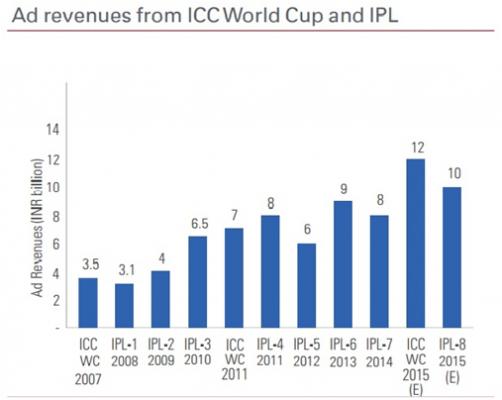
    Sports industry is still an ad driven revenue model. Media spends on sports, most of which is on TV, increased from Rs 11.5 billion to Rs 22.5 billion over 2008 to 2013 at a CAGR of 14 per cent. In mature markets, subscription is the main revenue driver for sports channels, contributing nearly 60 to 90 per cent of the revenues. However in India, advertisements still account for nearly 60 per cent of the revenues of sports channels, mainly driven by cricket, which is the largest revenue spinner and accounts for nearly 80 to 85 per cent of the total television sports media revenue. Non-cricket sports provide live sports content around the year, which gives advertisers a regular touch-point to their target segments. Revenues from advertisements in any year vary depending on the tournaments and series held during the year. Cricket mostly forms the peaks whereas the troughs are being evened out with non–cricket sports and non-live cricket content. In 2011, ad spends on TV for cricket was estimated to have crossed Rs 20 billion. In 2015, ad spends from the ICC World Cup and IPL 8 alone are expected to be around Rs 22 – 25 billion. Ad revenues for non-cricket sports are only a small fraction of cricket revenues. In 2013, ad revenues from Indian Badminton League and Hockey India League were Rs 0.9 billion and Rs 0.7 billion respectively.
    Key challenges facing the spurt of non-cricket leagues in India includes:

    • Poor investor confidence

    For instance the Indian Badminton League (IBL) suffered a loss of Rs 25 crore in the opening season in 2013 owing to investors pulling out casting doubt on the return of IBL with its second season. However, despite no play in 2014, the IBL is set to return in 2015.

    • Lack of industry status

    Provision of industry status could lead to an organized sports industry leading to higher available capital, newer sports businesses, additional revenue streams for stakeholders making leagues commercially viable ventures.

    • Lack of a culture for sports

    Sporting leagues in India are designed to last just a couple months every year. However, many major sporting league seasons in the world last for longer durations every year. Sporting leagues need to become year round (or at least three – four months a year) ventures. Apart from the benefit of a longer engagement with viewers (allowing the building of a larger fan base and culture for the game), this also touts the idea of sport becoming a year round profession furthering the advent of sports businesses.

    Revenue model in leagues

    Major sources of revenue for any league come from media rights, sponsorships and revenue from franchisees. Share of franchisee consideration in IPL has increased from 30 per cent in 2010 -11 to 37 per cent in 2012- 13 with a corresponding decrease in the revenues from sponsorship rights. Income from media rights and other sources have nearly the same share in 2012-13 as in 2010- 11.

    Major Sources of revenue for a League Franchisee

    Major sources of revenue for any league franchisee are share of the central revenues, local revenue and performance revenue.

    • Share of central revenue

    This includes a percentage of the revenue to the league from media rights and central sponsors like Pepsi in the IPL. In India, media rights are a major revenue sources both for the league and the franchisees. Channels are expected to further increase the subscription revenue for sports channels.

    • Local revenue

    Local revenue for a franchise entails revenue from match day ticket sales (gate revenue) and commercial revenue that includes funds from franchise sponsors, merchandise sales and revenue generated from membership with the franchise club if any. However, revenue from franchise sponsors makes for a majority of the commercial revenue. Sports merchandise sales is a fast growing segment with Rs 2 billion in retail sales in 2013. Moreover, contribution of gate revenue to overall revenue of franchises is low due to inexpensive ticket pricing, especially in non-cricket leagues. This is in contrast to leagues abroad where gate revenues are a significant contributor to a franchisee’s revenue.

    How can leagues be further popularised/ monetized?

    Some of the critical success factors of a league in India are identified below:

    • Players

    Involvement of top players of the world creates interest in the viewers and increases the quality of the game. The IPL is a successful example of the same. On the other hand, I-League is struggling to attract top players resulting in poor viewership.

    • Marketing

    An effective marketing campaign is another critical factor in making the league popular. Again, the involvement of various celebrities as brand ambassadors or owners in the IPL contributed to generating larger viewer interest in the league. In fact, the marriage of the Indian entertainment industry and cricket has aided in making IPL a commercial success.

    • Governance framework

     It is seen that leagues, which are run with the support of the approved federation have been able to sustain. The ICL failed due to lack of support from BCCI and World Series Hockey (WSH) is facing similar troubles due to non-recognition of the founding federation as the official national sports federation of hockey itself.

    • Stadium Infrastructure

    Quality of stadium infrastructure improves the viewing experience, hence increases the level of interest in the sport. It is important to create supporting infrastructure like restaurants, bars, fast-food chains, merchandise, stores, books and music stores, etc. to develop stadiums into popular entertainment spots for the family. Hike in ticket prices subsequent to rise in viewership, organizing multiple sporting events and entertainment shows wherever possible can help monetise stadium infrastructure.

    • Fan base

    An effective strategy to increase a franchisee fan base is engagement of respective franchises with local community. This helps generate greater TV viewership, increase attendance of matches and sale of merchandise. Performance of national team or players at international level increases the interest in the game, hence the league.

    League timing

    The tournament should be held at a time when there is no clash with international tournaments that could divert a significant section of the viewers, many players are available and weather is suitable for holding matches. The length of games and timing of matches (conducive for family viewing) are also important factors to consider, both having further helped significant viewership of the IPL. Other factors may include spectator friendly broadcasting such as better viewing angles and broadcasting in Hindi and English.


  • Star Plus wins big in week 12

    Star Plus wins big in week 12

    MUMBAI: In week 12 of TAM TV ratings, Star Plus and Colors were the only gainers. Further strengthening its viewership base, Star Plus recorded 624 GVMs, up from 592 GVMs.


    Colors, at number two, notched up and noted 457 GVMs, up from 428 GVMs last week. Zee TV, at number three, registered 394 GVMs, down from 407 GVMs.


    Life OK remained steady at number four with 302 GVMs, down from 307 GVMs. Sab too saw a dip in the viewership and stood at 275 GVMs, down from 288 GVMs. Sony Entertainment Television (SET) continued to remain at the bottom of the chart with 201 GVMs, down from 221 GVMs.


    The newly launched Hindi general entertainment channel (GEC) from the Zee stable, &TV too lost eyeballs as it noted 99 GVMs, down from 105 GVMs.


    Sony Pal witnessed a hike and scored 49 GVMs, up from 42 GVMs. Zindagi reported 21 GVMs, down from 23 GVMs.

  • Sony ushers in new programming with ‘Dil Ki Baatein’

    Sony ushers in new programming with ‘Dil Ki Baatein’

    MUMBAI: It has been struggling to regain lost ground in the Hindi general entertainment space for quite some time now. But, undeterred, the MulitScreen Media owned Sony Entertainment Television is taking another shot at attracting hordes of viewers to its prime time fare. In its first step towards that, the channel has launched a show called Dil Ki Baatein starring the popular TV actor Ram Kapoor in the lead. 


    “Sony has always prided in telecasting innovative shows. In the next 100 days we will be launching five new shows with interesting concepts as we believe there is an audience out there that exists for such content,” says SET senior executive vice president and business head Nachiket Pantvaidya.


    Dil Ki Baatein will be Kapoor’s come back to TV. He will be seen opposite Gurdeep Kohli. The show also stars Pankaj Dheer as Kohli’s father, whereas Mahima Makhwana and Ratna Shinde will essay the roles of the couple’s daughter and son respectively. 


    Dil Ki Baatein has been helmed by filmmaker Mahesh Bhatt and SET together. Sony took note of Bhatt’s narration about the concept a year and half ago.


    Talking about the concept of the show, SET senior vice president and marketing head Gaurav Seth says, “It is an unusual love story that brings out the struggle and various emotions of the family to the fore. It questions how far one can go for a loved one and to what extent? The show explores the complexities of human relationships and one’s emotional downfall when fate intervenes.”


    According to Seth, the biggest USP of the series is the role essayed by Kapoor. He will be portraying the role of a supportive husband to his cancer stricken wife, who faces a blood cancer relapse after two years. The programme has been produced by Guroudev Bhalla and Dhaval Gada from Bhatt’s production house, which also produced the show Udaan for Sony previously.


    “We have shot five different promos where Ram Kapoor is essaying a different role and emotion. In the first promo, for instance, he is seen conversing with God about his problems,” informs Seth.


    The promo was first launched on digital media, where along with active engagements from fan clubs, it trended at the top spot for five to 10 minutes. “For the first time, the promo itself registered one million views on YouTube,” says Seth.


    A robust marketing campaign has been planned across 35 Indian cities along with active OOH campaigns. Seth informs that the communication showing Kapoor along with a bald headed Kohli, has generated the necessary buzz. It has also generated 21 crore digital impression so far across various social media platforms. On Twitter, SET invited reactions from fans of how far would fans go for their loved ones.


    The show has LIC as the presenting sponsor and advertisers such as Otriven, Cadbury, KFC, Samsung Galaxy among others on board.


    Dil Ki Baatein, which went on air on 23 March, will be telecast from Monday to Thursday at 9:30 pm on Sony.

  • TheOneAlliance to switch off signals for Reliance Big TV

    TheOneAlliance to switch off signals for Reliance Big TV

    MUMBAI: TheOneAlliance has decided to suspend the signals of its premium channels to direct-to-home (DTH) service provider Reliance Big TV for non-payment of outstanding dues.


    According to TheOneAlliance, the DTH operator has failed to make payments of the outstanding amount despite constant follow ups and repeated reminders.


    This resulted in an issuance of a public notice for disconnection of signals on 18 March. In case the DTH operator fails to clear the outstanding dues, approximately 1.6 million Reliance Big TV subscribers will face a blackout after three weeks of the issuance of the public notice. 


    The switch-off could be a setback for sports enthusiasts, in view of the upcoming season of Pepsi IPL 2015, which commences on 8 April and will be aired on Sony Six and Max.


    In addition to the Pepsi IPL 2015, the subscribers of Reliance DTH platform will also miss viewing other channels including Sony Entertainment Television, Max2, Sab, Sony PAL, Mix, Pix, AXN, Animax and Aath.


    It seems as though Reliance BIG TV is making a habit of this. It may be recalled that last year too, TheOneAlliance had informed subscribers of Reliance Big TV via a public notice that the channels it aggregates can go off, if the DTH player doesn’t clear outstanding dues.