Tag: Sony TV

  • The Smurfs to dance to the tune of India’s viral sensation Adhi and Indian Idol Junior competitors

    The Smurfs to dance to the tune of India’s viral sensation Adhi and Indian Idol Junior competitors

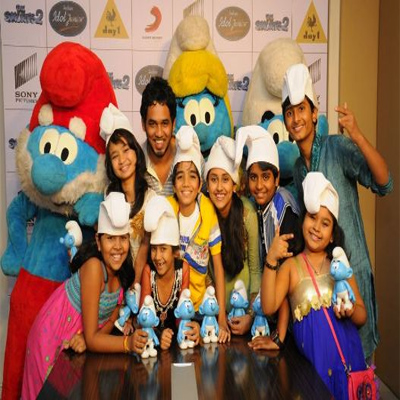
    NEW DELHI: Nine young participants in Sony TV’s Indian Idol Junior singing talent hunt, aged between eight and fifteen, have rendered an Indian song called “Na Na Na (Nice vs Naughty)” in the dubbed Hindi version of Sony Pictures’ Smurfs 2, being released on 2 August.


    To be released by Sony Music, the song features Chennai-based viral sensation Adhi of HipHop Tamizha (pronounced “Tamila”) whose hit “Club le Mabbu le” has garnered over 2.1 million views on YouTube.


    They join an illustrious group of top international artistes. The film’s international soundtrack features Britney Spears’ hit “Ooh La La”. Other major international artistes that have shown some Smurf love include Right Said Fred’s “I’m Too Smurfy” (a remake of their classic “I’m Too Sexy”) and LMFAO’s “I’m Vexy and I Know It” (remake of their super-hit “I’m Sexy and I Know It”).


    Sony Music will make the song available across all digital platforms. The film itself is being released in 3D in both Hindi and English.


    In this sequel to Columbia Pictures/Sony Pictures Animation’s hybrid live action/animated family blockbuster comedy The Smurfs, the evil wizard Gargamel creates a couple of mischievous Smurf-like creatures called the Naughties that he hopes will let him harness the all-powerful, magical Smurf-essence. But when he discovers that only a real Smurf can give him what he wants, and only a secret spell that Smurfette knows can turn the Naughties into real Smurfs, Gargamel kidnaps Smurfette and brings her to Paris, where he has been winning the adoration of millions as the world’s greatest sorcerer. It’s up to Papa, Clumsy, Grouchy, and Vanity to return to our world, reunite with their human friends Patrick and Grace Winslow, and rescue her.


    The film is directed by Raja Gosnell and produced by Jordan Kerner. The screenplay is by J. David Stem and David N. Weiss and Jay Scherick and David Ronn and Karey Kirkpatrick with a story by J. David Stem and David N. Weiss and Jay Scherick and David Ronn, and is based on the Characters and Works of Peyo.


    The story of the Smurfs started in 1958 with the creation of comic books which were later brought to both the big and small screen. Over the years, the little blue characters haven’t just limited themselves to the page and the screen. They have inspired records and CDs that have sold millions of copies, entire collections of figurines and toys, and many more products. In all, more than 3,000 derived products have been produced and leading brands and companies have spread their messages worldwide with the help of the Smurfs.


  • Mobile streaming platform Zenga TV looks to double revenues

    Mobile streaming platform Zenga TV looks to double revenues

    MUMBAI: Zenga Media, the mobile and web streaming company, has set itself an ambitious target of doubling its revenues in the current financial year.

    Zenga Media, which owns the mobile and web streaming platform Zenga TV, is promoted by former Sony TV executive Shabir Momin and Vikramjiet Roy.

    Shabir Momin, the MD and CTO of Zenga TV, says that the company‘s total revenue in the last fiscal was in the region of $2-3 million.

    According to Momin, the company has turned RoI (Return on Investment) positive in the last two fiscals and is paying for its own expenses.

    “The promoters did not have to infuse funds in the company as it is RoI positive,” he adds.

    No equity divestment is planned either, rather the aim is to grow the company before exploring fund raising avenues.

    Zenga TV is an ad-supported mobile and web streaming platform. It claims to have 22-23 million active users every month. Zenga‘s biggest differentiator, according to Momin, is that it is compatible with even feature phones and the technology is in-house.

    The digital streaming platform has content partnerships with the NDTV group, Times Television Network, BAG Network, Reliance Broadcast Network, and Raj TV Network.

    However, the big three television networks Star India, Zee Network, and MSM are missing from the platform. The Viacom18 channels too are no longer available on the platform.

    “While we don‘t have Star, Zee and Sony, we do have a lot international channels in our offering. Over and above that, we also produce content in various genres for our platform,” he avers.

    The absence of these powerful networks from Zenga TV means that the platform‘s entertainment bouquet is a a bit of a non-starter.

    However, Zenga TV has strong news offering with the presence of NDTV, Times Now, CNBC TV18, Aaj Tak and Headlines Today amongst others.

    News is one of the most consumed genres on mobile after entertainment and movies, says Momin. After news, the sports genre has a lot of traction among mobile TV consumers.

    However, the cost of acquiring sports rights makes it an unviable proposition to monetise, reveals Momin. After flirting with IPL rights in 2009, Zenga gave it up as it discovered it could not recoup its investments.

    “It‘s better to be profitable rather than taking risks with cricket rights,” he asserts.

    Zenga TV generally does 50-50 revenue share deals with broadcasters which means that its content costs is zilch. However, monetising content through advertisement is still not that easy a task.

    Reason: The ad spends on mobile are still very low compared to the kind of reach that it delivers. However, Momin is optimistic. His optimism stems from the predictions that mobile ad spends are expected to grow to Rs 3 billion by 2015 up from the current Rs 1.5 billion.

    Zenga TV plans to play the volume game by being a free content platform. Going pay is not a good option as one has to be at the mercy of telecom operators, who dictate terms to platform owners on revenue share, points out Momin.

  • Delhi HC restrains Sony TV from telecasting crime show on Chautala

    Delhi HC restrains Sony TV from telecasting crime show on Chautala

    NEW DELHI: A crime show based on the teachers‘ recruitment scam involving former Haryana chief minister Om Prakash Chautala and 54 others will not be telecast pending direction of the Delhi High Court.

    The show was to have been telecast on Sony TV‘s Crime Patrol tonight.

    Justice M L. Mehta‘s interim direction came on a plea of Chautala, his then officer on special duty Vidya Dhar and political advisor Sher Singh Badshami.

    Advocate Rajiv Nayyar, appearing for Chautala, asked the court to direct the channel to postpone the telecast till the pending petition seeking suspension of their sentence is decided by another bench, as the programme could adversely impact the appeal against the trial court verdict.

    He said that Chautala has also sought suspension of his 10 year imprisonment and till it is decided, the programme‘s telecast should be deferred.

    The trial court last month sentenced Chautala, his son Ajay Chautala and eight others to 10 years in jail while one convict was sentenced to five years and 45 others were handed out four-year jail terms after convicting them of illegally recruiting 3,206 junior basic trained teachers in Haryana in 2000.

  • ‘Ten Sports’ distribution is open for negotiations’ : Gurjeev Singh Kapoor – Set Discovery head

    ‘Ten Sports’ distribution is open for negotiations’ : Gurjeev Singh Kapoor – Set Discovery head

    Riding high on the ICC World Cup, Set Discovery reaped a harvest of $120 million (around Rs 4.8 billion) in 2006-07.

    The challenges, though, are stiff this year as flagship Hindi general entertainment channel Sony TV is floundering. But direct-to-home (DTH) revenues will start kicking in substantially as subscribers have doubled. And the cricket play is not over yet.

    The One Alliance, Set Discovery’s brand, has recently added three news channels from TV Today including Hindi market leader Aaj Tak. It is also planning to form regional bouquets with presence in Tamil, Telugu and Bengali markets.

    In an interview with Indiantelevision.com’s Sibabrata Das, Set Discovery head Gurjeev Singh Kapoor speaks about the distribution company’s interests in bidding for Ten Sports and HBO as they come up for grabs while chalking out its expansion plans.

    Excerpts:

    Will Set Discovery manage to retain its last fiscal revenue of $120 million in a year where it doesn’t have strong cricketing properties?
    I wouldn’t like to comment on the revenue front. But we would surpass it this fiscal, thanks to DTH (direct-to-home) where the numbers have doubled. We are also close to signing up with Reliance ADAG and Bharti Airtel’s upcoming DTH ventures. We have done IPTV deals with players like IOL Broadband, HFCL and Aksh Optifibre. And don’t forget that Ten Sports had a lineup of live cricket telecast.

    But Ten Sports admits that not having India cricket will affect their ad revenues this fiscal. Won’t this same logic extend to distribution?
    Ten Sports is a good sporting channel for distribution. Though it doesn’t have live India playing content this fiscal, we could capitalise on other cricket as it was exclusive. Having no India cricket may affect advertising. But our experience shows that distribution profits if there is live and exclusive content on the channel. Besides, Ten Sports has WWE which is a good property for distribution.

    Will Ten Sports not slip out of The One Alliance after the term ends in March 2008, particularly after Zee has taken a 50 per cent stake in the sports channel?
    Ten Sports’ distribution is open again for negotiations, despite Zee having taken a 50 per cent stake. The channel strategically helped us in pushing our bouquet and with the ICC World Cup, we had back to back cricketing properties. We gained from the ‘synergy effect.’ We are going to bid for it again. The distribution is up for grabs.

    Why didn’t Sony bid for the ICC World Cup, if it is crucial to have a cricketing property to push distribution bouquets?
    Our experience shows that on the distribution revenue front, it is always good to have 2-3 boards if you are getting live and exclusive cricket. We, undoubtedly, gained in subscription revenue because of the World Cup. But it is also true that we couldn’t encash on smaller markets because the World Cup is a largely shared property. We had to share with Doordarshan the India and other important big matches.

    Which is why Sony bid and took the New Zealand cricket board?
    Our cricket story will not stop there. We are looking at cricketing properties that make business sense for us. The thought process is that we will bid for IPL and other boards that come up for renewals.

    We are actively seeking a regional presence. We are looking at having Tamil, Telugu and Bengali channels

    Sony was in talks to distribute Neo Sports. Did it fail because Neo was asking for very high minimum guarantees?
    We couldn’t agree on the commercial terms. Though Neo has the BCCI rights to international cricket played in India, matches will have to be shared with DD. We felt the asking price was on the higher side.

    Set Disocery has recently signed a pact with TV Today Network to distribute Aaj Tak, Headlines Today and Tej. Will Aaj Tak help you to push Sony TV, which has weakened its position, and Sab TV in the Hindi heartland?
    It will complement our two Hindi general entertainment channels. But more than that, it will open up the Hindi news channels to go pay. Star News and Zee News are virtually free. As Aaj Tak is the No. 1 in its genre, cable operators will now have to understand that Hindi news channels are also pay. Already NDTV India is planning to go pay.

    Our bouquet will have pay channels in every genre. We already had NDTV as the leading English news channel; and with Aaj Tak, we will now have the leader in the Hindi news segment.

    How much of an upside do you see in revenue terms?
    The only way we can ask for more revenues from cable operators is by expanding our content. As we are adding the three TV Today news channels, we are hiking our second bouquet price from Rs 58 to Rs 65. We have a 40-month deal with TV Today which extends across all distribution platforms – cable, DTH, IPTV.

    Is The One Alliance planning to add more channels?
    We will be pitching for English movie channel HBO as its distribution deal with Zee Turner comes up for renewal early next year.

    What about forming regional bouquets?
    We are actively seeking a regional presence. We are eagerly looking at having Tamil, Telugu and Bengali channels. While Andhra Pradesh has an estimated 11 million cable households, in case of Tamil Nadu it is 10 million and West Bengal five million. Even if we manage to convert 50 per cent of that, that is a lot of pay revenues. Kerala is not on our radar as even popular channel Surya is free-to-air.

    Along with the regional channels, we can push our national bouquet more aggressively into these markets.

    Will more existing channels go pay as carriage fee shoots up?
    Several existing channels are looking to go pay fast. Carriage or placement fee is going to shoot up and up as cable networks have no frequency available. Between Star, Set Discovery, Zee Turner and ESPN Star Sports, there are about 70 pay channels. So where is the space on analogue cable. Bandwidth is going to be a big problem for everybody to handle.

    The telecom regulatory authority of India (Trai) has asked for a la carte pricing from broadcasters in non-Cas (conditional access system) areas. Do you see this contributing to more carriage fee?
    If the tariff order sails through, Trai will actually be promoting carriage as a concept. The multi-system operators will charge for carrying the channels while we have to offer them on an a la carte basis.

    Why has Sony moved the Tdsat (Telecom Disputes Redressal and Settlement Tribunal) against the Trai tariff order for non-Cas areas?
    We have two points of contention. Even if broadcasters offer channels on a la carte basis, how do we get paid for the exact number of our subscribers? The other reason is that we will have to reduce the rates of our channels for non-Cas areas. In Cas areas we do so but are compensated in a way because there is exact declaration of subscribers.

    And for whose benefit is this a la carte rate for? How the hell does the consumer benefit as technology won’t allow for a la carte choice of channels without a set-top box?

    If the Trai tariff order for non-Cas areas goes through, it will be a disaster for the broadcasters. It will send bad signals to a new channel wanting to come to India.

    Aren’t broadcasters also unhappy with the progress of Cas?
    For the first time, all of us came under one roof to foster Cas. But what we realised is that MSOs were in a way curbed by the last mile operators who did not want Cas.

    We are concerned about the low penetration of set-top boxes. There was the T20 World Cup on ESPN Star Sports, India won the championship, and it was live and exclusive. How in a Cas market, there was no big upside? This defeats the purpose of Cas and leads to a lot of questions.

    Besides, Trai came out with a particular reporting format, but we haven’t got anything of that from the MSOs. We have no choice but to knock at the doors of Trai. We want the sector regulator to intervene.

    Why aren’t broadcasters joining hands with MSOs to market for set-top box penetration?
    We are willing but the MSOs have internal problems. The last mile operators see a bigger threat from digital cable rather than DTH.


    How do you see new entrants impacting the market?
    Competition is healthy for everybody so long as the new MSOs can invest in technology and have financial stability. If cable monopolies are attacked in towns, it means more choice for customers and more revenues for us.

  • SET Discovery targets Rs 4.5 billion in FY07 on back of World Cup

    SET Discovery targets Rs 4.5 billion in FY07 on back of World Cup

    MUMBAI: Riding high on the ICC cricket World Cup wave, SET Discovery expects to garner a revenue of Rs 4.5 billion in 2006-07. This would mean a growth of 40 per cent in a tight subscription market with cable operators resisting any big increase in payouts to broadcasters.

    “SET Discovery is targeting a total income of Rs 4.5 billion in 2006-07. This will include for the first time income from direct-to-home (DTH) which should be contributing eight per cent of the overall kitty,” says a source in the industry who is close to the company.

    SET Discovery signed a contract with DTH service provider Dish TV in June 2006 and subsequently with Tata Sky.
    When contacted, SET Discovery president Anuj Gandhi declined to talk on the financials of the company. “We had set an aggressive target this year and we are going to hit it,” he said.

    Despite a slide in Sony TV’s ratings, analysts say SET Discovery’s growth in the fiscal would be greatly helped by a rich lineup of cricketing properties that include ICC Champions Trophy and the ICC World Cup.

    SET Discovery’s revenue stayed flat in 2004-05 but rose 15 per cent to Rs 3.2 billion last fiscal as it added Ten Sports in its distribution bouquet. Sony signed a distribution deal with the sports channel which has key cricket properties that include the Pakistan, Sri Lanka and West Indies boards.

  • ‘The real value of cricket is now going to show up’ : Rohit Gupta – SET India executive vice president ad sales and revenue management

    ‘The real value of cricket is now going to show up’ : Rohit Gupta – SET India executive vice president ad sales and revenue management

    Cricket, cricket and cricket. That is the exciting scorecard SET India will have for display in the fiscal 2006-07.

    A lineup of eight sponsors that is set to gobble up 50 per cent of the inventory. A bulk deal with Dentsu that eases the pain of selling individually to clients. Sony’s ad target: Rs 5 billion upwards. A figure that many in the industry are sceptical about, but the team at SET India is confident of achieving.

    Centring around the World Cup will also be a slew of high-profile programme launches. The aim: to give SAB TV and Sony TV the much-needed lift.

    In an interview with Sibabrata Das, SET India executive VP ad sales and revenue management Rohit Gupta talks about how media agencies should go beyond ratings and rates to work with broadcasters for deriving value from sports and other big properties. The industry with 70 million cable & satellite (C&S) homes, he says, is under-served and undervalued.

    Excerpts:

    What exactly is the deal with Dentsu?
    Dentsu has bought a high proportion of inventory on Max for the two ICC tournaments. By coming in early, the agency has ensured that its clients get into the World Cup without paying a real high premium (settling between the sponsorship and spot rates). The deal has put less pressure on us to individually sell that many spots.

    Was there a proposal to handle the entire inventory on a minimum guarantee (MG) and revenue share basis?
    Dentsu did make an offer. But we couldn’t have done that in India because of ICC restrictions. Besides, we were clear that we wouldn’t do one block deal. We still have to maintain our relationship with other agencies and clients.

    Is the Dentsu deal going to be a trendsetter in sports selling even as acquisition costs for cricket TV telecast rights go up?
    It definitely is an eye opener for a lot of people. What Dentsu has done, most agencies should start doing – engaging with broadcasters well in advance. Agencies shouldn’t try to beat the ground pricing always. As much as I have to sell, they have to buy. Everything can’t boil down to rates; then you will never get value. Where are the CPRPs (cost per rating point) for Super Bowl in the US? There is something called an ‘impact buy.’ Cricket should be looked at from that perspective; it not only brings in new audiences but is also a religion in the country.

    Is SET India targeting an advertising revenue of Rs 5 billion from the two ICC tournaments?
    I can’t disclose the exact figures. But we are going to double our revenues from the last World Cup.

    How?
    Just look at the cable and satellite (C&S) viewing universe which will have more than doubled from 32.5 million homes in the 2003 World Cup to 70 million by the time the March 2007 edition kicks off in the Caribbean. That would mean a potential viewership of over 300 million glued on to their TV sets.

    Besides, the two tournaments sit on a perfect timing with brands being active from October (festival season) to April (summer spending). Add to this the advantage of the Champions Trophy being played in India.

    We will use the World Cup to lift Sab to the next level. With cricket and Fame X, we have a far more aggressive growth plan for the channel

    How much money have you tied up from the eight sponsors?
    I can’t go into the specific details, but 50 per cent of the total inventory is consumed by the two presenting (Reliance Infocomm and Nokia) and six associate (Pepsi, Hero Honda, Maruti, Hewlett Packard, LG Electronics and ITC Foods) sponsors. We have sold the two tournaments together as they involved huge outlays from clients. We will eat into the share of the biggest channel’s revenues.

    What are the brands you target for Extraa Innings?
    This is a very big property for us and we sell it to a separate set of sponsors. We target smaller brands who do not have that kind of budgets to be on the World Cup matches itself. Extraa Innings is not just wraparound programming but is fun and entertainment. We monetise every property that we have.

    How much of a revenue advantage will the Hindi feed on Sab TV be?
    Doordarshan gets 30 per cent of its viewership from C&S homes because of the Hindi commentary. Our aim is to eat into this. We are, thus, simulcasting 18 key matches on Sab in Hindi. We are offering value to the advertisers who would have also bought on DD. We want to own the entire C&S homes.

    During the last World Cup, SET India’s strategy was to push Max. Are you working out a similar strategy with Sab this time?
    We will use the World Cup to lift Sab to the next level. We did that with Max during the last World Cup and raced ahead of Zee Cinema, which had an early mover advantage, in one year’s time. We have planned big launches like Fame X (the refurbished version of Fame Gurukul) on Sab TV. We have also recently put up a clutch of comedy shows.

    Have you changed the positioning of Sab TV after buying it out?
    When we acquired Sab TV, it had a fuddy, duddy image with an appeal in the Hindi heartland. As this old image restricted growth in ad revenues, we felt the need to reposition it as a youthful, light hearted channel. Sony as a network stands for the youth brand. With cricket and Fame X, we obviously have a far more aggressive growth plan for Sab. Our aim is not to make Sab TV a flanking but a strong channel standing on its own.

    Sony is in talks to acquire stake in Ten Sports. Do you feel the need of a complete sports channel?
    I wouldn’t like to offer comments on this.

    Is the time right to hive off Max into a complete movie channel in the changing scenario?
    With so much of cricket happening now, it is certainly good to have a sports channel. Because in a hybrid channel, you are disrupting the viewership and revenues. But it all depends on what properties you are acquiring. For us, Max has worked well as a hybrid channel. We have been able to marry together both the passions – movies and cricket. The ICC property we had offered major tournaments every two years; we could change gears effectively. Max is no more a poor cousin of Sony, but rakes in ad revenues over Rs 1 billion (from around Rs 280 million before the World Cup) purely on its movie strength. Whether we will continue down this road, I don’t really know. I wouldn’t at this stage be able to comment for the future.

    How will revenue support high telecast fees for the next World Cup bid?
    The industry will have to use new ways. As TV telecast rates climb higher and higher, we may have tie-ups with agencies and clients at the time of bid. We don’t know – all that may happen to minimise risks. We will have to explore all options. Cricket, after all, will be a dominant monopoly at least for the next ten years. Of course, other sports like football will emerge. But cricket will continue to rule in viewership and revenues.

    Will advertising back up such acquisition costs or the model be driven by subscription revenues?
    Ad rates will have to go up. When Harish Thawani starts selling this time, he will have to get real pricing because his company Nimbus has paid that kind of money to get the telecast rights for cricket in India. He couldn’t do that last time because he didn’t have a channel. The real value of cricket is now going to show up because the new rights where people have paid huge money are now coming in. So the next 6-8 months in cricket is going to be exciting because you will see the rates go up substantially. Otherwise, somebody is going to get bankrupt.

    We will also see money shift from on ground to on-air advertising. The value of on ground properties is diminishing.

    What about subscription revenues?
    Direct-to-home (DTH) and conditional access system (CAS) will form a revenue component when the ICC bid comes up this time. We had factored in some inflows from DTH when we made the bid last time, but it got delayed by two years. For us, it has been advertisement-led and we have successfully achieved that.

    With Zee TV on a resurgence, how has the slip in Sony TV’s ratings affected the revenues?
    As a network, our ad sales will grow by 30 per cent this fiscal. Sony TV saw a blip last quarter but with the launch of Jhalak Dikhla Jaa we are sorting it out. We will also be using cricket in a big way to promote our properties and are launching Big Brotherimmediately after the Champions Trophy. Unlike the last World Cup, we have planned up big show launches just after the tournament.

    Isn’t Pix slow to take off?
    We have now got the distribution right. We will start focussing on selling. We are looking at premium brands as the positioning of the channel is for SEC A.

    Pix has a library from MGM but lacks new movies which HBO and Star Movies are able to telecast. How do you plan to correct that?
    The two movie channels show premium new titles only once a quarter. We don’t plan to have those titles for at least the next one year. But that won’t affect us. We have a good library. Besides, there is space for three English movie channels.

    What are the plans for AXN?
    We will continue to do at least three big local ground events. That is the advantage AXN has against its competing channels. We integrate events with the local brands. Man’s World is also coming up. AXN is a youth and adventurous channel which telecasts action titles.

    Is there concern that the World Cup almost coincides with the implementation of CAS?
    We see it as an opportunity. The World Cup will drive CAS. Much like brands being born out of the World Cup. We have seen how the top two players in any sector (consumer durables, telecom, automobiles, etc) have used cricket to grow. That is the power cricket has over audiences in India.