Tag: Sony Mix

  • IPL7 campaign: Chalo bulaava aaya hai

    IPL7 campaign: Chalo bulaava aaya hai

    MUMBAI: Remember the movie Exorcism? The same will happen to the whole country when the “bhoot” of cricket will enter the minds and hearts of the countrymen and women and children!


    If we go by the latest campaign, the IPL-loving “bhoot” in all of us has to wake up.


    The seventh season of Indian Premiere League (IPL) which will be aired on Sony Max has begun its promotion.


    As part of the excitement, the channel has started engaging people through e-mailers, social media and radio wherein the buzz was created with ‘sabse bada bulaava aa raha hai’ campaign. 


    RJs “prepared” people for an impending major announcement to be made soon while SMSes informed people to stand-guard as a bulaava will soon come for them.


    Today, the channel revealed the two TVCs on youtube. “From tomorrow, the TVCs will go on air on all the channels of our network,” informs Sony Max marketing head Vaishali Sharma, who is happy with the response generated so far. “We have got responses through SMSes and on social media from people, cricket-lovers and it is overwhelming.”


    The campaign conceptualised by Havas Media Worldwide is based on the thought that one has to come when the IPL calls. Unlike last year, this year the campaign will feature aam aadmi and not a popular face in Farah Khan which was used in season six campaigns by the channel.


    Nonetheless, staying true to its filmy style, the two TVCs are melodramatic and showcase how in the country where cricket is like a religion, everything else is forgotten when one hears the so-familiar IPL tune.


    The concept was chosen after various meetings between the various stakeholders with the focal point being entertainment. “It is as if you cannot refuse a call from the god. In the same way, when IPL calls, you have to be there,” is how Sony MAX and Sony MIX executive vice president and business head Neeraj Vyas had explained the thought behind the campaign for IPL7 to indiantelevision.com in an interaction last month.


    The tournament which will commence on 16 April and end on 1 June has already made headlines. Till a couple of days back, nobody knew where the matches will be played? Since the tournament clashes with the general elections, it will be now played the in UAE, probably some matches in Bangladesh and the matches after counting of votes on May 16 in India.

  • The whole movie acquisition game has gone for a toss

    The whole movie acquisition game has gone for a toss

    MUMBAI: In recent times, quite a few International as well as regional films have been dubbed into Hindi to wide commercial acclaim. Why are the channels acquiring the rights to air these foreign films or south Indian films, dub in Hindi and air on their channels at primetime? What might be the reason behind it?


    Bollywood blockbusters have become too expensive. These films revolve around just the top four to five male actors. Plus, a Bollywood blockbuster comes with a baggage. Bollywood producers have become aggregators. When they sell a blockbuster film, four to five smaller-budget films come in the package.


    For example, when Karan Johar sells television rights for his blockbuster, he sells it as a package along with a few of the films made under his banner by other directors. The smaller-budget films make no commercial sense for television channels.


    When Sony MAX bought the television rights for Dhoom 3, reportedly paying a very high price, the movie channel had to buy yet-to-be-released film like Bewakoofiyaan as part of the package.


    Also, the recall value of bollywood blockbusters now is low. A bollywood blockbuster which was aired on a television channel for the second time, the viewership rating was more than 75 per cent lower than the ratings garnered by the film at its television premier in October 2013.


    The big budget films being made now make their money in the first and second weekends. The films do not qualify for a second viewing.


    The economics of acquiring bollywood blockbusters first drove movie channels to dubbing English and south Indian languages films, largely action movies, in Hindi.


    Sony MAX, Senior Vice President and Business Head, Neeraj Vyas, has an interesting take on the matter. He says, “it is because acquisition of Hindi films has become so expensive. It is virtually impossible to keep buying those films. Everybody everybody has a limited budget. There is a cost that you incur for renewing your existing library. So there is very little money to keep buying those films.”


    “The whole movie acquisition game has gone for a toss,” says Vyas.


    Even the Hollywood action blockbusters do not come cheap. These films too are packaged by the studios along with older movies. Aggregation happens even when television rights are sold for Hollywood movies. And, a substantial part of the movies acquired along with blockbusters add to the worthless movie library.


    In an interesting turn of events, the south Indian films being dubbed into Hindi are gaining more traction as compared the international films.


    Disney India Director, Programming, Movie Channels, Kunal Mukherjee says Disney has witnessed a preference towards regional films, specifically south Indian language films dubbed in Hindi. “While certain international titles do work wonderfully with the audiences, south Indian films, if taken average, certainly work better.”


    Do the channels tend to follow a particular timeslot, for example, airing Chinese films dubbed in Hindi on weekends and south Indian films dubbed in Hindi on weekdays? On that Mukherjee states, “We understand our audiences and there is no specific viewing pattern that is followed for dubbed movies. UTV Action brings in content as per the audience preferences and entertains them with movies in the manner and language that is relevant to them.”


    What is the selection process of the films? “We are constantly listening to our viewers’ choices and for UTV Action, we consider the star cast of the movie along with the number of action scenes and the date of release for our library.”


    Regarding the audience demographic being aimed at, Mukherjee stated that, UTV Action is a movie channel which entertains audiences across all age groups with content which is acquired through various partners  and associates who own the intellectual properties of the film.


    Sony MAX’s Vyas says, “Almost 25-30 per cent of everybody’s FPC in a week comprises of south Indian dubs. South Indian dubs are very integral reality of composition of every Hindi movie channel. Those guys completely enjoy south Indian cinema.”


    Another up and coming movie channel &Pictures also has some exciting projects lined up. The channel is launching ‘Hollywood Sundays’ at 12:00 pm, starting 2 March, 2014, to bring the Asli Desi flavour.

  • South Indian films dubbed in Hindi more popular than English

    South Indian films dubbed in Hindi more popular than English

    MUMBAI: Sony MAX and Sony MIX executive vice president and business head Neeraj Vyas was the Guest Editor of the day at Indiantelevision.com today.

    During his interaction with journalists at Indiantelevision.com, Vyas talked about what he thinks about broadcast journalism. His complaint was that journalists do less of research-based writing and are more interested in the financial details of the broadcasting business.

    While dwelling on the businesses he heads, Vyas talks about how Sony MIX has tried to make the music channel musical from being a trade channel, on the preparations for Indian Premier League (IPL) season 7 and the preferences of Indian audiences for the film genre.

    Following are the comments made by Vyas on films, music and IPL:

    There is a channel dedicated to English movies dubbed in Hindi — UTV Action. If you look at the other channels — Sony MAX, Zee Cinema, Star Gold, & Pictures and Movies OK, almost 25-30 per cent of everybody’s FPC in a week comprises south Indian films dubbed in Hindi. South Indian dubs are a very integral reality of composition of every Hindi movie channel. There was reluctance from advertisers initially. Indians completely enjoy south Indian cinema.  They might not know who is Nagarjuna or who Ravi Teja is but they love the action. They love the way the action is choreographed. They love the fact that there are no songs. They like the feel of the characters because they are larger than life.

    They like the plots in south Indian films because they feel some of the plots are better than Hindi movie plots. Its vendetta, its revenge, it’s about the common man rising. These are the plots that work across.

    The language of Indian cinema does not change just because the film is made in the south or made in Mumbai or Hyderabad. Most of the films dubbed are Telugu films which are over the top. Tamil films are by and large understated. Telugu films have blood and gore and all that. Indian viewer does not mind.

    The characters are bound differently because of language reasons, geographical reasons. Otherwise Indian films are Indian films. Viewership tilts towards the male.

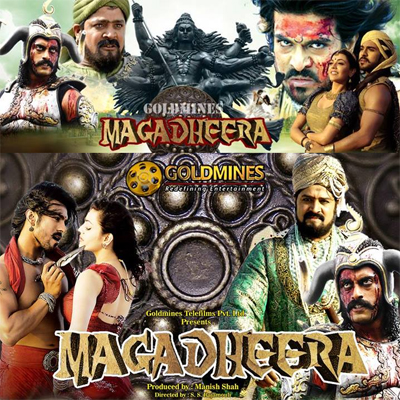
    Hindi movie channels are skewed towards male. Unless you have Chennai Express which is very universal. If I have to give you some south Indian parallel is Telugu film Magadheera. We promoted it as a proper Hindi film blockbuster. It gave me a rating of 2 in the first screening. That cuts through all TGs and massive special effects.

    International dubbed movies are not staple diet, but can be served as a surprise and can be a good break from the regular.

    MUSIC:

    We went and bought more music and put more variety than anybody else.  The other call we took was that whatever we do we should be musical. We will not have movies like some channels do. We will not have animated characters. Whatever we do will be music. We have got something like Solos. Singer comes and sings two lines.  These are things that we did and after digitisation we got shelf space. We saw 13 weeks in a row we were the number one channel. But for that we did a lot of sacrifice. We reduced advertising time. Against 30 minutes I was doing 15-20 minutes.

    We started with 12 million viewers and today we have 55 million viewers.

    Indian Premier League

    The second edition was done in South Africa, but at that time the scale at which IPL was hosted wasn’t as big as it is today. Everything today has changed. So the campaign has to be bigger.

    This season, if done outside India, will be very critical in terms of revenue as well. IPL for us is like a huge ‘Mela’. The ‘Mela’ gets prominence and written about because it happens in our city. If it happens outside India, it also impacts advertising, since the advertiser loses the buzz. It also has an impact on the rating. If IPL happens in South Africa, they will ensure that the match is aired in India at 8 pm. This time there will be only 60 games, because there is one team less.

    IPL Campaigns

    We need to up the entertainment quotient. There has to be a call of action. These two states always have to go hand in hand. It needs to be engaging, entertaining and fun-filled. It needs to be riveting; it needs to cut through different kinds of loops. Can’t be very male dominated, can’t be very male–centric, can’t be very female centric, can’t be very children centric. So, it’s a tough brief, not a very easy brief; because these guys are used to very focused briefs. I say, “this is my TG, these are the values of my brand, this is what it needs to be and these are the values that need to come through my communication. So, the consumer knows that I’m buying this for this.

    On Farah Khan

    Farah brought her own style and because of the fact that she’s a director and actor, made it easier for her to get into the zone of her character. She knew the tone and tenor of what we needed. She has changed the entire paradigm of the campaign. Then we roped in Vishal – Shekhar, who she is very close with. So it became a huge family gathering. We also got Rajeev Sethi, the director of Keroscene Films is also a childhood friend of ours.

    The 2014 campaign has no real people, they’re all models. Especially because our campaign is emotion based. One wrong reaction about what the character is feeling and the whole 30 second ad can go for a toss. That is why we spend a lot of time in casting. I personally am a stickler for casting!

    This year, we are doing five 30-40 seconders and one 60 seconder and again there will be an anthem that’s been composed again by Vishal Shekhar. We’ll also have an Extra Innings music video shot on that with the actors and the commentators. So, it all comes together as a package.

    So, this year we have the same girls and boys back for IPL.

  • Music genre to lose 15-20% inventory due to ad cap

    Music genre to lose 15-20% inventory due to ad cap

    MUMBAI: Sony MAX and Sony MIX executive vice president and business head Neeraj Vyas was the Guest Editor of the Day at Indiantelevision.com today. In his role as a journalist, Vyas interviewed Sony MIX’s senior VP sales Mayar Penkar on music broadcasting as a genre and its potential.


    Penkar feels the 12-minute per hour cap on advertisements would force music channels like 9XM and Masti to change their programming for the better.


    He says the music genre does not get what it deserves in terms of ad rates because of the way these channels have been positioned so far.


    Following are the excerpts from the interview:


    From the sales point of view, what do you think is the perception of the genre in the trade and what is the perception of MIX in the same subset?


    I completely believe that, music as a genre, and when I am saying music, I am talking about pure play music channels that are actually today looked upon as supplementaries or value addition to a media plan which is looking at Hindi speaking markets largely driven by the GEC (general entertainment channel) and Hindi movie channels. Today, it is being bought as a frequency buy. The reason for that are the broadcasters themselves for the way they have positioned the channel and the genre as more of a frequency buy channel and not as something which can actually deliver far more better results in audience targeting.


    How can music be the vehicle for better audience targeting?


    One of the biggest consumers of the music today is the youth. Be it on television, on mobile or any other digital platform and these are very important subset for most of the brands to actually be a part of the media plan or be a part of their marketing objectives. The broadcasters will actually have to make music channels far more relevant and important in the minds of clients than just the media sellers or media buyers. Till such time the client does not perceive music channels as a core genre for their media requirements or for their marketing requirements, they will continue to look the channel from a little downward point of view and not really from the mainland point of view. It will never be seen as the critical part of the media plan till such time the broadcasters take upon themselves to make it a relevant point with clients that this channel has lot of potential reaching out to the TG of 15-24 which is 60-70 per cent of today’s India youth.


    So what are you trying to say is that education has not happened. It is being treated like a commodity and sold like a commodity and hence the core values of the channel will never be exposed to the end buyer?


    Never! So coming back to MIX, the channel has made an effort to stand out in terms of its positioning, compared to what the other pure play music channels are. There is not so much differentiation that can be brought on to the content part. The role MIX has played by setting up the mood for the viewer with the segmentation of the music being played across the day has actually become far more acceptable to the viewer.


    Why is MIX perceived to be a favourite among the music fraternity?


    The kind of support MIX has got from the industry itself in terms of talent coming on to MIX and showcasing as to what their viewpoints on music are, has actually brought in a large amount of differentiation as far as MIX is concerned. Be it in terms of MIX voices, MIX Solos, MIX Gigs that we have done and TV’s first radio show. We brought radio live on television and I think that deserves a big applaud as far as MIX programming is concerned for having done something which is breakthrough in the space of music. Going forward things like this will only create that positive perception in the minds of clients that music can actually be looked upon as a proposition which is far more targeting and not anymore random and not just a commodity. So I guess MIX is playing that role, but is a fairly new channel in the space.


    Coming back to the critical reality of getting a fair share of revenues, do you think the genre per say gets its fair share of revenues?


    No product which is sold as a commodity will ever get its fair price. Today, my sense is that the entire genre is at least down by 50 per cent from the revenue point of view. The reason being, I think the way most of the broadcasters in the music space were operating was not very clear as to the setting up of the right benchmarks. Most importantly, in the pure play music channel, there were no strong networks involved in the business of pure play music.


    The first strongest network that was involved in pure play music was Sony and that was one of the last ones to enter. So when you look at channels like 9XM, 9X Jalwa, Masti or Mtunes, the whole survivor model for them is to actually somehow get the money. The survival model for them is to actually not look at creating brand assets or creating a proposition which can for a long term be monetised.


    What’s wrong in the music genre?


    When you have quarterly profitability into play, you have gone ahead and aired 30 minutes of the advertising time in an hour. In a scenario where you should have actually consolidated as a category and as a genre to help raise the benchmark of the music space, the sheer fear that you may lose out that little bit of revenue has prevented creation of a fair pricing model. It would have helped the category on the long-term basis and would have made the category even more stronger as far as revenue potentials are concerned.


    How will the 12-minute per hour ad cap impact?


    As far as MIX is concerned, we are clearly awaiting the ad-cap regulation to happen. Once that ad-cap regulation happens, there will be a level playing field. Also there would be approximately six and half to seven and half lakh seconds which will clearly get vanished from the current music genre space. Once the level playing field is set, the market will suddenly realise the importance of music space with close to 15-20 per cent of the inventory getting vanished overnight.


    People will start looking at this genre with a little more respect and I think that respect will come with a little bit of regulation and with a little bit of effort that each broadcaster will actually bring in to put on to the table when they are making their pricing models or pricing strategies.


    I guess this channel will move. The music category according to me is in the same phase as the Hindi movie channels were in 2002 — bought for frequency and not really for the content and the value that they want to bring on to the table. Hindi movie channels have actually moved a distance in the past 10 years. Music will move in a similar fashion.


    But provided every broadcaster chips in…?


    I don’t think there is a choice. Once they are down by 20-25 per cent of their inventory, nobody will have a choice but to actually re-look at their rates and by then if you have to go back to an advertiser asking for a rate hike, the first thing the advertiser will start looking at is the differentiation on the programming, content and quality of the channel if he has to start paying you a rate hike. Gone will be the days when broadcasters could accept commercials after commercials just because they could expand the time. So when the time restriction comes in, people will start looking at the product. I guess MIX in that point of time will be a clear winner as far as being looked upon as a much more valued product than just a commodity product.


    So giving these realities and given the fact that ad-cap is a likely reality for the entire genre, what do you think is the growth prospect?


    To look at it in a two-year horizon, the growth would be anywhere between 25-30 per cent. But if you look at it coming from the next fiscal which is going to be March- April next year, most of the people according to me are actually not ready for creating a strategy on how will they tackle the  rate growth. Reason being, most of these channels like 9XM or Masti used to enjoy clear dominance in terms of leadership 13 weeks prior to today. Even in a commodity model, they had established price points for themselves.


    For them after April, life will become a more real scenario where they are number two and three players by a distance, in the sense of 25-30 per cent distance, with number one being MIX. And then to work at price points which will be much higher than currently what they were operating with or what they were enjoying as leaders is going to be a difficult task.


    For them or for clients to start giving them higher rate hikes immediately, I don’t see that happening. We may see price point corrections happening but the category may just remain flat only because of lesser inventory and more or less securing the same level of revenue growth. But next year, this genre will actually become a very important channel. The genre will get its share price or share due in the next two years to come.

  • Chrome Data: Week 3 of nothingness

    Chrome Data: Week 3 of nothingness

    MUMBAI: It looks like that TV viewers are taking a break for a while. In the week three of opportunity to see (OTS) collated by Chrome Data Analytics & Media, no major changes were witnessed.


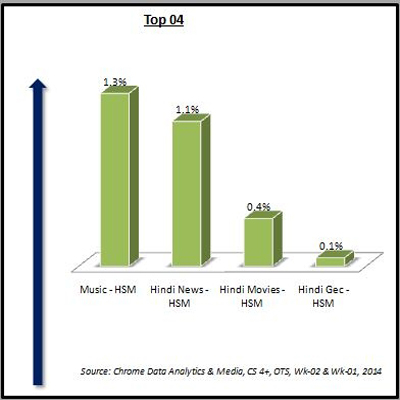
    As per the data provided by the media advisory consultancy, only music channels in the Hindi speaking market (HSM) saw a rise of 1.3 per cent. MTV took over Sony Mix with a small margin as it garnered 98.1 per cent OTS.


    Hindi News genre in the HSM continued to be where it was last week with Aaj Tak leading the way with 93.1 per cent OTS.


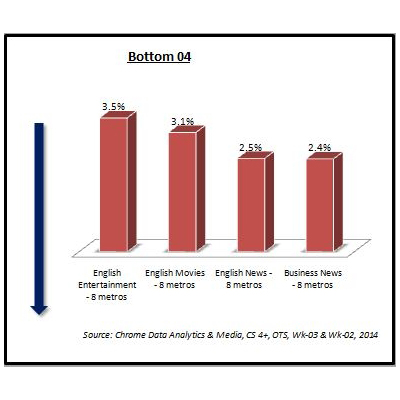
    As for the bottom four genres, English entertainment in the eight metros saw a fall of 3.5 per cent. However, AXN continued to rule with 76.6 per cent OTS.


    The genre was closely followed by English movie channels which fell by 3.1 per cent. In the eight metros, Pix remained on top with 88.1 per cent OTS.


    English and business new channels, both in the eight metro region, witnessed a drop of 2.5 per cent and 2.4 per cent respectively.


    Nevertheless, Times Now continued its winning streak with 88.1 per cent while CNBC Awaaz garnered 82.8 per cent OTS.

  • Music, Hindi news genre on top in OTS week 2

    Music, Hindi news genre on top in OTS week 2

    MUMBAI: It seems the New Year celebrations are not going to fade away so easily. The TV viewers gave thumbs up to the music channels as they claimed the first position in the week two of the opportunity to see (OTS) as per Chrome Data Analytics & Media. Either too many good songs were released that kept the adrenalin-pumping of the music lovers, or they couldn’t get enough of the older songs. The genre rose by 1.3 per cent with MTV toppling over Sony Mix to top the charts with 89 per cent OTS.


    In fact, the genres catering to the Hindi speaking market (HSM) were on a roll this week.


    Call it the AAP effect or something else; the Hindi news channels too turned tables. From being in the bottom four, last week, the genre in the HSM took the second place in the top four with 1.1 per cent. Aaj Tak remained the undisputed king of the genre as week after week it has topped the ranks. This week, the channel garnered 93.9 per cent OTS.


    Hindi movies too saw a marginal rise with 0.4 per cent in the HSM with Sony Max being the blockbuster with 96.5 per cent OTS. Hindi GECs also didn’t stay behind and rose 0.1 per cent with DD National showing who is the boss when it comes to entertaining with 97.6 per cent.


    As for the bottom four, English entertainment channels failed to impress its viewers even after launching new shows. The genre saw the maximum drop with 3.5 per cent in OTS with AXN continuing to rule the roost with 79.4 per cent OTS.


    English movies channels too didn’t do well. The genre saw a drop of 3.1 per cent with Pix again topping the charts with 86.1 per cent OTS in the eight metros.


    English news as well as Business news in the eight metros were in the bottom four by registering a drop of 2.5 per cent and 2.4 per cent OTS respectively.


    Arnab’sTimes Now, however, never fails to impress its viewers. This time too it topped the list in the genre with 91.2 per cent OTS. As for the business news, CNBC Awaaz garnered 85 per cent OTS to be ranked one in the genre.

  • Chrome Data: Week 1 meant business

    Chrome Data: Week 1 meant business

    MUMBAI: Money isn’t thought to be the biggest cause of worry for no reason. At least it seems so in this case. As the New Year ushered in, it was the news about money and the ups and downs that it saw in the last year that kept the TV viewers glued to their TV sets in the first week of the year. As various channels presented the yearly round-up, the business channels took away the largest share of audiences. The business channels topped the chart in the Week 1 of opportunity to see (OTS) as per Chrome Data Analytics & Media.


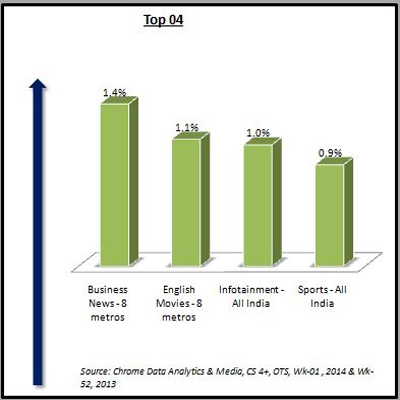
    The business channels across eight metros saw an increase of 1.4 per cent with the Hindi business channel, CNBC Awaaz, leading with 83.0 per cent OTS.


    And considering it was the holiday season, the second on the list were the English movie channels that fared really well in the eight metros. The genre saw a rise of 1.1 per cent. Pix reclaimed its first position, pushing behind Star Movies that had climbed to the first position in Week 52. The channel got 89.4 per cent OTS.


    Infotainment channels across India too saw an increase of 1 per cent with Discovery gaining 91.6 per cent. Sports channel claimed the fourth place in the OTS list with 0.9 per cent grow across India. Looks like the Ashes kept cricket fans occupied as Star Sports 1 was ahead of others in the genre with 77.9 per cent OTS.


    As for the bottom four, Hindi news channel in the Hindi speaking market (HSM) saw a fall of 1.4 per cent. Aaj Tak continued to be the popular one in the genre and garnered 94 per cent. English entertainment too didn’t get many viewers and fell by 0.9 per cent in the eight metros. Star World, however, toppled AXN which premiered the much-awaited season three of Sherlock. The channel from the Star bouquet scored 82.5 per cent OTS.


    In the HSM, music channels saw a slight dip of 0.1 per cent, whereas the religious channels didn’t see any change. Sony Mix with 89.2 per cent and Aastha channel with 98.3 per cent topped their respective genres.

  • Chrome Data: Religious channels lead the chart in week 52

    Chrome Data: Religious channels lead the chart in week 52

    MUMBAI: It’s ironical to note that in the week when everybody is up for some celebration – partying, enjoying and vacationing – the viewership of religious channels have increased. Is it that the elders at home have got an easy access to the channels they want to watch in the absence of the younger members of the family? Or, is it that people at large want to wash off their sins at the yearend by spending some time in spiritual viewing?

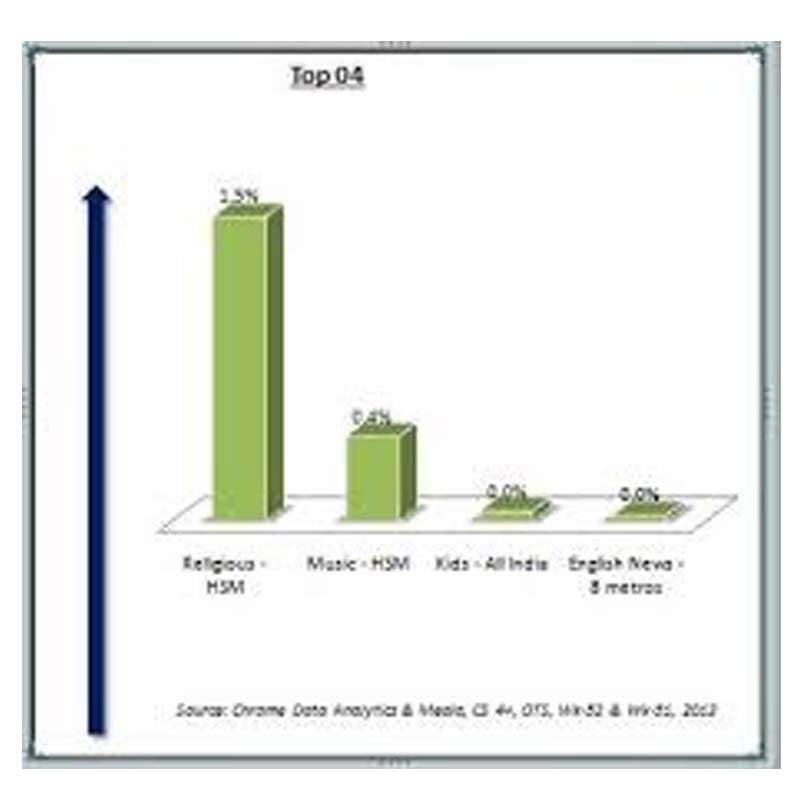
    Whatever the reasons may be, we are saying all this because in the week 52 of Chrome opportunity to see (OTS), the religious channels are leading the chart. The genre gained 1.5 per cent as per the data provided by Chrome Data Analytics & Media. Among all the religious channels, Aastha ruled with 98.3 per cent in the Hindi speaking markets (HSM).

    And not that the viewers just enjoyed the bhajans and spiritual lessons, they were in for some musical retreat as well. The music channels were at the second position in the week 52. The music genre in the HSM gained 0.5 per cent with Sony Mix ahead of other channels with 88.5 per cent OTS.

    The Kids genres across India and English news channels in the eight metros didn’t witness much change as compared to last week. However, the genres were in the top four. While Cartoon Network leads in the kids’ genre with 87.3 per cent, Times Now led in the news category with 90.4 per cent OTS.

    As for the bottom four, English entertainment channels saw a huge drop with 3.8 per cent in the eight metros. Star World overtook AXN to gain the first position with 81.1 per cent.

    The business channels couldn’t grab the viewers attention even after special line-ups featuring the high and low points of the year 2013. The genre in the eight metros saw 1.9 per cent drop with CNBC Awaaz leading the way with 83.8 per cent.

    English movie channels and Hindi news channels in the eight metros and HSM, respectively, saw a dip with former witnessing a drop by 0.6 per cent and latter by 0.4 per cent. Pix was at the top with 88.4 per cent, while Aaj Tak registered 94.6 per cent OTS.

  • MSM launches Sony Mix in US on Dish Network

    MSM launches Sony Mix in US on Dish Network

    MUMBAI: Sony Mix, Multi Screen Media‘s (MSM) Hindi music channel, has launched on leading US direct-broadcast satellite service provider, Dish Network.

    Moving into the gap created by erstwhile music channels rechristened as ‘youth channels‘ and other music channels dishing out non-music content as interstitial programming, the channel is confident that viewers shall enjoy Mix as a channel that remains true to the music genre.

    Mix also aims to maintain its focus on content by producing packaged shows offering right from user generated content to people profiles executed in the most unmistakably musical fashion.

    Says Sony Entertainment Television (SET) SVP International Business and Head of North America Jaideep Janakiram, “We are proud to announce the launch of our music channel – Mix on DISH Network for the discerning South Asian lovers of Hindi film music. We are confident that MIX will connect with every viewer with its variety of music and special programming. Mix is and shall stay true to music.”

    Dish Network Director of Programming Sruta Vootukuru states, “Sony Mix‘s unique theme-based music format helps Dish deliver a better experience to our customers. Adding the Sony MIX channel compliments Dish‘s robust international programming and enhances our South Asian offerings.”

    In a related development, SET has launched its flagship HIndi general entertainment channel Sony Entertainment on RCN, the all-Digital Cable, Internet & Phone provider in New York City effective 2 April.

    The channel is part of the brand-new RCN “Sona” tier, including other premium South Asian networks.

    “We‘re very excited to announce the launch of Sony Entertainment Television in New York City,” said RCN New York General Manager Bruce Abbott. “It falls perfectly in line with our goal to continually add more networks that provide maximum entertainment and value for our customers.”

    Adds Janakiram, “At Sony Entertainment Television, we continue to lead in ways to make our programming available to the widest possible audience. We are proud to announce the launch of SET Asia on RCN and are committed to bring our viewers the best family entertainment and Bollywood blockbusters.”

  • ‘Max will see 15-20% ad growth this year’ : Executive Vice-President and Business Head of Max and Sony Mix Neeraj Vyas

    ‘Max will see 15-20% ad growth this year’ : Executive Vice-President and Business Head of Max and Sony Mix Neeraj Vyas


    Neeraj Vyas, the Executive Vice-President and Business Head of Max and Sony Mix, is excited with the way the year went for Max, the Hindi movie channel from Multi Screen Media (MSM) stable.


    As the head of Max and Mix, Vyas has two challenges before him. The first is to take Max to the top position. The channel‘s strategy will be to acquire as many blockbuster movies as possible but at the same time remain judicious with the acquisition prices.


    The second challenge for Vyas is to grow Sony Mix, the music channel that was launched last year to widen the bouquet. The key for Mix, which operates in a tough genre, is to differentiate itself from other music channels through its programme offering while at the same time control costs to become viable.


    In an interview with Indiantelevision.com‘s Javed Farooqui and Urvi Malvania, Vyas shares his thoughts about the two channels and the way forward.


    Excerpts:


    Has the rise of Star Gold and the launch of its sibling channel affected the existing movie channels?
    Strictly from the ratings point of view, barring the first two months and post the IPL, it has been good for us. If you look at the ratings that were available three weeks back for the first 8-9 weeks, there is very little difference between the three of us – Star Gold, Zee Cinema, and Max. We have also had a successful movie acquisition year.


    How dependent is Max on big-ticket movie acquisitions as it has a premium positioning?
    Movie channels are completely driven by the library they have. Max has managed to have a premium image. It‘s completely by design and not by default because it‘s the way we want the channel and it‘s the way we present the channel. It‘s everything that you see on-air — the entire movie experience and our packaging. We want to set ourselves apart from others and hence did Extra Shots last year, a property where you get your trivia during the break and also put that into a half-an-hour show. This year we did something called Dirty Khabar.


    Does the premium positioning help Max get higher ad rates?
    It has helped us to extract premium from the advertisers. There are a lot of lifestyle brands, a lot of brands that are very conscious of the kind of environment they are seen in from an imagery point of view. If the advertisers have a choice between two or more channels, then Max will always be preferred.


    Did the ad slowdown have an impact on Max‘s revenues?
    There was no ad slowdown. In fact, we will see at least 15-20 per cent growth this year. The ad market for Hindi movie genre is a little under Rs 1,000 crore (Rs 10 billion).


    ‘The music genre accounts for about Rs 4 bn and is growing at 15% annually mainly due to new channel launches. We have set a 3- year period to break even‘

     
    What is driving this growth?
    There is money in the market, brands are being launched, and there are marketing activities. So there is no slowdown in my opinion. It (the slowdown) was a myth that was being created. At least till November or probably mid-December, we are tight on our inventory and are completely sold out.


    But there are broadcasters who have felt the pinch of ad slowdown?
    You tell me which broadcaster has slowed down in terms of content. Has anybody pulled back any shows? Despite no ratings, every GEC is going ahead with their biggest shows. There are two-three reality shows running on all the channels which are hugely expensive properties to produce. GECs are doing one-hour specials of their fiction shows and movie channels like us are marketing and putting more blockbusters on-air. Why would people do all these things if there was no money in the market? Give me a reason. I think the same people (who talk about a slowdown) need to answer this question.


    After a lull last year, has there been a spate of movie acquisitions this year?
    Yes, there was a lull. The way it (acquisition) works is if I have to acquire a film, I have to do it a good year-and-a-half before the film is released. If a producer doesn‘t get the price he wants, he waits for the box office performance of his film. Depending on the success or failure of the film, the price gets decided. The trend these days is strange as you have to acquire movies upfront. It sometimes works for you and sometimes it doesn‘t, so you have to be judicious.


    Has there been a price correction in acquiring movies?
    Unfortunately, what happens is that this industry is driven only by seven to eight stars. Unless we have more stars it will continue to be dominated by these 7-8 stars and it‘s essentially these men who lead the prices — the Khans, Akshay Kumar, Ajay Devgn and Ranbir Kapoor. If the price is going to be determined by these 7-8 stars, then their films will be sold at a premium.


    But a large number of movies go unsold?
    That is because the films of only these 7-8 guys get the ratings. For example, a film like Vicky Donor was liked by many but on television it won‘t get you a rating of even 1.5 TVR. Ratings for most GECs and time spent for channels like us come from the interiors of the country and the audience in the interiors is for films like Singham and Rowdy Rathore. That‘s the reality.


    Do you think acquiring movies on the basis of box office success is the criteria to follow?
    Honestly, that can be misleading. For example, Barfi is a brilliant film but put it on TV… probably it will get a rating of 2-3 TVR in the first airing, but it‘s not a movie that will get sustained ratings. Movie channels have a different model. When a film airs on television 10 times a year it has to give a certain yield and it has to give certain GRPs. As I said, the viewership comes from the interior.


    Zee walked out of the Barfi deal because at such high price point the monetisation becomes impossible. A correction is needed. It‘s a no-brainer. Zee‘s refusal to acquire Barfi rights was a step in the right direction. It also serves as a wake-up call for the producers or the corporates producing high-budget films. They have to get the pricing right irrespective of the box office collection because that is not connected to the success of the film on TV.


    Many networks have also experimented by premiering movies on GECs rather than the movie channel?
    That is a calculated gamble. Sometimes it pays off, sometimes it doesn‘t. It‘s a high-risk game because the price points of both the genres are hugely different. A GEC would trade at a certain level. Unfortunately movie channels have been under-priced since the beginning. By the time we start doing corrections, it is going to take time. The kind of money we recover on GECs will be far higher than on a movie channel. The yield is higher on GEC which is why we as an organisation have taken a decision to air certain movies like Paan Singh Tomar on Max but movies like Ek Tha Tiger and Rowdy Rathore will always be on Sony from a monetary point of view and its working for us. Once Sony has its one or two runs, it comes to Max and it really doesn‘t make a difference. What this does is safeguard our revenues and we manage our ratings better.


    How long does it take for a broadcaster to recover costs?
    For us it probably takes a little lesser time because we premiere on Sony. Our recovery is higher. It takes anywhere between two to three years to recover the costs. We acquire movies for a minimum of five years. We have a library of 800 movies and all of them are exclusive.


    Next year, IPL won‘t be there on Max since it will move to Sony Six. So what is your strategy going to be?
    We are a Hindi movie channel and we are happy that IPL is moving out. IPL moving out is a blessing for Max since we will get an opportunity to do a lot of things in the Bollywood space.


    Most Hindi movie channels also have dubbed content. How is it working?
    Almost 25-30 per cent of the content is dubbed and it is working. The prices of dubbed movies have also gone up although I can‘t give a number. The dubbed content adds variety to the channel. People in UP and MP don‘t know the actors but they love the action. Most of the South Indian films are in the realm of vendetta, revenge, high octane action, family values and so on. These are qualities that fit very well with the sensibilities of the heartland. Indian movies are Indian movies. People might look different but the basic ethos will always remain the same. The trend in Bollywood is that every big film that is going to come will be a remake of some or the other Southern language film. Everyone has acquired remake rights whether it is Salman Khan, Akshay Kumar or Aamir Khan.


    What implications will digitisation have on the genre?
    We are governed by the reality of libraries that we own. We will be able to run a large number of movies that we have not telecast. Hopefully, we will also get the opportunity to reach out to slightly more premium audiences. Also films like Silsila, Kabhi Kabhi, Rocket Singh and Saawariya which are rotting in our library will be able to see the light of the day.


    Coming to Sony Mix, how do you differentiate the channel from the other players in the genre?
    We decided to be a channel that is musical and understands the mood of the people. Our programming corresponds to the time of the day. So we have Surili Subah in the morning, Ishq Vishq in the afternoon, Mix Adda in the evening right up to Raina Beeti Jaaye, which is the slot for the retro songs. The promise of the channel is that we understand viewer‘s mood at different times of the day. We also went ahead and bought more music than anybody else simply because we wanted variety. So when other channels were playing the free plays and the new music launches, we went ahead and did deals with Yash Raj and Sony Music.


    What about your original content?
    We have a property called Mix Solos which has singers like Javed Ali, Roop Kumar Rathod and Shafqat Amanat Ali doing acoustic solos for the channel between songs. Then we have something called Mix Tippani where the channel suggests which song to listen to in which situation. We also have a show called Picture Abhi Baki hai. Here we take bytes from the actors, directors, music composers, singers etc — all with focus on the music and nothing else. It is like a sneak peak with focus on the music of the movie.


    These are the things that set us apart and we want to continue doing them. We want to do Harmony again which was on Sony 10 years back. We would love to revive that and have a show that has pure unplugged music. We also had a show “Yun Bana Yeh Song” with Swanand Kirkire where he explained how a song was made and took the viewers through the journey of the song. We have also brought back a lot of videos from the 90s that were huge back then. You see, you have to have a Mix of music for a music channel to be called a music channel.


    What is your primary TG? And what was your strategy when you launched Mix?
    Our primary TG is 15-24 age group, while our secondary TG is the 25-34 age group. We would never dilute our focus on the secondary TG. We firmly believe that you can‘t just cater to the youth which is why we have a Raina Beeti Jaaye at night. Music transcends age and we are going against the grain and not doing what everyone else is doing in the genre. Our belief is that it will pay off with digitisation and people wanting to make a choice.


    How tough is it to sustain a Hindi music channel?
    If you control your costs, then it is viable to have a music channel. But it is a tough game. We make use of our synergies with Sony Music and YRF. The challenge lies in how you programme your day as everyone has the same content in this genre. The brick of three songs before you go into an ad has to be so strong that it appeals to the audience.


    How is the revenue split between distribution and advertising?
    Distribution is negligible as a source of revenue right now. It‘s completely dependent on ad revenue. We have a wide range of advertisers come to us due to our programming. We have a broad base of viewers and though we are packaged as young and happy, our appeal is across age groups. You have to build the proposition based on the core values. The music genre accounts for about Rs 4 billion and is growing at 15 per cent annually mainly due to new channel launches. We have set a three-year period to break even.