Tag: Sonia Gandhi

  • NDTV announces Indian of the Year Awards

    NDTV announces Indian of the Year Awards

    MUMBAI: It’s that time of the year again when we salute the ambassadors of brand India. 2013 has been an important year in the history of India. From instances of individual brilliance to examples of nation building, this year has given rise to a set of Indians, who are not afraid to wear their Indian identity on their sleeve. To honour the contribution of these role models, NDTV is back with the seventh edition of the prestigious Indian of the Year award in association with LIC.


    One of the biggest and most credible awards in the country, the NDTV Indian of the Year 2013 will recognize the Indians whose contribution to the country have strengthened the foundation of our society and helped build Brand India. These iconic Indians will be honoured at a glittering ceremony in New Delhi on April 29, 2014 at the Taj Palace Hotel. They will be chosen from four categories: Sports, Entertainment, Business and Public Service.


    Announcing the 7th edition of the awards, Vikram Chandra, Group CEO, NDTV said, “We take immense pride in presenting the 7th edition of Indian of the Year awards. The awards recognize the contribution of individuals, who through their determination and fortitude continue to take the nation forward. We are privileged to honour this year’s winners with these awards.”


    Over the years, the recipients of these prestigious awards have included Ratan Tata, Sonia Gandhi, Justice J.S Verma, Anna Hazare, Late Pandit Ravi Shankar, N Chandrashekaran, Sachin Tendulkar, heroes of the Mumbai terrorist attacks and many more.

  • CNN-IBN & IBN7 are back with Kings & Queens

    CNN-IBN & IBN7 are back with Kings & Queens

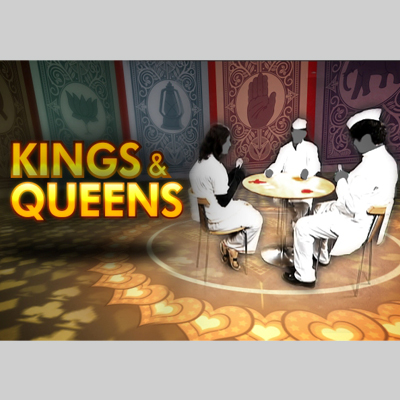
    MUMBAI: Living up to its legacy of offering the most extensive and diverse election programming line-up in the industry, CNN-IBN & IBN7 are back with ‘Kings & Queens’. The show will profile key political leaders such as Narendra Modi, Arvind Kejriwal, Sonia Gandhi, Rahul Gandhi to name a few, who are likely to play a central and defining role in the 2014 General Elections.

    Fronted by IBN Network’s senior-most and best known anchors-Deputy Editor Sagarika Ghose, National Bureau Chief Bhupendra Chaubey, Deputy Foreign Editor Suhasini Haidar and Senior Editor Anubha Bhosle, ‘Kings & Queens’ will examine the life and political careers of these key individuals, and will examine how they could emerge as a King or a Queen or be a King-maker. The documentaries will include people who are significant in their lives-their classmates, close relatives, mentors, friends, strongest allies as well as critics.

    Rajdeep Sardesai, Editor-in-Chief, CNN-IBN, IBN7 & IBN-Lokmat, said, “As we approach the most crucial elections in the history of India, we have a diverse and extensive election based programming in the pipeline. To help our viewers know their leaders better, we bring to you our much acclaimed documentary series Kings and Queens, which will trace the journey of political leaders who are set to influence the upcoming General Election significantly.”

    Don’t miss this special documentary series starting from 28th February, every Friday 10.00 PM only on CNN-IBN & 1st March onwards every Saturday 10.30 PM only on IBN7.

  • INC’s revamped website is all about Rahul Gandhi

    INC’s revamped website is all about Rahul Gandhi

    MUMBAI: Soon after Prime Minister Manmohan Singh’s announcement that he isn’t in the race for the 2014 Lok Sabha election, the Congress party seems to be going for an overhaul. Reportedly, the national party has brought on board Dentsu India, the Japanese advertising and public relations company (along with JWT) that will be working on a massive campaign around the party’s vice-president Rahul Gandhi.


    However, Dentsu isn’t talking about the association as of yet. “No comments on Congress,” is what Dentsu India executive chairman Rohit Ohri who is holidaying in Koh Samui, Thailand said.


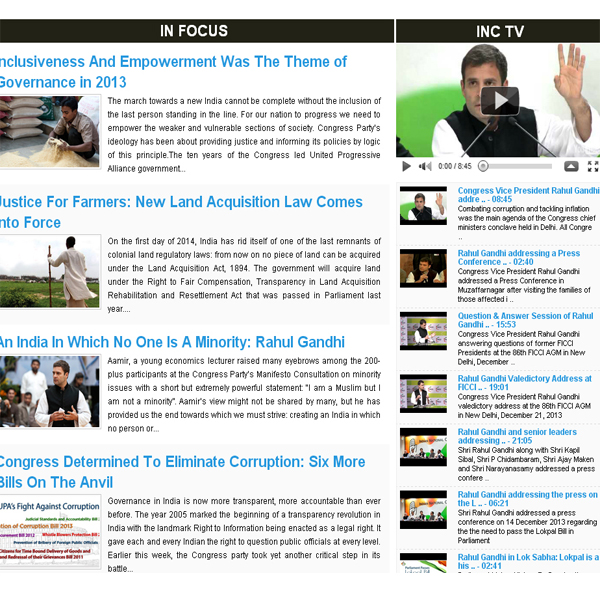
    But the idea is to build up the image of Gandhi before the election. And it seems the process has already begun. The homepage of the website of Indian National Congress shows Rahul Gandhi in the most positive light. The side panel on the website has stories just of Rahul Gandhi addressing people at different times. All his speeches that have made news till now also feature in the panel.


    Few of the highlights are: “An India In Which No One Is A Minority: Rahul Gandhi”; a video of Rahul Gandhi talking to the media in Delhi about combating corruption and tackling inflation; and also a report published in The Telegraph that talks about Rahul Gandhi already taking over the charge of the Indian National Congress. It says, “The new website the Congress launched a few days ago reflects the changes in the party, both in its content and approach, and provides evidence of Rahul Gandhi’s supremacy despite Sonia Gandhi still heading the hierarchy.”


    Besides, the Gandhi scion is the most highlighted person on the site’s homepage. The mention of everyone else who have contributed to the development of the Party is in different sections of the site.


    So, is it a beginning of announcing him as a PM candidate?

  • Spirit of inquiry amongst media must not morph into a campaign of calumny, cautions PM

    Spirit of inquiry amongst media must not morph into a campaign of calumny, cautions PM

    NEW DELHI: Prime Minister Manmohan Singh on Saturday called for caution as mediapersons executing their responsibilities in a vibrant democracy which revels in free enquiry and quest for answers.


    He said the media industry had a special role in assessing, tackling and overcoming the challenges that two decades of socio-economic change have brought about. “But a spirit of inquiry must not morph into a campaign of calumny. A witch-hunt is no substitute for investigative journalism. And personal prejudices must not replace the public good.”


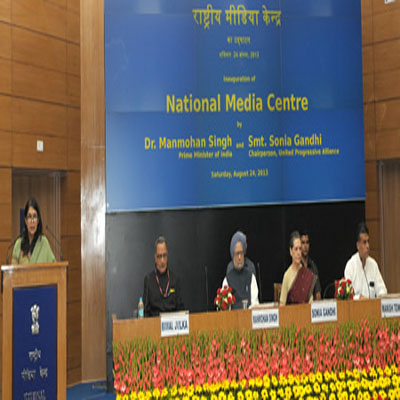
    Dr Singh was speaking after he and UPA Chairperson Sonia Gandhi inaugurated the National Media Centre in the capital this morning. Information and Broadcasting Minister Manish Tewari, I&B Secretary Bimal Julka, and Press Information Bureau Principal Director General Neelam Kapoor were also present.


    Singh said “It is a reality that journalism cannot be divorced from the business of which it is a part. The responsibilities of a media organization are not limited to the viewers and readers alone. The companies also have an obligation to their investors and shareholders. The tussle between bottom-lines and headlines is a fact of life for them. But this should not result in a situation where media organizations lose sight of their primary directive, which is to hold up a mirror to society and help provide a corrective. ”


    He said “This Centre showcases our ability to keep pace with similar state-of-the-art facilities across the world. It symbolizes the vibrant mood of the existing media landscape in our country. As a ‘Communication Hub’ and a ‘Single Window’ facility, I am sure it will fulfill the needs and requirements of our media fraternity, many of whom are present here today.”


    In her address, Gandhi said “The government and the media have the shared interest in disseminating programmes, policies, decisions and information. This is where an institution such as the National Press Centre assumes importance. I hope that it will represent a partnership in which both sides will be able to discharge their designated responsibilities.”  


    “In any society undergoing dramatic and rapid transformation there is constant need to renew and rebuild. This facility represents that evolution. I hope very much that it will become an effective nerve centre and a duct and an information bridge between the Government, the Media and the People,” she added.


    “I want to be quite clear we don’t favor propaganda or publicity campaign simply in order to score points for the government, but the people have a right to know their legal and other entitlements. They have a right to information. They have a right to be able to make informed decisions. Only an aware and conscious citizenry can be expected to make this system work well and hold governments and political parties to account.”


    Referring to the National Media Centre, Gandhi said “This beautiful building is not just brick and mortar. It is up to you media professionals, officials of Information and Broadcasting Ministry and others who will inhabit it to infuse life into it by making it an instrument to serve the people and empower them.”


    The Centre at 7E Raisina Marg in the proximity of Shastri Bhavan which presently houses the Press Information Bureau was inaugurated 21 years after it was first conceptualized during the 8th five year plan (1992-97).


    Tewari said: “We live in an era of an information overload. The media landscape has transformed exponentially over the past two decades. This transformation has brought its own set of challenges to the media industry. India today mirrors the world in global cross media consumption patterns.”


    He said a ‘very unfortunate collateral of this epoch making change’ is the print industry globally. It was distressing to learn that iconic newspapers and magazines around the world were ceasing to print. However, India appeared to have changed this trend. The Indian newspaper market will be the only one to grow at a double-digit CAGR [Compounded Annual Growth Rate] of 10 per cent and would emerge as the world’s sixth-largest newspaper market by 2017 as per industry reports on media and entertainment. The regional and vernacular print sector is growing on the back of rising literacy and low print media penetration as well as the heightened interest of advertisers wanting to leverage these markets.


    Tewari said according to industry sources, print has a combined market penetration of a ball park of 14 per cent. Thus, the print industry has the potential to expand its footprint and readership across the national canvas. This sector thus would be able to weather the shifting sands of technology at least in the Indian context.


    The Indian broadcasting sector had grown from one channel in 1991 to 852 at the last count.  After statutory rationalization the number now stood at 795 odd channels, he added. While this had brought about plurality, it had resulted in market fragmentation as well.


    “There are 15.4 crore TV households in India. Unfortunately the news and current affairs genre makes up only seven per cent of the total television viewership, according to TAM CS4+ all India weekly average for 2012. The remaining 93 per cent of this universe is occupied by general entrainment channels despite there being 395 odd news and current affairs channels.


    He said this generated hope that there is an exponential potential for growth, provided the news broadcasters and Multi System Operators (MSO’s) are prepared to re-imagine their content and carriage paradigms respectively.


    In both the print and television genres, he said the revenue model remains heavily dependent on advertising. As the advertisement cap requires a migration path synchronous with the roll out of digitization For the news broadcasting industry, Tewari hoped that the Telecom Regulatory Authority of India would re-consider its deadline.


    To give consumers the benefit of better quality of service and correct the skewed revenue models in the broadcasting sector government launched a massive digitization exercise in 2012.  With 10 million set top boxes seeded in Phase–I, another 20 million in Phase–II and yet another 80 million scheduled for Phase–III & IV, by the end of 2014 no one in the Broadcasting Sector can really say that bottom-lines and balance sheets in August 2013 are not looking better than in October, 2012.  


    The MSME sector must also endeavour to leverage this unique business opportunity and convert it into the India digitization story even in manufacturing terms.  


    India had 86.7 crore mobile phones, 12.4 crore Internet users with an expected growth up to 37 crore by 2017, eight crore people on Facebook and 1.8 crore on Twitter.


    The government had recently taken a decision to create a New Media Wing in the Ministry to have an institutional presence in this virtual civilization.


    He said the radio, till a decade back considered, was a casualty of the tectonic technological shifts but now stood poised on the threshold of a new wave. High mobile penetration and cheap call rates in our country had brought this renaissance into replay.


    The film industry had completed a century of existence. This industry had grown but still had tremendous potential. As per an industry estimate, about 14 million Indians go to the movies everyday. As per another report, the film industry is valued at Rs 112.4 billion [$1.741 billion], and is estimated to grow to about Rs 193.3 billion [$2.994 billion] by 2017, a compound annual growth rate (C.A.G.R.) of about 11.5 per cent. The regional film industry is a steady contributor to this growth process.


    The media sector had grown by a CAGR of over nine per cent between 2007-2012 and was projected to grow at 15 per cent between 2012 and 2017, Tewari added.


    But there were some paradoxes that all stakeholders in this sector must try and collectively resolve to find the elusive golden mean. These included flawed Revenue Models qua Questionable Revenue Generation practices; TRPs qua truth; Media Trials qua a Fair Judicial Trail guaranteed by article 21 of the Constitution; and anonymity masquerading as privacy in the new media space – the spectre of the ‘hidden’ people, apart from Last mile neutrality among carriage providers so that content providers get a level playing field and are able to reap the benefits of convergence.


    The National Media Centre (NMC) was initially conceptualized by the Press Information Bureau in 1989 to facilitate greater interaction between the Government and the media with a state-of- the-art equipped media centre. The Centre has been planned on the model of media centres in some of the capitals of the world such as Washington and Tokyo. It will have offices of the PIB as well as special facilities for the media to enable the Government to interact closely with the media.


    The Centre has a Press Conference Hall for 283 media persons, a briefing room for about 60 persons, 24 Work stations for the media, a library, media lounge and cafeteria. The press conference hall and media lounge are Wi-Fi enabled.


    Major Highlights:

    World Class Media Center, Ground + 4 Floors + 2 basements, Press Conference Hall with seating capacity for 283 persons, Media Lounge – Work area facilities for media personnel, Committee Room with video conferencing facilities, Library, Cafeteria, IT and AV Infrastructure in NMC.


    Facilities provided:

    Optic fibre internet backbone with redundancy, Mini Data Centre for application development and hosting, Webcast, including live webcast, Video feed to TV channels outside the building, Network with redundancy and expandability to 500 nodes, IT facilities to media persons in work area/Lounge, Internet Telephony, AV Video Wall.·        


    The NMC has been constructed by the National Buildings Construction Corporation (NBCC) over a period of three years with a total covered area of 13867 sq m. The plot size is 7787.46 sq m (1.95 acres).

  • Jagmohan Mundhra passes away

    Jagmohan Mundhra passes away

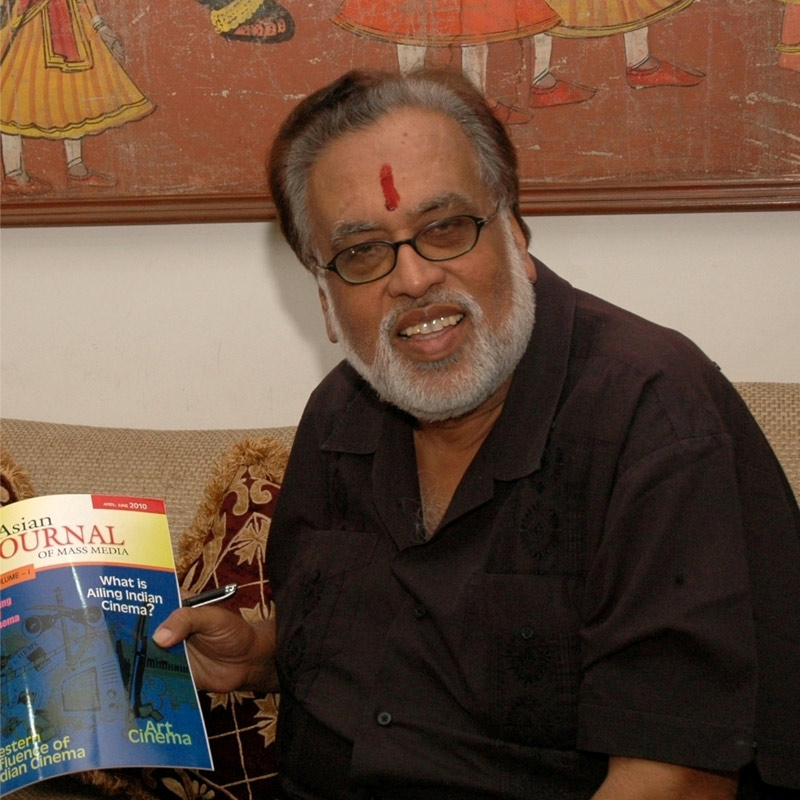
    MUMBAI: Film director Jagmohan Mundhra passed away in Mumbai on Sunday.

    The 62-year-old died of peptic ulcer and was in the hospital for the last couple of days.

    Mundhra was known for issue-oriented films like Bawandar and the Aishwarya Rai Bachchan-starrer Provoked.

    Born in 1948 in a conservative Marwadi family, Mundhra studied engineering at IIT Mumbai and then moved to the US to do his M.Sc. But his ultimate calling was filmmaking. In 1982, he made Suraag with Sanjeev Kumar and Shabana Azmi in lead roles. This was followed up Kamla, a women-centric film which had Shabana Azmi and Deepti Naval.

    A regular at FICCI, Mundhra was immensely interested in different aspects of the current-day filmmaking.

    His last directorial venture was Naughty@40. He was preparing to shoot a satire, Kissa Kutte Ka. He was very keen to make a film on Congress president Sonia Gandhi.

  • I&B MoS Ambareesh quits over Cauvery award

    I&B MoS Ambareesh quits over Cauvery award

    NEW DELHI: Renowned Kannada actor-turned-politician MH Ambareesh has quit as the minister of state for information and broadcasting and also his seat in the Lok Sabha protesting that the Cauvery Water Disputes Tribunal had been ”unfair” to Karnataka in its final verdict.

    Ambareesh announced in Bangalore yesterday that he had sent his resignation both to Lok Sabha Speaker Somnath Chatterjee as well as Prime Minister Dr Manmohan Singh, and also sent a copy to Congress president Sonia Gandhi.

    However, his resignation was rejected Chatterjee on technical grounds. The Speaker’s office contended that Ambareesh had faxed the resignation, which was not the acceptable method of putting in papers, even as his fans also urged him to withdraw the resignation.

    Ambareesh announced the resignation following pressure by people in his constituency Mandya when he was gheraoed by lawyers when he came to participate in a function in the Karnataka High Court here to release a special cover and cancellation of the Postal department to commemorate the golden jubilee of the High Court.

    Holding that the Tribunal had caused “injustice” to the southern state, he complimented the lawyers for taking up the cause of the state. Congress circles in the state were caught complete unawares by his move.

    Karnataka had been witnessing widespread protests after the 5 February Tribunal award, which directed Karnataka to release 192 tmc ft of water to Tamil Nadu, pegging the state’s requirement at 270 tmc ft as against 419 tmc ft of the lower riparian state.

    The star, who was elected from the Mandya Lok Sabha constituency for a third time in 2004, had led a procession of cine artistes against the award in the city yesterday.

    Meanwhile, G Made Gowda, president of the Cauvery Hitarakshana Horata Samiti, which is spearheading the agitation on the water sharing issue, termed the resignation of Ambareesh as a hasty decision and said the star should continue as a minister and fight for the water rights of the state.

  • SC stays Assam order cancelling NE TV accreditation for National Games

    SC stays Assam order cancelling NE TV accreditation for National Games

    NEW DELHI: The Supreme Court today stayed the order of the Assam Government cancelling the accreditation cards of North-East Television, thereby preventing it from covering the 33rd National Games starting today in Guwahati.

    A bench comprising Justices KG Balakrishnan and PK Jain stayed the operation of the impugned order dated 6 February, thereby permitting the petitioner television channel to cover the National Games, inaugurated by Congress President Sonia Gandhi this afternoon.

    Senior Counsel Harish Salve, appearing for the petitioner, alleged the order has been passed as the channel has exposed the killing of innocent persons by militant organisations like the United Liberation Front of Assom and others in various places of the North-East and said the state government’s action amounted to violation of freedom of speech.

    The television network, which telecasts in eight languages spoken in all the states of the Northeast, said the NE TV has always highlighted issues related to national security and sovereignty.