Tag: social media

  • Omron partners with Bhaag Milkha Bhaag, launches campaign for brand awareness

    Omron partners with Bhaag Milkha Bhaag, launches campaign for brand awareness

    NEW DELHI: Omron has associated with Bhaag Milkha Bhaag as the technology partner and promote the partnership via TV commercials, social media platforms and online portals.

    Farhan Akhtar as the brand ambassador of Omron has been endorsing the brand for the last two years and the association with his movie is an effort to broaden the ways to accentuate brand awareness by further utilising the rapport shared by him with the Indian audience at large.

    The movie, based on the life of the legendary athlete Milkha Singh, talks about challenging spirit, perseverance and inspiration which has a huge connect with Omron‘s legacy, philosophy and vision.

    Just as Milkha inspired the future generations by becoming the first athlete to represent India in Olympics with grit and conviction, Omron also has been introducing many first of its kind technology- based solutions touching and inspiring millions of lives in healthcare and industrial automation domains.

  • Tips Music crosses 2 million fans mark on Facebook

    Tips Music crosses 2 million fans mark on Facebook

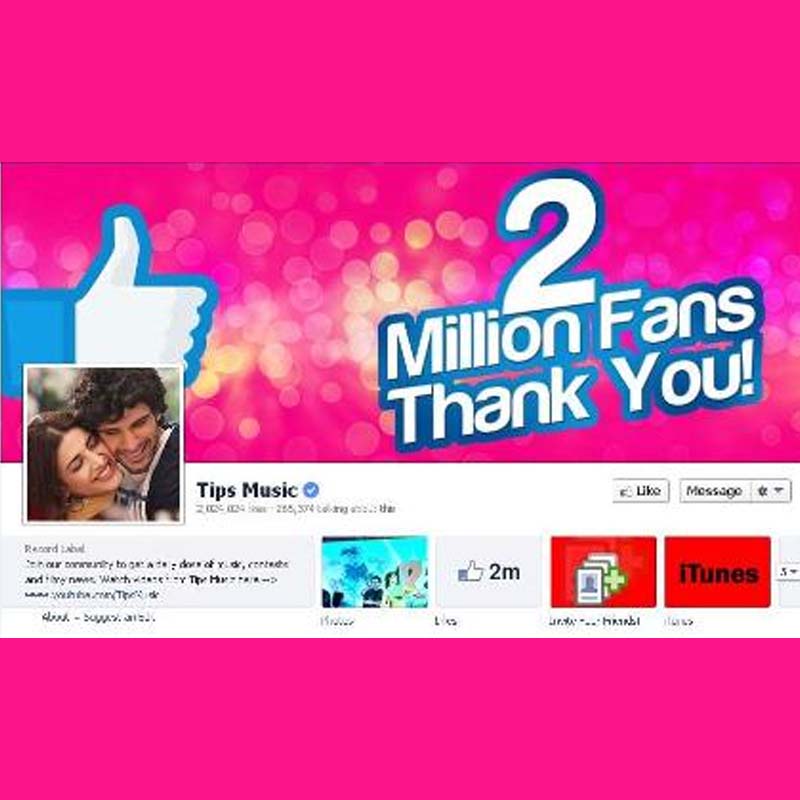
    MUMBAI: Tips Music has become one of the largest entertainment brands on Facebook in India. The company‘s Facebook community crossed 2 million fans and has reported to have one of the highest engagement rates on the social network.

    Tips was one of the last to join the social media bandwagon but has surpassed their competitors in a short span of two years. The company has the largest fan following on Facebook, not only amongst the music companies, but also in the film production companies in India.

    “We‘re very excited to cross this milestone on Facebook, we appreciate all the support our fans have given us in the last few years. Our company mission has always been to give the audience quality music and films and we‘re happy to be spreading this to the digital platform. I‘m personally very active on various social mediums and enjoy having conversations with people on Facebook and Twitter,” informs Tips Industries Limited managing director Kumar Taurani.

    Tips Music, unlike its competitors, broke the trend of depending only on new music to grow their community and leveraged their rich 90s music catalogue to engage with fans. “When we started our Facebook initiative, every expert we met told us the page would only grow during the time of a new soundtrack release. The problem was, at the time we only had one film up for release and a gap of a year till the next,” says Taurani.

    Tips which has a catalogue of 25,000+ tracks, did not want to limit their Facebook promotions to 10-15 recent songs. “We developed a unique strategy where the main focus was to refresh people‘s memory with the music from our 90s catalogue while introducing the youth to classic songs they may have never heard,” says Tips Industries Limited senior VP and business head Sahas Malhotra.

    The company also started sharing its content from films like Khal Nayak, Rangeela, Imtihaan, Phool Aur Kaante and Raja Hindustani. “Our initial interaction with people was very low. This forced us to question our decision. Though music from the 60s, 70s and 80s are considered evergreen and retro cool from a young person‘s perspective, the 90s did not yet have a label.”

    Tips then started receiving messages from their fans thanking them for sharing a song they had heard 15 years ago. “People now knew where they could get the hit songs of the 90s. Our fans on Facebook then started sending pictures of a cassette, asking if the title was available digitally. This forced us to dig deeper into our catalogue and churn out compilations with songs we didn‘t even think would be popular in this day and age. We were pleasantly surprised to see the overwhelming response from the youth and it‘s a great sign to see them consuming hits from the 90s.”

    Prabhudheva‘s Ramaiya Vastavaiya starring Girish Kumar and Shruti Haasan releasing 19 July, Rajkumar Santoshi‘s Phata Poster Nikhla Hero starring Shahid Kapoor and Ileana D‘Cruz on 20 September and ‘It‘s Entertainment‘ starring Akshay Kumar and Tamannah Bhatia directed by renowned screenplay writers Sajid-Farhad releasing 28 March 2014 are the forthcoming movies of Tips Music. 

  • Banking on social media

    Banking on social media

    MUMBAI: Given the customer centric nature of banking, financial services and insurance (BFSI) business, it is evident that banks need to constantly engage with their customers. And what better platform than using the digital medium that gives them the scope to interact with their customers on a regular basis.

    It is no surprise to see the banking sector using popular outlets such as Facebook, Twitter, Pinterest, and YouTube to connect with their customers and attract new ones.
    Here‘s how two BFSI entities – SBI Life Insurance and HDFC Bank use social media

    “The digital platform is an opportunity for us. However, to unlock its potential to the maximum, it makes sense to view the possibilities holistically, rather than confining it to merely a function or limiting the scope to a single dimension. We use the digital space for customer acquisition, brand building, service and distribution,” says SBI Life Insurance vice president and head-brand corporate communication and cross sell Chandramohan Mehra.

    SBI Life Insurance which initially followed a strategy of having differentiated content on Facebook and Twitter, now with its increasing fan base is transforming it into a holistic channel. “We are now stretching the scope of social media presence to promote and facilitate online product purchase, customer education and employee and distributor recruitment,” informs Mehra.

    SBI Life is the only life insurance company to have a website in nine Indian languages. “This enables customers to understand our products and services in language they are most comfortable with, before taking a well-informed decision,” he adds. And the company is using its social media presence to draw in potential and existing customers to its own website to keep them informed about developments, products and offerings.

    The insurance company is involved in creating video content in the area of customer education and services, specifically for online visitors. “We have developed apps and games including a virtual life insurance crossword, contests on facebook, e-life insurance dictionary and tax calculator. With increasing penetration of smart phones, we have intensified our efforts on developing apps that will be relevant to both internal and external audiences,” reveals Mehra.

    The use of digital media has helped companies to collect sizable amount of data about the customer‘s needs. The challenge, however, is to make sense of it. “Based on web analytics, integrated with social customer relationship management, one of the possibilities that exists is reaching out to the relevant audience, with targeted message at the right place and time,” Mehra opines.

    SBI Life Insurance creates content for YouTube which caters to varied audiences. “While prospective customers are served through viral ads and educational videos, for existing customers we have service related videos. We engage our employees and potential agents through testimonial videos and the general public through content pertaining to awards and recent recognitions bagged by SBI Life,” informs Mehra. SBI Life Insurance, which currently has 626,272 likes (at the time of writing) on its Facebook page, feels the fans on Facebook are irrelevant if it doesn‘t engage them.

    Engagement score is one of the key metrics we closely follow and we have one of the best engagement scores in the BFSI,” says Mehra. The insurance company has launched many exciting online campaigns. “In light of the Uttarakhand tragic event, we have started speedy claim assistance on our Facebook page. This is one of our initiatives through which we are trying to reach out to our existing customers,” he informs.

    HDFC Bank also engages its customers across social media platforms including Facebook, Twitter, You Tube, Linkedin, Google Plus, Pinterest and Foursquare. “We use updates, offers, financial awareness tips and monthly contests and applications to interact with customers on regular basis,” says a senior official from HDFC Bank. HDFC Bank currently has over 1.5 million fans on Facebook and a total of over 15,000 followers on Twitter handles.

    HDFC Bank gives financial awareness tips and hosts monthly contests to interact with customers

    “Given the customer centric nature of business, we have to ensure that we are present where our customers are and they are present on social media, voicing their views, opinions and engaging with others,” he adds. The bank posts a variety of content on various digital platforms including financial trivia, quizzes, opinion polls, offers on credit and debit cards, bank news, information about their products and services and comments around personal finance, etc.

    “Impressions are generated when viewers see and react to these posts. Updates are created specific to the kind of platform being used for communication,” reveals the senior official.

    “We use digital media to monitor customer feedback, address customer queries/complaints, communicate our products and services and derive insights on them from customers, educate customers, increase financial awareness and also do location based targeting of offers,” he adds.

    HDFC Bank, through its various social networking platforms tracks, identifies and responds to various issues highlighted by customers online. “We are one of the few banks in India which allows users to post on our Facebook page and have been recognised as the most responsive brand on Facebook in India,” he informs.

    The bank has tailored its digital content to help customers learn about their products (including offers and deals), knowledge on managing their finances and gain insights on the economy and finance.

    The digital bug has crawled into the banking sector. With the changing financial paradigm, banks have found an easy way to stay connected to its customers.

  • Colors’ gung-ho digital strategy

    Colors’ gung-ho digital strategy

    Send in your tweets to @ColorsTV, be a part of a Facebook contest, stand a chance to win an iPad, tweet away your views with #Jhalak..#Madhubala. Watch Colors live, maximum You Tube hits. #ThisIsTHEchannel WithanAdmirableOnlineStrategy.

    Well, the crux of this story is just that. Colors, Viacom18‘s maiden Hindi general entertainment channel (GEC), which has carved a commendable place for itself in a very short span of time, is a channel with a massive digital presence. Hence, taking our digital series forward (read the previous stories on Sony and Star Plushere), we take you through this interactive journey of the very dynamic Colors, presenting awe inducing figures, highlighting the ever increasing online fan communities and much more…

    The official Facebook page of Colors has an overwhelming 1.88 million likes with more than 100,000 active fans. While the channel keeps its official page up-to-date with galleries and snippets of upcoming episodes, it also links the platform to the official pages of its various shows. The official page of its popular fiction dailies likeMadhubala: Ek Ishq Ek Junoon and Balika Vadhu have garnered 0.48 million and 0.43 million likes respectively. Among non-fiction shows, Bigg Boss Season 6‘s official page boasts of 0.16 million likes, whereas, the recently launched Season 6 of popular celebrity dance reality show Jhalak Dikhhla Jaa has already garnered 0.1 million likes.

    Colors contstantly updates its Facebook profile for its 1.88 million plus fans with teasers, pictures and snippets

    Apart from the official pages, Colors has gained immense popularity through the numerous fan driven pages of its hot-selling properties. The upcoming season of Bigg Boss already has a fan page featuring more than 22,000 likes, while the previous season‘s fan page figures around 0.29 million likes. But the show which seems to have broken all records is the very popular Vivian Dsena – Drashti Dhami starrer Madhubala-Ek Ishq Ek Junoon, produced by Nautanki Films. The love-hate relationship of the lead protagonist has definitely captured the imagination of the TV viewing audience. There are more than 100 Facebook Fan pages dedicated to the show with some registering more than 60,000 likes. Well, if that‘s not impressive, what will be?

    In a world where news is being replaced by a tweet of 140 characters, soap plots are tweaked according to fan tweets. Twitter enables instant reactions and feedback and Colors makes the most of this platform. With more than 81,000 followers and around 16,000 tweets, the official twitter handle of the channel (@ColorsTV) is a buzzing place. Every few minutes, the handle buzzes with tweets and re-tweets. Every couple of days, the channel also launches interactive contests to engage with its fans. Recently, @ColorsTV awarded an iPad among other goodies to winners of the #Jhalak contest. The success of the Twitter launch of Jhalak Dikhhla Jaa can be gauged from the fact that the official hash-tag was trending all over India for nearly three consecutive days and also in UK and US for some time.

    It takes a person like Vivek to spearhead the digital revolution at Colors

    Colors Digital Head Vivek Srivastava asserts: "Our effort on social media is to start and manage conversations and we have some very good brands on both fiction and non-fiction which help our cause. Just to give you an example Colors properties trended 51 times at all India level in the last financial year."

    For a general entertainment channel, the video uploads drive maximum traffic and for the same purpose, Colors launched its official YouTube channel in June 2008 and has since uploaded around 18,300 videos. The YouTube channel has 0.2 million loyal subscribers and a magnanimous count of around 149 million video views so far.

    On an average, every Colors upload garners more than 20,000 video views within a couple of days. Here as well, popular properties like MadhubalaBalika VadhuJhalak and Bigg Bossgarner average views as high as 85,000, 40,000, 50,000 and 45,000 respectively. The wedding special episodes of Madhubalaalso recorded views as high as 0.16 million. Besides, the much promoted grand premiere of Jhalak was uploaded in 33 videos, each video garnering thousands of video views.

    Srivastava informs: "The episodes are uploaded within a couple of hours of the show going on-air, however we create specific content for the internet and mobile which goes beyond catch-up for episode. This is primarily aimed at engagement, if there is a Colors fan intending to know more, discuss or comment on our shows, we have to facilitate it."

    The mainstay platform of Colors has web exclusive content, photo galleries, polls and much more

    Such a comprehensive digital presence is further topped by the official website of Colors- www.colors.in.com. This is the mainstay platform of the channel as it aims to use all its other platforms to drive traffic towards the website. It is the hub of all online activities for the channel with web exclusive content created especially for it along with live streaming, picture gallery and video uploads, trends and show trivia. What more, the channel has been successful in generating 100 million page views last year. "We have a very strong offering in colors.in.com a website which goes beyond just catch-up TV. There is news, videos, behind the scene, interviews, discussions, special content, live streaming and much more; the effort is to feed an ardent Colors fan with as much information as possible," Srivastava elaborates.

    The question which hits our mind is whether the website delivers on the huge investment? Srivastava is very clear in his answer: "Yes, we are investing in it heavily. For a content heavy platform like Colors where we own most of the IP of our content, it‘s important to have own destinations and build traction for them from a long term perspective. YouTube, Facebook, twitter and other such platforms serve as media vehicles to best engage with our consumers and monetisation of our content, since most of these platforms have huge audience bases we put significant effort on them as well."

    Colors targets all social media platforms and also boasts of ‘web exclusive‘ content. All in all, it has done it all- from having an official Facebook page to an active twitter handle; from one of the largest YouTube portals to the very interactive colors.in.com

    Why so much of social networking? What was the driving force for this aggressive online strategy? The digital head reasons: "Viewers are viewing, sharing, blogging and tweeting TV content. Consumers are willing rather eager to engage with their favourite shows and characters outside the silver screen. We realise this need, these serve as great conversation starters and opinion builders. It's important that we are present wherever our consumers are seeking us, and wherever possible channelise conversations to positively impact the brands."

    An interesting aspect of GECs online is the apt usage of archived content. A lot of older episodes of popular properties as well as popular shows that have gone off air, get a considerable amount of traction. "Blockbuster content from any era gets traction, 1000 episodes down we still have viewers watching initial episode of Balika Vadhu and Uttaran. Obviously the shows on-air will get higher traction but there is always a market for classic content," adds Srivastava.

    Madhubala seems to set precedents for the rest of the fiction shows with more than 100 Facebook fan-driven pages

    In terms of genres, some non-fiction properties like Bigg Boss stand out because of the nature of the property and its ability to start conversations. But at an overall level both fiction and non-fiction gets equal traction.

    The virtual world of Colors is not restricted to your laptop and desktop, the channel has very impressively targeted mobile as well. It all began with the launch of the Bigg Boss app which allowed viewers to watch all that is happening inside the house at any given time. The 24/7 live streaming app became an instant success and got the Bigg Boss fanatics hooked to their cell phones.

    Today, Colors is taking the app world very seriously with the launch of the Jhalak app. This has a play along feature allowing the viewers to play real time along with the original telecast of the show. Apart from this, one can participate in quizzes about the show, vote for their contestants, watch videos, express your views on social platform etc all through one app.

    Srivastava further explains: "People today are using multiple screens – laptops, smart phones, tablets etc and multiple platforms – the video sites, the social networks, Apps, Games etc to access content. Although, the numbers are small especially when compared to the reach TV as a medium provides, however the growth and engagement the medium provides is phenomenal."

    Does he see then a profound shift from desktops to tablets very soon? "Tablets and mobiles are becoming important as the second screen, however the consumption is varied, most of video consumption is catch-up in case you have missed an episode or a highpoint," he further adds: "The bigger hook is exclusive content, viewers want to interact with their favourite stars, know more about their off screen personalities, behind the scenes, news, views, interactions, sometimes even spoilers. We ensure both these are present in equal proportion on our digital platforms."

    Episode videos are uploaded within 2 hours of the telecast. Popular shows get more than 80000 average video views per episode

    On that note, one has to but, wonder about this new-found lucrative source of revenue for the channel. How does the channel use this space in order to monetise? Srivastava reveals: "For a broadcaster, advertising and subscription revenues still contribute the maximum. However, revenues from digital platform have been exhibiting significant growth. Majority chunk of the revenue still comes from Linear and VOD content, then there is WAP, Voice, Gaming etc all of which exhibit positive numbers if you have the right offering."

    In that case, is it time that GECs start taking the digital platform seriously from the revenue generation point of view? "Without commenting on the numbers the digital revenues have been showcasing a healthy growth YOY and as penetration of internet and accessibility to smart devices increases over the next few years we anticipate a bullish trend."

    Television broadcasting is going through a metamorphosing phase, what with the TAM rating fiasco and the impending AD cap regulation. Talks about reducing dependence on advertising revenues is becoming the part of every discussion. In such a scenario, is there a possibility of subscription revenues from this rapidly growing online medium? "The Subscription market on both Internet and mobile is evolving. As models become stronger and penetration increases subscription revenues will start contributing more," states Srivastava.

    All in all, Colors has definitely created an everlasting place for itself on the digital platform. Who are these who have created this dynamic virtual reality? On prodding Srivastava answers: "We have full fledged team looking after content creation, SEO, SEM for all platforms – social media, Colors website, Internet and mobile."

    Whoever you knight in shining armours are, you have surely left an imprint in this ever evolving online space. Way to go!

  • IAMAI Conclave: Connecting marketers, consumers through social media

    IAMAI Conclave: Connecting marketers, consumers through social media

    MUMBAI: Digital media is the new buzz word. Every sector today is looking at ways to connect with its consumers through the new medium on the block- the social media. There is a huge shift in the way people consume products. With this shift, companies around different sectors have started looking at ways to build a connect between their offline and online consumers.

    At the Internet and Mobile Association of India (IAMAI), 9th Marketing Conclave ’13, held today at The Hyatt Regency, close to 150 professionals from across sectors came together to not only understand this medium, but also devised solutions to address the rising demands of consumers.

    Bisleri uses messaging to keep consumers engaged on Facebook; But Bisleri‘s Anjana Ghosh says it is a challenge to continue keeping them engaged

    “Data as a service is the next big thing. Digital evolution is happening at such a large pace that it has become mandatory for
    everyone to follow suit. It is essential that we work towards convergence of both online and offline technologies for effective
    marketing,” announced Netcore solutions chief executive officer Girish Nair.

    The forces driving the market have changed. “While 20-30 years ago, brands led the consumers, today the scenario is undergoing a reverse process,” said IBM Global business services partner Rajesh Rao, while setting the stage for the first of the five panel discussions.

    While session one of the conclave concentrated on the role digital marketing plays in ‘Consumer Product Goods’ (CPG), the other sessions dealt with the impact of social media on automobile, retail, travel and banking sectors. The sessions focused on the experiences and opinions of various marketers with social media.

    “We need to develop a preference for our product. This is possible only if we understand the needs of the consumer. Consumers will buy your product only if it is relevant to them and can influence them,” informed Marico India head media Aditya Save. It is newness in the product that generates interest amongst consumers. “Marketers today strive at engaging consumers and social media is the best tool to achieve this,” he adds.

    Marketing is all about psychographic proposition and demographic media. “There is a big tussle which marketers face between the two. Right segmentation and reach is a major problem,” said Save while explaining the challenges he faces while dealing with consumers through digital media.

    The changing purchasing trends has forced companies to draw a connect with consumers. “Digital marketing helps us listen to our consumers and respond accordingly,” says Bisleri International director- business development & HR Anjana Ghosh. Though even Bisleri uses social media to engage with consumers, the biggest challenge it faces is to keep them engaged.

    Mahindra & Mahindra‘s CMO- auto division Vivek Nayer uses the social media to tell stories that cannot be conveyed in a 20 second TVC

    Digital marketing has made the consumer the most powerful. “A consumer will buy your product only if it means anything to him and is relevant. It is important for marketers to create an emotional bond with consumers,” said WatConsult founder and chief executive officer Rajiv Dingra. Digital media creates buzz, engagement and bonding with consumers.

    “What is important is that consumers should connect to the product, whether it leads to sale today or later is irrelevant. We are building relationships through our digital endeavour,” informed Mahindra & Mahindra chief marketing officer – auto division Vivek Nayer.

    Brands always have had stories to tell; digital media has provided them with the platform to share stories with consumers. “These stories cannot be conveyed in a 20 second TVC. Digital media can give the audience what they could only dream of,” he added.

    Mahindra & Mahindra has successfully reached to its audience through its digital campaign. “We reached to close to 700,000 people through social media, as compared to only 100,000 using offline medium. If you have the content, it will travel to your audiences,” he said.

    Digital media has the power to provide real life brand experience using virtual platform. It also helps measure trends and emotions.
    “Trust, value, service and growth in retail hasn’t changed. What has changed are the channels, scale and technology to reach to consumers,” opined Reliance Industries chief brand and marketing officer Andrew Campbell.

    Though several companies have come up with separate campaigns for their offline and online consumers, Allen Solly believes in connecting the two. “We do not differentiate between the two. There is a need for merging of the world. Consumers do not want to be differentiated,” highlighted Madura Garments brand head-Allen Solly Sooraj Bhat.

    “We have grown from 200,000 Facebook fans in 2011 to 4.6 million fans today. We have also added several apps to connect with our consumers,” informed Shoppers Stop customer case associate and vice president, marketing and loyalty Vinay Bhatia.

    The conclave also concentrated on how the convergence of digital marketing technologies gave a creative boost to the travel industry, leading to formulation of new travel strategies. “We have now started using digital media to inform our consumers of our best services,” revealed Virgin Atlantic general manager-India Stephen King.

    Shoppers Stop‘s customer care & VP marketing & loyalty Vinay Bhatia has seen his facebook audience explode; Apps are also being used to connect with consumers

    For digital media to work perfectly in favour of companies, personalisation and targeting is the key. “This will take another 3-4
    years,” said Cleartrip chief marketing officer Subramanya Sharma. Cleartrip has added meta search engines like Trip Advisor, Google and Kayak to connect to its consumers.

    Social media has created a platform wherein consumers can express their happiness and grudges. “We have several feedback forms and forums through which we can hear our consumers and enhance our services accordingly. I make it a point to read to all feedbacks. It helps me understand the psyche of the consumer,” added Sharma.

    Digital medium has also changed the outlook of the banking, financial services and insurance (BFSI) sector. Every bank today wants to reach out to its customers as easily as possible. “We have had a very successful social media presence. We keep coming out with new ideas to interact with our consumers during events important to them,” said Standard Chartered head digital marketing- India & South Asia Shilpa Desai. Standard Chartered had started several online competitions for Kolkata Knight Rider fans during the IPL season. “We gave our customers a chance to watch the match live at Eden Gardens. This has worked wonderfully as a strategy to connect with customers,” she concluded.

    Digital media surely has created a space for itself. But, how successful will be the marketer in turning the screenagers into
    consumers? Only time will tell.

    Here are the photos from the IAMAI Conclave

  • Monetising OTT: Competing in a new game

    Monetising OTT: Competing in a new game

    SINGAPORE: In this session at BroadcastAsia 2013, Ericsson, sr. director, innovation and business development, content and enabler Jon M Sonsteby focused on how best to monetise from over the top services.


    He began his session with a very sleekly executed pre-roll advertisement and at the end he exclaimed, “Pre-roll is great, but let’s think outside the pre-roll ad. How can we best monetise from the OTT platform?”


    According to the Consumerlab Annual Research, which Sonsteby used during his presentation, Social TV is really exploding – as more than 60 per cent people use social forums while watching TV – these numbers reveal the results of 100,000 respondents, and reflects the views of nearly 1.1 billion consumers from more than 40 countries globally.


    Referring to the Ericsson ConsumerLab TV Video Consumer trends 2012, Sonsteby stressed on the fact that consumers are not canceling their traditional TV subscriptions on a larger scale, though the traction for OTT is growing.


    He further went on to explain the trend of scheduled broadcast TV falling from 92 per cent to 87 per cent between 2010 and 2012; the drastic fall in the trend of recorded broadcast TV from 61 per cent in 2010 to a mere 45 per cent in 2012. Whereas, DVD/Blue-ray witnessed a minor fall from 48 per cent to 45 per cent between 2010 and 2012 and PPV a rise by a per cent from 19 per cent to 20 per cent between 2010 and 2012.


    In terms of on-demand habits, the consumer’s TV/video consumption on a weekly basis or more has witnessed a rise in short video clips e.g. YouTube from 58 to 62 per cent between 2010 and 2012; even streamed or downloaded movies or TV shows witnessed a rise from 54 per cent to 59 per cent from 2010 to 2012.


    Sonsteby also mentioned how basic broadcast viewing has slowly migrated from internet based on-demand to multi-screen experience. He further dwelled into the change in social TV habits, where the maximum hike was witnessed during browsing the internet while watching television from 64 per cent in 2011 to 83 per cent in 2012 and the use of social media (Facebook, Twitter, blogs) rising from 44 per cent in 2011 to 62 per cent in 2012.


    “The important features that consumers are on the lookout for include: excellent video quality, simple user interface, A la cart TV/video service, ad free telecasts, a diverse availability of content and theatrical releases that come on TV too,” Sonsteby explained.


     Finally, coming to monetising from OTT, he said, “There are two possibilities to monetise from OTT, one being use of portal ads that include banner, text or rich media and the second being non-portal ads, which include in-stream ads (pre-roll, mid-roll or post-roll) and out-stream ads also called overlay ads.”


    Summing up his session, Sonsteby mentioned that consumers want content anytime, anywhere and access across any device or platform. He also mentioned that social media is the go to place in the future and broadcasters or content owners want to continue building brand loyalty and look at newer revenue streams to receive from consumers directly.

  • New Global Study heralds ‘New Normal for News’ as Digital Media Hits Newsrooms and Editorial Offices

    New Global Study heralds ‘New Normal for News’ as Digital Media Hits Newsrooms and Editorial Offices

    NEW DELHI: The full digital tool-set is now in use in newsrooms and editorial offices around the world – with far-reaching implications for the public relations industry, the latest Oriella Digital Journalism Study has found.

    The journalism study was done by Oriella and its partners cross the world including Candour Communications, which did the survey for India. A ‘digital first‘ policy, breaking news online as it happens, is in place at over a third of the media titles surveyed with use of mobile apps, in-house produced video, and social media as a news source all on the rise.

    The Oriella Digital Journalism Study based on a survey of almost 550 journalists from 15 countries including India and spanning Europe, Asia-Pacific and the Americas, tracks how digital technology is impacting how news is gathered and published around the world.

    This year‘s study – the sixth – provides evidence of wholesale changes in how publications gather and communicate stories. This year‘s study further found a quarter of the journalists surveyed often prepare multiple versions of the same story as it develops, while a fifth said that ‘citizen journalism‘ now carries as much credibility in their organisation, as mainstream reporting.

    Digital media is also shaping publications‘ revenue models. The proportion of respondents saying their outlet has a mobile app has nearly doubled over the past two years to 40 per cent. In addition, use of premium apps to monetise content has increased by a third since 2012.

    PR Network director of the Oriella Robin Grainger said, “Our study suggests 2013 is a watershed year for the world‘s media. The growing interest in ‘digital first‘ reporting, video, real-time news, mobile content and citizen journalism all exemplify what we‘re calling the ‘New Normal for News.‘”

    “If these trends accelerate, there are some potentially game-changing ramifications for media and communicators alike. First, touch-screen interfaces will open up new possibilities for story-telling. One example could be interactive graphics (or digi-graphics) which blend high design and big data to enable readers to navigate their own path through stories,” Grainger added.

    “Second, we may see a polarisation of journalistic output. At one end, short, tweet-like news updates will provide near real-time coverage of events in print and on video, optimised for small screens. At the other end, we may see much longer-form feature and investigative pieces. ‘Shorter but quicker‘ journalism could also afford media brands greater prominence – and consequently greater traffic – in search rankings, news readers and ‘social news aggregator‘ apps such as Flipboard and Pulse News,” he further stated.

    Social media in India

    “The survey in India threw up interesting trends that have emerged in the Indian media. Digitisation of news and the availability of social media platforms have drastically reduced dependence on conventional news gathering sources. With the increasing use of smart phones in India, access to real time news is only a click away”, said Candour Communications executive director Sanjay Bose.

    The study finds that journalists are using social media for news gathering, but continue to place an emphasis on trusted sources and pre-existing relationships. For example, 51 per cent of journalists said they source news stories from microblogs such as Twitter and Weibo, but only when the source behind them is already known to them. When the source is unknown, their use by journalists halved to 25 per cent. By contrast, 59 per cent of respondents said they sourced their news from ‘conversations with industry insiders‘.

    The sources most trusted by journalists were academics and other experts, who were trusted by 70 per cent of journalists; technical experts in companies (trusted by 63 per cent) and analysts (trusted by 49 per cent). Company CEOs were trusted by only 41 per cent and actually distrusted by one journalist in eight. The least trusted individuals were politicians, PR officers, heads of marketing and community managers – all of whom were distrusted than trusted by journalists. 

    Journalists‘ attitude to their job

    Despite all the changes occurring within newsrooms, the study found journalists remain upbeat about their jobs. Thirty four percent said they believed digital media had improved the quality of journalism over the past two years. However, the digital model is creating headaches for many of them – almost a third (32 per cent) agreed that they are finding it harder to keep abreast of events on social media.

    Grainger added, “For all the technological change, the fundamental role of journalism remains the same – to gather evidence from sources, build narratives and then convey them. What has changed, however, are the tools at their disposal. The brands that achieve cut-through in the ‘New Normal for News‘ will be those keep abreast of these changes. They will be the ones that integrate their story-telling – using conventional text, video, graphics and interactive content – as well as harnessing the social media profiles of their own people and those of key influencers around them.”

  • Social media to exert growing influence on TV viewing in the US

    Social media to exert growing influence on TV viewing in the US

    MUMBAI: Consumers‘ interaction with social media in relation to their television viewing in the US is relatively modest compared to other forms of communication and lags behind other online media, TV promotions and, especially, offline communication, according to a new study. Only 12 per cent of respondents use social media one or more times per day concerning TV.

    However, the number jumps to 37 per cent using social media one or more times per week-suggesting growth potential for social media as an influence on TV viewing. Half of these respondents report viewing TV concurrently with using social media.

    The research also identified several groups who are highly connected to social media and television, and who represent an important opportunity for marketers. These are among numerous findings from a multi-pronged study, entitled ‘Talking Social TV, to help determine how social media interaction impacts television viewing‘. The research was spearheaded by the Social Media Committee of the Council for Research Excellence (CRE), and included a quantitative study by the Keller Fay Group, an ethnographic study by Nielsen Life360, and social media analyses by NM Incite and Bluefin Labs.

    An academic team including Peter Fader of The Wharton School of the University of Pennsylvania, Mitch Lovett of the Simon School of Business at the University of Rochester, and Renana Peres of The Hebrew University of Jerusalem was engaged to undertake statistical modeling.

    Among the study‘s many findings:

    In terms of social-media influence, only 1.5 per cent of study respondents report being drawn to existing TV shows by social media -but that number increases to six per cent when asked about new shows; Social media use varies by genre; Sci-Fi, Sports and Talk/News show strong interaction overall, both while people are watching and while they are not watching.

    Reality programming‘s interaction is much stronger while People are watching, less so before or after the programme. Comedy follows an opposite pattern, with less interaction during the programme and more interaction in reaction to the programme;

    “Super Connectors”, defined as those most actively involved in social media usage related to TV viewing, are 12 per cent of the public, and tend to be younger and are more likely female. Other groups also are active, although Super Connectors are not well represented among adults over 45 years of age

    “Super Connectors” are far more likely to be involved with all means of communication about television (online, marketing and word of mouth). They were two-to-three times as likely to interact with social media related to television as the general population.

    “Hispanics” are more involved with social media than the general population, especially while watching television. However, they did not approach the level of interaction of the Super Connectors. While watching, Hispanics are 50 per cent more likely to interact with social media related to television, and to interact with most television genres, led by sports programming

    Mobile device ownership (smartphones and tablets) increases social media interaction; in on-demand and online watching occasions, social media played a role twice as often;

    People use social media to discuss TV shows even when others are watching with them.

  • ICC Champions Trophy digital, social media campaigns launched

    ICC Champions Trophy digital, social media campaigns launched

    MUMBAI: The International Cricket Council (ICC) has unveiled a new range of digital and social media activations for the ongoing ICC Champions Trophy 2013 taking place in England and Wales.

    ICC‘s recently launched YouTube channel www.youtube.com/cricketicc will give fans a ringside view of the on and off field proceedings at the event, with ‘Champions Trophy Daily‘ showcasing exclusive player interviews and behind-the-scenes content.

    Using the official event Twitter hashtag, #ct13, as well as official match and team hashtags, fans will be encouraged through the global broadcast feed, produced by STAR Sports for the ICC, to share their thoughts on the action and make this one of the most talked about cricket events.

    Fans will also get a chance to become a part of the event through the #LiveEveryBall activation that encourages them to upload photos from the event via Twitter or Instagram and become part of the #LiveEveryBall hub at www.icc-cricket.com/liveeveryball

    On Facebook, www.facebook.com/cricketicc, over two million fans will get access to exclusive in-depth infographics as well as a photo gallery from each match. Fans can follow all the action on Twitter with @cricketicc, which is followed by over 730,000 followers across the globe, and go behind-the-scenes with ICC‘s newly launched Instagram account www.instagram.com/cricketicc.

    Score updates will also be available for all matches via Twitter from @ICC_live, which will provide regular updates from all matches. Fans will also get a chance to win tickets for blockbuster matches at the event via regular competitions on @cricketicc.

    Other activations on the official event website, available at www.icc-cricket.com, include ‘Hot or Not‘, which offers fans a chance to view and vote on their top ODI moment, and an interactive match centre with the fastest live scores, video scorecards, Hawk-Eye graphics and an array of other exciting features.

  • Star Plus believes digital is the way forward

    Star Plus believes digital is the way forward

    (Hindi GEC Star Plus features in this the second of our series on what TV channels are doing in the digital and social media space)

    It’s the leader in the Hindi general entertainment space in India and has been so for the most part of the previous decade, and even this one. The Star India network, has been gung-ho on the online space, ever since one can remember like its owner Rupert Murdoch, who has had a fascination for it but confesses he does not know how to deal with it.

    Star India took a big punt when it acquired the much-touted indya.com way back in 2001, coughing up a hefty $50 million in buying it. It has since not known what to do with it. Just like Murdoch failed to fathom what the group could do with myspace.com, finally selling it out cheap.

    Star India‘s Indya.com fiasco looks unlikely to be repeated today. CEO Uday Shankar is quite clear on that and a crack team at the media giant has been working overtime to engage with its viewers.

    “We have leveraged the platform of digital, our various digital assets and the power of broadcast integration to drive deeper multi-screen engagement and conversations,” says Star India marketing & communications executive vice president Gayatri Yadav.

    “Having an engaged audience that can interact with the brand is a very meaningful goal. This helps us build loyalty for the characters and the brand, develop interest in new launches and of course acts as a great influencer for new audiences to sample the on air content. The engaged audience base also acts as a great feedback mechanism for our content.”

    Star India marketing & communications executive vice president Gayatri Yadav

    Star has been innovative in actively energising, featuring and interacting with audiences with powerful integration of online with on-screen content. All the key show launches and events now have at least one element of live engagement with the viewers. Auditions, which were earlier only limited to on-ground activities, have further been extended to the digital platform, reveals Yadav.

    In terms of video content that it uploads, Star Plus broadly classifies it into long form and short form, catch-up content, web exclusives, promos and legacy. For platforms like YouTube the channel‘s approach has been to upload short form catch-up content, which it says has been very well received. Its own video platforms have long form catch up content, along with some marquee legacy shows.

    Starplus.in and Star Player (www.startv.in) are among the two-owned platforms that it uses to encourage users to engage with the channel and download content. Data on how many downloads the Star Player app has achieved was not available at the time of writing but its Facebook page had received 93,000 likes or so.

    Star Plus constantly keeps on updating pictures and videos of its shows on their website

    Star Plus constantly keeps on updating pictures and videos of its shows on these websites. Star, however, does not upload an episode within a couple of hours of its telecast. Besides, it uses textual and image content like daily recaps, show highlights, trivia and polls to interact with and engage the visitor.

    Apart from internet based platforms, Star Plus also leverages the reach of the voice platform through SPOM (Star Plus on Mobile – 5057827). Through its voice portal Star Plus on Mobile, the channel runs audio recaps of the daily shows, daily diaries, and voice blogs of popular characters and also title tracks of the shows.

    Star Plus uses the mobile platform to leverage it‘s content

    With live engagement being one of the significant elements, Star has Plus has created applications for Apple, Blackberry, Android and Nokia through which people could interact, chat with the judges and read blogs while watching shows such as ‘MasterChef India‘.

    For some of its marquee shows like ‘Nach Baliye‘ and ‘MasterChef India‘, Star Plus has leveraged the transmedia storytelling route – where the main show has a strong storytelling leg running exclusively on digital platforms which link back meaningfully to the main show.

    Apart from this, the channel has showcased its content on the digital platform through initiatives like the web premiere of ‘Saraswatichandra‘ exclusively for digital audiences.

    Star Plus has an official Facebook page with around 2.80 million likes and hundreds of thousands of visitors talking about the channel and its programmes at any point in time. On Twitter, another vital ingredient of the social media mix, the channel has around 88,250 active followers. @StarPlus is buzzing with tweets and re-tweets every couple of hours. The numerous fan-driven handles of their popular shows are busy re-tweeting and sharing every Star update, making for a huge cacophony of views across the digital world.

    YouTube also plays an integral part in Star’s digital strategy with close to 2.50 million subscribers

    YouTube also plays an integral part in Star’s digital strategy with close to 2.50 million subscribers. Drama series and reality shows are attracting a good number of page views, say channel executives. Star uploads day-to-day activities, episodes that viewers may missed, comparatively, among on-air shows, fiction has an upper-hand over non -fiction shows.

    The channel’s official Facebook pages for some of its TV shows have received commendable responses from nitizens/viewers. The Facebook page of its leading fiction series ‘Diya Aur Baati Hum’ has 2.34 million likes with 2,485 active followers on Twitter. ‘Diya Aur Baati Hum’ also leads the drama genre with more than 32,304 video views on YouTube in just two days. Another fiction show ‘Yeh Rishta Kya Kehlata Hai’ bagged 20,529 video views for one of its episodes. Reality shows such as ‘India’s Dancing SuperStar’ lead with 1,18,222 video views.

    Star Plus marketing vice-president Nikhil Madhok

    Star Plus marketing vice-president Nikhil Madhok states, “We are producing a lot of content exclusively for our digital assets, be it in the form of behind-the-scenes clips, rehearsal footage, bloopers, interviews and much more. We have even made special edits of the episode acts just for digital. For example, Chaavat Boys, which is a group of engineering students from a Mumbai college, have already become a rage online, and all their dance acts have gone viral. In fact, people have been uploading videos of their own version of Chaavatgiri.”

    Star Plus claims that ‘Nach Baliye’ generated one billion impressions online during the course of its telecast. Of these, a 100 million happened on the final episode itself, which not only trended at no 1 in India but also worldwide, it says.

    ‘Satyamev Jayate’, (SMJ) the first talk show produced by Aamir Khan Productions created a lot of buzz on social media platforms. It became the most searched query on Google immediately after its first episode. SMJ has 93,929 followers on Twitter and its official Facebook page has 1.69 million likes.

    SMJ has 93,929 followers on Twitter and its official Facebook page has 1.69 million likes

    Official pages of SMJ were launched on the big three of social media – Facebook, Twitter and YouTube, to provide a platform for fans to share their views and interact. Updates were posted at regular intervals. Video snippets and full episodes were uploaded on YouTube for fans to watch the show or a favourite segment at their convenience.

    Reports suggest that though initial conversations around SMJ were triggered by Aamir Khan’s popularity, conversations around the causes he espoused on the show took centre stage later. The reason for this trend can be assumed to be the content fed into social media platforms. The fever of the show became strong on digital as the show only aired once in a week for 1 hour on Sunday. For the rest days, they storm the viewers by different social messages by constantly updating videos and statuses and also by tweeting.

    “We at Star deeply cherish our relationship with consumers. Giving consumers a chance to engage and interact deeply with our brands and characters is no longer an option, but a necessity. It is something we value deeply and have set up a team, infrastructure and partners to enable us to interact meaningfully with consumers across the network,” concludes Yadav.