Tag: social media

  • PM swearing in ceremony gets global reach through television and social media

    PM swearing in ceremony gets global reach through television and social media

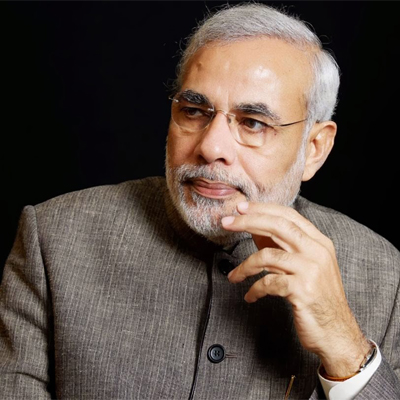
    NEW DELHI: In a dignified function rarely seen, Indian television channels today globally beamed live the swearing in of Narendra Modi as the fifteenth Prime Minister of the country, along with his team of 44 Ministers and Ministers of State.


    Around 4,000 people including all the leaders of the SAARC countries and Mauritius were present in the front courtyard of Rashtrapati Bhavan where President Pranab Mukherjee swore in the Prime Minister and his team.


    Apart from the stars of Bollywood who have made it to the portals of Parliament House, others who were present included Anupam Kher, Dharmendra, Salman Khan with father Salim Khan, Bappie Lahiri, Suresh Oberoi and Vivek Oberoi.


    The winning stars seen at the ceremony included Vinod Khanna, Manoj Tiwari, Smriti Irani and Hema Malini.


    While all television channels were allowed to come to Rashtrapati Bhavan and were stationed at the back of the entire assembly, only Doordarshan was permitted to beam the oath taking ceremony from close quarters.  


    As a result, most channels beamed the ceremony by taking the feed from Doordarshan, though many had their own commentators and experts who spoke about the various persons as they were sworn in.


    While channels like Times Now preferred to show the commentary by Doordarshan’s Sanjeev Upadhyaya and Gaura Lal Dhawan before and after the swearing in, several other channels like NDTV 24×7 showed the visuals from DD but had its own experts speaking about each person as he/she came up to take the oath.


    DD, which had the live coverage on its national channel and DD News, also made arrangements for simultaneous translation into sign language for the hearing impaired. The live telecast was also beamed live on DD’s website and its channel on YouTube, President Pranab Mukherjee’s site presidentofindia.nic.in and on the Prime Minister’s website pmindia.nic.in.


    The telecast commenced around 40 minutes before the ceremony commenced, showing the arrival of various VIPs and leaders of different parties,  including Sonia Gandhi and Rahul Gandhi. 


    The last time that ceremonies of this nature – though smaller magnitude – were held in the front courtyard of Rashtrapati Bhavan was in 1990 and 1998 when Chandrashekhar and Atal Behari Vajpayee were sworn in as Prime Ministers.


    However, this was the first  time since 1991 (when Rajiv Gandhi was cremated) that all the SAARC leaders were seen together in India.


    Modi, who has been tweeting throughout the campaign and even after being elected, used the opportunity to send out a message to the people and the media through the Prime Minister’s website, pmindia.nic.in.


    Referring to the social media and the internet, he said: “I envision this website as a very important medium of direct communication between us. I am a firm believer in the power of technology and social media to communicate with people across the world. I hope this platform creates opportunities to listen, learn and share one’s views. 

    “Through this website you will also get all the latest information about my speeches, schedules, foreign visits and lot more. I will also keep informing you about innovative initiatives undertaken by the Government of India.” 


    A section has been inserted on the website to greet the Prime Minister or send him a message.


  • “Competition is the biggest challenge in loyalty marketing”

    “Competition is the biggest challenge in loyalty marketing”

    MUMBAI: With retail chains, international labels, new airlines and hotels entering India in a big way, the brands are trying to woo consumers interestingly. One way in which brands are connecting with consumers more efficiently is by getting in to loyalty marketing. Loyalty marketing, which is considered to be personal, is now trying to use the power of technology in a big way.


    To understand more on this,indiantelevision.com recently met with ICLP India general manager Mark Spicer, who has been in the loyalty and incentives industry for over two decades now. Spicer spoke about marketing during tough times, the potential of loyalty marketing and much more…


    What according to you is the size of loyalty marketing in India?


    It can be noted that the current size of loyalty marketing in India is around $1.5 billion, as of the beginning of this calendar year. The numbers are expected to shoot up and one can expect double digit growth by end of the year.


    What are Indian brands doing right by getting into loyalty marketing?


    Many Indian brands have started interesting initiatives using loyalty marketing. What brands now need to focus on is to take communication to the next level. According to me, this is the right time when brands can jump into the picture to grab the attention and confidence of consumers. Today, consumers’ expectations have become dynamic. It will be extremely difficult to track their moves if you are not focused.


    What makes you say that it is the right time for loyalty marketing to take off in India?


    The changing market scenario is the major reason why I think brands should be keen in gaining the confidence of consumers. The Indian economy is showing a slowdown and this is an apt time for brands to jump in. Loyalty marketing has an immense potential in an emerging market like India.


    It can be observed that with an increase in inflation rate, consumer decisions are most likely to fluctuate. How can loyalty marketing help brands sustain themselves?


    The first step that brands should take during tough times is to clearly understand their consumers. The task that brands should put on their list is to make clear the road plan. Consumers like being valued. Also, it can be noted that brands need to make communication individual-specific. All this can happen only when brands start getting engagement in marketing. Consumers look for alternative product lines during inflation. Brands need to consider this as an opportunity and make the best use of it.


    Many brands use personal media such as social media and mobile in their loyalty marketing mix. Don’t you think this can intrude on a consumer’s privacy?


    Brands should give consumers the liberty to choose their medium of communication. Consumers are choosy about where they receive their marketing messages. Even though permission marketing exists with emergence of social media today, a lot of communication reaches a consumer at a faster rate.


    Consumers today have better control on communication. Brands need to map a costumer’s journey in loyalty marketing. Having said that, it is necessary that brands take note of how many times a message reaches a consumer and the medium through which it is sent.


    What are the challenges loyalty marketing can face in a diverse market like India?


    Competition is the biggest challenge in loyalty marketing. With cultural and political diversity, brands need to cater to different needs and deliver memorable experiences to consumers. It is also important for brands to keep on par with the ever evolving technology.


    Does talent in India have the right skill sets to take loyalty marketing to the next level?


    Talent in India is rich; what needs to be taken care of is to groom them to put data in the right context. Also, talent here can take learnings from other markets to sharpen their skills. The future looks very positive and bright.


    Marketing to millennials is a hot topic of discussion these days. How do you think loyalty marketing can deal with millennials who are believed to have a variety of choices?


    While dealing with millennials, it is necessary to think ahead of time.  Marketers need to be instant in the way they communicate and need to speak to them in the tone that they understand. Most importantly, data needs to be used smartly to understand their psychology. Marketers also should embed technology in their line of communication.

  • “Use of social media is good when it adds value to communication strategy”

    “Use of social media is good when it adds value to communication strategy”

    MUMBAI: Social-mobile-video marketing is an area waiting to be explored, at least in the Indian context. However, players like Digital Quotient – which already has a presence in the field with over 70 staff across key locations in India – will continue to enjoy a first movers’ advantage over those who come after them.


    Indiantelevision.com’s Priyanka Nair got Digital Quotient COO Vinish Kathuria to speak at length about the changing digital ecosystem, social media and everything in between…


    How have the demands of marketers from the digital platform changed in recent years?


    The Indian digital ecosystem is changing positively over the last decade. Marketers are trying their level best to catch up with consumers’ needs in the digital world. Today, digital is a must-have media vehicle. Gone are the days when we were asked, “What can be done on digital?” The need of the hour is how to take communication to the next level on digital. Tangible and controlled experiments are what brands expect from digital agencies today.


    With changing consumer demographics, it is necessary for digital agencies to have a clear idea of the business objectives of various brands. At Digital Quotient, we look at campaigning for a brand from a very strategic point of view. I think that should be the approach taken by agencies today.


    How is social media gaining importance in a marketer’s communication plans? Are the brands getting it right in terms of social media?


    It can be noted that every brand wants to have a social media presence. While some brands are getting it right in terms of social media, many others need to revise their approach. The first thing that brands should stop doing is racing towards fetching more likes. The question that brands which are looking for business should ask themselves more often is: “Does it add any value to the communication strategy?”


    Brands should understand that on social media, timeliness is of the utmost importance. A social media user has a different mindset. Brands should ensure a strategy whereby consumers are not left with stale or outdated content. Engagement mechanism is a must for social media branding. On the other hand, there are many brands which are using social media purely for post consumer service. This is an interesting move. Social media is now definitely a medium that cannot be ignored but it is up to brands how they shape up strategies that are worthy of attention.


    What are the key things that brands should keep in mind to build a healthy social media conversation? 


    It is just like any other marketing medium that needs to be accepted first. Though social media is largely technology-driven, it is emotional connect and remembrance that matters for consumers. It can be observed that content is taking different shifts over the years. From text-heavy content, brands are today looking at making a splash on social media through videos and pictures. Humanising content is what makes any social media conversation healthy.


    Mobile has still not been leveraged to the best of its capabilities by Indian brands. What is your observation on this?


    Earlier, conversations were very telephone-led but today, marketers are jumping into the mobile fray. It is for reach that marketers are looking at mobile as a communication platform. Brands need to take a cue from how global marketers are looking at social and mobile integration. There is much learning that comes from there, which is noteworthy. One thing is clear with the current numbers: India will soon lead the charts when it comes to mobile reach.


    Brands are betting big on video in digital campaigning. How can brands further optimise the use of video?


    There are many brands that roll out TVCs on social media. TVC is the easiest replication that a brand can do but clearly, it is not an ideal one. That is what brands are getting wrong when it comes to video. It is very important that brands create videos that are shareable. Brands need to start using different formats such as Vine or Instagram. Content curation is something that brands are leveraging on while creating videos.


    Do brands understand the power of big data?


    Understanding big data needs different skill sets. It is relatively new to decode for many professionals. Numbers driven from big data are fascinating and are like an asset that marketers can put to use. Time will help marketers discover the power of big data. 

  • Rajinikanth storms on to twitter

    Rajinikanth storms on to twitter

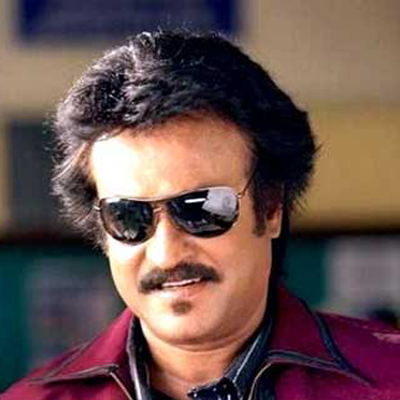
    MUMBAI:  Be it common man, politicians or actors, everyone is on social media. And after being the butt of jokes for years and more recently on twitter, Rajinikanth has finally made his debut on social networking site – Twitter.


    CA Media Digital’s first venture, Fluence, a celebrity digital network, will manage Rajinikanth’s digital interests, to further create and leverage the Thalaivar’s social presence.


    A cultural icon, the normally reticent superstar is looking forward to interacting with his fans on the platform. I have always believed that my career graph is a miracle I owe my fans. I have been contemplating joining the social media platform for a while to connect with them, hear what they have to say and share my thoughts.  Unfortunately I never got around to it until now. By partnering with Fluence I am confident that I have the best team and the best guides who will help me connect with my audience,” said the superstar. “I decided to start with Twitter because I felt that the platform is abuzz with all the news and the trends that happen across the globe and I’m told that this is where all the best Rajini one liners are!” he added.


    Fluence VP digital & business head Ashish Joshi said, “We are thrilled to partner with the enigmatic Rajinikanth. The digital landscape is exploding and when you work with Thalaivar the possibilities are endless. Twitter is the first step in building and growing his online presence and getting all the fans out there to directly engage with the phenomenon that is Rajinikanth. We will work closely with him to broaden the horizons of the digital landscape to create interesting and entertaining consumer facing properties that will engage the fans in a way that only Rajini sir can.”


    Said Twitter India market director Rishi Jaitly, “Twitter is the world’s leading real-time information network where users discover and converse with the people, organizations and media that interest them. This is truly an “only-on-Twitter” moment as Superstar Rajinikanth’s debut on Twitter also marks his debut in the digital space more generally. We welcome Rajinikanth to Twitter, are happy to support his launch on the platform and look forward to watching him use our mobile service to engage in live, public conversations with fans and other icons around the world.”


    This marks the superstar’s debut in the digital space.


    To make Superstar Rajinikanth’s debut on Twitter more exciting; fans from all over the world, who follow him on twitter @SuperStarRajini in the first week, will receive a ‘WelcomeGraph’, a personalized welcome picture from the icon.

  • Election 2014: The rise of social media

    Election 2014: The rise of social media

    MUMBAI: India is witnessing an election with several firsts to its credit. Not only is it the first time that a million youth are voting, it is also the first time the campaign spends of political parties are second only to the USA, the first time channels are jostling to show which one is more unique and it is also the very first time that social media is so actively involved in elections.

    IBN network managing editor Vinay Tewari puts it as:  “Today for any big event, social media communication is big. No news channel can survive without social media.” The 2009 Lok Sabha elections did not see as much mobile and social media penetration. So much so, the FICCI FRAMES annual report did not have a ‘new media’ section till 2011. 

    According to the report, the total number of internet users in India is 214 million, out of which 130 million access it through their mobile phones. This is just 17 per cent of the total population of the country!

    “It took a decade for the country to grow from a 10 million to 100 million internet user base and only three years to double (2011 to 2013) that number to 100 million.” says the report.

    According to India Today Group COO Digital Salil Kumar, “The age group of 18 to 24 years and then those above 24 years are the most vocal in the metros but maximum growth is being witnessed from tier two and three towns.”

    The FICCI FRAMES 2014 report says that by the end of 2013 there were nearly 72 million rural Indians who had accessed internet at least once in their lives and 49 million were active internet users. The primary reason that holds them back is unavailability of content in their local languages, which is something channels and mediums are trying to slowly bridge.

    Naturally, channels are pulling out all stops to get viewers hooked onto the second screen. CNN-IBN has a tie up with Microsoft and Google; ABP News and Aaj Tak are using their intense social media following; Times Now and CNBC-TV18 have tie ups with Twitter; while NDTV depends on its own proprietary material such as second screen and its app which has six million downloads.

    Aaj Tak had come up with an innovative campaign last year called E-Election (E-Chunav) where users were asked to virtually vote for their state parties in Delhi, Madhya Pradesh, Rajasthan and Chattisgarh, in order to gauge the mood of netizens. “With a dedicated team in place, we have been leveraging the medium to disseminate news, listen to feedback, hear views of the community and share  them back with audiences on TV, including the panelists on programmes,” says Kumar.

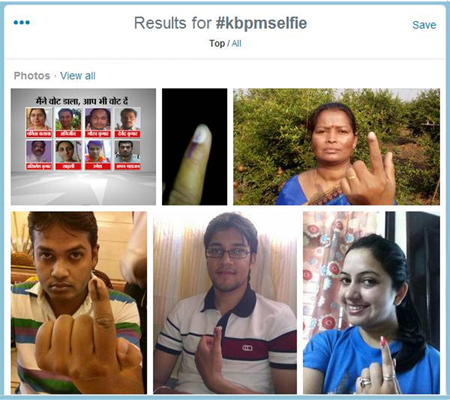
    ABP News started the trend #KBPMSelfie that encouraged voters to send selfies of their inked fingers through Twitter, Facebook and mail, leveraging its popular show Kaun Banega Pradhan Mantri (KBPM). It claimed to have received more than one lakh pictures. "We use social media actively throughout the year and we only see this activity increasing as news consumption on this platform is growing," says MCCS marketing manager Vikas Singh, the company that runs ABP News.

    An important medium for feedback, social media can no longer afford to be clubbed together with TV.  In fact, intensification on social media is not just for the elections but also post elections to retain people.  While Aaj Tak wants to improve its engagement with viewers as well as build brand loyalty among them, ABP News' Singh maintains, "From a channel perspective, it helps us communicate much better with our audience. Earlier if it used to be a one way communication, social media now helps it to become a two way channel. News travels faster and a lot of consumption of news happens through referrals, sharing and comments."

    According to Tewari, “The current focus is only elections. Post that, the interest in politics may decline but creating stickiness is something everyone is doing.”

    Word of mouth has become the biggest marketing tool today. The fact that news travels and gets consumed faster through social media means that it is effectively used for content dissemination and to provide breaking news. ‘Viral’ and ‘trends’ are the new operative words.

    Twitter claims that the buzz around the 2014 election on its platform in the last year has increased 600 per cent while the mention of political parties and candidates since the beginning of 2014 has gone up 10 times.


    Facebook has come up with an ‘I’m a Voter’ campaign urging voters to click the button and tell everyone about their moment of pride.

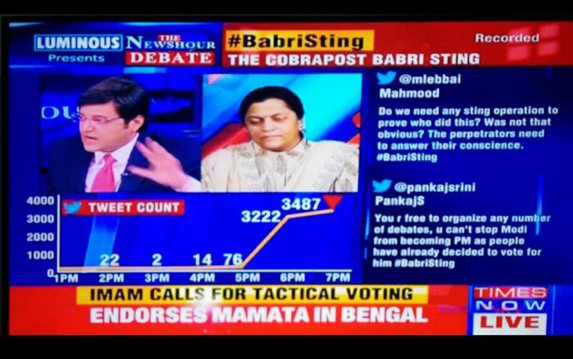
    This also brings us to the question as to how much of this information can actually be termed dependable? Times Now is doing live sentiment analysis of Twitter feeds while Network 18’s news channels are analysing election data through Microsoft’s technology. However, NDTV group CEO Vikram Chandra feels that these data are not very conclusive. “Though social media is an important factor, it is not necessarily the single factor that will dominate voting decisions. You have to also keep in mind that only a particular segment of the population has access to the internet or twitter. So mood gauging is fine but I am a bit wary of how far you can take it,” he says.

    With ABP News focusing on Facebook (3.9 million), Twitter (5.05 lakh) and G+ respectively while Aaj Tak on Facebook (6.5 million), Twitter (30,000), G+, YouTube, Flickr and Pinterest, CNN-IBN and IBN7 on their own websites first and NDTV depending on the second screen with its own application having 3.2 million followers on Facebook and 1.92 million on Twitter, how much of this information can be relied upon becomes a pertinent question.

    “In the last election, social media was considered a medium of a few. Internet penetration was not so deep. In the current environment, it is considered a major influencer and a lot of recourses have also been deployed by all political parties to influence the voter,” points out Kumar. Online data says that in 2009, the number of Facebook users was 1.6 million which has now crossed 100 million,  while Twitter which had about 0.6 million subscribers, hasn’t really caught up and currently has approximately 40 million visitors. However, it seems to now be making the most buzz.

    “Voting for Lok Sabha #Election2014 in India begins today in what has truly been the country’s first Twitter election” said a Twitter statement on the first day of elections. Even then, the social media user penetration in the country stands at 10.5 per cent of the total population, which is expected to grow to 17.2 per cent by 2017. So, although channels are vehemently focusing on communication through digital media, it still remains a small but actively growing part of the population.

    Quite possible that by then the meaning, use or method of ‘social media’ might change. However, channels are keenly tracking the number of followers, likes, people talking about it and the growth level. As India’s mobile and internet penetration sharpens and connections become better and cheaper, the social media landscape for news will totally change.

  • BJP’s manifesto most-talked on social media

    BJP’s manifesto most-talked on social media

    MUMBAI: The 2014 elections have been very different from the previous ones; never before have elections created so much buzz especially among the youngsters.


    Media has played a major role in creating elections the hot topic for months now with social media playing a vital role in it. With the Lok Sabha elections already underway, voters have been closely evaluating the manifestos of AAP, BJP and Congress. Conversations on social networks have been buzzing with netizens discussing the various developmental programmes promised by the political parties.


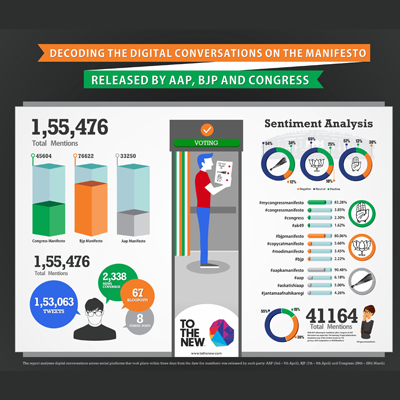
    To The New, an integrated digital services network, has released a report that analyses digital conversations across various social platforms such as Twitter, forums and news sites that took place within three days from the date the manifesto was released for that party. The report, powered by ThoughtBuzz, the social media analytics’ arm of the company, also tracks the sentiment around the manifesto and shares “word clouds” that highlights the key sentiments that are dominating the social platforms.


    To The New marketing head Irfan Khan said, “The 2014 General Elections has seen immense interest and vocal participation of the youth. The release of the manifestos by the political parties has given the young and the “first-time voters” the opportunity to evaluate and make an informed decision. The report on the buzz around manifesto enables us to understand the psyche of these voters.”


    The report reveals that mentions of BJP’s manifesto far outnumbered that of political rivals AAP and Congress with a whopping 76,662 mentions on the social platforms in the span of three days of the release of the party manifesto. In contrast, Congress had 45,604 mentions followed by AAP with 33,250 mentions.


    The report findings further revealed that the discussion on AAP manifesto had the most positive outcome amongst the three parties, 34 per cent had a positive tone, 54 per cent had a neutral tone and 12 per cent of the tonality was negative. 57 per cent of the discussion on Congress manifesto had a neutral tone, 30 per cent was negative while only a mere 13 per cent of the tonality was positive. On the other hand, 65 per cent of the discussion on BJP manifesto had a neutral tone, 25 per cent was positive while only 10 per cent of the tonality was negative. In the duration of three days of the release of BJP manifesto, the hashtag #copycatmanifesto, created a lot of buzz on the digital space receiving a total of 41,164 mentions.

  • Political advertising in India – social media and the first-time voter

    Political advertising in India – social media and the first-time voter

    If you’ve always wondered why and what’s the point of political advertising when the candidates get enough coverage around their sheninagans on a regular basis, then read on.

    The primary purpose of political advertising is to swing the perception of people who have ‘CONFUSION’ written all over their faces in capital letters, and ultimately, to win votes. Because for a larger percentage of the politicians, it’s all about obtaining and retaining power, fuelled by money and greed.

    Past demeanours do not count, and most political parties have cracked the seven deadly sins of Indian voters. To elaborate, here goes:

    1. The Indian public has extremely short-term memory

    2. Over time we learn to tolerate anything

    3. Nothing comes above religion and caste

    4. Political ignorance, even amongst the educated

    5. Petty appeasement through freebies

    6. Indians love to hate each other

    7. Need to hero worship and follow dynasties

    Courtesy: Ishaan Mohan Bagga, Editor, Indian Exponent. http://indianexponent.com/24298/7-weaknesses-of-indian-voter.html

    The economics of 2014 elections

    Having mentioned money, Reuters reports that ‘Indian politicians are expected to spend around US $5 billion (Rs 30,000 crores) on campaigning for elections next month (April 2014) – a sum second only to the most expensive US presidential campaign of all time – in a splurge that could give India’s floundering economy a temporary boost.

    India’s campaign spend, which can include cash stuffed in envelopes as well as multi-million-dollar ad campaigns, has been estimated at Rs 300 billion (US $4.9 billion) by the Centre for Media Studies, which tracks spending.

    That is triple the expenditure the Centre said was spent on electioneering in the last national poll in 2009.’

    Media is the largest beneficiary in the arsenal; and all related advertising, turns into a medium to deliver promises, attack and counter-attack opponents, and function as the political game changer. Swirling on a delicate ideological spindle – ‘A lie told often enough becomes the truth’ – Vladimir Lenin. Also successfully used by Hitler’s Propaganda minister Joseph Goebbels, who also served as chancellor for a day, following Hitler’s death.

    So couple greed with the seven deadly sins of Indian voters, stir in tonnes of cash and engage some of India’s leading advertising-PR-social media conglomerates to churn out propaganda and you have a volcanic blitz of media madness; where even educated, otherwise analytical minds can’t distinguish between hell or high water.

    The year 2014 is a very interesting year for India as the majority of the audience that will be voting this year will be very young. At a news conference in New Delhi, the election commission said that the process of voting in the sixteenth Lok Sabha will see the largest ever population of eligible voters, led by over 814 million voters, 100 million more than in 2009. This time round, more than 23 million voters are aged between 18 and 19. For the first time in a general election in India, voters will be allowed to cast a ballot for “None of the Above.”

    To the extent that the ultimate decision might also be in the hands of India’s youth because of the existing majority, the marketer has set up shop in the marketplace, i.e., political advertisers have looked into reaching out to the audience where they currently ‘hang out’.

    With advertising and communication being churned out faster than widgets, there is no thinking time for the creators; hence they all narrate versions of the same story, with a different overtones, over different platforms.

    The story goes something like this –

    Cause

    Here’s the starting point: what does the party stand for? Why does this party exist? What does the prime minister candidate stand for? There are many causes on offer: secular, development, safety, jobs, prices, pride, honesty and governance.

    The first-time voter is young, idealistic and seeks a motivating argument to come and vote. The best argument to this group is economic: the promise of jobs and a brighter future.

    Constituency

    Similar to brand marketing campaigns, the candidate who presents the best chance in the constituency is a combination of optimising many variables and micro-targeting, i.e., “Think national but choose local” being one of the most commonly used engagement strategies right now.

    Comparison

    By creating syndromes of fear, uncertainty and doubt amongst the people, political advertising portrays competitors in an unfavourable manner, thereby benefitting the attacking candidate and not marring his image; eventually leading to winning more votes.

    Celebrities

    Everyone from TV presenters, to actors, to former diplomats and government servants, will start offering their endorsements for the benefit of the voter. Such endorsements will multiply gradually in this election. Parties will rope in influential social commentators and feed them with talking points to build preference, especially among undecided voters.

    This election is therefore truly at the mercy of first-time voters and social media targeting, which will decide its outcome; since reliable stats reveal that over than half of the total youth audiences are on social websites. 

    According to a research by Autumn worldwide, ‘out of a million conversations on social media on elections in September 2013, first-time voters (overall 150 million) led 40 per cent of chats. They discussed the rupee, prices, women’s safety, governance and jobs. Their idea of accountability in politics will define India over the next 20 years’. So 2014 is the start…

    What’s important here is not which party wins the elections this time, but the power of crowd-sourcing and influencing opinion on the Indian social scene. This of course calls for a social and cultural mindset change, which is slowly experiencing what theologians call an ‘eschatological breaking in’, or a foretaste of things to come before they actually occur.

    Talk about bringing colour to Indian politics. While the political camps pore over rivals’ speeches looking for historical inaccuracies and discrepancies in political manifestos, a parallel analysis is unfolding across homes, public and individual spaces alike.

    Politics and the youth in India have never seemed to have had a liking for each other so far, the relationship between the two being pre-dominantly passive. But of late, with candidates like Meera Sanyal being active on social networks and using their personal pages to promote their ‘brand’ and reach out to the users by actually informing them about what they intend to do or what they are currently doing at the moment which helps them create a following amongst the dominant and previously dormant majority.

    This adoption of new media by Indian politicians, even though late provides a personal connect between the aspiring leaders and the junta making the game a little more complicated than it previously was keeping the users aware about the actual story instead of depending on paid media for biased information.

    There is another side to the story as well. Where there’s any form of advertising there are advertising agencies and this time they come with all guns blazing on the digital front too!

    The best example for this would be Narendra Modi who has managed to carve up a decent spot for himself in the cyberspace by making complete use of social networks along with the help of his agency by keeping the audience informed about his actions as well as sharing his opinions over different issues. Mr. Modi’s social pages also boast of web applications which look towards gathering volunteers for various causes as well as send festive audio greetings to his fans on the web.


    A bit too much you said? You be the judge, but you cannot undermine the fact that these are the reasons why the 2014 elections are so exciting.

    The future of the country is yet to be determined but advertising expenditure is enabling emulation of the likes of Lenin and Goebbels…

    Long live the Indian (r)evolution and heil to its leaders.

    Hello, anybody (with a conscience) home?

    (These are purely personal views of  Raising iBrows digital and engagement strategist Carl Noronha and indiantelevision.com does not subscribe to these views)
  • ThoughtBuzz introduces a new analytics platform, Omnio G

    ThoughtBuzz introduces a new analytics platform, Omnio G

    MUMBAI: The analytics arm of To The New, ThoughtBuzz, has launched a new analytics platform – Omnio G.


    The platform is an advanced, feature rich social media analytics medium that will help organisations listen, discover, measure and engage with today’s social and mobile first consumers. Unlike previous analytics platform by ThoughtBuzz, Omnio G will also support facebook and instagram along with all the existing social media platforms including LinkedIn, YouTube, blogs and forums, review sites like Amazon and CNET, QnA sites like yahoo Q&A and twitter.


    Companies today use social media as a way to connect with their customers, partners and employees. Consequently social media monitoring or listening is now more important than ever. Gartner predicts that by 2018, 75 per cent of transactions would start on social media and end on the mobile. With the growing use of social media by customers of all age groups, extensive tools are required to collect, analyse and respond to customers.


    The addition of facebook and instagram will enable existing clients to connect their facebook and instagram accounts and get an in-depth view of analytics for the pages they manage. Marketers would also be able to compare fan/follower activity on facebook and instagram with data outside their own assets. This will enable them to measure effectiveness of their campaigns across wide range of social platforms. Users would also be able to add multiple pages and view analytics for each of their pages on facebook and instagram accounts. The tool also has a premium layer, geared towards agencies that allow one to track multiple accounts enabling them to compare fan growth rates, engagement rates and demographics across all their pages.


    ThoughtBuzz founder and CEO Anshul Jain commented, “Instagram allows brands to engage with users visually,” He further stated, “Addition of instagram and facebook along with the existing support for social platforms like Twitter will empower marketers with data to analyze which content connects best with their consumers and benchmark how are they performing against competitors”.


    Omnio G builds on the previous ThoughtBuzz platform, introduced in 2013. It was built from the ground up on cutting-edge technologies such as Mongo DB and the Grails framework. The platform runs on Amazon Web Services platform to ensure maximum uptime and scalability. Existing customers will be moved to Omnio G gradually and new customers can start using Omnio G from today.

  • Tips Music crosses 5 million fans on Facebook!

    Tips Music crosses 5 million fans on Facebook!

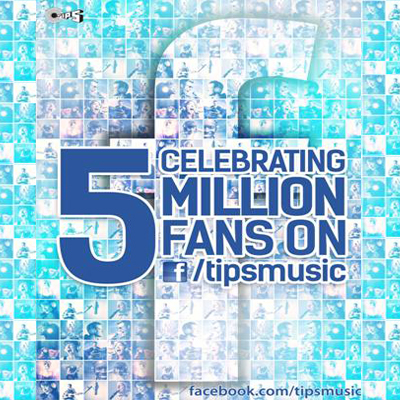
    MUMBAI: Tips Music created a landmark of sorts earlier this week when the company’s Facebook community hit the 5 million fan mark, making it one of the largest and most active entertainment brands on Facebook.

     Mr. Sahas Malhotra, (VP – Business Head) of Tips Industries said “This is a very important milestone for us and we would like to thank all our fans and supporters. We regard this as a testament to all the consumer oriented engagements that Tips has undertaken in the digital space. The number of fans on the page has been growing in leaps and bounds and this is a clear indication of our ever increasing popularity on Facebook. Our unique social media initiatives with which we have been engaging fans, has garnered a lot of attention.”

    In less than a year, the company has seen an increase of 50 percent in its fan base from 2 million in 2013, to the current 5 million. Tips Music is one of the few Indian entertainment companies with rich industry experience of over 25 years to realize the potential of social media and the digital platform with which they have been using to engage and build their fan community. With a single handed focus on the popularity of Facebook, Tips brings to its fans an exciting and interactive way of engaging with films and allowing music buffs the opportunity of extensive information about various artists, labels, and movies.

    Today, Tips is at the forefront of the digital music industry in India and this is just the beginning.

  • Can social media be a useful tool this election?

    Can social media be a useful tool this election?

    MUMBAI: The largest democracy of the world is set for the “big fight”. The General Elections are just a month away. The biggest challenge in front of the parties: to woo the public/voters who have have grown in more ways than one, thanks to the social media and the availability of information on the finger tips.


    The requirements of the political parties to win the voters confidence: more than just promises. And thus, they are doing everything possible to grab the voters’ attention – from being present on news channels and spending big moolahs on advertising, the political parties are doing everything to be actively involved with the voters on the social media.


    And if elections and social media both have become so big, the FICCI Frames 2014 could not have missed having a session on the raging topic. Thus, “Internet and Democracy: Interloper or Catalyst?” – a session that discussed if internet is a mere communication tool and an intruder into our privacy or is it an unparalleled minefield of education, community-building and a catalyst for social and economic change.


    Anchored by BBC Global News senior anchorperson Jon Sopel, the session saw panelists President Obama’s campaign PR expert Roger Fisk, Google India public policy and govt relations head Chetan Krishnaswamy, NDTV.com managing editor and NDTV director of strategy Suparna Singh, NowFloats.com founder Ronak Samantray, Harvard University Berkman center for internet & society Mike Best.


    Sopel brought to the fore the examples of Egypt and Libya because of which established social media as a tool for gaining freedom and ending the misery.


    Fisk elaborated on Obama’s election campaign, which is termed by many as the first political campaign in history to truly exploit the power of the social media to spread the word, garner support and engage people. “My experience in social media is that it helps amplify human nature. It lets people have dialogue with each other. Social media opened up the political campaign to people and gave them a chance to be part of the campaign – up, close and personal.”


    But cut to homeland and Singh didn’t sound optimistic about social media and politics, at least not in the present edition of the elections. She thinks it can become a catalyst of change, but we are one election away from it. “There is only limited exchange of opinion of social media today and is mostly crowd-based anger,” she remarked as she spoke of the recent incidents in Delhi between AAP and BJP supporters. “The #ViolentBJP and #NaxalAAP trended a week ago but if we take a closer look into such trends we will see how we are losing on an opportunity of using the social media well. People on twitter don’t want to listen to others but only want others to hear what they want to say. There is just too much noise.”


    Nonetheless, no one can deny the fact that the internet has become an important part of people’s lives today and social media is also a major part of it. On the growth of the internet, Krishnaswamy says that since 2000, internet has seen a tremendous growth in India. He predicts that by the end of this year, there will be 250 million users and believes that by the 2020 there will be half a billion internet users. “The most interesting part of it is that the next 100 million users will come from non-English speaking sections of our society,” he says while adding that language content has increased by 57 per cent in the recent past and hence, it shows how center of gravity is shifting.


    “The urban voter is using a lot of time online and looking at choices. And if a politician has an online presence, he/she is seen as more dynamic than others by these voters,” points out Krishnaswamy.


    Taking a cue from here, Singh adds, “Social media is also helping new political parties like AAP and independent candidates, who don’t have huge advertising or PR expenditure, to spread their word among people as well as interact with them.”


    The discussion concluded with the thought that social media is more than a communication tool but it hasn’t been exploited completely. Changes are needed before it can be used as an important tool, especially during elections.