Tag: social media

  • Discovery going all out to promote ‘Kisna’

    Discovery going all out to promote ‘Kisna’

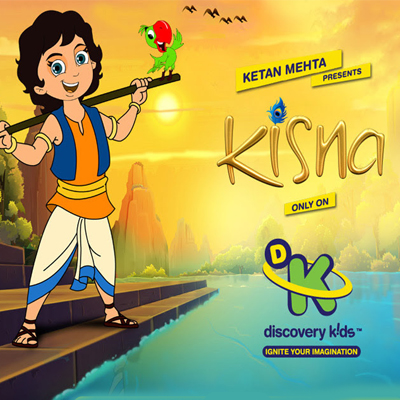
    NEW DELHI: The Discovery Kids channel is going all out to popularise its new animation series ‘Kisna’ as it is an India-based series and is a ‘driver show’.


    told indiantelevision.com on the sidelines of a press meet on the launch of the new series by, and series maker Rahul Johri and renowned filmmaker Ketan Mehta that the percentage of marketing was very high for this show.


    Discovery Channel Asia Pacific VP marketing Rajiv Bakshi  said while the series has already been promoted for almost a month on all Discovery channels, it will now be promoted on other channels as well as on billboards and through school activities. While Facebook was being used to promote the series among adults so that they could encourage the young to see it, the social network was not available to those under 18 years of age.


    Filmmaker Ketan Mehta said that the aim of the series was to impart education and entertainment at the same time. He said the name ‘Kisna’ had been used because it had an association with everyone in the subcontinent, but the series would be contemporary and every episode would also have some education value. Thus, it was not the story of Lord Krishna.


    The series, produced by Cosmos Entertainment and Maya Digital Studios, would be telecast from 19 October at 2 pm every Friday in English, Tamil and Hindi. It would be repeated at 6 pm.


    Discovery’s current portfolio in India includes 11 channels – Discovery Channel, Animal Planet, Investigation Discovery, TLC, Discovery Kids, Discovery Science, Discovery Tamil, Discovery Turbo, Discovery HD World, TLC HD World and Animal Planet HD World – apart from a Discovery Channel Magazine.


    Apart from the three High Definition channels – Discovery World, TLC World and Animal Planet World – Investigation Discovery (ID) was launched early this month and carries true stories of crime and their investigation. Though the stories are all American, they have been dubbed in Hindi.  Each story is complete in itself.


    Kisna is the story of an adventurous and amusing young boy from Anandnagri and his adversary the wicked Raja Durjan of Andhernagri. During the series, Kisna will clash with Raja Durjan and each time squash his evil plans of spreading fear in Kisna’s hometown.


     Mehta said, “Kisna is a fascinating story told through captivating characters. Kisna’s endearing personality combined with his superhero powers will make him a favourite character amongst the kids. We are delighted to partner with Discovery Kids, a renowned brand that delivers fun and enriching entertainment.”


    Discovery Kids is available in Hindi, English and Tamil languages across India on both analogue and DTH platforms including Tata Sky, Dish TV, Reliance DTH, Airtel Digital and Videocon d2h.


  • IBM Cloud to help MutualMind in expanding social media network

    IBM Cloud to help MutualMind in expanding social media network

    NEW DELHI: MutualMind, a startup that provides social media sentiment analysis, has leveraged IBM cloud to upgrade its infrastructure and double the computing power of its real-time, on-demand content analysis and visualisation application.


    MutualMind migrated to IBM after replacing Amazon Web Services and Rackspace.


    Through MutualMind, customers can monitor brand discussions on the social networks on which they have a presence, enabling them to gain valuable insights from social discussions.


    Major brands like Kraft, AT&T, Nestle and Walgreens use MutualMind to support various product development, market research and consumer care programs, the company said.


    IBM cloud powered by SoftLayer has allowed MutualMind to improve processing efficiency, performance and scalability while also meeting growing customer demand, said MutualMind CEO and co-founder Barbar Bhatti. “We now have the ability to successfully offer our products cost-efficiently and provide our customers the real-time support needed in today’s digitally social world.”


    By moving its application to SoftLayer, MutualMind is able to leverage the power of big data to help customers transform their operations and gain a competitive advantage.


    MutualMind’s platform can process between 30,000 to 80,000 different queries on these documents at any moment, and SoftLayer delivers the flexibility required to deliver accurate and continuous customer engagement in real time.


    Utilising SoftLayer’s bare metal infrastructure, MutualMind’s engineers can appropriately customise and configure the right kind of servers and apply these changes where needed – such as when a client needs extra support for a major new product launch or social media campaign, the company said.

  • Twitter India appoints Anupam Dixit as its first industry manager

    Twitter India appoints Anupam Dixit as its first industry manager

    MUMBAI: Twitter India has appointed Anupam Dixit as its first industry manager in the country. The official handle of Twitter India (@TwitterIndia) tweeted out the following announcing his appointment.


    As Twitter’s first industry manager in India, Dixit is responsible for providing support for Indian advertising campaigns leveraging the company’s platform for live, public conversations, while working with industry-leading marketers to increase engagement with their customers on Twitter.


    Dixit has eight years of digital marketing experience and has had a front row seat to the evolution of the medium in India. In his last role, he was MTS digital marketing and ecommerce head, where he worked on the MTS internet baby campaign, which is now the most viewed brand commercial on YouTube among other award winning digital innovations.


    Prior to MTS, he launched Blyk, a youth mobile messaging media platform, India; besides starting his first digital venture EveryMedia. 

  • IMImobile to power BBC’s mobile and social audience engagement

    IMImobile to power BBC’s mobile and social audience engagement

    MUMBAI: IMImobile, a global technology company providing software and services which help businesses capitalise on the growth in mobile communications, today announced that they have been awarded the contract under the BBC’s framework agreement for the provisioning of Mobile and Social Messaging services to help the BBC streamline the audience engagement process across mobile and social channels. The partnership commenced in July 2014, after an official supplier selection process. 


    The BBC will be using IMImobile’s DaVinci Social platform across radio, TV and live events, enabling production teams to seamlessly manage inbound and outbound audience interactions across SMS, MMS, email, Facebook, Instagram and Twitter. DaVinci Social is a single tool specifically developed to enable broadcasters to manage and respond to audience interaction across multiple channels, monitor citizen journalism and integrate contextual audience feedback into live programming. In addition, the platform will be used to manage interactive services such as social and mobile voting.


    IMImobile chief executive Jay Patel commented: “We are delighted to be selected by the BBC to deploy our DaVinci Social platform across the organisation. IMImobile has a deep heritage of delivering highly scalable solutions and services into the broadcasting sector. DaVinci Social fulfils the BBC’s requirements for being a universal tool for the monitoring and management of audience interaction across multiple channels”.


    The growth in mobile and social communication has changed the way audiences want to consume and participate in the broadcasting experience. To help broadcasters manage the complexity of mobile and social engagement, IMImobile developed DaVinci Social, an enterprise grade, highly scalable platform that can be deployed across hundreds of production teams to centralise the management of audience engagement across multiple digital and mobile channels.


    BBC head of Interactive Technical Advice & Contracts Unit Claire McLaughlin said: “Throughout the bid, IMImobile was able to successfully demonstrate that the DaVinci Social platform meets our high demands and criteria for centralising all audience interactions across our radio, TV and live event programming. The platform enables the BBC to respond to the change in audience behaviour and integrate mobile and social audience interactions into the broadcasting experience.”

  • Content creators see value in social media data

    Content creators see value in social media data

    MUMBAI: Twitter, Facebook and television go hand in hand these days. The relationship between television and social media has been growing over the years. But does it have the potential to turn into a major revenue stream?

    Discussing this was a panel at TV.Nxt 2014 comprising Viacom18 Media VP and Colors commercial and digital head Vivek Srivastava, CNN International New Delhi bureau chief Ravi Agrawal, Nielsen India MD Prashant Singh, GroupM South Asia managing partner Tushar Vyas and Star India VP and digital marketing and CRM head Venke Sharma. The session was headed by Provocateur Advisory principal Paritosh Joshi.

    Firing up the session, Joshi asked Agrawal to share some insights as to how CNN evolved and now functions with the proliferation of social media since it was one of the early entrants into it. Agrawal highlighted that in the early 2000s, CNN had created a website called ireport.com where it invited people to click pictures and post from places where a journalist couldn’t be. “That’s when we saw that regular citizens can get the story before anyone can. We saw this even in the 2008 attack on the Taj Hotel in Mumbai, when the first few images that came were from the common people which were of superb quality. That became a great tool for us to tell stories from places unreachable to us,” he said. He went on to add that the notion of TV and social media being a new marriage is actually an old one in many parts of the world.

    While the possibility of getting a return path was natural for news, how does it work for fiction makers? Sharma started off by saying that there are people for whom entertainment is defined by buzzing topics and a fear of missing out. Talking about Star Plus’ hit show Diya Aur Baati Hum, he said that although it rates high on TAM ratings, it doesn’t garner the same on social media vis-a-vis Iss Pyaar Ko Kya Naam Du which doesn’t get the ratings but gets the buzz.

    Joshi went on to ask Vyas about the translation of social media into a source of revenue. Vyas said that social media works as a surrogate and is also an incremental data point. “We capitalise on the second screen behaviour and try and reach out to all set of audiences on various platforms. Social media is an incremental data over TV data,” he said.

    Nielsen had recently launched its Twitter TV ratings in the US for calculating data on TV shows on the social networking platform. Said Singh, “In this, we don’t count the number of tweets but rather the impressions. It is the GRP equivalent. Whether the market will decide to trade on it or to use it as another dimension against TV ratings is to be seen. But we believe that being able to measure impressions would be more and more important.”

    Talking about how the medium works in sync with the TV, Srivastava said that it is mostly important from a catch-up stand point in the media space. Facebook was to interact while not watching TV while Twitter was an accompaniment while watching TV. This was agreed upon by Sharma who said that Star had used Facebook to sharply target and get viewers to sample its latest Pro Kabaddi League.

    However, Agrawal pointed out that the capability of knowing how people react to your stories also puts the onus on journalists to be more careful and responsible.

    Joshi said that content makers are worried about the fact that the value of a viewer on TV is 100 times more than on digital. To this Vyas said that although it might be true in terms of absolute value, the audience on a platform like YouTube is higher than many other TV monetisation that is happening today. “If you look at advertising money, then digital is slowly reaching the top of the pyramid,” said Vyas.

    Star has set up its own listening hub to understand trends and draw actionable insights, highlighted Sharma. Agrawal ended the session by stating that drawing data from social media is also a danger. “It isn’t always a reflection of reality. The demographics that use social media are of a certain type and especially globally I would be slightly vary about extrapolating data from there,” he concluded.

  • ThoughtBuzz launches cross-platform to identify ‘influencers’

    ThoughtBuzz launches cross-platform to identify ‘influencers’

    MUMBAI: The digital platform has become much more than just an end medium to market a product, today. Brands are conserving with the consumers directly through the platform to build a better and stronger relationship between the two.

    However, though there are many tools in the market that offer social media management, none of them provide a dashboard where a user can view not just fan growth, engagement rates but also see content performance, influencers and do competitor benchmarking.

    Hence, keeping this insight in mind, ThoughtBuzz, the analytics arm of TO THE NEW, launched a unified social media management and analytics platform for brands and enterprises.

    The platform is aimed at helping businesses to monitor, engage and identify influencers across all major social media platforms, namely Facebook, Twitter, Instagram and YouTube. The self-serve product compliments ThoughtBuzz’s enterprise grade OmnioG solution, which in addition also allows exhaustive external monitoring of brands and products on blogs, forums, news and review sites and completes its range of social intelligence solutions.

    Only a handful of tools provide image and video analytics, and since the new platform can analyse both, it differentiates from the rest. Key features of the new platform include influencer identification, cross platform analytics, competitor benchmarking, content performance, Instagram and Twitter analytics.

    “The new platform allows community and brand managers to understand what content works best for them. You can compare content performance across Instagram, YouTube, Facebook and Twitter simultaneously. This is a powerful feature for community managers to engage more with their audience,” said ThoughtBuzz CEO Anshul Jain.

    ThoughtBuzz COO Ashok Patro added, “As ThoughtBuzz is Asia’s only mobile first social analytics platform, we will be able to provide brands with the latest information and insights, empowering them to effectively manage their social media accounts and businesses in real-time.”

    A team of four worked on the product which promises to not invade consumers’ privacy. All the data that is crunched is public data; it doesn’t track any private data of any user on any platform. Secondly, all the analysis is concentrated on data from fan pages for Facebook specifically.

    The product can be used by simply logging on the digital agency’s website and selecting a plan – free as well as paid plans.

  • Creative agencies need digital support to develop a brand

    Creative agencies need digital support to develop a brand

    Get this straight, marketing team or agencies don’t make brands but your customers do. We live in a world driven by digital age and apparently breaking the traditional marketing norms it has changed the way brands are built; now brands are built by consumers in virtual world.


    Digital media is a vast term in itself. It precisely contains a vast array of digital channels which includes social media, intergrated banner ads, mobile apps & wap, search, websites, viral videos and photographs. No other channel offers the level of potential for building your brand and customer-business interactivity that digital does.


    Now let’s talk about brand. What is a brand? A brand is the emotional and psychological connection a customer has with a business and its products and services. Marketers and agencies encourage a brand relationship to occur between customer and business, that’s where the role of digital media comes into the picture; it gives the perfect environment for brand building.


    Today, you have to join, guide and lead conversations that shape your brand perception, what digital has done is given control to consumers and it’s the consumers who build your brand, also it influences the traditional marketing too. How? Let me explain: Digital except for serving your brand, is a gold mine of consumer driven data. DATA, this is where both traditional and digital media comes together.


    Digital Media provides databank of information and data-driven profiles that help brands satisfy consumer’s intent. A brand is brought to life online through content, copy, tone, user experience, how it engages with its audience through social media, the nature of digital can leave a brand wide open and exposed to its audience. That’s a smart way to change the perception and build your brand.


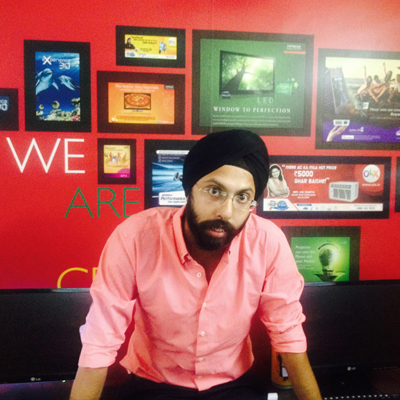
    (These are purely personal views of Option Designs MD Japneet Singh and indiantelevision.com does not subscribe to these views.)

  • Farewell, MSN Messenger

    Farewell, MSN Messenger

    MUMBAI: It was in the month of June when Google announced that it will shut Orkut down at the end of September 2014.


    And now, Microsoft’s Windows Live Messenger aka MSN Messenger will be switched off in China in October, marking an end to the 15-year-old service.


    The instant messenger was launched in 1999 as a simple text chat service and as a rival to AOL’s AIM service and ICQ. Till 2006, Microsoft released seven major versions and added features such as photo delivery, video calls and games as the technology developed.


    At its peak, MSN Messenger had 330 million users worldwide, as per reports.


    However, when the company purchased Skype for $8.5 billion in 2012 it spelled the beginning of the end for the MSN service. It was in 2012 end that Microsoft announced that Messenger and Skype services would merge in the first quarter of 2013, with users of Messenger client software moving to Skype.


    In January 2013, Microsoft had emailed Messenger users and informed them that with the exception of mainland China, the Messenger service would stop working on 15 March 2013 and users would not be able to sign in.


    Gigaom reports that the Tencent-owned company has over 200 million users in China. Following the rise of rival messenger platform QQ, MSN Messenger and Skype hopes to increase the competition in the country.


    After 31 October Chinese Messenger users too will need to use Skype, ending their relationship with the Messenger.


    Farewell, MSN Messenger.

  • #Whattheblack : Colgate’s charcoal toothbrush

    #Whattheblack : Colgate’s charcoal toothbrush

    MUMBAI: Have you ever seen a black egg, black newspaper or a black toothbrush?  If not, then behold, Colgate-Palmolive (India) has launched a Colgate SlimSoft Charcoal toothbrush. Yes, charcoal.


    The country’s first and only toothbrush with bristles infused with Charcoal is based on the key Indian insight of the traditional oral care benefits of charcoal. The launch is focused towards growing Colgate’s leadership in the toothbrush category, with the present market share of 43.6 per cent (YTD June 2014).


    However, what is more interesting is the buzz created on the digital medium before the big announcement.


    With the advent of new tools of communications, the digital media channel has increasingly become an integral part of the communications mix for brands today. The platform brings an opportunity to build lasting relationships with consumers, who could become the most vocal champions or brand advocates. So, for a brand with a great product or service, consumers are curious about it and often reach out through the social media.


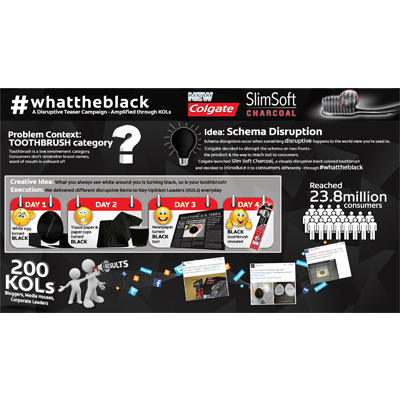
    The #whattheblack campaign, launched a few days before the announcement, was a unique approach to bring alive a category that often witnesses feature related communication. Going beyond traditional marketing techniques, through this campaign Colgate reached out to netizens for building advocacy. “For the first time the digital medium was innovatively used to launch a new product – through teasers, user generated content, creating conversations,” says the Colgate spokesperson.


    The campaign was conceptualised by Red Fuse Communications, WPP’s full-service integrated global agency dedicated to serving all of Colgate-Palmolive’s brands worldwide, and was executed by Candid Marketing.


    The insight which went into it was that toothbrush has traditionally been a low involvement category. Consumers don’t think or talk about it to others and the concept of word-of-mouth publicity has been non-existential in this category. However, with the launch of the new Colgate Slim Soft Charcoal toothbrush, unique opportunities have opened up, feels the brand and the agency.


    Black bristles in a category associated with white bristles is highly disruptive and this presented Colgate with an opportunity of creating brand visibility and advocacy through disruptive communication techniques. “To bring this alive, the approach was to generate curiosity and intrigue amongst the key opinion leaders. The objective of the campaign was to create schema disruption, leveraging the colour black. This was achieved by turning every day white items – such as eggs, newspapers, tissues – into black,” highlights the spokesperson while adding that the items were sent out on different days to media and key opinion leaders such as marketing professionals and bloggers across key metros without any mention of Colgate or the toothbrush. On the last day, the brand was revealed elaborating that the personal toothbrush has now turned black as well.


    All the campaign elements were tagged with the hashtag #whattheblack to further amplify visibility on digital platforms such as Facebook, Twitter and blogs. The campaign moniker #whattheblack through the digital platforms further assisted in developing user generated content.


    The campaign that was initially targeted towards 200 opinion leaders got amplified to 23.8 million consumers, a never before witnessed in this category.