
Tag: social media

  • When stars collide: Karan Johar and R Balki on Goafest day 2

    When stars collide: Karan Johar and R Balki on Goafest day 2

    MUMBAI: Post lunch sessions are always a challenge at any event: between people busy with their extended luncheons, grouping to go on smoke breaks, and fighting the urge for a siesta and so the house is often checkered with empty seats.

    But Goafest presented a completely different picture on its second day with a packed house eagerly waiting for the afternoon knowledge summit to start. This was no surprise, as two of the biggest stars in advertising and film fraternity were the speakers and so when they took the stage, the audience welcomed the speakers with thunderous applause. It was hard to decide who got the loudest cheer — Karan Johar or R. Balki.

    ‘Won’t make an ad film’
    The conversation kicked off with the two giving their take on what connects the two industries represented. “I just know that advertising pays a lot of money to the actors and celebrities, making it easier and cheaper for us to cast them in interesting films,” joked the sharp Johar, before going on to share his utter displeasure when his shoots are moved thanks to an actor’s endorsement schedule.            

    Johar was also quick to say how money was still flowing strongly in advertisements, while ‘god knows that our (film) footfalls are falling.”

    If that is so, would Johar like to make an ad film himself? “Nope” came his quick and precise answer. His reason? When at one time he was asked to shoot an ad film for Shah Rukh Khan, Johar was subjected to the infamous PPM or Pre Product Meeting. That didn’t go down well, and since then he hasn’t dared to shoot another as film, chuckled Johar.

     ‘Digital”: a word that floats with few understanding it

    Given the chance, would Balki consider making a film on the digital platform? “Certainly. Why not? It isn’t much of a question of what medium but more of a content issue. If there is a story which needs to be told, it wouldn’t matter if it’s in the digital platform. Budget is a deciding factor as well depending on the kind of story one is telling and treatment they want to give it.”

    Johar said that ‘digital’ was one word floating about in his industry without a shred of comprehension of the medium meant to the industry. “I believe there is a tremendous potential in the medium, but right now, people are simply throwing the word around without actually understanding it.”

    Which is a serious threat to the industry, both the speakers agreed. Johar went on to add, “Footfalls have reduced by 10 to 12 per cent this year. There are multiple alternative mediums of entertainment for the audience. If filmmakers do not push up their content ante, and don’t empower the writers well, the industry will soon see its death.”

    ‘How we market films is all wrong’:

    A knowledge summit at Goafest is incomplete without a direct advertising and marketing question, and so Balki popped the question to Johar: Why has the film fraternity not approached the advertisers or vice versa to market their films better? Is what being done currently working for them?

    “If the amount of talent in Indian advertising in this very room could sell soaps well, or another product, they could do far more for the films. Why don’t we see more collaboration between the industries?”

    “As much as I love my industry, and how solid it is, we are a very big victim of the herd mentality,” confessed Johar. “Currently what you see us doing to promote a film has perhaps been done by one person and the rest followed. No one really sat and strategized what will work or not. There is no science to it and perhaps we need it. Maybe we should get some help to do some actual market research. Right now, we have these promotions and launch events where actors and actresses turn up wearing designer clothes, and only fashion sites are having fun. Is it helping consumers to come and buy a ticket and watch the film? I am not sure at all. This entire bubble is going to burst. Over Marketing of a film can sometimes kill the product. We need to change the way we market films because right now we are doing it all wrong.”

    ‘It’s a myth that products pay a lot to be in the films’

    When quizzed about product placement in films, Balki started off with clarifying misconceptions about this. “There is a science to it. You can’t just randomly place a product in a film just because a brand has paid you money. First of all, it’s a myth that products pay a lot to be in a film. All they help is may be in promoting the film. They do not help in making the film.”

    Balki continues, “product placement works when it is part of a given scene, not randomly posed there. People are getting clever, and clients are also getting smart and not wanting that kind of product placement. Brands and directors are realising that it is when s product is integrated into the storyline and has a real role to play in the story or a particular scene that the product gets the right mileage.”

    On being on the Social media, the necessary evil

    Celebrities, mostly in the film industry, love to hear about themselves and in this era of social media everyone has an opinion.

    The speakers were asked their take on free speech on social media. Johar said. “I confess I love hearing about, reading about myself. Be it good bad or ugly I need to know what people are talking about me. I don’t believe one can be like ‘I do not care’, in today’s world. One cannot be indifferent to the reality of our times. That’s what keeps you grounded. I think the social media is a good reality check for us celebrities. You can’t beat them, so you must join them. I am on all major social media platforms and very active online. I don’t need PR to write my twitter, it’s all me.”

    Balki had a dramatically opposite take on the subject. Taking a cue from Johar’s answer, Balki added, “I am deluded enough to think I am the worst. I do not people to tell me that, nor do I want people to tell me how good I am. I do not feel the need to listen to it. I find it tiring. I am not in it for the practically.”

    Parting shots

    While the entire session gave enough fodder to fill several online ‘powerful quotes’ sites, there were a few takeaways: Johar’s honest and straightforward acknowledgement that he is through and through ‘an unapologetic Hindi filmmaker’ and that he had no plans to make films in Hollywood.

    And Balki’s explanation of how people tend to judge creativity – on films or in advertisements: “We have defined patterns of creativity. We think good must be like this. We have a picture to what good should be and when we see something violently breaking that, the first reaction is to feel uncomfortable. Because people don’t care about innovation, they are simply looking for relativity. Pain is the biggest risk in taking the risk. It is a pain everyone who breaks a mould will live with for quite some time.”

  • When stars collide: Karan Johar and R Balki on Goafest day 2

    When stars collide: Karan Johar and R Balki on Goafest day 2

    MUMBAI: Post lunch sessions are always a challenge at any event: between people busy with their extended luncheons, grouping to go on smoke breaks, and fighting the urge for a siesta and so the house is often checkered with empty seats.

    But Goafest presented a completely different picture on its second day with a packed house eagerly waiting for the afternoon knowledge summit to start. This was no surprise, as two of the biggest stars in advertising and film fraternity were the speakers and so when they took the stage, the audience welcomed the speakers with thunderous applause. It was hard to decide who got the loudest cheer — Karan Johar or R. Balki.

    ‘Won’t make an ad film’
    The conversation kicked off with the two giving their take on what connects the two industries represented. “I just know that advertising pays a lot of money to the actors and celebrities, making it easier and cheaper for us to cast them in interesting films,” joked the sharp Johar, before going on to share his utter displeasure when his shoots are moved thanks to an actor’s endorsement schedule.            

    Johar was also quick to say how money was still flowing strongly in advertisements, while ‘god knows that our (film) footfalls are falling.”

    If that is so, would Johar like to make an ad film himself? “Nope” came his quick and precise answer. His reason? When at one time he was asked to shoot an ad film for Shah Rukh Khan, Johar was subjected to the infamous PPM or Pre Product Meeting. That didn’t go down well, and since then he hasn’t dared to shoot another as film, chuckled Johar.

     ‘Digital”: a word that floats with few understanding it

    Given the chance, would Balki consider making a film on the digital platform? “Certainly. Why not? It isn’t much of a question of what medium but more of a content issue. If there is a story which needs to be told, it wouldn’t matter if it’s in the digital platform. Budget is a deciding factor as well depending on the kind of story one is telling and treatment they want to give it.”

    Johar said that ‘digital’ was one word floating about in his industry without a shred of comprehension of the medium meant to the industry. “I believe there is a tremendous potential in the medium, but right now, people are simply throwing the word around without actually understanding it.”

    Which is a serious threat to the industry, both the speakers agreed. Johar went on to add, “Footfalls have reduced by 10 to 12 per cent this year. There are multiple alternative mediums of entertainment for the audience. If filmmakers do not push up their content ante, and don’t empower the writers well, the industry will soon see its death.”

    ‘How we market films is all wrong’:

    A knowledge summit at Goafest is incomplete without a direct advertising and marketing question, and so Balki popped the question to Johar: Why has the film fraternity not approached the advertisers or vice versa to market their films better? Is what being done currently working for them?

    “If the amount of talent in Indian advertising in this very room could sell soaps well, or another product, they could do far more for the films. Why don’t we see more collaboration between the industries?”

    “As much as I love my industry, and how solid it is, we are a very big victim of the herd mentality,” confessed Johar. “Currently what you see us doing to promote a film has perhaps been done by one person and the rest followed. No one really sat and strategized what will work or not. There is no science to it and perhaps we need it. Maybe we should get some help to do some actual market research. Right now, we have these promotions and launch events where actors and actresses turn up wearing designer clothes, and only fashion sites are having fun. Is it helping consumers to come and buy a ticket and watch the film? I am not sure at all. This entire bubble is going to burst. Over Marketing of a film can sometimes kill the product. We need to change the way we market films because right now we are doing it all wrong.”

    ‘It’s a myth that products pay a lot to be in the films’

    When quizzed about product placement in films, Balki started off with clarifying misconceptions about this. “There is a science to it. You can’t just randomly place a product in a film just because a brand has paid you money. First of all, it’s a myth that products pay a lot to be in a film. All they help is may be in promoting the film. They do not help in making the film.”

    Balki continues, “product placement works when it is part of a given scene, not randomly posed there. People are getting clever, and clients are also getting smart and not wanting that kind of product placement. Brands and directors are realising that it is when s product is integrated into the storyline and has a real role to play in the story or a particular scene that the product gets the right mileage.”

    On being on the Social media, the necessary evil

    Celebrities, mostly in the film industry, love to hear about themselves and in this era of social media everyone has an opinion.

    The speakers were asked their take on free speech on social media. Johar said. “I confess I love hearing about, reading about myself. Be it good bad or ugly I need to know what people are talking about me. I don’t believe one can be like ‘I do not care’, in today’s world. One cannot be indifferent to the reality of our times. That’s what keeps you grounded. I think the social media is a good reality check for us celebrities. You can’t beat them, so you must join them. I am on all major social media platforms and very active online. I don’t need PR to write my twitter, it’s all me.”

    Balki had a dramatically opposite take on the subject. Taking a cue from Johar’s answer, Balki added, “I am deluded enough to think I am the worst. I do not people to tell me that, nor do I want people to tell me how good I am. I do not feel the need to listen to it. I find it tiring. I am not in it for the practically.”

    Parting shots

    While the entire session gave enough fodder to fill several online ‘powerful quotes’ sites, there were a few takeaways: Johar’s honest and straightforward acknowledgement that he is through and through ‘an unapologetic Hindi filmmaker’ and that he had no plans to make films in Hollywood.

    And Balki’s explanation of how people tend to judge creativity – on films or in advertisements: “We have defined patterns of creativity. We think good must be like this. We have a picture to what good should be and when we see something violently breaking that, the first reaction is to feel uncomfortable. Because people don’t care about innovation, they are simply looking for relativity. Pain is the biggest risk in taking the risk. It is a pain everyone who breaks a mould will live with for quite some time.”
  • Brand management through video marketing  campaign for Woohoo

    Brand management through video marketing campaign for Woohoo

    BENGALURU: In today’s day and age, the video is the new fuel that brands are filling up on as they gear up for the race for engagement on social media. As video consumption across multiple platforms is on the rise, videos become the natural choice for marketers seeking to position their brands and capture the attention of consumers. An often quoted statistic is that viewer engagement has to happen within thefirst 10 seconds of watching a video.

    Woohoo- go-to-platform for gifting by Qwikcilver solutions, recently engaged with consumers to ask them: ‘What would really make them happy?’ in the context of gifting. This was done through a recently launched video https://youtu.be/-C5Oszqz2fA

    The campaign talks about how ‘We think we know everything about our loved ones. But do we really?

    A selection of different pairs of people that include siblings, mother-daughter and married couples were put through a small test. As part of the test, they were asked a simple question on what they would gift their loved ones to make themtruly happy. An interesting observation that was noted at the end of the video was that the majority of people did not know what their loved ones actually wanted as a gift.

    Woohoo presented the solution to this problem in the form of a  small gift box in front of the participants, which comprised a mobile phone with the Woohoo app downloaded and a Woohoo gift card. This is the simplest and the most powerful way to gift someone we love, the freedom of choice from a world of brands, services and experiences.

  • Brand management through video marketing  campaign for Woohoo

    Brand management through video marketing campaign for Woohoo

    BENGALURU: In today’s day and age, the video is the new fuel that brands are filling up on as they gear up for the race for engagement on social media. As video consumption across multiple platforms is on the rise, videos become the natural choice for marketers seeking to position their brands and capture the attention of consumers. An often quoted statistic is that viewer engagement has to happen within thefirst 10 seconds of watching a video.

    Woohoo- go-to-platform for gifting by Qwikcilver solutions, recently engaged with consumers to ask them: ‘What would really make them happy?’ in the context of gifting. This was done through a recently launched video https://youtu.be/-C5Oszqz2fA

    The campaign talks about how ‘We think we know everything about our loved ones. But do we really?

    A selection of different pairs of people that include siblings, mother-daughter and married couples were put through a small test. As part of the test, they were asked a simple question on what they would gift their loved ones to make themtruly happy. An interesting observation that was noted at the end of the video was that the majority of people did not know what their loved ones actually wanted as a gift.

    Woohoo presented the solution to this problem in the form of a  small gift box in front of the participants, which comprised a mobile phone with the Woohoo app downloaded and a Woohoo gift card. This is the simplest and the most powerful way to gift someone we love, the freedom of choice from a world of brands, services and experiences.

  • Sony Pix to air Notty Pixy

    Sony Pix to air Notty Pixy

    MUMBAI: Are you up-to-date on Hollywood’s breaking news? From behind the scenes of latest Hollywood movies to who will be the next superhero, get to know all the breaking news from the tinsel town of Hollywood with Notty Pixy on Sony Pix starting from 10 March 2016.

    On receiving a phenomenal response from fanson social media, Sony PIX takes this property to a next level by launching Notty Pixy for the very first time on Indian television. To enthrall viewers across the country,Notty Pixy will break the latest Hollywood news first in India. Catch her latest promo on Sony Pix which will be straight out of H-Town. 

    Through Notty Pixy, viewers will get a chance to know what’s hot in Hollywood sitting on their couch watching their favorite movies on Sony PIX. In order to amaze the fans and viewers of Sony PIX, Notty Pixy will dish up the juiciest celebrity news on all your favorite stars. 
     
    Sony PIX has always gone that extra mile to bring the Hollywood connect to India for their fans and viewers. Be it through customized video bytes given by Hollywood stars like Emma Stone, Will Smith or in-movie memorabilia straight from Hollywood movies like Captain Phillips, Equalizerand White House Down. Now with Notty Pixy on-air, Sony PIX will bring Hollywood magic to India right when it happens in LA.

  • Sony Pix to air Notty Pixy

    Sony Pix to air Notty Pixy

    MUMBAI: Are you up-to-date on Hollywood’s breaking news? From behind the scenes of latest Hollywood movies to who will be the next superhero, get to know all the breaking news from the tinsel town of Hollywood with Notty Pixy on Sony Pix starting from 10 March 2016.

    On receiving a phenomenal response from fanson social media, Sony PIX takes this property to a next level by launching Notty Pixy for the very first time on Indian television. To enthrall viewers across the country,Notty Pixy will break the latest Hollywood news first in India. Catch her latest promo on Sony Pix which will be straight out of H-Town. 

    Through Notty Pixy, viewers will get a chance to know what’s hot in Hollywood sitting on their couch watching their favorite movies on Sony PIX. In order to amaze the fans and viewers of Sony PIX, Notty Pixy will dish up the juiciest celebrity news on all your favorite stars. 
     
    Sony PIX has always gone that extra mile to bring the Hollywood connect to India for their fans and viewers. Be it through customized video bytes given by Hollywood stars like Emma Stone, Will Smith or in-movie memorabilia straight from Hollywood movies like Captain Phillips, Equalizerand White House Down. Now with Notty Pixy on-air, Sony PIX will bring Hollywood magic to India right when it happens in LA.

  • Digi Osmosis unique campaign for ‘Ki & Ka’

    Digi Osmosis unique campaign for ‘Ki & Ka’

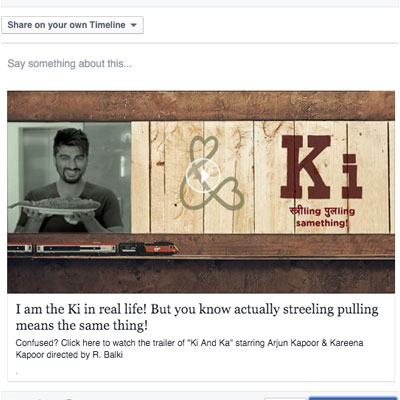
    MUMBAI: Digi Osmosis has crafted a unique campaign for R Balki’s latest production Ki &Ka from the T-Series Films stable by creating a special app for the Ki & Ka facebook page. Once the viewer has watched the trailer on Facebook, a question pops up asking the viewer ‘Who are you in your life, Ki or Ka?’. It further asks  viewers if they are the independent, career-oriented, outspoken Ki or the homely, loving and caring Ka. 

    After the viewer answers and clicks the share button, the trailer is shared on the user’s timeline on Facebook with another caption – ‘I’m Ka in real life but you know, ??????ling (Feminine) and ???ling (Masculine) means the same thing!’

    Commenting on the campaign Digi Osmosis founder Manish Kumar said, “For this trailer, the strategy was simple; there are thousands of people who identify with Ki&Ka on a very personal level. They will find it to be a very interesting activity and in turn share it with their friends. Their friends in turn, find it a quirky and engage with the trailer, repeating the process. This encourages share-ability, a factor crucial for social media and creates a simple viral chain garnering the reactions required. ”

    Ki & Ka director and producer R Balki mentioned that “It has been a terrific learning experience for me working with the Digi Osmosis team. I gave them the trailer of Ki & Ka and they just had a few hours to convert it into an active engagement piece rather than a passive experience. They developed an app embedded in the trailer to make the viewer see herself/ himself as the characters in the story and respond. Simple. Innovative. And really on the ball.”

  • Digi Osmosis unique campaign for ‘Ki & Ka’

    Digi Osmosis unique campaign for ‘Ki & Ka’

    MUMBAI: Digi Osmosis has crafted a unique campaign for R Balki’s latest production Ki &Ka from the T-Series Films stable by creating a special app for the Ki & Ka facebook page. Once the viewer has watched the trailer on Facebook, a question pops up asking the viewer ‘Who are you in your life, Ki or Ka?’. It further asks  viewers if they are the independent, career-oriented, outspoken Ki or the homely, loving and caring Ka. 

    After the viewer answers and clicks the share button, the trailer is shared on the user’s timeline on Facebook with another caption – ‘I’m Ka in real life but you know, ??????ling (Feminine) and ???ling (Masculine) means the same thing!’

    Commenting on the campaign Digi Osmosis founder Manish Kumar said, “For this trailer, the strategy was simple; there are thousands of people who identify with Ki&Ka on a very personal level. They will find it to be a very interesting activity and in turn share it with their friends. Their friends in turn, find it a quirky and engage with the trailer, repeating the process. This encourages share-ability, a factor crucial for social media and creates a simple viral chain garnering the reactions required. ”

    Ki & Ka director and producer R Balki mentioned that “It has been a terrific learning experience for me working with the Digi Osmosis team. I gave them the trailer of Ki & Ka and they just had a few hours to convert it into an active engagement piece rather than a passive experience. They developed an app embedded in the trailer to make the viewer see herself/ himself as the characters in the story and respond. Simple. Innovative. And really on the ball.”

  • What content marketers should keep in mind in 2016

    What content marketers should keep in mind in 2016

    GroupM’s This Year Next Year report 2016 has projected that Digital Ad Ex will grow by 47.5 per cent in 2016. It has also strongly hinted at an upcoming trend where brands will get into movie and content production.

    With disruption being the name of the game, traditional avenues of content marketing, yes, this breed of marketing did exist before the digital era, has gone through a major overhaul and marketers are already seeing some new trends emerging.

    With a billion mobile phone connections and counting, bandwidth for internet consumption is soon to grow manifold, thanks to improved telecom infrastructure and 4G hitting urban and semi-urban markets. Advertisers well aware of this rapidly changing ecosystem must evolve, must adapt or perish. Hence, content marketing keeping the digital world in mind is advisable.

    Industry experts share their inputs with www.indiantelevision.com about some factors that content marketers should keep in mind for 2016.

    Know thy social media:

    Stay ahead of the curve, it’s important to understand the digital eco-system well, including devices that make way for content marketing and the social media. “I feel a whole new generation is coming on to the mobile internet for the first time in India. Not just Delhi-Mumbai-Hyderabad-Bangalore, but also in the tier II cities like Jaipur, Kanpur and Allahabad,” says popular travel itinerary website Ixigo.com’s content marketing head Ashish Chopra.

    “The moms and dads are coming online. They aren’t necessarily tech savvy on desktops but they are pretty active on mobile social media like WhatsApp and Facebook. The fact that more and more people are spending longer hours on the internet is important for a content marketer like me. It has become necessary that we keep mobile sensitivity when we create videos,” he adds.

    To further substantiate his argument, Chopra proposes to make the content native to the user’s experience. “For example, if you copy and paste a YouTube video link on Facebook, it doesn’t get enough views. Two years ago, we launched a video and posted its YouTube link on Facebook.  It got around 300 views,” Chopra recalls from his personal experience. “The next day we uploaded it on Facebook as a native video and got 50,000 views on day one. So Facebook is killing the game right now. It wants good content, wants people to stick around longer on the platform. Content marketers must understand and capitalise on this, and see if it can be turned into a win-win for both the stakeholders,” he adds further.

    Know thy consumer better:

    With the nationwide penetration of internet in the rural and semi-urban markets, and advertisers taking increased interest in them to grow their markets, marketers are often heard asking if the strategy they have in place for their urban consumers will also work in these newer markets.

    The looming question is whether content popular in metros and other urban market will resonate in the newer markets or ifmarketers need to have a different strategy for these.

    “I look at content in a different light,” Chopra shares. “For every brand that invests in content marketing it’s the consumer who decides what the flavour of the content will be. ixigo has many users who travel by train. So we focus on those people.”

    What is important is that content marketers ask themselves if what they are creating is useful for their target audience, irrespective of the sensibility of urban, rural, tier I or tier II cities. “If it’s useful he or she is most likely to share it. One should keep an eye on topical content and inspirational stories that might relate to the audience. Then, with an insight into the lives of the consumers, come up with little things that touch their daily lives,” Chopra adds.

    Be a storyteller, not advertiser:

    Recognising the power of digital media and content to move  consumers, several brands are powering their marketing arms to become storytellers as well — either through brand integration or through partnerships with content creators (branded content).

    United Beverages’ alcohol-beverage brand Kingfisher is a fine example of a forward-looking brand that has done exceptionally well in tapping this potential.

    “At the end of the day YouTube has a viewership of 75 million of our target group and is the fifth largest video channel so to speak. Only a few television channels are larger than it. One has to start looking at YouTube as mainstream media as well,” says United Beverages Limited, marketing SVP Samar Singh Sheikhawat, talking about content marketing and digital marketing in general.

    With branded content being the buzzword, one mustn’t confuse it with ads. “People have little patience for advertisements.”

    “Earlier, say when there was only Doordarshan, people didn’t have a choice but to sit through them. After multiple channels came in, people had a remote control in their hands, and would mostly switch channels to avoid ads,” says Chopra.

    “For the current, digital generation, when an ad comes on YouTube or Facebook, viewers have 10 tabs open. So we can’t make ‘ads’ for this generation. It has to be authentic content of real value to them, solves a problem, fascinates or is topical. And there has to be entertainment of some sort. Period,” Chopra firmly asserts.

    And that is exactly what Kingfisher has done with the web-series Pitchers in partnership with The Viral Fever. “Kingfisher has already heavily and successfully invested in content marketing on the digital platform, their single most outstanding success being TVF’s Pitchers.

    It was produced by TVF and funded by us, and after the success of its season one, we have decided to be part of season 2 this year. Kingfisher has been woven into the story and the views you see are organic. We are not claiming credits or marketing it,” shares Sheikhawat, admitting that the brand is looking to invest in several similar initiatives. “We have received feelers from the likes of Ronnie Screwvala’s Arre, YRf’s new digital arm. So we are currently evaluating creating more content like pitchers,” Sheikhawat adds.

    Be patient, it works:

    The 120 Media Collective founder-CEO Roopak Saluja defines content marketing simply: “If advertising is telling the world you are a rock star, content marketing is showing you are one.”

    In the current eco-system, Saluja observes that advertisers lack patience with content marketing and aim for an immediate result. According to his market observations, “Though wisdom remains in investing in a sustainable content property, for the most part, brands and advertisers investing in content marketing are not looking into larger properties.”

    “From what the market looks like in early 2016, there will be brands that will be dipping their toes into content market to try it out. Rather than making a big investment, they might want to experiment at a small scale as an entry point into the field,” he elaborates. In other words, the adoption of the medium might be low intensity and not immediate.

    In agreement with his peers, Saluja reiterates that the current trend of content marketing is based on the rapid growth of video content digital available. ”Whether its small video content or a large property, the way ahead is definitely video-driven.”

    In content marketing, advertisers really see results in sustained strategy over getting content as a standalone initiative. Therefore advertisers making one-time small investments might not see the promised result from the medium and might go back to the traditional medium. This could be counterproductive for the medium. “It’s hard to say how it will affect the medium currently. Whether it’s five or 16 years later, traditional media will be deemed inefficient and all advertisers must be on board the content and digital bandwagon,” Saluja speculates.

    When it comes to effectiveness, Sheikhawat, a pioneer in content marketing, agrees that it is too soon to talk of efficacy as more often than not brands are aiming at credibility and loyalty than at direct effect on sales.

    Keeping Pitchers in mind Sheikhawat shares his experience on accountability of content marketing. “It is hard to tell in only one season, but it did get listed at position 21 on IMDB, rated next to shows like Game Of Thrones. It got over 10 million views for the five-episode web series. The target is to take it to 4 to 5 million unique viewers. That’s a significant number, larger than many television channels in this country. Apart from viewership, it comes with credibility, which is organically built with this digital-savvy generation, the future consumer base for us. We will continue this for a couple of more seasons. Then we will be in a better position to evaluate.”

    While the budget for content market is comparatively small for Kingfisher at the moment, it will only increase, says Sheikhawat. “Typically, digital advertising is 20 per cent of our marketing budget, out of which content creation will be close to half.”

    The industry is also discussing if an episodic way of introducing a marketing campaign to viewers and consumers can also be a way to keep them loyal to and interested in the brand. While many are concerned that episodic branded content requires longer commitment, they are willing to place their bets on it.

  • What content marketers should keep in mind in 2016

    What content marketers should keep in mind in 2016

    GroupM’s This Year Next Year report 2016 has projected that Digital Ad Ex will grow by 47.5 per cent in 2016. It has also strongly hinted at an upcoming trend where brands will get into movie and content production.

    With disruption being the name of the game, traditional avenues of content marketing, yes, this breed of marketing did exist before the digital era, has gone through a major overhaul and marketers are already seeing some new trends emerging.

    With a billion mobile phone connections and counting, bandwidth for internet consumption is soon to grow manifold, thanks to improved telecom infrastructure and 4G hitting urban and semi-urban markets. Advertisers well aware of this rapidly changing ecosystem must evolve, must adapt or perish. Hence, content marketing keeping the digital world in mind is advisable.

    Industry experts share their inputs with www.indiantelevision.com about some factors that content marketers should keep in mind for 2016.

    Know thy social media:

    Stay ahead of the curve, it’s important to understand the digital eco-system well, including devices that make way for content marketing and the social media. “I feel a whole new generation is coming on to the mobile internet for the first time in India. Not just Delhi-Mumbai-Hyderabad-Bangalore, but also in the tier II cities like Jaipur, Kanpur and Allahabad,” says popular travel itinerary website Ixigo.com’s content marketing head Ashish Chopra.

    “The moms and dads are coming online. They aren’t necessarily tech savvy on desktops but they are pretty active on mobile social media like WhatsApp and Facebook. The fact that more and more people are spending longer hours on the internet is important for a content marketer like me. It has become necessary that we keep mobile sensitivity when we create videos,” he adds.

    To further substantiate his argument, Chopra proposes to make the content native to the user’s experience. “For example, if you copy and paste a YouTube video link on Facebook, it doesn’t get enough views. Two years ago, we launched a video and posted its YouTube link on Facebook.  It got around 300 views,” Chopra recalls from his personal experience. “The next day we uploaded it on Facebook as a native video and got 50,000 views on day one. So Facebook is killing the game right now. It wants good content, wants people to stick around longer on the platform. Content marketers must understand and capitalise on this, and see if it can be turned into a win-win for both the stakeholders,” he adds further.

    Know thy consumer better:

    With the nationwide penetration of internet in the rural and semi-urban markets, and advertisers taking increased interest in them to grow their markets, marketers are often heard asking if the strategy they have in place for their urban consumers will also work in these newer markets.

    The looming question is whether content popular in metros and other urban market will resonate in the newer markets or ifmarketers need to have a different strategy for these.

    “I look at content in a different light,” Chopra shares. “For every brand that invests in content marketing it’s the consumer who decides what the flavour of the content will be. ixigo has many users who travel by train. So we focus on those people.”

    What is important is that content marketers ask themselves if what they are creating is useful for their target audience, irrespective of the sensibility of urban, rural, tier I or tier II cities. “If it’s useful he or she is most likely to share it. One should keep an eye on topical content and inspirational stories that might relate to the audience. Then, with an insight into the lives of the consumers, come up with little things that touch their daily lives,” Chopra adds.

    Be a storyteller, not advertiser:

    Recognising the power of digital media and content to move  consumers, several brands are powering their marketing arms to become storytellers as well — either through brand integration or through partnerships with content creators (branded content).

    United Beverages’ alcohol-beverage brand Kingfisher is a fine example of a forward-looking brand that has done exceptionally well in tapping this potential.

    “At the end of the day YouTube has a viewership of 75 million of our target group and is the fifth largest video channel so to speak. Only a few television channels are larger than it. One has to start looking at YouTube as mainstream media as well,” says United Beverages Limited, marketing SVP Samar Singh Sheikhawat, talking about content marketing and digital marketing in general.

    With branded content being the buzzword, one mustn’t confuse it with ads. “People have little patience for advertisements.”

    “Earlier, say when there was only Doordarshan, people didn’t have a choice but to sit through them. After multiple channels came in, people had a remote control in their hands, and would mostly switch channels to avoid ads,” says Chopra.

    “For the current, digital generation, when an ad comes on YouTube or Facebook, viewers have 10 tabs open. So we can’t make ‘ads’ for this generation. It has to be authentic content of real value to them, solves a problem, fascinates or is topical. And there has to be entertainment of some sort. Period,” Chopra firmly asserts.

    And that is exactly what Kingfisher has done with the web-series Pitchers in partnership with The Viral Fever. “Kingfisher has already heavily and successfully invested in content marketing on the digital platform, their single most outstanding success being TVF’s Pitchers.

    It was produced by TVF and funded by us, and after the success of its season one, we have decided to be part of season 2 this year. Kingfisher has been woven into the story and the views you see are organic. We are not claiming credits or marketing it,” shares Sheikhawat, admitting that the brand is looking to invest in several similar initiatives. “We have received feelers from the likes of Ronnie Screwvala’s Arre, YRf’s new digital arm. So we are currently evaluating creating more content like pitchers,” Sheikhawat adds.

    Be patient, it works:

    The 120 Media Collective founder-CEO Roopak Saluja defines content marketing simply: “If advertising is telling the world you are a rock star, content marketing is showing you are one.”

    In the current eco-system, Saluja observes that advertisers lack patience with content marketing and aim for an immediate result. According to his market observations, “Though wisdom remains in investing in a sustainable content property, for the most part, brands and advertisers investing in content marketing are not looking into larger properties.”

    “From what the market looks like in early 2016, there will be brands that will be dipping their toes into content market to try it out. Rather than making a big investment, they might want to experiment at a small scale as an entry point into the field,” he elaborates. In other words, the adoption of the medium might be low intensity and not immediate.

    In agreement with his peers, Saluja reiterates that the current trend of content marketing is based on the rapid growth of video content digital available. ”Whether its small video content or a large property, the way ahead is definitely video-driven.”

    In content marketing, advertisers really see results in sustained strategy over getting content as a standalone initiative. Therefore advertisers making one-time small investments might not see the promised result from the medium and might go back to the traditional medium. This could be counterproductive for the medium. “It’s hard to say how it will affect the medium currently. Whether it’s five or 16 years later, traditional media will be deemed inefficient and all advertisers must be on board the content and digital bandwagon,” Saluja speculates.

    When it comes to effectiveness, Sheikhawat, a pioneer in content marketing, agrees that it is too soon to talk of efficacy as more often than not brands are aiming at credibility and loyalty than at direct effect on sales.

    Keeping Pitchers in mind Sheikhawat shares his experience on accountability of content marketing. “It is hard to tell in only one season, but it did get listed at position 21 on IMDB, rated next to shows like Game Of Thrones. It got over 10 million views for the five-episode web series. The target is to take it to 4 to 5 million unique viewers. That’s a significant number, larger than many television channels in this country. Apart from viewership, it comes with credibility, which is organically built with this digital-savvy generation, the future consumer base for us. We will continue this for a couple of more seasons. Then we will be in a better position to evaluate.”

    While the budget for content market is comparatively small for Kingfisher at the moment, it will only increase, says Sheikhawat. “Typically, digital advertising is 20 per cent of our marketing budget, out of which content creation will be close to half.”

    The industry is also discussing if an episodic way of introducing a marketing campaign to viewers and consumers can also be a way to keep them loyal to and interested in the brand. While many are concerned that episodic branded content requires longer commitment, they are willing to place their bets on it.