Tag: social media

  • Brandie appoints Junaid Hakim as national director, India

    Brandie appoints Junaid Hakim as national director, India

    New Delhi: Social media word-of-mouth marketing platform, Brandie, has appointed Junaid Hakim as national director for India. He will be based in Bengaluru.

    Hakim joins from MediaCom, where he was the general manager and headed the media mandate for Dell till November, 2020. In his new role, he will oversee Brandie’s growth in the Indian market and develop stakeholder engagement, drive sales and new business development.

    “The Covid-19 pandemic has fundamentally impacted the marketing industry and highlighted the growing importance of word-of-mouth marketing and customer advocacy,” Brandie’s co-founder, Pranav Kosuri said. “Junaid’s vast experience, strategic perspective, and operational focus will play a vital role in strengthening Brandie’s core leadership team and ensure our continued fast growth and adoption amongst agencies and brands in one of our core markets.” 

    Talking about his new role, Hakim said, his focus in the first six months at the organization will be to drive awareness and education around Brandie, to boost product adoption. 

  • Twitter Blue: A subscription-led future of Twitter?

    Twitter Blue: A subscription-led future of Twitter?

    KOLKATA: Is Twitter gearing up to launch a subscription service? Yes, say reports. The microblogging site is considering the launch of Twitter Blue priced at $2.99 per month, according to an independent researcher.

    One of its most interesting features is “undo tweet” which could allow users to prevent a tweet from being sent. Users can even customise time intervals for undoing tweets. The subscription model also includes planned features that would help users to save and organise tweets into collections.

    The company has been gradually taking multiple steps in recent times to explore other revenue streams as its advertising-led model is facing several new challenges. For example, Apple’s recently launched App Tracking Transparency for all iPhones with iOS 14 forcing developers to ask users for permission before they can track them. Twitter is now asking users to give consent for tracking to ‘keep ads relevant’.

    Earlier this month, it acquired Scroll, a subscription service that removes ads from participating news sites. It “will become a meaningful addition to our subscription work as we build and shape a future subscription service on Twitter,” Twitter product vice president Mike Park wrote in a blog post after the acquisition.

    Twitter reported $1.04 billion in revenue for the first quarter of 2021, up 28 per cent year-on-year. It also posted a profit of $68 million, turning back its business from $8.4 million in losses a year ago. Advertising revenue totalled $899 million, an increase of 32 per cent and total ad engagements increased 11 per cent year-over-year. However, monetizable daily active users (mDAU) grew about 20 per cent to 199 million, falling slightly below the analysts’ expectation of 200 million

  • Twitter launches state-specific Covid updates to aid patients, families

    Twitter launches state-specific Covid updates to aid patients, families

    New Delhi: Microblogging platform Twitter has launched new state-specific Covid-19 pages in the country that surface the latest tweets from people asking for SOS resources, as well as those offering help.

    The social media giant currently has seven state-specific pages available in the places hardest hit by the lethal virus — Chhattisgarh, Delhi, Karnataka, Kerala, Madhya Pradesh, Maharashtra and Punjab. 

    “You will find bi-lingual tweets on these pages in both English and the official state language,” the company said in an update.

    Twitter said that it is partnering with news and media organisations as well as journalists across India to bring the latest, most credible news about Covid-19 to your timeline. It has also launched an interactive series called #AskTheDoctor in collaboration with the team of Editorji.

    National broadcaster Doordarshan also live-streams its daily show called #DoctorsSpeak on Twitter, where doctors answer frequently asked questions about Covid-19, including those via tweets using the hashtag.

    Developers in India are building creative tools and apps using the Twitter API to help people source information about medical services, oxygen, medicines, food, and more. 

    “We’ve been working closely with developers to ensure their services are able to have the widest impact, and reach the most people while operating in compliance with Twitter’s developer policies,” Twitter added.

    It went on to explain that these tools are built using the Twitter API and make use of Twitter’s Advanced Search functionality by providing easy-to-use filters that help people navigate tweets about Covid-19 in real-time by applying location filters or other search parameters.

  • No accounts will be deleted because of the new update, says WhatsApp

    No accounts will be deleted because of the new update, says WhatsApp

    New Delhi: Facebook owned instant messaging platform WhatsApp has clarified that it will not delete Indian user accounts that do not accept its new privacy policy.

    The app had earlier told users that if they do not accept the new update by 15 May, they would lose access to their accounts.

    “No accounts will be deleted on 15 May because of this update and no one in India will lose functionality of WhatsApp either. We will follow up with reminders to people over the next several weeks,” said the messenger in a statement.

    The controversial privacy policy was initially expected to come into effect on 8 February but was later deferred to 15 May amid severe backlash from users. The app plans to make it mandatory for users to agree to its new data-sharing norms, a key point of which is allegedly sharing data from WhatsApp business chats with third-party apps including its parent Facebook. 

    India is WhatsApp’s largest market with over 400 million subscribers.

    The messaging platform has previously tried to assure users that the privacy update – which is for users of its business services – does not compromise its end-to-end encryption.

    “We’ve spent the last few months working to clear up confusion and misinformation. As a reminder this update does not impact the privacy of personal messages for anyone,” WhatsApp said recently.

    Meanwhile, the Delhi high court has sought a response from the government as well as Facebook and WhatsApp on a petition that challenged the new policy. The court has issued notices to the Centre, Facebook and WhatsApp and sought their stand on the petition by 13 May – two days before the policy comes into effect.

    Earlier, the court had dismissed the plea filed by Facebook and WhatsApp challenging the Competition Commission of India (CCI) order directing a probe into its controversial new privacy policy. According to CCI, WhatsApp’s new privacy policy would lead to excessive data collection and “stalking” of consumers for targeted advertising to bring in more users and is therefore an alleged abuse of dominant position.

  • Concerns about fake news on the rise in India: Ormax report

    Concerns about fake news on the rise in India: Ormax report

    Mumbai: Two out of three news consumers consider fake news a major challenge facing the country’s news organisations, showed the latest report released by media consulting firm Ormax Media.

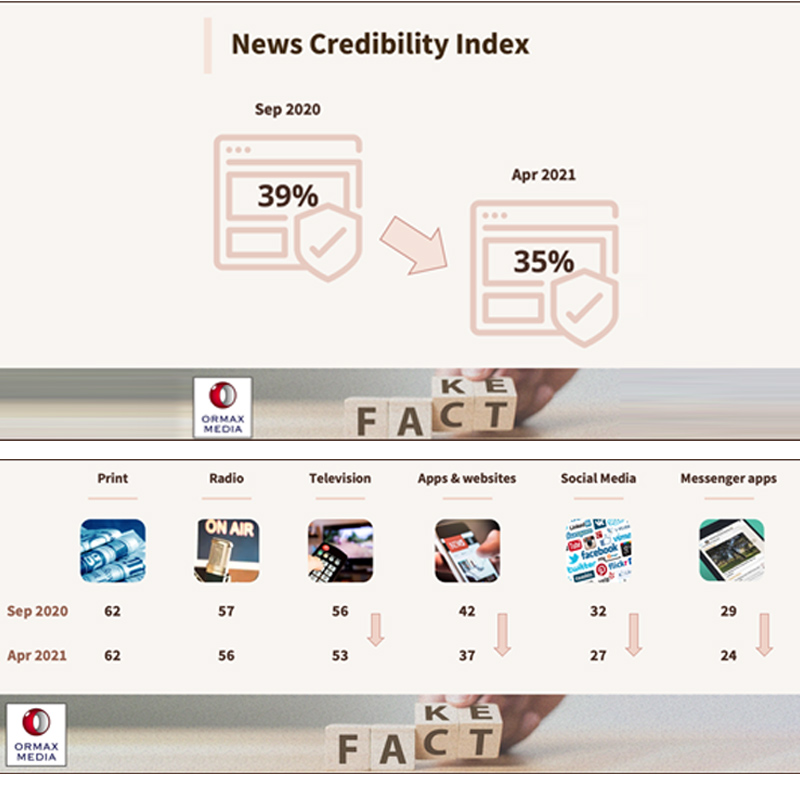
    According to the report Fact or Fake?, at least 65 per cent of the news consumers surveyed highlighted fake news as a major concern. The share of such individuals rose by four percentage points from last year, when the agency released the first edition of the report. Only 35 per cent news consumers feel that the news category in India doesn’t have any major fake news concerns, down from 39 per cent in September 2020.

    The findings are based on a survey of news consumers, which was conducted to measure the credibility of various news media, as well as their overall perception towards ‘fake news’. The survey covered around 1,000 urban news consumers (15+ years) from as many as 17 states and Union Territories in India. The questions were asked through computer-assisted telephonic interview.

    This is the second edition of the report, based on data collected in April 2021. The first edition was released on September 2020.

    According to the report, print media continued to lead in terms of credibility, as 62 per cent of news consumers generally considered the medium to be credible. Radio held on to the second position with 56 per cent consumers considering it as credible compared to 57 per cent in 2020. However, all other media platforms showed significant decline in credibility – television’s credibility index dropped from 56 per cent to 53 per cent and digital news apps and websites from 42 per cent to 37 per cent.

    The number of consumers (from the sample) who consider social media platforms to be credible also dropped from 32 per cent to 27 per cent and messenger apps from 29 per cent to 24 per cent. 

    Within social media, despite a drop since the last track, Twitter continues to rank on top with a news credibility Index of 47 per cent. No other social media or messenger app platform manages to touch even the 30 per cent mark, showed the survey.
     
    Ormax Media, founder and CEO Shailesh Kapoor said, “Concerns around fake news have been escalating worldwide over the last few years. But a drop from an already-low score of 39 per cent to 35 per cent within just seven months, does not augur well for the Indian news industry. In the midst of a pandemic, credibility of news becomes even more important. We hope to see television news and digital platforms address this concern more proactively, before it becomes a brand safety issue for advertisers using these media, and a cause for rejection for subscribers of paid news services”. 

    The report defines Media Credibility Index as a percentage of news consumers who find the news in a particular medium generally credible, respectively.

  • Koo’s ‘Talk to Type’ eases the way for regional language creators

    Koo’s ‘Talk to Type’ eases the way for regional language creators

    KOLKATA: Twitter’s Indian alternative Koo has rolled out the Talk to Type feature so anybody who wants to share their thoughts can now do so easily without having to type. They can speak their thoughts out loud and the words will show up on the screen. This feature will be supported in all the Indian languages Koo is currently available in.

    The Talk to Type feature will enable regional language creation in the easiest way possible for millions of Koo users. Many users who are uncomfortable using the keyboard will be enabled and empowered with such a feature, the company believes.

    “This “Talk to Type” feature takes creation for regional language creators to the next level. Users don’t have to use the keyboard anymore and type out lengthy thoughts. India language speakers can now speak their mind and the words will show up on the screen magically. For those who found it difficult to type in local languages, this feature removes all that pain. We will keep adding value to Indians by enabling the easiest localised forms of expression and present their thoughts to India in a seamless way,” Koo co-founder Aprameya Radhakrishna said.

    Co-founder Mayank Bidawatka claimed that Koo is the first social platform in the world to launch such a feature. “We are very excited to launch the “Talk to Type” feature that enables people to create without typing. All they have to do is hit a button and speak into their phone and the words will magically show up on the screen. It can’t get easier than this! You won’t find this on Facebook, Twitter or any other global platform.”

    Koo was founded in March 2020 as a micro-blogging platform in Indian languages. Available in multiple Indian languages, people from across different regions in India can express themselves in their mother tongue.

  • Facebook to launch vaccine finder tool on its mobile app

    Facebook to launch vaccine finder tool on its mobile app

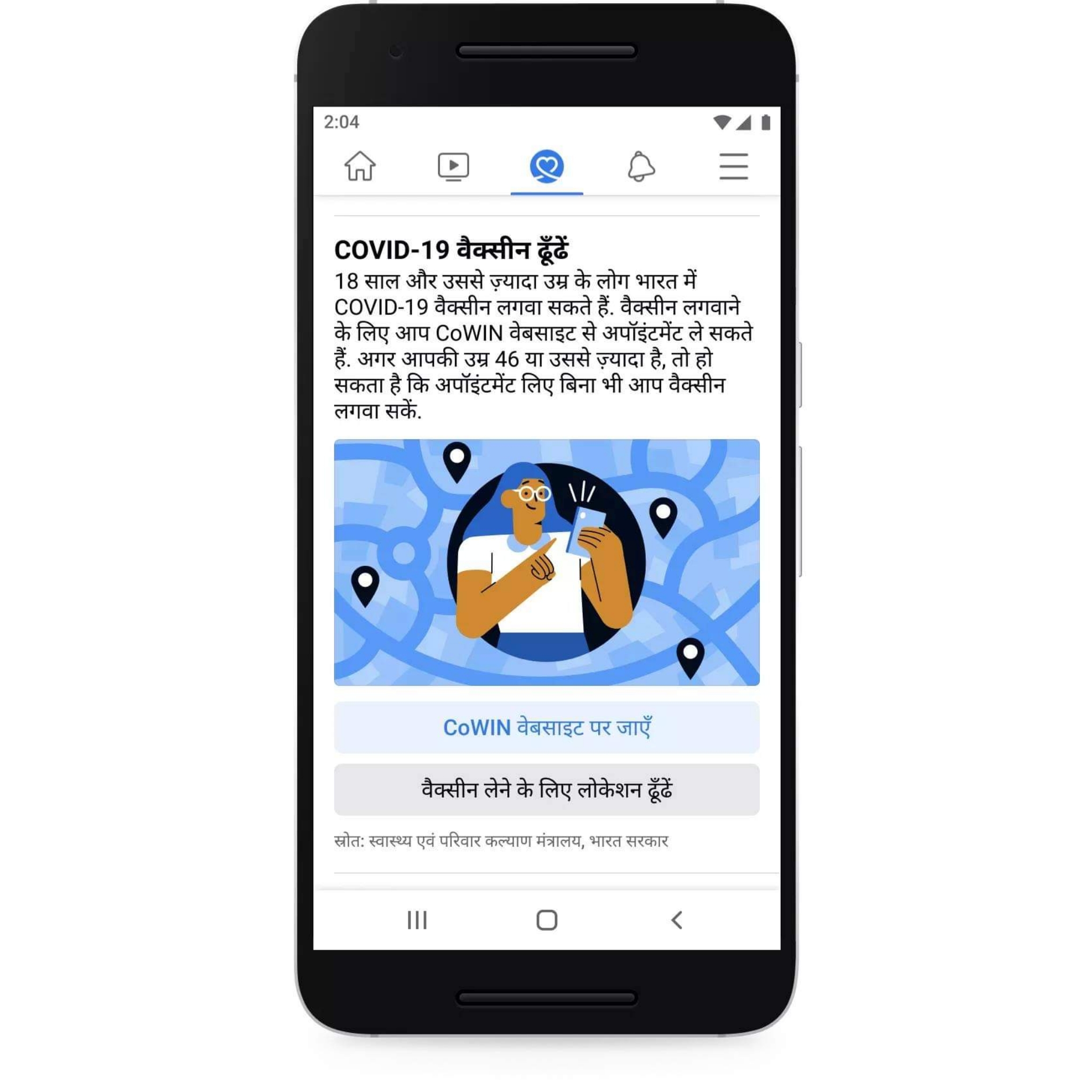
    New Delhi: Social media platform Facebook said it is partnering with the government to roll out a vaccine finder tool on its mobile app this week to help people identify nearby places to get inoculated. The announcement comes at a time when the country has begun the vaccination process for all citizens above 18 years.

    Earlier this week, the social media giant had announced a $10 million grant for emergency response efforts for the Covid2019 situation in India, which is grappling with a deadly second wave of Covid2019. “We are committed to doing our best to help the local communities in the country with medical supplies and other life-saving equipment,” it said in a public post on Friday.

    The tool will provide information in as many as 17 languages. The details of the vaccine center locations and their hours of operation have been provided by the ministry of health and family welfare (MoHFW).

    According to the government data, over 2.45 crore people have already registered on the Co-WIN app ahead of Phase-3 of the Covid2019 vaccination.

    In a post, Facebook said its tool will also show walk-in options for those aged above 45 years and a link to register on the Co-Win website and schedule vaccination appointments.

    “We are also partnering with organizations such as United Way, Swasth, Hemkunt Foundation, I Am Gurgaon, Project Mumbai, and US-India Strategic Partnership Forum (USISPF) to deploy the funds announced to help augment critical medical supplies with over 5,000 oxygen concentrators and other life-saving equipment like ventilators, BiPAP machines and to increase hospital bed capacity,” it stated.

    The platform said it is also providing health resources to people from UNICEF India about when to seek emergency care and how to manage mild symptoms at home. The information is accessible and prominent on Facebook’s COVID-19 Information Center and in Feed. It is also promoting this information on Instagram.

    Social media platforms like Facebook and Twitter have emerged as a lifeline, connecting those looking for oxygen cylinders, hospital beds, plasma donors, and ventilators with possible donors. Twitter too has set up a COVID-19 SOS page that helps surface information from those offering or seeking immediate help during this crisis.

    India is reeling under one of the most severe waves of Covid2019. The country reported a record 4 lakh new positive cases in the last 24 hours, its sharpest spike since the pandemic first gripped the country last year. 

  • Twitter’s monetisable daily active users grow 20% to 199 mn

    Twitter’s monetisable daily active users grow 20% to 199 mn

    KOLKATA: Microblogging site Twitter reported $1.04 billion revenue for the first quarter of 2021, up 28 per cent year-on-year. It also posted a profit of $68 million, turning back its business from $8.4 million in losses a year ago.

    Advertising revenue totaled $899 million, an increase of 32 per cent and total ad engagements increased 11 per cent year-over-year.

    “Q1 was a solid start to 2021, with total revenue of $1.04 billion up 28 per cent year-over-year, reflecting accelerating year-over-year growth in MAP (mobile application promotion) revenue and brand advertising that improved throughout the quarter,” Twitter CFO Ned Segal said.

    Despite its so-called “solid” performance, Twitter’s stock price dropped nine per cent after reporting Q1 earnings that only narrowly exceeded Wall Street estimates. Analysts had forecast the company would add eight million users during the quarter to surpass 200 million global users overall, as opposed to the one million daily users reported by the social platform.

    “Advertisers continue to benefit from updated ad formats, improved measurement, and new brand safety controls, contributing to 32 per cent year-over-year growth in ad revenue in Q1,” he added.

    The social media network’s monetisable daily active users (mDAU) grew about 20 per cent to 199 million, falling slightly below the analysts’ expectation of 200 million. Average US mDAU were 38 million for Q1, compared to 33 million in the same period of the previous year, and also bettering the count of 37 million in the previous quarter. On the other hand, international mDAU were 162 million for Q1, compared to 133 million in the same period of the previous year and against 155 million in the previous quarter.

    The company has guided total revenue to be between $980 million and $1.08 billion for Q2.

    “People turn to Twitter to see and talk about what’s happening, and we are helping them find their interests more quickly while making it easier to follow and participate in conversations,” Twitter CEO Jack Dorsey said.

    “Average monetisable DAU reached 199 million, up 20 per cent year over year and up seven million sequentially, driven by ongoing product improvements and global conversation around current events,” he noted.

    This quarter also marked Twitter’s first period mostly without the presence of former US president Donald Trump after he was banned from the service following the 6 January insurrection at the US Capitol in Washington DC. Speculations are rife in the industry corridors that Trump plans on starting his own social media site to go head to head with the likes of Twitter and Facebook.


  • Mother Sparsh’s #AyurvedaForHairHealth campaign clocks 10mn reach

    Mother Sparsh’s #AyurvedaForHairHealth campaign clocks 10mn reach

    MUMBAI: Baby care brand Mother Sparsh, which is marking its presence in the unisex personal care segment, recently concluded the first leg of a unique campaign focused on the virtues of Ayurveda in hair care. More than 5,000 influencers from across different social media and digital platforms, including Instagram and YouTube, were roped in as part of the campaign titled #AyurvedaForHairHealth.

    The first leg of the campaign, which commenced in February, registered an estimated reach of approximately 10 million users. Along with several mom bloggers and beauty and lifestyle experts, a few noted celebrities, such as television actresses Veebha Anand and Shikha Singh Shah, were brought onboard to drive across the pros of adding products that are Ayurvedic and based on age old recipes in one’s hair care regimen.

    Mother Sparsh co-founder Himanshu Gandhi said, “The #AyurvedaForHairHealth campaign is more about sensitising the current generation of millennials about the boons of ancient herbs and Ayurveda rather than persuade the users to buy products. The USP of the drive was the user generated content wherein people shared their real-life experiences about how bidding adieu to non-organic and non-natural products gave their hair and scalp a fresh lease of life.”

    The initial buzz around #AyurvedaForHairCare was created with influencers sharing unboxing videos of Mother Sparsh hair care products that comprise expert formulations of age-old Ayurvedic and natural ingredients like Dashamoola,Japapushpa, Bhringraj, Jatamansi, Amla Reetha, Shikakai, Neem, Methi and other Ayurvedic oils. Following the initial buzz, the campaign went on to garner exponential visibility at a pan-India level.

  • Facebook now has 2.85 billion MAUs, income skyrockets 94%

    Facebook now has 2.85 billion MAUs, income skyrockets 94%

    New Delhi: Facebook on Thursday reported stronger than expected financial results for the first quarter with soaring ad revenue during the pandemic. The social media giant said it earned $9.5 billion in the January-March quarter, a pole vault of 94 per cent from $4.9 billion last year. The total revenue grew 48 per cent from $17.44 billion to $26.17 billion in the previous fiscal, backed by a surge in digital ad spending during the pandemic when consumers mostly shopped online.

    The main driver of this growth was Facebook’s advertising business.

    “We are pleased with the strength of our advertising revenue growth in the first quarter of 2021, which was driven by a 30 per cent year-over-year increase in the average price per ad and a 12 per cent increase in the number of ads delivered. We expect that advertising revenue growth will continue to be primarily driven by price during the rest of 2021,” said Facebook CFO David Wehner as the company reported first quarter results.

    Wehner added that the company expects its year-over-year revenue growth rate for the period “to remain stable or modestly accelerate relative to the growth rate in the first quarter of 2021 as we lap slower growth related to the pandemic during the second quarter of 2020.”

    Facebook now has 2.85 billion monthly active users (MAUs), an increase of 10 per cent year-on-year. Concurrently, its daily active user base has reached 1.88 billion on average, an increase of eight per cent. The company currently employs 60,654 people, bolstering its workforce by 26 per cent year-over-year.

    Looking ahead, the world’s largest social network will focus on expanding its e-commerce offerings to strengthen its ad business. “We will continue to invest aggressively to deliver new and meaningful experiences for years to come, including in newer areas like augmented and virtual reality, commerce, and the creator economy,” said Facebook CEO Mark Zuckerberg in a statement.