Tag: social media

  • Gracenote says advertisers are botching connected TV with wrong targeting tactics

    Gracenote says advertisers are botching connected TV with wrong targeting tactics

    NEW YORK: Connected television was supposed to be the performance marketer’s dream: precision targeting on the biggest screen in the house. A decade in, it’s not delivering. American advertisers will spend $26.6 billion on CTV this year, up 12 per cent from 2024, according to the IAB. Yet 27 per cent cite lack of insight into whether ads reach their intended audience as their top challenge. Nearly a third rate CTV only “moderately effective” despite pouring money in.

    The problem is a mismatch between strategy and medium. Marketers are treating CTV like social media—chasing users with demographic and behavioural targeting—when they should be focusing on what people watch, not just who’s watching. A Gracenote survey of 600 American brand and agency executives found 30 per cent rank brand awareness as their top CTV objective, with customer retention a distant fourth. Yet 80 per cent still prioritise audience-based targeting over contextual approaches.

    “CTV has not delivered the scale and premium reach that marketers expect of the largest screen in the house largely based on the use of narrow targeting tactics,” said Gracenote VP of partnerships Jake Richardson. “By taking better advantage of contextual targeting capabilities with their CTV campaigns, they have new opportunities to drive both return on ads spend and the scale they’ve been looking for.”

    The irony is sharp. CTV now accounts for 48 per cent of American viewing time, overtaking live television’s 46 per cent in the first quarter of 2025. Ad-supported content makes up 45 per cent of streaming viewership. The audience is there, engaged and watching ads. But marketers haven’t adapted their playbook.

    Nearly 46 per cent of survey respondents have shifted at least 26 per cent of their budgets to CTV over the past three years. Among financial services, retail, technology and healthcare brands, that figure rises to 52 per cent. A quarter now allocate 40 per cent or more of total budgets to CTV. Yet confidence remains shaky. Only 28 per cent consider their CTV spending “extremely effective.”

    The culprit, according to Gracenote, is fragmentation and missing metadata. With 85 per cent of CTV buys purchased programmatically, incomplete or inconsistent content data leaves platforms blind. Nearly 70 per cent of respondents say lack of standardisation is at least a modest challenge when developing campaigns.

    Free ad-supported television (Fast) channels illustrate the problem. Gracenote tracked nearly 1,850 active Fast channels distributing more than 182,000 programmes as of July 2025. Pluto TV, Tubi and The Roku Channel accounted for 5.7 per cent of total American television usage in May 2025, up 36 per cent year-on-year. Yet the metadata is patchy. Before enrichment, 55 per cent of sports programmes on  Fast  channels lacked original air date information. A sample of 28 sports programmes shared by Rain the Growth Agency found only eight included proper content titles—three simply said “tv.”

    This matters because knowing whether a sports event is live, which teams are playing, or whether it’s a playoff game is crucial for advertisers. TV listing data can distinguish an MLB game between the Los Angeles Dodgers and San Francisco Giants from a Liga MX match between Santos Laguna and Pumas UNAM—both aired live on Fast channels on 12 July 2025.

    When asked if standardised content metadata would boost confidence in CTV planning, 62 per cent of respondents said yes. More than half said it would justify higher spending. When asked about TV schedule information, 72 per cent said it would help with planning and investing—rising to 78 per cent among financial services, retail, technology and healthcare advertisers.

    The solution, Gracenote argues, is contextual targeting at programme level. Only nine per cent of respondents currently prioritise this approach, compared with 29 per cent for demographic targeting. Yet contextual signals—knowing a programme has a TV-MA rating, includes adult language, has a gritty mood, or involves arms trafficking—provide the brand suitability insight that audience targeting can’t.

    The pitfalls of over-focusing on existing customers are well documented. Nike’s 2020 direct-to-consumer pivot, which neglected broader brand building, became a cautionary tale last year. Despite CTV’s addressable nature, excluding anyone outside the funnel inhibits future growth. Marketers want CTV for brand building, but to capitalise they’ll need to embrace a simple truth: what people watch matters as much as who’s watching.

    The survey was conducted online between 10 and 20 July 2025, polling brand and agency associates with director-level titles or above across media, entertainment, telecommunications, retail, financial services, automotive, consumer goods and healthcare.

  • WARC ad forecast: Digital giants to gorge on global bonanza in 2025

    WARC ad forecast: Digital giants to gorge on global bonanza in 2025

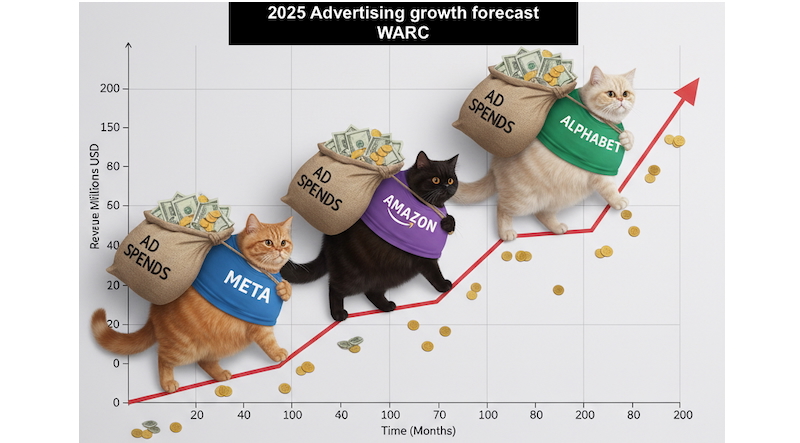
    MUMBAI: Global advertising expenditure is set to surge by 7.4 per cent this year to $1.17trn, according to WARC’s latest forecast—the first upward revision in more than a year. The research firm has boosted its projection by 1.2 percentage points since June, driven by what it calls a “social media windfall” and frenetic pre-tariff spending.

    The bonanza is heavily skewed towards a handful of technology titans. Meta, Alphabet and Amazon are forecast to hoover up nearly two-thirds of all advertising growth in 2025, cementing their stranglehold on the global marketing purse strings. Outside China, the trio already commands 55.8 per cent of all advertising spend—a share set to exceed 60 per cent by 2030.

    Digital platforms are cannibalising traditional media with ruthless efficiency. Nine in every ten new advertising dollars are flowing to online-only platforms, leaving legacy media owners—even those with digital arms—to scrap over what WARC likens to “the equivalent of Facebook’s monthly revenue.”

    Social media has emerged as the single largest advertising medium globally, gobbling up 40.6 per cent of new marketing dollars. Spending on the channel is projected to rocket by 14.9 per cent to $306.4bn this year, representing more than a quarter of total global advertising expenditure. Meta remains the chief beneficiary, capturing 60 per cent of all social media advertising spend.

    The spending spree was particularly pronounced in the second quarter, when social media expenditure jumped 20.2 per cent year-on-year—well above WARC’s initial projection of 12.4 per cent growth. The surge was driven by retailers rushing to stockpile inventory and promote value ahead of expected price hikes, with retail now the largest category on both Instagram and TikTok.

    Search advertising is attracting around 22 per cent of new dollars, while retail media platforms are capturing another 21.5 per cent. Amazon is poised to claim over a third of the retail media pie, which is forecast to grow 13.7 per cent to $175bn in 2025.

    The momentum is expected to accelerate further, with global advertising spend projected to rise 8.1 per cent to $1.27trn in 2026 and 7.1 per cent to $1.36trn in 2027. The market is on track to nearly double in value since the pandemic, underscoring advertising’s remarkable resilience despite economic headwinds.

    “This includes disruption to global trade and reduced purchasing power among consumers, brands are doubling down on Meta, Alphabet and Amazon,” said WARC director of data, intelligence and forecasting James Mcdonald. “The global market is set to nearly double in value since the pandemic, underscoring the resilience of advertising in a tougher economic climate.”

    The rosy outlook contrasts sharply with some other industry forecasts. eMarketer recently slashed its projections for American digital advertising spending, citing the impact of trade wars on automotive and retail sectors. But WARC’s global perspective suggests the digital advertising juggernaut shows no signs of slowing.

  • Bar Council warns lawyers & firms to refrain from using celebs and peddling on social media

    Bar Council warns lawyers & firms to refrain from using celebs and peddling on social media

    MUMBAI: India’s top legal regulator has launched a blistering attack on lawyers who peddle their services through social media and celebrity endorsements, declaring the practice as tasteless as a barrister in trainers.

    The Bar Council of India (BCI) has issued a stern rebuke to advocates who have been flaunting their legal prowess on digital platforms, particularly those enlisting Indian cinema  stars and “influencers” to hawk their services like common snake oil salesmen.

    “The profession of law, deeply rooted in public trust and ethical standards, is fundamentally distinct from commercial business ventures,” thundered the BCI in its proclamation. The regulator appears particularly vexed by self-styled “legal influencers” who dispense dubious advice on everything from matrimonial disputes to taxation without proper credentials.

    The council’s crackdown follows a landmark ruling by the Madras high court in July 2024, which emphasised that advocacy is meant to be a noble profession driven by societal service rather than commercial motives. The judgment specifically targeted online platforms like Quikr India and Just Dial, stripping them of protections under the Information Technology Act’s safe harbour provisions.

    The BCI’s diktat prohibits lawyers from:

    * Using screen actors or celebrities to promote legal practices
    * Erecting promotional banners at religious or cultural events
    * Dispensing legal advice on social media platforms
    * Any activity that might be construed as “solicitation” under Rule 36

    The strictures apply not just to individual barristers but to firms, companies and business process outsourcing operations that engage “in pith and substance” in the practice of law.

    Legal eagles who have been strutting their stuff online now face the prospect of disciplinary action if they fail to promptly remove their digital swagger. The BCI appears determined to ensure that the only thing going viral in the legal profession is respect for its ancient traditions.

    In an era when even the most solemn professions have succumbed to the temptations of digital marketing, India’s legal watchdog is making it clear: justice cannot be sold with a swipe to the right or left.

  • Global Paris Olympics viewership rose 25 per cent: IOC-backed research

    Global Paris Olympics viewership rose 25 per cent: IOC-backed research

    MUMBAI: Guess which was amongst the top most watched televised sports event in 2024?

    The most engaging?

    The one which saw eye-popping growth on many parameters?

    If you are going to mention football and the Premier League, you would be far from the truth.  

    If you are going to say cricket and the IPL, you will have got it wrong.

    At least that’s what new research conducted on behalf of the International Olympic Committee (IOC)  by independent researchers would have us believe. It says that a record 84 per cent of the potential global audience followed the Olympic Games Paris 2024, translating into an audience of five billion people. 

    This  means that more than half of the world’s population followed the inspirational achievements of the Olympic athletes and the magic of the Olympic Games, underlining the massive success of the games in Paris.

    Digital platforms drove an unprecedented level of attention revealed the research. There were an estimated 412 billion engagements from 270 million posts on social media platforms. This represents a 290 per cent increase compared to the previous edition of the games.

    Media rights-holders (MRHs) delivered record results, driven in large part by this increased visibility on digital channels. Globally, there were 13 times more social media engagements on MRH handles than for the previous games’ edition. Some 70 per cent of the global audience watched on both television and digital platforms.

    There was a 25 per cent increase in the amount of coverage watched, with 28.7 billion hours of footage viewed around the world on MRH platforms. This meant every viewer watched on average nine hours of coverage, a 20 per cent increase on the previous games. In the home market of France, 95 per cent of the potential audience watched an average of 24 hours of coverage of the Olympic Games.

    The IOC’s own digital platforms and social handles generated 16.7 billion engagements, a 174 per cent increase on the previous edition of the games. Olympic athletes, national Olympic committees, international federations and organising committees all benefitted from the huge social media engagement, growing their digital presence and adding a combined 85 million followers to their main social media handles. There was a 200 per cent increase in internet searches related to Olympic sports and the Olympic Games compared to the previous edition of the Olympic Games.

    The report outlining these figures was presented to the IOC’s executive board at a meeting held last week  in Lausanne.

    IOC president Thomas Bach said: “Paris 2024 demonstrated the unprecedented global appeal of the Olympic Games. Audiences are following and interacting with the Olympic Games like never before. The independent surveys also demonstrate that people believe that the Olympic Movement’s mission to unite the world in peaceful competition is more important than ever in a divided world; and that the Olympic values truly resonate with younger generations. These were Olympic Games of a new era.”

    In consumer insight studies, 78 per cent of those surveyed said they believed the Olympic Games are more important than ever in a divided world. Three out of four people also believe that the IOC was successful in “bringing the world together in peaceful competition” and in “building a better world through sport.”

    According to an independent brand tracker study conducted in September 2024, the relevance of the Olympic Games with Gen Z is now higher than with the general population, including outperforming other demographic groups in the metrics of “engagement with the Olympics,” “brand affinity” and “brand relevance”. This was driven in particular by the “inspiring stories of the athletes,” the “buzz on social media” and “improved accessibility to content.”

    Seven out of 10 people deemed Paris 2024 a “success” and thought the games would leave a positive legacy.

    The experience of the Paris 2024 spectators surveyed was rated as “excellent” or “good” by 85 per cent for the ticketed events, 95 per cent for the free events, and 98 per cent for the Marathon Pour Tous. “Atmosphere,” “visual appearance” and “security” were cited as key drivers across all events.

    Some 95 per cent of athletes surveyed rated their overall experience positively, with 89 per cent rating “becoming an Olympian” and 91 per cent citing “competing at the biggest multi-sport event on earth” as fundamental motivations for participating at the Olympic Games Paris 2024.

    (The brand tracker, broadcast research, and consumer and athlete surveys were conducted by Nielsen, Ipsos and Publicis Sport & Entertainment. Across all consumer studies a total of more than 55,000 people in 18 countries were surveyed, with all respondents aged between 13 and 65. Potential global audience with access to follow the Olympic Games and over the age of 4 years old.)

  • Australia passes bill banning social media for kids; India’s Vaishnaw calls for stricter regulation

    Australia passes bill banning social media for kids; India’s Vaishnaw calls for stricter regulation

    MUMBAI: No social media for kids. The Aussie house of representatives passed a bill yesterday imposing a ban against Instagram, Tiktok, Facebook, SnapChat, X,  Reddit from allowing kids under 16 from accessing these networking platforms. The onus has been put on social media to ensure that kids don’t use them;  fines up to $33 million will be imposed on them if a kid’s profile is found active. The bill will now require senate approval which it most likely will get and social media  will have  a year to clean up their acts. 

    That was Down Under. 

    In India too, the government would like to bring  social media under tight regulation. 

    While addressing a parliament question during the ongoing session of the Lok Sabha today, union minister of information & broadcasting, railways, and electronics & IT, Ashwini Vaishnaw,  once again highlighted the urgent need to strengthen existing laws governing social media and OTT platforms.

    “We are living in the era of social media and OTT platforms. However, the democratic institutions and traditional forms of the press that once relied on editorial checks to ensure accountability and correctness of content, have seen these checks diminish over time,” he said. 

    He noted that due to the absence of such editorial oversight, social media has become a platform for freedom of press on one hand, but on the other hand, it has also become a space for uncontrolled expression, which often includes vulgar content. 

    Acknowledging the distinct cultural differences between India and the geographies where these platforms originated, Vaishnaw emphasised. “The cultural sensitivities of India vastly differ from those of the regions where these platforms were created,” he said.  

    This makes it imperative for India to make existing laws more stricter and he urged everyone to come to a consensus on this matter.

    The minister also urged the parliamentary standing committee to take up this important matter issue as a priority. “There should be societal consensus on it, along with stricter laws to address this challenge” he said.

    Will Indian society agree? 

  • Warc revises ad revenue growth estimates upwards for 2024

    Warc revises ad revenue growth estimates upwards for 2024

    MUMBAI: Bullish is the mood at marketing effectiveness specialist Warc. The  firm had forecast in August 2024 that global advertising spend is on course to grow 10.5 per cent this year to a total of $1.07 trillion. Now, it has revised that growth upwards by 0.2 percentage points; its latest projection is that ad spends globally will grow by 10.7 per cent to touch  $1.08 trillion – the strongest growth rate in six years and the largest absolute rise on record if the post-Covid recovery of 2021 (+27.9 per cent year-on-year) is disregarded. 

    Warc’s latest global projections are based on data aggregated from 100 markets worldwide. Online media is on course to drive the growth,  a good year for TV has also made a notable contribution. The good news is that spends on linear TV are rising and are expected to end the year higher by 1.9 per cent, at $153.6 billion, following two years of slippage. Political TV adverts (especially in the US), the Paris Olympics and Euro football in Q3 have buoyed the spends on TV. However, before you start apart applauding please note that  linear TV’s hold today stands at just 14.3 per cent of global advertising spend, much, much lower than the heady days of a 41.3 per cent share in 2013. 

    We have all heard it before: Alphabet, Amazon and Meta are Pacmen increasingly swallowing up ad dollars in large chunks of billions every year. Warc data supports that. It stated that pure play online internet businesses like that of the three big tech firms, will see ad revenue growths of 14.1 per cent reaching $741.4 billion – accounting for a total of 68.8 per cent of all spends. Gadzillions!

    Social media ad spends are expected to leap upwards by 19.3 per cent reaching $252.7 billion -equalling 23.5 per cent of the total ad market. This is mostly because the sales folks at Facebook, Instagram and TikTok have been selling hard leading to better than expected results at the three firms during the first nine months of this year. 

    Overall ad spend growth is also expected to be buoyant next year at 7.6 per cent in 2025, and seven per cent in 2026 taking the global ad market to $1.24 trillion. For all those who have been doomsayers predicting the slamming of brakes on advertising here’s some facts: global ad investments have more than doubled over  the past 10 years and have grown 2.8 times faster than global economic output since 2014.

    Warc director of data, intelligence and forecasting and author of the research James McDonald said: “Our latest forecast anticipates $104bn in incremental advertising spend worldwide this year, the largest rise in history if the post-pandemic recovery year of 2021 were discounted. Whether this boom will sustain remains unclear, however, as 2025 presents a sliding doors moment due to heightened regulatory pressures on Google and TikTok – together a quarter of the ad market outside of China. This, alongside an increasingly challenging geopolitical climate, may spell uncertain times ahead for the businesses that rely on advertising trade.”

    (The image for this report was created using OpenArt AI. No copyright infringement is intended)
     

  • Social media has evolved from a brand awareness platform to now driving direct sales for consumers: Ruksheen Palia

    Social media has evolved from a brand awareness platform to now driving direct sales for consumers: Ruksheen Palia

    Mumbai: In the bustling lead-up to India’s festive season, the digital marketing landscape is set for a significant boost, with brands across e-commerce, retail, FMCG and small businesses are eyeing this time to connect deeply with consumers through digital avenues, aiming to capture the excitement and enthusiasm that characterises Diwali, Dussehra, and other festivals. As online engagement becomes the core strategy, brands are leaning into innovative digital marketing trends that make their presence felt and drive conversions.

    This season is also known for an uptick in consumer spending and has traditionally been the prime time for brands to invest heavily in advertising. It is primarily driven by the need to engage India’s increasingly digital-first population, where mobile phones are the primary medium for product discovery and purchases. Brands are setting aside significant budgets for click-to-WhatsApp ads, video content, and social media campaigns to capture consumer interest during this period of heightened shopping activity.

    Indiantelevision.com’s Rohin Ramesh caught up with Social Panga VP – business & strategy Ruksheen Palia, where she touched upon ad spends expected this festive season and some Key trends to look out for in digital marketing.

    Edited excerpts

    On the overall marketing budget are brands planning to allocate specifically for this festive season compared to previous years

    While budgets will differ industry to industry, marketers are upping their spends this festive season for campaigns. However the focus is changing from traditional to digital advertising with real time bidding AI generation, which will allow brands to maximise their spends.

    From the past years’ experience, brands are estimated to spend 25-30 per cent of their marketing budgets on festive campaigns which is similar to previous years but will be more focused on digital advertising strategies.

    On media channels (social media, traditional media etc) you are seeing the most significant increases in ad spend this festive season

    For 2024, the obvious answer would be the digital side of marketing is going to get the biggest ad spends this festive season. From social media, connected TV & retain media playing a huge part.

    On the anticipated ROI metrics for ad spending during this festive season

    Brands are optimistic this festive season & are targeting higher ROI metrics compared to last year. With enhanced AI, content personalisation & omnichannel strategies to make content creation especially of videos more efficient & cost effective.

    Brands are also focusing on emotional connections, convenience & innovative strategies to build more long term goals to acquire customers.  They are not just looking at short-term sales but also focusing on building lasting relationships and brand loyalty, which can pay dividends beyond the holiday season

    On importance of data analytics in shaping ad spend decisions for the upcoming festive campaigns

    A crucial role! With increasing competition & higher expectations from all consumers today, brands are relying extensively on targeting accurately. Data analytics help with personalisation & targeting, Real time optimisation, Channel selection & more data analytics to help improve strategies.

    This festive season, data analytics will play an important part in decision making, helping brands optimise both short-term & long-term goals to build consumer loyalty.

    On importance of personalised marketing during the festive season and strategies are brands using to create personalised experiences

    One of the ways to cut through all the noise this festive season, will be to adopt personalised marketing! Since personalised marketing helps in boosting engagement, enhances customer experience & increases likelihood of conversion a lot of brands should adopt this strategy. Few of the strategies that can be adopted by brands are: Personalised mailers, AI, Dynamic content websites & interactive and experiential marketing.

    On the role you foresee social commerce playing in festive marketing campaigns this year

    This year even more than before, Social commerce is going to play a huge role in festive marketing campaigns. With the integration of e-commerce & social media on platforms like Instagram, FB the role this would play for customers would be: Seamless shopping experience, quick on the go shopping, influencer led & testimonial based buying.

    On brands investing more in social media platforms for sales

    Yes, most definitely. Brands are significantly increasing their investments on social media platforms for sales, especially during the festive season. Social media has evolved from a brand awareness platform to now driving direct sales for consumers.

  • Navigating social media algorithms: Tips to boost content visibility

    Navigating social media algorithms: Tips to boost content visibility

    In the rapidly evolving nutraceutical industry, marketing has transcended traditional boundaries, becoming a sophisticated blend of science and art. Social media, once a platform for casual interaction, has emerged as a crucial battleground, particularly for B2B companies. Understanding the intricacies of social media algorithms is essential—not merely as a means to count likes, but as a strategic tool to ensure relevance, timeliness, and genuine engagement.

    Effective social media strategies today prioritise thoughtful interactions, leverage video content to narrate product journeys, and explore diverse platforms beyond the conventional. Industry-specific networks, visual-heavy platforms like Pinterest, and audio platforms for expert discussions offer untapped potential. User-generated content (UGC) stands as a valuable asset, with employees, customers, and influencers serving as authentic brand ambassadors.

    Additionally, the power of visuals, from product packaging to educational content, plays a pivotal role in crafting a brand’s narrative. Success in this space demands continuous measurement, adaptation, and staying informed about algorithm changes to ensure strategies that not only stand out but drive tangible business outcomes.

    Why are social media algorithms important?

    Algorithms are essential for managing the vast amount of content generated on social media platforms. They help users find relevant content quickly and efficiently by filtering out the noise. Here are some key reasons why social media algorithms are important:

    1. Filter out the content noise: With millions of posts published daily, algorithms sort and connect users with content that matches their interests, preventing them from being overwhelmed by endless streams of information.

    2.  Show users more of what they’re interested in: By analysing user behavior and interactions, algorithms personalize content recommendations, increasing user engagement and enhancing the overall user experience.

    3.  Personalise user experience: Algorithms allow users to have more control over their content by customizing feeds and filtering unwanted posts, making their social media experience more tailored and enjoyable.

    4.  Maximise organic reach: Understanding how algorithms work can boost your social media presence. High-engagement posts are promoted to a wider audience, increasing your content’s visibility and reach.

    Understanding how social media algorithms work

    Social media algorithms operate by analysing various signals to determine the relevance and value of content. These algorithms constantly learn from user interactions to refine content suggestions. Key signals include user engagement, where likes, shares, and comments indicate that users find the content interesting and relevant. Relevance is also crucial, with keywords and hashtags providing context and improving content visibility. Timing and frequency play a role as well, with consistent posting at optimal times enhancing visibility. Recency is another factor, as newer posts are prioritized over older ones. User interactions, such as following accounts, engaging with content, and click-through rates on links, signal content relevance and quality. Profile authority, including follower count, consistency, and engagement levels, impacts organic reach. Location is considered, with algorithms taking user location and demographics into account when curating content. Different content types, such as videos, images, and text, are treated based on user interaction, with videos often favored due to their high engagement rates. Virality, or the popularity and shares of content, signals relevance to the algorithm. Finally, watch time, or the duration users spend watching videos, influences content prioritisation.

    Tips for staying ahead of the algorithm and optimising your content

    1.  Prioritise quality engagement:

    .  Encourage thoughtful comments and meaningful interactions to boost your content’s visibility.

    Tip: Ask open-ended questions and create content that prompts discussions.

    2.   Leverage video content:

    . Video content is highly favored by algorithms due to its engaging nature.

    .  Tip: Use videos to showcase product journeys and behind-the-scenes content to humanize your brand.

    3.  Explore beyond conventional platforms:

    . Diversify your platform usage to reach different audience segments.

    . Tip: Utilise industry-specific platforms and experiment with audio platforms for expert interviews.

    4.  Leverage user-generated content (UGC):

     UGC enhances authenticity and trust.

     Tip: Encourage employees and customers to share their experiences and highlight these stories on your social media channels.

    5.  Emphasise visual storytelling:

    Visuals play a crucial role in social media marketing.

    Tip: Invest in high-quality visuals and maintain a consistent aesthetic that reflects your brand identity.

     6.  Measure and adapt:

    Continuous measurement and adaptation are essential for staying ahead of algorithm changes.

    Tip: Focus on metrics like click-through rates, conversion rates, and audience retention. Regularly update your strategy based on these insights.

    Conclusion

    Mastering social media algorithms is essential for enhancing content visibility and driving engagement. By prioritising quality engagement, leveraging video and user-generated content, exploring diverse platforms, emphasizing visual storytelling, and continuously measuring and adapting your strategies, you can create a robust social media presence that resonates with your audience and drives meaningful business results.

    The article has been authored by Zeon Lifesciences Ltd’s chief marketing officer Yashna Garg.

  • The future of TV news: AI-Powered content and social media

    The future of TV news: AI-Powered content and social media

    Mumbai: AI being the buzzword wherever you head to, is here to stay. Having it as an enabler or an extension of your current workflow means marrying human and machine to create an eponymous being that brings the best of both worlds.

    With implications covering almost all aspects of media and postproduction, there is no debate on the prevalence and longevity of AI. TV news broadcasters are slowly but surely picking up on certain applications and integrating it into their setups. From the first AI anchor to being used in content and social media, technology has sure come a long way.

    The discussion explores the evolving landscape of television news broadcasting, specifically focusing on the crucial roles of AI-based clip creation and a digital-first approach on social media platforms. It examines the advantages of AI-generated content for news production, the strategies for engaging audiences on social media, and the future implications of these innovations for the industry.

    The Rise of AI-Powered Clip Creation  

    Artificial intelligence (AI) is rapidly changing how news content is produced and consumed. AI-powered clip creation tools enable news organisations to generate short, engaging video clips from longer footage automatically. These tools use algorithms to analyse video content and identify key moments, highlight important information, and  create compelling visual narratives.  

    This technology significantly enhances eƯiciency in news production. Journalists can  focus on reporting and analysis while AI tools handle the tedious task of creating clips for various platforms. AI can also help personalise content by tailoring clips to diƯerent audiences and interests.  

    For example, a news story about a political event can be automatically segmented into clips highlighting diƯerent aspects of the story, such as policy positions, public reactions, and expert analysis.  

    Leveraging Digital-First Content for Social Media  

    In today’s media landscape, social media has become an indispensable platform for news consumption. Digital-first content is crucial for reaching and engaging audiences on these platforms. This approach emphasises the creation of content specifically designed for social media, rather than simply adapting existing TV news segments.  

    Digital-first content for social media requires a diƯerent approach to storytelling and presentation. Videos should be short, visually appealing, and tailored to the specific platform. This involves using eye-catching visuals, engaging music, and concise language to capture attention in a crowded online environment.  

    For example, a news story about a local event could be transformed into a series of bite-sized video clips, each highlighting a diƯerent aspect of the story and ending with a call to action for viewers to comment or share the content.

    Short & Engaging Videos  
    Content needs to be concise and visually captivating to grab attention in a short attention span environment.  

    Strong Visuals  
    High-quality visuals, such as striking photos, graphics, and animations, are essential for attracting viewers.

    Interactive Elements  
    Including polls, quizzes, and interactive elements can encourage viewer engagement and participation.  

    Call to Action  
    Encouraging viewers to comment, share, or visit the news website can build a community around the content.  

    Advantages of AI-Based Clip Generation for TV News  

    AI-based clip generation oƯers several advantages for TV news organisations:

    Increased eƯiciency 
    Improved content personalisation  
    Enhanced audience engagement  
    Cost savings  

    By automating the clip creation process, AI frees up journalists to focus on higher-level tasks like reporting, research, and analysis. The ability to generate multiple versions of a clip tailored to diƯerent audiences allows for more eƯective content distribution and audience targeting.  

    AI can also analyse viewer data to identify trends and preferences, enabling news organisations to create content that resonates with their target audiences.  

    Engaging Audiences Through Social Media Platforms  

    TV news organisations must strategically utilise social media platforms to reach and engage audiences. This involves understanding the unique characteristics of each platform and tailoring content accordingly.  

    For example, on Twitter, news organisations can use short, punchy tweets to share breaking news updates, while on Instagram, they can utilise visually appealing stories and Reels to showcase behind-the-scenes content and connect with viewers on a personal level.  

    Engaging audiences on social media requires more than simply posting news articles or video clips. News organisations must actively interact with their followers, respond to comments and questions, and participate in online conversations.  

    This strategy builds a sense of community around the news organisation and creates a more direct connection between journalists and their audience.

    Platform Content Strategy Engagement Tactics  

    Twitter Short, concise updates, breaking news alerts  

    Retweeting relevant content, responding to questions and comments  Facebook Longer articles, live videos, behind-the-scenes content  Running polls and quizzes, hosting Q&A sessions  

    Instagram Visually appealing stories, Reels, interactive content  

    Using relevant hashtags, collaborating with other accounts  

    YouTube Long-form documentaries, interviews, explainer videos, engaging viewers with  comments, creating playlists  

    Challenges and Best Practices for Digital First News  

    While digital-first news oƯers numerous benefits, it also presents unique challenges.  News organisations must adapt to the ever-changing landscape of social media,  constantly evolving algorithms, and the need to maintain journalistic integrity in a fast-paced online environment.  

    Here are some key best practices for digital-first news:  
    Prioritise high-quality, original content  
    Embrace multimedia storytelling  
    Focus on audience engagement  
    Monitor social media analytics  
    Promote diversity and inclusivity  

    By adhering to these best practices, news organisations can eƯectively leverage digital-first strategies to reach and engage audiences, maintain journalistic standards, and thrive in the evolving media landscape.

    This article has been authored by  K S Avinash 

  • The influence of social media on crowdfunding: Amplifying causes in the digital era

    The influence of social media on crowdfunding: Amplifying causes in the digital era

    Mumbai: The social media landscape has become an undeniable force in shaping our lives, transforming how we connect, share, and pursue our goals. This digital revolution has extended its influence to the realm of fundraising, creating a powerful new avenue for individuals and organizations to bring their ideas to life: crowdfunding. These initiatives can range from entrepreneurial startups and innovative products to charitable causes, artistic projects, and more.

    Crowdfunding themes that garner more visibility on social media platforms often revolve around social impact, personal journeys, innovative projects, humanitarian causes, tech innovations, community initiatives, and personal development. These themes evoke emotions, offer unique experiences, and address societal needs, making them highly shareable and relatable. Successful campaigns typically feature authentic storytelling and a clear call-to-action, captivating a diverse online audience and fostering widespread support.

    Social media has always been a boon to people’s lives. This digital revolution has also impacted fundraising, giving us crowdfunding. It’s a powerful way for people and groups to get support for their ideas. With the help of social media, creators can reach a large audience worldwide, gathering support and resources in a new and different way from the usual methods of fundraising. Social media platforms, which were initially designed for personal connections, have expanded their roles and become essential tools for businesses and organizations. Crowdfunding, in particular, has experienced a significant transformation due to this evolution. In the past, crowdfunding relied on reaching out to small communities with limited scope. However, with the widespread use of social media, crowdfunding campaigns can now tap into the extensive reach and focused engagement features of these platforms.

    Social media provides numerous benefits to crowdfunding campaigns, acting as a crucial tool for raising awareness, building communities, and securing financial support. To begin with, social media platforms provide a broad outreach, enabling advocates to engage with a worldwide audience and widely disseminate their initiatives. Through engaging content such as videos, images, and compelling stories, crowdfunding campaigns can capture the attention of potential backers. The interactive nature of social media fosters direct communication between creators and supporters, enabling real-time feedback, addressing queries, and building a sense of community around the project. Moreover, social media serves as an effective promotional tool, enabling the rapid dissemination of campaign updates, milestones, and behind-the-scenes content. The viral nature of platforms like Facebook, Twitter, and Instagram can result in campaigns gaining traction and going viral, reaching audiences far beyond the initial network.

    Crowdfunding platforms strategically leverage social media platforms to amplify their campaigns and foster community engagement. By building and nurturing communities around specific projects or campaign categories, these platforms create a sense of belonging and shared interest among potential backers. Social media also serves as a dynamic space for real-time interaction, enabling crowdfunding platforms to respond to user comments, share updates, and actively participate in conversations. Additionally, they harness the power of influencers and paid advertising to extend their reach and connect with a broader audience. By incorporating elements of social proof, educational content, and interactive challenges, crowdfunding platforms enhance the visibility and success of campaigns, ultimately creating a vibrant ecosystem that empowers creators and backers alike.

    The era of traditional fundraising methods, such as bake sales and car washes, has given way to a new landscape where an in-detail designed social media campaign has the power to transform a simple idea discussed at a kitchen table into a globally supported phenomenon. Social media platforms like Facebook, Twitter, and Instagram play a pivotal role as virtual megaphones, magnifying the voices of creators and bridging the gap between them and audiences that extend far beyond their local spheres. In this contemporary setting, the reach and influence of social media have reshaped the dynamics of fundraising.

    The once-constrained scope of fundraising efforts has expanded exponentially, allowing causes to resonate with diverse audiences globally, ultimately propelling grassroots initiatives into the realm of internationally recognized and funded endeavours.

    The following are majorly used tools in boosting crowdfunding platforms.

    1    Amplifying Your Voice: Social media empowers your network to become your advocates. Share your campaign with friends, family, and followers, sparking potential “viral” reach. If your story resonates, shares can propel your message to a vast and supportive audience.

    2    Building a Community of Care: Connect directly with your supporters! Share updates on your medical journey and express sincere gratitude for their contributions. This fosters a sense of shared purpose and encourages continued support, building a powerful community around your cause.

    3    Streamlining Donations: Social media platforms enable easy and secure online donations, making it convenient for anyone to contribute. This increases the potential for success by reaching a wider audience and accelerating fundraising efforts.

    Social media acts as a powerful catalyst for crowdfunding, providing a significant boost to campaigns in various ways. First and foremost, it serves as a promotional tool, enabling crowdfunding platforms to share captivating stories, multimedia content, and campaign updates, reaching a vast audience. The interactive nature of social media fosters community building, allowing creators to engage directly with potential backers, answer queries, and build a supportive network around their projects. Leveraging influencers and targeted advertising on platforms like Facebook and Instagram expands campaign visibility, attracting backers who align with specific interests or demographics. Social media platforms also facilitate the sharing of success stories and testimonials, building trust and credibility. Overall, the dynamic and viral nature of social media amplifies the reach and impact of crowdfunding campaigns, turning them into widely recognized and supported endeavours.

    The author of this article is Ketto India co-founder Varun Sheth.