Tag: Snapdeal

  • Snapdeal takes the road less travelled…

    Snapdeal takes the road less travelled…

    MUMBAI: Be it acquisitions, deals or launches of products, Snapdeal continues to make headlines.

    While Amazon India is partnering with Future Group and Flipkart has acquired Myntra to boost the fashion retail section, Snapdeal is attempting to break the clutter by filling its basket with products from diverse categories.

    In the last few weeks, the e-tailer is ventured into selling homes, two-wheelers and four-wheelers, gourmet food. It has also inked some exclusive tie-ups with electronics retailer Croma and television manufacturer VU Technologies among others. Snapdeal is also one of the sponsors for the famous reality television show, Bigg Boss 8.

    “We offer a platform where anyone can come and sell or buy anything that can be sold. We are trying to replicate the offline market place in its most democratic manner possible online,” says Snapdeal offlibe marketing senior VP Maneesh Goel.

    “The intention is to try and cater to every single consumer,” he adds.

    Snapdeal, as a strategy, is trying to capture the entire wallet share of Indian customers and has been quite successful so far.

     “Snapdeal has been one of the sites which is constantly evolving with newer ideas both in terms of products on offer and marketing strategies”, says Team Pumpkin co-founder, Swati Nathani.  

    According to Trust Research Advisory CEO, N Chandramouli, “This approach is done to get involved in every aspect of a customer’s purchase. All products are the same in the purchase – one pays and the other sells but with the degree of purchase involvement and the price changes. If Snapdeal is successful in smoothly operating the entire purchase cycle, they will definitely grow in terms of the bond that they share with their customers and thereby increasing trust.”

    Snapdeal has managed to raise over $233 million (over Rs 1,400 crores) this year from investors including Premji Invest, Temasek and eBay Inc. Industry veteran, Ratan Tata also invested in the site, giving it his stamp of approval.  According to media reports, Alibaba is also said to have forayed into the Indian e-commerce space with Snapdeal as its partners.

    With its ‘bachate raho (keep saving)’ tagline and focus on unbranded products sold by small manufacturers and retailers, Snapdeal has established itself as a mass-retailer, with over half of these 50,000 merchants selling fashion and lifestyle products that account for 60 percent of its orders.

    “Most categories which are generally sold on the urban arena involve middlemen and hence their value is rising. With Snapdeal foraying into the sections, the involvement of middlemen is reducing leading to fall in their value,” Goel added.

    Snapdeal recently crossed $1 billion (or Rs 6,000 crore) in sales (called gross merchandise value in the online world) taking on rival Flipkart, which had achieved the target a few months ago.

    The new categories such as real estate, gourmet foods and automobiles are critical for the portal. For both Tata Value Homes and the new Mahindra Scorpio, the site let users pre-book online for an amount (Rs 30,000 Tata Value Homes and Rs 20,000 for the new Mahindra Scorpio) that is much lower than required through traditional mediums such as at a car dealer’s or property sales office.

    Tying up with Tata Value Homes, the e-tailer announced 85 homes, worth Rs 40 crore, were sold in six days. It also introduced a new gourmet section on the site in partnership with Sanjeev Kapoor.

    According to Nathani, “Gourmet is the section which should bring the next level of revolution in the e-commerce space. After Books, Electronics, Fashion and Home, Gourmet has been one section which everyone wants to explore. The category has also been a little underplayed in the offline space and therefore, we think that this can be the game changer in the e-commerce space.”

    With Diwali coming soon, the online portal is planning a huge campaign for its customers. But more than that, they are concentrating on the marketing of it.

    “The campaign will last around 40-45 days. The intention is that, depending upon day to day we will be clocking around 1000-2000 ads slots everyday, the campaigns will peak on several days, overall targeting around 50,000-60,000 slots,” Goel reveals.

    “Intention is to double the revenue through Diwali sales,” he added.

    Jasper Infotech, which runs Snapdeal.com, has recently reported a loss of Rs 264.6 crores for the year ended March, compared with a loss of Rs 120 crores in the previous year.

    “In terms of numbers and reach, currently we would say Flipkart is the winner but with its constantly evolving strategies, we will soon see Snapdeal getting into the top spot, “Nathani opines.

    The battle is a close one for now. The company is venturing into various brands from auto, electronics, mobile phones, home furnishings, kitchen appliances, beauty, footwear to clothing to get them online.


  • And the e-commerce war continues…

    And the e-commerce war continues…

    MUMBAI: The day began with one of the most interesting ad wars on the front pages of leading newspapers of recent times and ended, on one hand with Flipkart apologising to its customers even after clocking $100 million in 10 hours while on the other hand Snapdeal, making a crore per minute, scoring its highest sale in a single day.


    Even though the fight for the market share between e-retailers has been going on for some time now, the day 6 October seems to have made history in the e-commerce space with discounts and deals never heard of and the impossible to miss marketing by the e-commerce sites. The day signals the start of a marketing war that is set to intensify in the months to come.


    In a bid to differentiate itself, Flipkart launched the ‘big billion day’ sale along with a matching television ad campaign for the past two weeks. It was projected as the mother of all flash sales, with the aim of surpassing the turnovers of multiple day sales in a single day. Though it did not turn out the way it was supposed to.


    The sale not only affected the home-grown brand Flipkart, it also impacted its competitors like Amazon and Snapdeal majorly along with Indian retailers like Future group. The Confederation of All India Traders (CAIT) has also launched a probe into the sites and the government may also launch a separate policy for the sector soon.


    According to Trust Research Advisory (TRA) CEO N Chandramouli the Big Billion day sale was merely a catalyst to a situation that has already been simmering for a while. “It is essential that the government looks into the matter as with the absence of legislative measures the online retailers exist in a state of anarchy,” he says.


    Talking about the Big billion day fiasco, Chandramouli reckons, “The Big Billion day fiasco definitely has coloured the perception of people negatively. If this has not awoken all the e-commerce brands to ensuring they tighten their systems before embarking on such an offer day, then there will still be trouble.”


    “On the other hand, this fiasco must have also strengthened the resolve of competing brands to prove that they will stand true to their promises, ensuring that their promise to the consumers is always met,” he adds.


    Chandramouli feels that mature players like Amazon were the gainers in this fiasco backed by their years of experience and learning. “Everyone other than Flipkart has benefitted from this fiasco. The competition is being trusted more and Flipkart’s stranglehold is being broken, the consumer has got some good deals and they benefit too,” he points out.


    Team Pumpkin business head Swati Nathani has a different view. She says, “We did see complete social media backlash for Flipkart on 6 October and assumed that the e-commerce giant will definitely not achieve the targets set by itself. However, at the end of the day, we did see Flipkart breaking all records and emerging as a clear winner. Despite that, the co founders sent an apology note to all the customers. In our opinion, Flipkart has gained more than it has lost after the fiasco.”


    When it came to ads, none of the e-tailers were behind. With Flipkart’s ‘Big Billion Day’ sale ads flooding the pages of major Indian newspapers, Amazon’s response alluded to India’s recent successes in space with its “Mission to Mars” campaign, while Snapdeal tried to play it cool with a pitch that ran with the tagline ‘For others it’s a big day. For us, today is no different’.


    The statistics show that a combination of #Flipkart and #BigBillionDay received approximately 57,600 mentions versus 15,000 mentions for #CheckSnapdealToday. #Flipkart and #BigBillionDay collectively received approximately 2,137 million impressions across Twitter, while #CheckSnapDeal received around 859 million impressions. Emotions favoured Snapdeal where it received only seven per cent negative sentiment mentions compared to 23 per cent for Flipkart. The conclusion could be that while Flipkart got the numbers, Snapdeal, even with the smaller numbers it could manage, kept customers happy.


    And now, even after the dust has settled on the 6 October fiasco, the ad wars continue.  As Amazon now comes up with its latest Diwali Dhamaka sale, Snapdeal continues with its trending #CheckSnapdealToday tagline. Full page back to back ads can be viewed in leading newspapers like the Times of India.


    Even as customers continue to shop with sites offering astonishing discounts, the retailers and the government have started expressing concerns over huge discounts being offered by e-commerce firms.


    While Chandramouli believes that there are only two possibilities in such cases, firstly that the offer is coming from manufacturers or the e-tailers are absorbing the losses of the discounts.


    “Either way, it is not sustainable. If the objective is to pulling in new e-buyers by offering them unheard of discounts, it will help, but it only builds the entire market, not loyalty to any particular brand,” he opines.


    Nathani reveals that the current focus of e-commerce players is more to gain the market share in customer mindsets rather than profitability. “Jabong has incurred a net loss of Rs 293 crore in the last fiscal year. So we would say that the e-tailers will even sell products at a loss to ensure that customers keep returning to them. Customers, therefore, are at the best spot right now in terms of advantages,” she says.


    But even with the losses, the discounts do not stop. “E-commerce is a rapidly growing sector and often due to the absence of a physical manifestation of the store, online advertisers tend to promise in superlatives,” says Chandramouli.


    Adding to the same, Nathani reckons, “Customers expectations have definitely risen in terms of discounts. For eg Snapdeal offered iPhone 5S for Rs 24,999 in its newspaper ad and now, this price has become benchmark for the customers who are looking out to buy the phone.”


    According to the pre-dominant consumer sentiment, Flipkart which holds 50 per cent market share in the Indian market may have to now work harder to get its back after the fiasco.


    Though, she clearly believes that In terms of numbers and reach, Flipkart is the clear winner currently.  “But with the constantly evolving strategies, they see Snapdeal getting closer to the top spot soon.”


    But with Diwali coming near, it would now be interesting to see how the #bigbillionday fiasco will or will not affect the sales of the portals and how prepared they are to give their customers a good time. But till they #happyshopping.


  • Movies OK ‘Karo Diwali Share’ contest

    Movies OK ‘Karo Diwali Share’ contest

    MUMBAI: Don’t limit the celebrations and gifts for loved ones this festive season! Movies OK, the ultimate movie destination for family entertainment, is all set to reward its viewers this Diwali with the launch of ‘Karo Diwali Share’ contest. Television viewers have the opportunity to win Snapdeal e-vouchers worth Rs. 10,000/- and buy exciting Diwali gifts daily. Share celebrations and happiness with loved ones by participating in Movies OK’s ‘Karo Diwali Share’ contest, from 8th October – 24th October at 8 pm.


    Avoid the long queuesand over-crowded stores this festive season; Diwali shopping gets convenient and hassle-free with Movies OK’s ‘Karo Diwali Share’ contest. Viewers can participate in the contest by answering a simple question flashed during the film and buy exciting gifts for their loved ones with just one click. The vouchers, worth Rs. 10000, can be redeemed to select from a range of apparels, accessories, kitchen appliances, electronics, and much more available on Snapdeal.com. This three week contest will showcase entertaining Bollywood films such as Dabangg, Jai Ho, Son of Sardaar and many more to build up to the excitement of Diwali.


    So, this festive season, sit back and share a hassle-free Diwali with your loved ones! Watch the best of Bollywood and win grand prizes without stepping out of your homes, only with Movies OK.


  • Future Group to now tie up with an e-commerce site

    Future Group to now tie up with an e-commerce site

    MUMBAI: A day after lashing out at e-commerce sites such as Flipkart for undercutting prices, Future Group CEO Kishore Biyani said that he would announce his ‘exclusive e-commerce partner’ soon, according to media reports.


    As per the reports, Biyani agreed that he met Amazon founder and CEO Jeff Bezos in Delhi last week, hinting that he might partner with Amazon to sell its private labels.


    “We discussed many things like the macro environment, the prime minister and so on,” Biyani told a leading business newspaper talking about his meeting with Bezos.


    “We can learn a lot of things from e-commerce players regarding their supply chain and logistics, sourcing and so on,” Biyani added.


    The buzz is also that Biyani is expected to meet other e-commerce players for a tie-up.


    The group would first take its fashion products online, followed by FMCG, general merchandise, food and others, he further said.


    The reports also add, “While tying up with e-commerce portal is a ‘brand strategy’ Biyani said, the group’s own omni channel strategy, set to go live after Diwali, is a retail strategy or extension of his physical stores. He said the group’s omni channel strategy will work simultaneously along with retailing on e-commerce partner.”


    As part of the omni strategy, the group’s electronics format, Ezone, is expected to go online first, followed by premium food chain Foodhall and hypermarket chain Big Bazaar, a group executive further revealed.


    Biyani recently came out strongly against the strategy of e-com firms, accusing them of predatory pricing backed with foreign funding.


    Media reports quoted him saying, “Laws in this country do not allow sales below cost price. This is anti-competitive. We (at Big Bazaar and other retail brands) never sell below cost price.”


    The future group also launched ad blitz, lashing out at the e-commerce portals with taglines like, “No deal can win the trust of a billion people, you have to earn it.”


    His comments came after Flipkart announced that it clocked record sales of $100 million (Rs 610 crore) in just 10 hours of its Big Billion Day sale on 6 October. Rival Snapdeal also claimed to have matched it with its chief saying the portal saw sales of over Rs 1 crore per minute.


    But the Flipkart Big Billion Day was far from perfect, the e-commerce portal later apologised for the glitches encountered admitting its ‘failure’ in living upto the expectations of its customers. Acknowledging that it was not adequately prepared for the sheer scale of the event, Flipkart promised to come better prepared next time.


    Targeting the e-retailer after it released the apology letter, Future group released another ad with the tagline ‘You can’t take a nation for granted even for a day.’


    Confederation of All India Traders (CAIT) too has expressed concerns over huge discounts being offered by e-commerce firms. It has asked the Commerce and Industry Ministry to take steps to monitor and regulate online businesses.

  • Integration with Bigg Boss season 8 gets 1 million new visitors on Snapdeal

    Integration with Bigg Boss season 8 gets 1 million new visitors on Snapdeal

    NEW DELHI: Snapdeal.com witnessed over 1 million incremental visits as a result of its innovative programming integration on Bigg Boss Season 8. In September, 2014 Snapdeal.com, India’s largest online marketplace, announced its association with COLORS’ popular reality show Bigg Boss Season 8 as its title sponsor. Since the launch of the show, Snapdeal.com together with COLORS has introduced a series of seamless integrations which have engaged both the contestants and viewers.


    As a part of the first phase of the programming integration, Snapdeal.com was seen as an integral part of the Bigg Boss house (episode13 aired on 03 October 2014), where the contestants were seen competing for points through specially designed tasks and using them to purchase products. A special shopping experience was created for the contestants through an interface showcasing products that were essential for sustenance in the house across the consumer durables and electronics categories. Through this integration, viewers got an opportunity to see the Bigg Boss contestants shop on India’s most trusted digital marketplace and also experience Snapdeal.com’s Diwali Bumper Sale.


    Talking about the partnership, Snapdeal.com Senior Vice President Marketing Sandeep Komaravelly said, “This partnership was a strategic move to integrate closely with one of the most popular shows on television. Bigg Boss is a popular show and widely viewed across the country. We saw this as the perfect opportunity to reach out to as well as increase our consumer base by engaging with them directly in their homes. The response that we have received till now is encouraging, and we are looking forward to receiving the same in the future as well.”


    Colors CEO Raj Nayak said, “Bigg Boss Season 8 is only getting bigger and better with every season. Joining hands with Snapdeal has given us the window to go beyond conventional integration ideas that will not only enhance the overall viewing experience for the audience but also help our sponsor to reach out to a wider audience base. In addition to the above, a special opportunity has been created for Bigg Boss fans to buy exclusive Bigg Boss merchandise from the Snapdeal website. The creation of such opportunities for our viewers as well as Snapdeal customers will enable us to draw synergies which will translate into a win-win situation for both parties. As the weeks progress, we aim to further build our partnership with multiple consumer engagement activities.”


    Further, Snapdeal.com has for the first time in India, also introduced a first-of-its-kind Bigg Boss merchandise store on its website where Bigg Boss aficionados can now own memorabilia from their favorite show. A wide range of products have been specially designed which will be available to consumers on: http://www.snapdeal.com/offers/bigg-boss-merchandise.


    Last week Snapdeal.com launched the “Order Order” contest for its customers. This contest allows consumers to be a part of the show directly wherein they have to select a quirky product for one of the contestants of the Bigg Boss House while citing a reason for doing so. Every week the customer who selects the most interesting combination of the product and reason, will get the opportunity of a lifetime to speak with host Salman Khan as well as one Bigg Boss contestant. For more details, log on to www.biggboss.snapdeal.com.


    Snapdeal.com together with Colors has many interesting programming integrations lined up and as the show progresses, viewers will get to engage more closely with the show via Snapdeal.com.

  • Snapdeal, now bringing shopping to the small screen

    Snapdeal, now bringing shopping to the small screen

    MUMBAI: Looking at the growth of e-commerce sector in India, shopping at a click of a button seems to be the favourite pastime of the millions in the country.


    To make the most of it, e-retailer Snapdeal has gone a step further and formed a 50:50 joint venture with Den Networks to extend its reach to television home shopping audiences.


    The entities are together setting up a TV channel, which will be used as a marketplace platform for facilitating the sale of branded and unbranded merchandise and services, including vouchers offered by third-party sellers on Snapdeal.


    A source from Snapdeal says, “Snapdeal is not only trying to provide for consumers in the metros but also for people in tier II tier III cities and beyond. The current retail environment doesn’t cater to the smaller cities.”


    “Digital marketing can really bring a lot of depth in our plans and communications when it comes to top few tier cities but when you really want to go deep down in community, to the next round of cities, television is a medium to choose. Digital is definitely going up and providing great reserves, but television still remains one of the primary mediums,” the source adds.


    Snapdeal, which currently has over 30,000 vendors on its platform, will get direct access to millions of households in one go through this collaboration.


    Based out of Delhi, Den Networks reaches an estimated 13 million households in over 200 cities across 13 states in the country.


    Speaking about the reason behind its association with Den Networks, the source states, “They are the best partners for us in terms of ideation, speed of moving ahead and also the kind of household that they had, so all of that fell in place perfectly for us.”


    A separate team is taking care of the channel, which will be headquartered in Delhi. The channel will have full-fledged distribution across the country in the coming six to seven months, adds the source.


    After raising $12 million in its first round of funding in January 2011, the company has so far raised $340 million from PE firms. Started in February 2010 by Kunal Bahl along with Rohit Bansal, the company witnessed phenomenal growth in 2013-14, growing 600 per cent, making it one of the fastest growing e-commerce companies in India.


    Snapdeal’s rival HomeShop18.com, part owned by media major Network18, has a combined reach of over 250 million consumers coming through its integrated television, internet and mobile device channels.


    HomeShop18 recently filed its prospectus to raise a total of $75 million through a listing on the New York Stock Exchange including an offer for sale by some shareholders such as its CEO and parent Network18.

  • We obsess about customer, not competition, says Jeff Bezos

    We obsess about customer, not competition, says Jeff Bezos

    MUMBAI: With the battle brewing in the e-commerce segment, the sector is making headlines every day; the latest being of Amazom chairman Jeff Bezos’s four-day visit to India.


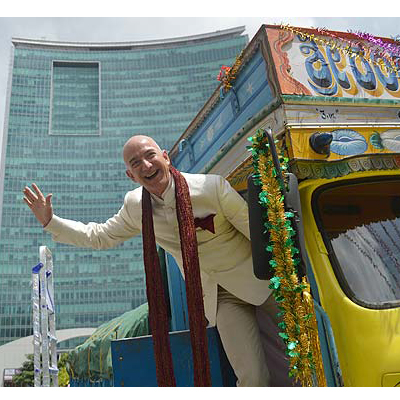
    To make his business intentions in India clear, Bezos, who is on his second visit to India, carried out a road show on a supply truck at the premises of a shopping mall in Bangalore on 28 August handing a $2 billion cheque to Amazon India VP and country manager Amit Agarwal. This is by far the biggest expansion money from overseas that has come from a multi-national.


    According to the media reports, while handing the cheque, he said, “Amazon has unveiled a $2 billion investment in the country … we’ll work to better what Indians love most in shopping — vast selection, competitive pricing and fast delivery.”


    Amazon had announced a $2billion investment in India barely a day after homegrown Flipkart raised $1 bn from private investors.

    As per the reports, Bezos added that the cash pile will be spent on building performance centers, upgrading logistics services, developing the mobile platform and new tools and techniques to help the small and medium businesses.


    Amazon’s interest in the small and medium enterprises has been echoed by several homegrown e-tailers. While Snapdeal recently announced that it was inching close to the 100,000-seller mark, Flipkart has been tying up with industry bodies like FISME and NCDPD to penetrate the SME clusters.


    In an initiative called Amazon OneonOne, Bezos also had luncheon with about 100 customers on 28 September in order to find their views and opinions about the site and if there were any recommendations.


    According to various media reports, Bezos also indicated that policy hurdles in India is not impacting the company’s investment plans for the country. India is yet to allow FDI in online retail. Another issue is lack of clarity in tax laws that are impacting the company’s functioning in various states.


    Amazon’s main rivals in India are Bangalore-based Flipkart and Snapdeal, the Delhi-based company that counts eBay, Azim Premji and Ratan Tata as investors. Together, they have sold goods worth more than $4 billion, with Flipkart alone estimated to have crossed $2 billion. Alibaba, too, is keen on India, and the Chinese company has the money, experience and ambition to succeed here.


    Talking about the competition, Bezos also reportedly said, “We have a long history of obsessing over customers rather than competition.”


    With revenue of nearly $75 billion in 2013 the giant online retail site has a market value of $150 billion. It also runs a fast growing cloud computing business called Amazon Web Services and makes Kindle tablets and Fire smartphones. Bezos, in his personal capacity, bought The Washington Post newspaper last year. In India, Amazon started its technology operation first and employs a total of about 12,000 staff at offices in Bangalore, Hyderabad, Chennai and Delhi.


  • Tata Group to be the ‘Alibaba’ of India?

    Tata Group to be the ‘Alibaba’ of India?

    MUMBAI: The multiple investments made by its chairman emeritus Ratan Tata in e-tail and the steep rise in the e-commerce industry seems to have inspired the Tata Group too, which is now reportedly planning a big entry into the e-commerce space with a marketplace-based model.


    The Economic Times reported that the site will be headed by its subsidiary Tata industries and that Tata is modeling its business on Tmall.com, which is the marketplace in the Alibaba Group.


    The new marketplace business, modelling on Alibaba’s Tmall.com, would allow third-party sellers on the platform. It would help generate revenues by charging a fee or commission from merchants, who will use the platform.


    The yet-to-be-named venture is likely to be rolled out in 2015, and will initially showcase Tata’s existing retail chain brands such as Westside, Croma and Star Bazaar. Tata is also planning to tie up with its partner Zara, which only sells online through its own sites.


    It will also allow other merchants to sell alongside Tata’s various units. The group has already reportedly begun enrolling vendors and hiring people, the report added.


    Tata already has a substantial presence in real-world retail, including joint ventures with Britain’s Tesco, Spain’s Zara and coffee chain Starbucks. Last month Ratan Tata, chairman emeritus of Tata Sons, bought a stake in Snapdeal and online jewellery retailer Bluestone.


    India’s e-commerce market has been booming in recent years with market leader Flipkart clocking a valuation of $7 billion in a July funding round when it raised $1 billion from a clutch of existing investors and a day later, Amazon announced plans to invest $2 billion in India.


    Also, India’s online retail business is expected to surge to between $19 billion and 38 billion, from about $2.3 billion in annual sales now. Enticed by the potential, other business houses like Reliance Industries and Aditya Birla Group have reportedly been hinting at forays into the e-commerce space but have not revealed any concrete plans so far.

  • New ‘gourmet category’ coming soon on Snapdeal

    New ‘gourmet category’ coming soon on Snapdeal

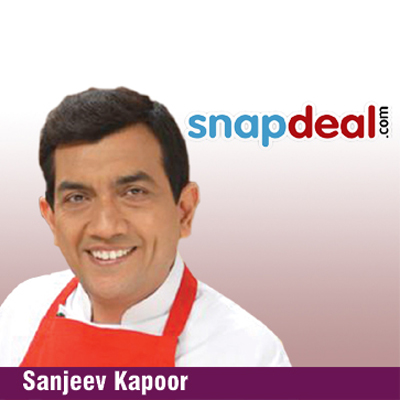
    MUMBAI: Continuing its category expansion spree, Delhi-based e-retailer Snapdeal.com has become the first online major to enter into non perishable food category. In a deal with the veteran chef Sanjeev Kapoor, the e-commerce company will soon offer a gourmet section to its customers.


    The industry pioneer, also known to author various cookbooks will be working closely with the website to launch the category.


    Talking about his latest venture with Snapdeal.com, Kapoor said, “This collaboration will bring good quality products to India at par with the rest of the world. People here find it difficult to find good gourmet products, through this tie-up, we will be able to provide excellent products to the customers.


    “All my endeavors are in line with the aim to glorify the richness of our food culture and to keep alive the traditions of the Indian kitchen. This new association with Snapdeal.com will now enable people across the country to order products like snacks, confectionery, international groceries, exotic dry fruits and nuts at their doorstep just with a simple click of a button,” he added


    The gourmet category will launched with chef’s brand WonderChef which already sells some of its products on the site.


    The section will include assortment of food products and beverages including ready to cook items, spreads and jams, wide range of Indian and international groceries, confectionery, chocolates and desserts.


    Snapdeal VP fashion Amit Maheshwari said, “This launch will further strengthen Snapdeal’s leadership as a marketplace and a destination of choice for all kind of products across categories which fulfill customers’ both home and business requirements.”


    The chef added, “We have been dealing with Snapdeal at a strategic level with our brand WonderChef which has seen huge success on the portal. So when they approached us this new deal and we jumped on board.”


    Even though the chef did not comment on how much the deal is worth, he added that if someone as credible as Ratan Tata is trusts the site, it’s not tough to take that extra leap of faith.


    Recently Snapdeal also tied up with Tata homes to sell houses online and also entered into a partnership with Croma to sell its electronics products online. Ratan Tata, the former chairman of salt-to-steel Tata conglomerate also bought a stake in the online retailer.

  • Alibaba in talks with Snapdeal to enter India

    Alibaba in talks with Snapdeal to enter India

    MUMBAI: As it is ready to embark upon a new journey by launching what may be the biggest IPO ever, Chinese e-retailer Alibaba may also be making a move to tap into the growing Indian retail market through an investment in local e-retailer Snapdeal.


    According to an Economic Times report, Alibaba, is in talks with online retailer Snapdeal to enter India. The e-commerce giant is in discussion for a possible investment in the Indian company, but no decision has been taken yet.


    The report also quoted a source saying that the deal will be announced in a month.


    The Chinese company is expected to be valued at over $165 billion at the conclusion of its initial public offer. So far, Alibaba has only been linking Indian merchants with overseas buyers and sellers.


    With its entry in the Indian online retail space by aligning with Snapdeal, the Chinese e-tailer will be competing directly against market leaders like Flipkart and Amazon. Even though the Chinese company would be a late entrant, it has the advantage of size — as per sales Alibaba is bigger than Amazon and eBay combined.


    While on the other hand, the Delhi-based company has already raised a total of $233 million in two rounds of investments this year. The last round in May valued the firm at $1 billion. It is expected to be worth Rs 50,000 crore by 2016, according to a market rating agency Crisil.


    The company, in which Ratan Tata holds a stake, is also attracting attention from Japan’s largest e-commerce company Rakuten Inc and telecommunications firm SoftBank Corp, the report added.


    On contacting Snapdeal, the spokesperson said, “As a policy, we do not comment on such speculations.”


    Alibaba’s shares are set to debut on the US market on 19 September, in what could be the world’s largest ever initial public offering. It increased the price range on its offering from $66 to $68 on 15 September, reflecting strong demand from investors for the year’s most anticipated debut.