Tag: SMS

  • Sibal scribes lyrics for a Dilli Gang

    Sibal scribes lyrics for a Dilli Gang

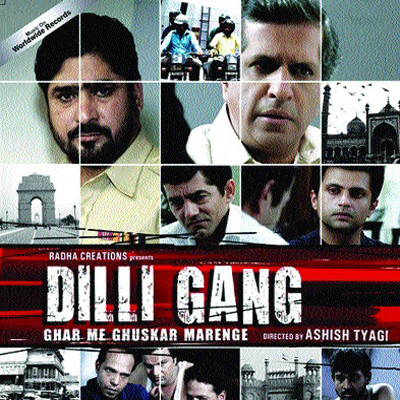
    Minister Kapil Sibal’s penchant for writing poems is well-known. He has now penned the lyrics for a Bollywood film based on the life of senior citizens. And will also appear on screen reciting his lines.


    After publishing a book of SMS poems, reciting his composition Aankh khuli aazad thi main as a tribute to women at the Star Parivaar Awards, taking on the murky side of IPL through writing, Sibal, through his poem, expresses his view on the issue of senior citizens’ safety in upcoming film Dilli Gang, which is based on true instances of crime against senior citizens, who sometimes get robbed or murdered when their children leave them.


    With a special poem composed for the film, which he recites in the beginning and towards the end of the movie, Sibal urges people to be compassionate towards their ageing parents. Karenge jo maa baap ki seva, Bhagwan unke saath rahega…, is what Sibal will be seen and heard saying in Dilli Gang.


    Talking about his compositions and poems, Sibal says social issues are his favourite subjects. “I have written poems on multiple social issues, especially on daughters. When the director and producer told me that the movie is about old people, I agreed to write a poem immediately. These topics touch my heart. The cultural transformation in our society, where children don’t respect parents and refuse to look after them, is a major issue to be addressed besides women’s safety,” he says.


    Sibal plans to continue his Bollywood innings. “Cinema is a medium which reflects the reality in society and is trying to raise hope. For people who think for the betterment of the society and want to express their views, Bollywood is the right channel. I am going to do more of this work,” he ends.

  • Now, Shah Rukh Khan is just a phone call away

    Now, Shah Rukh Khan is just a phone call away

    MUMBAI: In this era of social engagement with audiences and fans alike Bollywood’s King Khan, Shah Rukh Khan, takes one step ahead to reach out to his fans and become the first celeb to enable all his Indian fans to ‘Dial to follow him on Twitter’.

    Riding on the success of Chennai Express, in response to the love and affection shown by his fans worldwide SRK announced a groundbreaking global integration with Twitter India and ZipDial in which everyone living in India can follow and engage with him on Twitter via SMS.

    Effective immediately, anyone with a mobile phone in India can follow @iamsrk on Twitter by dialing (or giving a missed call) at 09015500555. The experience works for 100 per cent of mobile users in India on any phone, any operator network and is completely free, irrespective of whether they have a Twitter account or data-enabled phone.

    On calling the number this is the text message that is received – Thanks for dialing. Enjoy my Tweets by SMS. To reply to me or see my photos, just follow me on Twitter. Love, Shah Rukh Khan; followed by his latest tweet.

    Commenting on the integration, Shah Rukh Khan said, “I have always believed in the power of technology and use it in various ways to further my connection with my audience. In recent years, Twitter has been a magical place for me to engage with my fans. I hope all my fans in India will avail this new service to connect with me. I thank ZipDial and Twitter India for helping me inaugurate this innovation and help bring together my entire national audience who don’t access Twitter. Very soon I hope to also expand this to multiple countries, languages and platforms.”

    Twitter’s India market director Rishi Jaitly said, “Twitter is the world’s leading real time information network where hundreds of millions of people follow the people and organisations that interest them. In India, Twitter among other things brings our users closer to their favourite stars and icons. We are pleased to see Shah Rukh Khan and ZipDial use the Twitter platform in this way.”

  • Kolkata MSOs racing against time to meet DAS deadline

    Kolkata MSOs racing against time to meet DAS deadline

    KOLKATA: Multi System Operators (MSOs) and local cable operators (LCOs) in Kolkata are busy collecting the consumer application forms (CAF) and feeding in details for the complete implementation of the Digital Addressable System (DAS).

    “There’s a huge increase in workload, and everything has to be collected quicker and reported quicker,” says a Kolkata headquartered MSO. While a LOC says: “It’s very tiring to go home and get called back in again, and go home and get called back in again for clarifications and further clarifications.”

    With the Telecom Regulatory Authority of India (TRAI) confirming last week that it will strictly adhere to the 23 August deadline for implementation of subscriber management system (SMS) rollout in Kolkata, the MSOs and cable operators are collecting the know your client (KYC) form details and subscribers’ choice of channels swiftly and are racing against time to feed the data into their systems day and night.

    So far 30-35 per cent of the subscriber management system (SMS) data of cable consumers in Kolkata is completed as per the TRAI data.

    SitiCable which controls a substantial share of cable TV users in Kolkata said the call centers would update the details overnight. “We will work overnight and plan to achieve as much of the work before the deadline,” said SitiCable (Kolkata) director Suresh Sethia.

    SitiCable has set up around 11.5 lakh digital addressable systems (DAS) here.

    While for Manthan Broadband Services there are no holidays and Sundays. “We have 6.5 lakh to seven lakh subscribers. The CAF rate was around 25 per cent for us last week,” said Manthan Broadband Services director Sudip Ghosh.

    “The operators connected with Manthan are working 10 times faster than before,” added Ghosh.
    While Manthan Broadband Services director Gurmeet Singh, said: “With the regulation, we have to collect 100 per cent details. We have no other choice than asking the operators to work and achieve the target.”

    DEN Networks CEO SN Sharma said the CAF collection rate for it’s close to three lakh STBs in Kolkata is nearly 40 per cent-45 per cent.

    “Before the deadline, we aim to achieve 85 per cent -90 per cent work,” said Sharma with assurance.

    “The operators are so lethargic that the customers have not yet got the forms and we are getting calls from frantic TV viewers now,” said a MSO. “We have asked them to download the form from the website and fill it up, scan and mail it to us if possible so that their TV screens do not go blank,” he added.

    With just five days in hand to meet the switch-off date, other MSOs and LCOs said that they have deployed more personnel on shift and temporary basis.

    “Consumer Application Form (CAF) collection rate is expected to be around 70 per cent-75 per cent altogether in Kolkata by 23 August,” assumes Sethia.

    “Achieving 100 per cent target by 23 August is next to impossible. Kolkata will miss the deadline,” said Association of Cable Operators, Cable Operators Digitalisation Committee convener Swapan Chowdhury. “But the cable TV industry people are toiling hard now,” he expounded.

    On the other hand industry sources on the condition of anonymity said it is not possible to give authentic data in just five days. “Filling up more than 18 lakh CAFs is not a matter of joke. The LCO may tick mark the preference of the users themselves,” he said. “For not providing genuine information, the MSOs may face dreadful consequences,” he hinted.

    If around 5,000 local cable operators and 14 MSOs, which provide service in DAS areas do not abide by the deadline of submitting the CAFs, TRAI may file a case against any MSO, concluded a source.

    With the clock ticking and TRAI not willing to give any leeway, the MSOs and LCOs have their work cut out.

  • About 300,000 illegal telemarketing companies axed by TRAI

    About 300,000 illegal telemarketing companies axed by TRAI

    NEW DELHI: A total of about 300,000 telephone connections of un-registered telemarketers have been disconnected by the Access Service Providers and the name and address of 25,295 such subscribers have been put into the blacklist.

    Minister of State for Communications and Information Technology Milind Deora told Parliament that this follows concerted action taken by the Telecom Regulatory Authority of India (TRAI).

    TRAI issued the Telecom Commercial Communications Customer Preference (Twelfth Amendment) Regulation on 23 May this year. This regulation provides for disconnection of all the telecom resources of subscribers sending unsolicited calls/SMSs, blacklisting of the name and address of such subscribers for two years, disconnection of telecom resources to such subscriber by the other service providers within twenty four hours of blacklisting of such subscriber. No telecom resources shall be allotted to such blacklisted subscriber by any Access Provider for two years.

    Through the Telecom Commercial Communications Customer Preference Regulation, 2010 TRAI has laid down a revised framework for addressing Unsolicited Commercial Communications (UCC) and these regulations came into force with effect from 27 September 2011. TRAI has also issued various amendments to these regulations and a number of directions to make the regulatory framework more effective.

    The Minister said complaints related to unauthorised telemarketing activity from un-registered telemarketers (who are not registered with TRAI), had increased during the last one year.

    To make the framework more effective an amendment to the Telecom Commercial Communications Customer Preference Regulation (Tenth Amendment) has been issued by TRAI on 5 November last year to further control the unsolicited commercial communications, especially relating to commercial SMS from unregistered telemarketers. One of the key provision of this regulation includes restricting unregistered telemarketers from sending bulk promotional SMSs using software applications.

    Through this regulation TRAI has mandated the Access Service Providers to put in place a solution, which will ensure that no commercial SMSs are sent having same or similar characters or strings or variants from any source or number. The solution will ensure that no more than 200 SMSs with such similar ‘signature’ are sent in an hour. 

  • TRAI gets tough on deadline for CAFs

    TRAI gets tough on deadline for CAFs

    MUMBAI: The Telecom Regulatory Authority of India (TRAI) means business and how. The regulator had called for a meeting on 19 July with the leading Multi System Operators (MSOs) that provide cable TV services in Mumbai, Kolkata and 38 cities, covered under phase-II of Digital Addressable Cable TV Systems (DAS) implementation, to review the progress.

    TRAI has set the following deadlines for collection of the consumer application forms (CAFs) from the subscribers, complete in all respects, including choice of channels/services and entry of complete details in the subscriber management system (SMS), by the MSOs in these cities:-

    Sl. No.
    Cities
    Deadline
    1 Municipal Council of Greater Mumbai area 2 August 2013
    2 Kolkata Metropolitan area 23 August 2013
    3 38 Cities covered under phase-II of DAS implementation* 20 September 2013


    *Hyderabad, Visakhapatanam, Patna, Ahmedabad, Rajkot, Surat, Vadodara, Faridabad, Srinagar, Ranchi, Bengaluru, Mysore, Bhopal, Indore, Jabalpur, Auragabad, Kalyan-Dombivili, Nagpur, Nashik, Navi-Mumbai, Pimri-Chinchwad, Pune, Sholapur, Thane, Amritsar, Ludhiana, Jaipur, Jodhpur, Coimbatore, Agra, Allahabad, Ghaziabad, Kanpur, Luknow, Meerut, Varanasi, Chandigarh, Howrah.

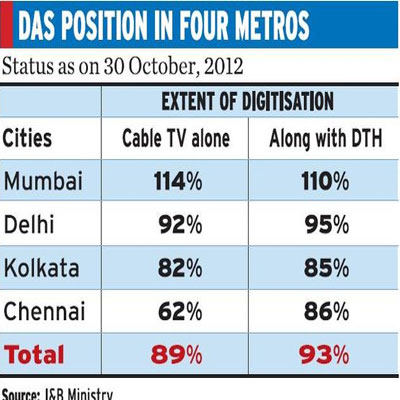
    TRAI has already collected 97 per cent of CAF forms from Delhi and 80 per cent from Mumbai.

    Speaking to Indiantelevision.com, TRAI principal advisor Parameswaran N said, “The deadline to submit the customer application forms in Kolkata is 23 August and there will be no extension. TRAI will take an action against LCOs and MSOs who will not submit the CAFs on time.”

    TRAI has requested cable TV subscribers of the above mentioned areas to cooperate and submit the CAFs, complete in all respects to the respective cable operators/MSOs at the earliest, to enjoy the full benefits of digitisation. In event of failure to do so, MSOs will have no option but to switch off the signal to those consumers who have not submitted the forms, otherwise such MSOs would be in breach of the law.

    Incable MD Ravi Mansukhani said, “80 per cent forms have been submitted and by the end of this month it should be 100 per cent in Mumbai.”

    A leading Cable operator‘s spokesperson said, “CAF forms cannot be filled in a month or two. It is a long process which will take time; LCOs have to understand that this process will increase their ARPU‘s (Average revenue per user) and at the same time the subscribers too are not educated about this issue and they would only be aware of the gravity of the situation once their connections will be downgraded.”

  • TRAI: Activation of VAS only on second confirmation

    TRAI: Activation of VAS only on second confirmation

    NEW DELHI: With the aim of reducing complaints relating to value added services (VAS) offered by telecom service providers, the Telecom Regulatory Authority of India (TRAI) on 10 July said any will be activated only after receiving a second confirmation from the customer.

    In the directions issued by it, TRAI says the service provider has to provide a system which takes a second consent from the customer before providing a value added service through any means – OBD, IVRS, WAP, Mobile Internet, USSD, SMS, Tele-calling or any other mode of activation.

    The first offer of a service is on the service providers‘ platform and a second confirmation from the customer is through a dedicated consent gateway which is owned by a third party and not by the service provider.

    At the outset, TRAI said activation of VAS by service providers has been the cause of many customer complaints. The Authority has been addressing, from time to time, consumer issues, which have come to its notice through consumer complaints, relating to activation of value added service through different modes, without the explicit consent of the consumer. These directions essentially prescribe the manner in which the explicit consent of the consumer is to be obtained for activation of value added services through different modes. While issuing these directions, the Authority has also considered the interests of the service providers and growth of value added service industry.

    In partial modification of existing directions, TRAI has directed all Service providers to implement a uniform procedure for taking explicit consent of the consumer for activation of value added service and for deactivation of value added service.

    A Common de-activation procedure using toll Free Common Short Code 155223 has been provided and all requests for de-activation have to be completed in four hours).

    VAS activation procedure will henceforth include all forms of activations and scenarios – OBD, IVRS, WAP, Mobile Internet, USSD, SMS, Tele-calling and any other mode of activation.

    The deactivation procedure should be publicised through advertisements in newspapers, updation in the website and SMS blasts.

    A full 24 hours before auto renewals of the VAS services, information about renewals to be provided to the customers, through SMS and Outbound Dialing (OBD).

    In case of wrong activation, the amount will be refunded within 24 hours of the customer‘s request. Such customer requests should be within 24 hours for VAS with validity of more than one day and within 6 hours for VAS with validity of one day.

    In case of USSD and SMS mode of activation, no activation response time should be more than 10 seconds and 60 minutes respectively and in case of non-response, the same should be treated as ‘no activation required‘.

    Upon activation of VAS service, the de-activation number, the validity of the VAS service and charges for renewal should be explicitly informed.

    A Monthly report on activations, de-activations and complaints received and their redressal to be submitted to TRAI.

    The directions for obtaining explicit consent of consumers for subscribing, renewing and deactivation of Value added services are available on TRAI website http://www.trai.gov.in

  • TRAI reduces roaming charges for calls and SMSs

    TRAI reduces roaming charges for calls and SMSs

    MUMBAI: Telecom Regulatory Authority of India (TRAI) on Monday announced reducing the national mobile phone roaming charges. The regulator said there would be no free national roaming as of now, but it had come out with conditional free national roaming plans to bring down cellphone roaming charges, reports said.

    “TRAI has reduced ceilings for national roaming calls and SMS and instituted a new regime for providing flexibility to telecom service providers to customise tariffs for national roamers through STVs (Special Tariff Vouchers) and Combo Vouchers,” the regulator said.

    It has also mandated two types of free national roaming plans to be provided by all telecom service providers. These changes will come into effect from 1 July 2013, it said.

    “Mandating a fully free roaming regime is simply not practicable at this juncture. Compelling a transition to a fully free national roaming regime would result in telecom service providers not being able to recover their costs from roamers,” the regulator said.

    In turn, telecom service providers would pass these costs on to all consumers (predominantly non-roamers) through higher tariffs, it added.

    In 2007, TRAI had prescribed the ceiling tariffs of Rs 1.40 per minute for outgoing local calls and Rs 2.40 per minute for outgoing STD calls while on national roaming. These ceilings were reduced to Rs 1 per minute and Rs 1.50 per minute respectively, it said.

    Similarly, the ceiling tariffs for incoming calls while on national roaming have been reduced from Rs 1.75 per minute to Rs 0.75 per minute, it said.

    Tariffs for outgoing SMS while on national roaming, which were earlier under moderation, have now been capped outgoing SMS (local) at Rs 1 per SMS and outgoing SMS (STD) at Rs 1.50 per SMS. Incoming SMS will remain free of charge, TRAI said.

  • Govt  firm  on Phase 2 deadline, claims 60% digitisation in 38 cities

    Govt firm on Phase 2 deadline, claims 60% digitisation in 38 cities

    MUMBAI: The Information & Broadcasting secretary Uday Kumar Varma has asserted that the government is firm on 31 March deadline.

    Giving a keynote at the Valedictory session of Ficci Frames, Varma said that the second phase of digitisation is on track with 60 per cent of households already going digital.

    "Digitisation is happening smoothly. We have achieved 60 per cent digitisation in the second phase. Subsequent to 31 March, the process will be irreversible," Varma said.

    Out of the 38 cities that are going digital in the second phase, as many as 10 cities have achieved 75 per cent digitisation.

    Four cities have been slow in implementing digitisation, Varma added. These include Ranchi, Srinagar and one in Tamil Nadu, where the state government is vehemently opposed to digitisation.

    "Out of 16 million STBs that are to be installed, 10 million have already been installed while six million are yet to be installed. However, we are confident that these will be installed within the deadline period," Varma asserted.

    Varma also said that the industry needs to keep the spirit of alignment to take the digitisation to its logical conclusion. However, he hastened to add that digitisation is still an incomplete task as even in phase 1 only set-top box (STB) has been installed and other aspects like Subscriber Management System (SMS) and billing are yet to be put in place.

    Digitisation, Varma said, will correct the aberrations of business model in the broadcasting industry and usher in an era of transparency.

    He also said that the role of state government is important for effective implementation of digitisation.

    He reiterated that the government can step in to provide guidelines for an independent television audience measurement system should the industry ask for it.

    "We need a robust and healthy ratings measurement agency," he said.

  • Industry  needs  to come together to put all systems in place for Phase 2: Parameswaran

    Industry needs to come together to put all systems in place for Phase 2: Parameswaran

    MUMBAI: The multi system operators (MSOs) might have successfully installed set top boxes (STBs) in majority of homes in phase 1 of digitisation but the government feels that is just one aspect of the drive and other aspects like subscriber management system (SMS) and billing system need to be put in place if the real benefits of digitisation have to be realised.

    The Telecom Regulatory Authority of India (Trai) wants the industry to set things right for Phase 2 of cable TV digitisation. Trai consultant N Parameswaran said Tuesday that the stakeholders need to work towards having all the systems in place in order to implement digitisation in letter and spirit.

    “Digitisation has not happened in a manner that we wanted to. It’s not a regulatory issue. The industry has to come together and ensure that that all the systems are in place from day one for phase 2,” he said.

    According to Parameswaran, the real benefits of digitisation have not reached people. "The subscriber management system is not in place. What has happened is only set top boxes have been installed,” Parameswaran said, while taking part in a panel discussion on digitisation at Ficci Frames 2013.

    Parameswaran said that the Trai had recently issued notices to MSOs and LCOs (Local Cable Operators) to make their SMS operational in DAS areas to ensure things fall in place.

    While commending the industry for achieving digitisation in a short span of time, Den Networks CMD Sameer Manchanda assured that the SMS and billing system will fall in place in 60 days.

    “We should have all things in place in 60 days. Putting eight million STBs was a herculean task. Digitisation has taken years in other countries,” Manchanda said.

    IndiaCast Group CEO Anuj Gandhi said the ARPUs (Average Revenue Per User) will increase gradually. The key is to segment existing channels and create packages accordingly. A case in point, Gandhi said, was having a South Indian channel package for Mumbai.

    Gandhi urged the industry to take one step at a time. The immediate priority, he said, was to get back-end systems in place. “For broadcasters, it’s a scary thought that the customers are getting more channels for the same price,” averred Gandhi.

    According to Multi Screen Media (MSM) CEO Man Jit Singh, government should continue to play the facilitators role like it did in the first phase. He also said that STBs have installed, subscribers are getting digital signals but little has changed apart from that.

    “What we have shown in first phase is that we came together as an industry to implement digitisation. The government also has a critical role to play. It should continue to play the facilitators role to bring together different stakeholders in the industry,” Singh said.

    He added, “Tiering and ARPU is incremental to drive the market together by understanding the consumer needs and expectations. The burden of expansion has to be shared by the Local Cable Operator (LCO), Multi System Operator (MSO), broadcaster and the consumer.”

    IBM Global Business Services India/SA Director & Partner, Industry Leader – Media & Entertainment Raman Kalra said that it is important for the industry to keep parallel strategy in place as the business model is evolving continuously.

    “Consumer is willing to pay but the industry should know how to extract it. The key is to know your customers to facilitate micro-segmentation and then work on the content strategy accordingly,” Kalra said.

    Reliance Broadcast Network Limited (RBNL) CEO Tarun Katial said the advent of digitisation has made things easier for new channels as the carriage and placement is not a big problem anymore.

    He also said that the availability of more channels has meant that consumers are sampling more channels which is good for niche channels. He also felt that dynamics will change as advertisers will now have to shell out more for advertising on television as subscription revenues go up and advertising duration is cut down.

    Times Television Network (TTN) MD & CEO Sunil Lulla said, “The current economics are not adequate for the success of Phase 2 of digitisation. There is an urgent need for industry transformation and an effective change in consumer experience. We are sitting at the cusp of change where widespread and deep digitisation will happen on the back of consumers, regulators and government working together.”

  • 79% smartphone users in India use password protection

    79% smartphone users in India use password protection

    NEW DELHI: A study has shown that 79 per cent of smartphone owners in India have password protection on their devices and 86 per cent of smartphone owners store personal and intimate information on their mobile devices which necessitates password protection.

    McAfee, one of the world’s leading digital data protection company, has claimed in its study that the personal data may include passwords, bank account information, credit card numbers and personal or family photos.

    It said 98 per cent Indians delete any personal text message, photos and emails regularly while 78 per cent regularly back up the data from their devices. As high as 96 per cent of the Indians believe that their data and personal photos are safe with their partners and most of them also share passwords with each other.

    But 77 per cent of adults had their personal content leaked without their prior permission. Moreover, three out of 10 ex-partners threatened the other of exposing their personal photos online. Even though 49 per cent of the broken couples have asked the other to delete all personal content, few respond to the request.

    Despite the veracity of the situation, McAfee claims that 53 per cent Indians still plan on sending romantic photos to their partners through email, SMS or social media on the Valentine’s Day.