Tag: SMS

  • AI Writes, brands shine as 0101.Today unveils 121 Comms for marketers

    AI Writes, brands shine as 0101.Today unveils 121 Comms for marketers

    MUMBAI: In the fast-scrolling world of digital marketing, brands battle to create content that cuts through the noise. Enter 121 Comms, the latest AI-powered tool from 0101.Today, designed to revolutionise how businesses craft marketing messages across email, WhatsApp, SMS, and RCS effortlessly, instantly, and with precision.

    For years, data-driven marketing has helped brands understand consumers, yet the content itself often lags behind. 121 Comms changes that by generating hyper-personalised, high-impact copy in seconds. Marketers simply input key details like category, medium, objective, brand, tonality, and specific instructions and the AI takes over, delivering content that is tailored, brand-aligned, and conversion-focused. Whether it’s a crisp SMS or a detailed email, the tool adapts dynamically to ensure the message hits the right note.

    0101.Today managing partner Ajay Verma believes this tool is a game-changer. “Marketers have access to vast amounts of data, but crafting impactful, brand-consistent content at scale remains a challenge. With 121 Comms, we bridge this gap bringing speed, accuracy, and engagement together in a way that feels effortless.”

    What sets 121 Comms apart is its industry-specific intelligence. Trained across eight verticals including fashion, BFSI, tech gadgets, media, and F&B, the tool understands nuances in tone, from playful to professional, conversational to luxury. Plus, it’s completely free, with no sign-ups, no lead captures, and no hidden costs, just pure AI-driven content creation at marketers’ fingertips.

  • Digital Brand Fest 2022: How SMS and mobile marketing can accelerate brand growth

    Digital Brand Fest 2022: How SMS and mobile marketing can accelerate brand growth

    Mumbai: The digitally empowered consumers of today have more choices than ever before. As we enter into 2022 with new technologies propelling the digital transformation, several new age, as well as legacy brands, have jumped onto the digital bandwagon to up their marketing game, and retain connect with consumers.

    On day one of the Indian Digital Brand Fest 2022, IndianTelevision.com brought a host of industry experts together on one platform to discuss these trends shaping the future.  The week-long virtual summit is presented by Voot, and Interakt, Josh, and Pixis have joined as industry partners.

    The session on ‘Panel on SMS, Notifications & Whatsapp Marketing’ held virtually on Monday was moderated by Group M head of mobile and emerging tech Niraj Ruparel and the panelists included Soptle chief business & marketing officer Ritesh Ghosal, PhonePe corporate communications head  Priya Patankar, SUGAR chief business officer Suchit Sikaria, ex-WOW Skin Science VP of Marketing Madhur Acharya, Jio-Haptik’s SMB Solutions VP & business head Ahshad Jussawala, and Clever Tap SVP Marketing Jayant Kshirsagar.

    The industry executives discussed the latest trends driving the change in mobile marketing and how it has impacted the industry’s growth. SUGAR CBO Suchit Sikaria noted that the digital strategy has to revolve around mobile, and it starts right at the time of designing the asset and it has to be a mobile-first design.

    PhonePe corporate communications head Priya Patankar shared that PhonePe considers itself essentially as a utilitarian that begins with payments. “We have realised customers start with the most basic use cases for which they download an app. Once customers start trusting the app, they graduate to the more complex use cases,” she said about new consumer behaviour on the payment platform, while admitting that the pandemic has been a huge inflection point for digital payments.

    When it comes to mobile marketing, SMS and WhatsApp are very powerful media to build a connection with the customer, the marketers asserted. However, brand communication to the consumer has to be looked at through the lens of relevance, timing & value in the message, the panelists noted. According to WOW Skin Science VP of marketing Madhur Acharya, mobile marketing gives a better ROI & retention as there is more clarity on how one’s campaign is performing.

    The executives emphasised on leveraging WhatsApp for a mobile marketing strategy from the beginning. Jio-Haptik’s Ahshad Jussawala added, “For any small business or SME looking to grow their online sales and improve overall customer support, Whatsapp can be a game-changer.”

    On customer acquisition, Clever Tap SVP Marketing Jayant Kshirsagar said, “Retention is more important than acquisition and we help our customers retain their customers.”

    Also read: Digital Brand Fest 2022: Decoding digital transformation for tech-led future

    The industry executives were also unanimous in their views on the importance of hyper-personalisation in mobile marketing. Clever Tap’s Jayant Kshirsagar observed that the right kind of personalisation involves looking at customers as a ‘cohort’, and not as a ‘one size fits all’ with hyper-personalisation. Soptle’s Ritesh Ghosal agreed that personalisation on WhatsApp & SMS marketing allowed them to create a loyalty program, by crafting a value into the message. To which SUGAR’s Sikaria shared their experience of sending out personalised messages to their most loyal customers on Whatsapp, wherein the responses the brand received from its customers consisted of instant emotive acknowledgments.

    Group M’s Niraj Ruparel gave a huge thumbs up to Mondelez’s SRK campaign, citing it as one of the best instances of hyper-personalisation using AI & ML.  “Stop selling, start serving. Because if you serve your customers right they’ll refer to your brand and you’ll get new customers!,” said Clever Tap’s Kshirsagar concluding the discussion.

    Towards the end of the session, the marketers also addressed the concerns of Spamming in mobile marketing. Putting consumer fears to rest it was pointed out that WhatsApp has all the policies and measures in place to curtail Spamming activities by brands.

    For more details on the event, click here

  • I&B ministry lays down guidelines for infrastructure sharing by MSOs

    I&B ministry lays down guidelines for infrastructure sharing by MSOs

    Mumbai: The ministry of information and broadcasting (I&B) has given its go-ahead to the multi-system operators (MSOs) to share infrastructure with other MSOs on a voluntary basis. As per the guidelines released by the ministry, the responsibility for compliance with guidelines and other regulations will lie with each MSO independently.

    According to the guidelines, each MSO will have to ensure encryption of signals and addressability of subscribers in all circumstances, and provide access of all the systems and the networks, used to provide broadcasting distribution network services, to the concerned broadcasters for audit as per the regulations and the authorised officers of the government and their representatives whenever demanded.

    The sharing of head-end used for cable TV services & transport streams transmitting signals of TV channels, among MSOs is permitted on a voluntary basis, said the ministry.

    Any MSO willing to share its transport stream of TV channels with another MSO should ensure that the latter has valid written interconnection agreements with concerned broadcasters for distribution of pay TV channels to the subscribers. They may share the common hardware for their SMS applications. But, the details of such arrangements should be reported to the MIB, the Trai, and the concerned broadcasters, 30 days in advance.

    As per the guidelines:

    ·Each MSO shall be accountable for ensuring the integrity and security of the CAS and the SMS data pertaining to such distributor.

    ·Each MSO shall maintain the backup of transaction logs and data of the CAS and the SMS, on a near real-time basis, for at least the past two years, at any point in time, on a secondary storage device.

    ·Each MSO shall undertake to provide access of the CAS and the SMS, used to provide broadcasting distribution network services, to the concerned broadcasters for the purpose of audit as per the regulations and the authorised officers of the government and their representatives whenever demanded.

    ·Each MSO sharing its infrastructure and transport streams of TV channels with other MSO, should set up systems and processes which ensure that the broadcasters are able to exercise their right of disconnection of signals in case of default of payment or due to any other reason, in terms of the interconnection agreement entered into between the broadcaster and the distributor and the relevant regulations in place.

    Under the new guidelines, the new applicant and existing licensee will jointly submit a detailed proposal for infrastructure sharing giving details of the infrastructure proposed to be shared and in the manner, infrastructure is proposed to be shared as well as roles and responsibilities of each to MIB. “The adherence and compliance to all the provisions of the rules and guidelines issued by MIB for grant of license to the MSO operator will be the responsibility of the existing operator and the new applicant proposing to share the infrastructure to the extent as may be required / applicable individually,” it added.

  • TRAI introduces new regulations for technical compliance of CAS & SMS

    KOLKATA: In a bid to put an end to content piracy in the pay TV ecosystem, the Telecom Regulatory Authority of India (TRAI) on Friday amended the interconnection regulations 2017, incorporating a framework for technical compliance of CAS & SMS.

    The authority has been receiving several complaints about the unauthorized distribution of signals and under-declaration of subscribers by distribution platforms, despite the implementation of the new regulatory digitization of the cable TV industry.

    “Sub-standard CAS and SMS also render the distribution network vulnerable to hacking and content piracy,” it said in a statement.

    According to TRAI, the framework is the first step to define an indigenous set of specifications in the line of international standards. A tightly synchronised working of CAS and SMS, as specified by the framework, will enable factual reporting of subscriber base etc. Eventually, this will reduce the revenue loss to stakeholders on account of erroneous subscription reporting.  

    “Better assurance of due revenue, in turn, may encourage the stakeholders to invest for further improvement in quality of content and service thereby benefiting the end consumer,” TRAI noted. Moreover, it will also usher-in better content security in the distribution value chain.

    The authority came out with a consultation paper seeking views on standardization of these systems last April. It also held an open house discussion later. The comments of the stakeholders received by TRAI during the consultation process were analysed. In view of the technical nature of the matter, the Authority decided to form a committee of members across the industry, related institutions.

    The committee, after extensive deliberations, recommended introducing a testing and certification regime for CAS and SMS to ensure better conformity to the standards and to improve the customer experience.

    Distribution platform operators will now need to obtain certification for their CAS and SMS systems from the certification and testing agency. The framework will be implemented through a testing and certification agency.

  • What will it take to make Indian CAS acceptable to MSOs?

    What will it take to make Indian CAS acceptable to MSOs?

    KOLKATA: Despite the overwhelming importance of Conditional Access System (CAS) in the overall content distribution network, there have been few discussions on CAS. Moreover, the market has been dominated by foreign vendors for a long time now. If the government comes up with clear standardisation of CAS and offers Indian vendors viable, competitive solutions, the transition may begin, believe industry leaders.

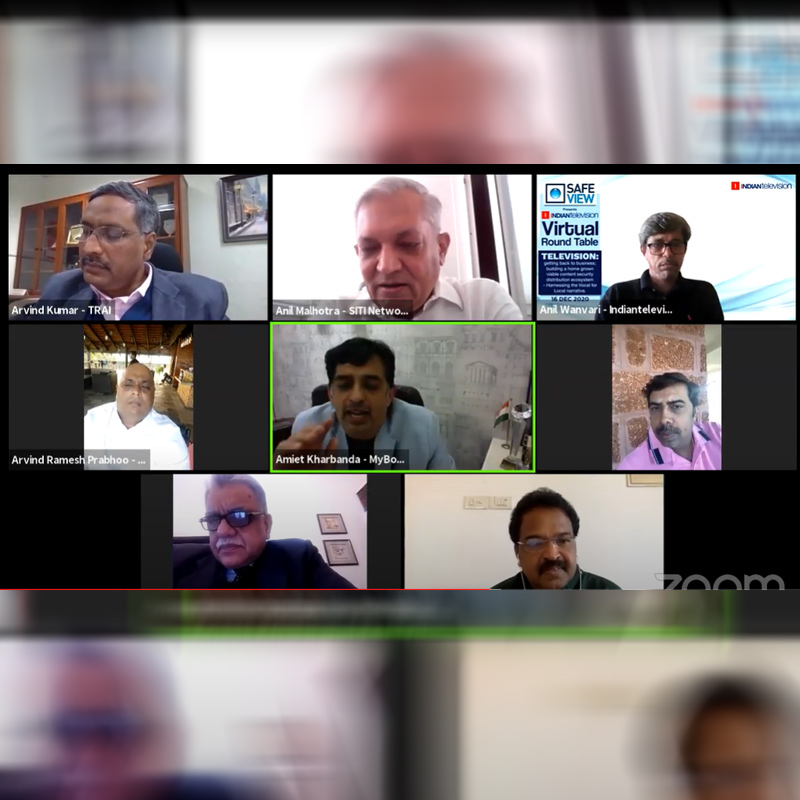
    At a virtual roundtable organised by Indiantelevision.com, moderated by founder, CEO & editor-in-chief Anil Wanvari, panellists discussed how the cable industry can be self-reliant in terms of security equipment and technology. TRAI advisor (broadcasting & cable service) Arvind Kumar, MyBox Technologies MD and CEO Amit Kharbanda, SITI Networks Ltd CEO Anil Malhotra, Maharashtra Cable Operators Federation (MCOF) president Arvind Ramesh Prabhoo, Metro Cast Network promoter Nagesh Narayandas Chhabria, Kerala Communicators Cable Ltd (KCCL) business head N Padmakumar, Safe View chairman Pradeip Nanda participated in the session.

    What did MSOs look for while setting up a security system during digitisation?

    The moderator kickstarted the session asking what were the main areas looked at by MSOs while setting up a security system during digitisation. Malhotra mentioned that the whole purpose of addressability post digitisation is lost without proper security in place. He shared that his MSO focuses on a robust system, ease of operation, 24/7 support system, scalability, the ability to satisfy broadcasters’ audits while choosing a security system.

    “Unfortunately, there is no security which is fool-proof and every security will get breached after a certain period of time. You have to consider a security system that survives the onslaught of hackers for up to 12 years at least, which is the life of an STB. When we choose anything for our network, we keep these things in mind,” Malhotra added.

    In 2013-14, Metro Cast had surveyed which CAS vendors had already deployed services to more than a million or two million customers before selecting one, shared Chhabria. Initially, they went to European CAS vendors but later moved on to Chinese vendors as their service was 30-40 per cent cheaper. Unfortunately, there was no significant Indian CAS vendor at that time, he noted.

    MCOF’s Prabhoo said that the local cable operators had limited choice because CAS and SMS as per regulation were supposed to be in the purview of MSO. So, they had very little say in which are the STBs and which is the backend SMS. It was the MSO that had the onus of choosing it.

    “On the broadband and internet side, the first important thing was what was the availability. Therefore, with a ban on products from China, we had to look into more Indian products – which is cost-effective – and what service we got from them. These were the prime considerations while we were upgrading our networks,” he commented.

    Is ‘Vocal for Local’ story taking off?

    “Efforts should be made to adopt Indian technologies. Entrepreneurs, vendors didn’t have aspirations to become big or go global in the past. Now after a major push by the government in terms of initiatives and the narrative of vocal for local, they are aspiring to grow. But they can’t do it without support from the service providers who are catering to the masses. The supply chain must be endorsed by DTH operators, MSOs, whoever in the chain, then only it will encourage new or existing entrepreneurs,” TRAI’s Kumar said.

    For instance, Safe View is a domestic producer who is very keen on working with Indian MSOs. Nanda mentioned that it is a 100 per cent Indian company and 120 small and big MSOs work with it. Moreover, it has a huge footprint overseas. Safe View has been in the market for six years with three million subscribers on its system.

    Talking about the trust deficit with Indian vendors, KCCL’s Padmakumar added that the concern is more about security and quality. In his view, CAS should be secured entirely so that customers don't get affected and there should not be any scope for piracy in the system. If domestic players can provide such CAS internally, the industry would be happy to utilise their services, he said. However, it should be cost-effective as well.

    On the other hand, Malhotra pointed out that Indian CAS entered quite late in the market, when the majority of the STBs had already been deployed. Had they come at the beginning of 2012 as the MSOs were deciding which CAS to take, the majority of STBs would have bought from Indian companies only.

    “Even now also with Atmanirbhar Bharat, we are not seeing a push on the set top boxes because it is not an overnight thing. One needs to start integrating and create a road map. The Indian companies are still not talked about much, because there’s still hope that the government will understand and let imports continue. Six months later we will say we do not have the same volume that we have even now. However, the government is very clear now, Make in India cannot be an assembled product. And that for me is where we missed the bus time and again,” Kharbanda elaborated.

    Chhabria also noted that the manufacturers are not getting total support from the Centre in keeping prices competitive. Naturally, price conscious MSOs are going for the Chinese players. If the same product is given at a competitive rate, then they would love to go with the Indian product. Hence, he is of the view that the government has to support the manufacturers with some incentives.

    “As far as TRAI is concerned, we have already given recommendations on indigenous telecom equipment manufacturing. We are also mulling over what we can do for the broadcasting sector also. Recommendations on interoperability of STB have already been given. I think this is the right time to blend vocal for local narrative with interoperable STBs. Security part also becomes stronger with indigenous technology,” TRAI’s Kumar commented.

    Standard guidelines for CAS is need of the hour:

    However, all the MSOs agreed that adoption will be higher once TRAI comes up with clear guidelines and standardisation of CAS. In addition to that, if TRAI or an independent agency starts certification of CAS, then it will enhance the trust of MSOs. Testing procedures for CAS in the country also need to be initiated as early as possible.

    “Every stakeholder has to play a role. There is a role for the government and the regulator also. We are making a framework for standardisation and I think that will happen very soon. In telecom, we had given recommendations to the government on telecom equipment manufacturing. Similar recommendations can be given to the government for the broadcasting sector. Most importantly, stakeholders, especially MSOs, have to come forward to use Indian-origin technology. It should be their call that at least all STB or CAS should be replaced by homegrown tech in future. As far as CAS is concerned, it is a question of only a thousand distributors who have to adopt indigenous technology. Hence, it should be the MSOs' will to support Indian CAS vendors,” Kumar stated.

  • MIB amends HITs  guidelines focusing on infrastructure sharing

    MIB amends HITs guidelines focusing on infrastructure sharing

    KOLKATA: The ministry of Information & broadcasting (MIB) has amended the policy guidelines for Headend in the Sky (HITS) operators. According to the newly added guidelines, sharing of transport stream between HITS operators and MSOs will be permitted but on certain conditions.

    HITS is a digital distribution platform and provides subscribers with a cheaper  alternative to digital cable TV   (operational expenses of managing multiple head‐ends on the ground are very high)  and DTH.

    As per the new guidelines, a HITS operator willing to share its transport stream with an MSO, should ensure that MSO has a valid written interconnection agreement with the concerned broadcasters for distribution of pay TV channels.

    The ministry has added two new paragraphs to the existing guidelines. As per the MIB the directive, wherever technically feasible, the HITS operator should share the platform infrastructure on a voluntary basis for distribution of TV channels provided that the signals of the HITS provider are distributed to subscribers through cable operator only and the encryption of signals, addressability and liabilities are not compromised.

     For sharing of infrastructure by a HITS operator with an MSO, the operator will be allowed sharing only on Indian controlled satellites. In addition to that, written permission from the department of space (DOS) would be required in this regard. Sharing of  satellite resources and uplinking infrastructure will be allowed with the written permission of MIB and WPC and NOCC, DoT.

    The adherence and compliance with all the provisions of the rules and guidelines issued by MIB and NOCC and WPC, DoT for grant of licence to the HITS operator will be the responsibility of both, the existing operator and the new applicant proposing to share the infrastructure.

    The regulator further added that sharing parties may use common hardware for CAS and SMS. But details of such an arrangement should be intimated to MIB and broadcasters 30 days in advance. However, the respective HITS operator, MSO or cable operator will be accountable for the integrity and security of CAS and SMS data pertaining to the respective operator.

    To avoid any conflict in payment, each operator sharing the stream should be individually responsible for setting up the system and processes. This move will ensure that the broadcasters can exercise right for disconnection in case of default of payment or due to any other reason in terms of interconnection agreements between the broadcaster and the operator as well as the relevant regulations in place.

    “Each operator in the sharing environment should undertake to ensure the encryption of signals and addressability to all the subscribers in all circumstances and provide requisite access for audit or for authorized officers of government wherever demanded,” MIB stated.

  • TRAI consultation paper: Tech players echo need for defined CAS/SMS framework

    TRAI consultation paper: Tech players echo need for defined CAS/SMS framework

    MUMBAI: The irregularities in the conditional access system (CAS) and subscriber management systems (SMS), the key pillars of delivering broadcast services in the digitised era,  have been major concerns for stakeholders. Like all broadcasters and major distribution platform operators (DPOs), technology players have voiced the need to define a framework for CAS/SMS systems as the Telecom Regulatory Authority of India (TRAI) issued a consultation paper seeking comments on the issue.  

    ByDesign India Private Ltd (BIPL), which offers an advanced embedded security CAS, SMS platform, recommends certain additional audit measures to improve the compliance of CAS, SMS which can be utilised by TRAI and/or its appointed auditors as it is of the view that self-certification is not sufficient.

    “BIPL has long been an advocate for standardisation of the systems which creates a level playing field and a fair operating environment for all ecosystem partners," it said. According to it, a defined framework with minimum requirements would ensure good service quality to end consumers, help broadcasters by reducing content security threat and prevent loss of revenue for the government of India. It mentioned the dire need to define a framework to benchmark the minimum requirements of the system before these can be deployed by any DPO in India.

    “A standard framework also allows the product / application developers / providers to plan their resources and price their products / services in accordance to the market offerings and end consumer requirements. This helps in running sustainable business operations with healthy competition and implementing growth strategies thereby providing confidence and satisfaction to its investors, shareholders as well as its employees,” it added. 

    Nagra Kudelski opined that a certificate from CAS and SMS vendor is sufficient to confirm the compliance of CAS, SMS. However, it also noted that a compliance certificate certifying that the SoC (System on Chip) has implemented secure TEE or hardware root of trust (security module) needs to be issued by the SoC vendor. It also added that SoC, CAS, SMS vendors should have a registered office in India with the necessary infrastructure to provide 24 x 7 support. 

    “While we follow the Digital Video Broadcasting Project (DVB) standards, we also agree that there is a need to define a framework for the overall Digital TV systems in India. There is a need to define CAS security and robustness to ensure that the business and technical interests of Operators and the Government of India are fully met,” it stated further. 

    ReliableSoft, one of the leading SMS providers in India recommended that TRAI should finalise benchmark features of SMS apart from Schedule III features and then all DPOs should conform those features with their existing SMS or New SMS that DPOs are going to finalise, based on that SMS compliance can be improved. It is also in favour of a defined framework for SMS systems in India.

    Schedule III of the interconnection regulation specifies the benchmark features or technical criteria that the systems are required to comply with. In addition, there are provisions in Schedule III that entail CAS and SMS systems to conform to certain technical features to check the piracy.

    SAFEVIEW, which offers CAS/DRM solution to TV operators, said that CAS-issued certificate for the SMS deployed in that particular DPO should be made mandatory. It also added that current version of CAS deployed needs to be certified by an accredited international agency for Hollywood studios. It is also in favour of defining a framework for CAS/ SMS systems to benchmark the minimum requirements.

    However, technology players differ in their opinion on the topic that who should be entrusted with the task of defining the framework. BIPL said a committee should be entrusted with a chairperson who should be reporting to the regulator. It also suggested representation from TRAI,  ministry of information and broadcasting (MIB), ministry of electronics and information technology ( MEITY), ministry of home affairs (MHA), ministry of finance (MoF),  ministry of company/ corporate and consumer affairs, Prasar Bharati, Software Testing and Quality Certification (STQC) Directorate, BIS (Bureau of Indian Standards). 

    “We propose that TRAI leads the overall monitoring and execution with support from BIS. Assign industry members including the leading CAS vendors, operators and SMS vendors as part of a group to define the framework. As TRAI is the leading authority that defines the rules and regulations for the industry, and therefore, is in best position to ensure proper measures are put in place. Adding industry members will ensure that the operation and business interests are considered as part of the framework,” Nagra Kudelski said. 

    ReliableSoft suggested that STQC Directorate should be entrusted with the task while SAFEVIEW recommended TRAI itself should take up the task. 

  • TRAI consultation: B’casters insist on framework, stakeholder-based industry body for CAS/SMS

    TRAI consultation: B’casters insist on framework, stakeholder-based industry body for CAS/SMS

    MUMBAI: While one of the prime targets of digitisation, the cable industry, was bringing transparency, the irregularities in the conditional access system (CAS) and subscriber management systems (SMS) have been major concerns for broadcasters. Bringing a ray of hope to many broadcasters, the Telecom Regulatory Authority of India (TRAI) released a consultation paper seeking comments on the issue. In their submissions, all broadcasters have strongly advised a need to define a framework for CAS/SMS systems and an industry body to be entrusted with the responsibility. 

    Star India said that there is an urgent need to define a framework for CAS/SMS systems to benchmark the minimum requirements of the system before these can be deployed as presently there are many CAS and SMS systems deployed that do not have required features and capabilities for securing content and reporting accurate subscriber numbers. It added that robust framework is required in order to ensure that there is no possibility of manipulation of records and piracy/illegal retransmission of signals of channels by deployment of sub-standard CAS and SMS systems as the same leads to loss of revenue to the operator, broadcaster as well as to the government in form of taxes.

    It also recommended that the technical framework must be strengthened by forming an autonomous body that will be responsible for defining the framework, accreditation of the vendors, ensuring timely upgradation of Schedule III technical specification and operational requirements and continued compliance by the CAS and SMS vendors with the requirements of Schedule III. The broadcaster added that the autonomous body may be set up by representatives of broadcasters or DPOs or CAS and SMS vendors only. This body shall be entrusted with the task of accreditation, upgradation of specifications with the involvement of technical experts, and through a consultative process with relevant stakeholders defining the framework. 

    “However, till such time the autonomous body is set up, it is imperative that Schedule III of the interconnect regulations be amended at the earliest to reflect the proposed changes and to enable strict compliance of the requirements of the amended Schedule III by DPOs and CAS and SMS vendors in order to eliminate under-declaration, manipulation of subscriber numbers and illegal retransmission of TV signals and to enable the integrity of CAS and SMS systems. In the interim until the finalisation and setting up of the autonomous body, the CAS and SMS vendors shall be held responsible for compliance of Schedule III, through the DPO and the SLA between them, it added further.” 

    Schedule III of the interconnection regulation specifies the benchmark features or technical criteria that the systems are required to comply with. In addition, there are provisions in Schedule III that entail CAS and SMS systems to conform to certain technical features to check the piracy.

    Zeel Entertainment Enterprises Ltd (Zeel) said there is a need to define the minimum basic functionality (MBF) for every CAS/SMS system to be approved in the country. Irrespective of the technology deployed, the few basic criteria should be met. 

    However, Zeel has suggested different entities rather than one autonomous body. “There are different roles which need to be performed by a different set of entities so that checks and balances are maintained and there is a concept of maker, checker, reviewer, auditor and adjudicator. The role of setting standards for CAS, SMS, MUX and DHE should ideally reside with a multidisciplinary body which has representation from relevant ministries of the government, TRAI, CDAC, STQC, broadcasters, major distribution platforms, major CAS, SMS, MUX, STB, DHE vendors, chip manufacturers, device manufacturers and noted academicians of international repute and TRAI empanelled auditors.

    “Such an agency could work under the direct supervision of TRAI as they are well versed with the intricate issues of the industry and can bring realistic elements in a timebound manner. The body/agency drafting standards should not overlap with either the body/agency providing the certification and/or the body/agency in the role of audit of these systems at a later stage. All these three units should be watertight and completely mutually exclusive,” it added. 

    According to Zeel, there should be a designated agency to carry out the testing and certification to ensure compliance with such a framework. It mentioned that TEC is the agency which is appropriately placed to carry such testing as they have been doing the same for Telco equipment and have processes and procedures in place for same. In addition to that, TEC has no direct involvement with the routine activities of the broadcasting sector, it will be able to act as an independent accreditor. 

    Times Network also feels that changes are needed. “We feel that there is a need to define a standardised technical framework for CAS/ SMS systems to benchmark the minimum requirements of the system before these can be deployed by any DPO in India. The deployment of CAS/ SMS systems is suggested to be based on advanced embedded system backed by mandatory tests and necessary. CAS must comply with CSA-2 or CSA-3 standards of scrambling algorithm and embedded in SoC (“Security on Chip”) in STB,” it said.

    It has also highlighted that the standards should be made keeping in mind that these are at par with global standards and are also useful from middleware perspective. It added that there may be a specific SOC for CAS TO minimise the chances of hacking. It should be endeavoured that no sub-standard systems can be deployed.

    “We feel that an independent, autonomous, neutral body should be set up for defining the framework for CAS and SMS in India. The autonomous body may be set up by representatives of broadcasters, DPOs, CAS and SMS vendors, technology vendors, manufacturer or importers of devices, representatives of R&D Centres, members of regulatory bodies etc. who can be assisted by trained investigators, legal and law enforcement members, cryptography analysts and system/network security auditors,” the broadcaster added. 

    Echoing the tone of Zeel, Times added that the autonomous body should take into consideration global best practices and standards while proposing and suggesting the framework or technical standards for India. 

    Sony Pictures Networks India (SPN) is also of the opinion that there is an urgent need to define a framework for CAS and SMS/Systems to benchmark the requirements of the systems due to the reasons as stated in the foregoing clauses. Such new frameworks should be effective for all the existing systems as well. 

    “We firmly believe that this would also help protection of content, removal of rampant piracy and under-declaration of subscriber base and enhancement of consumer choices and experience thereby benefiting all the stakeholders. Hence the urgency to create a framework that would look at resolving the issues as raised herein. Further, the CAS and SMS vendors supplying their systems to the DPOs within India should also be mandated to follow the Schedule III requirements read with the TRAI regulations strictly and they should be made accountable for the same,” it added. 

    SPN has also proposed an independent industry body comprising mainly the technical members from all the stakeholders including government, broadcasters, DPO and the OEMs to define a framework for the concerned issue in the country. The task of this body should be to primarily define and set the framework for CAS and SMS/Systems, which should be a benchmark for future deployments. 

    “A standardised framework is required for CAS/SMS systems to benchmark the minimum requirements of the systems before it can be deployed by any DPO in India. Unsecured CAS/SMS system may lead to theft of broadcaster’s content and cause loss to the public exchequer. Substandard CAS/SMS system also impacts the performance of STBs thereby leading to unnecessary harassment of end-users,” TV18 stated. 

    Like its competitors, the broadcaster reiterated that industry body comprising of stakeholders from every level of the value chain should be entrusted with the task of defining the framework for CAS and SMS in India and that an industry-led body is best-suited solution that ought to be considered for the same. 

    “The industry body, thus, incorporated should take into consideration the framework adopted worldwide such as Movie Labs, IBCAP, DVB, etc. while defining the framework for India. However, it is necessary that DPOs, as well as CAS and SMS vendors, are made amenable to the Industry Body. In this regard, requirements such as, mandating CAS and SMS vendors to register as other service providers should be introduced,” it added. 

  • TRAI’s consultation: DPOs favour defined CAS/SMS framework; Tata Sky, Airtel, IMCL differ

    TRAI’s consultation: DPOs favour defined CAS/SMS framework; Tata Sky, Airtel, IMCL differ

    MUMBAI: Conditional access system (CAS) and subscriber management systems (SMS) are two key pillars of delivering broadcast services in a secured and encrypted manner to authorised subscribers. However, existing technical requirements for CAS and SMS are generic in nature allowing all type of CAS and SMS systems to exist in the eco-system. Piracy in the distribution of signals occurs due to the deployment of CAS or SMS that do not comply with security protocols as per extant standards. Hence, the Telecom Regulatory Authority of India (TRAI) issued a consultation paper seeking comments on CAS and SMS.

    In response to the consultation paper, most major distribution platform operators (DPOs) have agreed that there is a need to define a framework for CAS/SMS systems to benchmark the minimum requirements of the system before these can be deployed by any DPO.

    Siti Networks has strongly agreed to the need of a framework commenting, “It has been observed that SMS and CAS vendors demand exorbitant amount for upgradation of their CAS/SMS according to the mandatory requirements of the regulations and the service providers does not have any option other than agree to their blackmailing due to the compliance requirement. Any such statutory upgradation in the system should not be burdened on the service providers.”

    Another major MSO, DEN Networks, also thinks that defining the framework for benchmarking the CAS or SMS will help DPOs to choose the right solution. There are various factors in CAS which differs from vendor to vendor as they use proprietary solutions to address the content security.

    GTPL Hathway also reflects the same tone as it says there is certainly an urgent need to define a framework for CAS/SMS systems. It adds that currently all CAS/SMS systems largely vary in terms of both security features and performance features.

    “Under the appliable regulations, DPOs are mandated to grant their customers a free choice to make their own package(s). However, it is pertinent to mention that most CAS available in the market have an upper limit to the number of packages in which the same service/channel can be repeated. Therefore, it is necessary that CAS should be able to be upgraded for offering all services and combinations thereof, available on such platform. Availability of full technical local support in India. Almost all CAS vendors have their experts based out-of-India which may affect DPO’s QoS as the availability of off-shore resources may sometime take time as they help remotely,” it adds.

    Among the DTH platforms, Dish TV also voiced for a comprehensive framework for CAS/SMS system especially for the requirement of end-to-end content protection and transparency in business for the CAS side and an end-to-end business enablement from the SMS side. It has also recommended an operating model wherein the DPO should have direct contract with each stack-holder viz. CAS service provider, SoC/Chipset maker, middleware, security element provider and STB maker wherein the CAS vendor will be as one of stack holder in entire echo system like others. 

    However, Tata Sky holds a different view. According to the operator, it may be premature to assume that the CAS or SMS systems require benchmarking right now. It adds that existing audits could be successful in identifying the systematic gaps which would force those specific DPOs to upgrade their systems to continue to receive signals from the broadcasters. 

    “We would need to be careful that a new and stringent regulation does not get misused to disenfranchise a large number of DPOs thus leading to another round of subscriber shock and dissatisfaction. If it is still concluded that a framework for benchmarking of the system needs to be created, then it should be arrived at by a multi stake holder consensus approach,” it adds.

    Airtel, which also runs a sizable DTH business, states that the basic and minimum requirements of CAS/SMS are well captured in Schedule III of TRAI regulation. It adds that CAS /SMS being a globally deployed technology, innovations are a constant feature. 

    "To start with, Airtel believes that TRAI can continue to use Schedule III requirements for the CAS /SMS while adding more features to it at regular intervals to make it more robust and to accommodate new innovations in the technology. Hence, there is no need for defining or introducing a new CAS /SMS framework. The requirements listed in Schedule III should be benchmarked as the minimum qualifying requirements for all CAS /SMS solutions operating in India as well as for all future deployment of CAS/SMS by a new DPO,” it states.

    While most MSOs are in favour of a framework, IMCL holds same opinion as Tata Sky and Airtel. “We believe that subject to the CAS/SMS/STB meeting the requirements specified in Schedule III, there is no need for any further assessment or benchmarking of products required in order for DPOs to deploy them within their networks. At most the regulator can “recommend” some preferred products, but there should not be any limit to DPOs being able to purchase or even build their own solutions subject to the requirements specified in Schedule III being met,” it comments. 

    IMCL also highlights that migrating to a new SMS platform as selected by TRAI would result in heavy costs being incurred, customisations having to be re-built into any new platform and large migration exercises to move customers to the new platform. Hence, its portals or mobile applications that are built to support LCOs, MSOs, subscribers and engineering staff would all need to be re-built in order to work with a new SMS platform. This change will result in essentially re-building the business from scratch taking away the business from other revenue-generating activities. 

  • New Epsilon study reveals that only 2% of consumers choose marketing updates via. SMS as their top preference

    New Epsilon study reveals that only 2% of consumers choose marketing updates via. SMS as their top preference

    MUMBAI: Epsilon, a global leader in creating connections between people and brands, today released the commissioned study ‘Marketing In India Is Personal, Not Just Business’ conducted by Forrester Consulting. The findings revealed the huge chasm between what marketeers believe they need to do to reach consumers, and what consumers actually prefer.

    The study analysed the marketing techniques used by Indian brands and the areas they could improve to optimise their Return on Marketing Investment (ROMI). The findings indicate that 74% of marketeers use marketing technologies to reach consumers via SMS while only 2% of consumers prefer to receive marketing updates through this channel.

    The online survey of more than 600 people that included both consumers and senior marketing professionals in decision-making roles from retail, consumer packaged goods, financial services, insurance and travel, and hospitality brands in India. The study sought to understand the use of marketing technologies across targeted industries and its relationship with consumer expectations regarding advertisements, loyalty and brand engagement.

     Key finding of the survey : (Elaborated in Annexure)

    ●        63% of  Indian consumers prefer personalized marketing and are inclined to purchase from brands that provide relevant content and offers

    ●        About 78% of consumers expect companies to have a mobile app (50% regularly keep in touch with their most frequently-purchased brand on their mobile apps), and 68% feel frustrated when a website is not mobile-friendly

    ●        In the next 12 months, 60% of  marketeers plan to increase their technology spends

    ●        71% plan to increase spending on advertising and marketing performance measurement solutions

    ●        72% of the 25-34 years old read product reviews online

    ●        63% of  Indian consumers are not willing to share personal information with companies to receive more relevant advertising however over 90% will give up information for perks and benefits

    ●        Consumers require transparency and privacy protection, but only 15% of marketers in India consider preparing for GDPR as a priority

     In line with this, Ashish Sinha, Country Head, Epsilon shared, “This research is a barometer for marketeers to guide them in reorienting their strategies and priorities to serve their consumers better and more effectively. We need to help marketeers understand what they are misreading when it comes to customer engagement. The study helps understand consumers and their predilections to help marketeers evolve. For instance, the study found, although about 92% of marketeers in India consider improving their ability to personalize capabilities as priority in marketing, the Indian market is unfledged in terms of data and technology readiness, cross-channel expertise, and in bridging organizational silos.”

    He further added, “It is a big challenge for marketeers to opt for and use the right technology to help them make sense of data and make triable marketing decisions as fast as possible. Matters like privacy are sensitive areas for Indians and hence, marketeers need to sustain a balance between personalization and privacy.  Indian marketeers need to find good partners with proven expertise for strategic guidance around collecting, cleansing and integrating consumer data and break down the internal data layers to improve their ROMI.”

    Marketeers need to better understand how consumers want to be served in order to align their (Enterprise Marketing Technology) EMT investments and optimize their omnichannel marketing.