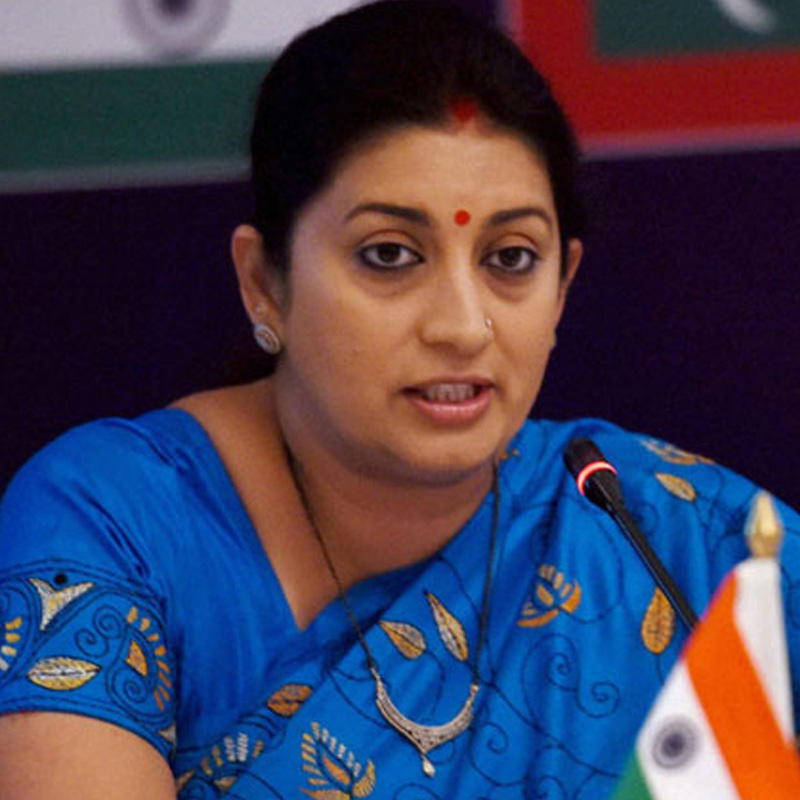
Tag: Smriti Irani

  • PMO directs MIB to withdraw guidelines on fake news

    PMO directs MIB to withdraw guidelines on fake news

    MUMBAI: The Prime Minister’s Office (PMO) has ordered the withdrawal of guidelines to crack down on journalists responsible for distributing fake news, a senior government official said today.

    “The prime minister has directed that the press statement regarding fake news be withdrawn and the matter be addressed in the Press Council of India,” a senior official in Modi’s office told news agency Reuters. No reason was given.

    On Monday, the Ministry of Information and Broadcasting (MIB) had issued a statement stating that noticing increasing instances of fake news in various mediums, including print and electronic, the guidelines for accreditation of journalists have been amended with penalties and punishment factored in.

    “On receiving any complaints of instances of fake news, the same would get referred to the Press Council of India (PCI) if it pertains to print media and to News Broadcasters Association (NBA) of India if it relates to electronic media for determination of the news item being fake or not,” the MIB statement had said, adding that the process would be completed within 15 days.

    Even as the government announced amendments in the guidelines for accreditation of print and electronic or TV journalists outlining punishments for breaches on account of fake news, the intention was termed by stakeholders as debatably honourable but an indirect way to muzzle media freedom.

    Welcoming the decision, News Broadcasters Association has issued a statement. The move has been lauded for letting industry bodies such as NBA and Press Council of India(PCI) to decide all Fake News related issues as it was proposed by Smriti Irani earlier.

    Also Read: MIB issues stringent norms on fake news in TV & print media

  • Smriti Irani says govt mulling legislation for online content

    Smriti Irani says govt mulling legislation for online content

    MUMBAI: With the rising usage of social media, platforms are witnessing an increasing incidence of hate content. Since these platforms do not fall under any regulation in India, it’s a tough task to curb the problem with the help of law. Information and broadcasting minister Smriti Irani said at the Rising India summit that the ministry was planning to bring about regulations, especially for online news, opinion and entertainment content.

    With the rise of technology and social media users, the amount of fake news spreading online is also increasing. Many of the news pieces are editorialised, undermining the true information. Irani also expressed her concern over this trend at the summit. “We cannot ignore the capacity of fake news to demean. We cannot ignore the technology engineered to deteriorate,” she said.

    When a newspaper or a television channel runs news, it has to adhere to the law. There are self-regulatory bodies to set guidelines for traditional media. In the online ecosystem, however, the legislation in terms of news or video content is not very clear. Moreover, social media now acts as an open platform for citizens to voice their opinion. The Ministry of Information and Broadcasting (MIB) is currently working on to control the balance by introducing some regulation to fight this problem. Irani also mentioned that the ministry was having conversations with various stakeholders on this.

    “This is something the ministry is considering to classify similar to what is reflected in broadcasting. Having a similar line of ethics and code of conduct has to be put in place which is incumbent upon the agencies to abide by to ensure that customers do not get affected by the vested views in news, broadcasting and advertorial content,” she added.

    According to some earlier reports, the Telecom Regulatory Authority of India (TRAI) was also evaluating a consultation process to regulate online video-streaming platforms such as Netflix, Amazon Prime and Hotstar.

    Also Read:

    Smriti Irani favours facilitating constructive communication in digital world

    Ficci Frames 2018: Smriti Irani for highlighting M&E’s economic importance 

  • DD Free Dish looks at  advertising for monetisation

    DD Free Dish looks at advertising for monetisation

    MUMBAI: The government’s own direct-to-home (DTH) platform DD Free Dish has had a good run since launch because of its wide acceptance, especially in the rural areas where the reach of cable is limited and pay TV is expensive. Now, the government is drawing up plans to make money from the platform.

    Last year, the government sanctioned a scheme to extend the number of channels to up to 250. In a reply in the Lok Sabha recently, Minister of State in the Ministry of Information and Broadcasting (MIB) Rajyavardhan Rathore said that this would enable Free Dish to generate revenue via advertisements. Quoting a private newspaper, the response mentions that private channels easily garner Rs 500-700 crore as revenue a year while a channel slot on Free Dish is as low as Rs 6-8 crore. He admitted that there were limitations to the revenue models that could be adapted into the free service if it wanted to ensure quality and reach.

    Another means of making money is via auction of channel slots on the DTH platform, which turned into a legal case when the auctions were arbitrarily called off mid last year by Smriti Irani, the information and broadcasting minister. Auctions have been kept in abeyance till a settlement is reached between Prasar Bharati and the networks that have reached out to the Telecom Disputes Settlement Appellate Tribunal. The tribunal has asked the government to conduct a comprehensive review on the auctioning policy for Free Dish before any stand is taken.

    At present, there are 72 free channels and 39 radio stations available on Free Dish.

    Updating the parliament on its growth, Rathore added that about 66,000 DTH set-top boxes have been given out in tribal, remote and border areas. According to estimates, Free Dish’s total subscriber base is 22 million.

    Also Read :

    TDSAT interim order ensures continuity for private channels on FreeDish

    TDSAT gives Prasar Bharati 2 days to respond to FreeDish auction suspension

    FreeDish auction on 4 July, different reserve prices for GEC and news


  • Ficci Frames 2018: Smriti Irani for highlighting M&E’s economic importance

    Ficci Frames 2018: Smriti Irani for highlighting M&E’s economic importance

    MUMBAI: Even as the Indian media and entertainment (M&E) sector is projected to cross $31 billion by 2020, Minister for Information and Broadcasting (MIB) Smriti Irani said yesterday it is imperative that the country as a whole projected the economic value that the industry lends to the country’s economy.

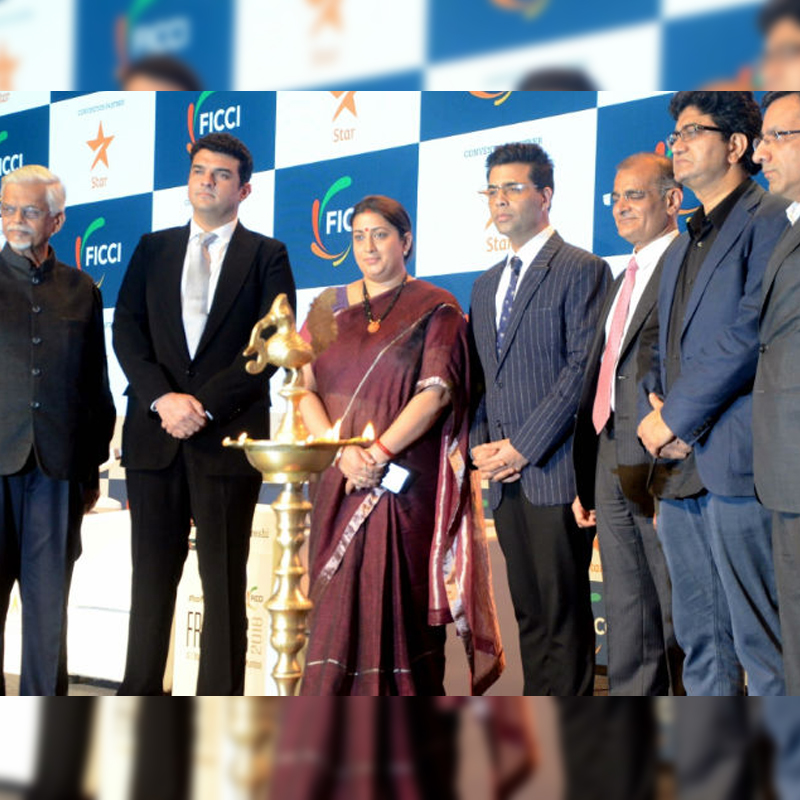
    Speaking at the FICCI-Frames 2018 inaugural ceremony here, Irani said the Indian M&E industry is much more than just naach-gana (song and dance) and it was high time that the industry came forward to articulate the economic value and contribution that it gave to the Indian economy and exhorted the industry to use modern data analytics and technology to arrive at conclusions at the type of content the consumer desired.

    Referring to artificial intelligence or AI and other technologies, she said, “Technology is looked upon as a disruptor, but have we looked at technology from a creative point of view?”

    The Indian M&E sector hit nearly Rs 1.5 trillion ($22.7 billion) in 2017, growth of around 13 per cent over 2016. With its current trajectory, it is expected to cross Rs 2 trillion ($31 billion) by 2020, at a CAGR of 11.6 per cent. The digital segment-led growth demonstrates that advertising budgets are in line with the changing content consumption patterns, according to the FICCI-EY report ‘Re-imagining India’s M&E sector.’

    Launched on Sunday in the presence of the minister and other industry stalwarts such as Star India MD Sanjay Gupta, Siddharth Roy Kapoor and filmmaker Karna Johar, the FICCI-EY report highlighted that the M&E sector continues to grow at a rate faster than the GDP growth rate, reflecting the growing disposable income led by stable economic growth and changing demographics.

    The report states that the subscription growth outpaced advertising growth in 2017, but advertising would continue to grow till 2020 led by digital advertising.

    The report estimates that 1.5 million consumers in India today are digital-only and would not normally use traditional media. It is expected that this customer base will to grow to 4 million by 2020, generating significant digital subscription revenue of approximately Rs 20 billion. Going forward, micropayments, enabled through the Unified Payment Interface (UPI) and Bharat Interface for Money (BHIM) platforms, developed by the National Payments Corporation of India (NPCI), will further accelerate subscription revenue for entertainment content.

    EY partner and M&E leader Farokh Balsara stated, “The Indian M&E sector reached INR1.5 trillion in 2017 led by digital. With digital subscribers expected to reach 20 million by 2020, has Indian M&E reached its digital tipping point? We now need to reimagine the future of Indian M&E sector.”

    Said Gupta, “These are truly exciting times for our industry. It is amongst the fastest growing sectors in the country and has crossed the Rs 147 thousand crore mark. There is a revolution happening all around us, one that promises to, and in fact, has already started to redefine the future of media and entertainment.”

    “To compete well with the world, we need to set new standards of storytelling, we need to reimagine our stories. We cannot allow our legacy to shape our creativity. With digital, we have the license to break away from all the trappings of traditional media. We need to challenge where we release our films first, in a theatre or on a mobile screen. We need to challenge the constraints of 8 pm prime time, daily and hourly news formats and 22-minute episode lengths,” he added.

  • MIB calls for ‘fiscal prudence’ in Prasar Bharati

    MIB calls for ‘fiscal prudence’ in Prasar Bharati

    NEW DELHI: The Ministry of Information and Broadcasting (MIB) on Friday justified certain government directives to India’s publicly funded national broadcaster Prasar Bharati Corporation by saying “fiscal prudence” was the need of the hour, while reiterating its commitment to safeguard interest of the organisation’s employees.

    “Fiscal prudence and accountability is the very fulcrum of the functioning of any government organisation. Prasar Bharati is as much bound by the general financial rules (GFR) of the government of India as any ministry or any organisation receiving grants-in-aid from the government,” MIB said in a statement, which, apparently, looks like a rebuttal to a report appearing in news website The Wire that questioned certain decisions of minister Smriti Irani.

    MIB also termed the story, without directly referring to it, as a “deliberate, sinister (and) motivated campaign” to “tarnish” its image by putting out a report that was “based on ill-will and incorrect appreciation with half baked facts”.

    “As per the provision of GFR, any autonomous organisation receiving grant-in-aid must sign a Memorandum of Understanding (MoU) with the ministry, clearly bringing out the physical and financial targets with timelines for activities to be done by utilising the said grant during that financial year,” MIB clarified further, adding, “For the record, irrespective of repeated reminders from the ministry, no MoU has been signed by Prasar Bharati.”

    In a news report, headlined ‘Angered by Prasar Bharati’s Defiance, Smriti Irani Blocks Salary Funds for DD, AIR’, which went viral on social media over the last few days, The Wire quoted Prasar Bharati chairman Surya Prakash, serving his second term, as saying contingency funds were utilised to pay salaries to employees for the month of January and February 2018. It also concluded that if the standoff continued, the pubcaster will run out of money by April.

    The story’s reporter, a freelance journalist who’s also written a book on BJP’s online troll army, highlighted that the federal government earmarked around Rs 2,800 crore in 2018-19 towards Prasar Bharati where the allocation is routed through the MIB, which releases monthly installments for the salaries of its approximately 5000 employees.

    The report went on to state, quoting unnamed sources in the pubcaster, that the ministry had been “raising queries and creating problems” before releasing funds and, since December, has “not released money for salaries, forcing a drawdown of contingency funds”. The crisis, the report quoted the sources as saying, began when Prakash started questioning some of  Irani’s actions.

    It must be stated here that Indiantelevision.com is not in a position to independently verify the allegations made in The Wire report and has based its present news story on an official statement put out by MIB on the website of Press Information Bureau on a day when majority of Indians took a public holiday to celebrate the festival of colours – Holi.

    However, illustrating how fiscal accountability led to “curbing of wasteful expenditure” in the Prasar Bharati, which controls Doordarshan and All India Radio, MIB said, “By bringing in Human Resource Information System in Prasar Bharati, at repeated insistence of the ministry, exact amount of expenditure on employees has been worked out and this has resulted in savings to the tune of nearly Rs 30 crore per month for the salary head (Rs 360 crore a year). The Sam Pitroda Committee had also suggested a number of measures such as manpower audit etc. to enhance financial discipline. Hence, we are hopeful that following similar footsteps, together a lot can be done to enhance transparency and accountability.”

    At a media conference last week Irani had publicly questioned Prasar Bharati management’s ability in generating additional revenues. “The tragedy was that private broadcasters grew at the cost of [pubcaster] Prasar Bharati [riding DD’s FTA FreeDish platform],” Irani had said, adding, “How can we leverage the infrastructure that taxpayer has paid for so that good content is available [and] there is increased ad spend because of sheer power of reach of Prasar Bharati?”

    Meanwhile, according to a report in The Economic Times, the MIB is scrutinising the pay packages given to senior officers in Prasar Bharati and pointing out cases of mismatch in positions to pay. Being an administrative ministry, it claims to have more power in deciding the pay for current and retired employees, superseding the directive of Prasar Bharati.

    In one particular case, Rajeev Singh, an officer at the additional secretary position in the finance wing, is drawing the salary of a secretary. This leads to a difference in pay of Rs 20,000. Seven other employees in the rank of additional director general are being probed with regard to their appointments.

    ALSO READ:

    Smriti Irani exhorts DD to leverage reach better

    Prasar Bharati’s main role is of pubcaster, not revenue generator, says Rathore

    MIB minister Smriti Irani orders review of DD prime time auction process

    Smriti Irani tweets industry body advisory urging restraint by TV news channels
  • New initiatives at FICCI Frames 2018

    New initiatives at FICCI Frames 2018

    MUMBAI: The 19th edition of FICCI Frames to be inaugurated by the I&B and Textiles minister Smriti Irani on March 4 is all set to be a grand event.

    There are a lot of interesting sessions lined up with few new initiatives this year.

    The annual media and entertainment global convention will kick-start on the 4th evening with the launch event, which will be followed by the CEOs round-table addressed by Maharashtra Chief Minister Devendra Fadnavis.

    The 4-day event that will commence from the 4th and conclude on the 7th will see the who’s who from the media and entertainment industry attend, including the likes of Karan Johar, Shabana Azmi, Siddharth Roy Kapur, Nandita Das among many others.

    One of the major attractions will be the launch of a content market, which is expected to bring over 70 buyers and sellers of content from across the world to this platform.

    FICCI FRAMES CONTENT MARKET – A CONTENT BUYER AND SELLER PARADISE

    The 1st edition of the Content Market is aimed at facilitating the business of Content. Over 70 buyers from across the globe have been invited for the bazaar, including the likes of 102 Distribution, Edko Films, Shoreline Entertainment, Spuul, Top Entertainment, Aurora Global Media Capital, Front Row entertainment, Alpha Violet Sarl and Indian companies like Zee enterprises, Star, Eros Now, Reliance entertainment among others.

    In the first edition of the market, a special screening facility has also been set up to introduce festival programmers and key buyers to a highly curated slate of new Indian films. Festival programmers from International film festivals such as London, Venice, Edinburgh among others will also be in attendance.

    With over 100 sellers and over 70 buyers of content expected to be part of the 1st content market organized by FICCI, this sets the ball rolling for greater content exchange.

    Speaking about the 1st content market Leena Jaisani, FICCI said “This is being organized with the support and advise from the media and entertainment industry professionals. There was a dearth for such a market and with this first step, we hope to move ahead towards filling this void and facilitating more business for content.”

    International Women’s Day Celebrations with Women Leaders at FICCI FRAMES

    On 5th March, few women leader will get together to discuss women empowerment in the digital era, the rise of women movements, and how the community can support the development of more women leaders in the future.

    Led by Maya Hari, Managing Director of Asia Pacific at Twitter, who will be moderating the session, the panel will feature Director of Lipstick under my burkha Alankrita Shrivastava Actor Gul Panag, Author of Face at the window Kiran Manral; Deputy Editor of Rolling Stones India, Nirmika Singh and film producer and founder of IconicBot, Vishakha Singh

    Other Important sessions
    Few of the other important sessions would include discussions on Film Tourism, The future of TV in India, Box Office Collections of films, Biopics made in India, Women Power in Films, Screen density in India, Digital Revolution, Investments in Sports, Fake News, Low budget content heavy films, Regional Films going beyond regions, Films making money internationally, GST in Entertainment sector and Cyber security.

    There will also be a masterclass with Director Anand L Rai, a case study on web series Breathe along with a workshop on Facebook.

    Annual Media and Entertainment reports to be launched

    The annual media and entertainment report on figures related to entertainment industry and an Economic Contribution Report (ECR) for 2018 will also be launched.

  • Smriti Irani exhorts DD to leverage reach better

    Smriti Irani exhorts DD to leverage reach better

    NEW DELHI: Minister of Information and Broadcasting Smriti Irani at a public platform yesterday posed a question that may not be palatable to all but would bolster the confidence of Doordarshan bosses. She asked why the pubcaster couldn’t better leverage its own taxpayer-funded vast infrastructure for revenue generation the same way as private sector broadcasters had done.

    “The tragedy was that private broadcasters grew at the cost of [pubcaster] Prasar Bharati [riding DD’s FTA FreeDish platform],” Irani said, asking further, “How can we leverage the infrastructure that the taxpayer has paid [for] so that good content is available [and] there is increased ad spend because of sheer power of reach of Prasar Bharati?”

    According to her, India’s total advertising spend is expected to grow from 9.6 per cent last year to 12.5 per cent this year.  

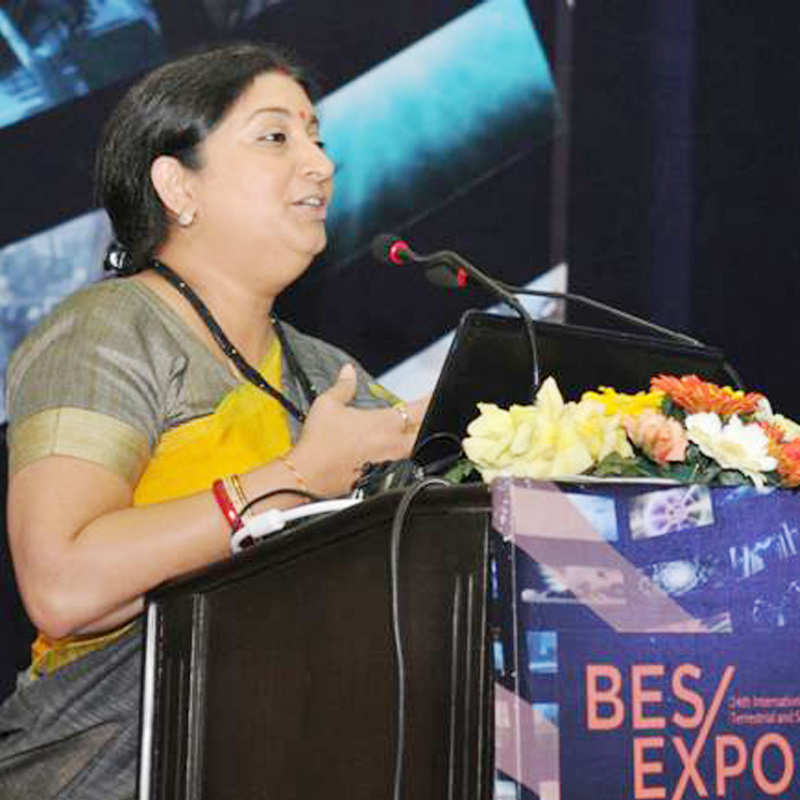
    Irani, speaking at the Broadcast Engineering Society-oraginsed BES Expo 2018, went on to raise several other issues on the need of marrying good business model with technology, inadequate capacity and capability to manufacture locally STBs and the importance of broadcast engineering in the development of India’s media industry.

    DD’s KU-band DTH service, marketed under FreeDish brand, has been in the news lately with private TV channels questioning the pubcaster’s decision to not renew contracts to be on the FTA platform on expiry. Since then, DD has been giving temporary extensions to TV channels, waiting for broadcast disputes tribunal TDSAT, moved by some by some aggrieved TV channels, to give a final ruling on the matter.

    Bringing up the issue of FreeDish at a media event, Irani looked at a natural process of sending a message across to the private sector TV channels (over 800 on last count) and the mandarins of Prasar Bharati, which, by an Act of Parliament, is an autonomous body but relies heavily on government for funds.

    “The tragedy was that private broadcasters [on DD FreeDish] ended up taking a huge chunk from the ad pie not only from the ad spend of private sector, but also from government institutions like the DAVP [agency responsible for handing out government ads] on the basis of strength they leveraged from Prasar Bharati’s own infrastructure,” the minister pointed out.

    According to Irani, if Prasar Bharati, the managers and owners of DD, leveraged its infrastructure better, it would result in not only increased advertising revenue for the pubcaster but also reducing the burden of the taxpayer. She added that the government had allocated over Rs 2,500 crore to Prasar Bharati to fund its activities that also include DD’s sibling the All India Radio.

    Admitting that online consumption of video is increasing in India—40 per cent of entertainment is consumed online—and there is a growing demand in the digital arena for broadcasting, the minister asked whether Indian consumers, both rural and urban, have been sufficiently educated about digitisation of entertainment and the convergence happening in the country.

    While exhorting the stakeholders to collaborate with phone handset manufacturers to get additional numbers on video consumption patterns in terms of quality, quantity and genre, Irani said, “Data cannot have only [a] few masters… [one of the] greatest liberators in terms of data is the expanding reach of digital tech.”

    Bemoaning the country’s inability to manufacture locally good quality, cost-effective STBs in adequate numbers, Irani said, “That engineering anomaly needs to be addressed.”

    Though India is still far from digitising fully its 183 million TV homes, industry observers say the country imports almost 90 per cent of the boxes from China and ASEAN countries not because of engineering inability but lack of financial incentives.

    The BES Expo is one of the biggest broadcast technology shows in India. Nearly 300 companies from 25 countries will display their products in this year directly or through their dealers and distributors in India.

    Also Read :

    WOW Cinema petitions TDSAT on delayed auctions for DD FreeDish slots

    Right time for India-centric global news channel: Smriti Irani

    Smriti Irani: Need to reduce gap between regional & national news & democratize viewership

  • Right time for India-centric global news channel: Smriti Irani

    Right time for India-centric global news channel: Smriti Irani

    MUMBAI: Information and broadcasting (I&B) minister Smriti Irani is ready to take India abroad. The minister has said it is the right time for the state-owned broadcaster to launch a news channel focused on India for the international market, although she added that no decision has been taken yet.

    In an interview with the Hindustan Times, Irani added that Doordarshan’s (DD) quality of content had to improve significantly for it to compete with private news and general entertainment channels but added that Prasar Bharati (DD’s parent body) had the kind of infrastructure and reach that could not be matched by private broadcasters.

    According to Irani, the big priorities for the I&B ministry are to minimise the interference of the government, but because I&B is a sensitive area, there are many regulations that need to be reviewed. “I need to increase the efficiency of how we work, because this is the first time in the history of the I&B ministry that we have eight zones specially set up (as communication hubs for the government). Zone-wise, state-wise, our communication has to be strengthened. My third big focus is on communication in local and regional languages,” she said hoping that the CEO of Prasar Bharati can make some big-bang changes.

    “The data needs to be democratised—that data cannot have only have a few masters. It is this data that helps fund channels and programmes. It is this data that drives what the viewer consumes. Advertising decisions are based on this data. The kind of programmes produced is based on this data. If the data is opaque, it leaves many questions unanswered,” she said during the interview.

    But Irani is not in the habit of casting aspersions at random. “The facts at hand are simply that we do not have details on many aspects related to ratings agency BARC (Broadcast Audience Research Council), and when BARC gives us that information I can make a more informed decision. As things stand, there’s very little understanding of BARC in the public domain,” she said.

    She said that there have to be more voices from regional media and language-based media houses — editors, creators. “On budget day, when DD was the only channel with the finance minister and ministry officials, we saw a 582 per cent growth in viewership,” she added.

    On the talks of expanding the reach of DD News to over 100 countries, she said, “If we do something like this, we will also have to involve the Ministry of External Affairs, but there is no decision on this. Yes, the timing is right to do something like this, and the market also seems to be ready.”

    She brushed away claims that the department controls advertising. “That’s a misconception. Government departments and ministries decide how much they want to spend and where they want to spend it. We just become the channel for implementing it. To say I&B decides who spends what and where is an anomaly,” she pointed out.

    Also read:

    MIB mulls broadcast of DD News to 100 countries

    Doordarshan’s R-Day broadcast notches up record TV viewership

  • Law ministry likely to give opinion on DTH guidelines review

    Law ministry likely to give opinion on DTH guidelines review

    MUMBAI: Even as the government admitted in Parliament yesterday that it has granted six companies licences to operate DTH services in India, the Ministry of Information and Broadcasting (MIB) has, reportedly, referred to the Law Ministry a long-pending proposal to review DTH guidelines in the country.

    Replying to a question in Lok Sabha or Lower House on the DTH sector, Minister of Information and Broadcasting Smriti Irani, in written statement, said Dish TV, Tata Sky, Sun Direct, Reliance BIG TV, Bharti Telemedia and Videocon d2h are licenced to provide services in India under the DTH guidelines issued on 15 March 2001, which is amended from time to time.

    She said that in addition to the private players, pubcaster Doordarshan too operated a free to air DTH services in the country and there was no restriction on the total number of DTH licences.

    According to the minister, a licencee, in addition to an initial non-refundable entry fee of Rs 10 crore (Rs 100 million), is required to pay an annual licence fee that amounts to 10 per cent of its gross revenue.

    In the meanwhile, the DTH players who had been lobbying for the last 24 months or so for another review of the DTH guidelines, aimed at bringing down the annual revenue sharing percentage to between 6-8 per cent amongst other things, may have to wait for relief.

    MIB, which was studying a proposal to review the DTH guidelines based also on some past recommendations of the Telecom Regulatory Authority of India, has already referred or is in the process of referring the matter to the Law Ministry for an opinion, if government sources are to be believed.

    Amongst the six DTH licencees, a few are operating on the basis of temporary extension of their licences as the DTH guidelines do not spell out clearly the modalities for licence renewal once the initial 10-year period is over, DTH industry sources explained.

    MIB’s indecision on the regulatory review process hasn’t helped the industry much as the sector is witnessing consolidation — for example, the ongoing Dish TV-Videocon d2h merger and the sale of Reliance’s DTH business to a set of new investors — apart from the expiry of the 10-year licence period.

    Also Read:

    DTH’s year of consolidation

    Recalibrating India’s DTH sector after Airtel DTH-Warburg Pincus deal

    Dish TV-Videocon d2h deal on course

  • MIB says fewer TV channels violating ad, prog norms

    MIB says fewer TV channels violating ad, prog norms

    NEW DELHI: Indian channels seem to be finally toeing the line. The number of TV channels violating codes has been on a decline over the years. As many as 54 private television channels have violated the programme and advertising codes since 2014, though the number has been dipping, the Lok Sabha (Lower House of Parliament) was informed.

    17 channels each violated the code in 2014 and 2015, while 16 channels in 2016, Minister for Information and Broadcasting Smriti Irani said in a written reply on Thursday to question from a fellow parliamentarian.

    However, there was a sharp dip in 2017 with only four channels found to have violated the code. No violations have been reported yet this year.

    The minister said that all the programmes and advertisements telecast on private satellite TV channels were required to adhere to the Programme and Advertising Codes prescribed under the Cable Television Networks (Regulation) Act, 1995, and Cable Television Network Rules, 1994.

    The minister added that the regulations do not provide for pre-censorship of any programme or advertisement telecast on the channels. However, all programmes and advertisements were required to be in conformity with the relevant codes, which contain a whole range of parameters to regulate programmes and advertisements on TV channels.

    Irani said that action is taken against TV channels as per uplinking and downlinking guidelines whenever any violation of the codes is established.

    Also Read :

    Govt warned 55 violators of programme & ad codes in 3 yrs, says Rathore

    Prog & Advt Code violation: 30 channels faced action in 2015 & 2016

    No proposal to ban junk food ads on TV: Smriti Irani 

    MIB recants, says only explicit condom ads banned during the day