Tag: Smartphone

  • Festive season propels Indian smartphone market

    Festive season propels Indian smartphone market

    KOLKATA: The festive season has pushed the Indian smartphone market with a quarter-on-quarter growth of 27 per cent in Q3 of the current calendar year 2014 to propel it as the largest growing smartphone market in the APAC region.


    The overall mobile market stood at 72.5 million units in Q3 2014, registering a 15 per cent quarter-on-quarter growth and a 9 per cent year-on-year growth, according to the International Data Corporation (IDC).


    “With 44 million units shipped in CY 2013 and the current market scenario hinting at 80 million plus shipments in CY 2014, we have a big chunk of end-user market which is awaiting refresh. To add to this, new initiatives on the 4G front are expected to be rolled out, which should spark up demand in the smartphone market in CY 2015,” said IDC India senior market analyst Karan Thakkar.


    However, phablets are hitting a stagnancy which has been one of the key reasons for consumers opting for smartphones, the IDC said.


    “With 6 per cent of the overall smartphone market, phablets are observed to be hitting a plateau. Smartphones are seen as the sweet spot for consumer preference. However, consumers need larger screen sizes to enjoy media content and with the 4G rollout expected in CY 2015, we expect the phablets segment to pick up again,” said IDC India research manager, client devices Kiran Kumar.


    Interestingly, Micromax is fast crawling up to challenge Samsung, the market leader. Market share for Micromax stood at 20 per cent in Q3, up by two per cent from the previous quarter while Samsung’s market share is 24 per cent.


    The Q3 results reveal the second consecutive quarter of over 80 per cent year-on-year shipment growth for smartphones, reflecting robust end-user demand for the category in the devices market in India.


    The share of smartphones in the overall mobile phone market stood at 32 per cent in Q3 2014, which is a considerable increase over 19 per cent in the same period a year ago.


    According to the Asia-Pacific (excluding Japan) Quarterly Mobile Phone Tracker, vendors shipped a total of 23.3 million smartphones in Q3 2014 compared to 12.8 million units in the same period of CY 2013.

  • Airtel launches ‘One Touch Internet’

    Airtel launches ‘One Touch Internet’

    MUMBAI: Bharti Airtel, the telecom service provider with operations in 20 countries across Asia and Africa, has announced the launch of ‘One Touch Internet’ – a first of its kind initiative aimed at simplifying internet services for millions of first-time users in India.

     Airtel’s ‘One Touch Internet’ is a WAP (Wireless Application Protocol) portal designed with a simple, secure and intuitive interface that will allow first-time users to discover the internet easily and help them overcome common perception barriers around the mobile data experience. Now available for prepaid mobile customers on Airtel – ‘One Touch Internet’ will work as a single point destination for uninitiated internet users to see-try-buy a host of popular services (including social networking, videos, online shopping and travel bookings) through free tutorial videos and trial packs – all with just one touch.

    Bharti Airtel consumer business director Srinivasan Gopalan said, “The Indian telecom market has entered a phase of data led growth. As data networks expand and internet enabled devices become affordable – more and more Indians are getting online on their mobile devices. However, our market research has shown that there are millions of customers across the country who own an internet-ready mobile device and are keen on getting online, but are apprehensive due to reasons like lack of know-how and fear of incurring heavy data charges. Airtel’s ‘One Touch Internet’ will address these very customer challenges and play the crucial role of hand-holding first-time mobile users as they discover the internet. We believe that this initiative can play a transformational role in breaking perception barriers among customers and demystifying the internet not only for the young and urban, but for people from across generations and social strata – thus giving the Indian masses an opportunity to enjoy their first ever internet experience”.

    The rapid penetration of mobile telephony has played a pivotal role in transforming the socio economic growth in countries world over, including India. According to estimates – India has over 220 million internet users today, of which, about 59 per cent get online over a mobile device. Projected to reach a whopping 385 million by 2017, the smartphone penetration in India is only growing stronger and contributing to a rapidly increasing base of internet users, which is expected to more than double to 480 million by 2017.

    To self-learn or have family and friends explain the internet to them easily, Airtel prepaid mobile customers can now call 111 or simply visit http://one.airtel.in on their mobile phones’ web browsers. Currently available in English and Hindi, ‘One Touch Internet’ will soon also be available in 8 Indian vernacular languages in weeks to come.

     To promote the launch of ‘One Touch Internet’, Airtel is also launching a full-blown 360 brand campaign. The insight for its Television Commercial (TVC) film comes from the brand’s core territory of enabling relationships, and evokes a strong emotional connect compelling viewers to teach someone how to discover the joys of the internet. The TVC will also be supported by a strong digital leg.


  • India leads growth in mobile advertising in the Asia Pacific Region: Opera Mediaworks

    India leads growth in mobile advertising in the Asia Pacific Region: Opera Mediaworks

    NEW DELHI: With a year-over-year growth rate of over 70 per cent, the Asia-Pacific region has been our fastest-growing region for the delivery of ad impressions this year, with India leading this rapid expansion of ad traffic by increasing its delivered impressions by over 260 per cent since July 2013.


    Coupled with this rapid growth of ad traffic is an aggressive transformation of the marketplace from one dominated by less capable feature phones to a transformational market, with Android devices emerging as the market leader, according to a study by Opera Mediaworks in its special edition of the State of Mobile Advertising Report.


    The future is bright for the mobile advertising business in India. This market continues to grow aggressively and is rapidly transitioning to advanced smartphone platforms, led by Android.


    With this growth and technological transformation, we believe the market presents tremendous opportunity for mobile sites and applications focused on delivering richer experiences in categories with higher monetisation potential, as we’ve witnessed on a global level.


    While India is still one of the global leaders in retaining older feature phone models, and the Symbian platform continues to hang on, it is significant to note that iOS struggles to make inroads.


    Overall, however, mobile users are shifting to “smart” devices — and with that transformation comes an increasing number of interactions with mobile services and advertising.

    As with many markets, there are major differences when one views market share based on the number of unique devices, the number of impressions served or the amount of revenue earned (eCPM).


    India is no exception to this rule, and while Android follows other devices (predominantly feature phones) in market share, it is the clear leader in impressions served and revenue production.


    However, iOS clearly outpaces the competition for its ability to produce ad revenue on a fairly small market share, producing over 2 per cent of total revenue on just 0.5 per cent of total ad impressions.

    India differentiates itself from other countries and regions in many other respects, as well. For example, when comparing the top mobile site categories supported by Opera Mediaworks’ advertising technologies globally, India presents a significantly different mix of media types.

    In both our global and India markets, social sites and apps lead the mix. However, India shows a significantly higher use of mobile app store sites (most with significant mobile games catalogs), gaming and education-oriented sites. Interest in music and other streaming media sites fall well below our global average, along with News & Information, and Arts & Entertainment.


    It is also significant to note that many of these sites and apps are accessed through a mobile operator/carrier portal, which is very different from our experience in the United States and Europe, but more common in Asia and Africa.

    The site category types and their accompanying user experience models, when coupled with a device mix that remains predominantly feature phone, result in advertising models significantly different than those experienced in the United States and parts of Europe.


    For example, simple banner ads dominate the Indian market, with only 3.2 per cent of impressions being rich-media creative. It is very promising to see, though, that over 26 per cent of revenue comes from rich media, and it clearly shows the huge potential for this market as more users adopt advanced device platforms.

    The dominant advertisers in the market focus on selling games and mobile devices, at 25.5 per cent and 22.7 per cent, respectively. Classifieds are also an important part of the ad economy, with about one in five ad impressions being for items like cars and bicycles via classified ads.

    Through our research on the market we found the India audience is predominantly young and male. The 18-24 age group accounts for over 60 per cent of all users, while males make up 82 per cent.

    Over 64 per cent of users access mobile sites and apps on a weekly basis. The most popular period for these interactions is during the weekend, with a slightly lower tendency to engage at mid-week. This day-of-week fluctuation is driven to a large extent by older feature phone users who show a much more pronounced decrease in activity at mid-week than do Android users.

    During the week, about half of unique users (49.5 per cent) are classified as “occasional” users. These users access the mobile web one or two days per week. The next largest group of users (28.9 per cent), is regular users (using the mobile web three, four or five days per week). Finally, 21.6 per cent are frequent users (accessing six or seven days per week). Over 60 per cent of impressions are served to users classified as “frequent”.

    Because so much of today’s ad traffic in India is driven by older technology feature phones, we thought it instructive to look specifically at user behavior on Android devices.


    As with the total audience, Android users flock to social-networking sites and apps. Disregarding this category, however, leads to several observed differences in audience behaviour. First, it is significant to note that interest in app stores and carrier portals is far less for the Android audience than for the audience in general. We believe this is the result of two factors. Primarily, it is likely caused by the heavy reliance feature phone users have on their carrier portals and different mobile stores and portals for content. It is also likely a reflection of our customer base, which does not include Google Play.


    Therefore, to gain more clarity into the different behaviour exhibited by the Android audience, we have eliminated the category from the graphic view, to the right. The resulting differences in user behavior between the total India audience and the India Android audience are marked.

    Android users are far more likely to engage with Arts & Entertainment, News & Information, as well as Business, Finance & Investing sites and apps than the audience in general.


    When these facts are considered in light of the revenue generation and monetization potential for these categories we see on a global basis, a critical opportunity emerges for the marketplace, as it transitions to Android and other more advanced devices.


    On a global basis, Arts & Entertainment and News & Information combine to generate over 30 per cent of the revenue managed on our platform. Compare this with the just over 4 per cent of revenue we see for these categories in India. However, when we compare our global ad traffic with India’s Android audience interest, we see more similarity and, therefore, great opportunity.

    India’s Android audience interest in News & Information sites is much more closely comparable to our experience delivering ad impressions globally than is the total Indian audience.


    News & Information publishers collectively account for just over 13 per cent of the revenue we manage for publishers globally. This is far above the 6.7 per cent we see in India.


    However, this opportunity pales in comparison to that presented by the Arts & Entertainment category. As shown on the chart above (which disregards traffic from social and application store and portal sites), the Android audience in India for Arts & Entertainment is larger than what we experience for ad traffic globally.


    Globally, these publishers account for just under 8 per cent of traffic (12 per cent disregarding social, app and portal) but they generate 17.6 per cent of the total revenue managed by our platform.

  • Facebook for every phone rolls out feelings for status updates

    Facebook for every phone rolls out feelings for status updates

    NEW DELHI: Facebook is commencing the rollout of adding feelings to status updates on ‘Facebook for Every Phone,’ which will allow users to share what they are doing or how they are feeling in a structured and visual way.


    This new feature allows one to easily add a user’s current mood, or activity to the status update right from the new smiley face icon in the composer. Share what one is listening to, reading, watching, or eating, and the post will include an icon and links to other relevant info. The feature will be working exactly the same way as it currently does on the other interfaces.


    To share one’s feelings through status updates, the user just needs to click update status, click and choose feeling or what he or she is doing in the dropdown. One can choose suggestions from the drop down or type in the whole word. Once the feeling or activity has been added, finish filling in the status update and click post. If one chooses an activity that involves an authentic page — like a brand, sports team or movie—that page will appear in the status update.


     If one describes activities like watching a TV show or reading a book, the TV show or book will also appear in the related sections on the about page where one lists things one cares about. If one does not have this feature on the about page yet, the activities one shares now will appear there when the feature is available.


     This feature was earlier available only on smartphones and now it is open for all the mobile users.

  • Trendspotters.tv now available on iOS

    Trendspotters.tv now available on iOS

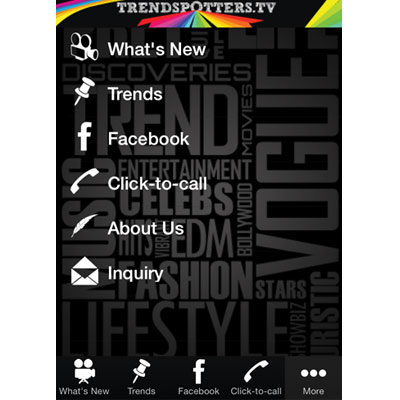
    MUMBAI: Trendspotters.tv is now available on the iOS platform. The addition will help consumers stay in the know of all that is trending around them on their Apple devices.

    The iOS app allows one to catch up with all the action in the world of fashion, entertainment and lifestyle. One can also share interesting news and trends that appeals to them with their networks on popular social networking sites like Facebook, twitter etc. through this app.

    www.trendspotters.tv founder Kunal Kishore Sinha elaborated, “While our Android app has been successfully able to penetrate the tablet, smartphone and online platforms, our iOS app will now enable users of Mac devices like iPads, iPods and iPhones to easily access our content. With this app, we are now confident of reaching out to the mobile generation of today more comprehensively. The app ensures that they can follow all the micro trends that are becoming the talk of the town easily and stay updated always.”

    The app also promotes enhanced user engagement as it allows the viewer to connect with Facebook and Twitter friends via the Trendspotters.tv page. The app is push notification enabled so as to alert the consumer with new content, as soon as it hits the page online.

    With Trendspotters.tv gaining favourable traction since its launch so far, this app goes a step further in empowering users to stay on top of what’s hot and in vogue around them, through a platform that is quick, convenient and extremely user-friendly.

  • Close Trendspotters.tv launches android to ensure TV availability everywhere

    Close Trendspotters.tv launches android to ensure TV availability everywhere

    NEW DELHI: India’s first online digital channel, Trendspotters.tv, is set for a beta launch of its app that will help viewers stay tuned to the latest trends, wherever they are.

    With direct access to watch all the stories that are trending on www.trendspotters.tv, it helps catch a quick glimpse of the best of shows for this season in the world of fashion, entertainment and lifestyle. It also enables users to share interesting news in these segments with their friends, through popular social networking sites like Facebook, Twitter etc.

    Trendspotters.tv founder Kunal Kishore Sinha said: “The launch of our new Android app for Trendspotters.tv is in continuation of our commitment to reach out to our target audience through the tablet, smartphone and online platform. The mobile generation today demands a way of accessing their news in a manner that is snappy and crisp without losing its relevance. The app caters to this need to be in the thick of micro trends as they happen as well as comment, review and share their feedback directly with our team.”

    The app is also created to enhance user engagement with an opportunity to connect with Facebook and Twitter friends via the Trendspotters.tv page. It is an innovative way of digital interaction that manoeuvres the medium of the smartphone to keep the user ahead of the times. The app is push notification enabled so as to given an alert if there is any new content, as soon as it hits the page online.

    With Trendspotters.tv gaining favourable traction since its launch so far, its app will try to take a step further in empowering users to stay on top of the best of entertainment and fashion, through a platform that is quick, convenient and extremely user-friendly.

  • Verizon Expands and Enhances Next-Generation Identity Platform to Enable Safer, More Trustworthy Internet

    Verizon Expands and Enhances Next-Generation Identity Platform to Enable Safer, More Trustworthy Internet

    Verizon Enterprise Solutions is expanding availability of its next-generation, cloud-based identity platform – Verizon Universal Identity Services – to Europe, effective immediately. The platform, previously available only in the U.S., also boasts new user-friendly features, including an updated mobile app, Quick Response code-enabled access, and a simplified end-user interface, making identities easy to manage and use.

    Verizon Universal Identity Servicesuses multifactor authentication to verify users are who they say they are by combining an individual’s username-password with a computing device that generates a one-time password or a biometric scan, such as fingerprint recognition. Once authenticated, users can securely access online content such as websites, corporate resources and even electronic medical records from their computer, smartphone or tablet. Verizon’s cloud-based identity services are an alternative to traditional solutions and provide an easier, faster, more flexibleand secure way for organizations to implement two-factor authentication.

    According to the “Verizon 2013 Data Breach Investigations Report,”weak or stolen passwords and credentials account for 76 percent of data breaches, underscoring the need for stronger online identities.

    “The bad guys are becoming increasingly more sophisticated as they continue to probe business and government networks to gain access and steal information,” said David Small, chief platform officer for Verizon Enterprise Solutions. “Verizon Universal Identity Services is transforming the business of validating online identities to provide a safer, more trustworthy Internet. Our platform will help achieve the vision of a single, trusted universal identity that individuals can use for all online activities, whether at home, at work or on the go.”

    The Verizon identity platform is available on the iOS Android, Windows and BlackBerry operating systems and can be used to validate the identities of employees, partners and customers. The platform also features legally binding digital signature capabilities, such as those required for electronic prescriptions, online tax filing and license renewals.

    In addition, anew,simplified end-user interfaceoffers administratorsan enhanced dashboard with expanded security and operations reportingthat help organizations address and demonstrate security compliance.

    “Verizon has invested in expanding the availability and enhancing the features of its next-generation, cloud-based identity platform,” said Amy DeCarlo, principal analyst for security and data center services, Current Analysis. “By focusing on the end-user experience to create an identity platform that is easy to deploy, manage and use, Verizon Universal Identity Services stands out from other identity solutions available on the market today.”

    Launched in the U.S. in 2010, Verizon Universal Identity Servicesis delivered from Verizon data centers to meet enterprise security, availability and reliability requirements.

    Said Small:“Verizon is investing today to meet the online identity requirements of tomorrow. By continuing our close collaboration with government and industry stakeholders around the globe, we are working to create a global identity ecosystem that will improve the privacy, security and convenience of sensitive online transactions.”

  • Arkadin becomes an official provider of Tata Comms jamvee video service

    Arkadin becomes an official provider of Tata Comms jamvee video service

    MUMBAI: Tata Communications has announced an agreement with Arkadin, one of the world’s largest and fastest growing collaboration service providers. Arkadin becomes an official APAC provider of Tata Communications’ recently launched jamvee conferencing – an on-demand unified communication service which enables, anyone, anywhere, to instantly access a business video meeting on any device – be it desktop, laptop, tablet, smartphone, Telepresence or video conferencing rooms.


    Connecting via video across multiple devices and platforms will be made easier. Delivered through the world’s only fibre optic cable ring around the globe, jamvee is a global video conferencing tool for enterprises that makes video conferencing – both within and between companies – as easy as making an audio conferencing call.


    Arkadin Asia Pacific MD & EVP Serge Genetet said: “With demand for video conferencing exploding, we’re confident jamvee will be popular with enterprises that need a simple on-demand service with business-grade quality that also offers the flexibility to use existing video equipment. We’re thrilled to partner with Tata Communications and certain the alliance will help strengthen our value proposition for providing customers with advanced collaboration and unified communications solutions.”


    The jamvee software application is compatible with Windows, OSX software-based devices, iPhone, iPad and Android devices. Users of Lync and other video conferencing software, as well as those with access to standard video conferencing systems such as Telepresence, can also meet using jamvee. Up to 46 participants can join each conference at the touch of a button, bringing globally-dispersed teams in fast-moving businesses closer together than ever before as the bring-your-own-device (BYOD) culture continues to gather pace.


    Tata Communications unified communications & collaboration senior VP Anthony Bartolo said, “Our mission is to create the world’s richest open video ecosystem. The partnership with Arkadin enforces this strategy which will enable true unified communication for enterprises operating in today’s mobile, always-on and global environment. Using jamvee is as easy as making an audio conferencing call and together with Arkadin’s expertise in delivering collaboration services with dedicated local-language teams; we will enable more businesses to experience the benefit that true video collaboration brings.”


    The partnership agreement with Arkadin will first roll-out in Australia and New Zealand followed by the rest of the Asia Pacific region.


    Frost & Sullivan APAC ICT Research VP Andrew Milroy said, “Frost & Sullivan attributes Tata Communications’ Managed Video Collaboration Service Provider of the Year award win to the depth of its managed video service portfolio, particularly the most recent launch of the video collaboration service – jamvee, its customer centric approach and continued execution of its video strategy. Tata Communications has built strong branding around its video strengths and is well recognised across multiple industries for its success in video collaboration. It is widely perceived to be an expert in the Asia Pacific video collaboration service market.”

  • Smartphone based VAS to generate Rs Ten Trillion business

    Smartphone based VAS to generate Rs Ten Trillion business

    MUMBAI: The wireless Value Added Services (VAS) would subsume all services that today are delivered through different devices which are expected to create over 25,000 highly scalable new businesses with a revenue potential of Rs ten lakh crores over a period of time.

    While addressing the 14th VAS Asia 2013 Conference, at New Delhi on 12 July Telecom Regulatory Authority of India (TRAI) member R. K. Arnold said, “To achieve this, all the stake holders involved in telecom industry will have to work together to create a low cost smartphone device and make people aware of the potential of such a device.” The 14th VAS Asia 2013 conference was organised by Bharat Exhibitions.

    Welcoming the delegates to the conference Bharat Exhibitions managing director Shashi Dharan said, “The issue today with TRAI is not against the industry making money, but how does it make money is surely an issue.”

    Today the country needs to examine the fact that less than 40 per cent of the Indian population has the connectivity and out of which about four per cent own smartphones. “Mobile data could generate revenues worth Rs 40,000 crores by 2015. To achieve these numbers we need to look at the bottom of the pyramid where Mobile VAS will be most useful and economical,” said BSNL chairman & managing director Rakesh K Upadhyay.

    Dependence on the Internet for day to day life is on increase, said Bharti Airtel chief of strategy, architecture and engineering Shyam P. Mardikar, while dwelling on the vast changes that were already evident in the common man‘s work due to the mobile delivering newer and newer services.

    In a wide ranging presentation at the conference the Bharti Airtel executive demonstrated how the onrush new innovations were overtaking several traditional services like SMS. “Messaging applications have depleted dependence on SMS”, he said.

    M-Wallet, M-health services, are changing the market scenario. Text books are being replaced by wireless access to books that makes knowledge available to a much larger mass at low cost. The viability of this mode of information is making data consumption an opportunity.

    “The last mile connectivity is being replaced by a first mile super highway. The challenge for the operator is to make this happen by a dense network that would have flatter architecture with dynamic and on demand capacity as against the layered one. The move is towards a network that would be closer to the user forcing the last mile to shrink.”

    “The challenge which needs to be addressed is to create a situation where-in cross operators platform(s) needs to develop and deploy services with ease, in local language, across operators,” said OnMobile Global Ltd. co-founder & chief executive officer Mouli Raman. “The industry stakeholders need to collaborate to find the right solutions through technology.”

    Analysing the problems faced by the telecom service operators Cellular Operators Association of India director-general Rajan S. Mathews welcomed the latest changes that the TRAI has made in the regulations in VAS service provision. “However, we need to rethink on revenue sharing model between operators, application providers and government. If the Government wanted broadband to be universal, the operators should be offered 500 MHz of spectrum and not the small quantities now placed on auction,” he said.

    On the issue of refarming of spectrum use, Mathews said that the operators should be allowed to use it in the way they consider best rather than government forcing it on them as it involved huge costs that would impact service charges. He specifically pleaded for AADHAR being incorporated into the mobile to expand the services the user could obtain from them. “There is a huge opportunity in penetration of vernacular languages in the mobile smartphones specifically in speech recognition at the bottom of the pyramid level.”

    The possible fall in profitability for the operator as voice was substituted by data was a matter of concern, said Robi Axiata CMO Pradeep Shrivastava. Scale was the next step forward in Mobile VAS.

    OnMobile, Qualcomm, Radisys, IMImobile, Tri-O-Tech Solutions, One97, Dialogic, DigiVive, Gemalto, IPgallery, Ehangcom, MediaTek, Synway, BincaTunes, DONJIN, SUPRANETCOM, DSNL, D‘Well Research, InCights Mobile, Nexge and Teracom participated in the event, making it a truly global platform to conduct business.

  • Smartphone sales surge; Smartphone apps score over tablets

    Smartphone sales surge; Smartphone apps score over tablets

    MUMBAI: Here‘s some food for thought. Even as Nokia is betting on its 1O5 $20 phone to ramp up its sales worldwide, IDC last week reported that sales of smartphones in Q1, raced ahead of sales of simple or feature phones for the first time in mobile phone history.

    According to market research firm, International Data Corp (IDC), vendors shipped a total of 418.6 million mobile phones in Q1 compared to 402.4 million units in the first quarter of 2012 and 483.2 million units in the fourth quarter of 2012.

    In the worldwide smartphone market, vendors shipped 216.2 million units in Q1 2013, which marked the first time more than half (51.6 per cent) the total phone shipments in a quarter were smartphones. The market grew 41.6 per cent compared to the 152.7 million units shipped in Q1 2012, but 5.1 per cent lower than the 227.8 million units shipped in Q2 2012.


    The big trend in Q1 is the emergence of Chinese companies in the Top five smartphone vendors list. Huawei and ZTE hawked 9.9 million units and 9.1 million units each in Q1 2013.

    Top Five Smartphone Vendors, Shipments, and Market Share, 2013 Q1 (Units in Millions)

    Vendor

    Q1 2013 Unit Shipments

    Q1 2013 Market Share

    Q1 2012 Unit Shipments

    Q1 2012 Market Share

    Year-over-year Change

    Samsung

    70.7

    32.7%

    44.0

    28.8%

    60.7%

    Apple

    37.4

    17.3%

    35.1

    23.0%

    6.6%

    LG

    10.3

    4.8%

    4.9

    3.2%

    110.2%

    Huawei

    9.9

    4.6%

    5.1

    3.3%

    94.1%

    ZTE

    9.1

    4.2%

    6.1

    4.0%

    49.2%

    Others

    78.8

    36.4%

    57.5

    37.7%

    37.0%

    Total

    216.2

    100.0%

    152.7

    100.0%

    41.6%

    If one looks at the chart above, Samsung sold more smart handsets than the rest of the four in the top 5 combined.

    Samsung‘s reign in the top five overall mobile phone shipment chart got stronger in Q1 with its share of shipments rising to 27.5 per cent. Nokia, however, saw its share dropping a quarter to fall to 14.8 per cent. Apple too reported single digit growth rates during Q1.


    Top Five Total Mobile Phone Vendors, Shipments, and Market Share, 2013 Q1 (Units in Millions)

    Vendor

    Q1 2013 Unit Shipments

    Q1 2013 Market Share

    Q1 2012 Unit Shipments

    Q1 2012 Market Share

    Year-over-year Change

    Samsung

    115.0

    27.5%

    93.6

    23.3%

    22.9%

    Nokia

    61.9

    14.8%

    82.7

    20.6%

    -25.1%

    Apple

    37.4

    8.9%

    35.1

    8.7%

    6.6%

    LG

    15.4

    3.7%

    13.7

    3.4%

    12.4%

    ZTE

    13.5

    3.2%

    16.2

    4.0%

    -16.5%

    Others

    175.4

    41.9%

    161.1

    40.0%

    8.9%

    Total

    418.6

    100.0%

    402.4

    100.0%

    4.0%


    What does the surge in sales mean for those of us in entertainment? Clearly, that mobile phone users are seeking more and more out of their handsets. They have simply moved beyond being just devices to be used as a long-distance talking tool.

    Kantar Media‘s latest proprietary TGI Clickstream study, with data collated from October 2011 to September 2012, has revealed that the smartphone is the device that consumers prefer as their pocket companion, even though tablets sales have been climbing crazily worldwide .Says Kantar Media‘s TGI International head Geoff Wicked: “There‘s no denying that more and more people are purchasing tablets for both business and personal use, but the fact remains that there are a billion smartphones on the planet, and tablet sales are still in their millions. While tablets will continue to become both more accessible and more sophisticated, the smartphone is still considered the all-round communications device that stays with a user for nearly 24 hours a day.”

    Kantar Media has been running a showcase theatre session at the Festival of Media Global, which is ending today Montreux, Switzerland.

    According to the Kantar Media study, social networking is the most popular type of smartphone app, with 37 per cent of smartphone web users surveyed saying they had downloaded a social networking app in the past twelve months. While this was the second most popular kind of tablet app, just half that amount (18 per cent) of tablet web users surveyed had downloaded a social networking app in the past twelve months.

    The biggest gap was evident across health and diet apps, which were downloaded by 11 per cent of smartphone web users but just 3 per cent of tablet web users – a difference of more than triple. The smallest gap was for property apps – downloaded by 4 per cent of smartphone web users and 3 per cent of tablet web users.

    Music, the fourth most popular type of app across users of both devices, was downloaded by more than double the amount of smartphone web users compared with tablet web users (25 per cent vs 11 per cent). Obviously, who wants to carry a clunky tablet with her when she is jogging around Central Park in New York or taking a walk in Lodhi Gardens in New Delhi. Similar results were revealed for mapping apps, which are the fifth most popular across both user types, but are downloaded by 22 per cent of smartphone web users compared with 11 per cent of tablet users.

    Mobile apps downloaded October 2011 to September 2012 (% of smartphone web users)

    Tablet apps downloaded October 2011 to September 2012 (% of tablet web users)

    Social networking – 37%

    Entertainment (games, digital books etc) – 19%

    Entertainment (games, digital books etc) – 32%

    Social networking – 18%

    Music – 25%

    News/weather – 15%

    News/weather – 27%

    Music – 11%

    Maps – 22%

    Maps – 11%

    Shopping – 18%

    Shopping – 10%

    Lifestyle – 11%

    Lifestyle – 8%

    Health and diet – 11%

    Sports – 7%

    Sports – 18%

    Health and diet – 3%

    Property – 4%

    Property – 3%

    Other practical apps – 20%

    Other practical apps – 10%

    Other – 12%

    Other – 4%