Tag: Smartphone

  • Free commercial time on Zee News and IBN7 for winners of special Amagi contest

    Free commercial time on Zee News and IBN7 for winners of special Amagi contest

    MUMBAI A new contest has been launched for people who want to advertise on TV on the Dubsmash platform by the Amagi which claims to be the country’s largest TV ad network.

    The winner of the ‘EK Lakh Ka Dubsmash’ contest will be awarded Free Commercial Time worth Rs One lakh on Zee News and IBN7. The winner will have the option to choose Free Commercial Time in one out of Delhi, Mumbai, Uttar Pradesh, Punjab, Gujarat, Bihar, Madhya Pradesh, rest-of-Maharashtra, West Bengal, Jammu & Kashmir, North East, Chhattisgarh, and Jharkhand.

    The contest will accept submissions from 23 March to 13 April.

    Contestants should download the Dubsmash app on a smartphone, create a Dubsmash video lip-syncing with Amagi’s ‘Bada Socho TV Socho’ commercial (which can be found in the Dubsmash library) and upload this video to YouTube.

    The YouTube link needs to be shared on social channels across Facebook and Twitter using #BadaSochoTVSocho. On completion, contestants will have to fill out a form on the Amagi website and include a link to their YouTube video.

    The winner will be determined by the highest number of YouTube views on their ‘Amagi Bada Socho TV Socho’ Dubsmash video.

    The steps have been explained in the promo.

  • Smartphone becomes popular payment wallet in India: Nielsen

    Smartphone becomes popular payment wallet in India: Nielsen

    MUMBAI There is no denying the fact that the smartphone has become an incredibly powerful tool of information, content and entertainment. And now it is rapidly growing to become a wallet, especially in India, with Paytm having the highest penetration as of December 2015 as per a Nielsen report.

    According to data from Nielsen Informate Mobile Insights, the most popular mobile payment apps in terms of time spent, are those that provide services over and above pure payment like mobile recharging, ability to book movie tickets, shopping and so on. This ability to multitask creates a ‘sticky’ factor with users.

    For most marketers, mobile payments have largely been considered a product for developed markets, but based on current trends in India they hold just as much appeal in developing markets. With over 6 billion mobile users, and with 4G entering the market, internet proliferation is expected to reach an all-time high in 2016. Putting the same in perspective with the findings of UK based Juniper Research, the adoption of mobile payment is projected to be strong.

    More than one in three mobile wallets and over 50 per cent in developed markets, will feature contactless payment by 2018, says the research. The popularity of such apps has risen from over one-in-five active users last year to over one in every two users this year. 

    An analysis of real time metered smartphone usage data with Nielsen Informate Mobile Insights reveals how Indian consumers are using mobile payment apps. Overall time spent on mobile payment apps has increased by nearly 1.5x, with users spending an hour and a half on mobile payment apps every month.

    The study has also observed certain trends that have emerged in the Indian market:

    Males drive the mobile payment category on smartphones

    Mobile wallets have made transactions effortless, and more men seem to have embraced this concept than women. Mobile payment apps are 1.2 times more popular among men than women, and men are twice more engaged with these apps than women.

    Small Town Buzz

    Nielsen’s findings indicate that even though the penetration of mobile payment apps among users is similar across towns of all sizes (60 per cent of those in large towns and 58 per cent in small town use them), usage is higher among tier I and tier II users, with these consumers spending 109 minutes a month on these apps.

    Less Is More

    As per experts, the key to accelerate mobile payment app adoption is to make the payment process simple for the consumer. The less information the consumer has to manually enter, the better the adoption rate is. The other key factors that limit consumers’ willingness to use mobile payments include trust, convenience and unstable data connectivity.

  • Smartphone becomes popular payment wallet in India: Nielsen

    Smartphone becomes popular payment wallet in India: Nielsen

    MUMBAI There is no denying the fact that the smartphone has become an incredibly powerful tool of information, content and entertainment. And now it is rapidly growing to become a wallet, especially in India, with Paytm having the highest penetration as of December 2015 as per a Nielsen report.

    According to data from Nielsen Informate Mobile Insights, the most popular mobile payment apps in terms of time spent, are those that provide services over and above pure payment like mobile recharging, ability to book movie tickets, shopping and so on. This ability to multitask creates a ‘sticky’ factor with users.

    For most marketers, mobile payments have largely been considered a product for developed markets, but based on current trends in India they hold just as much appeal in developing markets. With over 6 billion mobile users, and with 4G entering the market, internet proliferation is expected to reach an all-time high in 2016. Putting the same in perspective with the findings of UK based Juniper Research, the adoption of mobile payment is projected to be strong.

    More than one in three mobile wallets and over 50 per cent in developed markets, will feature contactless payment by 2018, says the research. The popularity of such apps has risen from over one-in-five active users last year to over one in every two users this year. 

    An analysis of real time metered smartphone usage data with Nielsen Informate Mobile Insights reveals how Indian consumers are using mobile payment apps. Overall time spent on mobile payment apps has increased by nearly 1.5x, with users spending an hour and a half on mobile payment apps every month.

    The study has also observed certain trends that have emerged in the Indian market:

    Males drive the mobile payment category on smartphones

    Mobile wallets have made transactions effortless, and more men seem to have embraced this concept than women. Mobile payment apps are 1.2 times more popular among men than women, and men are twice more engaged with these apps than women.

    Small Town Buzz

    Nielsen’s findings indicate that even though the penetration of mobile payment apps among users is similar across towns of all sizes (60 per cent of those in large towns and 58 per cent in small town use them), usage is higher among tier I and tier II users, with these consumers spending 109 minutes a month on these apps.

    Less Is More

    As per experts, the key to accelerate mobile payment app adoption is to make the payment process simple for the consumer. The less information the consumer has to manually enter, the better the adoption rate is. The other key factors that limit consumers’ willingness to use mobile payments include trust, convenience and unstable data connectivity.

  • Broadcom launches low power combo chip for mobile platforms

    Broadcom launches low power combo chip for mobile platforms

    MUMBAI: Broadcom Corporation has launched its latest and lowest power Wi-Fi/Bluetooth combo chip for mobile platforms and accessories.


    The BCM43012 delivers up to 3X longer battery life compared to Broadcom’s previous combo chips, enabling OEMs to design a new wave of high-performance connected devices.


    The BCM43012 allows OEMs to integrate Wi-Fi into platforms that have traditionally been powered by Bluetooth alone due to battery size or constrained power budgets. 


    In some applications, the BCM43012 Wi-Fi consumes 80 per cent less power than the most common Bluetooth solutions today. This reduction in Wi-Fi power consumption enables OEMs to leverage the increased throughput and range of Wi-Fi to deliver new use cases in a wide variety of devices. Using integrated Wi-Fi, accessories can also connect directly to the cloud without an intermediary smartphone.


    “For more than a decade, Broadcom has achieved a market leadership position in connectivity combos by setting the standard for performance, features, and power consumption,” said Broadcom wireless connectivity combos vice president – marketing Dino Bekis. “We have applied this expertise to launch a family of products for the promising mobile accessories markets with solutions that allow our customers to deliver a new generation of connected platforms with breakthrough capabilities.”

  • Vivo furthers Indian localisation strategy with IPL; plans major marketing push

    Vivo furthers Indian localisation strategy with IPL; plans major marketing push

    MUMBAI: With an aim to expand its Indian localisation strategy as well as furthering its interest and association in sporting events, Chinese multinational manufacturer of smartphones Vivo has set sight on the Indian market field in a big way.


    As was reported earlier by Indiantelevision.com, Vivo hit a six by grabbing the title sponsorship for the multi-million dollar cricket tourney – The Indian Premiere League (IPL) for a period of two years. The move came in the wake of Pepsi withdrawing its title sponsorship deal.


    This is Vivo’s first and so far the largest brand association since its launch in the Indian market. With 2015 being Vivo’s 20th anniversary and the first anniversary in India, the company sees Vivo-IPL making the throttle of its development even stronger.


    In the coming two seasons (2016 and 2017), Vivo and IPL will have extensive cooperation in terms of sports events, on-ground activations, media exposure and marketing campaigns.


    As a brand, Vivo has shown great interest in sports and had sponsored NBA’s live broadcasting in China last year. With an aim to enhance its brand awareness and reputation as well as get closer to its potential customers in the vast Indian market, Vivo will be utilising the IPL medium to the hilt over the next two years with a major marketing push. The Chinese company plans to launch 360 degree marketing campaigns, which will include athlete endorsements, television commercials (TVCs), venue advertisements, on-ground activation, digital and social media campaigns and fan meetings amongst others.


    Vivo Mobile India CEO Alex Feng said, “We always believe in supporting new talents and associated ourselves only with premium events globally. This investment reiterates how important Indian market is for us, and we are confident that Vivo will get returns from our investment in IPL, and this association will further advance our Love India, Love Vivo initiative.” 


    “Vivo is the pioneer of Hi-Fi music smartphone, and we strive to create smartphones combined with artistic design and technological innovation. Vivo’s spirit is to pursue excellence and create surprises. IPL, as the world’s premium cricket event, is also creating the ultimate sports experience to the world. It is this shared commitment to excellence that brought IPL and Vivo together,” he added.


    BCCI secretary Anurag Thakur said, “IPL is all about opportunities and exhibition of talent and with Vivo coming in as the title sponsor, it is yet another initiative to showcase a brand, which is young, full of life and looking for a platform to showcase its talent. Just like the IPL, Vivo in a very short span have created a niche and legacy in the smartphone market and I am sure this will be a long and enriching affiliation for both the stakeholders.”


    Speculations were rife that in the light of the match fixing controversy, which led to Pepsi pulling out of the IPL title sponsorship, the sponsorship rates might drop. However, Thakur informed that the IPL was still a coveted property in the eyes of many a brands. Thakur says that Vivo was not the only brand, which had bid for the IPL title sponsorship and that there were four brands, which were interested in coming on board as the title sponsor for the IPL and another three (apart from Vivo) were still interested in coming on board via different associations.. 


    Starting from 2014, Vivo initiated its global expansion including India. The company’s association with IPL is a strong sign of its ambition of the long term development in India. Moreover, Prime Minister Narendra Modi’s ‘Make in India’ initiative also resonates with Vivo’s plan. Its assembly unit in Greater Noida is the first step toward this commitment. With Rs 125 crore first-phase investment, this unit will be operational in November, 2015.


    The company employs 8,000 people in India and has associated with over 10,000 retailers, in over 300 cities in 22 states, with a strong focus on Hi-Fi Music. The company embedded Hi-Fi & Smart into its brand and product genes. It created the world’s first Hi-Fi smartphone, established smartphone Hi-Fi standard and upgraded it to Hi-Fi 2.0.

  • Dentsu Ventures invests in US ‘cloud-first’ smartphone development startup

    Dentsu Ventures invests in US ‘cloud-first’ smartphone development startup

    MUMBAI: Dentsu Ventures Global Fund I has made an investment in San Francisco based Nexbit Systems Inc, a startup developing cloud-integrated services for smart devices from both the hardware and software perspectives.


    Nextbit is the third company in which Dentsu Ventures has invested since its launch in April 2015.


    The company was established with the objectives of investing in ambitious start-up companies that will create an as yet unseen future and furthering open innovation across the Dentsu Group through collaboration with investees. In addition to funding, Dentsu Ventures will support businesses and entrepreneurs by providing problem-solving solutions and resources that are unique to the Group.


    On 1 September, Nextbit launched Robin, a “cloud-first” smartphone that enables synchronized cloud storage of music, videos, apps, photos and other high-volume data without any user action required. The crowdfunding campaign for the Robin smartphone was launched the same day, and the US$500,000 goal was reached within a matter of hours. Nextbit is pushing mobile computing forward with the introduction of innovative software and hardware that solves important user problems such as running out of local storage space on smart devices.


    As smart devices continue to diversify, Dentsu Ventures believes that real-time data integration and linking across devices together with the development and provision of unprecedented user experiences that optimise this capability will become increasingly important. Nextbit’s innovative technology will offer smart device users an entirely new type of cloud service in this Internet of Things era.


    Looking ahead, the Dentsu Group will provide support for the spread of the Robin smartphone worldwide as well as the other new businesses that Nextbit will develop in the future.

  • Flipkart to take app route; says 70-75 % of its total traffic comes from mobile app

    Flipkart to take app route; says 70-75 % of its total traffic comes from mobile app

    MUMBAI: After taking the only app route with e-tailing platform Myntra, the Bansals are now gearing to make even Flipkart an only app platform by September, 2015.  


    Online shopaholics will now have to squeeze in the Flipkart app somewhere in their congested phone memory if they want to use attractive discounts and shop from the rapidly growing venture. Customers will only be able to shop from the app as is the case now with Myntra. It must be noted that post going only app way Myntra has witnessed a 10 per cent drop in sales.


    In a statement Flipkart spokesperson asserted, “India is gradually transitioning from a mobile first to a mobile only country. At Flipkart, we have been following a mobile first approach and 70-75 per cent of our total traffic is already coming from our mobile app. We are constantly experimenting with various aspects of our service to create the best shopping experience for our users on our app. Meanwhile, we continue to offer both desktop as well as mobile option for our customers.”


    Mobile is driving the internet penetration in India and till December 2014, India had 173 million mobile phone internet users. The figure witnessed a growth of 33 per cent if compared to the 2013 analysis and is expected to grow by CAGR 21 per cent from 2014 to 2019. 


    The key factors that will drive the growth of mobile are:


    .  Increasing investments by telecom operators in data infrastructure.

    .  Push for favourable regulations from industry bodies.

    .  Falling handset prices.

    .  Economic growth of the country and financial stability of middleclass.

    .  Increase in mobile screen sizes and quality of display.

    .  Improving quality of curated online content.


    As per Google play store analysis, Indians keep social media in the top spot in their priority list followed by shopping platforms, when it comes to downloading of apps. With over one billion downloads, Whatsapp leads the tally of most downloaded free apps followed by Facebook messenger. Flipkart is currently placed on the fifth slot, with over 10 million downloads on Android. Its US based competitor Amazon India holds the 13th spot.


    In terms of web search google.co.in tops the list of most visited websites in India followed by facebook.com. Flipkart which is speculated to take its website off holds the fifth place over Amazon.in which is placed seventh. They are the only two shopping websites to have a presence in the list of top 10 website searches in India.


    At this point of time, India approximately has over 300 million internet users out of which 66 per cent come from Desktop PCs and Laptops, 55 per cent comes from mobile phones (it is estimated to grow by CAGR 21 per cent), and 11 per cent from Tablets.


    Android dominates the mobile platform with mammoth 91 per cent market share, iOS holds 2 per cent share where as Windows occupies 6 per cent of the marketplace.


    An e-commerce expert said, “The number of smartphones is already higher than number of computers, moreover people spend more time on mobile phone compared to PCs and laptops. Besides that, from an app, wide variety of consumer insights can be acquired which can emerge as an effective factor when it comes to marketing. So there are a lot of factors which signifies the positives of apps and why players are taking the only app route.”


    According to the expert, it could be to subtly force consumers to download the app. “It could be that once they reach their target they might have both: the app and the website. They have already experienced it with Myntra. They certainly have a plan which might result in a temporary drop of their sales but in the long run will be efficiently effective.”


    India is the fastest growing smartphone market. It currently has over 200 million online shoppers dominated by travel category. The number is expected to witness huge growth as various players are starting different interactive initiatives to popularise the medium in rural India.


    Key challenges for Flipkart if they go only app way:


    .   Making consumers download the app.

    .   Not letting customers shift to competitors.

    .   Having adequate backend facilities to ensure smooth running of the app.

    .   Making proper use of the acquired consumer insights.


    The only app route can also open up opportunities for joint marketing and monetization avenues between the venture and telcos. What remains to be seen is if the only app formula will bring in another source of revenue for the venture. 
  • Facebook introduces Instant Articles for interactivity among publishers

    Facebook introduces Instant Articles for interactivity among publishers

    NEW DELHI: Facebook has introduced a new product for publishers called Instant Articles to create fast, interactive articles on the social networking website.


    Facebook product manager Michael Reckhow said, “As more people get their news on mobile devices, we want to make the experience faster and richer on Facebook. People share a lot of articles on Facebook, particularly on our mobile app. To date, however, these stories take an average of eight seconds to load, by far the slowest single content type on Facebook. Instant Articles makes the reading experience as much as ten times faster than standard mobile web articles.”


    Along with a faster experience, Instant Articles introduced a suite of interactive features that allow publishers to bring their stories to life in new ways including zoom in and exploring high-resolution photos by tilting the smartphone. Auto-play videos will come alive as one scrolls through stories. One can explore interactive maps, listen to audio captions, and even like and comment on individual parts of an article in-line.


    Reckhow added, “We designed Instant Articles to give publishers control over their stories, brand experience and monetization opportunities. Publishers can sell ads in their articles and keep the revenue, or they can choose to use Facebook’s Audience Network to monetize unsold inventory. Publishers will also have the ability to track data and traffic through comScore and other analytics tools.”


    “Fundamentally, this is a tool that enables publishers to provide a better experience for their readers on Facebook. Instant Articles lets them deliver fast, interactive articles while maintaining control of their content and business models,” said Facebook chief product officer Chris Cox.


    Facebook is working with nine launch partners for Instant Articles: The New York Times, National Geographic, BuzzFeed, NBC, The Atlantic, The Guardian, BBC, Spiegel and Bild. 


    The New York Times Company president and CEO Mark Thompson said, “The New York Times already has a significant and growing audience on Facebook. We’re participating in Instant Articles to explore ways of growing the number of Times users on Facebook, improving their experience of our journalism and deepening their engagement. We have a long tradition of meeting readers where they are and that means being available not just on our own sites, but on the social platforms frequented by many current and potential Times users.”


    “It is great to see Facebook trailing new ways for quality journalism to flourish on mobile. The Guardian is keen to test how the new platform can provide an even more engaging experience for our readers. It is then vital that, over time, Instant Articles delivers recurring benefit for publishers, whose continued investment in original content underpins its success,” added Guardian News & Media international directorTony Danker.


    Instant Articles launched with a special set of stories published by The New York Times, BuzzFeed, National Geographic, NBC and The Atlantic. Facebook will continue developing Instant Articles with its partners over the coming months and listening to feedback from readers to help improve the experience.

  • Lapcare ropes in actor Manish Paul as brand ambassador

    Lapcare ropes in actor Manish Paul as brand ambassador

    NEW DELHI: Actor and anchor Manish Paul has been appointed brand ambassador for smartphone, tablet and laptop accessories and peripherals brand Lapcare.


    The move is part of the company’s overall strategy to reach out to younger customers, tap newer markets and build a solid brand recall in the smartphone and tablet accessories segment.


    The actor would be promoting Lapcare and Lapcare Yo! series’ entire range of products including Bluetooth speakers, headsets and powerbanks among others. A national campaign starring Paul will be kicked off in the first week of April across print, digital and various other mediums.


    Paul, who starred in the movie Mickey Virus, has a slate of movie launches lined up this year, including the sequel to Tere Bin Laden. As anchor, Paul has hosted India’s Got TalentJhalak Dikhla Ja and multiple award shows.


    According to Lapcare officials, Paul packs fun, style, and youth appeal; just the right attributes that Lapcare as a brand wants to associate with.


    Paul said, “It is indeed a matter of great pleasure to be associated with Lapcare, a brand that is synonymous with innovation, style and functionality. I am a gadget buff and very selective about the products I use .So, when I came across the funky products of Lapcare, I felt they fit my  technology related needs, style, and personality very well. I now use them every day for various purposes and really glad with the association.”


    Lapcare chief operating officer Sandeep Popli added, “Our association with Manish is a milestone for us and our first major endeavor to grow Lapcare as a national brand in the mobile and tablet accessories market. We wanted someone who embodied youthful zest, has a unique style and most importantly a connect with the masses. Manish fit the bill perfectly for us, as someone who is popular across the country, yet adds a dash of much needed freshness to the campaign. It helps us to break the clutter and position Lapcare as a unique, innovative and stylish brand geared towards the youth. We believe it will be a great association and benefit Lapcare immensely.”

  • MEC & FreeCharge explore new ‘Smart’ messaging platform

    MEC & FreeCharge explore new ‘Smart’ messaging platform

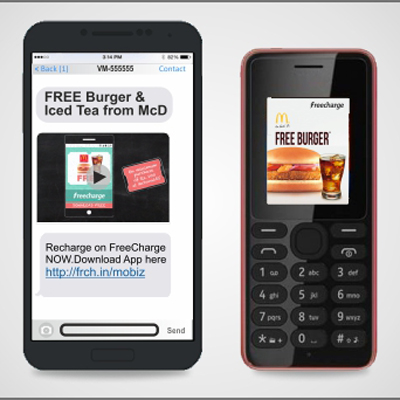
    MUMBAI: MEC, a part of GroupM, along with FreeCharge have harnessed a new ‘Smart Messaging Platform’ to reach out to consumer’s mobile phones with branded high quality, rich media such as videos, images, audio clips and more, directly, rather than having to push links.

    Smart Messaging Platform works across all platforms – iOS, Android and Windows and more and does not require users to download any application to support it. Commonly known in the Tech world as ‘MMS+ technology’, it merely requires the consumer to have a data-enabled mobile phone (both smartphones and feature phones).

    For the very first time 1,00,000 consumers across, Mumbai, Bangalore and Pune will receive a message, which will play the FreeCharge video directly without requiring the consumer to click on a link.

    MEC national director activation Sidhraj Shah said, “The MMS+ technology offers hyper-personalisation opportunities including tracking consumer reaction to the call for action, which is not possible with the current SMS platform.  At MEC we are constantly scouting to offer new experiences & technologies for our clients, to engage with their customers. With ‘Smart Messaging platform’ we have only scratched the surface.”

    Mobizon Media COO and co-founder Swapnil Rap said, “‘Messaging’ is an app that every phone in the world has by default! We have reimagined the traditional 160 characters by transforming it into a rich media communication channel. Every consumer in India can now experience high quality content from their favourite Brands, irrespective of whether they have Smart or Feature phones.”