Tag: SK gupta

  • TRAI extends dates for consultation paper on CAS, SMS for cable services

    TRAI extends dates for consultation paper on CAS, SMS for cable services

    MUMBAI: The Telecom Regulatory Authority of  India  (TRAI)  has extended the time for submission of comments on consultation paper on “Framework for technical compliance of conditional access system (CAS) and subscriber management systems (SMS) for broadcasting & cable services” from stakeholders/industry  associations up to 3 June 2020 and for counter-comments up to 17 June.

    No further requests for extension would be considered.

    TRAI had invited comments/counter-comments of stakeholders on 22 April 2020. The last date for receiving written comments and counter-comments were fixed as 20 May 2020 and 3 June 2020, respectively.

    The comments/counter-comments may be sent, preferably in electronic form to advbcs-2@trai.gov.in or jadvisor-bcs@trai.gov.in, said Trai secretary SK Gupta in release.  

  • TRAI’s SK Gupta on Independent TV troubles, BARC overhaul, landing page controversy & tariff order

    TRAI’s SK Gupta on Independent TV troubles, BARC overhaul, landing page controversy & tariff order

    MUMBAI: Top Telecom Regulatory Authority of India (TRAI) functionaries were in Mumbai on Wednesday for the second leg of the open house discussion (OHD) to review the television audience measurement and ratings system in India. In the audience were industry stakeholders spanning across broadcasters, advertisers, distribution platform operators (DPOs) and BARC representatives among others.

    “Ratings have to be unbiased, correct representation of the feelings of the people and should not be impacted by various methodologies being used to influence them,” said TRAI secretary Sunil K Gupta as he set the agenda.

    TRAI had received multiple comments and counter-comments from industry to its consultation paper, which featured a list of questions. In order to further deepen the engagement, Gupta recommended three additional topics be taken up for discussion.

    “What are the concerns and problems when it comes to return path data with set top boxes? Let us analyse and understand how we can increase the sample size of meters so that influencing data becomes difficult. Secondly, many broadcasters said in the Delhi OHD that data collected through such meters is filtered or manipulated to delete the outliers. They feel that the level of transparency in doing so is not there and in some cases they feel it is one of the tools to manipulate the TRP of a channel. Thirdly, is there any other alternative that can be adopted to make ratings more effective or more representative of viewership?” the secretary asked.

    However, despite the officials’ best efforts to initiate a conversation to highlight problems and suggest solutions, those present were rather conservative in their approach, side-stepping critical issues that continue to plague the broadcasting sector from a TV audience measurement standpoint. While regional broadcasters did argue in favour of a more representative sample to take into account multiple socio-cultural regions, major broadcasters failed to approach the discussion with their usual vigour.

    From BARC’s perspective, COO Romil Ramgarhia and chairman of its technical committee Shashi Sinha were rather frank and forthright, articulating their respective positions on all issues at hand quite candidly.

    In order to gain a better understanding of the regulator's viewpoint, Indiantelevision.com’s Dattaraj Thaly engaged the TRAI secretary in a quick chat on the sidelines of the OHD. 

    Edited excerpts follow.

    What compelled you to float a consultation paper on review of television audience measurement and ratings in India?

    We recommended the formation of an entity to rate the audience measurement for the TV sector and as per that recommendation, MIB came up with guidelines and then BARC was registered. Having said that, (BARC) working for the last three years, we just wanted to see how good the work is being done and there are different concerns of different stakeholders to improve the transparency of BARC rating. So, what are the concerns of stakeholders and how can we improve its functions was our objective.

    What are the specific functions you want improved? Is it credibility of the ratings, transparency of the system? What are the benchmarks for improvement?

    In fact it includes all the things. It is credibility, accuracy of the system and also to make it broad-based so that any attempt to tamper any information etc., should have minimum impact on rating given by the BARC.

    We know what the broadcasters’ concerns with BARC are. Can you tell us what the regulator’s view on the TV audience measurement body is?

    TRAI does not have any view of its own. We raise various issues to the stakeholders. We take oral as well as written comments of the stakeholders. We also analyse the international experiences, the issues raised by different people on what needs to be addressed and ultimately firmly take a view what should be done. So, one thing is very clear TRAI does not have its own view.

    You’ve now held two open house discussions (Delhi and Mumbai) to review our current TV audience measurement system. Have any key themes emerged from these consultations?

    One is that everybody wants BARC to give the ratings that are credible, transparent, not influenced by any of the stakeholders. They also want a broad-based rating pattern, so that chances of getting it influenced by few meters is reduced. Thirdly, they want to improve the transparency of the system.

    BARC’s data validation and outlier policy post the TDSAT order on landing pages has created quite a stir in the industry. What’s your view on this issue?

    You would have heard BARC clearly stating today that they do not have a method to identify landing page and therefore effectively address the issue.

    So, what is the way forward?

    You have yourself very clearly pointed out that there is a decision by TDSAT and we will look into it further and see what can be done. Also today you have heard that this is a call to be taken by the industry also.

    Are you satisfied with what you’ve accomplished in terms of the new tariff order roll-out?

    If you look at the preamble of the regulations and the tariff order issues, the objective raised over there were met to a great extent. So, we are satisfied.

    Two fundamental issues – consumer choice and transparency – were emphasised on by TRAI during the implementation of the new tariff order. Has the new regime addressed these two tenets?

    We have introduced giving the price of each channel in EPG, which has been appreciated by all of the stakeholders. As far as giving choice is concerned, we have checked different platforms and most of the platforms are complying and giving choice. What we have found is that there is a need to educate the consumers. Because consumers from the beginning have been given bouquets. Now awareness has been generated that options have been enabled to choose channels on a-la-carte basis. On this front, I think some more work is required.

    Has the broadcasting and cable services landscape settled down post the new tariff order implementation?

    The choice of customer is a dynamic situation and it will change from time to time and that is what we precisely feel like. The market will work once the consumer has got the options to exercise and it will depend on many things such as the type of programmes you are showing in your TV channel, the language, the awareness, etc. So, this is working very well on the ground and naturally it will take some time to settle. Saying that it has already settled may not be accurate, but yes it is going in the right direction.

    What’s your take on the Independent TV situation?

    Independent TV has been very recently given their license for DTH. The matter has been taken up with MIB and with the other enforcement arms of MIB, which is spread in the state and districts. We are looking into that.

    Is TRAI committed to light-touch regulation across the broadcasting and distribution sector?

    New tariff order is the right example of light-touch regulation (https://www.indiantelevision.com/regulators/trai/broadcasters-split-over-trai-s-directive-to-barc-on-tv-viewership-data-190226). We have given complete freedom to broadcasters to price their channels. We have given freedom to DPOs to carry out their business and get a certain committed revenue so that quality of the network can be upgraded and quality of the services can be given to the consumers. We are only prescribing the broad architecture and not micro-managing.

  • Broadcasters split over TRAI’s directive to BARC on TV viewership data

    Broadcasters split over TRAI’s directive to BARC on TV viewership data

    MUMBAI: The latest episode in the ongoing tariff order implementation saga saw industry watchdog and regulator, the Telecom Regulatory Authority of India (TRAI), direct TV ratings monitoring body – Broadcast Audience Research Council (BARC) – to publish ratings and TV viewership data from the week ending 8 February on its website with immediate effect. BARC, which was set up as an industry-funded body, citing the implementation of the new framework, has been releasing the data only to its subscribers. Earlier, the audience measurement firm published the weekly data on its website every Thursday.

    Indiantelevision.com spoke to several broadcasters, none of who wanted to be identified, about the latest development to gain perspective.

    “ISA has already advised that you should not use this data for planning. If there is a transition happening it will reflect in the data. Advertisers need to figure out how they want to maximise their investment in the market place. In my point of view, it (weekly data) should be used as a broad indicator. I’m in the favour of it being published,” the CEO of a news network said.

    “This is the transition period and they (BARC) are not publishing on the site but data is available between all the stakeholders, agencies, clients and broadcaster. In my opinion, the people who are not paying for the data should not get the data,” said another CEO of a news network.

    Recently, TRAI extended the deadline for consumers to select television channels under its new tariff regime till 31 March. Subscribers that don’t opt for new channels would be moved to ‘Best Fit Plans’, which would be developed as per usage pattern, language and channel popularity, the sector regulator said in its statement.

    “There are two ways to look at it—if the ratings are being published given the level of disruption, advertisers and marketers would want to know what is going on at the ground level. Implementation takes time and some markets may have done more implementation than other markets. So, if the data is viewed in that light then it is fine but if it’s not then it starts becoming a bit of an issue because people will plan based out of an erratic pattern and obviously no one wants that,” argued a business head of a major network.

    The Indian Society of Advertisers' (ISA) executive council had advised its members to not use the BARC data for media buying, planning and evaluation perspective during the transition period, which it feels will stretch up to six weeks.

    “If people view the interim data correctly and look at it and understand what it is over a period of time, then it is fine. But if they make decisions by viewing one week or two week data, then that’s when mistakes will be made. This is why there were two thoughts whether to publish the data or not. But on the other hand, it is good because people will see the progress of whether a channel is up or down. I think people should use this and make plans for the medium to long term,” he further added.

    The sector regulator had asked BARC to furnish compliance by 25 February 2019, "failing which, appropriate action would be initiated" under relevant sections of the TRAI Act.

    “According to me, BARC should publish the data. There’s no logic for them to not publish the viewership data. The only thing here is that consumers may be misguided because of the fluctuating viewership ratings of the channels,” opined the promoter of a regional network.

    According to TRAI, BARC has ignored its previous directives of publishing ratings and viewership data for television channels.

    Several industry watchers told Indiantelevision.com that it was in fact the broadcasters that weren’t keen on weekly data being published on the BARC website.

    “Yes, nobody was in favour of the data being published initially. Now that the system has somewhat stabilised, we are better equipped to tackle potential issues. TRAI’s directive is on expected lines,” said a senior executive of a major broadcast network.

    TRAI held a meeting on Friday with distribution platform operators (DPOs) where it was informed that almost all cable consumers have either made their channel preferences or moved to ‘best fit plan’ under the new tariff regime.

    The meeting was attended by multi-system operators (MSO) and all major DTH players to review the progress of migration of TV viewers under the new framework.

    "According to inputs received by the regulator from players, in the case of DTH services, about 43 per cent customers have made their channel preferences known. When combined with statistics for ‘best fit plan’, this number rises to 57 per cent," stated TRAI secretary SK Gupta.

  • TRAI: Almost 100% cable consumers have picked channels in new tariff regime

    TRAI: Almost 100% cable consumers have picked channels in new tariff regime

    MUMBAI: The Telecom Regulatory Authority of India (TRAI) held a meeting on Friday with distribution platform operators (DPOs) where it was informed that almost all cable consumers have either made their channel preferences or moved to ‘best fit plan’ under the new tariff regime, according to a report by the Press Trust of India.

    The meeting was attended by multi-system operators (MSO) and all major DTH players to review the progress of migration of TV viewers under the new framework.

    TRAI secretary SK Gupta said, "According to inputs received by the regulator from players, in the case of DTH services, about 43 per cent customers have made their channel preferences known. When combined with statistics for ‘best fit plan’, this number rises to 57 per cent."

    The DTH service providers have submitted to TRAI that all subscribers of this prepaid platform will be migrated to the new framework in the next 2-3 weeks. TRAI has also emphasised to players that customers should not face any inconvenience or service disruption during the migration process.

    Earlier this month, the regulator had extended the timeline for consumers to make their channel preferences till 31 March 2019.

    “TRAI is urging subscribers to exercise their options to select TV channels of their choice, immediately. DPOs have been instructed to execute the options of subscribers at the earliest,” he said.

  • Govt extends support to M&E sector in fighting digital piracy

    Govt extends support to M&E sector in fighting digital piracy

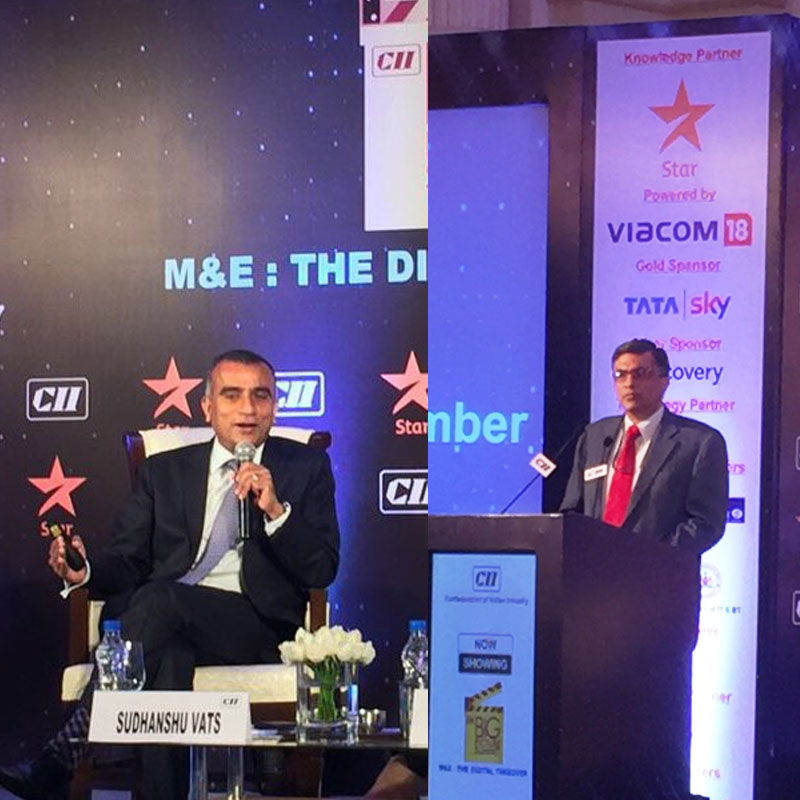
    NEW DELHI: The government of India yesterday stressed that it stood alongside the media and entertainment (M&E) industry in fighting digital piracy to safeguard loss of revenue and ease norms for doing business, while CII entertainment committee head and Viacom18 group CEO Sudhanshu Vats, on behalf of the industry, admitted that automation could result in loss of jobs leading to challenging times, but said the core of the industry will be ‘automation-proof’.

    “The government will stand with you on the issue of digital piracy,” department of industrial policy & promotion (DIPP) joint secretary Rajiv Aggarwal told the audience on Tuesday at the CII-organised Big Picture Summit here, adding that they were exploring a national anti-piracy regulation or regime and there was no need to get further into enacting complicated laws but finding solutions based on global experiences.

    Digital or online piracy is not only a big global challenge for the M&E industry, but has awakened stakeholders in India too who are feeling the heat of heavy loss of revenue due to rampant piracy of Indian content worldwide.

    Pointing out that the Indian government is alive to the issue of digital piracy and the potential of the M&E industry in being able to generate revenues and employment in the country, Aggarwal said that they were looking at how global and some local bodies (like PIPCU of the UK, TIPCU in Telangana and Maharashtra’s online anti-piracy unit) were addressing this challenge.

    Dwelling further on this issue, he exhorted the industry stakeholders to give feedback that will help India in forming a strong case and point of view for submission at WIPO where discussions are on to formulate standards for a global broadcast treaty.

    This year’s Big Picture Summit, an annual two-day conference on issues related to M&E industry, has been themed `The Digital Takeover’, which lays emphasis on the creeping digitisation in general and of delivery services like cable, HITS and OTT, and an impending automation (egged on by the likes of AI) of the various industry sectors.

    TRAI non-committal on exploring auctioning of TV licences

    SK Gupta, telecom regulatory authority of India (TRAI) secretary, which is the telecoms and broadcast regulator, while dwelling on various issues of the recently issued recommendations on net neutrality said the organisation’s efforts have always laid emphasis on consumer interest, while creating a level playing field for all players.

    Incidentally, at a time when the FCC has dismantled net neutrality norms in the US, put in place by the Obama regime earlier, favouring walled gardens of content and premium tiered pricing of various services, India’s TRAI has upheld net neutrality stating that all content should be made available to all distribution platforms on a non-discriminatory basis, apart from other level playing initiatives.

    Later, asked by journalists on the sidelines whether TRAI was exploring a consultation paper on auctioning of TV licences or permissions on the advice of the ministry of information and broadcasting (MIB), Gupta said he at least was not aware of any such move. He was non-committal when pressed on the issue.

    Asian Age newspaper a week back had reported that the government was exploring auctioning of television channel frequencies on the lines of telecoms spectrum, coal blocks and FM radio licences. Reason: bid to increase government revenues as presently permission to uplink and/or downlink TV channels cost a fixed amount with the applicant fulfilling certain set out financial norms, apart from getting clearances for satellite space and internal security. The newspaper report had added that MIB had sought advice from TRAI in this regard. What the report did not clarify was whether the auctioning was of TV licences pertained to DTT (digital terrestrial transmission) or satellite-delivered TV channels later distributed by cable and online.

    M&E industry holds key to creating future-proof, dynamic workforce: Vats

    Earlier in the morning, setting the agenda for the two-day conference, CII entertainment committee head and Viacom18 group CEO Sudhanshu Vats in his opening address said that the theme of ‘Digital Takeover’ was a topic that had “loads of nuances” that needed to be addressed in a proper perspective.

    “In my honest assessment, this is an extremely provocative theme – and one that can mean different things to different people. I can imagine some of my colleagues from the broadcast sector feeling upset. I can also imagine what some of my younger colleagues, who are already social media influencers thinking – this theme is passé, the takeover was complete a few years ago. I don’t want to pick a side at this stage and I’m certain that no definitive side can be picked,” Vats said, adding that he hoped the theme would help delegates form their own distinctive understanding of the future of the Indian industry in general.

    Pointing out that digital takeover could mean greater automation and fewer human jobs, a trend that could is likely to play out slowly in India because of availability of cheap labour, Vats said the Indian M&E sector directly employs between 1.1-1.2 million Indians and in the next five years one million more jobs would be added, thereby playing a role in “assuaging the challenge”. He added: “If we achieve breakout growth, that number can also touch five million. However, I would like to draw your attention not to the number of jobs but to their quality.”

    Explaining that skills, like creativity, story-telling, emotional intelligence and cognitive ability, in M&E sector were most ‘non-routine’ jobs, Vats said, “These are also the skills that can be transferred to other sectors, making us a part of the solution. Of course, we too will face our share of the burden. Some roles will be automated, and the media organisation might look very different in 2027, but our core will still be automation-proof.”

    Vats also pointed out that the private sector needed to be more ‘creator-friendly’ or ‘freelancer-friendly’, which also meant that the M&E sector could hold the key to “creating a future-proof, agile, dynamic workforce” that can take its skills and drive impact across industries even as the government continued to create a better business environment.

     ALSO READ:

    M&E industry to hit Rs8 trillion revenue by 2022: report


  • Balaji Telefilms targets OTT as core business in 5 years’ time

    Balaji Telefilms targets OTT as core business in 5 years’ time

    BENGALURU: Just a couple of days back at the Indian Digital Operators Summit (IDOS) 2015 organised by Indiantelevision.com and Media Partners Asia, Telecom Regulatory Authority of India (TRAI) principal advisor SK Gupta said that ‘the customer was king’ and suggested that players in the broadcast industry ecosystem look at over-the-top (OTT) platforms to cater to the consumers need.


    Taking a cue from the current ‘over the top’ mood in the Indian broadcast industry, Balaji Telefilms Ltd is planning to make digital B2C (business to consumer) as its core business in five years’ time. This strategy will be driven via its own content as well as curated content.


    As was reported earlier by Indiantelevision.com, this business will be housed under Balaji’s subsidiary company ALT Digital, which was re-launched in Q2-2016 with renewed vigour.


    With a three-pronged growth strategy covering television, films and digital B2C, Balaji Telefilms is looking at becoming a diversified media company. The most important component of the company’s growth strategy is to diversify into new opportunities via digital B2C. Balaji’s plans are built around the emerging changes in the consumers’ viewing habits.


    Through ALT Digital, Balaji plans to offer original and curated premium content on its own Subscription Video on Demand (SVOD) and advertising -Video on Demand (AVOD) platform across multiple genres and languages to garner a share of the online mobile and video market. The subscription driven platforms on ALT mobile app and other connected devices as well as the ALT website are slated for a Beta launch in Q3-2016 (quarter ending 31 December, 2016). Additionally, technical development, content production, promo launch and pre-launch marketing is also being targeted in the same quarter. The formal launch is being targeted for Q4-2016 (quarter ending 31 March, 2016).


    While Balaji has been a content company, it seldom has had the chance to interact directly with the consumers. Now with the digital foray, not only will it have an opportunity to connect with consumers but will also be the owner of the digital IP unlike in television content where the IP of the show belongs to the broadcaster.


    According to the company, a majority of content available online are either re-runs or DIY, which in turn leaves a big opportunity to offer original web-series for internet audience.


    The business model that Balaji has chalked out for digital is subscription based ‘freemium’ approach as the primary source of revenue. Revenue from advertising, licensing and sponsorship will be the secondary source of revenue.


    Targeting an urban and semi-urban audience group that comprises smartphone internet users active on YouTube and social media in the 19-34 age group, Balaji plans to use global ‘best of breed’ technology to ride on the imminent explosion of internet bandwidth in the country. Viewers will have streaming and offline viewing options, delivered over multiple screens. 


    The company’s strategy is to churn out original, edgy, never-seen-before content in India created especially for the OTT platform.


    Balaji Telefilms is in the process of putting together a skilled team. Additionally, a robust implementation plan is being executed to help realise the opportunity and meet its goals.


    Apart from its digital focus, Balaji Telefilms’ other two areas of focus are its existing businesses of television content and film production. On the television front, the company, which has had Hindi fiction as its mainstay until now, is planning to foray into regional and non-fiction content by making selective risk-reward plays. On the other hand, for films Balaji’s strategy is to scale moderately and become profitable.

  • TRAI prefers industry-driven guidelines instead of mandating directives: SK Gupta

    TRAI prefers industry-driven guidelines instead of mandating directives: SK Gupta

    GOA: Even as he reiterated that there will be no further extension of date for the third phase of Digital Addressable System (DAS) slated for 31 December, 2015, Telecom Regulatory Authority of India (TRAI) principal advisor  SK Gupta stressed the need of industry-driven guidelines instead of those mandated by the regulators.


    Pointing out that many lessons had been learnt from implementation of the first two phases of DAS, Gupta also stressed that the consumer was king and all policy decisions including tariffs had to be made with him in mind.


    Addressing the concluding session of the Indian Digital Operators Summit (IDOS) 2015, through teleconferencing from Delhi, Gupta accepted a suggestion for the need of a ‘supra-body’ other than the Task Force to go into these issues and solve problems that arise during implementation. 


    IDOS 2015 was organised by Indiantelevision.com and Media Partners Asia from 24 to 26 September in Goa.


    Gupta was of the opinion that the consumer’s choice was neglected and he was forced to pay for bundling of channels or bouquets instead of a la carte rates, which may not give him the channels he wants.


    At the outset, he said that there the industry had seen a sizeable growth. “The number of cable households have gone up from 79 million in 2006 to over 101 million at present. The number of channels have gone up to over 800,” he said.


    However, he added that though the number of channels have grown to over 800 in India, the driver channels totalled to just around 50.


    Furthermore, he said that customer still face billing problems and it wasn’t easy for them to switch to another operator. “The stakeholders must jointly resolve these issues. It has to be understood that it will not be easy to get customer to pay more,” he said.


    Pointing out that the increase in average revenue per user (ARPU) is illusory, if the system was faulty, Gupta asked stakeholders to reflect on it jointly. However, he was quick to add that this may not be possible, given “the level of infighting within the sector.”


    Gupta also urged the broadcasting sector to take a few lessons from the telecom sector, which had also begun with lot of litigations but had then realised that collaboration was the only way to go ahead. “Today they are prepared to share and sell spectrum and have accepted mobile portability. As a result, there has been tremendous growth in the telecom sector,” he said.


    Speaking on broadband, Gupta said, “Lowering the price of broadband is do-able if set top boxes could provide both television and broadband. TRAI gave its recommendations in this regard to the Government in January this year. This will herald the start of a new era in broadband growth.”


    “Stakeholders need to realise that the concept of television or video watching is moving to mono-viewing,” he said.


    While it was for the stakeholders to find ways to get the customer to fill the Common Assessment Framework (CAF) forms, Gupta said that lessons learnt from the first two phases should help. TRAI would “like to see consensus,” he said.


    Gupta also said that while TRAI had its offices in many centres of the country, he would urge the Information and Broadcasting Ministry to send proper instructions to nodal officers in the Phase III and Phase IV areas. His remark came following a complaint that most nodal officers in smaller towns were still not clear about their role in DAS.


  • FICCI Frames: The roadmap for success in broadcasting

    FICCI Frames: The roadmap for success in broadcasting

    MUMBAI: In its three decades of existence, the promising broadcast narrative in India continues to be challenged on issues such as transparency, pricing, taxation, consumer choice and lack of a coherent regulatory and policy framework.


    To find a solution to these and similar questions, a panel anchored by media analyst, author and columnist Vanita Kohli Khandekar highlighted a session on the Future of Vision 2020 – laying a transformative roadmap for Indian broadcasting. The panelists stressed issues for unlocking value in Indian broadcasting on the first day of the FICCI Frames convention held on 25 March in Mumbai.


    Speakers who shared their opinion and views were I&B Ministry additional secretary JS Mathur, TRAI principal advisor SK Gupta, BBC Global News CEO Jim Egan, Siti Cable CEO VD Wadhwa, Star India COO Sanjay Gupta, Tata Sky CEO Harit Nagpal, Viacom 18 Group CEO Sudhanshu Vats and Discovery Networks Asia-Pacific south Asia and southeast Asia GM and executive VP Rahul Johri.


    According to Wadhwa, in order for the media and entertainment sector to grow, digitisation should be completed. “Digitisation must be completed and that will bring in transparency. Secondly, we need to work together to see how can we monetise the business far better.”


    It may be recalled that in phase I and II of digitisation, average revenue per user (ARPU) had witnessed a significant jump in places where people were consuming cable broadband. In response to that, Nagpal said, “We can either have monopolies or regulations but one has regulation where there are monopolies. I believe that I am digging my own grave if I am not serving my customers and as a regulator, we need to make sure that he is getting adequate infrastructure to do his job well.”


    Sharing his views on the media and entertainment sector, Star’s Gupta said that today the industry size is close to Rs 30,000 crore and the big challenge going forward will be on how to make it a Rs 300,000 crore industry. Gupta opined that the one fundamental issue that plagues the industry is that they have regulated the industry from a wrong perspective. “You need to get the capital to invest high, while creating innovation for consumers. That’s how industries have grown. However, that is the challenge for the M&E industry.”


    When on the one hand broadcasters believe that regulation is not required, on the other hand TRAI’s Gupta had a different opinion. “If regulation is not required then what is required? Is it that we are required to keep quiet on the customer front if they are not getting any choice?” he questioned.


    He went on to add that the country has 30 million DTH customers, 30 million DAS customers and 10 million addressable systems. However, the question was how many consumers have the choice of individual channels? “If I ask a consumer if he/she is watching all the channels given to them, the answer will be a big no. Therefore the price can be deregulated and total selection of the channel should be given to the consumer at the desired price. And for this to happen certain broad guidelines should be created and this should be done soon.”


    Picking up points from Sanjay and S K Gupta, Vats said that in order to drive the size of the pie, pricing is the difficult thing. “If we focus on the price of the analogue cable, in some way, we are constraining the ‘X’ to increase and my request is that if we become open to it, we will allow the ‘Y’ to increase. The moment we allow the ‘Y’ to increase, I think we will define the problem collectively better between LMOs, MSOs, broadcasters etc.”


    Vats was of the view that competition needs to be encouraged, even though there is enough competition in the media and entertainment industry. “Competition itself will ensure that we are reaching out to every possible Indian, outside India as well. It happens in every industry, why has it not happened here?”  A firm believer of  a free market, Vats is confident that it will drive the industry and take it to the next level.

  • SK Gupta moved to broadcasting in TRAI, N Parameswaran to look after network services

    SK Gupta moved to broadcasting in TRAI, N Parameswaran to look after network services

    NEW DELHI: S K Gupta, who was until now looking after broadband issues in the Telecom Regulatory Authority of India (TRAI), has been made the Principal Advisor in charge of Broadcasting issues.


    He thus takes the place of N Parameswaran, who will now be looking after network services and licensing as Principal Advisor.


    Telecom Ministry sources confirmed that the term of Parameswaran in TRAI is to expire later this year. He has been in the telecom sector since January 1980. He played a key role in the liberalisation of the telecom sector in India. He was the first executive director of the Information & Communication Technologies Authority, Mauritius, wherein he set up the Authority and facilitated the liberalisation of the ICT sector. He has held various positions in Department of Telecom and MTNL.  He joined TRAI in 2007 and was looking after broadcasting since 2009.


    The term of TRAI chairman Rahul Khullar is also expiring in May this year. A 1975 batch IAS officer of Delhi cadre, Khullar succeeded J. S. Sarma in May 2012 for a three-year term.