Tag: Sir Martin Sorrell

  • TAM or BARC, the market has to decide: Sir Martin Sorrell

    TAM or BARC, the market has to decide: Sir Martin Sorrell

    MUMBAI: They are known as the lions who go for the kill in their respective fields. One heads the world’s largest advertising communications group by revenue, which he has built up in around three decades. And the other is known for his innate ability to decimate almost every guest who dares to be a part of his nationally televised daily news show.


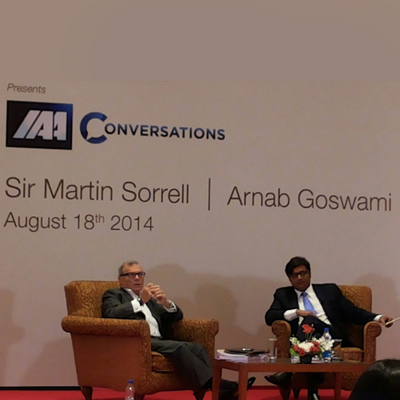
    Yes, we are talking about none other than WPP CEO Sir Martin Sorrell and Times Now editor-in-chief Arnab Goswami who got together on stage to have  a public chat under the umbrella of the Indian chapter of the International Advertising Association (IAA) in Mumbai.


    Before the IAA conversation between the two commenced almost all those assembled – the who’s who of the media industry – were hard pressed to second guess as to who would have the upper hand: the calulator (read: Sorrell, as The Economist had once labelled him, when he battled with David Ogilvy to take over O&M) or the microphone (read: Arnab).


    Their curiosity was laid to rest quickly  and it became clear that it would not be a “I’ll eat you up for high tea”  Arnab interview when it was Sorrell who fielded the first question, querying how the 2014 Lok Sabha elections went for him. Goswami laughingly responded saying that  not many know that the  Congress (I) took out an internal report to know the reasons for the debacle. And the number one reason in that report was Arnab Goswami as he was the only TV journalist to have interviewed the party’s vice president Rahul Gandhi.


    And with India’s sad performance during the ongoing Test series in England, cricket was bound to be spoken about. Talking about the recession of ‘91-‘92, Sorrell took the example of how he handled the situation comparing it to the crisis the Indian team was going through and how MS Dhoni should be handling it.


    So, do you still push yourself, asked Goswami. And yes, came the  prompt reply from the man who believes that with the development of the new technologies, the way people consumed media has changed over the years due to disruption. “If you see what consumers consume and what our clients invest in, there are two major differences. The first being the traditional media which consists of magazines and newspapers, 20 per cent is invested in it and on the other side, 46 per cent is invested on mobile,” said Sorrell. He  emphasised that though the study represents the west, India is also headed in the same direction.


    Responding to Goswami’s question about the position of Indian media in the next 20-30 years, Sorrell highlighted that with the economic changes taking place in the country under the new government, the country can only move forward.  “India is in a better position than the US because it leapfrogged from legacy media to smartphones. And the country will play an important role in  digital growth as well,” he asserted adding that the traditional businesses need to be digitised at the earliest, as Indian media needs to go with the flow.


    However, not everyone at the audience believed in Sorrell’s India digital growth design. Madison World chairman Sam Balsara believes that in the country where print and TV is still booming, digital cannot overtake the two here at least for some time now.


    A firm believer in data and gut, Sorrell also believes that media has to play the roles of both – influencing the market behavior and analysing it too.


    After a few more exchanges on what role data plays in Sorrell’s businesses, the conversation shifted from media and advertising to television and the ongoing case of television viewership ratings in India.


    Kantar Media, part of the WPP Group, the 50 per cent shareholder in Indian television ratings agency TAM Media Research had moved the Delhi High Court when the government, early this year, approved the regulations policy guidelines for TV rating agencies. According to it, no single entity can hold paid-up equity in excess of 10 per cent simultaneously in a rating agency and a broadcaster, advertiser or advertising agency and is compelled to increase the panel home size by 10,000 ever year until the size reaches 50,000 panel homes.


    “In a country of 1.2 billion, just a few thousand peoplemeters. The math doesn’t match up. Did you really need a regulation to tell you to increase the sample data?” asked Goswami who added that he has been waiting for 15 years to ask the question.


    To this, Sorrell said that the decision to increase the number of peoplemeters was taken long before the regulations came out. “One must not forget that the number of peoplemeters reflects the cost of science. Anywhere in the world, the industry has to pay for that cost. The research agency has three equal partners, that is, one-third is media agencies, one-third advertisers and one-third broadcasters. It involves cost and the industry needs to contribute to it.”


    He went on to add  that the way media is consumed is changing and so the media rating agencies too will have to change. He cited the example of TV networks in the US using ‘C7 ratings’, which includes same-day viewing plus seven additional days, as opposed to three, and how WPP was the first one to recognise that change.


    “The market had decided for the 10,000 peoplemeters then, and later on the government decided to increase that,” he added.


    Does Sorrell see TAM and BARC working together?


    “The market will have to decide that; if they are ready to pay for both then good. However, if we look elsewhere, the  market doesn’t pay for two rating currencies,” he said.


    To this BARC India CEO Partho Dasgupta smiled and said, “It’s good that he acknowledged that there can be only one currency.”


    The two-hour long conversation ended with Goswami asking Sorrell that if he would start his career all over again like he did at 40 then what would be on his mind. “I would have started maybe a little earlier, say 30-35 years of age, and gone private after collecting all my assets,” he replied.


    Spoken like a true number cruncher.

  • Arnab Goswami’s rendezvous with Sir Martin Sorrell

    Arnab Goswami’s rendezvous with Sir Martin Sorrell

    MUMBAI: World’s most respected marketing professional WPP CEO Sir Martin Sorrell and India’s popular news anchor Times Now editor-in-chief Arnab Goswami will meet up this August.


    Courtesy, International Advertising Association (IAA), as both will be part of a discussion on 18 August as part of IAA’s Conversations series of the Indian Chapter.


    “We find the IAA Conversations offering an excellent opportunity to engage two well-known media professionals in a meaningful dialogue on wide-ranging professional and personal topics. Sir Martin Sorrell, is one of the most important powerful media professionals in the world and our own Arnab Goswami is one of the most popular faces of news television in the country,” said IAA India Chapter and vice president-development Asia Pacific Srinivasan K Swamy.


    Event chairperson Dr Bhaskar Das added, “Both Sir Martin Sorrell and Arnab Goswami are great to listen to. And now when they sit together at the IAA Conversations, we are sure to not just have a lively session but also see some interesting insights coming up. People who follow ‘Frankly Speaking with Arnab’ will see a similar program but in a live format. An open-to-audience Q&A will follow the discussion.”


    The event will be held at the ITC Grand Central Hotel in Mumbai.

  • Sir Martin Sorrell shares 10 trends shaping the global ad business

    Sir Martin Sorrell shares 10 trends shaping the global ad business

    The world’s biggest media conglomerate, which shapes the advertising and marketing of brands globally, has good news for marketing companies even though some nations are going through economic crises.


    WPP’s founder and CEO Sir Martin Sorrell shared his views on the trends impacting the global marketing service industry on his Linkedin blog.


    “As we plan for the future of our business, looking across the 110 countries in which we operate, we try to identify the trends that we think are shaping the global marketing services industry.


    Here’s our top ten:


    1. Power is shifting South, East and South East

    New York is still very much the centre of the world, but power (economic, political and social) is becoming more widely distributed, marching South, East and South East: to Latin America, India, China, Russia, Africa and the Middle East, and Central and Eastern Europe.


    Although growth rates in these markets have slowed, the underlying trends persist as economic development lifts countless millions into lives of greater prosperity, aspiration and consumption.


    2. Supply exceeds demand – except in talent

    Despite the events that followed the collapse of Lehman Brothers in 2008, manufacturing production still generally outstrips consumer demand. This is good news for marketing companies, because manufacturers need to invest in branding in order to differentiate their products from the competition.


    Meanwhile, the war for talent, particularly in traditional Western companies, has only just begun. The squeeze is coming from two directions: declining birth rates and smaller family sizes; and the relentless rise of the web and associated digital technologies.


    Simply, there will be fewer entrants to the jobs market and, when they do enter it, young people expect to work for tech-focused, more networked, less bureaucratic companies. It is hard now; it will be harder in 20 years.


    3. Disintermediation (and a post-digital world)

    An ugly word, with even uglier consequences for those who fail to manage it. It’s the name of the game for web giants like Apple, Google and Amazon, which have removed large chunks of the supply chain (think music retailers, business directories and bookshops) in order to deliver goods and services to consumers more simply and at lower cost.


    Take our “frienemy” Google: our biggest trading partner (as the largest recipient of our clients’ media investment) and one of our main rivals, too. It’s a formidable competitor that has grown very big indeed by – some say – eating everyone else’s lunch, but marketing services businesses have a crucial advantage.


    Google (like Facebook, Twitter, LinkedIn and others) is not a neutral intermediary, but a media owner. Google sells Google, Facebook sells Facebook and Twitter sells Twitter.


    We, however, are independent, meaning we can give disinterested, platform-agnostic advice to clients. You wouldn’t hand your media plan to News Corporation or Viacom and let them tell you where to spend your advertising dollars and pounds, so why hand it to Google and co?


    Taking a broader view of our increasingly tech-based world, words like “digital”, “programmatic” and “data” will soon feel out-dated and obsolete as, enmeshed with so many aspects of our daily lives, network-based technologies, automation and the large-scale analysis of information become the norm.


    The internet has been a tremendous net positive for the advertising and communications services business, allowing us to reach consumers more efficiently, more usefully and often more creatively on behalf of clients. But it won’t be long before those clients stop asking our agencies for a “digital” marketing strategy (many already have). It will simply be an inherent part of what we’re expected to offer.


    4. Changing power dynamics in retail

    For the last 20 years or so the big retailers like Walmart, Tesco and Carrefour have had a lot more power than manufacturers because they deal directly with consumers who are accustomed to visiting their stores.


    This won’t change overnight, but manufacturers can now have direct relationships with consumers via the web and e-commerce platforms in particular. Amazon is the example we all think of in the West, but watch out for Alibaba, the Chinese behemoth due to list on the New York Stock Exchange later this summer in what could be the largest IPO in corporate history (and heading a capitalisation of around $200 billion).


    5. The growing reputation of internal communications


    Once an unloved adjunct to the HR department, internal comms has moved up the food chain and enlightened leaders now see it as critical to business success.


    One of the biggest challenges facing any chairman or CEO is how to communicate strategic and structural change within their own organisations. The prestige has traditionally been attached to external communications, but getting internal constituencies on board is at least as important, and arguably more than half of our business.


    6. Global and local on the up, regional down

    The way our clients structure and organise their businesses is changing. Globalisation continues apace, making the need for a strong corporate centre even more important.


    Increasingly, though, what CEOs want is a nimble, much more networked centre, with direct connections to local markets. This hands greater responsibility and accountability to local managers, and puts pressure on regional management layers that act as a buffer, preventing information from flowing and things from happening.


    7. Finance and procurement have too much clout, but this will change

    Some companies seem to think they can cost-cut their way to growth. This misconception is a post-Lehman phenomenon: corporates still bear the mental scars of the crash, and conservatism rules.


    But there’s hope: the accountants will only hold sway over the chief marketing officers in the short-term. There’s a limit to how much you can cut, but top-line growth (driven by investment in marketing) is infinite, at least until you reach 100% market share.


    8. Bigger government


    Governments are becoming ever more important – as regulators, investors and clients. Following the global financial crisis and ensuing recession, governments have had to step in and assert themselves – just as they did during and after the Great Depression in the 1930s and 1940s. And they’re not going to retreat any time soon.


    Administrations need to communicate public policy to citizens, drive health initiatives, recruit people, promote their countries abroad, encourage tourism and foreign investment, and build their digital government capabilities. All of which require the services of our industry.


    9. Sustainability is no longer “soft”

    The days when companies regarded sustainability as a bit of window-dressing (or, worse, a profit-sapping distraction) are, happily, long gone. Today’s business leaders understand that social responsibility goes hand-in-hand with sustained growth and profitability.


    Business needs permission from society to operate, and virtually every CEO recognises that you ignore stakeholders at your peril – if you’re trying to build brands for the long term.


    10. Merger flops won’t put others off

    Despite the failure of one or two recent high-profile mega-mergers, we expect consolidation to continue – among clients, media owners and marketing services agencies. Bigger companies will have the advantages of scale, technology and investment, while those that remain small will have flexibility and a more entrepreneurial spirit on their side.


    FMCG and pharmaceuticals (driven by companies like 3G and Valeant) are where we anticipate the greatest consolidation, while our own industry is likely to see some activity – with IPG and Havas the subject of constant takeover rumours. At WPP we’ll continue to play our part by focusing on small- and medium-sized strategic acquisitions (31 so far this year, and counting).”


     (These are purely personal views of  WPP’s founder and CEO Sir Martin Sorrell and indiantelevision.com does not subscribe to these views.)

  • WPP Q1 2013 revenues grow 6%; looks to maintain tempo

    WPP Q1 2013 revenues grow 6%; looks to maintain tempo

    MUMBAI: Sir Martin Sorrell‘s charge is doing very well, thank you. Take a dekko at the Q1 2013 financials that the global advertising and marketing leader WPP has posted. Revenue growth is at 5.85 per cent, which seems not much, but it is far better than some of its peers‘ performances (Omnicom at 2.8 per cent and IPG at 2.4 per cent). Revenues were at ?2.53 billion as against Q1 2012‘s ?2.39 billion.

    On a like-for-like basis, excluding the impact of acquisitions and currency fluctuations, revenues were up 2.1 per cent with gross margin up 1.9 per cent compared with the same period last year.

    North America led the media communications conglomerate‘s growth by contributing 35 per cent of the total revenue pie followed by the Asia Pacific, Latin America, Africa & Middle East and Central & Eastern Europe region at 29.1 per cent. Western Continental Europe accounted for 23.4 per cent of WPP‘s Q1 2013 revenues while United Kingdom pitched in the rest 12.5 per cent. The UK and the Asia Pacific Asia Pacific, Latin America, Africa & Middle East and Central & Eastern Europe region were the only two regions which showed a growth in share of the revenue pie.

    Business sector wise, advertising and media investment management continued to be the strongest sector accounting for 40.8 per cent of the total revenues, followed by branding and identity, healthcare and specialist communications with 27.3 per cent, while consumer insight and public relations and public affairs made up 23.2 per cent and 8.7 per cent respectively.

    In line with the group‘s strategic focus on new markets, new media and consumer insight, WPP completed 13 transactions in the first quarter. Nine acquisitions and investments were classified in new markets (of which eight were in new media), two in consumer insight, including data analytics and the application of technology and two driven by individual client or agency needs.

    Specifically, in the first quarter of 2013, acquisitions and increased equity stakes have been completed in advertising and media investment management in Canada, Colombia, Hong Kong, Indonesia, Myanmar, Philippines and Thailand; in consumer insight in the United States and Myanmar; in public relations and public affairs in China; in direct, digital and interactive in the United States, the United Kingdom, South Africa, Turkey, Argentina, Brazil, Colombia, Uruguay and Australia, says the media group‘s release.

    WPP gained a total of ?940 million in net new business wins (including all losses) in the first quarter, compared to ?1.159 billion in the same period last year and in line with the quarterly average in 2012 of approximately ?940 million. Of this, JWT, Ogilvy & Mather, Y&R, Grey and United generated net new business billings of ?281 million.

    Also, out of the group total, GroupM, its media investment management company,which includes Mindshare, MEC, MediaCom, Maxus, GroupM Search and Xaxis, together with tenthavenue, generated net new business billings of ?465 million ($743 million).

    In its financial guidance for the rest of 2013, WPP says “our prime focus will remain on growing revenues and gross margin faster than the industry average, driven by our leading position in the new markets, in new media, in consumer insight, including data analytics and the application of technology, creativity and horizontality. At the same time, we will concentrate on meeting our operating margin objectives by managing absolute levels of costs and increasing our flexibility, in order to adapt our cost structure to significant market changes and ensuring that the benefits of the restructuring investments taken in 2012 are realised.” It has targeted like-for-like revenue and gross margin growth of 3 per cent and also improving its operating margins by half a point.