Tag: Sinclair Broadcast

  • Sinclair to take ANI’s My India to US TV homes

    Sinclair to take ANI’s My India to US TV homes

    MUMBAI: My India is going to Uncle Sam. Indian news Agency Asian News International (ANI) and  Sinclair subsidiary Sinclair  Broadcast have signed an agreement wherein the latter will take the former’s weekly TV programme My India to major American cities.

    Launched in Q2’24 and produced by  ANI, My India offers a 30-minute in-depth reportage and analysis of  India’s economy, vibrant culture and growing impact on the global stage. My  India also captures the deepening people to people (P2P), business to business (B2B) and government to government (G2G) ties between two of the most important democracies in the world. 

    Hitherto, the show could  be viewed in the US through Komo TV’s FAST channel and its affiliated YouTube channel, and on Tag Tv’s You Tube channel in the US and Canada.
     

    My India the TV show

    My India will be made available across the US  in Washington DC, California, Rhode Island, Ohio, Michigan, Florida,  Indiana, Seattle, Baltimore, Texas, and Wisconsin among others over Sinclair-owned  TV stations affiliated with ABC, CBS, NBC, and Fox.

    Said Sinclair  president & CEO Chris Ripley: “The expanded distribution of My India highlights the close connections between the world’s oldest democracy and the world’s largest democracy. We look forward to continuing our partnership with  ANI.”

    Said ANI CEO Sanjiv Prakash: “The relationship between  ANI and  Sinclair  has already proven to be successful and is a testament to the strong bond between the US and India. We are excited to reach a broader audience in the US, including the  Indian diaspora and beyond. We look forward to bringing My  India showcasing unique and personal stories highlighting  India’s ancient culture and thriving traditions to more homes in America.” 

    The expanded partnership between Sinclair and  ANI builds on the solid foundation established between the two companies with a joint mission to provide high quality news stories from  India and the broader south Asia region to a diverse set of American audiences interested in understanding the  India story, said an ANI press release. 

  • Long live linear TV, courtesy of NextGenTV

    Long live linear TV, courtesy of NextGenTV

    MUMBAI: Las Vegas. Normally labelled as Sin City. But in April it was all about the future of entertainment technology with the NAB Show opening with a bang. And what a bang it was. It is a hard knock for those who continue to resist the frenetic pace of technological evolution. One of these is ATSC 3.0 which is coming. Yes, even as it is spreading gradually in the US, it is being planned to come to India. That is if Sankhya Labs, Sinclair Broadcast, Doordarshan and Prasar Bharti succeed in its rollout.

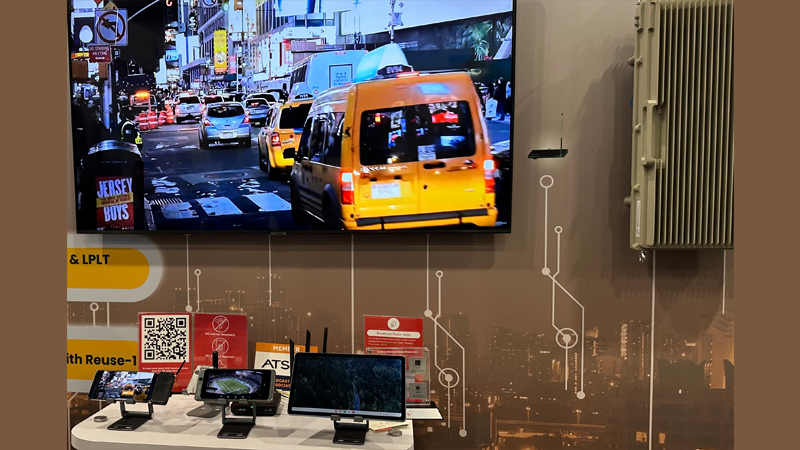
    I happened to see some trial broadcasts in the Las Vegas Convention Centre and it was awesome.

    At early stages yet, ATSC 3.0 endeavours to wirelessly transmit data, video and audio, over the air without using the traditional terrestrial frequencies or the 4G, 5G or 6G spectrum. Also known as NextGen TV, it is a digital television standard developed by the Advanced Television Systems Committee (ATSC), offering features such as ultra-high-definition video, high-efficiency video coding (HEVC), high dynamic range (HDR), immersive audio, and interactive capabilities.

    Sankhya Labs has been working on developing semiconductor solutions and software for ATSC 3.0-enabled devices. These solutions encompass various aspects of ATSC 3.0 technology, including receivers, modulators, demodulators, and related software stacks. Sankhya Labs aims to offer cost-effective and scalable solutions to enable the deployment of ATSC 3.0 infrastructure and consumer devices in India and other markets. Currently, it has developed – and continues to develop –  the PCB, the software, the receiver and dongle, and set-top box designs which will then be farmed out for local manufacture.

    I happened to see the transmitter developed by Sankhya at the NAB Show which will be mounted – when the service is ripe and ready to be rolled out – next to the cellular towers which dot Indian building terraces in urban and rural India. Then there is the dongle (looking like the early device we used to get connected to the internet) which will act as the receiver and can be attached to an ordinary smartphone with basic video capabilities and receive the transmitted video at almost no cost to the customer. (Remember there are more than 500 million smartphone users in this country and even if 10 per cent of them opt for ATSC 3.0 that will be a humungous base of 50 million viewers) For the home, users will have a set-top box (which Sankhya hopes to gradually decrease in size)  that will sit next to the TV set to receive the signals for family viewing.

    As it does for FreeDish, DD is likely to auction channels to private broadcasters who can reach viewers with another linear service, thus giving traditional TV a new lease on life and advertisers another medium to target the vast masses of television viewers.  This is at a time when YouTube video, Instagram reels, free-to-air TV, and streaming services have totally disrupted satellite and cable pay TV services in India with cord-cutters, cord nevers reaching record highs. The streamers need help to retain clever viewers who are sharing passwords as well as churning when they finish watching shows that interest them in one service or another.

    How long will ATSC 3.0  take to become a reality? Broadcasters, handset manufacturers, telcos have all blackballed it saying that it is a needless platform that is being created. 

    But Sankhya Labs and the NextGenTV committee would like it to spread tomorrow itself. Work has been going on for at least the past three to four years and it might take as much time for the government-owned broadcaster to give it a clear green signal. (I’m crossing my fingers DD moves fast once a government is formed at the Centre post the elections or a private company is given the responsibility of spreading ATSC 3.0 services in a public-private partnership.)  One can be optimistic and only hope that this exciting technology which can lead to the creation of zillions of local channels monitoring local traffic conditions, weather conditions, long-distance medicine, education, etc etc comes quickly enough.

    When it does arrive, it will come with the potential to revolutionise the way we consume our entertainment once again. And oodles of other services.