Tag: Simon Murray

  • Netflix to remain SVod world leader by 2027: Digital TV Research

    Netflix to remain SVod world leader by 2027: Digital TV Research

    Mumbai: Global SVod subscriptions will increase by 475 million between 2021 and 2027 to reach 1.68 billion. Six US-based platforms will account for 47 per cent of the world’s total in 2027.

    Netflix will remain the revenue winner, with $30 billion expected by 2027 – similar to Disney+, HBO Max and Paramount+ combined. Global SVod revenues will reach $132 billion by 2027.

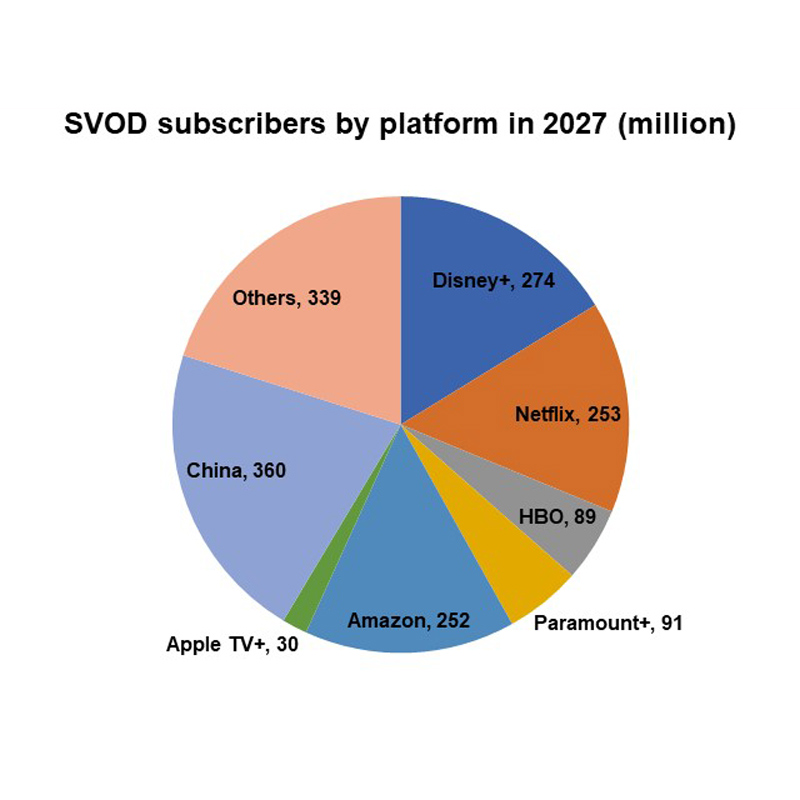
    Digital TV Research principal analyst Simon Murray said, “Our forecasts in June had Disney+ [274 million subscribers] overtaking Netflix [253 million subs] by 2027. These forecasts assumed that Disney+ Hotstar would retain the Indian Premier League cricket rights. It didn’t – hence the 67 million lower forecast for Disney+.

    “SVod revenues for Disney+ will reach $15 billion by 2027. Despite lowering our forecasts by 67 million subscribers, SVod revenues for Disney+ will be the same in 2027 as in our previous forecast. SVoD ARPUs and revenues will increase in key markets after the platform introduces the hybrid AVoD-SVoD tier and the more expensive SVod-only tier,” he added.

  • Western Europe continues to witness growth; adds 73 mn Svod subscribers

    Western Europe continues to witness growth; adds 73 mn Svod subscribers

    Mumbai: Western Europe will have 238 million Svod subscriptions by 2027. The figure has increased from 165 million by end-2021. Six US-based platforms will account for 81 percent of all Svod subscriptions by 2027.

    Netflix will have 62 million subscribers by 2027 – three million more than 2021. Subscriptions are flat for 2022 mainly due to increased competition. Netflix’s share of the total will fall from 36 percent in 2021 to 26 percent by 2027.

    Disney+ will have 46 million subscribers by 2027 – 20 million more than 2021. Newcomer Paramount+ and SkyShowtime will add 11 million subscribers and HBO Max will bring in an extra 5 million.

    Western European Svod revenues will total $25 billion by 2027 – up from $16 billion in 2021. The UK will remain the Svod revenue leader.

    Digital TV Research principal analyst Simon Murray said, “Netflix will slowly lose Svod revenues as we assume that it will convert its cheapest tier to a lower-priced hybrid Avod-Svod tier. Any Svod revenue shortfall will be covered by its Avod revenues. Netflix will remain the Svod revenue winner, although its share of the total will fall from nearly half in 2021 to a third in 2027.

    “We do not expect many more price rises due to the intense competition. We assume that Disney+ will follow its US example by converting its present tier to a hybrid Avod-Svod one and charging more for SVOD-only tier,” Murray added.

  • US SVod revenues to be flat from 2024-2027: Digital TV Research

    US SVod revenues to be flat from 2024-2027: Digital TV Research

    Mumbai: Despite being the world’s most mature market, US SVod (subscription video-on-demand) revenues will grow by $14 billion from $43 billion in 2021 to a peak of $56 billion in 2024, according to new data from Digital TV Research. However, revenue growth will be almost flat from 2024 to 2027 due to price competition and new hybrid AVoD-SVoD tiers from major players such as Disney+ and Netflix.

    Digital TV Research principal analyst Simon Murray said, “Netflix will remain the SVoD revenue winner. However, the platform will lose $1.4 billion in SVoD revenues between 2022 and 2027 due to lower ARPUs from 2023. Netflix will more than recoup these SVoD revenue losses with AVoD (Advertising-based video on demand) sales.”

    Netflix will have 63 million subscribers by 2027 – down by 4 million from 2021. Hulu, Disney+, HBO and Paramount+ will each boast 40-50 million subscribers by 2027. Some consolidation – mergers and closures – is likely.

  • Netflix to lose SVOD revenues in Latin America: Digital TV Research

    Netflix to lose SVOD revenues in Latin America: Digital TV Research

    MUMBAI: Latin American SVOD revenues will reach $8.54 billion by 2027; up from $5.01 billion in 2021. Netflix will account for 41 percent of the 2027 total, down from 72 percent in 2021. Netflix’s revenues will peak at $3.73 billion in 2023.

    Digital TV Research principal analyst Simon Murray said, “Netflix will introduce AVod-SVod tiers [one for Brazil and another pan-regional one for the Spanish-speaking countries] in 2024, with SVOD revenues and Arpus falling slowly as some subscribers convert to cheaper packages.”

    Disney+ is likely to introduce similar tiers in 2024. The platform is expected to follow its US example by converting its current subscription tier to AVOD-SVOD and charging more for SVOD-only. This will push up average revenue per user (ARPU).

    Latin America will have 139 million gross SVOD subscriptions by 2027; up from 75 million end-2021. Seven US-based platforms (Netflix, Amazon Prime Video, Disney+, Star+, Paramount+, Apple TV+ and HBO) will account for 90 percent of the region’s paying SVOD subscriptions by end of 2027.

  • SVOD subscribers base to reach 22 million in Arab countries: Report

    SVOD subscribers base to reach 22 million in Arab countries: Report

    Mumbai: In a forecast report from Digital TV Research on Monday, it is noted that there will be 21.52 million paying SVOD subscriptions [TV episodes and movies only], up from 9.49 million in 2021, across 13 Arabic countries by 2027 in the next five years.

    The largest player in the region will continue to be Netflix, which will see its Arabic base increase from 3.55 million to 5.45 million by 2027.  Despite its fast growth, Disney+ will remain behind Shahid VIP (second place), increasing from 2.16 million to 3.77 million, while Starzplay will be in third with 3.47 million. 

    With its launch in the region earlier this year, Disney+ is set to have an explosively growing launch period to become the fourth largest player with 3.39 million, with Amazon seeing similar massive growth from 715,000 in 2021 to 2.35 million in 2027.

    After Disney+ withdrew its content and launched as a standalone platform, OSN lost some traction. However, OSN will retain exclusive rights to HBO Max and Paramount+ content. By 2027, OSN will have 1.60 million paid SVOD subscribers.

    Digital TV Research principal analyst Simon Murray commented, “Netflix will continue to lead the market, although Disney+ has provided a strong challenge since June. We assume that Netflix and Disney+ will add hybrid ad-supported tiers in a pan-Arabic platform from 2024.”

  • OTT global revenues to increase significantly in 2022: Report

    OTT global revenues to increase significantly in 2022: Report

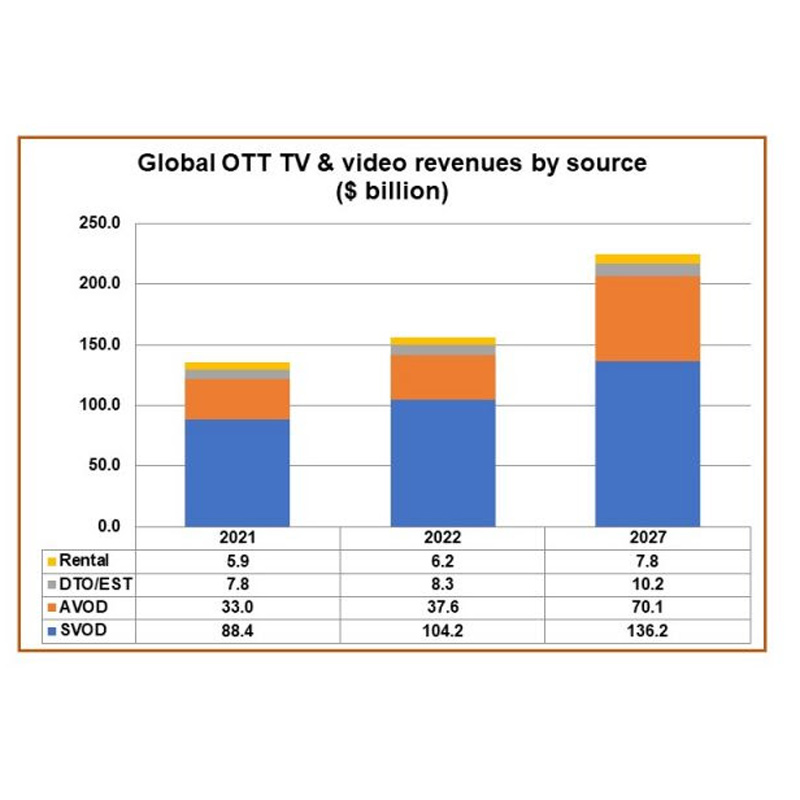
    Mumbai: Global revenues from OTT TV episodes and movies will reach $224 billion in 2027. According to the reports, this will be up from $135 billion in 2021.

    About $21 billion will be added in 2022 alone, according to Digital TV Research.

    SVOD revenues will climb by $48 billion between 2021 and 2027 to total $136 billion. AVOD revenues will increase by $37 billion between 2021 and 2027 to reach $70 billion.

    From the 138 countries covered, the top five will command 65  percent of global OTT revenues by 2027. OTT revenues will exceed $1 billion in 25 countries by 2027; up from 17 countries in 2021.

    Digital TV Research principal analyst Simon Murray said, “The US will command 45 per cent of global revenues by 2027. We forecast that US revenues will climb by $45 billion between 2021 and 2027 to reach $106 billion.”

  • Global SVOD subscriptions to grow by 485 million: Research

    Global SVOD subscriptions to grow by 485 million: Research

    MUMBAI: Global Subscription Video On Demand (SVOD) subscriptions will surge by 485 million between 2021 and 2027 to reach 1.69 billion. Six US-based platforms will have 988 million paying SVOD subscribers by 2027, up from 612 million in 2021, according to a report by Digital TV Research.

    Digital TV Research principal analyst Simon Murray said, “Our Netflix forecasts for 2027 are 29 million lower than our February update – at 253 million. Netflix needs to boost its content to counter its fresher and cheaper rivals.”

    Despite losing four million subscribers in North America, a total of 31 million subscribers Netflix will add between 2021 and 2027.

    It is estimated that Disney+ will overtake Netflix in 2025. Disney+ will add 144 million subscribers between 2021 and 2027 to take its total to 274 million Disney+ Hotstar will roll out to 13 Asian countries by 2027. These countries will supply 114 million (42 per cent) of the global Disney+ subscriber total, but only $1.58 billion (11 per cent) of Disney+’ revenues ($14.7 billion) by 2027.

    Netflix will remain the revenue winner, with $34 billion by 2027 – similar to Disney+, HBO Max and Paramount+ combined. However, the Netflix total is only $4 billion more than 2021 as subscriber growth decelerates and average revenue per user (arpu) is squeezed.

  • 17 mn SVoD homes to generate $ 1.8 bn in West Asia & Africa by ’22

    MUMBAI: Middle East (West Asia) & North Africa OTT TV episodes and movies will generate revenues of US$1.75 billion by 2022; more than quadruple the US$428 million recorded in 2016.

    According to the Middle East and North Africa OTT TV & Video Forecasts report, SVoD’s dominance of the sector will grow. SVoD revenues will reach $1.23 billion by 2022 (or 70% of the OTT total); nearly $1 billion more than the 2016 total (56% of OTT revenues).

    Digital TV Research forecasts 17.27 million SVoD homes by 2022, up from 3.74 million recorded by end-2016. Turkey will remain the leader by some distance, having established a major local player as far back as 2011.

    The top six regional platforms (Netflix, Amazon Prime Video, Icflix, Starz Play, Iflix and Shahid Plus) will account for 39% of the region’s SVoD subscribers by end-2022, up from 34% in 2016. Extracting Israel and Turkey, these six platforms will account for 78% of SVoD subscribers by 2022 – down from 88% in 2016.

    Netflix will be the largest pan-regional SVoD platform by 2022, with an expected 3.26 million paying subscribers. This is more than quintuple the 2016 total. Longer-established Icflix will cross 2 million subscribers by 2022 – quadruple its 2016 total. Starz Play will add a further 1.60 million. Our forecasts of 695,000 subs for Iflix by 2022 only cover six of its eight current countries in the region.

    Digital TV Research principal analyst Simon Murray said: “A handful of mobile operators such as Orange, Zain, Ooredoo, Etisalat and Vodafone have assets across several countries. SVOD platforms can gain considerable economies of scale by signing distribution deals with mobile operators. Deals between mobile operators and SVoD platforms are already prevalent in the Middle East and North Africa – offering an example for the rest of the world to follow.”

    ALSO READ :

    Just 11% video viewership is on OTT: Akamai’s Reddy

    Synergy between quality content & branding workable in digital space, feel industry experts

  • Pay-TV: India among four countries which contributed $16 bn rev between ’10 & ’16

    MUMBAI: In 138 countries, pay-TV revenues increased by $32 billion (Rs 2063 billion) between 2010 and 2016, to reach $202 billion. However, according to the Global Pay TV Revenue Databook from Digital TV Research, only $1.23 billion was added last year (in 2016).

    Almost 50 per cent of the $32 billion additional revenues came from four countries: the US provided $7 billion, Brazil $3 billion, China $4 billion, and India $2 billion, Advanced Television reported. Revenues, however, declined in nine countries, primarily owing to subscribers converting from standalone TV to bundles (which are less lucrative for TV). Between 2010 and 2016, revenues of pay-TV more than doubled in 59 countries.

    Digital TV Research principal analyst Simon Murray said that, although no decline was recorded, European pay-TV revenue growth had slowed down considerably. Despite its pay-TV revenues being higher in 2016 than in 2010, North America had peaked in 2015, Murray added.

    The Asia Pacific region positively added $10.21 billion between 2010 and 2016 – increasing by 42 per cent to $34.38 billion. Latin America hiked by 78 per cent to $18.44 billion. Sub-Saharan Africa more than doubled its total revenues to $4.20 billion.

    In all 49.5 per cent global pay-TV revenues in 2016 came from the US; for the first time falling below the halfway median. The 2016 total — 54.5 per cent in 2010 — is down. The US is followed by far by China, the UK, Japan, and Canada. Two-thirds of global pay-TV revenues in 2016 was generated by these five nations.

    Also Read :

    Pay TV-DTH gains: Airtel leads subs race as Jio could pose challenges

    Tata Sky offers top channels & services

  • India to add maximum satellite TV revenues and subscribers by 2020: Report

    India to add maximum satellite TV revenues and subscribers by 2020: Report

    MUMBAI: A report released by Digital TV Research has thrown some light on how satellite TV revenues will change between now and 2020. The report, that covers 138 countries, estimates that Asia Pacific and Latin America will show strong growth, while western Europe will witness a fall in revenue. This will be due to increased competition from other platforms.

    Satellite TV revenues for all these countries are estimated to hit $ 99.9 billion in 2020, up from $87.8 billion in 2013 and $69.3 billion in 2010. It also predicts that satellite TV revenues will overtake cable TV revenues in 2014. Therefore, satellite TV will comprise 46 per cent of total pay TV revenues in 2014, rising to 47.8 per cent by 2020.

    Even though the US will remain as the leader in revenue generation, India is expected to add the most satellite TV revenues between 2013 and 2020 ($3.2 billion, tripling its total). This is followed by Latin American country Brazil with $1.6 billion and the US with $1.5 billion. In more than 44 countries, revenues will more than double.

    The top five revenue generators in the year 2020 will be the US with $40,570 (up from $39,034 in 2013), Brazil with $7,634 (up from $6,084 in 2013), UK with $5968 (down from $6,124 in 2013), India will add $4,704 and Mexico with $4,204 (up from $3,762 in 2013).

    Report author Simon Murray said: “Satellite TV revenues will decline for 19 countries between 2013 and 2020. Much of this is due to greater competition forcing satellite TV platforms to offer cheaper packages which will lead to lower ARPUs. Furthermore, low-cost satellite TV packages are making a significant impact in several countries.”

    The total number of pay satellite TV homes will be 271 million by 2020, up from 192 million by end of 2013 and 143 million by 2010 end. It also states that out of the expected 78.5 million subscribers that will be added between the years 2013 to 2020, maximum will come from India-27.7 million. This will be followed by Brazil trailing at 5.8 million and Indonesia with 5.4 million.

    Pay TV subscriber total will more than double in 47 countries but will fall in 13 countries. India will lead in the total number of pay satellite TV homes in 2020 with 69.2 million for which it toppled the US in 2012.  India will be followed by Russia and Brazil. Together, India, US, Brazil and Russia will account for just over half the global total by then.

    439 million homes will directly receive TV signals via satellite dishes, up by 100 million by end of 2013. More than a quarter of global TV households will have satellite dishes by 2020, up from 18.3 per cent in 2010 and 22.3 per cent in 2013.