Tag: Signature

  • Celeb endorsements of tobacco products- On whom does the onus lie?

    Celeb endorsements of tobacco products- On whom does the onus lie?

    Mumbai: With the ‘World No Tobacco Day’ well and truly behind us, it is perhaps time to chew on the undeniable reality that pan masala is among India’s biggest industries, with a market estimated at over Rs 40,000 crore. According to a recent report by Expert Market Research, aided by vigorous marketing campaigns by the industry players, the market is expected to witness further growth and is projected to reach well above Rs 70,000 crore by 2026. Despite an existing ban on direct tobacco advertisements, celebrity-led advertising is immensely popular among these brands that collectively spend hundreds of crore rupees on advertising via surrogate means, with several A-listers of Bollywood routinely featuring in pan masala ads.  

    The recent list of celebrity endorsers of premium pan masala brands includes names such as Amitabh Bachhan, Akshay Kumar, Ajay Devgn, Shah Rukh Khan, Ranveer Singh, Saif Ali Khan, Hrithik Roshan, Priyanka Chopra Jonas and Anushka Sharma, among others who currently or at some point endorsed brands like Vimal, Signature, Baba Elaichi and Pan Bahar. The association has drawn much censure for the actors from netizens & general public for promoting tobacco products via surrogate advertisements. Following backlash from fans, Amitabh Bachhan and most recently, Akshay Kumar withdrew their endorsements.

    Recently, a case was also filed against actors Shah Rukh Khan, Ranveer Singh, Ajay Devgn and Amitabh Bachchan for promoting these unhealthy tobacco products.

    In this scenario, the question arises: On whom does the onus lie? Is it on the celebrity brand endorsers who perhaps owe a moral/ethical responsibility to their fans? Or, is it on the policy makers for allowing such thinly veiled surrogate ads for tobacco products in the first place, by seemingly turning a blind eye? Should the laws be made more stringent on such advertisements, with perhaps a blanket ban on tobacco promotions in all forms- surrogate or otherwise- being the only solution? We asked some marketing and advertising industry insiders for their take on the matter, and this is what they said.

    According to Pulp Strategy founder and managing director Ambika Sharma, stars will get many offers but as part of their stardom, there is a responsibility toward the well-being of their fans. “The law does not prevent the advertising of surrogates, but the ethical compass should. In my opinion, the responsibility of the messaging lies with the delivery equally. Why just the stars, there is media also involved,” she says, adding that while the policy for surrogates is in place, the law should be changed based on the current needs and future assessments.” It should be expanded to cover all tobacco products including close monitoring of surrogates,” she believes.

    Surrogate advertising, for the unversed, is a form of advertising which is used to promote banned products, like cigarettes/tobacco and alcohol, in the disguise of another product. Pan masala is a generic term for modern areca nut products that fall under the category of smokeless tobacco commodities. The pan masala industry is known to spend huge amounts on the promotion of these tobacco brands by adopting various marketing tactics.

    According to Grapes executive creative director Priyank Narain, the very idea of surrogate advertising seems quite strange. “Everyone knows what’s being advertised. You may as well ban the brand being advertised or the actual product. This middle path is just a strange way for some people who want to earn money but also have a conscience.”

    While acknowledging that celebrity brand endorsers do owe a lot to their fans, Narain asks why should the onus lie on the celebrities alone? “Doesn’t the government also have a moral responsibility towards the health of the nation? And if they do, why allow the manufacturing and sales of such products in the first place?.” Adding that, “if the government is fine to have these products manufactured because it can earn some money, it should be fine for a few celebrities to earn a little more.”

    Citing Akshay Kumar’s example who initially made big promises of never endorsing a tobacco brand only to then appear in one, Narain says that it’s obvious “we are living in times where profits and economics make more sense than anything else and morals are low. Hence, it’s up to the consumer to be smart enough and make a conscious decision.”

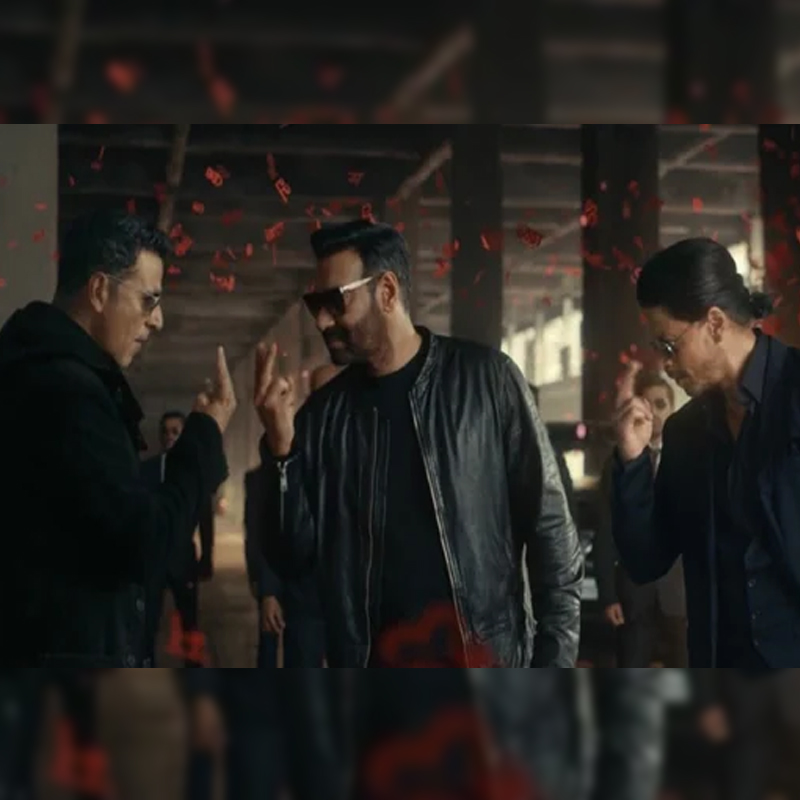
    Akshay Kumar is the latest entrant in the Vimal universe. After the Bollywood actor featured in the pan masala brand’s latest ad, alongside Devgn and Khan, he was heavily trolled for going back on his earlier stance of never endorsing harmful products such as gutkha.

    Earlier last year, Megastar Amitabh Bachchan faced flak for featuring in an advertisement for pan masala brand, Kamla Pasand, following which the big B announced his withdrawal from the advertising campaign. Bachchan initially defended his stance, calling it part and parcel of the entertainment business that employs many but later backtracked. The move came after the national anti-tobacco organisation also requested him to refrain from endorsing pan masala as it could help prevent youngsters from getting addicted to tobacco.  

    Thought blurb Communications managing director and CCO Vinod Kunj, strongly believe, “there should be a blanket ban – not on the advertising, but the manufacturing and sale of all tobacco products. Until that decision is taken these futile debates and arguments will continue.” However, he feels that will not happen, “because, that would mean a huge drain on the coffers of the people who make these quixotic policies.” They compensate for that by making surrogate terms and conditions whose very purpose is for them to be circumvented, he continues, questioning, “why to blame hapless stars and starlets when our policies are dystopian in the first place.”

    On the flip side, Jigsaw Brand Consultants founder Rutu Mody Kamdar doesn’t think it is a lawmaker’s job alone to impose a blanket ban. Lawmakers are one stakeholder who can create guardrails but it is a multi-pronged approach to deal with this issue with various people committing to do their bit, she feels, adding that the onus lies on everyone. “On account of a flourishing industry, there are multiple stakeholders who are choosing to benefit. But on account of a larger societal and ethical issue which honestly is everyone’s responsibility, the brands, celebrities, media and consumers are all responsible for propagating it in some way or the other,” she explains.

    What does the law say?

    By law, tobacco advertising is not allowed. The Cigarettes and Other Tobacco Products Act, 2003 or COTPA, 2003 is an act of Parliament of India enacted in 2003 to prohibit the advertisement of, and to provide for the regulation of trade and commerce in, and production, supply and distribution of cigarettes and other tobacco products in India.

    The ad industry regulator Advertising Standards Council of India’s (ASCI) guidelines also clearly state that celebrities should not participate in advertisements for products that by law require a health warning in their ads or packaging.

    While this debate can go on and on, Zee Studios head marketing Neeraj Joshi believes that bans are not a solution. “Bans are usually against the grain of democracy and defeat the purpose of a competitive market. If the product is being sold, banning its communication is not necessarily going to curb consumption.” And product bans don’t achieve much and possibly cause more harm; as in the case of Bihar, he adds.

    According to Joshi, in an open market scenario, celebrity endorsements are bound to be aggressively pursued by brands. “Celebs endorse a range of products and services. Making them accountable for everything is a bit unfair.” Such a thought process also “infantilizes the consumers,” he concludes.

  • Diageo enters e-alcohol space with Rs 270 mn investment in HipBar

    Diageo enters e-alcohol space with Rs 270 mn investment in HipBar

    MUMBAI: Diageo India, the country’s leading beverage alcohol group, through its legal entity United Spirits has made an equity investment in HipBar, a payment technology start-up that serves the needs of the beverage alcohol industry and its consumers, through a mobile wallet and delivery app.

    Diageo has acquired a 26 per cent equity stake in HipBar for Rs 270 million.

    Diageo India is committed to transforming the beverage alcohol industry and with this investment, the company will support HipBar’s digital ambition and help expand its footprint across more markets. HipBar unlocks the industry’s need to provide better experiences, promote responsible consumption and digitally connect brands, retail stores and consumers through a common digital platform.

    https://www.hipbardelivery.com

    With the HipBar app, age verified consumers can browse a range of alcoholic beverages, select a brand of their choice and pay through the mobile wallet to have the product delivered at their doorstep (where permitted) or pick it up from a retail store at their convenience.

    HipBar has developed a stringent age verification process as well as highly compliant standard operating procedures to ensure that the company’s delivery service fosters a safe drinking environment in India.

    On the B2B front, HipBar works closely with the beverage alcohol industry and the government to custom build software and deploy technology projects that will help the category to move forward in a compliant and sustainable manner. 

    Some of these digital initiatives include last mile alcohol delivery platform, SaaS based e-governance module for use by governments, HipBar point-of-sale for standalone licenced retail stores and HipBar Pay for government controlled retail stores. 

    Founded in 2015, HipBar operates in Bengaluru and Chennai.

    Diageo India CEO and managing director Anand Kripalu says, “E-commerce is making an impact on just about every industry imaginable, and the beverage alcohol industry is set to be the next sector to be disrupted by the continued shift to digital. This investment allows us to discover ideas that anticipate shifts in consumer behaviour and enables us to remain at the forefront of trends.”

    HipBar will continue to run as an independent enterprise driven by its founding team.

    HipBar founder Prasanna Natarajan mentions that the company’s interest will always be subservient to how HipBar is performing in the social sphere and if it is indeed bringing the intended benefits of technology to help people drink more responsibly.

  • Signature Start Up TVC shows journey of celeb chef Nikhil Chib

    Signature Start Up TVC shows journey of celeb chef Nikhil Chib

    MUMBAI: The pursuit of their passions drives the pulse of today’s youth and they strongly believe that this element makes the biggest difference in their lives. 

    Signaturestartup.in – My Mark, My Signature is an online platform launched by Diageo to inspire talented individuals to convert their passion to a paycheck. It houses a series of ‘Signature Start Up’ stories of real life individuals who, driven by their dreams, passion and commitment have made their mark in various fields.

    Through an amalgamation of such real life success stories, the platform also extends on-ground and online through masterclasses – a series of workshops which are conducted across the country with the passionate successful individuals who share their inspirational stories amidst people with similar dreams and aspirations.

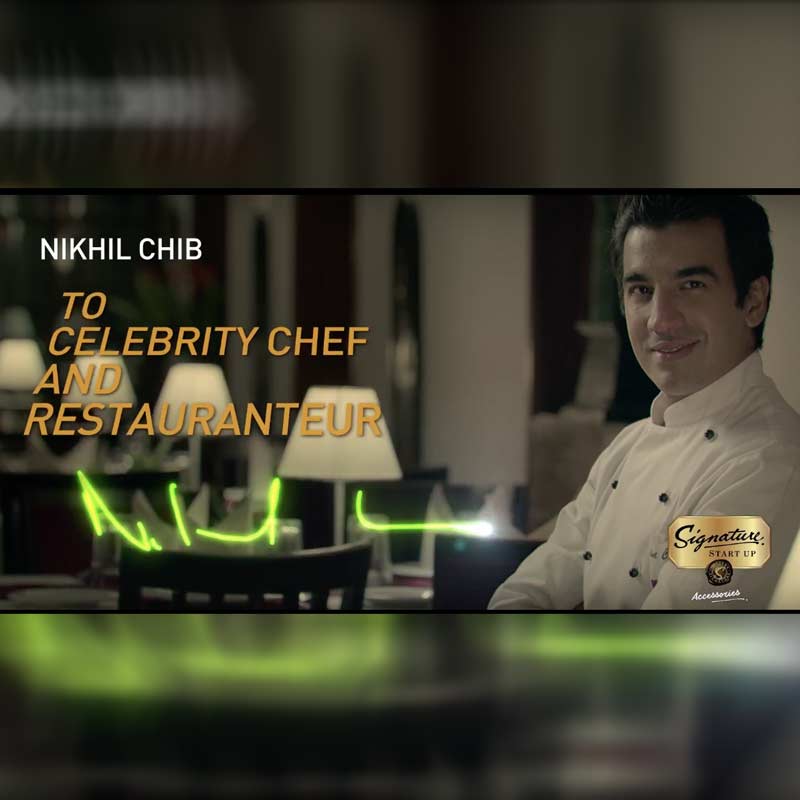
    The Signature Start Up platform has now launched its second TVC featuring the celebrity chef Nikhil Chib, who started off as an investment banker at Wall Street and later went on to find his passion in cooking, thus starting his first restaurant Busaba in 2001. With the launch, he gave Mumbai’s culinary curious lot a taste of the most authentic Southeast Asian cuisine. Kaukswe – Burmese curry noodles served with a plethora of toppings — became a household name among the city’s swish set. 

    The TVC narrates the story of what inspired Chib to quit a stable job in New York and follow his passion for food which led to him winning the hearts of many Mumbaikars.

    Diageo India executive vice president and portfolio head, marketing Amarpreet Anand says, “Today we have a generation who is very keen on following their passion and turning it into a successful career but they just need that one extra push or encouragement and a right platform. As a brand, Signature Start Up is trying to achieve what no other platform has done before. The brand wants to empower and inspire the millennials to follow their passion and make their mark in their chosen areas of interest or professions through these inspiring stories. Nikhil’s is one such real story and we hope it will strongly resonate with everyone who wants to make a mark.”

    Diageo India is the country’s leading beverage alcohol company and a subsidiary of global leader Diageo plc. The company manufactures, sells and distributes an outstanding portfolio of premium brands such as Johnnie Walker, Black Dog, Black and White, VAT 69, Antiquity, Signature, Royal Challenge, McDowell’s No.1, Smirnoff, Captain Morgan and Four Seasons.

  • The rise of the Zombies at Comic Con

    The rise of the Zombies at Comic Con

    MUMBAI: The recently concluded Mumbai Film and Comics Convention (MFCC) aka Comic Con proved to be a crowd-puller, much like its predecessor last year.  

    Held over two days 21 and 22 December at the Goregaon Exhibition Centre in Mumbai, Comic Con had Wonderbai, our very own ‘desi’ interpretation of popular comic Wonder Woman as its mascot.


    Inside, visitors were greeted by life-size statues of Marvel Comics’ superheroes Iron Man and The Hulk in their ‘signature’ poses.


    Apart from world-renowned names like Marvel Comics and DC Comics, the event was also marked by the presence of indigenous creative entities such as Graphicurry, Manta Ray and Wontolla.


    One of the highlights was the promotion of ‘Zombie Rising: Volume I’, graphic novel and prequel to India’s first original zombie film ‘Rise of the Zombie’ by actor, co-director and 9XO channel head Luke Kenny and writer and co-director Devika Singh.


    While also announcing that the sequel to ‘Rise of the Zombie’ is “in the works”, Kenny said: “The prequel comic, the film, and an upcoming video game aim to serve as a new vision to a western genre and Indianising it. It is the Comic Con audience that we are aiming at and not necessarily the Bollywood audience. Presenting it to the public at a time when ‘The Walking Dead’ (a hit US TV series about zombies) is at the peak of its popularity is an added advantage.”


    Singh on her part said: “With a limited audience for this genre, a majority of the audience has to be educated before they can acquire a taste for Zombie films that border between blood and gore. The entire genre of zombies is still a rarity in India, a niche on its own; we aim to expose as many Indians as we can to this genre; especially now that successful films like ‘Warm Bodies’ and TV shows like ‘The Returned’ are taking the world by storm.”


    Incidentally, ‘Rise of the Zombie’ is a film about a wildlife photographer who transforms into a zombie after being infected by one. Both Kenny’s performance and Singh’s writing have been lauded on the social media circuit.


    The other high point was Tere Bin Laden writer-director Abhishek Sharma’s announcement of an “unconventional spinoff” to his 2010 cult comedy titled ‘Tere Bin Laden 3’. Said Sharma, “The two films, even though extremely similar, exist in two different universes,” without giving away any more details.


    However, when a member of the audience asked the also present host-actor Manish Paul, who plays one of the leads in Sharma’s upcoming film, to name the character he plays, Sharma answered out of turn: “Since my name is so common in India that you will find apartment buildings sharing it, Manish has decided to give all his future characters my last name – Sharma.”


    The humor wasn’t lost on the crowd which burst out into peals of laughter even as another spectator asked Paul whether he would ever return to television after making a debut on the big screen. “I will continue hosting, and balance films alongside. I am currently working on a new TV show, but am not at liberty to say more,” replied Paul.


    Leaving aside the event itself, Comic Con has garnered 5 lakh likes on its official Facebook page.

  • ITC Classmate’s new TVC celebrates ‘uniqueness’ in every child

    ITC Classmate’s new TVC celebrates ‘uniqueness’ in every child

    MUMBAI: It is at a tender age of 9-10 years that children first start interacting with a pen to write. This is also the time when they try to create their unique signature which is as unique as the individual. ITC Classmate‘s new TVC, focuses on this aspect of childhood. ‘Signature‘ which is the central theme of the new ITC Classmate commercial is all set to be aired on 2 July.

    The new campaign is the next logical step in the communication continuum, taking forward the current brand campaign- ‘Because you are one of a kind.‘ The TVC has been conceptualised and created by Rediffusion Y&R and will be launched in two languages – Hindi and Tamil. While the Hindi TVC adorns lyrics penned by the legendary Padma Bhushan Gulzar, the Tamil TVC is embellished with lyrics penned by six times National Award winner Vairamuthu.

    The theme campaign comprises three commercials of 60, 40 and 30-second durations. The TVC creatively amplifies a “Signature/Dastkhat”, which is almost the beginning of a new life stage – where the pen becomes a trusted honest companion, almost like an instrument of empowerment.

    “Classmate has always endeavored to recognise, nurture and celebrate the uniqueness of every child. “We decided to take the concept of ‘uniqueness‘ forward by exploring what is that one thing in every child that is the most obvious manifestation of his/her own uniqueness,” ITC Stationary Business marketing manager Karan Kumar.

    The ad is a simple insight into the way every child writes his/her name. “The ad concentrates on the unique signature that every child always wants to create, almost like a master-piece, developed after many rounds of secret iterations. This stands as an outward representation of every child‘s uniqueness. It is this powerful simplicity of the child‘s endeavor that we wanted to capture,” he informed.

    “We are proud and happy that we have worked with Gulzar and Vairamuthu, both extremely acclaimed writers, to capture the powerful yet innocent emotions of children during this pursuit, in an extremely important life-stage.”

    The film opens on Tara, a young girl who grows up in the hills. Standing on the cusp of childhood and adolescence as she does, Tara is earnestly trying to create her own unique signature – an identity that represents her and her unique individuality. While at it, she‘s very protective, almost zealously guarding her various iterations from everyone around her; it is almost her own very secret which she wants to reveal only once she has masterfully crafted it. She finally finds her inspiration at the local community festival where the swirls of ribbons set against all the festivities, inspire her to her final flourish.

    The national television campaign will be supported extensively by digital and social media marketing; consumer activations and engagements, besides a slew of school connect programmes.