Tag: Siddharth Roy Kapoor

  • Disney pushes brand bindass as it merges with bindass Play, enters OTT space

    Disney pushes brand bindass as it merges with bindass Play, enters OTT space

    MUMBAI: It’s hardly a week since Disney India rebranded its movie channel UTV Movies, and now the network has consolidated its two channels — that is bindass and bindass Play. Along with that, in its promise to be omni-present across platforms, bindass will launch an OTT platform for the millennials who want to consume content on-the-go.

    The brand bindass will undergo a transformation this month-end, and after the consolidation with bindass, what will happen to bindass Play is anybody’s guess.

    With the addition of OTT, bindass will have complete presence across linear and digital platforms, providing the users with more opportunities to interact with the brand. Also, the bindass channel will represent a variety of content in a refreshing new packaging.

    Disney media networks and interactive vice president Abhishek Maheshwari said, “The first big initiative we are taking is that we are launching a bindass app in the next few weeks. The idea is to interact with our consumer directly and they can view all our content on one place and to create an engaging platform. We will start with the content we have and, going forward, we will start building content on the basis of consumer preference — this is the key initiative we are doing with bindass.”

    About the ad rate, Disney India says it believes in going with story and finding out the best deal to integrate the brand in the content.

    The network is bringing together branded content, original shows, contemporary music and movies on a single platform – bindass. “The second is that — we are re-packaging bindass. As we look at the evolution of the brand, bindass was launched a decade ago, and the brand stood for entertainment for the millennials, the core remains the same but how stories are told is evolving, and now when we will have a digital presence not on just one platform but on multi-platform along with the linear presence while coming up with the bindass’ new look.”

    bindass Play was launched in 2014, when Siddharth Roy-Kapoor was heading Disney India. bindass Play replaced UTV Stars as the network wanted to build on a youth-centric brand.

    The channel was launched with 13 shows like Tia’s request, Tweet Meri Beat, Ishq Messenger and among others, allowing viewers to choose his/her playlist from social media.

    The rebranded channel will have more music and movies, 13 hours of Hindi music spread across the day, every day, starting with five hours of uninterrupted hit in the morning including viewers’ favorite Selfie Wala request show and two-hour block of Tia’s Request show injects a ton load of energy in the evening.

    Four hours of great stories are to be enjoyed through the day including everyone’s favorite Yeh Hai Aashiqui and the latest show in the bindass stable – Dil Buffering, which launches on 29 September. The weekends have a little extra with a movie every afternoon on Friday, Saturday and Sunday.

    “For Dil Buffering, we have a fairly aggressive marketing campaign around that. We will be pushing the brand bindass, not the channel bindass,” Maheshwari added.

    Maheshwari informed: “In music, we see lots of engagement from the audience, therefore we will go with 13 hours’ music. We have also done social media integration, and we will continue to do more. Also, we have seen a decent amount of interest in movies. We will have movies in the slot called Filmwaag. The idea is to air movies that appeal to the youth.”

    Last year, with Girl in the City (followed by The Trip and Girl In The City Chapter 2), bindass led the wave of disruption with an omni-content, multi-platform strategy to win over millennials in a rapidly evolving digital space with outstanding success.

    “We launched three major web series Girl In the City season 1, 2 and The Trip, and we saw phenomenal success. We have got 180 million views across Facebook and Youtube. The core of web — whichever format and medium they are using — is great storytelling, and that’s what brand bindass stands for. Also these are the sponsored content, we worked with brands. We integrate their stories as the part of the content but the core again be true to the story. Even the music was independently featured on Hungama, iTunes etc.”

    bindass will now welcome a slew of new series which will kick off with the launch of Dil Buffering and TereLiye Bro in the next two months.

    The 10-episodic series Dil Buffering is a love story which will go on air from 29 September at 7pm time slot with simulcast on all Youtube Facebook and TV. The channel has tied up with brands like Micromax, Tinder, Sofy and Ginger by lifestyle. The channel is in talks for their next web series.

  • FICCI Frames 2017: Stakeholders feel regulations cripple monetization

    MUMBAI: In keeping with the tone set in the morning about the changing scenario as far the political climate and censorship were concerned, every participant was keen to hear what the Government had to say about this on day one of the FICCI FRAMES meet here.

    Clearly not wanting to disappoint the M and E sector, Information and Broadcasting Ministry Secretary Ajay Mittal said the Ministry was conscious of these issues and was working on them.

    He expressed optimism that the entertainment industry will soon get an effective solution to their complaints, though he said he was not liberty at present to give more details about this. But the Government appreciated that “Creativity is a great thing, is the soul of society and it should not be affected”.

    Earlier in the same session, film producer Siddharth Roy Kapoor said, “I would strongly urge the government when it comes to the sub-titling and the litigation of the businesses, these issues must be left to the industry. The maximum support from the government should come from the tax regime, infrastructure sector and censorship.”

    Even as everyone appreciates the growth of the sector over the year, the ‘Do the Lions still roar: a reality check for the M&E industry’ was largely devoted to exploring whether the players in the content ecosystem have done their part to address the industry’s shortcomings or has the plot got lost in translation.

    The M&E industry has been a steady contributor to national revenues, employment growth and socio-economic development; it has shown a trajectory of growth over the past 15 years, been at the real cusp of ‘Make in India’ while promoting Indian culture and its soft power globally. And yet, it was largely dismissed as a glamour hub rather than a serious economic nerve centre.

    Of late, the industry has seen a battle of wits between stakeholders and the Government, thus preventing the sector from realizing its full potential. But the question sought to be explored in the session was whether the industry had done enough to highlight its own story.

    Moderated by The Times of India consulting editor and South Asian History and Culture senior fellow, IDF and editor Nalin Mehta, the session was attended by Union Department of Commerce joint secretary Sudhanshu Pandey, the Film and Television Producers Guild of India president Siddharth Roy Kapur, BAG Films & Media chairman and managing director Anurradha Prasad, Harvard Business School Professor of Business Administration Bharat Anand, Viacom 18 Colors CEO Raj Nayak, TataSky MD and CEO Harit Nagpal, and UFO Moviez India Ltd joint managing director Kapil Agarwal among the panelists.

    Asked about the impact of digitization of content and on the business, Nayak said, “People say that the data is the new oil but my philosophy is that the content is the new water. Digitization is no longer a new word. It is just that the number of pipes delivering the content has multiplied in different platforms. If I look at digitization, what is happening is that people have the choice of watching content wherever they want to. But the television audience today is 180 million households and still expected to grow by 80 billion households.”

    He added, “When we look at the monetization, 85 per cent is between Google and Facebook.Of the balance 15 per cent, the growth may be 30 to 35 per cent but it is so fragmented that everybody is losing money. Even when Netflix came, it came via television. If some breaking news is happening people will watch it, if there is some live speech going on or may be for sports, people will watch it on their television sets. As we evolved, we wanted bigger screens to watch television sets that show reality. For content creators, it is a great thing and it is not a golden but a diamond era for them. But the problem is when it comes to monetization because there is so much fragmentation I really doubt how most of these platforms will survive unless of course you are able to get subscription. If you are not able to make the right subscription revenue model, a lot of digital platforms will find it difficult to survive.”

    Asked whether the DTH players were making money from the content, Nagpal said, “People consume content in different ways. Some will spend Rs 20 on the content and some might take different channels in a bundling. So there are different segments. But the purpose of television digitization is to create the infrastructure which is digital and the customer can make his choice. We created a box between the customer and the television, but is that addressable? Officially, DAS Phase 1 and 2 are digitized. We were also supposed to bring transparency. The Government is one stakeholder, the broadcaster is the other stakeholder and the platform that distributes is the third one and the money is divided between the three of us.”

    Nagpal said, “DTH took 33 per cent of phase1 and phase 2 market and two-thirds is sitting with cable. On the service and entertainment tax, this 33 per cent component of digitization would be paying 80 to 90 per cent entertainment tax and 66 per cent of the digital cable sector is paying 10 to 20 per cent of the taxes. Is that addressability? So let not the government waste its time in deciding how I should be pricing myself. They should be making sure whether the digital transparent addressable platform that has been created rightfully.”

    Prasad asked, “Do we still roar? Sorry to say we don’t roar, we don’t have a voice. We have so many issues and for every issue we are going to the court. The stakeholders and the policy makers have divested their power and authority in the organization called TRAI and they vote themselves as they do not know how to move forward. Content needs to be curated, you have to be innovative and for that you need to spend money. You don’t have money flowing back to the system. So the money is getting divested. We don’t get the money back.”

    Sudhanshu Pandey said the service sector in India largely remained unorganized and had to find its own way to develop and grow. Fair market practices have to come in, and the finances should be there for that industry to grow. Some sectors regulators have come but there are many sectors without regulators.

    Agarwal asked: “How do you monetize the film content? The first window of monetization of the film content is theatre, then it goes to the satellite channel and then to other platforms. As a country we need more than 20,000 screens. The capital is there, the facilitation is there but it is restricted by regulations because at least 40 approvals are required. Today the screens are growing only by 2 per cent per annum. When we move from regulation to facilitation, the growth will start and the growth will just not come from the multiplexes but has to happen all over the country. The multiplex sector is very expensive.”

  • Copyright owners call for competitive pricing over TRAI regulation

    Copyright owners call for competitive pricing over TRAI regulation

    NEW DELHI: The Film and Television Producers Guild of India has expressed its voice against any mandated tariff as far as television channels are concerned.

    In a reaction to the recent Draft Telecommunication (Broadcasting And Cable Services) (Eighth) (Addressable Systems) Tariff Order 2016 drawn up by the Telecom Regulatory Authority of India, Guild President Siddharth Roy Kapoor said: “As India continues to develop its thriving creative industry, a transparent, market-based environment free from mandated tariffs, is essential to build investor confidence and to foster the creation of quality content benefiting India’s consumers and its economy.”

    Guild secretary-general Kulmeet Makkar said: “We believe that price controls should only be considered when the market lacks competition which harms consumers or where there is clear systemic market failure. It would be advantageous to abolish any restrictions on price and thereby encourage FDI investments in India– as is the case in countries such as Australia, Hong Kong, Indonesia, Japan, Malaysia, Philippines, Singapore, and South Korea, where the retail and wholesale rates are not subject to restrictions. A more economically efficient model would be to allow the market to determine prices while encouraging investment in quality content.”

    Fox Star Studios CEO Vijay Singh said, “Since the availability of content is not an issue in the context of the Indian market, restricting numbers/genres/mix tantamount to predetermination and therefore, pre-empts creativity. There can never be an exhaustive list of genres for governments to determine any mix and TRAI’s intervention will have cataclysmic effect on the creative community as a whole as TRAI effectively has price capped creativity.”

    “Under the Copyright Act 1957, a content owner has the freedom to monetize copyright works and enter into contracts to monetize content in a manner he deems fit. However the price restrictions imposed by TRAI interferes with this basic freedom. It risks stifling creativity and may force smaller companies out of the market – resulting in less choice for consumers,” according to Motion Picture Distributors Association (India) Pvt. Ltd MD Uday Singh.

    Sectoral regulations have seriously impeded the growth of the film sector. Despite active participation by global studios and broadcasters, investments in the sector have trickled down in the past few years. Indian studios and independent producers are also facing similar challenges. An open market environment can best guarantee that the film sector will not be distorted to the detriment of consumers, creators and providers, the Guild said in its reaction.

    The Guild says that the Tariff Order is likely to take effect from 1 April 2017. It says that the current draft order prescribes maximum retail price caps for pay channels, by genre, Rs 10 (USD 0.15) for movie channels (a-la-carte), excluding taxes] and further caps channels into seven genres.

  • Copyright owners call for competitive pricing over TRAI regulation

    Copyright owners call for competitive pricing over TRAI regulation

    NEW DELHI: The Film and Television Producers Guild of India has expressed its voice against any mandated tariff as far as television channels are concerned.

    In a reaction to the recent Draft Telecommunication (Broadcasting And Cable Services) (Eighth) (Addressable Systems) Tariff Order 2016 drawn up by the Telecom Regulatory Authority of India, Guild President Siddharth Roy Kapoor said: “As India continues to develop its thriving creative industry, a transparent, market-based environment free from mandated tariffs, is essential to build investor confidence and to foster the creation of quality content benefiting India’s consumers and its economy.”

    Guild secretary-general Kulmeet Makkar said: “We believe that price controls should only be considered when the market lacks competition which harms consumers or where there is clear systemic market failure. It would be advantageous to abolish any restrictions on price and thereby encourage FDI investments in India– as is the case in countries such as Australia, Hong Kong, Indonesia, Japan, Malaysia, Philippines, Singapore, and South Korea, where the retail and wholesale rates are not subject to restrictions. A more economically efficient model would be to allow the market to determine prices while encouraging investment in quality content.”

    Fox Star Studios CEO Vijay Singh said, “Since the availability of content is not an issue in the context of the Indian market, restricting numbers/genres/mix tantamount to predetermination and therefore, pre-empts creativity. There can never be an exhaustive list of genres for governments to determine any mix and TRAI’s intervention will have cataclysmic effect on the creative community as a whole as TRAI effectively has price capped creativity.”

    “Under the Copyright Act 1957, a content owner has the freedom to monetize copyright works and enter into contracts to monetize content in a manner he deems fit. However the price restrictions imposed by TRAI interferes with this basic freedom. It risks stifling creativity and may force smaller companies out of the market – resulting in less choice for consumers,” according to Motion Picture Distributors Association (India) Pvt. Ltd MD Uday Singh.

    Sectoral regulations have seriously impeded the growth of the film sector. Despite active participation by global studios and broadcasters, investments in the sector have trickled down in the past few years. Indian studios and independent producers are also facing similar challenges. An open market environment can best guarantee that the film sector will not be distorted to the detriment of consumers, creators and providers, the Guild said in its reaction.

    The Guild says that the Tariff Order is likely to take effect from 1 April 2017. It says that the current draft order prescribes maximum retail price caps for pay channels, by genre, Rs 10 (USD 0.15) for movie channels (a-la-carte), excluding taxes] and further caps channels into seven genres.

  • ‘Anybody Can Dance 2’: Can they?

    ‘Anybody Can Dance 2’: Can they?

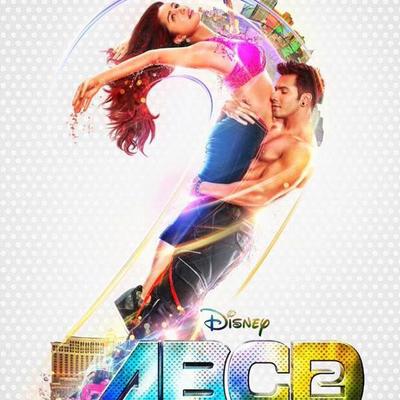
    MUMBAI: Anybody Can Dance 2 (ABCD2) is a sequel to ABCD (2013) and is also about hip hop dancers who aspire to make it big. Wanting to cash in on the fair success and appreciation of the earlier version, the sequel seeks to be more ambitious. It features rising young stats, Varun Dhawan and Shraddha Kapoor, as against the unknown, non-glamorous faces of the original.


    Varun is a pizza delivery boy whose mother was a Padmashri awardee classical dancer. Dancing is in his genes but being today’s youth, his choice is hip hop. He has formed his own group along with other such boys. This group has just one girl among them, Shraddha, who works at a ladies salon nearby. This lot is from a distant Mumbai suburb working their way to break into the middleclass bracket.


    The group is full of enthusiasm but is rudderless. They have nobody to guide them and whatever they learn about dancing is through videos. They decide to make it big and participate in a dance competition. They dance well but are soon exposed for having copied the whole performance step by step from a foreign group. They are disqualified and jeered.


    This may be a small group from almost nowhere but, taking an indirect dig at the contemporary media, their ‘shame’ makes headlines all over with captions “same to shame”! So much so, even dance competition organisers all over the world know about them. The makers could have used this kind of imagination on the script.


    The boys are devastated and most of them opt out. Only Shraddha and a couple of others still have faith in Varun who wants to regroup or form another group and earn fame through the backdoor, which is to participate in the international hip hop competition at Las Vegas, US.


    The boys need guidance and soon they find a guru in Prabhu Deva, a renowned dancer whom every dancer and aspiring dancer worth his salt knows. However, the route to the Vegas hip hop competition is through all India qualifier at Bangalore. Prabhu prepares them for the qualifier. But, when they arrive at Bangalore, they are welcomed with a chant of “Cheaters, Cheaters”! One of the judges decides to disqualify the group.


    One thought a judge at such events was as much an outsider as the participants; they are not the organizers. The judge even wants to know who Prabhu is, so much for being a celebrity dancer who even a dance competition judge does not know!


    Expectedly, the boys qualify to participate at the Vegas event. Like all Indian sports and competition films, they are the underdogs. The usual routine follows, qualifier, quarter finals, semi-finals and, eventually, after much ill-conceived dramatic moments, the finals.


    ABCD 2 has nothing in the name of a script. Even documentaries have better ones. The director has no clue where the film is going and, in the absence of anything cogent to go on, spends over 38 minutes on songs and dance (most of it cacophonous) and rest of the time on the group rehearsing in this marathon 153-minute trial of patience.


    This is a musical and yet it has poor musical score and almost nil romance. All relations are cosmetic. Dialogue writing shows incompetence. Lyrics, when audible, fail to make sense or blend with the situation. Also, considering this is a film about dance, choreography leaves much to be desired except for the last two songs. The positive in the film is its visual appeal, which makes it tolerable to an extent.


    As for performances, considering it is a dance film, though they may be on the same side, pitting Varun against Prabhu was a bad idea. Shraddha Kapoor is just passable in dances. As for acting, nobody bothers. Bringing Lauren Gottlieb as a third angle in a romance that is not, proves a dud. Prabhu’s dancing is not much help either.


    ABCD 2, as expected, has taken a good opening thanks to the expectations of youth but the word of mouth is not good and sustaining at the box office will be a task.


    Producer: Siddharth Roy Kapoor (Disney)

    Director: Remo D’Souza

    Cast: Varun Dhawan, Shraddha Kapoor, Lauren Gottlieb, Prabhu Dheva, Dharmesh Yelande


  • ‘ABCD2’ in 3D will bring out the best in Indian dancing: Shraddha Kapoor

    ‘ABCD2’ in 3D will bring out the best in Indian dancing: Shraddha Kapoor

    NEW DELHI: For Shraddha Kapoor, who had made a mark with Aashiqui 2, dancing in a film like ABCD2 did not come easy but she surprised her fellow cast members including Varun Dhawan when she attempted to match their energy.


    Kapoor is particularly grateful to Remo Fernandes for training her for this sequel to the earlier ABCD, which came in 2013. The film also stars Lauren Gottlieb, Raghav Juyal and Dharmesh Yelande in supporting roles. The movie is directed by Remo D’Souza and produced by Siddharth Roy Kapoor under the banner of UTV-Disney Pictures.  


    The story explores the real life struggle of of four boys Rohit, Pavan, Suresh and Vernon who are part of a dance institute named Fictitious Dance Academy and take up the challenge to win the World Hip-Hop dance championship.


    Belonging to a non-dancer background, Kapoor, who has earlier also acted in Ek Villain, said at a press meet here that she sweated it out really hard and proved that actually ‘Any Body Can Dance’.


    Kapoor proved her dancing mettle in the song ‘Sun Sathiya,’ which was also there in the original film where Lauren Gottlieb danced to the tunes of this catchy number.


    Asked about the challenges she faced, she said, “It was really hard for me to match the energy of other dancers as all of them had taken training somewhere. I did learn a bit of dancing at my school days but had never taken any proper training for the same. The film has changed my life and my body completely. Before this I use to dance in bathroom, in front of mirror, in my room or at birthday parties. I always wanted to dance openly on stage but somewhere I was under-confident or shy to dance in front of so many people. This is all because of Remo sir that he made me confident enough to give my best and whatever positive comments I am getting for my work will made Remo sir proud.”


    The film also features the song ‘Bezubaan’ from the original film, which was a hit among the masses and is now titled as ‘Bezubaan Phirse,’ where the stars show the best of their dance moves.


    Dhawan plays the character of Suresh in the film and features in the recently released song ‘Chunar.’ Asked why he agreed to star in the film, he said, “As an actor, you always listen to the script first, but Remo sir did a very unique thing. He showed me the documentary of ‘Fictitious Group’ who also participated in India’s Got Talent. He showed us footage of dancers from America, China and different countries. When it was announced that India was participating in the global talent series and made it to the finals, I felt so proud and patriotic. I got really emotional and that is why I said yes to it.”


    Raghav Juyal who gave birth to the slow motion dance shared his knowledge of dance with the audience. He is often called as Crockroax, which is an amalgamation of being powerful like a crocodile and creepy like a cockroach. “Earlier people used to mock at the dancers and call them as ‘Nachaniya’ but now value is being attached with dancing as an art. This kind of revolution is shown in the film and I would just say that parents should support their children and as I always say Fame is a devil and art is an angel. Fame will come and go but art will always be within.”


    Asked why is Disney was attached with ABCD2 as the story did not give any fairy tale kind of feeling, Disney India vice president and head, marketing & distribution – studios Amrita Pandey said, “It is a very inspiring story about an underdog dance troupe and has strong emotion of heart. When you’ll watch the film, you’ll see that it is not only about fun and dance. ABCD2 inspires you and Disney always promotes stories, which inspires you in a way or the other.”

  • Disney India and Salman Khan announce the official mobile game on ‘Kick’

    Disney India and Salman Khan announce the official mobile game on ‘Kick’

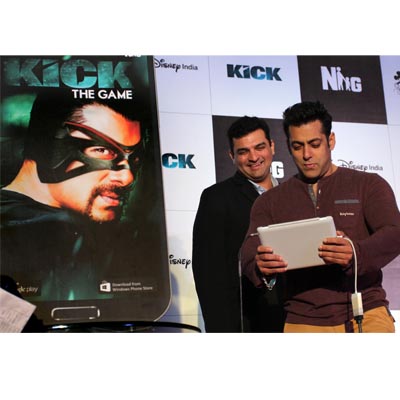
    MUMBAI: You have enjoyed his dialogues, his dance moves and even his unique style… here is your chance to play Salman Khan in the newly launched Kick mobile game. Disney India’s Interactive business, today announced the launch of the official mobile game based on the most awaited movie of the year – ‘Kick’.


    The game has all the elements of the movie – heroism, stealth, entertainment and above all, the game avatar of Salman Khan’s character himself! Superstar Salman Khan and actress Jacqueline Fernandez were present to launch the game amidst much fanfare. Salman Khan being his usual witty self, enjoyed showing off his gaming skills and entertained the crowd with his comments and sense of humour. The game is developed for both feature phones and smartphones (Android, Windows) to reach out to a wide audience of mobile users in the country. The iOS and feature phone version of the game will be launched along with the release of the movie.


    In the game titled after the movie, the player takes on the role of Devil (Salman Khan’s movie character) and embarks upon a benevolent yet exciting journey where he robs from the rich and corrupt and deposits that money in the bank for philanthropic causes. The game sways in two phases letting the player experience robbing and escaping gameplays consecutively. The objective of a level is achieved only when the player manages to complete both the phases. The gamer will need to play in stealth style and escape the cops in grit. The gameplay includes numerous obstacles which include security alarms, lasers, manholes, street cones and more.


    Commenting on the launch of the game, actor Salman Khan, said, “We (Sajid, me and the KICK team) wanted to create an interactive experience of our movie for the fans. The mobile game developed by Disney India is both exciting and easy to play which makes it fun and engaging. I hope my fans will enjoy playing the KICK game as much as I do.”  


    Producer and Director, Sajid Nadiadwala said, “Kick is a very special movie for us and we wanted to take the movie’s experience to all the audiences and give them a taste of the unique style of Salman’s film character and the essence of the movie through this game. The team has worked really hard to create a fun game and we are happy with the outcome.”


    “The kind of movie that Kick is, its concept of action comedy, perfectly lends itself to making a game. The game based on the movie will give gamers and Salman Khan’s fans an opportunity to not only play as Salman Khan himself but also enjoy an immersive gameplay offering the essence of their favourite star’s movie. Salman and the team have been very excited about the game and worked closely with our team to make it happen. We are confident that the game will be a blockbuster hit just like the movie,” said Disney Idnia MD Siddharth Roy Kapur.


    “Gaming today has emerged as one of the top entertainment sources on mobile phones in the country and Indians love Bollywood. By marrying the two, it extends the experience of the movie to consumers in an interactive environment through a highly engaging game,”said Disney India VP and head (interactive)  Sameer Ganapathy.


    Kick will hit the theatres worldwide on 25th July 2014. So get your gaming hats on and get gaming as Salman Khan this Eid!


    Game now available on:


    Android – Google Play Store link: https://play.google.com/store/apps/details?id=com.indiagames.kick


    SYNOPSIS OF THE FILM:


    On a train journey in Warsaw, apretty psychiatrist, Shaina, meets Himanshu, a police officer from India, for an arranged match. Both not wanting to marry, become friends and share their pasts.


    Shaina shares the story of her ex-boyfriend Devi, a guy who lived only for his ‘Kick.’ She talks about his madness and their whirlwind romance, until one day he breaks up with her for a new kick and walks away, never to return.


    Himanshu tells her about his glorious escapades and that he has finally met his match; an intelligent thief.


    What they don’t know is that both their stories have one thing in common; Devi. He returns back into their lives under a new guise of having lost his memory. Behind it all, is a deeper mystery and an uncompromising mission, for which Devi is ready to lose his life.


    What is the mystery of Devi and his real mission?


    Do Shaina and Himanshu find their closure?


    Releasing this Eid, Kick promises to be a complete wholesome action entertainer with Superstar Salman Khan at his natural best – An action hero and a passionate, naughty lover.


  • Kai Po Che: Newcomers put up an impressive performance

    Kai Po Che: Newcomers put up an impressive performance

    MUMBAI: Kai Po Che is an adaptation of the Chetan Bhagat novel, Three Mistakes Of My Life, about three friends living the Gujarat dream – to become entrepreneurs. This is Bhagat‘s third book to be made into a film after One Night @ The Call Centre (Hello) and, Five Point Someone (3 Idiots).

    Producers: Ronnie Screwvala, Siddharth Roy Kapoor.

    Director: Abhishek Kapoor.

    Cast: Sushant Singh Rajput, Raj Kumar Yadav, Amit Sadh, Amrita Puri, Digvijay Deshmukh, Manav Kaul.

    Raju Hirani‘s 3 Idiots turned Five Point Someone into a cinematic miracle which went on to become the highest Hindi grosser so far. Kai Po Che has the tough task of bettering it or, at least, living up to it. To start with a small correction with spellings, it is ‘Chhe‘ in Gujarati language and ‘Che‘ means nothing in Gujarati.

    A pol in Ahmedabad is a congested one-track settlement where households live as one family; the main doors are always open and you don‘t have to knock to enter. It is typically an old Ahmedabad phenomenon and Hindu and Muslim localities usually share demarcations by a lane or two.

    Govind (Raj Kumar Yadav), Ishaan (Sushant Singh Rajput) and Omi (Amit Sadh) have grown up together in one such pol and are more like brothers than friends. Still, all three are poles apart. Yadav is practical and ambitious with entrepreneurial instincts, Rajput is a cricket fanatic and Sadh is all brawn and no brains, just happy to belong. The centre point of this pol is a temple where Sadh‘s father is the chief priest while his mama, Manav Kaul, is the trustee and treasurer with heavy leanings towards a political party.

    Yadav gives tuitions to local kids and helps his mother with her home industry of delivering popular Gujarati snacks like khakhras and theplas. However, his entrepreneurial side won‘t let him rest with just so little. Since Rajput is a cricket enthusiast and spends time coaching the neighbourhood kids, and Sadh‘s family controls the temple, he suggests they set up a shop in the temple premises selling sports goods. Nobody is convinced initially with the idea but, Sadh being his only nephew for whom he has grand plans in politics, Kaul finances and encourages them to go ahead. The shop is quite a success and there are picnics and celebrations for the trio.

    The lives of three friends are soon destined to follow different tracks. Yadav carries on with his zeal to expand and is in search for a bigger outlet somewhere in the developing parts of the city, finally settling on a mall, Sadh is gradually drawn into politics by Kaul while Rajput has finally found his calling; he has met a young Muslim boy, Digvijay Deshmukh, in who he sees potential to be a cricket star some day. Rajput takes it upon himself to train the boy with all his time and resources. That is when the 26 January, 2001 earthquake hits Gujarat. Among others it has also destroyed the mall in which the three had invested Rs 500, 000 loaned by Kaul.

    No sooner has the calamity been forgotten, the infamous Sabarmati Express episode happens a year later, leading to communal riots. The three have different priorities: Yadav is worried he has impregnated Rajput‘s sister, Rajput wants to save Deshmukh and his family members while Sadh, who has lost his parents in the train disaster, wants to avenge them and is on the move with rioting mobs.

    The first half of the film is all about three friends, their carefree life and finding a cause while post interval, the perspective changes to wider issues, the riots and how they changed lives.

    The feel good film suddenly turns heavy, stuffing in too much. The story of three friends through various moments in their lives does not touch the viewer at anytime. Being a period-specific story, the director has not been very particular about the city he is dealing with. The pol in the story opens on the main road showing traffic, there are green and yellow CNG rickshaws in 2001, and many malls in the making. None of this is accurate. The interiors are shown to be dull and drab which don‘t make for pleasant viewing. There is extensive use of Gujarati language but it neither has Ahmedabadi twang nor is pronounced properly by non Gujarati artistes. The title Kai Po Che has no relevance to the story and the film has just one passing kite-flying scene while kite flying is a passion in the city climaxing on 14 January every year. Also, the title, which is a cry that goes when an opponent‘s kite is cut, it means little to those outside of Gujarat and Mumbai. The songs are soothing.

    The new faces in the film, Yadav, Sadh as well as Rajput do very well while Amrita Puri in her brief role is suitably apt alternating between a coy girl and a bold one romancing her brother‘s best friend on the sly. Deshmukh is impressive. Kaul lives up to his part.

    Kai Po Che has been much hyped yet falls short of expected opening response. While some improvement may be expected over next two days, it may not be enough. 

    Zila Ghaziabad: Of gangs, guns and gore

    Producer: Vinod Bachchan.

    Director: Anand Kumar.

    Cast: Sanjay Dutt, Arsad Warsi, Vivek Oberoi, Paresh Rawal, Ravi Kissen, Chandrachur Singh, Sunil Grover, Minissha Lamba, Charmy Kaur, Eijaz Khan, Ashutosh Rana.

    Zila Ghaziabad is one of those local stories from Ghaziabad, UP, and considering the region, it is about violence and gang wars blended with politics and police to complete the chowkdy (gathering of four).

    The film is supposed to be inspired from a real life war between two Gujjar community gangs of the town, only turned up many notches in violence. In fact, the film is all about violence with a few item/dance numbers thrown in while all other aspects like relations and emotions are mere props.

    Vivek Oberoi wears desi garb, teaches youngsters under a tree and quotes Mahatma Gandhi. That is not all. He is a multi-talented man: a lawyer by qualification, he romances the town head‘s daughter and can even take to arms if it comes to it. The headman, Paresh Rawal, usually engages muscleman Arshad Warsi but is convinced when Oberoi suggests a legal route to solve a land dispute with Ravi Kissen. The sarpanch being the judge and jury, Oberoi wins the day for Rawal whose brother in law, Sunil Grover, is not pleased with his proximity either with Rawal or with his daughter, Charmy Kaur. Thus a couple of enmity angles have opened up.

    Grover, playing the old-fashioned villain, creates a rift between Warsi and Oberoi. Blood flows getting the media attention and it is time for the super cop, Sanjay Dutt, to enter. He metes out instant justice. There are no arrests and no court cases in his law book. Dutt seems to plan his strategies on a chessboard. He studies it like a tarot card and decides to let Oberoi and Warsi loose on each other and for them to fight it out between themselves. Dead bodies drop like nine pins: Chandrachur Singh, Rawal, some women and a horde of henchmen. Nobody is counting.

    Being UP, the politics and gangster nexus is inevitable. It is election time and gangster Kissen, aided by Warsi, decides to throw in his hat, with Oberoi‘s brother, Eijaz Khan, opposing him. Kissen wins hands down giving him a licence to rule the district and eliminate anybody who crosses his path. But before that, he has to eliminate Warsi who has now become a nuisance for him. So there are going to be some more gun fights and some hand-to-hand combat as well. In fact, the film is all about fights except when it breaks for an item number.

    All the while when the gangs are shooting at each other, Dutt does support one of them from behind the scene. You can‘t have Dutt in the cast and not have him be part of the action. Finally, when all the baddies have gone down, Oberoi survives to resume spreading Gandhi‘s philosophies again. His is one case where Dutt has made an exception and got him his due punishment instead of giving justice on the spot, a bullet in the head.

    Zila Ghaziabad has a number of artistes in its roster and as a new one arrives on screen, an old one makes way. Dutt, Oberoi, Warsi, Rawal, Singh, Kissen are all apt. The one who stands out in the lot is Grover. The girls Kaur, Minissha Lamba, and Divya Dutta appear intermittently with nothing substantial to do. Direction is routine and the locations, except a couple of passing ones, have no identification with Ghaziabad or the district. Cinematography is below par while editing is slack. Except for one item number, Baap ka maal…, music has no appeal. The fights are repetitive and the kind seen in many South remakes recently.

    Zila Ghaziabad is a poor fare, the kind they stopped making by 1980. It has been received very well in Ghaziabad and neighbouring districts but is poor elsewhere.

  • Vidya Balan weds Siddharth Roy Kapoor

    Vidya Balan weds Siddharth Roy Kapoor

    MUMBAI: UTV Motion Pictures CEO Siddharth Roy Kapur tied the knot with Bollywood actor Vidya Balan on 14 December in a ceremony which was a mix of both Punjabi and Tamil traditions.

    The wedding took place in Mumbai and was a private affair in the presence of family and close friends of the bride and the groom.

    Bollywood actor Priyanka Chopra tweeted, "Congratulations to my friends Siddharth Roy Kapoor and Vidya Balan! They make such a beautiful couple..heres wishing them happiness forever!"

    Meanwhile, filmmaker Madhur Bhandarkar tweeted, "My heart filled wishes to buddy Siddharth Roy Kapoor and Vidya Balan for the new phase of their lives together. Congratulations to the beautiful couple."

  • Siddharth Roy Kapoor reacts to legal notice of Murphy

    Siddharth Roy Kapoor reacts to legal notice of Murphy

    MUMBAI: Reacting to the legal notice that his company UTV Motion Picture has received from Mumbai based Murphy Enterprises for alleged trademark infringement in the upcoming film Barfi, the film‘s producer Siddharth Roy Kapur said, “It is true that we have received a notice from them. It‘s an honest approach and we will be responding to the legal notice. We are quite clear that we have done nothing wrong. The brand has been presented in a very positive light.”

    Radio‘ and ‘Murphy Munna‘ in the title song as well as in the film without taking an NOC (no objection certificate) from them.

    Starring Ranbir Kapoor, Priyanka Chopra and Ileana D‘Cruz, Barfi! hits theatres tomorrow.

    Named Murphy, Kapoor‘s character is addressed as Barfi by people all around him.