Tag: Shobha Kapoor

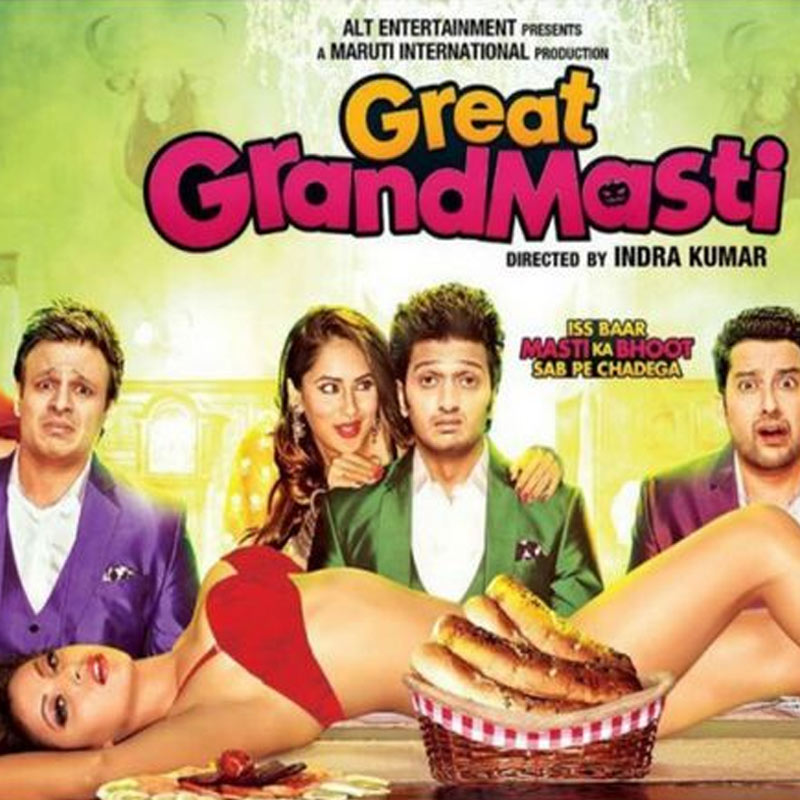
  • Great Grand Masti….Greater disappointment!

    Great Grand Masti….Greater disappointment!

    MUMBAI: Indra Kumar acted in and made a few Gujarati films in the era of tax exemption and subsidy offered by the Gujarat government to promote Gujarati films. Indra’s forte in those days was to thrive on vulgar gestures and double meaning dialogue. It worked because Gujarati films catered mainly to a certain level of audience. He also came to be called the Dada Kondke (the legendary Marathi filmmaker) of Gujarati films. Indra directed some notable films in Hindi with top stars.

    With corporate studios calling shots and stakes gone sky-high, survival for independent filmmakers became impossible. Indra decided to go back to his Kondke style of film making starting with Masti (2004), followed by Grand Masti (2013) to now come up with the third part of his Masti series with Great Grand Masti.

    The Great Grand Masti has the same agenda as its earlier versions which is to weave a comedy around vulgarity. The male and female anatomy is the theme around which the makers plan to play. To this end, Indra lets loose his three generally out of work male characters from his earlier films, Riteish Deshmukh, Aftab Shivdasani and Vivek Oberoi. All that these three have in mind is sex 24×7. It oozes from all their actions.

    All three are married to very revealing and willing girls but all three girls carry excess baggage which keeps the trio from getting anywhere close to their spouses. Since the lads are desperate for sex and their own women are not available to them, they need to look elsewhere. They decide to embark on a village where Riteish has a palatial property to sell.

    The makers think it is time to make this film hattke from the earlier two. So the angle of paranormal is added to consolidate the comedy. This is rare because paranormal on its own has few takers in Hindi films, let alone with a blend of comedy. Last one in memory is late producer-actor Deven Verma’s Bhaago Boot Aaya, inspired from a James Hadley Chase novel, Miss Shumway Waves A Wand. But, to a disastrous results.

    In absence of a script or good gags, Indra lets his three non-actors loose on the screen as they start with trying to seduce the sexy maid, Urvashi Rautela, at the palatial house and, later, to save their lives when they realize that the maid is a ghost waiting to be seduced for the last 50 years! The hide n seek between the guys and ghost is meant to be funny but it is not and falls flat. In its 127 minute duration, the only funny scene the film has is of Viagra aftereffect which, again, has been lifted from Mel Brook’s comedy, History Of The World (1981). And, that too has been killed by stretching it too far.

    The film is a poor specimen of comedy, entertainment or whatever it may be called. Nothing works here. The performers keep to their reputation and don’t act; over two hours of buffoonery is what they resort to.

    The film is poor on all counts and has no hopes at the box office.

    Producers: Shobha Kapoor, Ekta Kapoor, Sameer Nair, Aman Gill, Ashok Thakeria, Sri Adhikari Brothers, Anand Pandit.

    Director: Indra Kumar.

    Cast: Ritesh Deshmukh, Vivek Oberoi, Aftab Shivdasani, Urvashi Rautela, Pooja Bose, Amar Saxena, Sanjay Mishra, Shreyas Talpade.

  • Balaji Telefilms’ promoters up stake to 47.29% post Star India’s exit

    Balaji Telefilms’ promoters up stake to 47.29% post Star India’s exit

    MUMBAI: After Star’s stake sale of 25.99 per cent in Balaji Telefilms Limited (BTL), the company’s promoters Shobha and Ekta Kapoor have acquired 28,43,000 equity shares at Rs 63.60 per equity share. With this, the promoters have upped their stake in BTL from 42.93 per cent to 47.29 per cent.


    Prior to the acquisition, Shobha Kapoor held 14 per cent stake in BTL, which has now been upped to 15.31 per cent (99,82,462 equity shares) post the acquisition of shares from Star Middle East FZ-LLC.


    On the other hand, Ekta Kapoor’s shareholding in the company has increased to 23.87 per cent (1,55,62,704 equity shares) from the previous 20.81 per cent post the share acquisition.


    Balaji Telefilms group CEO Sameer Nair also acquired 416,000 equity shares, which takes his current holding in the company to 1.06 per cent (692,729 equity shares).


    Balaji Telefilms Limited managing director Shobha Kapoor said, “Balaji Telefilms has in place a very strong growth platform in both the television and motion pictures segments. We are very optimistic about our growth outlook that is being driven by a highly capable leadership team. This transaction is reflective of our confidence in the company and its growth story.”


    Nair added, “We have already embarked upon several exciting strategic initiatives, which we believe will translate into improved operating and financial performance. We are also very well poised to capitalise on the several opportunities opening up in the media industry.”

  • We will look for international, local collaborations and diversifications: Sameer Nair

    We will look for international, local collaborations and diversifications: Sameer Nair

    I had never gone away”, says the man who is credited with bringing KBC and K shows to the Indian television screens. Sameer Nair, after a hiatus of three years, is back at doing what he does best. He has been busy exploring opportunities in online video, e-commerce, film & television production, education, hospitality and of course, helped the newest entrant, AAP, into Indian politics.


    A maverick as many call him goes by the philosophy – communicate clearly, be polite, be persuasive, sweat the detail, seize the moment and create not compete for what is already created.


    As the new group CEO at the country’s biggest production house, Balaji Telefilms, he will work closely with Shobha and Ekta Kapoor to take it to the next level.


    Indiantelevision.com’s Meghna Sharma caught up with him to know about his views on today’s audiences, their taste, Balaji’s success in gripping the viewers’ pulse and its future plans.


    Excerpts…


    You had the genius to select the content which caught the pulse of the viewers. How has that evolved? How do you keep abreast with the change in taste?


    Television is dynamic. When we did ‘KBC’ and ‘Kyunki saas bhi kabhi bahu thi’ which went on air on the same night, quickly followed by ‘Kahani ghar ghar kii’ and ‘Kasauti zindagi kay’, it used to be half an hour weekly programming on three main channels – Star Plus, Zee and Sony. This gave viewers 90 choices to pick from. At Star our big strategy was to channel this to daily and changed the whole schedule, reducing the primetime viewing choice to five. Which others followed and continues to be even done today. It was a new concept then and people liked it. With Imagine, we got mythology into primetime which can be seen today as well.


    In the last 22 years of Indian television, we have had a full generation of television – executive, creatives. When I started of in 1993, we were the pioneers then, and had only the legacy of Doordarshan (DD) to look back at whereas today’s generation has 22 years of television to study. So, in the last 20 years, there has been a lot of process especially in consumer taste because the country has progressed. Today we have 150 million television homes, 800 million mobile phones, internet, disposable income has increased and content has kept in pace with it because of the new talent entering the space. For instance, Colors has had wonderful success, Sab has created a special niche for itself and done remarkably well, production houses are doing well and coming up with shows like ‘24’ and ‘Yudh’.


    Content has evolved and so have the people.


    Channels do a lot of research, but what I feel is that research can only prevent you from doing a mistake. It can tell you what not to do and not what to do. Finally, what has to be done is done with meticulous details, creativity and the way a story is told. For instance, ‘kyunki…’ as a daily show was a good idea strategically, but people remember the story of Tulsi in the big Virani family. It is all about great stories, well told.


    What is your role as group CEO?


    Balaji is in a very good place and we have had a successful run of films as well as shows. I was doing a count and Balaji has 15 of the top 50 shows currently on the Indian television screens. There are a very few listed industries in this space and it is one of them.


    And in the past six months we have been discussing the growth plans and one of the main take outs of those meetings has been that we should scale up the company. So, now Balaji will do more movies, more television, we will look for international as well as local collaborations and look for diversifications.


    I have really come here to work with Shobha and Ekta Kapoor to do that.


    Which verticals are you looking at for collaborations?


    Could be movies, shows, formats or just partnering with an international company on specific projects. If there is a format company looking to set up a shop here in India or wants to do catalogue shows here then that could be an opportunity we would be looking at.


    Between Ekta, Shobha and you, how are the roles divided?


    Ekta is creative and she is great at that. Mrs Kapoor has been the operational backbone of the company, so I will work closely with her. And also with Ekta. The main aim here is to work together and look for growth opportunities.  


    What in your assessment are Balaji’s strengths and weaknesses? And what are its opportunities?


    Balaji has a very good team and they have produced some incredible work. So, if there has to be a weakness then it is to have craft a strategic plan and then execute it. At its current stage, the Indian television industry is at its best and has no weaknesses. But of course, one can always do better and look at different genres, show etc. But, I wouldn’t say that these are weaknesses but are opportunities.


    As for the strengths, they are very strong on creative, production and have the ability to deliver. The talent in Balaji is phenomenal and there is a lot of ambition.  


    What is Balaji’s USP- is it talent, creativity or the ability to know what viewers want?


    The USP is the storytelling. Ekta’s way of telling a story is what sets her apart from the others. The market is crowded and a lot of others are also doing a great job. It is not a monopolistic market. But Balaji is special.


    A lot of famous faces have come from Balaji’s house. How is the talent management arm, Spark, doing?


    I haven’t taken a look at it yet, but will soon do. I want to do some reorganisation with that arm. We at Balaji want to manage the talent in the country and look at growing more talent.


    Lately, we have seen channels experimenting with finite shows. According to you, what is its future in India?


    The market is already segmenting. There is a segment which will continue to watch the dailies and then there is another who will consume mythology and historical shows. But there is and will grow into a bigger section of audience which is interested in finite shows. So, there will be two distinctive audiences – you and your mother.


    Niche is always more valuable. And with digitisation it will benefit the industry and the viewer as one can choose to pay for a channel showcasing only hi-end products. As this group grows, it becomes a business model.


    The market is moving that ways and we are the market leaders.


    Globally, there are firms like Shine, BBC, Fremantle who have spread their wings internationally. Do you think Balaji can be India’s Shine?


    A lot of global companies which have come to India and come with their format catalogue which they are selling in India tend to be in reality and game show space. But we haven’t seen any international firm making any head way in the fiction space. The same thing applies on reverse basis. The west has been more advanced than India when it comes to television. The formats have done well there and since they are universal, they can travel across the globe.


    What Balaji will look to do is to partner with them. The future of this business is creative collaboration rather than destructive competition. We are looking at more people to work for.


    And we have already had a few offers to co-produce international movies into Hindi with a foreign partner. Maybe, later we could do shows as well and who knows set up a collaborated company in the future.


    Earlier there was Balaji and Balaji alone, apart from UTV. But today we have Beyond Dreams, Director’s Kut, Swastik which are producing big ticket shows. Did Balaji let go of opportunities? Or was it the content demand that helped them crop?


    It’s an expanding market and there is a limit to what a production house can do and should do. So, it’s just a dynamic market. There are too many channels and we need more shows so therefore more producers are needed to produce these shows.


    It is a nice competitive space with good creativity energy.


    Balaji did produce regional content for TV, will we see that happening again? What about venturing into regional films?


    I have heard that regional market is going through a bit of turmoil and price points have really crashed there. So, we are looking at the regional market to work with the right partners. So, again the big focus in on collaboration.


    Balaji has a lot of inherent strength and a lot of reverse so we have to see if we can collaborate with creative people there. We have an open door policy and anybody with a great idea can approach us. We are always looking for people to work with whether in television or films or new media.


    As far as films are concerned, what is the strategy?


    We have had a good run this year and the plan is to settle towards eight to 12 movie slates per year. So we will have to work really hard to achieve this because it will have to be across genre and across budgets. We have always done it that way and that’s why we have had films like ‘Ragini MMS 2’, ‘Mein Tera Hero’ and ‘Ek Villian’. So there is a lot of variety and we will be looking at scaling it up.


    What will be Tanuj Garg’s role now?


    The film arm is strong and has churned out fabulous work in the past. And will continue do so. Tanuj will be reporting to me.


    Balaji doesn’t own IP. Is that what has kept its price at the level it is?


    There is too much hype given to Intellectual Property (IP). The value of IP is when it has the ability to monetise the content. Movies have IP because after the theatrical release you can sell the broadcast rights to a channel and then re-syndicate it through DVDs.  In television, the kind of shows that are being made there is not much beyond what is in the first run. The channels are anyway syndicating it aboard.


    The US has so much of IP because of the content available there. For instance, they can have a great run of a show like ‘Big Bang theory’ and then sell it in India because we watch it too. But the reverse doesn’t work for us. For example, we can’t sell a ‘CID’ there for the Americans to watch, but we will watch ‘CSI’. So, IP makes sense when your content can cross boundaries and still be consumed.


    What is on the agenda for the next couple for years?


    We are looking a long term strategy of growing the business. In the next three to five years, we should double or triple in size. That means more shows, films and some good co-productions.


    The big agenda is that we are looking for creative people and companies to partner with and grow in inorganic manner as well.

     

  • Sameer Nair joins Balaji Telefilms as Group CEO

    Sameer Nair joins Balaji Telefilms as Group CEO

    MUMBAI: He has donned numerous hats. From selling space in Yellow Pages to being a member of a political party, Sameer Nair has had a volatile career.


    The former Star India CEO is now all set to join Ekta Kapoor’s Balaji Telefilms as Group CEO.


    On 15 July, Nair attended the board of directors meet and will take full -charge from today.


    Nair said, “I have enjoyed a wonderful association with the Kapoor family since 2000 following the launch of the hugely successful ‘K-series’ on Star Plus and later with their shows on Imagine. Undoubtedly the team has done a remarkable job of creating one of the most vibrant entities in content generation. The M&E industry is currently at a very dynamic stage and  will  continue  to  present  several  exciting  opportunities  across  all  segments, heralding significant change in times to come. I am delighted to have the opportunity of being a part of an extremely exciting business at one of India’s most pioneering, creative and talented media houses. Given BTL’s several strengths as a business, it is very well poised to capitalise on emerging growth prospects. I look forward to working together with Ekta, Shobhaji and the team, in driving strategic initiatives, furthering the Group’s vision of being regarded as an innovative entertainment powerhouse and enhancing value for all stakeholders.”


    Balaji Telefilms MD Shobha Kapoor added, “We are delighted to have Mr. Nair joining the Balaji family. Sameer brings with him immense and diverse experience in the media and entertainment industry and an acknowledged   record  of  content  innovation,  business  leadership  besides  being  an excellent  resource  unifier. Over  the  last  several  years  we  have  built  an  unparalleled franchise in creation of television content and have also developed  a very strong brand equity within the film production  segment. We are excited that Mr. Nair possesses  the same passion  for entertainment  as us and we look forward to him further reinforcing Balaji’s  inherent  strengths  in  both  segments  and  driving  the  Company’s  growth  & expansion strategies to help us scale greater heights.”


    Nair who was very vocal about his association with Aam Admi Party (AAP) started his TV career in 1994 where he began as a director-producer for Star Movies, Star’s English movie channel. In 2000, his career as well as Star reached higher peaks with Kaun Banega Crorepati which helped take Star Plus from number three position to number one.


    Soon, he was given the charge of the network as CEO. But it was short lived as he quit the company after 13 years of association in 2003.


    After that, he joined NDTV’s new joint venture with Karan Johar’s Dharma Productions as CEO. As part of the JV, he was involved in launching NDTV Imagine, the Hindi GEC in November 2007. However, the channel didn’t do well and was shut in 2012. 


    Since then, Nair has been busy as independent media entrepreneur and been making frequent trips to Delhi to support and contribute in AAP’s communication strategy.

  • 20 years of Balaji Telefilms’ dominance

    20 years of Balaji Telefilms’ dominance

    MUMBAI: “My company works on two principles. One, nothing is bigger than the programme, not even the company. Two, if you believe in me and really want to share my goal and vision, please join me; else don’t show me your face. I have never told this to anybody before, but seriously, the company needs an attitude. No company which does not have an attitude can ever be successful,” are the words of the woman who turned the small screen into big!


    India’s largest fiction TV producer Balaji Telefilms which  redefined  Indian television and made Ekta Kapoor a household name can be credited for the satellite boom in the country as well. 


    Like many of her counterparts, she too started her career very young. From being just yesteryear’s superstar Jeetendra’s daughter, today Ekta Kapoor is the woman who rules the hearts and the minds of many. She started off at 17 and since then, has loved, eaten and slept only television. Always thinking about concepts, casting, styling, selecting technicians, shooting and scheduling, marketing and acquiring the new skills required to succeed.


    Set up in 1994, the powerhouse has completed 20 years of entertainment. It all started with a comedy show on Zee TV, ‘Hum Paanch’, in 1995 and today it has an array of shows to its name.


    Satellite television began in the early nineties with the launch of Zee TV, followed by Sony Entertainment Television later in the decade and finally Star Plus as the millenium ended. It wouldn’t be unreasonable to say her TV shows have played a pivotal role in each one of their successes at some time or the other. Even the latest major entrant Colors – from Viacom18 – is relying on her new show Meri Aashiqui Tum Se Hi to give it an injection of TRPs. One after the other, the production house has created blockbusters on the small screen. ‘Kyunki Saas Bhi Kabhi Bahu Thi’ and ‘Kahaani Ghar Ghar Ki’ made everyone switch on to Star Plus every night from 10pm to 11 pm; people cried and laughed with the characters. So much so that the death of the character Mihir Virani on ‘Kyunki Saas Bhi Kabhi Bahu Thi’ lead to fan protest marches to bring back him back. The shows also garnered unheard of TRPs for eight long years.


    Then, came another slew of superhit drama series  like ‘Kabhi Souten Kabhie Saheli’ (Star Plus), ‘Kutumb’ (Sony), ‘Kuch Jhuki Palkein’ (Sony) and ‘Kohi Apna Sa’ (Zee), ‘Kahin To Hoga’ (Star Plus), ‘Kasautii Zindagi Kay’ (Star Plus), ‘Kkusum’ (Sony) which took the company miles ahead from its competitors.


    Some of the company’s on-going popular shows like ‘Jodha Akbar’ (Zee TV) ‘Bade Acche Lagte Hai’ (Sony), ‘Pavitra Rishta’ (Zee TV), ‘Ye Hain Mohobbatein’ (Star Plus), and ‘Kumkum Bhagya’ (Zee TV) hold strong in their time band.


    Balaji, which possesses 23 modern sets and 37 editing suites in India, also helped enhance the primetime slot on GECs.


    The company has produced more than 15,000 hours of television content since its inception, including content in Hindi, Tamil, Telegu, Kannada and Malayalam.


    Filmy business


    If television dominance wasn’t enough, the company soon entered the Indian motion picture business in 2002.  


    Till 2009, the company through its wholly-owned subsidiary, Balaji Motion Pictures, had produced and/or acquired 12 films, including hits like Bhool Bhulaiyaa and Sarkar Raj.


    It set trends here as well when it co-produced and distributed India’s premiere digital film Love, Sex aur Dhokha, released in March 2010 under its ALT Entertainment banner. The film emerged as a sleeper hit receiving critical and commercial acclaim from audiences, worldwide.


    The company continued the LSD success story with its second production, Once Upon A Time In Mumbaai, which broke ground at the worldwide box office. Other films to its credit are Kuku Mathur Ki Jhand Ho Gayi, Main Tera Hero, Ragini MMS 2, Shaadi Ke Side Effects, Once Upon A Time In Mumbai Dobaara, Kya SuperKool Hai Hum, Dirty Picture and Shootout at Lokhandwala.


    With an impressive slate like that, she has earned Balaji a position amongst the major film studios in India.


    Other ventures


    But that hasn’t stopped her or the company from venturing into other spaces.


    Over the years, from a television content provider, Balaji Telefilms has evolved into a media conglomerate with organisational divisions responsible for television, motion pictures, internet and mobile.


    Being the largest player in the industry and after having creating larger-than-life characters, it understands the skill sets required to be successful.


    Balaji Telefilms took an initiative to bridge the gap between demand and supply of professionals/actors, by launching its ICE Institute of Creative Excellence. The institute trains tomorrows’ players by teaching them the various skills needed to make a career in the Media and Entertainment industry.


    What next for Ekta and Balaji? She is going back to her roots: television. For the past three to four years she has been absolutely focused on making Balaji a force in the film industry, leaving the running of the television productions to mother Shobha Kapoor, Tanusri Dasgupta, Ketan Gupta, among many other professionals. But just last month she was quite clear when she said: “I am a TV producer who works 24 *7. It’s just that I am focusing more on television as I am getting a chance to explore myself.”

    As one philosopher said: “Life is a journey, not a destination.”  And for Balaji and Ekta, it seems like a never ending dream journey.


  • ‘Ek Villain’…Box Office Hero

    ‘Ek Villain’…Box Office Hero

    MUMBAI: In the old days, they would say that there are only seven story themes in this world and we keep making films around them. Then came television, and the serials took away more than half of them to beam into people’s drawing rooms on a daily basis. Of these, romance and comedy as feel-good themes work on both mediums, films as well as television.

    The situation led to some trying out different storylines. So we have makers who work on finding new blends and we get a Vicky Donor or a Dirty Picture or a Kahaani once in a while. Ek Villain, for a change, combines many varied genres. It is a love story, it has that tried-and-tested Love Story (Erich Segal) angle of one of the leads having an expiry date, and it is a psycho killer thriller, with cops and criminal and also a dash of underworld. It takes all that to make the 209-minute saga that is Ek Villain. Film titles are at premium and, at times, (like this one) look forced.

    Sidharth Malhotra had a bad childhood watching his parents being killed by goons while he hid under the bed. Next thing you know, he is all brawn punching people into oblivion. He represents the local Goa don played by Remo Fernandes. He plays the kind of character Dharmendra played in all time classic Phool Aur Paththar (1966); a heartless inhuman kind who melts due to circumstances.

    Sidharth knows only one thing well, how to liquidate a person. And he does not use a gun to do that. Shraddha Kapoor, a journalist, spots him at a police station going through third degree. Sidharth catches her fancy and she chases him in her typical choolbooli ways, again done earlier by just about every heroine since the inception of cinema. But, Shraddha plays what Rajesh Khanna played in Anand or what Ranjeeta Kaur played in Ankhiyon Ke Jharokhon Se. Sidharth is now in love with her. His softer side takes over and has a purpose to live. 

    Producers: Ekta Kapoor, Shobha Kapoor.

    Director: Mohit Suri.

    Cast: Sidharth Malhotra, Shradha Kapoor, Riteish Deshmukh, Aamna Sharif, Shaad Randhawa, Remo Fernandes, Kamaal Rashid Khan and cameo by Prachi Desai.

    He has changed, he has just managed to land a job when Shraddha is killed by a psycho even as he listens to her shrieks on his cell phone. There is no secret about who the psycho is as he is revealed to public soon enough though Sidharth has still to find out who he is and get after him. There is a cop who likes to play two sides against each other and he directs Sidharth to Remo as the killer of Shraddha which he has not but this opens an opportunity to add an action sequence to the film. Remo assures Sidharth that he looks upon him as a son and had no cause to kill his love.

    Sidharth is back to square one but soon gets lucky as he comes across a young boy who leads him to the killer, Riteish Deshmukh. Sidharth decides to punish Riteish on regular basis instead of killing him in one go. Beaten badly, Riteish is delivered to a hospital doorstep by Sidharth and there he tries to kill a nurse. What sets off the murderer in him? It seems Riteish has always been ridiculed and humiliated mostly by women including his wife. But he loves his wife too much to kill her and takes his revenge on other women who provoke him in any way; whatever jewelry he finds on his victim, he gifts it to his wife to try to win her back.

    The wrap of the story is on expected lines but convincing which works in the favour of the film. That it does not threaten the viewer with a sequel is a relief.

    The script is generally well-etched; a few glitches and liberties here and there are accepted. Direction is able with Mohit Suri maintaining a generous dose of emotions throughout. The film drops momentum at times but catches up again soon. Suri has been able to eke out good performances from his cast when not through histrionics then through expressions. Sidharth does a lot just by his expressions and also doing well in brute action. Shraddha as a cute do-gooder waiting for her inevitable death impresses. Riteish gets a killer look with the help of grey contact lenses which are exploited mainly during his killer moods which also helps juxtapose his docile, henpecked husband at home. Aamna Sharif does a decent job of being his nagging wife. Shaad Randhwa as a sly cop is okay. But, what is Kamaal Rashid Khan doing here? He is supposedly the comic relief. Maybe the makers thought his very presence provides that.

    One of the positives of the film is its music as it has already become popular. Item numbers are a norm nowadays but, here, Prachi Desai does an item on a sad number which is well thought of. Photography is good.

    Ek Villain has had a bumper opening with positive word of mouth and looks set to be a hit.

  • ‘Citylights’ …Dark and drab…

    ‘Citylights’ …Dark and drab…

    MUMBAI: Citylights is a pretentious film which attempts to depict the plight of a migrant family in a metropolis like Mumbai! The film is actually a crime story but is touted as a poor migrant’s travails in a major city.

    Rajkumar Rao is an ex-army man turned sari trader in Rajsthan’s Pali district. He fails to pay his liabilities and is thrown out of his shop by his creditors. After some deliberation, he decides to migrate to Mumbai with one contact number of a relative. He decides to do this with his wife and daughter, a move that you don’t see a sensible person make.

    In Mumbai, where a newcomer ceases to be so within minutes as the city takes him into its embrace, Rao’s start is not good. His contact is not traceable on the number he has, and with just a name and no address to go on, Rao doesn’t make much progress. Next, someone offers him a one-bedroom home against Rs 10,000 deposit and rent to be paid later. The house is actually in the hands of painters who are giving it a fresh coat of paint. Rao has been duped of his money. Finally he finds shelter in an under construction building for Rs 100 a night.

    From then on starts his struggle to find a job, which he lands eventually as a driver for a security company’s armoured car. These cars deliver sealed boxes to various clients and contain cash or stuff worth crores of rupees. Out of a horde of applicants, Manav Kaul, the supervisor, chooses Rao with a design in mind. Rao’s wife, Patralekha, meanwhile, finds a job with a dance bar.

    Producer: Mukesh Bhatt.

    Director: Hansal Mehta.

    Cast: Rajkumar Rao, Patralekha, Manav Kaul.

    Kaul gradually cultivates Rao and plots to involve him in an earlier foiled robbery. Kaul had managed to save the box from that robbery and now he needs Rao’s help to get the key lying in the security company’s locker room. The boxes can’t be forced open as doing that can detonate a bomb inside killing the one who attempts. Kaul shifts Rao to the house where he has hidden the box before telling him about his plan. Rao is livid but Kaul has trapped him from all sides. While on one assignment, the robbers catch up with Kaul and kill him. Rao is suspended for not saving him. He is now jobless and broke. Patralekha has kicked her job too. Exasperated, Rao decides to make a sacrifice for his family. He decides to execute the plan Kaul had made.

    The direction is fair. Music has no place yet is forced in. The original simple script has been complicated here. Performances by Rao and Patralekha are very good. Kaul makes an impact.

    A black film with no relief, Citylights is hard to take; all it can hope for is an award or two.

    ‘Kuku Mathur Ki Jhand Ho Gayi’…Same to you…

    This is one more film with Delhi flavour and locales. It is about a middle class locality of Delhi where two friends have grown up together. They are inseparable and the most clandestine thing they do is to indulge in fruit beer once in a while. And, lest the audience not believe it is truly a Delhi story, the inevitable statue of Bajrangbali of Jhandewalan/Karol Bagh does not fail to make its appearance like in all Delhi centric films! And, of course, the title, Kuku Mathur Ki Jhand Ho Gayi, is a local colloquial having little to do with rest of the country.

    Producers: Shobha Kapoor, Ekta Kapoor, Bejoy Nambiar.

    Director: Aman Sachdeva.

    Cast: Sidharth Gupta, Ashish Juneja, Simran Kaur Mundi.

    Siddharth Gupta (Kuku) is an average student who fails to get admission to a college after high school. He, like all boys of such age, has agendas they dare not open up about. Siddharth attends the English tuition class only because the girl living in the house opposite the class, Simran Kaur Mundi, has caught his fancy. He is motherless, responsible for looking after and cooking for his younger sister and father, a government servant. But cooking is something he relishes doing. His dream is to own a restaurant some day while his father wants him to become a NASA scientist.

    Kuku’s best friend, Ashish Juneja, is a little better off, hailing from a trading family. His family runs a sari shop and decides to set up a matching centre for him next to the sari shop so those who buy saris may go next door to his shop to buy matching falls and blouse pieces. While Ashish gets busy selling matching blouse pieces, Siddharth manages a job as a spot boy with a Haryanvi film unit. Here, at the shooting, just about everybody humiliates Siddharth. He snaps when his best friend too insults him.

    Siddharth is seething with anger when his cousin from Kanpur enters the scene. The cousin is as foxy as they come and, as a way of taking revenge on Ashish, suggests to Siddharth that they burn down the Sari godown owned by Ashish’s family after stealing all the goods which could be sold to another trader to finance Siddharth’s dream of starting a restaurant.

    Siddharth is now a successful eatery owner. Things change, he now has a car and, finally, also starts dating Simran who never noticed him in the seven years that he pined for her. But, the Kanpur cousin proves destructor for the family; his father gives up on his job while his sister is talked into leaking exam papers, both on the cousin’s advice.

    Siddharth’s conscience begins to bite him for his crime. He decides to meet Ashish and own up to his crime. Eventually, crime does not pay but friendship does.

    It is tough to understand the title of Kuku Mathur Ki Jhand Ho Gayi to care enough to watch it. It was explained to me by the director as the generally used term ‘Vaat lag gayi’ in Mumbai. That is the most likely fate of this film at the box office.

  • ‘Main Tera Hero’: David & Dhavan

    ‘Main Tera Hero’: David & Dhavan

    MUMBAI: When watching a David Dhavan film, remember he is a Manmohan Desai fan and believes in making films to entertain. Ergo, don’t look for logic or argue about the last scene and the next being not connected. As long as the film gives you ‘time pass’ his agenda has been met. A father directing his son is a rare privilege enjoyed by very few filmmakers. Here, David directs his son, Varun Dhavan.

    Varun is a good-for-nothing boy studying in Coonoor and, obviously, finds it hard to get through his class. Many of his fellow students go to Bengaluru to study and come back with better results. Varun also decides to do that. Once in a Bengaluru college, the inevitable happens. He spots Ileana D’Cruz and, for him, it is love at first sight. Since this is a remake of the Telugu film, Kandireega, what follows is bizarre! It happens only in South Indian films and that is, Ileana is being watched over by a bunch of goons delegated by Arunoday Singh, a local cop who is in love with her and overtly possessive about her so no one dare look at her, let alone come anywhere near her or love her. Arunoday is always accompanied by a fellow cop and his sidekick, Rajpal Yadav.

    Well, Varun has already fallen for her and is not scared of Arunoday which he proves at first opportunity by thrashing his goons. Next he should be thrashing Arunoday and that would be the end of the story. But that would also mean the end of the film less than hour into it. For the sake of affording the film its full 2-hours-plus run, Arunoday challenges Varun to win over Ileana in the next three days or else face his wrath.

    Varun wins over Ileana even before he starts and Arunoday should not be a hurdle anymore.  And he is not, but there is a bigger challenge for Varun now. His lady love, Ileana is kidnapped and the man behind it is the father of a girl who fell for Varun when he was on his way to Bengaluru. It so happened that he fought some rowdy boys on the way and a girl, Nargis Fakhri, who captured his actions on her handycam had fallen for him. She happens to be the daughter of the biggest don operating between Asia and Africa, Anupam Kher. Ileana has been kidnapped by the don’s man so that Varun follows her and Kher can then make him marry his daughter, Nargis!

    Producers: Ekta Kapoor, Shobha Kapoor.

    Director: David Dhavan.

    Cast: Varun Dhawa,Ileana D’Cruz, Nargis Fakhri, Arunoday Singh, Anupam Kher, Evelyn Sharma, Raju Kher.

    Anupam is supposed to be sinister, pulling out a gun at the drop of a hat. But for the sake of entertainment, he is more of a caricature, with Saurabh Shukla as his sidekick. As if that were not enough, Arunoday, along with his sidekick, Rajpal, has also followed Varun to Anupam’s den. Varun has ten days to marry Nargis. Meanwhile, he has to pretend to be in love with Nargis while trying to get her out of his hair so he can romance with his true love, Ileana. The only help he has is from lord Ganesh and Jesus Christ, their statues talking back to him. Finally, Nargis finds her true love in Arunoday with some help and prodding from Varun.

    While the first half is fun and dance and battles of one-upmanship with Arunoday, the film gathers more pace in second half as more characters are added in the form of Anupam, Saurabh and Nargis. Being a Telugu remake, some aspects may seem farfetched: like the character of Arunoday, a mere inspector who terrorises a girl and her parents as he plans to marry her, that too in a metro like Bengaluru.

    David Dhavan directs his son and has rightly chosen to make a light entertainer which usually don’t backfire and fit the slot of a typical David film. As usual, he also does not get carried away with length and restricts the film to 128 minutes. The film has peppy music and provides scope for Varun to showcase his dancing prowess. However, the background score is full of pieces from RD Burman and Bappi Lahiri repertoire. Cinematography is good. Varun has an easy job of playing a carefree young man with the role requiring no drama. But why is he imitating Govinda and Anil Kapoor? Ileana is okay while Nargis has little to do. Anupam and Saurabh are in their element providing much of the fun. Shakti Kapoor in guest role lends his presence.

    On the whole, Main Tera Hero is a fair entertainer with a reasonably good opening response. While the T20 may affect its collections on Friday and Sunday (if India qualifies for the finals), in many parts it will have the advantage of Ram Navami and election day holidays.

    Jal: Dry run…

    Kutch, the deserted district of north-west Gujarat, seems to have become the flavour of the season for both commercial as well as offbeat films. Jal is the latest film based in Kutch, dealing with its water problems. The film is about a clairvoyant who can pinpoint a spot where a well can be dug to find water. Now that Narmada waters have reached far-flung corners of Kutch including the borders manned by the army, the subject may seem a bit out of sync but mattered a lot not very long ago.

    Producers: Puneet Singh, Girish Malik, Sumit Kapoor, Yogesh Mittal.

    Director: Girish Malik.

    Cast: Purab H Kohli, Kirti Kulhari, Saidha Jules, Mukul Dev, Tannishtha Chatterjee, Yashpal

    Sharma, Ravi Gossain, Vicky Ahuja.

    Purab Kohli is Bakka who is gifted with this instinct of spotting water underground with the help of his two brass sticks. He is right 60 per cent of the time by his own admission and his village counts on him in the absence of an alternative. When he isolates a spot, they just dig! This is his livelihood. On a personal front, Bakka loves the daughter of the mukhiya of the neighbouring village, Kirti Kulhari, with which his village has a running feud because that village has abundant water while his village has no source of water. Bakka is also loved by his best friend’s sister in his own village, Tannishtha Chatterjee.

    Things change for Bakka and his villagers when a researcher, Saidha Jules, arrives. She sets up her base on the waterfront where thousands of flamingos arrive each year. Soon she notices that the young ones of these flamingos die because of excess salt content in the water. The salt dries up in their wings rendering them flightless. She realises that sweet water needs to be added to this flow of water. Drilling machines are brought in and spots isolated where water could be found. This also provides labour to villagers who are engaged to take the dug sand away. However, despite the drill and the computer, the team fails to find water.

    Bakka’s skills are called upon to identify spots with water. All the three spots he earmarks give water. Bakka becomes a small celebrity and also gets employment from the government. Now the neighbouring village mukhiya is ready to give his daughter to Bakka in marriage. All is going well when his own villagers expect Bakka to borrow the drilling machine from Saidha and her colleague Gary Richardson. But, before he could raise the subject with Saidha she has left having finished her job. Gary also feels he has no use for Bakka now and ignores him. It is while Gary and his team are away that Bakka lures their middleman, Yashpal Sharma, with gold collected from the villagers. But, tragedy strikes, the machine breaks down and all hell breaks loose.

    The happy days are over for Bakka. His efforts to manually dig for water fail. The gold is stolen and he is blamed and thrown out of the village along with his heavily pregnant wife. When, finally, good news comes in the form of an article on his skills and a cheque as a reward, Bakka is nowhere around to collect it.

    While the first half is light with a lot of bonhomie and humour among the villagers, the second half, especially towards the end, becomes heavy with some forced tragedy. Direction is generally good. Background score as well as the choice of folk songs is effective. The highlight of the film is cinematography by Sunita Radia who captures vast vistas of the desert beautifully while also excelling otherwise. Purab is impressive with another good performance coming from Tannishtha. The rest, cast as village folk are natural.

    Jal will find a lot of appreciation from critics as well as on the festival circuit but not find many takers in cinema halls.

  • Ragini MMS 2: Sex sells

    Ragini MMS 2: Sex sells

    MUMBAI: Ragini MMS 2 has two major factors working for it: the brand equity created by Ragini MMS and the image of Sunny Leone. What is more, while anything goes in the name of horror genre, there is a lot of inspiration in Hollywood films so that you don’t need to copy only one source but use various sources to create characters, get-up and events.

    A haunted house is the most convenient and plausible place to actually be haunted. Since this is a sequel, the ground is laid for the theme. A director, Pravin Dabas, wants to make a film on the Ragini case. He gets more than he asked for as the place has its own in-house chudail and spirits. For distractions, there are the side artistes in Sandhya Mridul who is prepared for the casting couch and there is Karan Mehra, the TV star and Divya Dutta, a psychiatrist, who treats the spirits rather than victims as she chants mantras to drive the evil away!

    Though there is more horror than there is sex, it does not totally disappoint those who went mainly for Sunny. Starting with a display of Sunny’s daily change of colourful underwear to bathroom sex and lesbian scenes, the film delivers what it promises to viewers. When it comes to horror, the main source seems to be the TV serial, American Horror.

    Sunny is competent in sex scenes. For the rest, she passes muster. After all, histrionics is not what people come expecting from her. Divya Dutta is good in a corny role. Sandhya Mridul and rest are okay. Direction is tacky. The film has two popular songs, Baby doll… and Char bottle vodka.. the latter one having been wasted on end titles.

    Producers: Ekta Kapoor, Shobha Kapoor.

    Director: Bhushan Kapoor.

    Cast: Sunny Leone, Pravin Dabas, Sahil Prem, Sandhya Mridul, Divya Dutta, Karan Mehra.

    With its ace of spade, Sunny, assures the film a good opening response.  Merits won’t matter for Ragini MMS 2 at the box office as it should sail through in its opening weekend.

    Lakshmi: Misnomer for box office

    Lakshmi is about child prostitution and, hence, there is nothing that you have not seen often before. Sadly, it is so commonplace that even the newspapers don’t cover it except when it is something sensational or involves a famed NGO. However, it is a staple fodder for crime-based TV serials like Crime Patrol. The story of Lakshmi is also based on real life cases, though several incidents have been composited and told through one character, that of Lakshmi. The outcome is neither a formula for a box office hit nor a documentary.

    Monali Thakur (Lakshmi) lives with her drunkard father and two younger sisters in a small Andhra village. She is pretty and presentable and her father sells her off to a local female municipal councilor, Gulfam Khan, who maintains a supply line of young girls for a brothel owned by Satish Kaushik and managed by his brother, Nagesh Kukunoor, in nearby Hyderabad. The brothers run a brothel under the guise of a needy women’s hostel. Kaushik, who initially berates Nagesh for bringing an underage girl, decides to keep her with him on the girl’s own insistence! Now, why would she want to give up her two loving younger sisters who depend totally on her in their village to willingly stay with Kaushik? This is only the beginning; the film’s script abounds in illogical inputs.

    Kaushik who comes across as a pure heart, is not all that. He is getting the girl treated for early physical maturity through artificial hormonal enhancement. In three weeks, he is ready to rape her and then put her out in his brothel. Now Lakshmi is raped every day but, tutored by her roommate, Flora Saini, she learns to manage. Her attempts to escape continue on and off for which she pays heavily with bodily harm at the hands of Kukunoor.

    Producers: Nagesh Kukunoor, Elahe Hiptoola, Satish Kaushik.

    Director: NageshKukunoor.

    Cast: Monali Thakur, Satish Kaushik, Nagesh Kukunoor, Shefali Shah, Ram Kapoor, Flora Saini.

    Enter an NGO which sends a man in the guise of a customer who, with the help of the madam of the joint, Shifaali Shah, plants a video camera in Lakshmi’s room! Why only her room? Now it is time to bring the culprits to book. There is no scene wasted on establishing how and why Reddy brothers, Kaushik and Nagesh, are so dreaded but seems like no lawyer in his senses will accept Lakshmi’s case when she decides to file for rape. So, inspired by many Hollywood and some Indian films, it is left for a loser lawyer, Ram Kapoor, to take up the case. What follows is a test of tolerance of a viewer.

    This can go down as one of the worst scripts complemented by most unimaginative direction. Unsurprisingly, the director and the writer happen to be the same person. Most characters contradict their part in the film. In later parts, the film resorts to gore and cheap gimmicks like a cigarette up a woman and hitting the victim girl with a rod prepared with multiple nails. This is frankly disgusting. The court trial is comic and the judge and the lawyers are caricatures. So is the courtroom set. Music is no help. Of all the performers, Monali tries her best despite her funny getup with a wig! Shifaali is okay despite her poor characterisation. Flora Saini emerges the best of the lot. Kaushik is a make-believe Andhrite. Kukunoor is rank bad as an actor. Direction is shoddy and visually too, the film is grim.

    Lakshmi is one film which was better off not attempted.

    Gang of Ghosts: Ghost of a chance

    Since many people are worried that ghost stories may encourage superstition, such films often end with vested interests—all of the non-ghost variety—creating situations to drive people away from lucrative properties. However, Gang of Ghosts is a remake of a hit and much-acclaimed Bengali film, Bhooter Bhabishyat and actually tells the story of ghosts, the troubled souls whose abodes are being eyed by a greedy land grabber, Rajesh Khattar. It is about how a bunch of ghosts decide to take on the land mafia to save their terrain.

    Royal Mansion is a palatial mansion built by Anupam Kher next to a mill in this pre-independence saga. Having sold his mill to the British Raj in exchange for the title of Rai Bahadur, he plans to use the place to fete and celebrate evenings with the rulers. You may compare this part to a chapter from Kolkata’s Jagirdari era when every evening was a celebration. But, by selling his mill to the British, Anupam has offended his mill workers who are now being exploited by the new owners. Deprived of their dues, the workers decide to burn down the mill as well as the adjoining Royal Mansion.

    The burning mill and the mansion also take Anupam along. Anupam, now a ghost, is lonely in his mansion while a lot of stray ghosts are looking for a place to belong. He decides to accommodate some more ghosts in his mansion so as to make ghostly-hood livelier. Starting with an Empire era J Barandon Hill, the ghost family goes on to include Mahie Gill, Saurabh Shukla, Rajpal Yadav, Meera Chopra, Yashpal Sharma and the later additions Chunky Pandey and Jackie Shroff.

    Producers: Venus Records & Tapes Ltd, Satish Kaushik Entertainment.

    Director: Satish Kaushik.

    Cast: Sharman Joshi, Parambrata Chatterjee, Mahie Gill, Anupam Kher, Meera Chopra, J. Brandon Hill, Rajesh Khattar, Saurabh Shukla, Rajpal Yadav, Yashpal Sharma, Vijay Verma, Chunky Pandey, Jackie Shroff, Paoli Dam and Aniruddh Dave (guest app).

    Sabyasachi Chakrabarty is an ad film maker on a visit to recce the mansion as a location for his ad film. The place used to be a popular location for film shoots but out of favour since a starlet saw a ghost in her makeup room mirror! Here, he is being stalked by an aspiring/ struggling script writer, Sharman Joshi. Sharman has a script on ghosts which he wants Sabyasachi to direct. Joshi narrates the script of the owner of Royal Mansion, Anupam, who haunts the mansion along with few others and how there is a plot by Rajesh Khattar to bring down the mansion and build a mall in its place. The ghosts have their own social networking media called Spook Book from where they trace Khattar’s ghost wife, who he killed, and a don-turned-ghost Jackie Shroff to tackle Khattar, in an effort to save the mansion.

    After spending considerable footage on Sharman introducing the characters of his story, there is some song and dance as the ghosts party. But then the property and mall aspects of the film make it just another routine story. Suffering from a poorly written script despite adaption from an acclaimed Bengali film, Gang of Ghosts goes nowhere and lacks in substance. Satish Kaushik, who is known for his comic roles and who has found some success in directing remakes (usually from South) is totally at sea here. There is no comedy evident except some punning, which is over the top; only the characters on screen seem to enjoy the film since they laugh all the time. Music is bad with songs crammed in at random. Editing needed to be tighter as the film sags often. There is not much to performances unless loud gestures pass as acting.

    Gang of Ghosts is poor in all respects and will remain so at the box office too.

    Ankhon Dekhi : Seeing is believing…but not this one

    Ankhon Dekhi is a film which you can’t slot in any year; it is so ancient! The closest you can come to identifying it is with the 1984 TV serial (in the era of Doordarshan’s monopoly days) Hum Log, which is about a middle class Old Delhi family. This film looks like a prequel to Hum Log if such a thing was possible. The ‘Hero’ of the film is Sanjay Mishra and his name is expected to draw the audience to cinema halls.What else can one expect when the maker calls Mani Kaul and Kumar Shahani his idols or inspirations. Whatever you call it, this film has nothing to do with the business of high-risk filmmaking.

    Producer: Manish Mundra.

    Director: Rajat Kapoor.

    Cast: Sanjay Mishra, Rajat Kapoor.

    Sanjay Mishra and his brother, Rajat Kapoor, live jointly in a middleclass Old Delhi locality. The house is always bustling with activity and efforts to solve typical middleclass problems. Resolving one such problem, it dawns on Mishra that he should never believe in hearsay and commit himself only after being sure of facts. This is like a person swearing never to tell a lie. One can imagine the problems such a decision can produce. Mishra works at a travel agency. When a customer wanting to book a ticket wants to know about timings, Mishra refuses to commit on the basis of airline website since he has not travelled to the destination and has no first hand information! For him, the motto is ‘Seeing is Believing’. Not willing to continue with a job where he has to rely on secondhand information, he resigns.

    For a few days, Mishra pretends to go to office. Instead, with his tiffin in hand, he roams around the city like a bunking school kid would. The family soon finds out and troubles start on home front too. Firstly, because Mishra has stopped praying as he used to since he has not seen God. Mainly, he counts on his brother and son to support the family. The inevitable happens, Rajat wants out while the son he was counting on has become a gambler and builtup debt with the local gambling den. That is when the film starts getting really odd: Mishra turns a professional gambler himself jockeying for the club. It is hard to think of many middle class homes where such things can happen.

    Mishra is a seasoned artiste and does very well. Rajat is suitably restrained. The rest are okay. But where is the monotonous background music from, the Film Division library?

    The film can be described as an old-fashioned family drama, the kind they made in mid-1900s, except that this one is an odd ball. With a slow-paced script and direction to match, shot on drab surroundings, it is not much of a viewing pleasure.

  • ‘Shaadi Ke Side Effects’: A Yawn Fest

    ‘Shaadi Ke Side Effects’: A Yawn Fest

    MUMBAI: A sequel to director’s earlier film, Pyaar Ke Side Effects (2006), Shaadi Ke Side Effects deals with the post marriage equations between an urban couple, their ups and downs and their attempts to finally strike a balance in their married life. The names of the lead characters are carried forward though the faces have changed. Though posed as a comedy on two very independent people trying to adjust with each other, it is not really that. It crams in a lot of situations and issues in what could have been an outright laugh riot.

    Farhan Akhtar and Vidya Balan tie the knot even though her widowed mother, Rati Agnihotri, does not really approve of Vidya’s choice. Because, while Vidya is a well-placed executive, Farhan is a struggling singer waiting to cut his first album and, till that happens, making some living out of composing jingles. Considering all that, the couple lives a lavish life. They have devised some role playing games which is supposed to keep their marriage interesting and Farhan also believes in saying sorry to his wife either way, whether he is wrong or she is. One of the games they play is, they check into a hotel and land up in its bar. They pretend to be total strangers who have become friends over a few drinks and have decided to go to bed together.

    Their ecstatic romantic life leads to the inevitable. Vidya is pregnant. Neither one of the two is ready to start a family. While Farhan wants to do it after his career is launched, Vidya is shortly due for a promotion. While Vidya develops this sudden urge for motherhood, Farhan’s answer is no. It is while Vidya is on the operation table with an abortion due shortly that Farhan meets a father of quadruplets. They are the result of delaying parenthood and opting for other fertility methods, he learns. His decision is made and he wants the child too. The abortion process is terminated. To be fair to his wife, Farhan tries to undergo similar experiences that a pregnant woman would go through. The idea is to add some fun to the goings-on.

    Producers: Ekta Kapoor, Shobha Kapoor, Pritish Nandy, Rangita Nandy.

    Director: Saket Chaudhary.

    Cast: Farhan Akhtar, Vidya Balan, Ram Kapoor, Gautami Kapoor, Vir Das, Purab Kohli, Rati Agnihotri.

    Between the two, it is romance but when the couple becomes a family, role-playing and saying sorry stops being effective. Farhan tries his best to be helpful in tending to the child but Vidya’s maternal instincts always get the better of him. She knows why the child is crying, when it is feeling hungry, warm or cold. Farhan is no more the centre of attention to Vidya, he is marginalised while not being allowed to participate in parenting.

    Farhan approaches Vidya’s brother-in-law, Ram Kapoor, a man he never thought much of. But he has watched Ram doting on his wife and kid. The couple is lovey-dovey with Ram taking the lead all the time. He wants to know how Ram manages this. Ram has his little secret on which Farhan tumbles accidently! He is advised by Ram to follow the same formula as him. He starts doing what, they say, ‘all men do’. Tolerable so far, the film loses it purpose and goes on an abstract track. With its age-old marital discord theme, its attempts to be contemporary but ends up creating a mess.

    Scripting is rather ad hoc as it slips into flash-forward or flashback at whim. This includes a romantic song in flashback after the couple is married which does not quite interest a viewer. As a result of the script, the director has no hold on the proceedings and the film keeps meandering even as attempts at some light moments also fail. The film has some good songs in Tauba main vyaah karke pachtaya…, Bawla sa sapna, Desi romance… and Harry is not a brahmachari. However, these songs make for better listening on the audio track than they do in the film. Dialogue shows some sparks of wry humour in parts. 

    Yet, the main problem is with the film’s length, with two characters hogging most of the footage, it carries on for 145 minutes. This shortcoming shows as the film goes on to become unbearable in the second half. Vidya performs well as expected; but she is fast going out of shape to be appealing. Farhan is his usual casual self. Ram Kapoor is good in a brief role. Vir Das is loud. While Rati Agnihotri, Purab Kohli and Gautami Kapoor are okay in support, Ila Arun’s character looks forced.

    Shaadi Ke Side Effects has had a poor opening response despite much promotion; its reports won’t help further its prospects any more.