Tag: Shiva Kirti Singh

  • Training programme on collaboration among digital societies commences in capital

    Training programme on collaboration among digital societies commences in capital

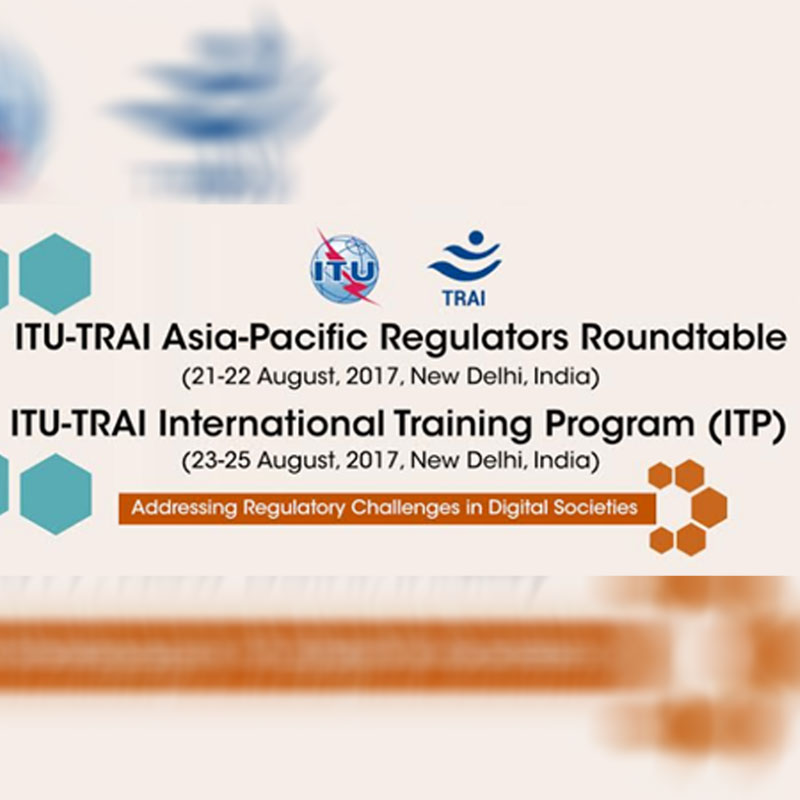
    NEW DELHI: Delegates from 24 countries are participating in a training programme on “Collaborative Regulation for Digital Societies” being hosted by the Telecom Regulatory Authority of India (TRAI).

    Teleom Disputes Settlement and Appellate Tribunal Chairman Justice Shiva Kirti Singh inaugurated the programme organized between 23 and 25 August 2017 by TRAI jointly with International Telecommunication Union (ITU) on ‘Collaborative regulation for digital societies.’

    The delegates are particularly from the Asia-Pacific region. Besides, this training programme is being attended by large number of domestic participants representing various stakeholders such as government departments, telecom service providers, telecom vendors, academia etc.

    This ITU-TRAI International Training Programme 2017 aims to build skills to address the policy and regulatory issues in the emerging era beyond convergence of telecommunications and information technology. The Programme will highlight the building blocks required to ensure that regulatory measures remain relevant and appropriate for the new environment. It will bring together international experiences in this area with a focus on India’s experiences and the lessons learnt.

    The theme of this training programme is extremely relevant for all the economies worldwide. Collaborative regulation in ICT sector has various facets. In the converged ICT era, the physical boundaries would cease to exist. The seamless communication would transcend across geographical boundaries and therefore requires fine tuning of existing regulations. The Cloud computing technologies has made revolutionary trends in data storage and management.  The need for developing ecosystems for launch of new services has become inevitable.   With ever increasing subscriber base, there is a great need for optimum utilization of available spectrum through harmonization. With technological development, the task of harmonization of spectrum has become much easier and has become important.

    Cross sectoral collaboration is one of the most important aspects of regulating ICT sector. Governments should aim to improve coordination across regulators for the ultimate benefit of consumers and for coherent and consistent economic regulations across different sectors. Collaboration of regulators with researchers and academicians is another aspect of ICT regulations. Collaborative regulations can result in significant benefits for competition and the economy as a whole if working synergies are created through ongoing dialogue and regulatory cooperation.

    This three day training programme has been divided into 12 sessions and each session will be dealing with pertinent issues related to regulation of digital societies. The sessions will deal with topics such as ‘Regulatory approaches for smart societies’, ‘Converged Licensing Regime’, ‘Spectrum Planning and Management – Strategies for SG’, ‘Building Trust in Digital World’,  ‘Internet  of Things (loT)/Machine  to Machine (M2M) Communications’ etc. This training programme will assist in building institutional capacity by sharing experiences and successful case studies for potential collaboration in all these areas.

  • LCOs to get unique TRAI number to ensure fair deals, says advisor Gupta

    NEW DELHI: Despite claims of major achievements in all parts of the country in digital addressable system, a meet held recently in Chandigarh presented a dismal picture with many local cable operators complaining that the switching off of analogue had badly affected their business.

    In the seminar organised by the Telecom Disputes Settlement Appellate Tribunal, even Tribunal chairman Justice Shiva Kirti Singh said the operators should approach the government for solutions.

    Information and broadcasting ministry joint secretary (broadcasting) Manoj Kumar Pingua talked about the achievements of digitisation and referred to the transparency leading to greater tax collections by the centre as well as state governments.

    The seminar, on ‘Digitisation: Achievements Issues and the Way Forward’, was attended by the judges of different courts, lawyers, multi-system operators broadcasters and LCOs.

    Telecom Regulatory Authority of India principal advisor S K Gupta said there was a plan to issue a unique number to each LCO and keep a track of his Interconnection Agreements to ensure he gets a fair deal.

    One LCO from the Chamba in Himachal Pradesh said that he had lost all his business because broadcasters had switched off analogue signals and multisystem operators were not prepared to supply him digital signals.

    Another LCO from Punjab said his investments of Rs seven million in a HITS headend and STBs have gone waste as Jain HITS has closed its business. The government has made no policy to compensate cable operators in such conditions. He said that HITS was not working in the present circumstances as broadcasters create hurdles in providing content.

    Earlier, Zee HITS had also closed down. Now only NeXT Digital of Hindujas is operating but he said LCOs were losing faith in the technology.

    Another LCO said MSOs were not giving signed copy of the Interconnection Agreement to LCOs and exploited them every now and then by raising subscriptions. He said there is no security in the business, and since all regulations are challenged in the courts, even the regulator is unable to help.

    While GST had been cleared and Cable and DTH services will attract 18% tax and STBs and other digital equipment will be taxed at 28%, the speakers said they were worried about the negative impact of GST on the business as neither ‘Make in India’ will succeed nor the dream of a ‘Digital India’ will be fulfilled.

  • PIL against Sahara ad reportedly denigrating Sebi

    PIL against Sahara ad reportedly denigrating Sebi

    NEW DELHI: The Lucknow bench of the Allahabad High Court is expected to hear later this week a public interest litigation alleging that a full page advertisement dated 17 March 2013 by Sahara India Parivar and Subrata Roy Sahara are against the provisions of law.


    The PIL filed by IPS officer Amitabh Thakur and social activist Nutan Thakur says that a private person and a private organisation have openly denigrated and accused Sebi, which is a statutory body established to safeguard the interests of investors and to act as the market regulator.


    The ad has also criticised Justice B N Agarwal’s conduct while both Sebi and Justice Agarwal are only performing their official duty. The matter is still sub-judice before the Supreme Court and hence these people could have presented their grievance there.


    This act of criticising Sebi through an ad prima-facie is alleged to be a criminal misconduct under sections 186 and 189 IPC and provisions of Companies Act 1956.


    The petitioners have sought a complete ban on all advertisements where any constitutional or statutory body is criticised. They have also asked for enquiry into the issue and necessary subsequent legal actions against Sahara India parivar and Subrata Roy.


    The PIL is expected to be heard on 22 March before the Bench of Chief Justice Shiva Kirti Singh and Justice D K Arora.