Tag: Shastri Bhavan

  • MIB burning midnight oil to find ways to counter battery of High Court orders staying DAS

    MIB burning midnight oil to find ways to counter battery of High Court orders staying DAS

    NEW DELHI: Considering the odds it is facing from various High Courts all over the country for extending the deadline for implementing Phase III of Digital Addressable System (DAS), the Ministry of Information and Broadcasting (MIB) has to find a way to get even justice for the ultimate stakeholder — the consumer.


    Perhaps because of that, the last few days have been very busy in the corridors of fifth and sixth floors of Shastri Bhavan in the capital, which houses the MIB, with officials holding several meetings to find a way to stop the snowballing of the orders that commenced from Hyderabad and found a boost in the arguments in the Bombay High Court based on the Kusum Ingots case of 2004, which encouraged multi system operators (MSOs) and local cable operators (LCOs) in other states.


    At present, the implementation remains stayed for varying periods in the states of Andhra Pradesh, Assam, Maharashtra, Orissa, Sikkim, and Telangana, apart from Tamil Nadu where prolonged legal cases have been pending since Phase I. A petition has already been filed in the Karnataka High Court and is listed for 8 January.


    Ministry sources confirmed to Indiantelevision.com that meetings had been held with legal experts and particularly with Government counsel.


    There was also general consensus on filing a petition by the Government in the Supreme Court, particularly as the apex court had on an earlier occasion relating to the Cable Television Networks (Regulation) Act 1995 and orders issued thereunder that High Courts have to be cautious when giving orders on matters relating to policy.  


    Government legal experts advised that an appeal could be filed against any of the High Court orders in the Supreme Court and the apex court could be asked to transfer all linked matters to Delhi to be heard together.


    However, it needs to be seen whether this will be in the form of a writ petition or an appeal against the various High Courts – a decision left to a battery of legal experts.


    MSOs said, however, that this would impose a lot of financial burden on them as they could ill-afford to hire counsel in the Supreme Court. 


    Even as the Ministry would obey the directives of the various High Courts, which had extended the DAS deadline by various periods ranging between eight to 12 weeks, it would prepare to oppose the decisions.


    A senior Ministry official said that even as the Ministry was waiting to see all the High Court orders, it was working on how plans to thwart the implementation of Phase III could be prevented – if necessary through legislative processes.


    The official also expressed the view that the cases would in fact benefit the direct to home (DTH) and Headend In The Sky (HITS) players and would affect the last mile operator (LMO).


    The sources said they had evidence to show seeding of set top boxes (STBs) to the extent of 76 per cent as revealed in the 13th Task Force meeting on 30 December. 


    Meanwhile, legal opinion is divided on whether the Kusum Ingots case, which was referred to in the Bombay High Court could be used by a High Court to direct a pan-India stay.


    The broadcasters and channel distributors are united on one view: the government should not give any extension on its own, as that would lead to a further delay in not just the Phase III and Phase IV (slated for December 2016) but also pockets of Phase I and Phase II, which have still not implemented digital addressable systems.


    It is also learnt that both broadcasters on the one hand and the channel distributors and major MSOs on the other, are pressing the government to move the apex court to get a single ruling instead of different High Court orders.


    However, it was admitted by the stakeholders that there was very little progress as far as indigenous STBs are concerned with just one or two players making local boxes despite the ‘Make in India’ campaign, and the government had to be proactive in this regard.


    The attempt would be to prevent the High Courts from staying implementation of Phase III under which analogue signals were to be switched off after midnight on 31 December, 2015.


    One representative of a broadcaster said switching back to analogue on getting a High Court stay did not cause any technical difficulty, but it raised problems relating to accounts and agreements already agreed upon.


    Be that as it may, the consumer who has already spent money on acquiring STBs hopes his efforts will not go waste in haste.

  • Two open house meetings every month to speed channel licence clearance

    Two open house meetings every month to speed channel licence clearance

    NEW DELHI: The new government at the centre certainly seems to be taking the issue of channel licence clearance very seriously. To clear the long list of pending applications for new TV channels, the Information and Broadcasting (I&B) Ministry has decided to hold open house meeting with stakeholders twice a month, as against the earlier practice of one meeting a month.


    The next meeting is slated for 18 July in Shastri Bhavan, the main office of the Ministry. Stakeholders have been asked to send, in advance, the information they require, so that these can be supplied to them at the meeting.


    It is understood that almost a hundred applications are pending for clearance at various stages either with the I&B Ministry, Home Ministry or the Department of Telecom.


    Furthermore, the coming into force of the code of conduct in April this year prevented clearance of any new channels and therefore the number of channels which was 795 at the end of May remained the same at the end of June.


    A large number of new applications including those by Media Content and Communications Services (MCCS) that runs the ABP group of channels, Star India for its second Tamil channel, and Epic TV are pending.


    The only change was that the number of news and current affairs channels went up by two to 395 and the number of non news and current affairs channels came down by the same number to 400.


    The first four months of 2014 saw licences being given to nine channels including AXN HD and SET HD.


    The Ministry also placed on its website the names of the companies which own these channels, the language, and the date when permission was granted. 

  • Biometric systems to check attendance in I&B Ministry, quotations invited

    Biometric systems to check attendance in I&B Ministry, quotations invited

    NEW DELHI: A few days after Information and Broadcasting Minister Prakash Javadekar had forced around 100 officers of the Ministry to take leave for the day for coming late to office, the Ministry has decided to install biometric device for Attendance System.


    The Ministry has called for quotations for such systems (through finger print/face detection/ smart card) with in-built time and attendance software in the Ministry in Shastri Bhavan, New Delhi.


    The quotations have to be filed by the end of this month and will be opened the same day in the presence of those who bid.


    The bid has to be furnished in a two-bid system: technical bid and financial bid. Details of the contents of these bids have been furnished on the website mib.nic.in.


    The financial bid of only those firms will be considered which qualify for the technical bid. 


  • DD emulates Javadekar, conducts surprise check

    DD emulates Javadekar, conducts surprise check

    NEW DELHI: Just two days after a surprise check by Information and Broadcasting Minister Prakash Javadekar in Shastri Bhavan, a similar exercise has been undertaken to ensure punctuality in Doordarshan.


    It is learnt that Javadekar who generally spends the first half in the Environment Ministry office in Pariyavaran Bhavan found around 100 officers and other staff missing when he turned up in the Information and Broadcasting Ministry early in the morning.


    Taking a cue from this, four Deputy Director General level officers at Doordarshan have been asked to keep a check on the punctuality of officers.


    Consequently, a surprise check was conducted in Doordarshan Bhawan on Thursday from 9:30 am onwards to find out the defaulters/late comers.


    Doordarshan has already issued a circular to its employees to ensure punctuality.


    During the surprise check, a very few late comers were found, and DD sources say that the employees appeared to have taken the cue from the surprise check done by Javadekar.


    However Doordarshan is initiating action against all those who will be reported late, with more such surprise checks may be done in the future.

  • Spirit of inquiry amongst media must not morph into a campaign of calumny, cautions PM

    Spirit of inquiry amongst media must not morph into a campaign of calumny, cautions PM

    NEW DELHI: Prime Minister Manmohan Singh on Saturday called for caution as mediapersons executing their responsibilities in a vibrant democracy which revels in free enquiry and quest for answers.


    He said the media industry had a special role in assessing, tackling and overcoming the challenges that two decades of socio-economic change have brought about. “But a spirit of inquiry must not morph into a campaign of calumny. A witch-hunt is no substitute for investigative journalism. And personal prejudices must not replace the public good.”


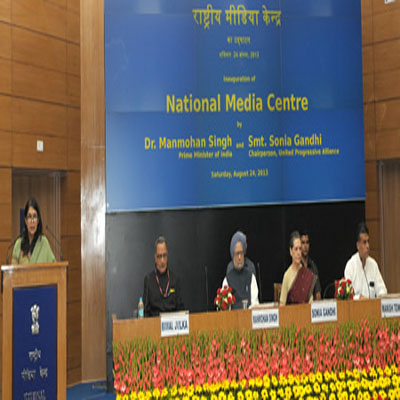
    Dr Singh was speaking after he and UPA Chairperson Sonia Gandhi inaugurated the National Media Centre in the capital this morning. Information and Broadcasting Minister Manish Tewari, I&B Secretary Bimal Julka, and Press Information Bureau Principal Director General Neelam Kapoor were also present.


    Singh said “It is a reality that journalism cannot be divorced from the business of which it is a part. The responsibilities of a media organization are not limited to the viewers and readers alone. The companies also have an obligation to their investors and shareholders. The tussle between bottom-lines and headlines is a fact of life for them. But this should not result in a situation where media organizations lose sight of their primary directive, which is to hold up a mirror to society and help provide a corrective. ”


    He said “This Centre showcases our ability to keep pace with similar state-of-the-art facilities across the world. It symbolizes the vibrant mood of the existing media landscape in our country. As a ‘Communication Hub’ and a ‘Single Window’ facility, I am sure it will fulfill the needs and requirements of our media fraternity, many of whom are present here today.”


    In her address, Gandhi said “The government and the media have the shared interest in disseminating programmes, policies, decisions and information. This is where an institution such as the National Press Centre assumes importance. I hope that it will represent a partnership in which both sides will be able to discharge their designated responsibilities.”  


    “In any society undergoing dramatic and rapid transformation there is constant need to renew and rebuild. This facility represents that evolution. I hope very much that it will become an effective nerve centre and a duct and an information bridge between the Government, the Media and the People,” she added.


    “I want to be quite clear we don’t favor propaganda or publicity campaign simply in order to score points for the government, but the people have a right to know their legal and other entitlements. They have a right to information. They have a right to be able to make informed decisions. Only an aware and conscious citizenry can be expected to make this system work well and hold governments and political parties to account.”


    Referring to the National Media Centre, Gandhi said “This beautiful building is not just brick and mortar. It is up to you media professionals, officials of Information and Broadcasting Ministry and others who will inhabit it to infuse life into it by making it an instrument to serve the people and empower them.”


    The Centre at 7E Raisina Marg in the proximity of Shastri Bhavan which presently houses the Press Information Bureau was inaugurated 21 years after it was first conceptualized during the 8th five year plan (1992-97).


    Tewari said: “We live in an era of an information overload. The media landscape has transformed exponentially over the past two decades. This transformation has brought its own set of challenges to the media industry. India today mirrors the world in global cross media consumption patterns.”


    He said a ‘very unfortunate collateral of this epoch making change’ is the print industry globally. It was distressing to learn that iconic newspapers and magazines around the world were ceasing to print. However, India appeared to have changed this trend. The Indian newspaper market will be the only one to grow at a double-digit CAGR [Compounded Annual Growth Rate] of 10 per cent and would emerge as the world’s sixth-largest newspaper market by 2017 as per industry reports on media and entertainment. The regional and vernacular print sector is growing on the back of rising literacy and low print media penetration as well as the heightened interest of advertisers wanting to leverage these markets.


    Tewari said according to industry sources, print has a combined market penetration of a ball park of 14 per cent. Thus, the print industry has the potential to expand its footprint and readership across the national canvas. This sector thus would be able to weather the shifting sands of technology at least in the Indian context.


    The Indian broadcasting sector had grown from one channel in 1991 to 852 at the last count.  After statutory rationalization the number now stood at 795 odd channels, he added. While this had brought about plurality, it had resulted in market fragmentation as well.


    “There are 15.4 crore TV households in India. Unfortunately the news and current affairs genre makes up only seven per cent of the total television viewership, according to TAM CS4+ all India weekly average for 2012. The remaining 93 per cent of this universe is occupied by general entrainment channels despite there being 395 odd news and current affairs channels.


    He said this generated hope that there is an exponential potential for growth, provided the news broadcasters and Multi System Operators (MSO’s) are prepared to re-imagine their content and carriage paradigms respectively.


    In both the print and television genres, he said the revenue model remains heavily dependent on advertising. As the advertisement cap requires a migration path synchronous with the roll out of digitization For the news broadcasting industry, Tewari hoped that the Telecom Regulatory Authority of India would re-consider its deadline.


    To give consumers the benefit of better quality of service and correct the skewed revenue models in the broadcasting sector government launched a massive digitization exercise in 2012.  With 10 million set top boxes seeded in Phase–I, another 20 million in Phase–II and yet another 80 million scheduled for Phase–III & IV, by the end of 2014 no one in the Broadcasting Sector can really say that bottom-lines and balance sheets in August 2013 are not looking better than in October, 2012.  


    The MSME sector must also endeavour to leverage this unique business opportunity and convert it into the India digitization story even in manufacturing terms.  


    India had 86.7 crore mobile phones, 12.4 crore Internet users with an expected growth up to 37 crore by 2017, eight crore people on Facebook and 1.8 crore on Twitter.


    The government had recently taken a decision to create a New Media Wing in the Ministry to have an institutional presence in this virtual civilization.


    He said the radio, till a decade back considered, was a casualty of the tectonic technological shifts but now stood poised on the threshold of a new wave. High mobile penetration and cheap call rates in our country had brought this renaissance into replay.


    The film industry had completed a century of existence. This industry had grown but still had tremendous potential. As per an industry estimate, about 14 million Indians go to the movies everyday. As per another report, the film industry is valued at Rs 112.4 billion [$1.741 billion], and is estimated to grow to about Rs 193.3 billion [$2.994 billion] by 2017, a compound annual growth rate (C.A.G.R.) of about 11.5 per cent. The regional film industry is a steady contributor to this growth process.


    The media sector had grown by a CAGR of over nine per cent between 2007-2012 and was projected to grow at 15 per cent between 2012 and 2017, Tewari added.


    But there were some paradoxes that all stakeholders in this sector must try and collectively resolve to find the elusive golden mean. These included flawed Revenue Models qua Questionable Revenue Generation practices; TRPs qua truth; Media Trials qua a Fair Judicial Trail guaranteed by article 21 of the Constitution; and anonymity masquerading as privacy in the new media space – the spectre of the ‘hidden’ people, apart from Last mile neutrality among carriage providers so that content providers get a level playing field and are able to reap the benefits of convergence.


    The National Media Centre (NMC) was initially conceptualized by the Press Information Bureau in 1989 to facilitate greater interaction between the Government and the media with a state-of- the-art equipped media centre. The Centre has been planned on the model of media centres in some of the capitals of the world such as Washington and Tokyo. It will have offices of the PIB as well as special facilities for the media to enable the Government to interact closely with the media.


    The Centre has a Press Conference Hall for 283 media persons, a briefing room for about 60 persons, 24 Work stations for the media, a library, media lounge and cafeteria. The press conference hall and media lounge are Wi-Fi enabled.


    Major Highlights:

    World Class Media Center, Ground + 4 Floors + 2 basements, Press Conference Hall with seating capacity for 283 persons, Media Lounge – Work area facilities for media personnel, Committee Room with video conferencing facilities, Library, Cafeteria, IT and AV Infrastructure in NMC.


    Facilities provided:

    Optic fibre internet backbone with redundancy, Mini Data Centre for application development and hosting, Webcast, including live webcast, Video feed to TV channels outside the building, Network with redundancy and expandability to 500 nodes, IT facilities to media persons in work area/Lounge, Internet Telephony, AV Video Wall.·        


    The NMC has been constructed by the National Buildings Construction Corporation (NBCC) over a period of three years with a total covered area of 13867 sq m. The plot size is 7787.46 sq m (1.95 acres).

  • News Channels: Sensation-fatigue, government’s attitude and regional channels will decide future content

    So, as one captain of the industry says, if the advertisers stay with the credible, then some channels will die out and TAM would have to ask itself serious questions, or “there will be no place for it in the Indian TV news market”.

    Lastly, come to the Content Code. If anyone feels that the government will wait and wait and not act till the news channels give in their draft, slated for this month end (but one never knows), then it would be foolishness.

    This is a precarious position for the ruling UPA and with Gujarat and Himachal Pradesh going the BJP way, it will be even more circumspect in dealing with the media. And yet, it is after all not the parties in power but the bureaucrats who bring out the pending issues in front of successive new ministers and make them do the things they want.

    Many bureaucrats –not necessarily just the ones in Shastri Bhavan – have suffered due to stings and for many of them, controlling content is important. So electoral concerns may have made Prime Minsiter Manmohan Singh ask I&B minister Priyaranjan Dasmunsi to soft pedal for the moment, but the government will ultimately set up the regulator and the code will be in place. At least, that is what Shastri Bhavan insiders have given us to understand.

    In the year to come, content will be shaped by a few things, of which the first will be the government’s attitude to it and that will largely be patterned on how the news channels behave vis-?-vis the government. They can do some serious work on their own Code and the chances are that the government will accept it, just as it had adopted the ASCI code for advertisement. However, if the attitude of the NBA is to play footsie with the government, they could well kill their own chances of governing themselves, which is the best thing one can wish for.

    The second deciding factor would be what some see as fatigue setting in on sensationalism, which even Naqvi has warned about. The channels themselves are running out of sensational ideas that are new and more importantly, that would last, for all the experiments have at last died, and the pace of mortality of newer ideas is increasing.

    The third will be the government’s position on TAM, and it has warned TAM when the CEO failed to turn up for a Parliamentary Committee meeting in Mumbai at the end of this year. If the government – and in all probability it will, because that is a way of controlling content without talking of the much hated Code imposes certain modes of operation and measures TAM must take for rating channels, it will have a direct impact on content.

    Last but not least, and though it will take some time, is the massive oncoming growth of regional channels and their own niche content that would drive the mainstream channels to do a hard rethink.

    For the moment, the proponents of serious journalism are assured, with IBN 7 seeking relief in the fact that they did touch 14 per cent and are doing better business than rival India TV; NDTV seeing market assurance from the fact of its grossing the second tallest figures, and CNN-IBN as well as NDTV going into the diversification drive emphasising that the serious guys are not about to fall by the wayside.