Tag: Shashank Srivastava

  • Why ZEE Kannada’s Sa Re Ga Ma Pa is a hit with audience and advertisers?

    Why ZEE Kannada’s Sa Re Ga Ma Pa is a hit with audience and advertisers?

    Mumbai: ZEE Kannada, the number one Kannada entertainment channel in the country seems to be getting it all right with its content and business strategy in recent times. The channel, which crossed  the significant milestone of completing 250 weeks of leadership in the Karnataka market continues to enjoy the acceptance and loyalty of its audience and advertisers alike.

    Known for its relentless efforts to craft the best fiction and grand non-fiction shows, all of the channel’s newest launches like Amruthadhaare, Seetha Rama and Bharjari Bachelors have gone on to become slot leaders and propelling the leader channel to increase the gap between them and competition. Its newest launch Sa Re Ga Ma Pa Season 20 has already got the audience rooting for their favourite singers.

    For the uninitiated, ZEE’s flagship show Sa Re Ga Ma Pa has been the longest-running reality show on ZEE Kannada completing 19 seasons, successfully establishing itself as one of the best singing platforms the country has witnessed. With the new season, the channel for the first time has opened the platform to singing talents from across the globe and has already launched to become the number one Kannada Reality Show.

    Prior to the launch, the ZEE Kannada team spent an entire month searching for the best singers in the age group of 14 and 60 years across the state and the country, and among Kannadiga NRIs between the age group was six to 60 years. Twenty precious and talented candidates were hand-picked from the record-breaking number of passionate contenders who attended the mega auditions, and they are now ready to cast a spell on the audience this season.

    The show boasts of a stellar judges panel comprising of iconic composer Naadabramha Hamsalekha as the Mahaguru along with singer Vijay Prakash and composer Arjun Janya with Ansuhree taking on the anchoring duties.

    Talking about the show’s legacy and the love of the audience ZEE Kannada & ZEE Marathi chief content officer Raghavendra Hunsur said “Sa Re Ga Ma Pa is our channel’s pride, and it has experienced substantial growth in its following over the years. What sets us apart is the fact that we have retained the soul of music as an art within the show and our judges panel plays a big role in it which the audience love. The show is rooted in its values while being presented with unmatchable grandeur.  This season going global is in line with our commitment to offer something new in each of our shows which I’m sure will add to the excitement of the audience.”

    What makes the show a big hit among the advertisers?  

    According to ZEEL chief growth officer Ashish Sehgal, “ZEE Network’s reality shows have a unique ability to captivate the diverse audiences in every market that they are launched, due to our profound expertise in creating content based on the cultural understanding. Leading the pack is the pioneer of music reality shows in India, ZEE’s Sa Re Ga Ma Pa – an iconic brand and one of the most successful reality shows of India for more than two decades. The story is similar for our top channel from South, where ZEE Kannada’s Sa Re Ga Ma Pa has delivered blockbuster content for 19 seasons, discovered unique talents and created the singing stars of the future. With the launch of the 20th season this month, we have kept the promise of adding more depth and unique elements to the show to keep our viewers hooked. Complementing the popularity of the show, we have got a phenomenal response from the advertisers this season, with substantial interest from the retail market. I whole-heartedly welcome all the 14 sponsors of the show and I am extremely delighted to continue our partnership with Maruti Suzuki and White Gold, who joins us as the Co-Title sponsors. Each of the sponsors will get innovative brand engagement opportunities in every phase of the show to bring out their brands’ core propositions effortlessly and leave a long-lasting impression among the viewers in this festive season. I am certain that this new season of Sa Re Ga Ma Pa will inspire millions of our Kannada viewers to sing along with the talented contestants and generate massive value for our revered partners.”

    ZEEL chief sales officer – South cluster VS Raghavan agrees with Ashish. He added, “Being a market leader for over 250 weeks, ZEE Kannada has always been the first choice platform for brands targeting Kannada heartland to build reach, TOMA or drive consideration. Sa Re Ga Ma Pa, being our flagship has always been investors’ preferred destination given the distinct set of viewers it caters to, enabling brands achieve sharper connections with consumers be it for new launches, build awareness or for better engagement. In our 20th season, we have  raised our bar a notch higher by taking it global and onboarded many great brands this season with as many as 14 sponsors as part of the show, including several home grown local brands, which testify the trust and aspirations behind a talent show like Sa Re Ga Ma Pa.”

    Maruti Suzuki India Ltd Sr executive officer, marketing & sales Shashank Srivastava shared his thoughts on the association saying “On behalf of Maruti Suzuki, I’d like to extend my best wishes to another year of Sa Re Ga Ma Pa on ZEE Kannada. It is exciting for all of us to partner again with the show in its 20th Season which promotes and celebrates the best of Kannada singing talents from India and across the globe.  This partnership helps us reach out to our relevant audiences in the most engaging manner making the association truly symbolic.”

    “At Amrith Noni company, we firmly believe in partnering with properties that align with our values and contribute positively to society and ZEE Kannada’s shows have been doing exactly that in the Karnataka market.  We have been closely associated with many of the channel’s marquee shows that have a strong following among our core consumers.  Our association with ZEE Kannada over the years has given us the opportunity to make a real difference in the lives of people, our products are aimed at making life easy and so are their shows and we see this as a harmonious marriage that go on for longer” said Amrith Noni CEO Narayan N.

    White Gold managing director Babu C J who is associating with the show for the first time said, “We are delighted to announce our collaboration with ZEE Kannada’s Sa Re Ga Ma Pa. White Gold aims to transform the unorganized gold-buying market in India with its organized work process and 100% transparency. We have been serving people who wanted to sell gold by providing them with liquidity for their emergency money requirements and offering a fair value for their gold. Sa Re Ga Ma Pa embarks on a parallel journey where talent converges with opportunity and has scripted many underdog-winning stories. This collaboration further enhances our brand’s positioning within the pertinent audience and together we aspire to deliver an exceptional season that resonates with all.”

    Sa Re Ga Ma Pa Season S20 airs every Saturday and Sunday at 7.30 pm, on ZEE Kannada and ZEE Kannada HD.
  • Expert speak: Traditional brands taking the unconventional, new-age route

    Expert speak: Traditional brands taking the unconventional, new-age route

    Mumbai: Technology and its advancement have been put to effective use across various domains. Much to everyone’s surprise, legacy and traditional brands are not lagging behind either in the optimal usage of new-age technology to communicate and engage with their cohort. From AR, VR to metaverse, chatbots, NFTs – brands have taken a sip of these and many more to make their presence felt and lure their target audience, and continue to do so. Considering that, there is no looking back ever since technological advancements have made inroads into the hearts of traditional brands; there is only one way to move with it – upwards.

    Indiantelevision.com spoke to some legacy brands that have made their mark in the country with their communication strategy and also illustrated their boldness in experimenting largely with new-age technology while putting together their advertising and marketing plans.

    The transition for legacy brands: From traditional to new-age technology-based innovative solutions

    When it comes to communication plans, the obvious question is how have legacy brands transformed from simply using traditional media to using cutting-edge new-age technology-based solutions which are innovative?

    One of the largest advertisers in the snacks and food category and also one of the first to experiment with technology-based innovations, was Mondelez, for its much-loved brand Cadbury. Mondelez India vice president – marketing Nitin Saini points out, “Traditional brands have historically relied heavily on TV advertising and the approach has also been to create a TVC first. However, the changing consumer landscape means that you can no longer rely on reach from TV alone. Today there are 700mn + internet users in the country and 350 Mn+ online shoppers. This shows that consumers not only have a choice to purchase off online platforms, but they can also research and learn about brands online. In fact, Digital has overtaken TV in terms of Ad Expenditure as more and more advertisers are coming on the digital platforms with an omni-channel approach. Large and evolved advertisers are putting more than 50 per cent of their media dollars on digital which is growing at a much more rapid pace. The other point to note is that consumer journeys are not linear and hence presence offline and online becomes imperative.”

    “Brands are embracing social media to connect better with their consumers through evolved targeted and personalized communication. Content marketing and influencer partnerships are moving brands into the creator economy which involves creating valuable, relevant, and consistent content to attract and engage their target audience. New age practices like Generative AI are helping brands create more frictionless communication that resonates with the consumer,” he adds.

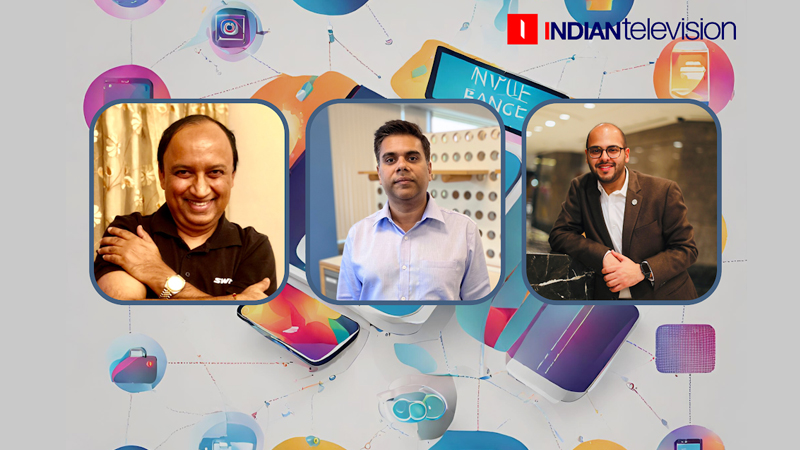
    Maruti Suzuki executive director – marketing Shashank Srivastava understands that legacy and traditional brands have seen a major transition in terms of communication in recent years. “They have reduced the dependence on traditional media, such as print and television, and have embraced new-age technology-based innovative solutions like digital media (social, OTT, mobile & DTH), and cinema. This is due to the changing demographics of consumers and increasing demand for personalized experiences.”

    According to him, some of the ways in which new-age technology has been adopted in communication in recent years are:

    a.    Use of Customer Data Platforms (CDP) for personalized experiences: To cater to increasing demand for personalized content and experiences, CDP platforms help create unified customer view (SVOC), improved customer experience providing relevant and customized information and offers and helps improve marketing ROI by identifying and optimizing the media channels most effective for generating brand KPIs and sales.

    b.    Tailored media channels to reach new age consumers (Gen Z): Social media platforms like Facebook, Twitter and Instagram are now essential tools for brands to connect with new age Gen Z consumers. Video on demand (VOD) has sprung up in a big way and consumers today are increasingly watching content on OTT platforms. Brands are now creating media campaigns not only planning on TV but starting with TV+OTT as a base for media plans. This helps cater to incremental reach of OTT over TV.

    c.    Email, Mobile & WhatsApp marketing: Tools like WhatsApp and email are being leveraged to engage with consumers in more personalized and cost-effective way targeting consumers for both upper and lower funnel marketing activities like newsletters, promotional offers, DIY guides and other such updates.

    d.    Use of Innovative Cinema & OOH: Today brands leverage tools like 3D projection in cinema halls and Anamorphic displays in Outdoor campaigns to create mesmerizing experiences for their consumers.  

    MG Motor India head of marketing Udit Malhotra states that in the ever-evolving landscape of consumer behaviour, organisations are recognizing imperative ways to keep up pace with shifting consumer preferences in order to secure a competitive edge within their respective industries. “As businesses have transformed from traditional to technologically advanced platforms, AI stands out at the pivot of key marketing communication. MG Motor India Celebrates 100 Years of Innovation and Customer-Centricity and our latest ad campaign has reincarnated Cecil Kimber, who is talking about MG’s vision for India. These advanced tools like MG’s Mobile App, NFT and Metaverse are enabling customers to understand a brand with refreshed outlook. Through the digital, authentic, and relatable content MG tries to meet customer needs and drive traction to the brand. The momentum behind adopting such solutions is rapidly increasing and is poised to become the standard practice in the foreseeable future.”

    Opening the door to modern technology and tech-based innovations in communication

    What has made traditional brands such as these, open their hearts and minds to modern technology and tech-based innovations in their communication strategy?

    Srivastava says, “In today’s world, tech-based innovations are helping marketeers like us tailor made our communication, making it more relevant and useful for our TG.”

    He feels that these innovations are being mandated due to the following reasons:

    a.    Increasing media proliferation and consumption of different mediums

    b.    Need for contextual and personalized targeting.

    c.    Changing consumer demographics (rise of Gen Z consumers) where appointment viewership is on the rise.

    d.    Increasing Media ROI: Brands like us are increasingly being conscious and choosing to optimize our media mix thus staying both relevant and competitive in today’s business scenario.

    e.    Better creative optimisation: Now one creative for all the mediums does not work and both creative optimization and placements basis the media tools are required.

    Malhotra fathoms that in today’s world, modern technology enables brands to get unmatched global reach, facilitating heightened engagement. “This engagement, in turn, empowers brands to craft content of immense value, delivering education, entertainment, and solutions tailored precisely to their target audience’s needs. MG paves the way for personalized communication, enabling it to swiftly respond to customer inquiries and issues through MG Mobile Apps and chatbots. With the dynamic customer behaviour and a surge in connected car technologies, brands have the incredible opportunity to connect with consumers no matter where they are. This connection is further strengthened by real-time interactions through social media, instant messaging, and chatbots.”

    He goes on, “Moreover, the proliferation of smartphone users and the seamless integration of cutting-edge technologies, such as artificial intelligence, have prompted MG to introduce state-of-the-art innovations like MG AViRA and MG Metaverse. These advancements signify MG’s commitment to staying at the forefront of innovation and meeting the evolving needs of our customers. Ultimately, this contributes to the development of stronger and more meaningful customer relationships. KYC (Know your customer) is the center piece of our communication strategy, any initiative that supports us in this endeavour is always welcome. With the help of these innovations our latest campaign of “EVing is Living” is centred around the idea behind the overarching thought is manifested into “EVing is Exploring/Thrilling/Saving/Easy charging,” focusing on the myths about EVs, reassuring those who are indecisive about transitioning to EVs, while also alleviating any uncertainties they may hold regarding EV cars.”

    Saini reveals, “At Mondelez, we believe very strongly in being where the consumer is. The changing consumer behavior and landscape has made us also evolve our strategies to be more open to modern technology and tech-based innovation. As legacy brands we face competition not only from other traditional players but also from agile, digitally native startups, thus embracing technology allows us to level the playing field, differentiate ourselves, and stay competitive. Technology allows for better understanding of customer preferences and behaviors through data analytics. This, in turn, enables brands to deliver personalized experiences, products, and content, fostering stronger customer relationships. Today most of our campaigns are tech-enabled to create delightful consumer experience. We have increased using own understanding of consumers from our data capital and arrive at consumer insights that can further fuel our brands’ strong equity with consumers.”

    Enthusiastic about experimenting with modern technology

    As a traditional brand, when it comes to modern technology and tech-based innovations, what are they most enthusiastic about experimenting with, in their advertising and marketing strategy? And why?

    Malhotra emphasises that as an auto-Tech brand, innovation has always been a driving force for MG. “These innovations open more avenues to reach out to our customers in a focused manner, it is a source of competitive edge for us. We are always looking for the next big thing, new possibilities keep us excited. MG’s tech-first spirit is evident in its industry-leading initiatives, such as MG Xpert, Epay, MG VPhy NFT, and MGVerse and now our recent AI led 100 year of innovation and Customer-Centricity campaign as well as ZSEV ‘Eving is Living’ has made a profound impact on our marketing outcomes and our customers. It helps us personalize content for individuals and improves creativity to captivate customer mindspace. With this, we hope to embark on a new benchmark and keep up with the dynamic marketing activations, in the automotive realm.”

    “Today the avenues in technology are manifold. There is AR/VR that is becoming a very interesting space and allows consumers to have an immersive experience with brands. There are AI powered chatbots that are answering consumer queries and solving problems in real time and then there is Gen AI which is enabling personalized content creation at scale. All these are very exciting spaces to explore in the near future,” elucidates Saini.

    Srivastava tells,”Big data and analytics are no more a catch phrase but a reality. Augmenting its impact by further using AI is something we are very enthusiastic about. AI is still a relatively new technology, but it is rapidly becoming an essential tool for businesses of all sizes.”

    He concludes by pointing out that as AI continues to evolve, it is likely to have an even greater impact on the future of advertising and marketing. It can be helpful in:

    a.    Personalisation : Basis single view of customer, their past driving and purchase habits , we can personalize advertising campaigns based on interests, demographics, and past purchase history. This may be very helpful for repeat buyers as well as First Time Buyers based on their interests.

    b.    Community Creation : Very impactful in creating a sense of community around our brands, by sharing interesting content, responding to comments and questions, and running contests and giveaways.

    c.    Using AI and VR helps us in creating immersive and interactive experience for our customers. We are already working towards it with launch of ARENAVERSE and NEXAVERSE and use of oculus/ other tools in our dealerships.

    d.    Chatbots powered by AI: We are already progressing in this field with use of our MS Chatbots to help provide customer service, answer questions, and quell queries. Hence, its potential is immense ranging from precise targeting, experiential marketing, and moment marketing to self-serving ads and that makes us very enthusiastic about it.

  • Mruci strengthens India leadership; appoints S Sinha & S Gupta as new members on the board

    Mruci strengthens India leadership; appoints S Sinha & S Gupta as new members on the board

    Mumbai: Media Research Users Council India (Mruci) held its 28th annual general meeting (AGM) on Tuesday via video conferencing.

    Mediabrands CEO – India Shashidhar Sinha and Jagran Prakashan director Shailesh Gupta will continue in their respective roles as chairman and vice chairman of Mruci. 

    The leadership duo was unanimously re-elected at Mruci’s board meeting, which was held shortly after its AGM.

    Maruti Suzuki India’s senior executive director of marketing & sales Shashank Srivastava and TV Today Network group chief marketing officer & COO of consumer revenue Vivek Malhotra have also been added to the board of governors as new members.

    Speaking of his appointment, Sinha stated, “With Covid behind us and the industry back to normal, we should hopefully start work on the new IRS shortly.”

    Adding to this, Gupta commented, “These are interesting times for research. With markets and businesses returning to normalcy, research will play a huge role in enabling business decisions. Mruci is well poised to enter the next phase of research, which will be increasingly powered by better use of technology that will power business, media, and marketing decisions.”

  • IPL brings growth in traffic and advertisers for ESPNcricinfo

    IPL brings growth in traffic and advertisers for ESPNcricinfo

    Mumbai: The second phase of IPL 14 is witnessing a strong surge in consumption on the ESPNcricinfo app with a 30 per cent jump in time spent and 25 per cent growth in unique users on the back of the India-England test series. With over 95 per cent active users, the platform has cricket fans checking out new features like pinning and sharing of live scores, dark mode, and runs forecaster. 

    To further engage the audience the platform had launched its latest product ‘Askcricinfo’ – an AI-powered tool for all cricket stats.  

    “ESPNcricinfo has once again proven its dominance as a leader in well-rounded cricket coverage and in nurturing a strong community for cricket fandom and multiple opportunities for advertising and content partnerships,” said ESPN head of sales for South Asia Akshaya Kolhe. “We have an excellent line-up of traditional and new age brands onboard such as Maruti Suzuki, Intel, HDFC Ergo General Insurance, TVS Tyres, ITC Bingo, Coinswitch Kuber, HDFC Life, ForexTime, GoMechanic, Swiggy, Playerzpot, Upstox, and FreshToHome. We are thankful to our partners for their continued trust in the platform which is a testimony to the strength of our multiple brand partnership opportunities.”

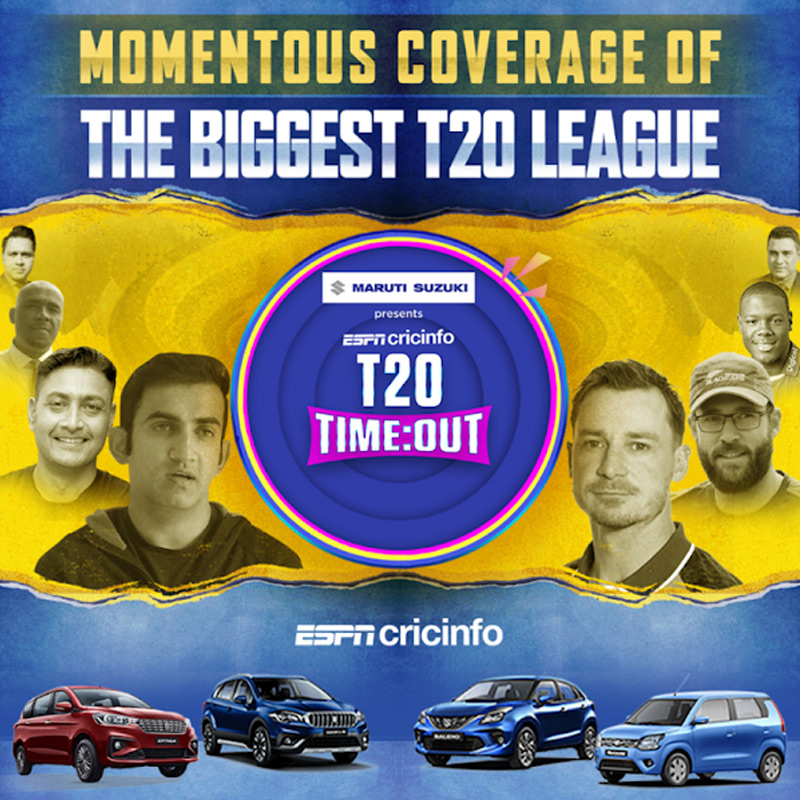
    A mix of live shows, chat rooms, stats-based daily coverage and insights, fun and comedy, and off-field stories in English and Hindi serves fans with the unique perspectives of the game from experts in an interactive format. Most popular among them is the pre, mid, and post-match show “ESPNcricinfo T20 Time:Out,” which has experts such as Carlos Brathwaite, Daniel Vettori, Gautam Gambhir, Dale Steyn, Ian Bishop, Aakash Chopra, and Deep Dasgupta providing a holistic analysis of every match.

    The daily live is being simulcast on the ESPNcricinfo YouTube and Facebook channels to enhance reach and make it available to fans anytime, anywhere, said the platform.

    “Indian customers love two things – cricket and value for their money! As the presenting sponsors on ESPNcricinfo T20 Timeout, we are thrilled to engage cricket fans across the country, throughout the day as they consume match-related content and stories,” stated Maruti Suzuki senior executive director of sales and marketing Shashank Srivastava. “We have the daily post-match segment – Kam Se Kaam Banega Player of the Day centred on the key facet of our current campaign – optimisation or efficiency. These content propositions are a great way to reach out to our customers as they seamlessly integrate our brand communication and help us drive brand love.”

    “We believe it is important for fans to be cautious and aware of what they are purchasing when it comes to a health insurance plan and our partnership will witness fan-favourites come together and educate viewers on the nuances of our Optima Secure Health Insurance,” commented HDFC Ergo General Insurance president of accident and health business Ravi Vishwanath. “IPL is a great communication platform for brands and ESPNCricinfo being the hub of all things cricket provides the opportunity to build awareness through intriguing post-match segments like “Sabse Bada Performer.”

    In addition to the flagship show ESPNcricinfo is also hosting a range of in-depth programmes such as “Newsroom” and debate-led shows like “Runorder” and “Mute Me.”

  • ‘Enormous opportunity’: Brands upbeat about TV advertising in 2021

    ‘Enormous opportunity’: Brands upbeat about TV advertising in 2021

    MUMBAI: It would be safe to conclude from the BARC TV Universe 2020 figures that television remains our favourite form of video entertainment across India. The report, which showed that the number of TV viewers had gone up by more than 50 million to 892 million in the last couple of years, highlights how the power of television and consequently, television advertising remains steadfast and there’s nothing to halt its run! Little wonder then that advertisers are ready to bet big bucks on this old-fashioned medium. As these growing numbers prove, the ‘idiot box’ has proven remarkably resilient in an era of immense disruption, despite the threat of pandemic and emergence of new SVoD platforms.

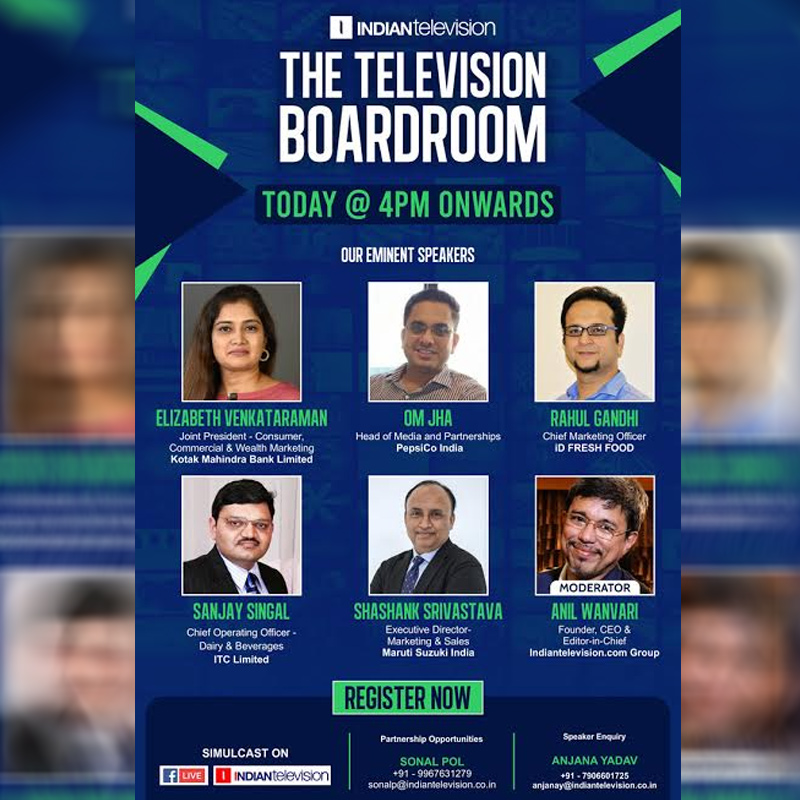
    At the virtual panel discussion The Television Boardroom- organised by Indiantelevision.com Friday, brands across sectors ranging from F&B to automobiles spoke about the whys and hows of TV still taking the biggest slice of the advertising pie. The panel, moderated by Indiantelevision.com's Anil Wanvari  comprised Kotak Mahindra Bank’s Elizabeth Venkataraman, PepsiCo India’s Om Jha, id Fresh Food’s Rahul Gandhi, ITC’s Sanjay Singal and Maruti Suzuki India’s Shashank Srivastava. 

    Brands buoyant about 2021

    While the uncertainty and turmoil caused by the pandemic leading to a virtual halt of film and television shoots in the country was a dampener, marketers remained optimistic about prospects of advertising on television, especially as compared to 2020. The panel tried to explore the mindsets of the TV-viewing consumers and also shared what their expectations from the medium are.

    Kotak’s Venkataraman made note of the unusual consumer viewing behaviour in the year gone by, which needed to be watched carefully to learn whether it sustains going ahead, as we come out of the pandemic. So while all agreed that TV viewership will be higher than 2019, there was a doubt on whether the levels that we see now would continue going ahead, with lockdowns being phased out and work and life calling.

    Srivastava shared his data on projections for TV ad spend in 2021 which are 12 to 13 percent higher than previous year’s. Overall hope and optimism from this year was that it will not be an out and out disruptive year like the year before. With expectations from vaccination drives and/ or herd immunity impact, the world is expected to settle in by mid-2022. Consequently, both viewership and marketer’s spending should improve this year on, was the general opinion.

    Role of branded content & impactful advertising

    Discussions also revolved around the roles branded content and impactful advertising can play in upping the television adex game. ITC’s Singhal spoke about its tie-up with Star during the pandemic called ITC Masterchef, which had insights from five star hotel chefs on how to cook up five-star-like fare, using ingredients already available in one’s kitchen. This got a lot of mileage, so there is definitely a space for branded content, but the need has to be there first, or it could fall flat, he felt.

    TV advertising consists of very short formats of 30-odd-seconds slots, hence to convey a larger picture of what the brand wants to talk about, branded content could help weave a brand story within the content very subtly so that the brand appears organically to the viewer. Brand integration can make it more relatable, without making it look like marketing -oriented.

    Brand association, integration and branded content gives one extra arsenal to marketers to push your product and gain brand recall, while telling the story of the brand, Srivastava said.

    However, contextual or relevance value along with understanding consumer’s needs is crucial for branded content to succeed. So, while TV offers the opportunity, for a brand to make it work is the challenge. That fear needs to be addressed for investment to come in this area. The impact also needs to be felt in numbers for it to be feasible.

    TV stands out for marketers with its impact and reach, and with third party organisations like BARC doing the measurement for the brand on TV modelling analytical capability on television has evolved to a different level. All the impactful advertising in IPL is a case in point – brands associated with IPL 2020 have become household names. Srivastava cited the IPL viewership touching a high of 400 billion viewing minutes in 2020. “There is no debate on the glory and size of TV advertising’s impact” stated Kotak’s Elizabeth.

    Alongside hard data it is also heavily intuitive, while being dependent on the brand objective. Hence there is also a role for a marketer’s gut instinct alongside the measurable impact was agreed overall.

    On looking at sports content beyond cricket

    Nothing beats or even comes close to cricket when it comes to sports in India is unanimously accepted. For television or brands to pick a sport and develop it, the nation must first adopt that sport, opined Jha. He cited instances to prove his point. Sony has been broadcasting football leagues for ages, while Star did a fantastic job with pro-kabaddi but the viewership is nowhere comparable to that of cricket.

    Panelists concurred that brands have been shy of investing in other sports for the same reason, unless it’s a niche region. There were hopes from Football and Kabaddi in this context. Maruti Suzuki is eyeing football as the next massy sport to look forward to in TV advertising, Srivastava shared. Venkataraman deemed Kabaddi as a local sport and also showed promise. There was a feeling that building up hype and hoopla around a sport league could help the sport, as transpired with kabaddi.

    All said and done, TV remains the best pick for a marketer today in India for ROI. And while it may not always be cheap, it is cost efficient for the kind of scale and resilience that the medium offers.

    Also, with television reinventing itself by evolving into smart TVs, which can be connected to the home Wi-Fi or an Amazon firestick, it will continue to remain relevant to consumers and the viewership can only grow from here. And with 90 million households yet to own a TV set in India, according to BARC data, that indicates enormous opportunity for brands in times to come.

  • Why TV remains the preferred mode of advertising for brands

    Why TV remains the preferred mode of advertising for brands

    MUMBAI: Cord-cutting may be a thing in the west, but in India, television still rules the roost when it comes to at-home entertainment. Consequently, there’s a tremendous amount of money spent on TV content and advertising on the medium. However, the Covid2019 pandemic altered this TV-centric state of affairs; now, with changing world scenarios and consumer behaviour, we have already seen and can expect further shifts in the way viewers and advertisers interact with content on TV. 

    Indiantelevision.com organised The Television Boardroom- a virtual panel discussion that explored how to fully understand TV audiences as well as the brand journey through TV today.

    The panel comprised esteemed representatives from the industry – Kotak Mahindra Bank joint president-consumer, commercial & wealth marketing Elizabeth Venkataraman, PepsiCo India head media and partnerships Om Jha, id Fresh Food chief marketing officer Rahul Gandhi, ITC chief operating officer- dairy and beverages Sanjay Singal, Maruti Suzuki India executive director – marketing and sales Shashank Srivastava and Indiantelevision.com's founder, CEO and editor-in-chief Anil Wanvari presided over the session.

    Why TV takes biggest slice of brands’ adex pie

    Maruti Suzuki’s Srivastava took the discussion ahead, sharing the company’s advertising spend – the auto-maker blows 40 per cent of its budget majorly on print, television is a close second at 30 percent and digital is at 25 per cent with the balance being split by radio, OOH and cinema.

    “We are using TV at the top end of the funnel for the reach, brand awareness and brand salience KPIs. Clearly television stands out as a huge medium of importance when it comes to these points,” he added.

    The executive director also shared how the growth in TV audience has been all-encompassing – not just in rural but also urban regions. Citing the example of how e-commerce giant Amazon was the third largest spender in advertising on TV in 2017-18 in India, he asserted that India is proving to be different from other countries when it came to the reach of television.

    Id’s Rahul Gandhi spoke about how the rhetoric question of ‘Who even watches TV?’ should be done away with because “out of the 133-crore people in India a sizeable 100 crore use TV as their primary source of entertainment still”. Thus, “there are many Indias within India with different indicators, which could come as a shock to the naysayers.”

    Also, with television reinventing itself by evolving into Smart TVs, which can be connected to the home wifi or an amazon firestick, it will continue to remain relevant to consumers and the viewership can only grow from here, was Gandhi’s opinion.

    Pepsi’s Jha agreed that “TV remains indispensable to not only consumers but also to marketers” who wish to leverage their brand’s advertising. A large part of marketing that happens in India is centred around TV, for most of the brands and product categories. Speaking about the soft drink brand, Jha said they cater to both spectrums of consumers- from the lowest socio-economic strata to the deepest pockets of our society. And television helps them to reach the last mile of this wide-ranging audience from the two ends of the spectrum. Hence the bulk of the beverage company’s spends would remain in television, he said.

    Where would a brand prefer to advertise on TV

    Recently released BARC stats have shown an upward mobility in TV viewing. The panel theorised that the pandemic seems to have increased the value consciousness of the average Indian. Jha pointed out that “if one had to communicate with 90 per cent of the audience in this country” you will have to go to a mass-heavy medium like television. And that this will only further improve with improving affluence of societies in lower GDP markets like Jharkhand, Bihar and Orissa – which presents a great opportunity for brands like Pepsi for which these are untapped markets.

    Even when it came to high value items like automobiles, Srivastava said that they still prefer television for more strategic brand building, launch and reaching even the interior vernacular regions, while print would be for tactical and lower end of the funnel. All agreed that these stats are highly encouraging, even for high value products. As, not only have the numbers but also the viewing time has spiked.

    “Which is a big vindication of the automaker’s investment of 300 crores currently in television- of which GEC takes up 100-120 crores,” Shashank shared, referring to the IPL viewership touching a high of 400 billion viewing minutes.

    Kotak’s Venkataraman made note of the unusual consumer viewing behaviour in the year gone by, which needed to be watched carefully to learn whether it sustains going ahead, as we come out of the pandemic. So while all agreed, TV viewership will be higher than 2019, but it will probably not remain at the levels that we see now.

    Perspective on TV advertising in 2021

    The jury is out on how many more covid waves the world has to contend with, before it can settle back into pre-Covid “normalcy”. It is apparent we need to learn to manage the waves, while learning to live with it without letting economic activity come to a complete standstill.

    The outlook for 2021 is more optimistic, that it will be more like 2019 rather than the previous year. Herd immunity or vaccination impact also bodes well for settling in by mid-2022. So both viewership and marketer’s spending should improve this year on, was the general opinion.

    “Projections for spending on TV adverts this year is 12 to 13 percent higher than previously,” Srivastava shared. There was overall hope and optimism from 2021 that it will not be an out and out disruptive year like the year before.

  • How brands view television advertising in 2021

    How brands view television advertising in 2021

    New Delhi: Television has been one of the most resilient and strongest mediums of communication, especially in India. Unlike other countries, where an increasing number of people are cutting the cord with pay-TV, India’s reach in television is only growing. Around 210 million households in India now own a TV set, an increase of 6.9 per cent from 197 million in 2018, according to the latest estimates released by TV monitoring agency Broadcast Audience Research Council (BARC) on Thursday.

    But the fast adoption of video streaming services has no doubt changed the dynamics of advertising on television. So, what are the factors that brands now take into consideration when they choose to advertise on general entertainment channels? Does the content matter or is it just the reach? What is the perspective on sports content? Other than cricket what sports content are brands looking at?

    Some of these questions will take centre stage at The Television Boardroom- a virtual panel discussion being organised by Indiantelevision.com at 4 pm on Friday, where some leading brands and advertisers will talk about the different genres of television (movies, infotainment, GEC, news, kids) and their thoughts on them. The event will explore various issues related to the future of television and how the expectations of advertisers from TV have evolved over the years.

    The panel will comprise esteemed representatives from the industry – Kotak Mahindra Bank joint president-consumer, commercial & wealth marketing Elizabeth Venkataraman, PepsiCo India head media and partnerships Om Jha, id Fresh Food chief marketing officer Rahul Gandhi, ITC chief operating officer- dairy and beverages Sanjay Singal, Maruti Suzuki India executive director – marketing and sales Shashank Srivastava and Indiantelevision.com's founder, CEO and editor-in-chief Anil Wanvari.

    The event will be streamed LIVE on the social media platforms of Indiantelevision.com. To join us for stimulating conversations and interesting insights on the issue, register at https://www.indiantelevision.com/television-boardroom/login-system/registration.php

  • Auto industry steps on the gas to lift festive season sales

    Auto industry steps on the gas to lift festive season sales

    NEW DELHI: India's automobile industry has had a bumpy ride these last few years. Add a global pandemic on top of that and the sector was completely stalled. However, with the onset of the festive season, the industry finally seems to be on the road to recovery.

    Factors like consumers shifting to personal mobility (due to Covid risk), new product launches, increase in bookings and enquiries have raised the pent-up demand among buyers. The month of August and September has seen an improvement in retail volumes with sales picking up marginally. The rebound in auto sales is an important barometer that economic recovery is on a progressive track. The festive period has helped boost the sentiment across demographics.

    Traditionally, the industry has always been optimistic around the Diwali-Dussehra period, and this year too, car and two-wheeler makers are busy unveiling new products, giving discounts on service and older models. The recent surge in demand has led companies to focus more on their marketing strategies and get the best possible return out of it.

    Maruti Suzuki India executive director, marketing and sales Shashank Srivastava held the view that car buying is a discretionary purchase and therefore is influenced hugely by sentiment. "Festival season always brings in positive sentiment and therefore sales improve during this time. We saw that positive jump during the Onam festival in Kerala. We are optimistic about the festive season sales. A caveat here is that this time there could be headwinds because of Covid2019. So, our optimism is a bit muted because of this. But our dealers are well-prepared to take care of consumer demand and have replenished their stocks which were made possible by the improved production levels in September,” he elaborated.

    There’s little doubt that this year’s festive season will be crunch time for the auto industry, with customers looking to make big-ticket purchases post the lockdown, shares Vivek Srivatsa, head of marketing, passenger vehicles business unit at Tata Motors head.

    “Despite the slowdown caused by the pandemic, our market share has already doubled after the first quarter of this financial year to 9.5 per cent, as compared to the number at the end of the last fiscal year. Tata Motors was the only carmaker to see a visible growth of 10 per cent in passenger vehicle sales between April and September 2020, at 69,366 units,” said Srivatsa.

    Post the festive season, auto players will have to see how the demand sustains and the impact of underlying macro-economic factors. “We continue to witness a robust recovery and our supplies are being steadily ramped up to cater to the growing demand, despite industry-wide challenge in the supply chain.”

    In order to capitalise on the crucial festive period sales, a Volkswagen spokesperson said the car manufacturer has rolled out 360-degree campaigns extending customised offers to customers.

    “It is definitely a crucial spell for the industry and us. There has been an increase in the uptake for accessible individual mobility as consumers prioritise health, sanitization, and hygiene, steering them away from shared mobility,” the spokesperson added.

    Yamaha Motors deputy general manager Vijay Kaul also explains that the auto category has seen bigger growth every in this golden quarter. “We are hopeful that retails will be better in this period, primarily because of two reasons. Natural festive demand and fear of public transport due to covid19. This is seen by the upward trends in search volume for the auto category and sales numbers compared to pre-covid.”

    This year, the festive season happens to coincide with the IPL, and auto brands are keen to make the most of this golden opportunity. Since the unlock phase, they have trotted out aggressive marketing campaigns to fire up flagging consumer demand.

    For example, Hyundai’s launched a ‘thank you’ campaign with the anthem Haq Hai Hamara, “to honour the spirit of mankind.” Similarly, TVS Motor roped in Amitabh Bachchan and MS Dhoni for a new corporate brand creative. Brands like Honda (cars), and Hero MotoCorp released print ads to announce offers. Recently, Volkswagen rolled out ‘Volksfest 2020’ festive promotion to introduce the red and white edition of the Polo and Vento models.

    Srivatsa shared that before the pandemic the focus was equally spread across mediums. But given the current scenario, digital is leading the way as that is where most consumption of content is taking place.

    This year, Tata Motors is betting big on the IPL, building its marketing strategy across TV and digital medium around the cricketing extravaganza.

    “The former (TV) should help us with a wide reach amongst the audience and the latter (digital) will help us in engaging with the customers by giving them an innovative and immersive experience. We are looking at multiple engagement opportunities with the audience and players across mediums,” explained Srivatsa.

    Kaul also defines that digital has taken a leap. “We are currently betting on the two strong medium TV & Digital. Within digital, we are highly skewed towards performance. That’s the need of the hour to get the call for action.”

    Volkswagen echoed the sentiment, saying that digital and online media communication are definitely key in its media planning. “Traditionally, we have focussed 60 per cent of our ad spends on traditional mediums of TV, Print and OOH while 40 per cent on digital. Now, we are balancing our traditional and digital media spend equally and believe that the media spend on digital will increase in the upcoming years.”

    Dentsu Impact president Amit Wadhwa also agreed that the festive season should certainly be a big step towards pushing up retail sales for the industry. “In fact, we can see it happening across both four-wheelers and two-wheelers brands. The hope is that it brings the same cheer back to some other categories too,” he said.

    While on the subject, which medium are advertisers spending the most on, and is the ad revenue cycle geared up for the festive season?

     Wadhwa explained that business performance is directly proportional to the ad spends/ revenue, so this certainly will reflect on that front too. “Digital has seen a significant upswing in time spent by consumers – and hence, bucks spent by advertisers, despite the high affinity for TV. What is heartening to see is the traction that even print and outdoor is getting with life getting somewhat back on track.”

    In the past few months, digital buying has emerged as a new trend among auto buyers due to its bankability. For instance, Tata Motors launched an online portal called ‘Click to Drive’ to connect with all its dealerships across the country.  The end-to-end digital sales platform allows the customer to make the purchase from the safety and the comfort of their homes.

    However, with the gradual lifting of the lockdown, customers are once again heading back to showrooms.

    The Volkswagen spokesperson shared that the brand is experiencing an increase in footfalls at its offline locations, while online platforms are also registering strong growth and demand. When shopping for a car, it’s natural for prospective buyers to visit a showroom to touch and feel a vehicle before finalizing the purchase. However, now the brand has observed a significant shift in the buying habits of consumers, as people are learning about the product online and then setting-up virtual discussions to understand the vehicle with the salesforce team.

    Clearly, the auto industry is showing signs of recovery and banking on the festive season to deliver good cheer in the form of exceptional retail sales. While significant challenges lie on the road ahead, for now, the only mantra automakers need to follow is 'drive on.'

  • Maruti Suzuki, Dentsu Impact launch ‘Swift Limitless Stories’ campaign to salute real-life heroes

    Maruti Suzuki, Dentsu Impact launch ‘Swift Limitless Stories’ campaign to salute real-life heroes

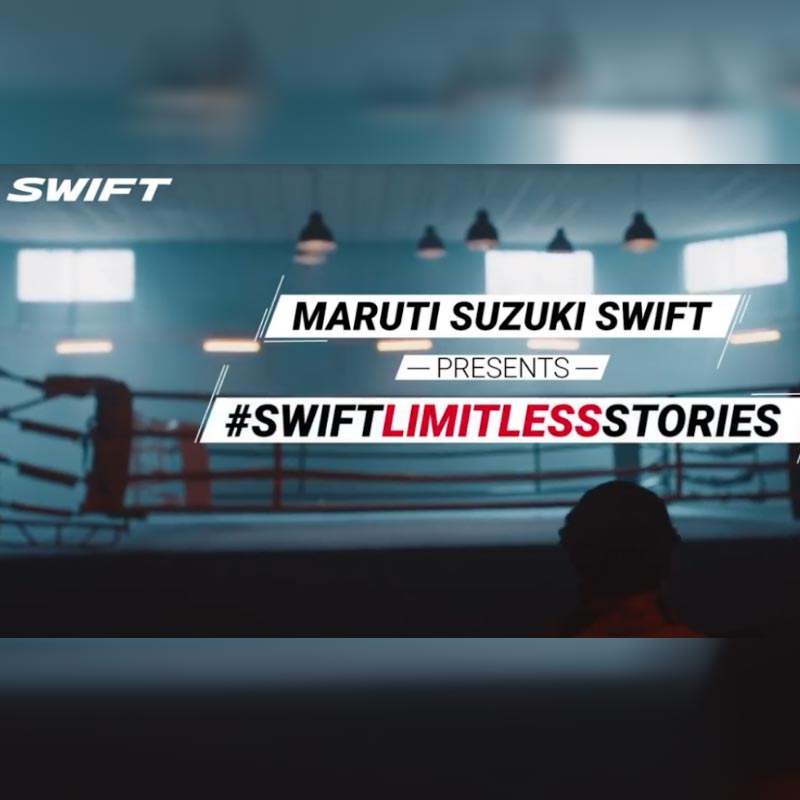
    MUMBAI: Maruti Suzuki India, in collaboration with Dentsu Impact, has unveiled a brand-new campaign, ‘Swift Limitless Stories’ for the 3rd generation Swift.

    After the launch of the new model last year with the campaign #BeLimitless, MSIL was looking to take Swift’s legacy of performance forward. The objective of the campaign was to help people connect; not just physically but also emotionally with the concept of being ‘Limitless’.

    Commenting on the campaign, Maruti Suzuki India executive director-marketing and sales Shashank Srivastava said, “We want to engage with our target group (TG) in a more meaningful way. The Swift Limitless Stories is a way to build a higher level of brand salience to associate with performance but in an emotional way. It is also going to be our long-term strategy. These stories celebrate individuals who keep challenging themselves to become their better version. We wish to associate Maruti Suzuki with visual dynamism and pursuit for excellence. We also have a separate campaign for sales promotion for Swift. This campaign does not push for immediate sales. It, however, is meant to build brand salience."

    Brought to life by Dentsu Impact, the creative agency from the house of Dentsu Aegis Network, the ‘Swift Limitless Stories’ campaign celebrates three individuals who have overcome immense challenges in their lives while in their pursuit of greatness – Olympic and World Champion Mary Kom, Para-athlete Bhupendra Sharma, and a corporate banker Vikas Dimri, who conquered Mt. Everest and the Ironman Race the same year.

    Speaking about the campaign, Dentsu Impact national creative director Anupama Ramaswamy said, “Swift has always celebrated performance. And the ‘Swift Limitless Stories’ campaign has been created to do exactly that, with one difference – it takes the ‘Be Limitless’ philosophy beyond just the car. It salutes the undying spirit of certain special achievers who never accept things as they are and keep pushing past all limits to achieve their dreams. These stories have been carefully selected; because we felt they strongly connect with our consumer’s ‘nothing-is-impossible’ attitude.”

    The campaign relies on storytelling and celebrating the limitless heroes without consciously integrating the car. Reason being that the vision of this campaign is to personify the philosophy of ‘Be Limitless’ by highlighting the strength, passion and relentless determination of certain out-of-the-ordinary individuals.

    Swift Limitless Stories has been created to engage specifically with audiences on social media, Maruti Suzuki’s content hub, as well as the individual social media handles of these heroes.

    Dentsu Impact senior vice president Hindol Purkayastha said, “Swift has been an iconic brand which has been loved by multiple generations. Our latest campaign focuses on the digital audience and with compelling storytelling it will truly allow us to inspire millions of followers and get newer younger audience. With performance at the core of the brand, it was time to shift the conversation to individuals from the product. Thus, the concept of #BeLimitless campaign was used as a trigger to invite more stories of individual achievements. With this, we continue to own the space of performance.”

    With the Limitless Stories campaign, MSIL is not just sharing inspiring stories, but is also creating a platform for its audience to share their own journey with the world.

    The films have been directed by Sharat Sharma of Crazy Few Films.

  • Maruti Suzuki launches #BeLimitless Swift campaign to celebrate real-life heroes

    Maruti Suzuki launches #BeLimitless Swift campaign to celebrate real-life heroes

    MUMBAI: Focusing on recognising heroes who have gone far and beyond across different walks of life, Maruti Suzuki India Ltd, the leading passenger car maker in India, has launched ‘Be Limitless’—a 3-part video campaign for Maruti Swift. The campaign for Swift is aimed at highlighting the stories of extraordinary people, who are as dynamic as Maruti Suzuki and are relentless pursuing challenges every day.

    The digital campaign features six-time world champion and bronze winner in Olympics Mary Kom, para-athlete Bhupender Sharma, and corporate banker who scaled Mt Everest, Vikas Dimri. The campaign salutes the undying spirit of the special achievers who never accept things as they are and keep pushing past all limits to realise their dreams.

    Commenting on the campaign launch, executive director, sales and marketing Shashank Srivastava said, “At Maruti, we have always strived to engage with our audience and with our latest campaign our agenda is to engage with our target group in a more meaningful way. Be Limitless is a way to build a higher level of brand salience to associate with performance but in an emotional way which is going to be our long-term strategy. A deep dive into the lives of consumers made us realize that they seek new challenges. The campaign celebrates individuals who keep challenging themselves. These individual heroes have gone beyond the ordinary like the Maruti Swift; that has created the premium hatchback segment in India. The campaign not only honors those who are in the relentless pursuit of new challenges but also celebrates the very essence of being limitless.”

    Maruti Suzuki strives to inspire the audience to get up and work towards their goal, no matter how difficult or impossible they are to achieve. Just like Maruti Suzuki has been limitless in catering to the evolving tastes and preferences of their car buyers. ‘Be Limitless’ speaks to the men and women of action – those who are upbeat, energetic and are always on-the-go. Epitomising the relentless spirit of various individuals, the campaign will be entirely leveraged on the digital media across handles of Maruti Suzuki Arena content hub and the ever-inspiring limitless heroes.

    The campaign will be promoted across digital and social media platforms. Swift is a market leader in the premium hatch back segment with a market share of 28.4 per cent. Maruti Suzuki has sold over 21.96 lakhs units of Swift since it was launched in India in 2005.