Tag: Shashank Arora

  • Applause Entertainment and yes Studios partner for Tanaav season two

    Applause Entertainment and yes Studios partner for Tanaav season two

    Mumbai: yes Studios and Applause Entertainment extend partnership for the second season of Fauda adaptation in India, Tanaav. The first season of Fauda was adapted by Applause Entertainment as Tanaav and premiered to much acclaim on Sony LIV in November 2022. Set against the idyllic backdrop of Kashmir, Tanaav tells the story of a Special Task Group and weaves tightly knit action with the emotional stories of compelling characters caught up in the fight against terrorism in the region.

    Season one of Tanaav featured a stellar Indian cast, including Manav Vij, Sumit Kaul, Rajat Kapoor and Shashank Arora, and was directed by Sudhir Mishra (Serious Men) and co-directed by Sachin Mamta Krishn (Hostages). Details about season two will be made available in due course.

    Sharon Levi, managing director of yes Studios said: “We are thrilled that our relationship with Applause Entertainment will continue and are excited that this extension to the format deal will ensure a return for Tanaav. Fauda was our first big global hit and Tanaav its first local adaptation. It was very important for us to work with the right partner, one that could deftly cover differing perspectives in a highly complex situation and create interesting and relevant characters anchored in its own unique local setting and circumstances. The Applause Entertainment team did all this brilliantly, and we can’t wait to see what they have planned for season two.”

    Applause Entertainment managing director Sameer Nair added: “We’re honoured to extend our partnership with yes Studios after the resounding success of Tanaav Season One. The teams at Applause and Sony LIV are pumped as we set out to craft an even more gripping tale for our audience with a season two. Stay tuned for an extraordinary tale of courage, conflict, and camaraderie as we embark on this exciting new adventure.”

    Fauda, which follows the work of a team of elite Israeli undercover agents, was created by Avi Issacharoff and Lior Raz. It has won numerous awards, including Best Series at the Israeli Academy TV Awards, and has been critically acclaimed in the press across the world. Fauda is produced by L. Benasuly Productions and yes TV, with yes Studios distributing the series and format.

  • Rock On II….Rock Bottom!

    Rock On II….Rock Bottom!

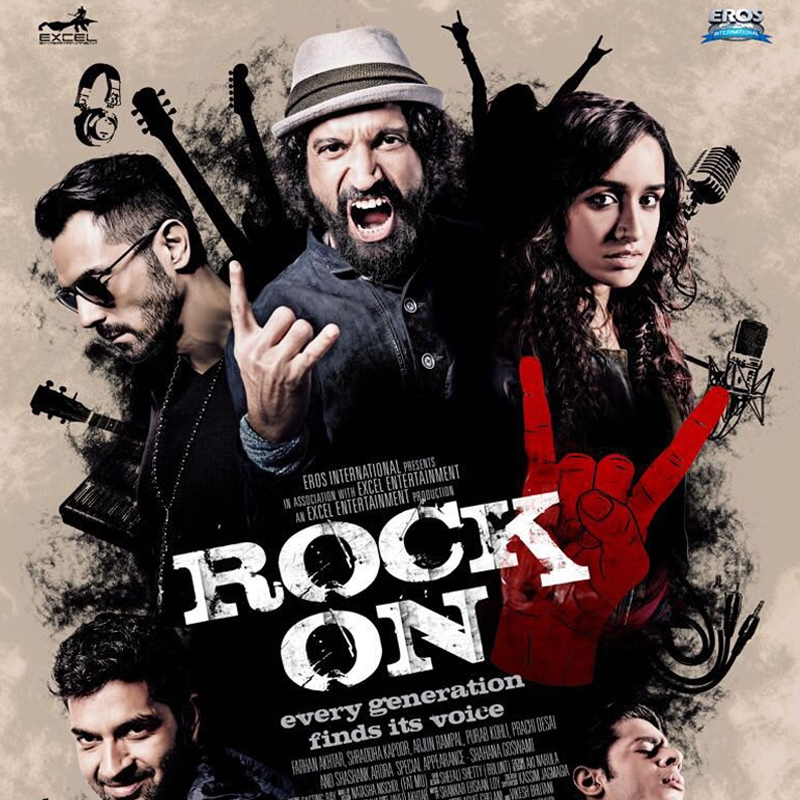
    Rock On II has a different director in Shujaat Saudagar, the first one, Rock On (2008) having been directed by Abhishek Kapoor. The lead actors, however, remain the same. After all, there has to be some identification with the original for it has been eight years since the original. 

    Farhan Akhtar, Arjun Rampal and Purab Kohli, the members of the band Magik, remain friends though the band has been disintegrated. Farhan, married and father of a son, has moved to Meghalaya helping the local farmers with his cooperative movement as well as running a school. He has left his wife, Prachi Desai, and son behind. Arjun Rampal owns a club leaving behind his deprived childhood. Purab Kohli runs a studio composing jingles for his clients. 

    The wherewithal of the characters having been established, the film now moves towards reuniting the band, Magik, and regain its past glory and the happier times. Arjun, Purab and Prachi pay Farhan a visit on the eve of his birthday and, soon enough, he is convinced to return to Mumbai to give their band a second chance. 

    If that were the purpose of making the sequel, the film would have been fun with the help of some good tunes. But, the film now opens up multiple tracks: a boy who is an exponent in playing Sarod Shashank Arora, a reluctant song writer and singer, Shraddha Kapoor, her father, Kumud Mishra, a classical Indian music maestro who desists pop music as also its fusion with Indian music. 

    Then there is a track of an aspiring musician whose suicide haunts Farhan, besides the exploitation of the farmers under Farhan’s cooperative by a cartel.  To add to all these tracks, there is one where the farmer members of Farhan’s movement are victims of a forest fires, all their crops destroyed leaving them starving.

    The muddled bunch of stories never connect with each other and the film jumps from one thread to another leaving loose ends in the process. For some substance during gaps, the story goes into flashbacks of the earlier days of the group keeping the present events aside. 

    After a number of forced incidents, the band is now ready to relaunch and the cause is found; it will perform in Shillong to raise funds for the fire affected farmers. Even while this is being planned a few more side tracks play the villain to ruin the concert. But once the mood is set by Usha Uthup rendering the opening number of the concert, crowds from all over swell the venue. 

    The writing is disjointed and twisted and turned on whim. Shraddha has a partner in Arora but just to link her with Farhan, one fine evening, Prachi comes and declares to him that they are no more compatible. This paves the way for Shraddha to keep eyeing Farhan with suggestive looks! The concert venue along with the sound system is ransacked by local goons but, magically, replaced by a chela of Arjun. The film is full of such fillers inserted as per convenience. 

    The idea to bring back the band story with middle-aged actors looks passé as even on English music scene, groups are now limited to rock; it is mostly solo performers topping the charts. Even the musical score required for such a film is a let down here.   This is a tough film to edit and it shows all over. Dialogue is mediocre. 

    There is nothing much to the performances as Farhan seems to monopolize the footage. Arjun makes his presence felt though. Shraddha’s part is about carrying a sad face through most of the film till she singles out Farhan for her smiles and meaningful looks. Prachi and ShahanGoswami have little footage. Shashank does well. 

    Rock On 2 fails to qualify as a musical as well as a feel good film. Too slow and heavy on head, it has had a very poor opening and the public reports will only add to its misery. 

    Producers: Farhan Akhtar, RiteshSidhwani.

    Director: ShujaatSaudagar. 

    Cast: ShraddhaKapoor, Farhan Akhtar, Arjun Rampal, PurabKohli,Shashank Arora, Prachi Desai, Shahana Goswami, Kumud Mishra. 

    Dongri Ka Raja….No dons please!

    Looks like every aspiring or new director worth his salt wants to make a film on underworld folk stories set in the once famous “Mumbai-3” as it was known, or the Dongri area. No matter that these stories and their imagined versions have been done to death. There is no Deewaar to be made anymore as many recent Mumbai underworld films have proved.

    The director, Hadi Ali Abrar, and writer, M Salim, come up with an emotional love saga about a Dongri don, his excuse of a wife, their adopted Hindu son and the son’s love story. Things get complicated and repetitive but here is an attempt to decode it:

    Ronit Roy is the dreaded don who operates from Dongri. He seems to have married a woman, Ashwini Kalsekar, out of some compulsion and there is no love lost between the two. The don’s two-man army consists of a Hindu Man-Friday and his adopted Hindu son, Gashmeer Mahajani. Mahajani is much loved by Ashwini, just like her own son. This equation takes time to come through and fathom. 

    Gashmeer is Ronit’s most trusted sharpshooter who usually wears the uniform of a known police inspector, Ashmit Patel, when shooting a rival. As is the tradition with love stories which went on to become folklore, Gashmeer falls in love with Richa Sinha, who, it turns out, is the sister of inspector Ashmit. 

    Her romance with Gashmeer — is it just a ploy, or real?

    It is surprising that the police, instead of targeting Ronit, the force behind all the illegal activities, is chasing his shooter! The rest of the film is about Richa’s merry-go-round; when she is not with her brother and his cause, she is with Gashmeer, her love. She betrays Ashmit and Gashmeer in turns. Gashmeer and Ashmit play chor sipahee through the film leaving Ronit out of contention to be never seen again even as the film ends.

    Dongri Ka Raja is a contrived, amateurish don story living by the stereotype that a don has to be a Muslim, dreaded by all just because you are told so. The story idea, scripting, direction, dialogue are all poor. Performances are stagey and even Ronit Roy does not bother to vary his single expression. Gashmeer Mahajani is good in parts. 
    Dongri Ka Raja is as passé as once upon a time stories.

    Producer: PS Chhatwal. 

    Director: Hadi Ali Abrar.

    Cast: Ronit Roy, Gashmeer Mahajani, Ashmit Patel, Reecha Sinha, Ashwini Kalsekar, Sachin Suvarna, Gulshan Pandey. 

    Chaar Sahibzaade: Rise Of Banda Singh Bahadur (3-D: Animation)….Limited appeal

    Chaar Sahibzaade: The Rise Of Banda Singh Bahadur (3-D: Animation) comes as a sequel to the maker Harry Baweja’s earlier film, Chaar Sahibzaade (also 3-D: Animation-2014), about the martyrdom of four young sons of the the tenth Sikh Guru, Guru Gobind Singh. The earlier film dealt with the Sikh community’s various battles with the invading Mughals and their harsh ways of meting out justice as well as about Sikhs’ defending the religion against forcible conversion.

    This film tells the story of the Sikh religion and its warriors post Guru Gobind Singh.

    The Sikhs are fighting a valiant battle against the tyranny of Mughals, especially the sadist subedaar of Sirhind, Wazir Khan. Wazir, who had killed the two older sons (aged 18 and 14) of Guru Gobind Singh, imprisons the two younger sons (aged 9 and 7) of the Guru, to suffocate them to death.

    The fights have now taken the form of deceit. The Sikh army is small but impenetrable and Wazir Khan wants Guru Gobind Singh dead. He deputes two of his men to sneak into the Sikh camp and assassinate Guru Gobind Singh. Guru Gobind Singh is hurt and survives only to die a slow death of blood poisoning.

    Guru has no heir apparent left and he does not want the Sikh faith to suffer the same fate as the Caliphate did. He declares the end of Guru System, declares Guru Granth Saahib as the ultimate and perpetual Guru of the Faith. He appoints one of his trusted disciples, Banda Singh, to settle scores with Wazir Khan with five selected wise Sikh men called Panj Pyare, as the deciding council to help and guide Banda Singh as well as to check on him.

    Banda Singh and his five-man council go on to tackle Mughals, help their victims and build an army to finally take on the might on Wazir Khan.

    The story is about Banda Singh and how he succeeds in sustaining and furthering the Sikh religion. But, Harry Baweja takes his time in coming to that part as he uses most of the first half of the film in retelling the story of four sons of Guru Gobind Singh which has already been the story of the previous film. This stretches the duration to 140 minutes, which is rather lengthy for a community-based animation film.

    The narration is like a bedtime story, too much detail in a linear manner creating no interesting moments. There is no conclusion to the Banda Singh story leaving an option open to carry on the saga further. Dialogue and rest of the approach is monotonous. The musical score is inspiring. Om Puri does the narrative voiceover as he did in the earlier film. Animation and the 3-D effects are okay.

    Chaar Sahibzaade: Rise Of Banda Singh Bahadur is aimed mainly at the Sikh community which appreciated the first film. The returns with the sequel are likely to show diminishing returns because of a huge part of the film being a repeat of the original.

    Producer: Pammi Baweja.

    Director: Harry Baweja.

    Voice: Om Puri and others

  • Rock On II….Rock Bottom!

    Rock On II….Rock Bottom!

    Rock On II has a different director in Shujaat Saudagar, the first one, Rock On (2008) having been directed by Abhishek Kapoor. The lead actors, however, remain the same. After all, there has to be some identification with the original for it has been eight years since the original. 

    Farhan Akhtar, Arjun Rampal and Purab Kohli, the members of the band Magik, remain friends though the band has been disintegrated. Farhan, married and father of a son, has moved to Meghalaya helping the local farmers with his cooperative movement as well as running a school. He has left his wife, Prachi Desai, and son behind. Arjun Rampal owns a club leaving behind his deprived childhood. Purab Kohli runs a studio composing jingles for his clients. 

    The wherewithal of the characters having been established, the film now moves towards reuniting the band, Magik, and regain its past glory and the happier times. Arjun, Purab and Prachi pay Farhan a visit on the eve of his birthday and, soon enough, he is convinced to return to Mumbai to give their band a second chance. 

    If that were the purpose of making the sequel, the film would have been fun with the help of some good tunes. But, the film now opens up multiple tracks: a boy who is an exponent in playing Sarod Shashank Arora, a reluctant song writer and singer, Shraddha Kapoor, her father, Kumud Mishra, a classical Indian music maestro who desists pop music as also its fusion with Indian music. 

    Then there is a track of an aspiring musician whose suicide haunts Farhan, besides the exploitation of the farmers under Farhan’s cooperative by a cartel.  To add to all these tracks, there is one where the farmer members of Farhan’s movement are victims of a forest fires, all their crops destroyed leaving them starving.

    The muddled bunch of stories never connect with each other and the film jumps from one thread to another leaving loose ends in the process. For some substance during gaps, the story goes into flashbacks of the earlier days of the group keeping the present events aside. 

    After a number of forced incidents, the band is now ready to relaunch and the cause is found; it will perform in Shillong to raise funds for the fire affected farmers. Even while this is being planned a few more side tracks play the villain to ruin the concert. But once the mood is set by Usha Uthup rendering the opening number of the concert, crowds from all over swell the venue. 

    The writing is disjointed and twisted and turned on whim. Shraddha has a partner in Arora but just to link her with Farhan, one fine evening, Prachi comes and declares to him that they are no more compatible. This paves the way for Shraddha to keep eyeing Farhan with suggestive looks! The concert venue along with the sound system is ransacked by local goons but, magically, replaced by a chela of Arjun. The film is full of such fillers inserted as per convenience. 

    The idea to bring back the band story with middle-aged actors looks passé as even on English music scene, groups are now limited to rock; it is mostly solo performers topping the charts. Even the musical score required for such a film is a let down here.   This is a tough film to edit and it shows all over. Dialogue is mediocre. 

    There is nothing much to the performances as Farhan seems to monopolize the footage. Arjun makes his presence felt though. Shraddha’s part is about carrying a sad face through most of the film till she singles out Farhan for her smiles and meaningful looks. Prachi and ShahanGoswami have little footage. Shashank does well. 

    Rock On 2 fails to qualify as a musical as well as a feel good film. Too slow and heavy on head, it has had a very poor opening and the public reports will only add to its misery. 

    Producers: Farhan Akhtar, RiteshSidhwani.

    Director: ShujaatSaudagar. 

    Cast: ShraddhaKapoor, Farhan Akhtar, Arjun Rampal, PurabKohli,Shashank Arora, Prachi Desai, Shahana Goswami, Kumud Mishra. 

    Dongri Ka Raja….No dons please!

    Looks like every aspiring or new director worth his salt wants to make a film on underworld folk stories set in the once famous “Mumbai-3” as it was known, or the Dongri area. No matter that these stories and their imagined versions have been done to death. There is no Deewaar to be made anymore as many recent Mumbai underworld films have proved.

    The director, Hadi Ali Abrar, and writer, M Salim, come up with an emotional love saga about a Dongri don, his excuse of a wife, their adopted Hindu son and the son’s love story. Things get complicated and repetitive but here is an attempt to decode it:

    Ronit Roy is the dreaded don who operates from Dongri. He seems to have married a woman, Ashwini Kalsekar, out of some compulsion and there is no love lost between the two. The don’s two-man army consists of a Hindu Man-Friday and his adopted Hindu son, Gashmeer Mahajani. Mahajani is much loved by Ashwini, just like her own son. This equation takes time to come through and fathom. 

    Gashmeer is Ronit’s most trusted sharpshooter who usually wears the uniform of a known police inspector, Ashmit Patel, when shooting a rival. As is the tradition with love stories which went on to become folklore, Gashmeer falls in love with Richa Sinha, who, it turns out, is the sister of inspector Ashmit. 

    Her romance with Gashmeer — is it just a ploy, or real?

    It is surprising that the police, instead of targeting Ronit, the force behind all the illegal activities, is chasing his shooter! The rest of the film is about Richa’s merry-go-round; when she is not with her brother and his cause, she is with Gashmeer, her love. She betrays Ashmit and Gashmeer in turns. Gashmeer and Ashmit play chor sipahee through the film leaving Ronit out of contention to be never seen again even as the film ends.

    Dongri Ka Raja is a contrived, amateurish don story living by the stereotype that a don has to be a Muslim, dreaded by all just because you are told so. The story idea, scripting, direction, dialogue are all poor. Performances are stagey and even Ronit Roy does not bother to vary his single expression. Gashmeer Mahajani is good in parts. 
    Dongri Ka Raja is as passé as once upon a time stories.

    Producer: PS Chhatwal. 

    Director: Hadi Ali Abrar.

    Cast: Ronit Roy, Gashmeer Mahajani, Ashmit Patel, Reecha Sinha, Ashwini Kalsekar, Sachin Suvarna, Gulshan Pandey. 

    Chaar Sahibzaade: Rise Of Banda Singh Bahadur (3-D: Animation)….Limited appeal

    Chaar Sahibzaade: The Rise Of Banda Singh Bahadur (3-D: Animation) comes as a sequel to the maker Harry Baweja’s earlier film, Chaar Sahibzaade (also 3-D: Animation-2014), about the martyrdom of four young sons of the the tenth Sikh Guru, Guru Gobind Singh. The earlier film dealt with the Sikh community’s various battles with the invading Mughals and their harsh ways of meting out justice as well as about Sikhs’ defending the religion against forcible conversion.

    This film tells the story of the Sikh religion and its warriors post Guru Gobind Singh.

    The Sikhs are fighting a valiant battle against the tyranny of Mughals, especially the sadist subedaar of Sirhind, Wazir Khan. Wazir, who had killed the two older sons (aged 18 and 14) of Guru Gobind Singh, imprisons the two younger sons (aged 9 and 7) of the Guru, to suffocate them to death.

    The fights have now taken the form of deceit. The Sikh army is small but impenetrable and Wazir Khan wants Guru Gobind Singh dead. He deputes two of his men to sneak into the Sikh camp and assassinate Guru Gobind Singh. Guru Gobind Singh is hurt and survives only to die a slow death of blood poisoning.

    Guru has no heir apparent left and he does not want the Sikh faith to suffer the same fate as the Caliphate did. He declares the end of Guru System, declares Guru Granth Saahib as the ultimate and perpetual Guru of the Faith. He appoints one of his trusted disciples, Banda Singh, to settle scores with Wazir Khan with five selected wise Sikh men called Panj Pyare, as the deciding council to help and guide Banda Singh as well as to check on him.

    Banda Singh and his five-man council go on to tackle Mughals, help their victims and build an army to finally take on the might on Wazir Khan.

    The story is about Banda Singh and how he succeeds in sustaining and furthering the Sikh religion. But, Harry Baweja takes his time in coming to that part as he uses most of the first half of the film in retelling the story of four sons of Guru Gobind Singh which has already been the story of the previous film. This stretches the duration to 140 minutes, which is rather lengthy for a community-based animation film.

    The narration is like a bedtime story, too much detail in a linear manner creating no interesting moments. There is no conclusion to the Banda Singh story leaving an option open to carry on the saga further. Dialogue and rest of the approach is monotonous. The musical score is inspiring. Om Puri does the narrative voiceover as he did in the earlier film. Animation and the 3-D effects are okay.

    Chaar Sahibzaade: Rise Of Banda Singh Bahadur is aimed mainly at the Sikh community which appreciated the first film. The returns with the sequel are likely to show diminishing returns because of a huge part of the film being a repeat of the original.

    Producer: Pammi Baweja.

    Director: Harry Baweja.

    Voice: Om Puri and others

  • YRF and DBP’s ‘Titli’ wins Best First Foreign Film Prize

    YRF and DBP’s ‘Titli’ wins Best First Foreign Film Prize

    MUMBAI: Directed by Kanu Behl and co-produced by YRF and DBP, Titli has won the Best First Foreign Film Prize by the French Syndicate of Cinema Critics on 1 February 2016.

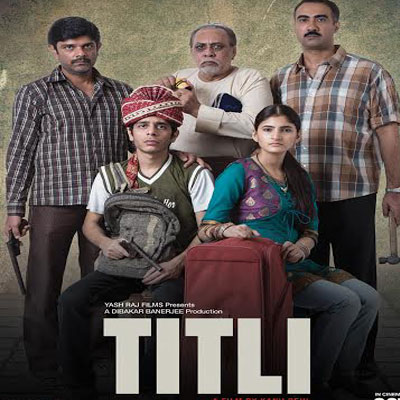
    The film stars newcomers like Shashank Arora, Shivani Raghuvanshi, Ranvir Shorey, Amit Sial and Lalit Behl. It is a story of dysfunctional family and young boy’s struggle to escape his oppressive family.

    The film ‘Titli- har family, family nahi hoti’ was released across India on 30 October 2015.

    On this achievement, Behl said “It’s a huge honour. The French Critics Syndicate has a long and ongoing relationship with recognising cinema that looks to push boundaries. To be in the company of other eminent films of the year, is heartening as a filmmaker. This belongs to the whole team of Titli, and we hope to continue the good work.”

    The FSCC awards 4 prestigious prizes each year including Best French Film, Best International Film, Best First Film and Best Short Film.

  • YRF and DBP’s ‘Titli’ wins Best First Foreign Film Prize

    YRF and DBP’s ‘Titli’ wins Best First Foreign Film Prize

    MUMBAI: Directed by Kanu Behl and co-produced by YRF and DBP, Titli has won the Best First Foreign Film Prize by the French Syndicate of Cinema Critics on 1 February 2016.

    The film stars newcomers like Shashank Arora, Shivani Raghuvanshi, Ranvir Shorey, Amit Sial and Lalit Behl. It is a story of dysfunctional family and young boy’s struggle to escape his oppressive family.

    The film ‘Titli- har family, family nahi hoti’ was released across India on 30 October 2015.

    On this achievement, Behl said “It’s a huge honour. The French Critics Syndicate has a long and ongoing relationship with recognising cinema that looks to push boundaries. To be in the company of other eminent films of the year, is heartening as a filmmaker. This belongs to the whole team of Titli, and we hope to continue the good work.”

    The FSCC awards 4 prestigious prizes each year including Best French Film, Best International Film, Best First Film and Best Short Film.

  • YRF to release Kanu Behl’s directorial debut ‘Titli’ on 30 October

    YRF to release Kanu Behl’s directorial debut ‘Titli’ on 30 October

    MUMBAI: Yash Raj Films and Dibakar Banerjee Productions’ co-production titled Titli, which is the debut directorial vehicle of Kanu Behl, will release across India on 30 October, 2015.


    The film’s tagline ‘har family, family nahi hoti’ (every family is not a family) has been given by YRF head honcho Aditya Chopra.


    Banerjee said, “We were all struggling to find a befitting tagline for the poster but nothing good was coming out. I was feeling a bit stuck when Adi very casually came up with this line and I realised that he just gave me the tagline. It came out very naturally from him.”


    “This came from a man who has a deep, gut level understanding of the Indian audience. Moreover, I felt that this tag line translated in any language anywhere in the world would be as kickass. Any person who has a family and has understood the pain and the pleasure of the complex dynamics of a family will get this,” he added.


    Director Kanu Behl’s father – Lalit Behl plays Titli’s father, whereas Shivani Raghuvanshi plays Titli’s wife, Neelu in the movie.


    Titli is a tale of a dysfunctional family and a young boy’s struggle to escape his oppressive family. It also stars Shashank Arora, Ranvir Shorey and Amit Sial.