Tag: Set top Box

  • Cricket and other sports pirates get the boot as broadcasters flex their legal muscle

    Cricket and other sports pirates get the boot as broadcasters flex their legal muscle

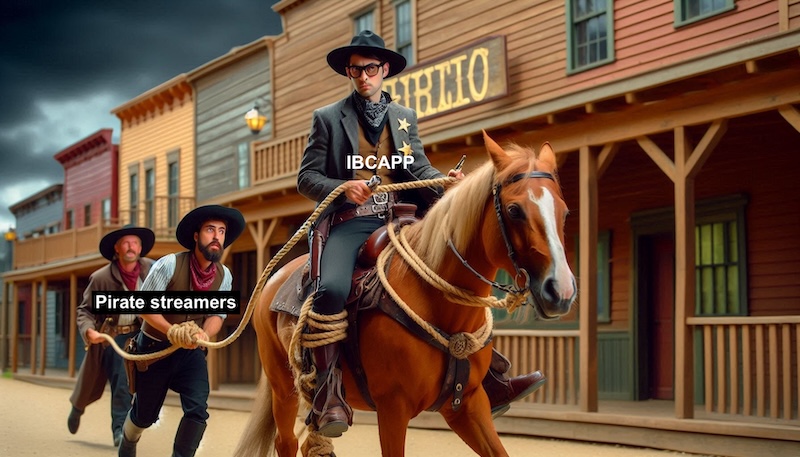
    MUMBAI: The International Broadcaster Coalition Against Piracy (Ibcap) has been rather busy playing digital sheriff, rounding up streaming rustlers and making pirates walk the legal plank. The coalition’s 2025 annual report, released at its Anaheim gathering  on 14 May, revealed a year of impressive swashbuckling against content thieves who’ve been helping themselves to premium programming without so much as a by-your-leave.

    The real crowd-pleaser was  Ibcap’s cricket crusade, where it showed that protecting live sports requires the reflexes of a wicket-keeper and the persistence of a tail-end batsman. During the 2024 Indian Premier League tournament, its analysts in India and America worked in real-time shifts, sending takedown notices faster than Jasprit Bumrah delivers yorkers. The result was spectacular: 6,723 streams disrupted over the tournament’s duration and more than 2.1 million Facebook Live views blocked worldwide. Its takedown rate on social media and mobile apps achieved a perfect 100 per cent—leaving pirates and would-be viewers equally frustrated.

    The highly popular cricket T20 World Cup saw similar success, with Ibcap’s laboratory removing 3,783 streams and disrupting over a million Facebook Live views globally. On set-top box and IPTV services, it knocked out 2,852 streams with a 77 per cent success rate, whilst web-based live streams suffered even more, with 5,940 removed at a 70 per cent clip. Social media and mobile apps once again proved no match for IBCAP’s digital fielding, maintaining that perfect 100 per cent takedown rate.

    Ibcap expanded it merry band of  crusaders with three notable additions: Japanese public broadcaster NHK, whose programming reaches 160 countries, joined the fray in June 2024, bringing protection for Japanese-language content into the fold. American video distribution heavyweight DirecTV followed suit in March 2025, broadening Ibcap’s reach into mainstream American programming. Most recently, Italy’s national broadcaster Rai signed up, dragging its popular channels Rai Uno and Rai Italia—home to variety shows, sports, and live Serie A football—under Ibcap’s protective umbrella.  With programming available across 174 countries on five continents, RAI’s addition proves that even the land of pasta and beautiful football isn’t immune to streaming skulduggery. Ibcap currently represents over 220 television channels from America, Europe, Brazil, the Middle East and South Asia. 

    The coalition hasn’t just been collecting members like Panini stickers. Its laboratory techies have developed a rather clever automated monitoring system that spots dodgy video-on-demand content on set-top boxes and IPTV services faster than you can say “buffering.” This proprietary digital bloodhound doesn’t just watch—it captures evidence, preserves it for legal proceedings, and fires off automated takedown notices to infringing services, content delivery networks, and hosting companies worldwide. The result? Illegal streams vanish quicker than a Test match in Perth. Ibcap is so pleased with this technological marvel that it’s considering offering the service to non-members and other organisations in the broader anti-piracy battle.

    Ibcap’s legal team has been throwing punches worth millions, building on its successful track record of making hosting providers pay for digital negligence. After pocketing a tidy $3m settlement from hosting provider Datacamp—a warning shot across the industry’s bow—it has trained its legal cannons on Virtual Systems and Innetra PC with lawsuits filed in October 2024 and May 2025 respectively.

    Virtual Systems’ behaviour was particularly brazen, operating what can only be described as a piracy paradise. The company allegedly ran a “DMCA ignored” policy—about as subtle as a brick through a window—advertising that “we ignore DMCA takedown notices” to potential customers. When Ibcap sent over 500 separate infringement notices, Virtual Systems treated them with all the respect of junk mail, allowing numerous pirate services to continue using its servers and network infrastructure to stream copyrighted content. The company’s reward for such cavalier attitudes? A lawsuit seeking over $41m in statutory damages plus a permanent injunction.

    Innetra PC proved equally troublesome, emerging as a major offender in Ibcap’s crosshairs after being identified as responsible for delivering approximately 15 per cent of unauthorised Ibcap member streams on set-top box and IPTV services during the first quarter of 2025. Its comeuppance: a lawsuit demanding more than $25m in statutory damages and, like Virtual Systems, a permanent injunction to stop hosting infringing content.

    Perhaps most satisfying was the legal thrashing handed to the operators of Lemo TV and Kemo IPTV in April 2025. These streaming scallywags had been particularly audacious, continuing to broadcast Ibcap protected content despite receiving approximately 100 infringement notices—roughly one for every boundary in a decent innings. During the first quarter of 2025 alone, the service accounted for almost 30 per cent of all unauthorised streams detected on set-top box and IPTV services monitored by Ibcap’s laboratory.

    The service’s persistence in piracy proved costly. The lawsuit seeks statutory damages exceeding $25m, plus profits from potentially thousands of unregistered works that were illegally distributed. But the legal punishment doesn’t stop at financial penalties—Ibcap wants a permanent injunction to shut down the operation entirely, an order forcing the transfer of domain names used by the service, and recovery of reasonable legal fees and costs. It’s the equivalent of not just getting bowled out, but having your stumps scattered across three counties.

    The message is crystal clear: content pirates may think they’re sailing in international waters, but Ibcap’s legal navy is patrolling every digital sea lane with an arsenal that would make admiral Nelson proud. With automated monitoring systems scanning the digital horizon, a growing fleet of broadcaster allies from five continents, and a track record of multi-million-dollar settlements, the coalition is proving that in the world of content protection, crime doesn’t pay—especially when it’s streaming someone else’s cricket match, Serie A fixture, or prime-time drama without permission.

  • Fastway Transmissions launches a new android TV set top box

    Fastway Transmissions launches a new android TV set top box

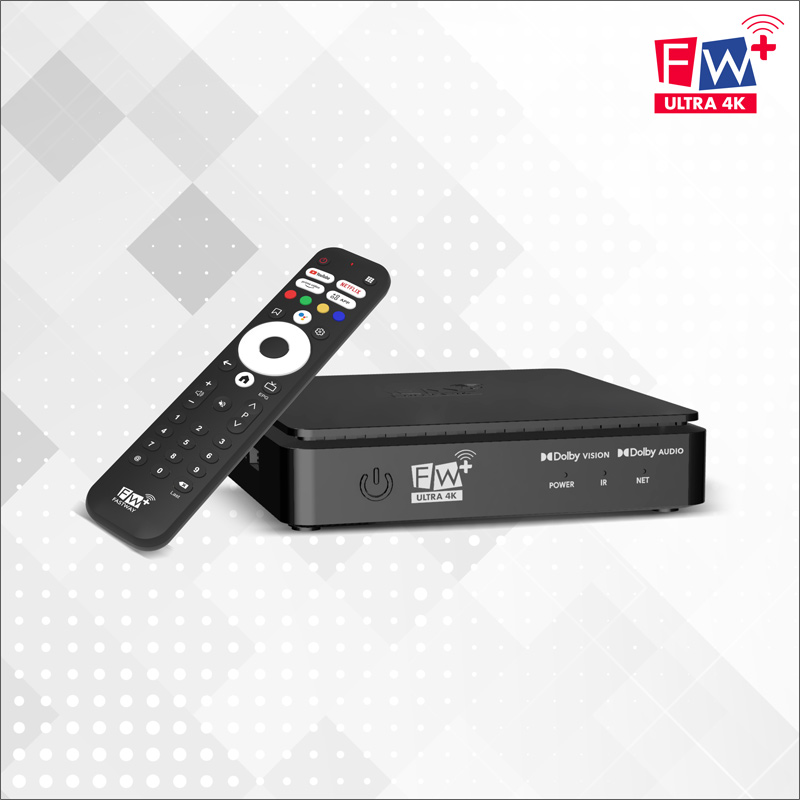
    Mumbai: Fastway Transmissions, a subsidiary of the Jujhar group and a cable network provider in India, has launched a Dolby Vision and Dolby Audio enabled android TV based hybrid and OTT set-top box, the FW+ ultra 4K STB. Plans start at Rs 699.

    Powered by Netplus Broadband, the internet arm of Fastway Transmissions, the set-top box will be preloaded with a bundled plan that offers access to ultra-high-definition (UHD) content and is affordably priced. Access to unlimited internet, premium OTT content, and free voice calls will be included in the bundle plans. The hybrid cable box can also be used to pair linear TV with playback services in HDR quality.

    The Fastway STB provides users with access to Prime Video, YouTube, and Google Play through direct links and a remote with a single click. The STB is equipped with features, including Dolby Vision, Dolby Audio, HDMI 2.1, dual band, bluetooth, USB3.0, micro SDXC (expandable up to 1TB), and a built-in chromecast.

    According to a report, the worldwide set-top box market is anticipated to increase at a compound annual growth rate (CAGR) of more than four per cent in terms of volume from 2021 to 2028. Rising internet and broadband penetration, as well as increased preference for high-quality channels and on-demand video services in 4K HDR, are expected to drive this market’s growth.

    The consumers of today, the company said, are seeking premium entertainment experiences. To cater to this evolving demand and to ensure customer delight, the set-top box comes equipped with Dolby Vision and Dolby Audio.

    Jujhar Group chairman S. Gurdeep Singh said, “This is a very significant step towards delivering comprehensive services to our existing as well as potential user base. With the launch of this exciting new product with Dolby vision and Dolby audio technology, we want to target a substantial share of users in the tier one and tier two regions of the country. The subscribers will be able to enjoy the ultra-smart hub with an easy-to-use interface through play store services. Further, users can also customise their smart boxes using the apps that can be downloaded from the play store.

    “As android TV grows in popularity, the number of monthly active users is on a significant rise, indicating an increase in popularity and trust for the company. We are looking forward to utilising our extensive broadband and cable network experience to deliver a premium OTT viewing experience.”

    Dolby Laboratories’ senior director of commercial partnerships, India, Middle East and Africa Karan Grover said, “We are thrilled to collaborate with Fastway Transmissions to deliver a premium entertainment experience to consumers across streaming and cable networks. At Dolby, it is our constant pursuit to elevate the audio-visual entertainment quotient for our audience and make sure they are immersed completely in a life-like experience. Fastway subscribers will be able to experience their favourite entertainment like never before in Dolby Vision and Dolby Audio with Fastways new set-top box.”

  • Why Barc’s landing page viewership measurement is worrying TV9’s Barun Das

    Why Barc’s landing page viewership measurement is worrying TV9’s Barun Das

    Mumbai: The landing page controversy continues to dog ratings body the Broadcast Audience Research Council India (Barc). The latest one to wave a red flag is TV9 Network CEO Barun Das. Das is quite emphatic that the TV monitor needs to change the manner in the way it measures viewership, especially that which is garnered by news channels through channel placement on the landing page of a distribution platform operator (DPO). He has gone so far as to call it illegitimate and a restrictive trade practice.

    The landing page helps TV broadcasters enhance reach as it allows them to be the first channel on which the viewer lands when he/she switches on the set-top-box (STB). News broadcasters have been paying top dollar to place their respective channels on the landing page as it allegedly helps them garner higher ratings on their respective genres.

    It has been argued that landing pages are a marketing tool for broadcasters to promote their TV channels. An analogy has been drawn that a channel placed on a landing page is akin to FMCG companies prominently displaying their products on shelves in a retail outlet. This practice by FMCG players gives consumers the ‘opportunity to see’ their products.

    Das says this reasoning has no merit, in a letter addressed to Barc chairman Shashi Sinha. Prasar Bharati CEO Shashi Shekhar Vempati and Barc CEO Nakul Chopra have also been sent a copy.

    “A landing page actually blocks other channels from reaching consumers as soon as a viewer switches on the TV. It is a restrictive trade practice as a whole,” he states in the missive. “All the more so because, unlike an FMCG where the shelf space (first step) only attracts the attention, and then the purchase (actual transaction) happens. In the context of TV, watching itself is the transaction. Thus, it cannot be compared to an FMCG.”

    Das further claims that due to some mechanisms on the ground, the landing page has been adjusted in such a way that even if the consumer does not want to watch the landing channel, the remote doesn’t allow him/her to change to another one.

    “Any viewership achieved this way is certainly not legitimate,” posits Das.

    The larger issue of leveraging landing pages is that it makes the news broadcasting industry uncompetitive and unviable.

    As per industry estimates, when a broadcaster signs a carriage deal with a cable operator, the same deal costs two to three times more with the addition of placement on the landing page. So, a carriage deal that costs Rs 10 lakh may amount to Rs 40 lakh with the landing page included. Such deals are locked with large sized head ends and multiservice operators.

    “The news industry collectively went wrong when they started paying absurd carriage/placement fees for better LCNs (logical channel numbers).  Now, we’re creating one more demon in the form of a landing page. If you continue to allow landing pages as part of legitimate viewership, the same carriage-fee phenomenon will set in soon,” Das appeals in the letter.

    Das is referring to the industry practice, where a broadcaster pays exorbitant placement fees to DPOs for favourable placement of its channel in the LCN. This practice continued until the Telecom Regulatory Authority of India (Trai) directed DPOs that all channels of a particular genre must be placed together and any change in the position of the channel cannot take place without prior approval from the regulatory body.

    “Landing pages are so priced so exorbitantly that only GECs (general entertainment channels) which have a far higher revenue base can afford them,” states Das. “Also, since the viewership base of GEC is much higher (compared with news genre), the viewership gained through landing pages has a minor impact on the overall viewership. In the context of news channels, the impact of landing pages is very significant.”

    In September 2017, the ministry of information and broadcasting asked Barc to pause the ratings of TV channels that were using landing pages. This was followed by Trai directing all broadcasters of TV channels to refrain from placing any registered satellite television channel whose TV rating was measured by Barc India on the landing LCN or landing channel or boot up screen.  

    This directive was overturned by the Telecom Disputes Settlement and Appellate Tribunal (TDSAT) in an order dated May 2019 after news broadcaster Times Network approached the appellate body. The order by TDSAT stated that the landing page was a legitimate tool for promotion, allowing the industry to continue using it.

    However, Das argues that the cost of placement on landing channels cannot be matched by the revenue potential of the news genre. Similar to LCN placement, in the quest for short term gains, news channels may again scramble to be placed on the landing page by out paying one another.  

    “Some channels are paying astronomical amounts and are gaining viewership,” claims Das.

    Barc has attempted to mitigate some of the impact of the landing page on viewership of channels, although it has not been able to completely exclude landing page data with its algorithm-based data validation method. The outlier data was previously removed using symptomatic statistics but Barc replaced it with a methodology that uses inferential statistics to deliver better results across genres.

    In his letter, Das appeals to the Barc board to investigate and resolve the landing page issue and save the broadcast industry from this ‘coming crisis.’

    “I strongly reiterate that landing pages can by all means be used as a promotional/marketing tool. But the viewership garnered through the landing page cannot be counted in BARC viewership reports,” Das tells Indiantelevision.com.

  • News genre ratings: Broadcasters question ‘curious delay’; NBDA calls for additional measures

    News genre ratings: Broadcasters question ‘curious delay’; NBDA calls for additional measures

    Mumbai: Day after the government gave its long-awaited approval to Broadcast Audience Research Council (Barc) India to release ratings for news channels, the News Broadcasters and Digital Association (NBDA) called upon the TV rating agency to take “some additional measures” before any ratings are released.

    In a statement released on Thursday, the association said that while it recognises that a number of reforms are being undertaken at Barc, there is “still room to make systems more transparent, robust and reliable”. The association, which had earlier termed the Barc ratings “unreliable”, further noted that Barc should also evaluate ways to enhance data security and ensure that there is no manual intervention at any step in the ratings process.

    “We hope before any ratings are released, these measures are in place,” stated NBDA, even as another industry association- News Broadcasters Federation (NBF) cried foul over the “unnecessary delay” in executing the orders. 

    “The audience viewership data is with Barc and withholding it despite clear instruction from the ministry, is not necessary. It should comply and release the ratings of news channels without any further delay. If there are news channels that don’t want ratings, they can be voluntarily exempted,” said NBF in a statement, highlighting that it was “disappointed.”

    The representative body of news broadcasters exhorted Barc to put an end to the severe challenge that the news genre was facing as advertising was deeply hurt in absence of any ratings, leading to a loss in revenue. 

    When will the news ratings finally be released?

    The statements come amid Barc India’s continued silence over the release of TRPs for news channels which have been in limbo since October 2020. While the I&B ministry has asked the TV measurement body to “release the news ratings with immediate effect” along with last three months’ data in a monthly format, it is yet to announce when it will publish the same.

    Queries sent to Barc India did not elicit any response till the filing of the report.

    On Wednesday, the I&B ministry directed the rating agency to resume news genre ratings on TV effective immediately on a four-week rolling average concept to ensure fair and equitable representation of true trends.

    Furthermore, the government also assured broadcasters that Barc has undertaken revision in its processes, protocols, oversight mechanism and initiated changes in governance structure, and revamped and tightened the access protocols for data. “Barc has indicated that in view of the changes undertaken by it, they are reaching out to related constituencies to explain the new proposals and are in readiness to actually commence the release as per the new protocols,” it stated further.

    NBDA says it stands vindicated

    Meanwhile, the NBDA also stated that it stands vindicated as the ministry has recognised the need for improvement, acknowledged the deficiencies, and the need to urgently increase sample size and systemic corrections. “The association will continue to work with all stakeholders on refining the Outlier Policy to eliminate statistical anomalies and increasing the sample size to strengthen the credibility of data,” it added further.

    The ministry’s go-ahead comes just weeks ahead of an intense election season in five states, including an electoral battle for India’s most populous state. However, with broadcasters continuing to spar over the issue, it remains to be seen how long the state of suspension will continue.

    The overhaul in the television rating system in India kick-started in October 2020 when Mumbai Police claimed in a press briefing that they probed a case of manipulation of TRPs and found some incriminating evidence. The police said the accused were allegedly bribing the households to keep a particular channel running, leading to several arrests, and FIRs against three news channels. The controversy which quickly turned into a political football for the broadcasters, with allegations and counter-allegation forcing Barc India to temporarily suspend the publishing of weekly data for news channels in October 2020, which hangs fire till date.

  • Tata Sky Binge adds Amazon Prime Video to its streaming bouquet

    Tata Sky Binge adds Amazon Prime Video to its streaming bouquet

    New Delhi: In a bid to bolster its OTT game, Tata Sky on Monday announced that it has extended its integrated content offering on the Tata Sky Binge Mobile app by bringing onboard the streaming giant, Amazon Prime Video.

    The partnership will enable Tata Sky Binge subscribers to subscribe to Prime Video via Binge and explore its vast content library including the Amazon Originals as well as its vast portfolio of international and regional movies and web series. Subscribers will be able to opt for a Prime Video subscription directly through their Tata Sky account at the cost of Rs 129 per month. Access to the Prime Video app can commence either by clicking on the Prime Video banner on the home page or by clicking any Prime Video asset on the content rail, it said on Monday.

    Further, Tata Sky has also integrated the Amazon Prime Video metadata within its Android enabled smart set-top box, Tata Sky Binge+.

    Tata Sky’s OTT aggregator service, Tata Sky Binge currently offers interface to 11 of the OTT apps including Disney+ Hotstar Premium, ZEE5, SonyLIV, SunNxt, Hungama Play, Eros Now, ShemarooMe, Voot Select, Voot Kids, CuriosityStream and now Amazon Prime Video. Viewers can access Tata Sky Binge service on their screens of choice via two plans to choose from – Rs 149 & Rs 299, said the company on Monday.

    Tata Sky, chief commercial and content officer, Pallavi Puri said, “We are glad to further fortify our collaboration with Amazon Prime Video to bring to our subscribers its premium content both on our hybrid set-top box Binge+ as well as the Binge mobile app. We believe our continuous effort to scale up our offerings on Tata Sky Binge will make Binge an even more desirable proposition for our subscribers.”

    Tata Sky Binge users can now enjoy exclusive Amazon Originals as well as popular movies and TV shows. Some of the new movies include Sherni, Cold Case, The Tomorrow War, Asuran, Wonder Woman 1984, and The Great Indian Kitchen. Among Amazon Original TV shows, subscribers can watch new seasons of The Family Man, Mirzapur, Comicstaan and new Originals including DOM among others.

  • Make in India push for set-top boxes face challenges

    Make in India push for set-top boxes face challenges

    KOLKATA: Last year it made headlines when large DTH players including Tata Sky, Dish TV announced their decision to move manufacturing of a significant portion of set-top boxes (STBs) in India. The announcements were in line with the government’s renewed push for Make in India. But with complexities looming over the initiative, manufacturers remained worried about the impact of the initiative, if it remained limited to just ‘assembling the products in India’.

    There have been talks around different aspects of the Make in India push for STBs since the last two years. “In 2020, the department for the promotion of industry and internal trade (DPIIT) formed a committee. It asked the ministry of information and broadcasting (MIB) to be a part of it and a meeting was held with operators and STB manufacturers to gauge the overall situation,” said MyBox Technologies MD and CEO Amit Kharbanda. “STB as an electronic product falls under the purview of the ministry of electronics and information technology (MeitY)Meity, but buyers are regulated by MIB, an ‘unusual situation’.”

    According to MIB, Make in India is not just about assembling the product in India but also about promoting Indian designs.

    “Our entire HITS business was premised on furthering the mission of ‘Digital India’ – taking signals to remote semi-rural and rural areas across our pan-India satellite footprint; facilitating a digital transition. As regards local sourcing, our Cable Operator Premise Equipment or COPEs bear testimony to our ‘Make In India’ approach; with a significant percentage of locally sourced components. With Set-Top Boxes, we have already moved whatever inventory production was possible, to India. This includes not just India-based manufacturers but also Indian companies. But, the challenge is that several components of the STBs still need to be procured from overseas manufacturers,” said NXTDigital MD & CEO Vynsley Fernandes.

    The draft National Broadcasting Policy (NBP) finalised early this year also focused on policies to indigenise the production of consumer premises equipment including the set-top boxes, which are heavily import-dependent. This will be done by setting up a self-reliant local manufacturing ecosystem and roping in the Bureau of Indian Standards (BIS) and other agencies to publish the quality benchmark. The policy also called for setting up measures to rationalise the import tariffs and provide preference to domestically manufactured electronic products and mandate increasing deployment of indigenous equipment.

    GTPL Hathway cable TV head and chief strategy officer Piyush Pankaj said, “MIB has been promoting the initiative for the last two-three years, focusing on Indian manufacturers. But, the problem is many components like chipsets still come from a foreign country and are being assembled here. However, the MSO is also buying boxes from Indian vendors.”

    While domestic manufactures are trying to make way for Indian designing, it takes more than a year to develop designing. “Indian design companies have competence but the business is not in good shape, so the domestic manufacturers are requesting the operators to cooperate with them. The operators can be worried about the quality of boxes but they can opt for trial orders,” said MyBox Technologies MD and CEO Amit Kharbanda.

    On the other hand, some operators have distanced themselves from the matter.

    “We support the Make in India initiative. But, we have also clarified that it applies to any product manufactured in India by an entity here, whether it’s an Indian company or a foreign one. As a service provider, I can’t go checking on the antecedents of the company and whether it has ‘designed’ or ‘assembled’ in India, or whether there was a technology transfer or indigenous technology used. It is very complicated for us. We are buying from a company registered in India, paying Indian taxes, not importing. As long as we are doing that, we believe we are buying from India. Now it is up to the government to find out this nitty-gritty and it wants to take a policy initiative,” a senior executive with a large MSO said on conditions of anonymity.

  • Is IPTV DASH mechanism the way forward for cable operators in India?

    Is IPTV DASH mechanism the way forward for cable operators in India?

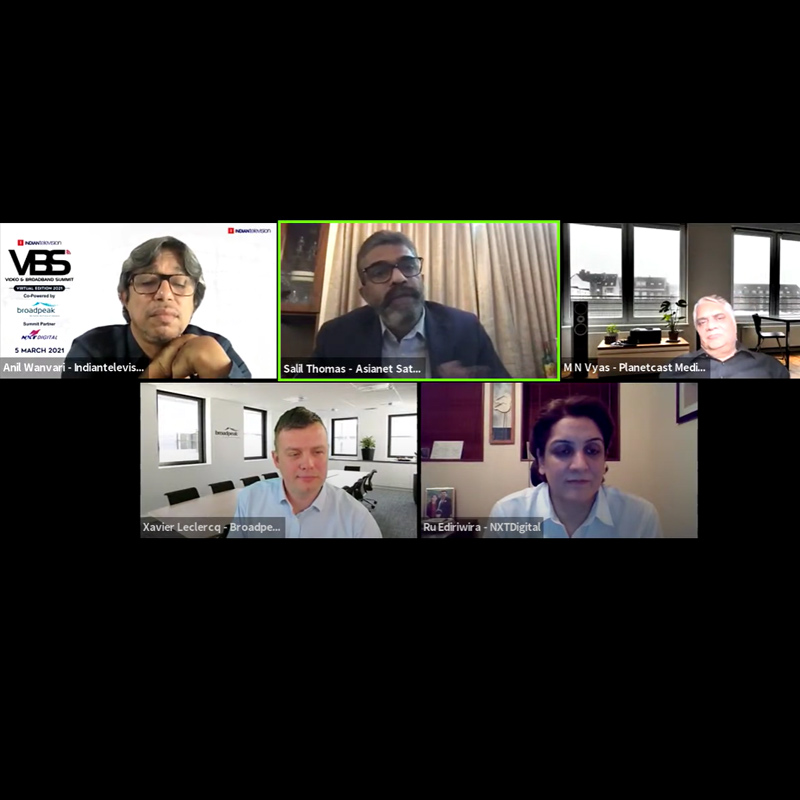
    KOLKATA: Cable television service, the biggest video service provider in India, now needs to look at new technologies for cutting down cost of operations as well as simpler content delivery. At a time when multi-system operators (MSOs) are extending their offerings to broadband services, IPTV network can be the way forward, experts opined at a session at the Video and Broadband Summit (VBS) 2021.

    The panel discussion, ‘Future proofing DPOs on video delivery solutions’ included NXTDigital group CTO Ru Ediriwira, Asianet Satellite Communications Ltd vice president & technology head Salil Thomas, Broadpeak Business Development vice president Xavier Leclercq, and Planetcast Media Services founder director MN Vyas and was moderated by Indiantelevision.com founder and CEO , editor-in-chief Anil Wanvari.

    Although 100 per cent future-proofing is hard to achieve, any organisation should be future-ready in terms of technology, Ediriwira said. “You don’t know what new technology will come around the corner and completely disrupt your industry, way of working. Look at social media, more kids watch YouTube than TV. You have to keep abreast of what is going on and how future generations are changing their content habits, viewing habits,” she added.

    Vyas agreed to the view that futureproof is something that is never possible. But the companies have to look at what is really needed at least in the next five years. According to him, a sea change is needed in the current distribution system. Broadcasters and DPOs have to realise that their role has to be minimal now and TV has to be more intelligent, he stated. The operators need to take an approach where they can take and leverage the existing resources along with adding new things.

    While looking at the future is important, working on the right technology at the right time is also crucial. Thomas explained that they launched a 4K Android TV set-top box three years ago but the boxes are still sitting in their inventory as consumers are not ready for that. Hence, catching up is important rather than jumping ahead of time, he explained.

    “There is a transition happening which is trying to focus more on new users, young audiences and having the ability to reach more screens. We are sort of moving away from the traditional broadcaster domain. This is an interesting turning point,” Leclercq noted.

    According to Ediriwira, the cable industry is seeing logical progression. However, while the industry is nine years into DAS, MPEG-2 slots are still around. While operators are making a push for MPEG-4 and HD boxes, they are a long way off from adopting 4K boxes. MSOs have the advantage, unlimited bandwidth to push 4K and 8K, but there is no content, she said. Moreover, if the industry is not able to sell a huge amount of HD boxes, take off of 8K or 4K boxes will not be possible either.

    “We are seeing people are moving to different devices like fire stick, Chromecast, plug it into TV and install an app and deliver to content. This is a relatively cheaper and cost-effective way of adding new devices and adding streaming applications. On top of it, the difficulty with this is some of the HD, 4K channels have trouble growing in ninjas. This is basically heavy for the networks, for each individual session coming from one of those set top boxes back to the network. You will basically load the network with unicast traffic,” Leclercq mentioned.

    Broadpeak has introduced a technology called MABR that can be used to push multi-screen ABR content (DASH, HLS) over an ISP network. That can be a cable MSO network for example, he added. This content can be pushed all the way to set top box and then it can be consumed by the end device. Operators are starting to build this multicast ABR proposition, he said.

    According to Thomas, IPTV DASH and multicast broadcast is a way forward. IPTV DASH replaces the traditional MPEG-2 TS video structure with a more flexible and adaptive technology. It essentially offers the best of both worlds – the greater flexibility offered by OTT combined with the scalability and low latency at stake with IPTV. It can reduce the huge cost of maintenance for cable networks.

    He added that the aging of cable networks is a big factor that should be considered. Rather than incurring high maintenance cost, it is better to go for fibre-based IP network which will cater to both cable and broadband services. It is better to move TV on the same platform, he stated. Vyas also agreed that someday the industry has to really get into IP deliveries.

    “It is a possibility and we most MSOs have now converted our network to fibre on which we are running both broadband as well as cable. The move to run a full IPTV network that is something any of us have not considered yet. It is very easy for us to drive everything as a broadcast mechanism on Radio Frequency box. But it is definitely worth considering as a potential future capability but at the moment most of us are focusing on trying to upgrade our networks to IP . We have to think about the last mile level also. That requires huge investment from each of the cable operators. We have to help them,” Ediriwira mentioned.

    She added that until that does not happen, the MSOs have to use current technologies. The operators are anyway upgrading their networks and moving to fibre. While she believes that operators should look at transitioning from cable broadcast mechanism to IP network mechanism, she is not certain how helpful it will be for rural areas.  

  • Domestic STB manufactures felt the pinch of Covid since January: Amit Kharbanda

    Domestic STB manufactures felt the pinch of Covid since January: Amit Kharbanda

    KOLKATA: The Covid2019 pandemic has hurt most businesses in India since the beginning of March. But the set top box (STB) manufacturers felt the pinch of crisis even before that, from January itself, MyBox Technologies managing director Amit Kharbanda said. Although the company ended up having six months of zero sales, it continued R&D in the interim for new products.

    Kharbanda explained that there are a decent amount of components that come from China, even for normal electronics products. As China went into shutdown from January, MyBox faced a shortage in components for manufacturing. He added that it has impacted all domestic STB companies.

    Furthermore, domestic STB companies have been struggling since ASEAN came into effect a couple of years ago. Big cable and DTH operators that used to buy products from domestic companies, switched to importing from ASEAN. Kharbanda emphasised that the competition in this space is not between Indian STB manufacturers but with the international players. In these challenging circumstances, MyBox has been able to survive as it tends to do R&D all the time whether it is with Google or Amazon, he stated.

    While the business environment was already tough for the players, the cash flow went for a toss post-Covid, Kharbanda added. The company had to cut down on its expenses. “Bankers started questioning the business model. It took time to get that issue streamlined and convince them, finding the right way of optimising the funding and everything. Now as all of that has been settled, we are hoping from this month onwards or next month we should start shipping. At the end of this year, we should at least come back closer to our quantities which we were shipping last year,” he said. MyBox sold 40 crore boxes in FY20.

    However, he mentioned that they kept up R&D during the lockdown. Some product launches including the android box, Alexa Solution have been delayed but the company has added new features during the period. Now as the business is opening up, it will release those products one by one.

    “We have been working on some very interesting solutions. One of these was the Android OTT box which we have tried to make valuable for ISPs. There are a lot of small ISPs in India. They can actually utilise the OTT box and give it as a package to their consumers. There is good ARPU source they can make on,” Kharbanda added.

    Talking about overall opportunities for STB manufacturers, Kharbanda said that India still has millions of TV unpenetrated households. Moreover, there is scope for old box replacements and new hybrid boxes. Even post-Covid, there has been a major demand for TV sets. But it does not translate into a huge benefit for domestic STB manufacturers as the large operators buy from international players, he rued. 

    Although the large DTH operators recently undertook ‘Make in India’ route for STB production, the move is more directed at getting foreign vendors here to assemble and sell rather than buying products from homegrown manufactures. However, he shared that MyBox is working closely with the government of India to push STB manufacturing here. Moreover, the ministry of commerce is also working on the issue and the ministry of information and broadcasting (MIB) is in talks with operators for boosting domestic manufacturing. Kharbanda is optimistic that these endeavours will give a much-needed nudge to the growth of STB manufacturers in India.  

  • Dish TV to push 50% STB manufacturing in India

    Dish TV to push 50% STB manufacturing in India

    KOLKATA: Dish TV India Ltd announced the manufacturing of its set-top boxes in India. Demonstrating its commitment to the government’s ‘Make in India’ vision, Dish TV India has shifted the production of its set-top boxes to India, adopting a ‘vocal for local’ strategy. The first consignment of made in India set-top boxes is ready and being shipped to the market. The company offers DTH services across the country and operates Dish TV, D2H, and Zing brands in this segment, besides its rapidly growing OTT service brand Watcho.

    Being the pioneer and technology leader in the DTH segment, Dish TV India plans to shift almost 50 per cent of its production to India by the Q1 of 2021 while simultaneously benefitting its business and customers. The process will further intensify in the coming months, as the company is planning to also start the manufacturing of the major components of the set-top box and its accessories in India, further boosting its commitment to ‘vocal for local’. Dish TV India plans to make the STB cabinet in India soon, has already started procuring the power adaptor from Indian manufacturers, and is in the advanced stage of talks with remote control manufacturers to produce the remote controls also in India.

    Elaborating Dish TV India’s ‘Make in India’ plan, Dish TV India chairman and managing director Jawahar Goel said, “We are thrilled to join the government of India’s ‘Make in India’ initiative and localize the manufacturing of set-top boxes and other key accessories in India only. This announcement reiterates our pioneering position within the DTH industry as we aim to further expand our business operations and develop products that match the intrinsic needs of our customers.  With the vision of ‘Make in India we reiterate our commitment to producing quality products and are confident that we can achieve several industry firsts. We thank the Government of India for all their support and favorable policies.”

    By shifting the production to India, the company looks at scaling manufacturing in the country and ways to enable industry revival. This will further assist them to streamline the supply chain, operations, and management. 

    Sharing the optimism, Dish TV India executive director and group CEO Anil Dua added, “Making our own STBs and accessories in India could not have come at a better time. Customer needs are evolving rapidly. As we refresh our STB range with a new set of connected devices and hybrid options, working with local design, development and production are definitely going to be a competitive edge for our business.”

    Innovation is at the heart of the Dish TV operations; the company is credited with many firsts in the industry. Launched the first DTH service in the country, Live TV for moving vehicle- DishOnwheels, High- Definition services, Unlimited recording facility in STB, Live TV in luxury trains, Online TV for DTH viewers- DishOnline, Sub-brand for the regional markets- Zing, Home Video System- DishFlix to name a few. More recently, Dish TV India is also the first to launch a voice-enabled (Alexa powered) Smart and Magic range of technologically advanced products and the first DTH company to launch its own OTT platform, Watcho.

  • Guest Column: Streamline Set-top-box, CAS specifications and save subscribers hundreds of crores

    Guest Column: Streamline Set-top-box, CAS specifications and save subscribers hundreds of crores

    Broadcast pay-TV in India is based on globally developed standards that enabled the fast and affordable deployment of innovative services, and intense competition. During the Covid2019 crisis, broadcast pay-TV cable and DTH platforms continued to provide consistent quality of service to all subscribers.

    In contrast, over-the-top (OTT) video streaming services required concerted interventions by broadcasters and mobile network operators to reduce video quality, bitrates, and reduce congestion. While Indian regulation of OTT video services has been very light touch, Indian broadcast pay-TV regulation has grown in complexity and cost since DTH services began in 2003. Not only are DTH and cable operators expected to divert time and resources into jumping through ever more convoluted regulatory hoops, but these additional costs would ultimately be borne by subscribers.

    Beyond India, the costs of over-regulation in various sectors have increasingly been recognised and challenged. In India, the rise of broadband internet penetration has provided direct access to new, large, well-funded foreign and local OTT players that are lightly regulated. The result is increased competition, which better serves subscribers and viewers than over-regulation.

    Read more news on TRAI

    Particularly effective measures taken elsewhere to reduce regulatory burdens have been to mandate:

    overall cost-benefit analysis for justification of all new regulations and changes, and

    sunset dates before which all regulations must be reviewed to ensure they are still justified, otherwise they automatically expire.

    Indian regulators would do well to adopt similar measures, both in policy and in practice, and save Indian subscribers hundreds of crores. The capex alone spent to support existing interoperability measures on DTH STBs have exceeded Rs 600 crore.

    TRAI’s bundling and pricing controls on content – both distribution and retail – have been widely critiqued. Also pernicious are its technology regulations – most recently its recommendations on set-top-box interoperability measures (10 April 2020) and mooted changes to the technical compliance framework for Conditional Access Systems (CAS) and Subscriber Management Systems (SMS) (Consultation Paper of 22 April 2020). Both are rooted in decades-old competition concerns, predating the internet age and massive advances in basic and digital literacy.

    The set-top-box (STB) regulations in particular fail to recognise that pay-TV operators are not in the business of providing devices, but of services. To the extent they are not prevented by regulation, broadcast pay-TV operators differentiate their service offerings with unique combinations of content

    and user experience, also VAS, and customer support.

    Read our coverage on set-top boxes

    The level of “interoperability” TRAI’s measures would enable – video and audio from one pay-TV platform to be able to be seen and heard via an STB owned by a competitor – were questionable in 2003, when STBs were relatively costly compared to dishes and installation, and the content and user experiences almost unknown without a service subscription. 

    In 2020, almost anyone can preview videos on the pay-TV providers’ websites, via search engines, or online review sites and make well-informed choices. Pay-TV operators must meet a plethora of regulated quality of service criteria in addition to bundling and pricing criteria. And for those who remain too cautious to commit, STB rental is available from all pay-TV operators.

    Unfortunately, TRAI has not performed a cost-benefit analysis on STB interoperability recently, if at all. Costs of interoperability to be borne by all subscribers are quantifiable in terms of capex and opex for each pay-TV operator platform and delays to other road-mapped innovations, which could bring greater benefit to more subscribers. If there is any benefit of TRAI’s recommended interoperability measures, it has never been quantified, nor even systematically estimated, at least not publicly. The capex alone spent to support existing interoperability measures on DTH STBs has exceeded Rs 600 crores, just for the common interface sockets. The benefit to subscribers and viewers has been zero for this white elephant, that all have paid for and none have benefited from. And at the end-of-life, the extra plastic and metal from these STBs are destined for reprocessing or landfill.

    The choice of USB port-based interoperability makes the TRAI recommendation appear simple. The simplicity of “plug and play” devices to the user hides huge amounts of standardisation and pre-integration work between USB hosts (STBs) and clients (USB dongles). Content and revenue security and subscriber privacy requirements, plus a history of USB malware exploits targeting embedded systems, make for a large development overhead to support TRAI’s recommended measures without compromising security.

    India-unique security requirements also need India-specific standardisation and pre-integration. Costs will again be borne by all existing and future Indian broadcast pay-TV subscribers, for no obvious benefit to any. The existing technical compliance framework for CAS and SMS was meant to ensure minimum content security performance, functionality, and features across platforms and maximum real choice for subscribers, as more content would be made available to each platform complying with this framework.

    Although it has not entirely met its objectives, specific incremental changes to the existing framework are preferable to establishing a new framework. Increased auditing capability is needed – especially more technical expertise – to minimise delays and reduce the number of spurious compliances reported. There is also the need to augment, revise and tighten the security parameters within the framework in line with global developments, to schedule future periodic revisions, and to provide a mechanism for urgent out-of-schedule revisions to address exceptional situations. But there is no need to constitute a brand-new framework from scratch.

    In summary, TRAI’s recently recommended set-top-box interoperability measures and mooted changes to the technical compliance framework for CAS and SMS threaten to disrupt a sector facing increasing external competition from lightly regulated OTT video and fierce internal competition. Costly, resource-diverting, and time-consuming changes to broadcast pay-TV now, due to redundant early 2000’s concerns, should be avoided. In regulating the most dependable, differentiated, and diversely available pay-TV services, take great care, and first, do no harm!

    For further details, please refer to Synamedia’s responses to the relevant TRAI consultations:

    https://www.trai.gov.in/sites/default/files/Synamedia_19122019.pdf and here:

    https://www.trai.gov.in/sites/default/files/Synamedia_04062020.pdf.

    (The author is Synamedia India Sales head Deepak Bhatia. The views are personal and Indiantelevision.com may not subscribe to them.)