Tag: SET Discovery

  • ‘Ten Sports’ distribution is open for negotiations’ : Gurjeev Singh Kapoor – Set Discovery head

    ‘Ten Sports’ distribution is open for negotiations’ : Gurjeev Singh Kapoor – Set Discovery head

    Riding high on the ICC World Cup, Set Discovery reaped a harvest of $120 million (around Rs 4.8 billion) in 2006-07.

    The challenges, though, are stiff this year as flagship Hindi general entertainment channel Sony TV is floundering. But direct-to-home (DTH) revenues will start kicking in substantially as subscribers have doubled. And the cricket play is not over yet.

    The One Alliance, Set Discovery’s brand, has recently added three news channels from TV Today including Hindi market leader Aaj Tak. It is also planning to form regional bouquets with presence in Tamil, Telugu and Bengali markets.

    In an interview with Indiantelevision.com’s Sibabrata Das, Set Discovery head Gurjeev Singh Kapoor speaks about the distribution company’s interests in bidding for Ten Sports and HBO as they come up for grabs while chalking out its expansion plans.

    Excerpts:

    Will Set Discovery manage to retain its last fiscal revenue of $120 million in a year where it doesn’t have strong cricketing properties?
    I wouldn’t like to comment on the revenue front. But we would surpass it this fiscal, thanks to DTH (direct-to-home) where the numbers have doubled. We are also close to signing up with Reliance ADAG and Bharti Airtel’s upcoming DTH ventures. We have done IPTV deals with players like IOL Broadband, HFCL and Aksh Optifibre. And don’t forget that Ten Sports had a lineup of live cricket telecast.

    But Ten Sports admits that not having India cricket will affect their ad revenues this fiscal. Won’t this same logic extend to distribution?
    Ten Sports is a good sporting channel for distribution. Though it doesn’t have live India playing content this fiscal, we could capitalise on other cricket as it was exclusive. Having no India cricket may affect advertising. But our experience shows that distribution profits if there is live and exclusive content on the channel. Besides, Ten Sports has WWE which is a good property for distribution.

    Will Ten Sports not slip out of The One Alliance after the term ends in March 2008, particularly after Zee has taken a 50 per cent stake in the sports channel?
    Ten Sports’ distribution is open again for negotiations, despite Zee having taken a 50 per cent stake. The channel strategically helped us in pushing our bouquet and with the ICC World Cup, we had back to back cricketing properties. We gained from the ‘synergy effect.’ We are going to bid for it again. The distribution is up for grabs.

    Why didn’t Sony bid for the ICC World Cup, if it is crucial to have a cricketing property to push distribution bouquets?
    Our experience shows that on the distribution revenue front, it is always good to have 2-3 boards if you are getting live and exclusive cricket. We, undoubtedly, gained in subscription revenue because of the World Cup. But it is also true that we couldn’t encash on smaller markets because the World Cup is a largely shared property. We had to share with Doordarshan the India and other important big matches.

    Which is why Sony bid and took the New Zealand cricket board?
    Our cricket story will not stop there. We are looking at cricketing properties that make business sense for us. The thought process is that we will bid for IPL and other boards that come up for renewals.

    We are actively seeking a regional presence. We are looking at having Tamil, Telugu and Bengali channels

    Sony was in talks to distribute Neo Sports. Did it fail because Neo was asking for very high minimum guarantees?
    We couldn’t agree on the commercial terms. Though Neo has the BCCI rights to international cricket played in India, matches will have to be shared with DD. We felt the asking price was on the higher side.

    Set Disocery has recently signed a pact with TV Today Network to distribute Aaj Tak, Headlines Today and Tej. Will Aaj Tak help you to push Sony TV, which has weakened its position, and Sab TV in the Hindi heartland?
    It will complement our two Hindi general entertainment channels. But more than that, it will open up the Hindi news channels to go pay. Star News and Zee News are virtually free. As Aaj Tak is the No. 1 in its genre, cable operators will now have to understand that Hindi news channels are also pay. Already NDTV India is planning to go pay.

    Our bouquet will have pay channels in every genre. We already had NDTV as the leading English news channel; and with Aaj Tak, we will now have the leader in the Hindi news segment.

    How much of an upside do you see in revenue terms?
    The only way we can ask for more revenues from cable operators is by expanding our content. As we are adding the three TV Today news channels, we are hiking our second bouquet price from Rs 58 to Rs 65. We have a 40-month deal with TV Today which extends across all distribution platforms – cable, DTH, IPTV.

    Is The One Alliance planning to add more channels?
    We will be pitching for English movie channel HBO as its distribution deal with Zee Turner comes up for renewal early next year.

    What about forming regional bouquets?
    We are actively seeking a regional presence. We are eagerly looking at having Tamil, Telugu and Bengali channels. While Andhra Pradesh has an estimated 11 million cable households, in case of Tamil Nadu it is 10 million and West Bengal five million. Even if we manage to convert 50 per cent of that, that is a lot of pay revenues. Kerala is not on our radar as even popular channel Surya is free-to-air.

    Along with the regional channels, we can push our national bouquet more aggressively into these markets.

    Will more existing channels go pay as carriage fee shoots up?
    Several existing channels are looking to go pay fast. Carriage or placement fee is going to shoot up and up as cable networks have no frequency available. Between Star, Set Discovery, Zee Turner and ESPN Star Sports, there are about 70 pay channels. So where is the space on analogue cable. Bandwidth is going to be a big problem for everybody to handle.

    The telecom regulatory authority of India (Trai) has asked for a la carte pricing from broadcasters in non-Cas (conditional access system) areas. Do you see this contributing to more carriage fee?
    If the tariff order sails through, Trai will actually be promoting carriage as a concept. The multi-system operators will charge for carrying the channels while we have to offer them on an a la carte basis.

    Why has Sony moved the Tdsat (Telecom Disputes Redressal and Settlement Tribunal) against the Trai tariff order for non-Cas areas?
    We have two points of contention. Even if broadcasters offer channels on a la carte basis, how do we get paid for the exact number of our subscribers? The other reason is that we will have to reduce the rates of our channels for non-Cas areas. In Cas areas we do so but are compensated in a way because there is exact declaration of subscribers.

    And for whose benefit is this a la carte rate for? How the hell does the consumer benefit as technology won’t allow for a la carte choice of channels without a set-top box?

    If the Trai tariff order for non-Cas areas goes through, it will be a disaster for the broadcasters. It will send bad signals to a new channel wanting to come to India.

    Aren’t broadcasters also unhappy with the progress of Cas?
    For the first time, all of us came under one roof to foster Cas. But what we realised is that MSOs were in a way curbed by the last mile operators who did not want Cas.

    We are concerned about the low penetration of set-top boxes. There was the T20 World Cup on ESPN Star Sports, India won the championship, and it was live and exclusive. How in a Cas market, there was no big upside? This defeats the purpose of Cas and leads to a lot of questions.

    Besides, Trai came out with a particular reporting format, but we haven’t got anything of that from the MSOs. We have no choice but to knock at the doors of Trai. We want the sector regulator to intervene.

    Why aren’t broadcasters joining hands with MSOs to market for set-top box penetration?
    We are willing but the MSOs have internal problems. The last mile operators see a bigger threat from digital cable rather than DTH.


    How do you see new entrants impacting the market?
    Competition is healthy for everybody so long as the new MSOs can invest in technology and have financial stability. If cable monopolies are attacked in towns, it means more choice for customers and more revenues for us.

  • ‘Higher price cap than Rs 5 would have allowed us to play within that float’ : Anuj Gandhi – SET Discovery president

    ‘Higher price cap than Rs 5 would have allowed us to play within that float’ : Anuj Gandhi – SET Discovery president

    SET Discovery has been riding high on the wave of ICC cricket for over four years. Having the ICC Championship and World Cup in a single year, the company is targeting a 40 per cent growth in turnover to end 2006-07 at Rs 4.5 billion.


    In an interview with Indiantelevision.com’s Sibabrata Das, SET Discovery president Anuj Gandhi talks of the challenges digital cable faces and how the distribution scenario would shape up in future to impact the pay-TV broadcasting business in India.


    Excerpts:

    Are you happy with the way Cas has rolled out so far?

    We are terribly disappointed. The multi-system operators (MSOs) were not fully prepared. Their systems were not in place and there weren’t enough set-top boxes (STBs). Some operators were even providing boxes without smart cards.

    MSOs say broadcasters created an uncertain environment till the end by approaching the courts. Isn’t it true that they got very little time for actual preparedness?

    There was enough indication that Cas would happen. We were challenging the pricing and not introduction of Cas. Broadcasters signed their contracts with the MSOs on time. Some local cable operators (LCOs) who were against Cas, moved the courts but could get nothing in their favour. If Cas has to take off, this blame game has to stop. All the stakeholders have to play their role.

    Is it a case of low consumer demand for boxes?

    That is a separate issue and, if need be, can be tackled with different marketing schemes. We are in a situation where the MSOs aren’t quite ready. There is lack of information flowing into us, the subscriber forms have not been filled up, and in some Cas markets analogue signals are available of popular general Hindi entertainment channels in prime time.

    Why then couldn’t this market substantially move to direct-to-home?

    DTH is more expensive. It has a higher entry price and there is no big subsidy on the STBs. Besides, DTH operators took time to service this market. With cable operators not capitalising heavily on Cas, we have lost an opportunity to create a build up for a massive ramp up in demand for STBs at the time of the World Cup.

    Will the World Cup drive a 40 per cent penetration in STBs as predicted by some positive analysts?

    We see the World Cup acting as a catalyst and expect the STB penetration to touch 45-50 per cent in the Cas markets. Only when we reach that level can all the stakeholders make money. Already DTH service providers Tata Sky and Dish TV have announced their schemes for the World Cup. MSOs should also be sorting out their issues and coming out with a plan for the big event.

    Is SET Discovery targeting a revenue of Rs 4.5 billion in 2006-07 on the back of the World Cup?

    We have set an aggressive target this year and are going to hit it. We will benefit from key cricketing events like the ICC Champions Trophy and the World Cup. Besides, we had cricket on Ten Sports. For the first time, we would be capturing revenues from DTH as we signed up Dish TV and Tata Sky during the year.

    Will Cas affect the business?

    In the overall scenario, Cas has a very limited number of cable and satellite homes. Besides, Cas has come into effect only in the last quarter of the fiscal.

    Do you see broadcasters dropping prices of their weaker channels in a bid to push sale of STBs?

    With a price cap on a la carte channels at Rs 5, it won’t make business sense to further drop rates. The whole justification for this is to have higher volumes. But we could have got the current levels of box penetration with a more liberal pricing.

    DTH growth for the last six months has been as we had expected. It is only digital cable numbers which have been disappointing

    Are you suggesting a price ceiling but at a higher rate?

    This would have allowed us to play within that float. We could have weighed the weaker channels, observed their relative strengths in the marketplace, and come up with a differential pricing while staying competitive. The whole subscription model at Rs 5 doesn’t give us scope for such pricing play and is unfair to niche channels. There is precious little that content providers can do and dropping prices would be bad for the MSOs as well. Besides, we haven’t yet got any billing data from the MSOs on the Cas subscribers to chalk out a strategy.

    Are you planning to take any action as the deadline has crossed?

    It should have come to us by 15 February, but we haven’t received any information from them yet. If we don’t get any feedback from them in the next few days, we will issue them notices as specified by the Telecom Regulatory Authority of India (Trai) in order to safeguard our interests.

    Trai is trying to push for voluntary Cas. How do you think this can speed up in other parts of the country?

    Digitisation is a reality but will take a while to happen. Cas has been a learning process and we have to evolve a phase-wise strategy for digitalisation. We have to fix a sunrise and a sunset date where we have to give adequate time taking into account availability of boxes, prices and investments by MSOs.

    MSOs are saying that broadcasters should be more understanding and not ask for more subscribers in voluntary digitalisation as the collection of money from the LCOs doesn’t improve. Isn’t entering into commercial agreements between MSOs and broadcasters crucial for the success of voluntary Cas?

    The analogue and the digital markets have to be distinguished. The MSOs can’t argue that they can’t recover money and so can’t pass it on to us. Then how will broadcasters make money from voluntary Cas? There has to be some incentive for broadcasters to push for digitalisation.

    In the newly notifuied Cas market, we are seeing a three-MSO play. Do broadcasters welcome such a strong wave of consolidation?

    There shouldn’t be a problem so long as the business is transparent. If there was one monopoly player emerging in the cable TV distribution arena, then it would have concerned us. Besides, the market is large enough for other players to emerge. And the independent operators who have aligned with the MSOs would continue to remain as franchisees. We don’t see them disappearing from the chain.

    Will carriage spread to new towns where Tam has expanded its reach?

    It is too soon to say how carriage will impact in Tam’s new panel. A lot will depend on how the channels are getting affected. The market has more or less stabilised. Broadly, however, as ratings towns get added, carriage will move there. But I don’t see budgets of broadcasters towards carriage really bloating. What would happen is that they would be picking and choosing the places where they want better placement and carriage.

    When do you see DTH significantly contributing to the kitty of the pay-TV broadcasters?

    It will take DTH a while for getting those numbers. But it has certainly started impacting the business because MSOs are having to think twice before blacking out channels so that they don’t upset their subscribers. And DTH growth for the last six months has been as we had expected. It is only digital cable numbers which have been disappointing, but we will soon see that changing too.

    SET Discovery will have no cricket to play with in the next fiscal while in the GEC space, Sony TV is dropping in ratings. How tough will it be for the company to post growth?

    Cricket, no doubt, is a big play in India. In a MSO market, you can still do with no big impact hitting us. But when you go down into the interiors, this is the only driver. We have grown rapidly for over four years on the back of cricket. We will try to maintain what we have and ask for realistic increases. But we have no channel as such that will make carriage on cable networks a problem; there is strength in our bouquet.

  • ‘As an industry, we should support unregulated Cas’

    ‘As an industry, we should support unregulated Cas’

    SET Discovery president Anuj Gandhi offers his take on how the distribution scenario would shape up in 2007 in the wake of digital cable and direct-to-home (DTH) penetration.


    The year 2006 was when broadcasters consolidated their businesses and made money on the second bouquet. The incremental increase in revenues for distribution companies largely came from this.


    The combined growth in pay TV revenues was in the region of Rs 2.5-3 billion. This included the southern channels and later in the year Sun TV, the most popular channel in the region, also turned pay. Star One, which had problems in Mumbai and Kolkata, got established. We also made money from our second bouquet.


    Direct-to-home (DTH) also became a reality in the year. Though it took time, Star India and SET Discovery bouquets were available on DTH as rates became realistic.


    On the cable TV front, progress was made towards implementation of Cas (conditional access system). The Telecom Regulatory Authority of India (Trai) came out with more definite regulations and there was intervention from the various courts. Unlike 2003, Cas definitely is more structured and planned this time. It, however, remains to be seen in 2007 whether it turns out to be a success or not.


    The big story in 2007 would be DTHccccccccccccccccccccccccccccccccccccccccccccccccccc and digital cable. Pay broadcasters would expect to net Rs 3.5-4 billion from DTH and the bulk of it would be incremental without eating into cable TV.


    We should see deals being struck on all addressable platforms. Digital cable, voluntary Cas, Headend-In-The-Sky (HITS) should all become a reality and make economic sense to distribution companies like us. As an industry, we should support unregulated Cas. Things will take time to settle down till digital gets in mass volumes.


    The big problem area should be a la carte pricing, but I don’t see channels deciding to price themselves individually below Rs 5. We would also see bouquets emerging in the Cas areas. It won’t be easy for consumers to forget the channels that they were receiving for so long. Family packages, properly priced, should take off. Pricing and a lot of other things, though, will depend on volumes.


    Equations will change in carriage payouts to multi-system operators (MSOs). As ratings towns get added, carriage will move there. And these towns would not have a digital story. But I don’t see budgets of broadcasters towards carriage really jumping. What would happen is that they would be picking and choosing the places where they want better placement and carriage.


    IPTV will see trial runs in 2007 but the commercial launches should happen only a year after that. All in all, there will be lot of changes in the marketplace in 2007.

  • Delhi High Court, Tdsat refuse to grant stay on Cas

    Delhi High Court, Tdsat refuse to grant stay on Cas

    NEW DELHI: This seems to be the last word on Cas (conditional access system). The Delhi High Court and Tdsat (Telecom Disputes Settlement and Appellate Tribunal) today made it clear in separate verdicts that Cas had to roll out on 1 January, ending the efforts of broadcasters and some multi-system operators (MSOs) to obtain a stay.

    The High Court heard arguments in two appeals clubbed together, filed before it against the roll out of Cas, while Tdsat heard appeals against the tariff rate being fixed at Rs 5 per channel as well the interconnection order by Trai, regarding sharing of revenue between the MSOs, last mile operators (LMOs), and the broadcasters.

    The Delhi High Court, refusing to grant more time to MSOs, said that there is no question of Cas not being rolled out on the notified date. It asked the two petitioners to file replies which will be heard after the court vacation ends.

    Star Broadband Services, a MSO in Delhi whose licence for operating under Cas had been cancelled by Trai in an order dated 14 December, had moved the court saying that it was getting ready for Cas roll out but needed more time.

    NGO Shakti had filed application seeking postponement on the ground that the MSOs were not yet ready with the infrastructure for Cas implementation on the due date. Hence, Cas should be postponed indefinitely.

    Meanwhile, in a separate hearing, the Tdsat declined to grant stay on an appeal filed by ESPN and SET Discovery.

    The Tdsat sat through the final arguments by Trai and MSOs and the rejoinder by the broadcasters (ESPN and SET), and asked them to file written submissions, to be taken up after the vacation, but said that nothing that would be argued or heard later would mean that Cas will not roll out on the impugned date.

    The Tdsat had been told earlier by the broadcasters’ counsels that there was no rationale in the tariff fixed and that the Chennai model, where Cas had been found to be effective without Trai intervention in pricing, had left the subscribers happy. The broadcasters held that the ‘facts’ shown by Trai and the ‘assumption’ on which they based their order were mutually contradictory.

    The counsel for SET Discovery dubbed this as non-application of mind, and said this was unacceptable when Trai is issuing such a momentous order that would govern the industry for a long time.

    The counsel for the broadcasters said that Trai’s fixing of price was based on such arbitrary assumptions that went against the survey report quoted by the Authority itself.

    The Trai senior counsel, in his argument yesterday, had caused a flutter in the court, showing that the broadcasters had completely failed in Chennai and that only 3.7 per cent of the total cable households there had opted for pay channels because the prices fixed by the pay channels were too high.

    This revelation had almost every sit up, and the judges had asked whether this means that Chennai cable homes had the option of both CAS and non-CAS operation. Trai senior counsel Rakesh Dwivedi said that was correct, and that the vast majority had not take the offer.

    Dwivedi also argued that the Chennai model in any case could not be extended to Mumbai, Kolkata or Delhi, as in Chennai, four out of the five most popular channels are FTAs, and only one of the top five is a pay channel The case is the reverse with the other three metros.

    In fact, he argued that by fixing the ratio of revenue sharing at 45 per cent, Trai had actually given the broadcasters three benefits at one go: it has got rid of underdeclaration as a perennial problem; cut out ‘piracy’ that broadcasters had accused LMOs of indulging in; and given them a 300 per cent rise in their revenues.

    He argued that the broadcasters had complained that under the present system of operations, the LMOs and MSOs retain 85 to 90 per cent of the revenue from subscriotion, and only 15 per cent reach them, and that too becomes difficult to collect. “We are ensuring them a 45 per cent share and besides, the bulk of their revenue, as they claim, from advertisements remains intact,” the Trai counsel said.

    The counsel for SET Discovery today in his rejoinder said that while Trai had the legal authority to fix the tariff, it was the manner in which that had been done that bordered on perversity.

    His argument was that the Trai had itself admitted that there was not enough material on which the fixation was based.

    The SET Discovery counsel held that Trai had been referring to a document, an IMRB survey that was two and half years old and today could not be valid, since so many FTAs have now become pay channels. He said also that the budgets of households had increased manifold and that Trai had fixed the tariff without adequacy of material to support that pricing.

    Besides, the Trai had so long not brought up the issue of the IMRB survey, which had not been mentioned in the Consultation Paper issued by Trai, nor in later discussions, and was only using it to justify a wrong decision taken without any basis.

    The SET Discovery counsel also held that the Trai itself had repeatedly admitted in the court that any price fixation is arbitrary. The price, thus, fixed could not be held to be legal.

    SET Discovery’s last plea was that Tdsat should ask Trai to undertake a fresh survey and base the new tariff fixation on that. He said that actually the price fixed should be around Rs 10 per pay channel, and that if the price is fixed now at Rs 5, then there would never be an upward revision, even if Trai held a review. Public ire would prevent that upward revision, if Trai did the review at all, which he doubted would ever happen in actuality.

  • SaharaOne and Filmy accept CAS ceiling price of Rs 5

    SaharaOne and Filmy accept CAS ceiling price of Rs 5

    MUMBAI: Sahara One Media and Entertainment Ltd have let the 15 October deadline pass to inform sector regulator Telecom Regulatory Authority of India (Trai) the channel price fixed for the notified areas under conditional access system (CAS).

    The company, which manages general entertainment channel SaharaOne and movie channel Filmy, has acknowledged the ceiling price of Rs 5. 

    The two channels switched to the pay mode in September. 

    The regulator had set a common price on all pay channels directing that under CAS regime they will cost a maximum Rs 5/- per channel per subscriber per month (excluding taxes).

    Ahead of the deadline, most pay broadcasters including Star India, Set Discovery, ESPN Software, Raj TV Network, Sun TV, Udaya TV, Gemini TV limited, Ushodaya Enterprises Limited, B4U Television Network, Sun TV, Udaya TV and Gemini TV, British Broadcasting Corporation (BBC) and Zee Turner Ltd had agreed to the price and declared the charges of all the channels.

  • Tata Sky launches DTH service; STB price Rs 3999, basic subscription Rs 200

    Tata Sky launches DTH service; STB price Rs 3999, basic subscription Rs 200

    NEW DELHI/MUMBAI: Tata Sky Ltd, the $ 500 million joint venture between Tata Sons and the Rupert Murdoch-owned Star Group, today officially announced its arrival as India’s second DTH platform after Dish TV.

    Tata Sky is kicking of its service in 300 cities at an “introductory” monthly subscription of Rs 200 for the 55-odd channels it presently has on the platform.

    Price: hardware+installation Rs 3,999
    Monthly subscription: Rs 200
    No. of channels available: 55+
    Present area of service: 300 cities
    1st year target: 1 million subscribers
    Investments made till now: over Rs 25 billion
    Most critically, the Tata Sky set top box (supplied by News Corp owned NDS)
    has been priced at Rs 3,999 (inclusive of taxes). This includes installation
    and hardware cost and a full service warranty for one year.

    However, along with the monthly subscription of Rs 200, the Tata Sky offering will be more expensive than rival Dish TV’s package.

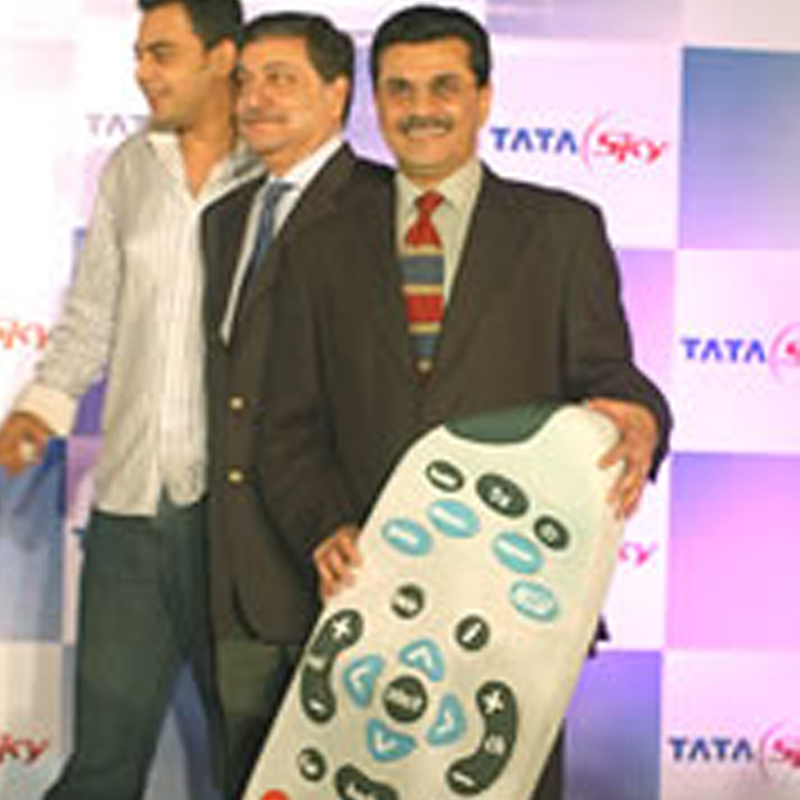
    Tata Sky CEO and MD Vikram Kaushik with Tata Sky chairman Ishaat Hussain
    Click here for a slideshow
    The Subhash Chandra-owned Dish TV is priced at Rs 3,290 (inclusive of taxes). This includes the cost of the STB as well as three months’ subscription. The monthly subscription for the basic Dish TV service of 75 channels is Rs 180.
    Announcing the launch at a glitzy event in Delhi where the likes of cricket commentator Harsha Bhogle rubbed shoulders with Mandira Bedi, Tata Sky MD and CEO Vikram Kaushik grandly proclaimed, “Entertainment will never be the same again.”

    Going on to harp on the state-of-the-art technology and finesse of the service, Kaushik added, “It’s a technological innovation that’ll bring the senses alive.”

    Apart from the many channels on the Tata Sky platform, a conspicuous absentee is the Zee Turner bouquet of over 20 channels as an agreement between Tata Sky and Zee Turner Ltd has not yet been concluded.

    Kaushik admitted that negotiations have not been concluded, but was hopeful that “things would get sorted out soon.”

    Another major absentee is the Sun Network, which dominates the South Indian markets. Tata Sky is, however, not alone in this, since Dish TV does not have access to the Sun channels either.

    “We are offering 55+ channels at the moment and with the passage of time the number of offerings would grow,” Kaushik said.

    The channels presently available on the non-tiered Tata Sky platform include all the channels from the Star (17), Sony Discovery One Alliance (14) bouquets as well as ESPN Star Sports and two channels of NDTV as its key offerings.

    It is worth noting here that it was only this morning that the deal for the carriage of the One Alliance channels by Tata Sky was signed and delivered.

    Confirming this to Indiantelevision.com, SET Discovery president Anuj Gandhi said the pricing terms was similar to the one signed recently with Dish TV.

    One Alliance is being paid around Rs 38 per subscriber by Dish for its channels. The deal is a five-year one that is extendable at the end of it, Gandhi revealed.

    Also available on the Tata Sky platform would be some Doordarshan channels as well the likes of Times Now, Aaj Tak, Headlines Today, etc. Some interactive and specially designed movie channels have also been thrown in as a sop.

    The Tata Sky service, Kaushik claimed in the presence of his company chairman Ishaat Hussain, has been designed to give subscribers “choice, control and convenience” in the way they want to watch television.

    A host of interactive services such as an on-screen programme guide, Actve Sports, Actve Star News, Actve Newsroom and Actve Khabar are also on offer.

    To offer maximum convenience to subscribers, Tata Sky has set up a pan-India distribution network of popular consumer electronic stores and mobile phone outlets for retailing its hardware and prepaid recharge vouchers.

    The pre-paid vouchers come in various denominations starting off with Rs 260.

    The company has also tied up with LG, ITC International Business Division and Indian Oil Corporation as part of its distribution drive.

    “We are looking at ramping up our activity and service over the next three months when the service should be covering the whole of India,” Tata Sky consumer marketing head Vikram Mehra said.

    The company has engaged a field force of approximately 3,000 people who will be complemented by a high-end 24×7 call centre, manned by multi-lingual customer service associates, trained to solve all customer problems.

    But Mehra was not forthcoming on the media campaign that’s about to break “soon”, except to say that it would be a 360 degree campaign using all normal media outlets.

    Tata Sky is an 80:20 DTH joint venture between the Tata Group and Hong Kong-based Star Group.

    The joint venture has invested over Rs 25 billion in the project till now, according to Kaushik, who added the target of 1 million subscribers in the first year is achievable.

    The unveiling of the Tata Sky service finally turns into reality a dream Murdoch has had since 1997 – of having a DTH platform in India

  • Set Discovery promotes Gurjeev Singh Kapoor to SVP, sales & marketing

    Set Discovery promotes Gurjeev Singh Kapoor to SVP, sales & marketing

    MUMBAI: Set Discovery Pvt. Ltd., which distributes a bouquet channels under the brand name One Alliance, has promoted Gurjeev Singh Kapoor to the position of SVP, sales & marketing.

    In his new position, Kapoor will look after the company’s India sales and marketing operations. He will also take up the additional responsibility of international marketing.

    Based out of Mumbai, Kapoor will be reporting to Set Discovery President Anuj Gandhi.

    Set Discovery has also promoted about 17 executives in the junior and middle level management categories, across the country. “We have promoted people across the board. There are senior managers who have become AVPs and managers who have been assigned as senior managers,” informs Gandhi.

    Kapoor has earlier worked with ESPN and Zee International before joining Discovery Communications. He moved to Set Discovery in April 2002, when the joint venture between Sony Entertainment Television and Discovery Communications was formed.

    SET Discovery distributes channels including Sony Entertainment Television, Max, Discovery, Ten Sports, Discovery Travel and Living, MTV, Sab TV, AXN, NDTV India, NDTV 24×7, NDTV Profit, Nick, Animal Planet and Animax channels through the One Alliance brand.