Tag: Security

  • Anker sets bold new course with AI, robotics and solar at IFA Berlin

    Anker sets bold new course with AI, robotics and solar at IFA Berlin

    BERLIN: Anker Innovations, the Chinese consumer-tech firm best known for power banks and chargers, is no longer content with cables and batteries. At IFA 2025 in Berlin, chief executive Steven Yang unveiled a sweeping new brand direction, positioning the group as a global leader in “smart hardware” and pledging to “ignite new possibilities through ultimate innovation.”

    The company will now operate under three unified marques: Anker for charging and energy, Eufy for home and security, and Soundcore for audio and entertainment. Yang told the audience that the pivot is rooted in three principles: break problems down to fundamentals, pursue higher standards rather than easy wins, and grow together with partners and users. The rhetoric, he said, would drive a “maker spirit” across the group — more workshop than corporate HQ.

    IFA saw the debut of the EufyMake UV Printer E1, marketed as the world’s first personal 3D-texture UV printer. Already the most funded Kickstarter hardware project ever — raising $46m from 17,000 backers — it ships to early adopters now and will reach retail in December at $2,499 / €2,499. Bundled with upgraded AI design tools, it promises to turn sketches or photos into textured prints on wood, leather or metal.

    Eufy’s Omni S2 robot vacuum introduced HydroJet 2.0 scrubbing and a 30kPa AeroTurbo cleaning system capable of deep-cleaning carpets and crossing five-centimetre obstacles. More eye-catching was Marswalker, a robotic carrier that lugs the S2 up and down stairs — a long-standing Achilles’ heel of robot vacuums. Marswalker will ship in the first half of 2026.

    In security, Eufy announced AI Core, a large-model agent running locally in the home to detect over 100 scenarios, from package deliveries to trespassers, while keeping data off the cloud. Its companion, the eufyCam S4, is a hybrid 4K/2K PTZ camera promising panoramic views and facial detail up to 15 metres.
    Soundcore meanwhile stretched from earbuds into wellness and theatre. The Sleep A30, a pair of ANC sleep buds already selling in the US, has reached Europe. They adaptively cancel noise and play AI-generated brainwave audio to tackle snoring and other disruptions.

    The brand also introduced a coin-sized wearable voice recorder with real-time transcription and 97 per cent accuracy across more than 100 languages, aimed at students, professionals and journalists.

    Perhaps the boldest move was absorbing Anker’s Nebula projector business, reborn as Soundcore Nebula. The flagship X1 Pro projector, launching on Kickstarter on 23 September, combines a 4K triple-laser engine with Dolby Vision video and Dolby Atmos multi-channel audio. Its detachable wireless speakers and powered subwoofers turn it into what Soundcore dubs the world’s first “mobile theatre station.”

    Anker’s own division doubled down on power. Its new Prime line adds AnkerSense View smart displays to show charging speeds and temperatures. The Prime 160W charger, Prime 300W power bank, Qi2 wireless charging station and triple-display docking station all pitch efficiency and compact design as their edge.

    The group’s energy arm, Anker Solix, launched the Solarbank Multisystem, a modular kit linking up to four Solarbank units with 14kW solar input and 4.8kW output. Targeted squarely at Europe’s high-tariff households, it promises up to 80 per cent savings on energy bills and a four-year payback period. Its semi-DIY installation is marketed as 85 per cent cheaper than conventional solar. Complementing it is the V1 Smart EV Charger with gesture-based control and tariff-synchronised charging. The starter kit begins at €1,898, with the EV charger priced at €499. Germany gets it first, with France and the Netherlands following on 11 September.

    The showcase in Berlin marked more than another tech fair launch. Anker is re-casting itself as a systems company, fusing AI, robotics and renewable energy into everyday hardware. If successful, Yang’s bet could move the firm up from niche accessories into the ranks of household consumer-tech giants. The risk is execution: a vacuum that climbs stairs and a solar charger that pays for itself in four years are promises the market will hold him to.

  • Airtel’s AI solution flags eight billion spam calls in 2.5 months

    Airtel’s AI solution flags eight billion spam calls in 2.5 months

    MUMBAI: Remember the days when our phones buzzed incessantly with spam calls, and we wished for a magic wand to make them disappear? It felt like a far-off dream, especially during those pandemic days when AI was making life easier in ways we never imagined. Fast forward to today, and the digital universe is buzzing with AI tools for every conceivable purpose—yet the menace of spam calls persisted, poking its nose into our daily peace.

    But then, Airtel stepped in, promising us relief with its AI-driven spam-blocking innovation. The big question was: would it truly work, or would it just be another tech gimmick? Well, the results are in, and they’re nothing short of astonishing, albeit with a sprinkle of curiosity.

    In just 75 days, Airtel’s AI flagged a jaw-dropping eight billion spam calls and 800 million spam SMS messages. Impressive, right? But as we sift through the details, the big question looms: has Airtel really silenced the spam storm, or are there gaps to fill? Let’s dive into the numbers and see if this is the revolution we’ve been waiting for—or if we’re left wanting more.

    Airtel’s sophisticated AI algorithm has been instrumental in identifying approximately 1 million spammers daily, alerting 252 million unique customers to suspicious activities. This initiative has led to a 12 per cent reduction in the number of customers answering spam calls, marking a significant step toward user security.

    Key insights from Airtel’s spam report

    ●    Spam Sources: Over 35 per cent of spam calls originated from landlines, with Delhi leading as both the top spam call origin and recipient region. For SMS, Gujarat emerged as the top origin, targeting users in Mumbai, Chennai, and Gujarat.

    ●    Demographic Impact: Male customers accounted for 76 per cent of spam calls, with those aged 36–60 receiving 48 per cent of calls. Senior citizens were notably less targeted, at just 8 per cent.

    ●    Device Preferences: Phones priced between Rs 15,000 and Rs 20,000 were the most frequent recipients, comprising 22 per cent of spam calls.

    ●    Peak Hours: Spam activity peaked between noon and 3 PM, with a notable 40 per cent drop in volume on Sundays.

    Airtel’s AI-driven system meticulously analyses diverse parameters to provide real-time detection, ensuring privacy and convenience for its users. This innovation solidifies Airtel’s position as India’s first network to deploy a comprehensive spam-blocking solution, delivering industry-leading security measures.

    “We are committed to safeguarding our customers from the growing menace of spam. Our advanced AI system reflects our dedication to delivering superior experiences while prioritising user privacy,” an Airtel spokesperson said.

    With this initiative, Airtel reaffirms its commitment to enhancing user trust and redefining industry standards. The solution not only curbs intrusive communications but also paves the way for a safer and more secure digital environment.

  • From Script to Security: Protecting Your Family with Life Insurance

    From Script to Security: Protecting Your Family with Life Insurance

    The rising cost of living has a significant impact on people’s wallets. To keep pace with these rising expenses, it’s crucial for individuals to budget wisely and make sound financial investments. Amongst smart investment options, Life insurance is a great choice for protecting your family’s financial security.  Scroll down to learn more about how life insurance can protect your family. 

    Does Life Insurance Ensure Financial Security?

    Life insurance plays a crucial role in securing financial stability for policy holders and their loved ones. Life policies and their useful riders provide financial protection against unforeseen circumstances, including death, critical illness, terminal illness, permanent disability and more. 

    Life insurance is a financial contract between a policyholder and an insurance company. In exchange for life coverage, the policyholder agrees to make lump sum or regular payments, known as premiums, to the insurance company. 

    . In the event of the policyholder’s death, nominees will be offered the sum assured as the death benefit.  Sum assured, meaning – the guaranteed amount that the insurance company agrees to pay to the policyholder’s nominees. The payout can help dependents fulfil financial liabilities and commitments, thereby preventing financial setbacks

    . In case of your policy maturity, the payout can fulfil the policyholder’s major financial goals.

    The Script of Life Insurance – Different Policies, Different Needs

    Life insurance isn’t a one-size-fits-all solution. There are various policy types, each catering to specific needs and budgets. Here are the two most common types: 

    Term Life insurance

    Term insurance is the most popular and affordable life insurance plan. It offers protection for a predetermined amount of time or term, usually 10, 20, or 30 years. If you pass away within the term, your beneficiaries receive the death benefit. Young families or those with specific financial goals, such as paying off a mortgage, typically find term life insurance advantageous. 

    Whole life insurance

    This insurance provides lifetime coverage and builds cash value in addition to the death payout. Withdrawals and loans are permitted from the cash value, which increases over time (according to policy limits). Although whole life insurance has greater premiums than term insurance, it guarantees death payouts and long-term savings.

    Beyond the Script – Key Considerations When Choosing a Policy

    Selecting the best life insurance plan needs careful consideration of several factors. The following are some important things to remember:

    . Needs Assessment: Consider your family’s financial commitments and long-term objectives. How much coverage is necessary for them to live the way they do and fulfil their dreams?

    . Selection of Beneficiaries: Decide which beneficiaries will receive the death benefit. You can choose the payout percentages and specify more than one beneficiary.

    . Budget: The cost of life insurance might differ greatly. Regarding your spending, be reasonable and get insurance that will not break the bank over time.

    . Term Length: When choosing a term life insurance policy, think about how long your family will require financial security.

    . Age and Health Factors: Your age and health significantly impact your premium expenses and eligibility. When completing the application, ensure that you tell the truth about your age and health. 

    Final Words

    To wrap it up, investing in life insurance plans is one smart way to ensure your family’s financial stability while maximising your savings. Given life unpredictabilities, being financially empowered is crucial. Make sure to evaluate your financial requirements and opt for a suitable life insurance plan today.

  • How Blockchain Technology Is Attracting Indian Youth?

    How Blockchain Technology Is Attracting Indian Youth?

    Had you invested Rs. 1 lakh in Sensex last year, you would get a return of Rs. 1.2 lakh by now. The same investment would give you a return of Rs. 1.7 lakhs if you had invested in Bitcoins. You sure have heard about bitcoins and cryptocurrency. You might have heard about Blockchain technology and have thought that bitcoins and Blockchain technology are interchangeable terms. Well, that’s not the case. Bitcoin is just one type of cryptocurrency that operates using Blockchain technology.

    A Blockchain is a shared database that consists of blocks of information stored in a digital format. The structure in which data is organized in blockchains differentiates it from a typical database. Blockchain technology is defined as “a decentralized, distributed ledger that records the provenance of a digital asset.” The asset mentioned here can be both tangible such as a house, cash, etc., or intangible such as intellectual property, copyrights, patents, etc. Blockchains facilitate the recording and tracking of assets in a business network. It is the Distributed Ledger Technology (DLT) and the use of decentralization and cryptographic hashing that accounts for the immutability yet transparency of digital assets. Let us find out how blockchain training can benefit you.

    Popularity Among Youth

    It is not just because of the high returns that people invest in bitcoins. When it comes to bitcoins and cryptocurrency, there is a lack of regulation and extreme volatility in the markets. Despite this, blockchain technology can be seen gaining popularity among the Indian youth. Below are some reasons cited by young users who regularly use blockchain technology.

    ●    Well-designed Blockchain trading applications are attracting young people. A percentage of youth regularly invest because of a wonderful user experience. The user interface makes the process of investment and transaction easy.
    ●    A regular user had mentioned that even the biggest banks were not able to put it across in an exact way as to what lay on the screen while they were trading stocks.
    ●    A few others are investing in cryptocurrency for betting purposes.
    ●    A person had taken to blockchain technology for ledger management problems after his family faced land transferring issues.
    ●    A budding young adult said that he had opened an account with a cryptocurrency exchange company after seeing an advertisement about the same. However, when he understood the technology behind the working principle of cryptocurrency, he started investing more and saw his returns grow threefold.  
    ●    Not everyone, though, invests for the returns. Many are aware that they will not be able to make payments using cryptocurrency, and that, at any moment, the Government can declare a ban on it. This percentage of the population makes a calculated investment as this is a bet on this future-oriented technology and its focus on decentralization.

    Benefits of Blockchain Technology

    The popularity of Blockchain Technology lies in its features. Let us see what those are:

    1. Security

    It is a common occurrence for people to send money from one account to another. When money is being transacted, these records can be mishandled. With Blockchain Technology, the mishandling of the data can be prevented.

    The blocks are organized in a linear and chronological manner to the end of a blockchain using a digital signature. Each of these blocks has its own hash along with the hash of the preceding block. Hash codes are created by mathematical functions that turn digital information into an alphanumeric string. Changing the content of the block is extremely difficult, which is what makes Blockchain Technology highly secure. It is not easy for even the system administrator to delete a transaction. Let’s understand this:

    If a hacker wants to make changes to a blockchain to steal cryptocurrency, his copy would no longer align with the copy of the others. For alignment with the other copies, he will need to make changes to all the blocks. A change in all the blocks of the blockchain not only indicates a new hashcode but a new timestamp on them as well. This would involve a lot of money, time, and resources, and most definitely not being able to remain unnoticed, meaning that the venture would prove to be fruitless and, ultimately, a loss to the hacker.

    2. Decentralization

    The information in the database is spread out among various network nodes at different locations. This not only helps in accessing the required information should there be a power failure or internet failure in one of the locations but also maintains the fidelity of the data stored in these blocks. Therefore, if a record in one node is tampered with, all other nodes will cross-reference and easily find out the node that has incorrect information.

    3. Transparency

    With personal nodes or with blockchain explorers, people can see all the transactions, including ones that occur live. Even if hackers are anonymous, the bitcoins that have been extracted or moved can be known. Bitcoin allows the recording and distribution of digital information. The transactions can be recorded only once. The information cannot be altered or mutated, duplicated, deleted, or destroyed. This is the distributed ledger technology of bitcoins.

    4. Smart Contracts

    A smart contract is a set of rules stored on blockchains and executed automatically to speed up transactions. These contracts define conditions for corporate bond transfers, travel insurance payment terms, and more.

    Conclusion

    Information is required to run a business. The faster the information is received and with accuracy, the better it is. Blockchain provides information with transparency related to live transactions that can be accessed by one and all. The information provided is immediate and accurate, to the extent that any information that has been hacked can be easily noticed.

    Therefore it is self-explanatory why blockchain technology is finding a place of such importance in businesses. Today numerous business domains are using blockchain technology to track orders, payments, accounts, and many other tasks.

    Thus, what we understand is that blockchain technology is not just a whim of the young adults but is a serious business that is being considered by the who’s who of the corporates as well.

  • What will it take to make Indian CAS acceptable to MSOs?

    What will it take to make Indian CAS acceptable to MSOs?

    KOLKATA: Despite the overwhelming importance of Conditional Access System (CAS) in the overall content distribution network, there have been few discussions on CAS. Moreover, the market has been dominated by foreign vendors for a long time now. If the government comes up with clear standardisation of CAS and offers Indian vendors viable, competitive solutions, the transition may begin, believe industry leaders.

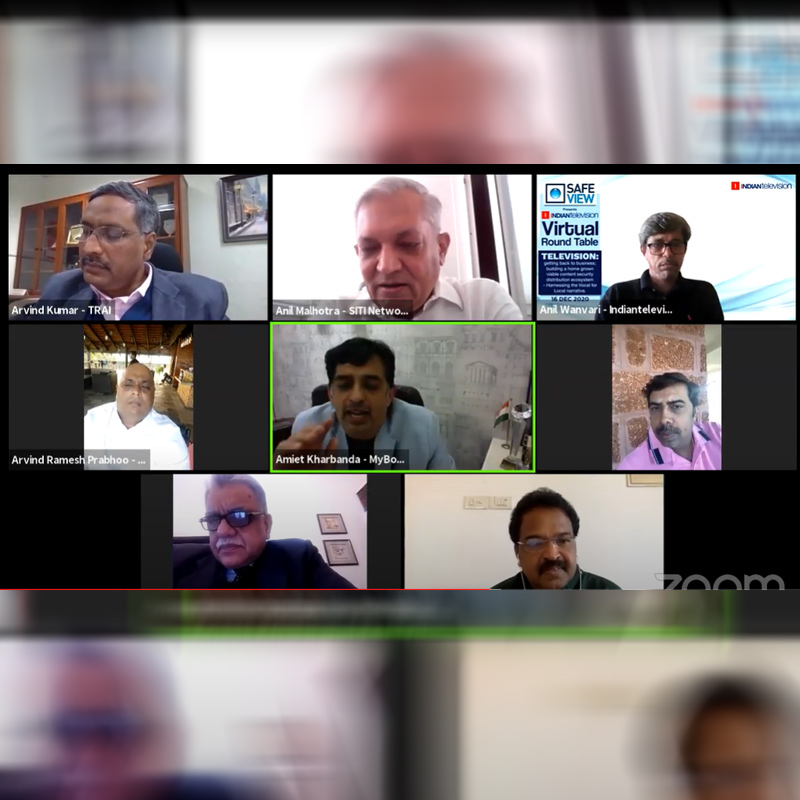
    At a virtual roundtable organised by Indiantelevision.com, moderated by founder, CEO & editor-in-chief Anil Wanvari, panellists discussed how the cable industry can be self-reliant in terms of security equipment and technology. TRAI advisor (broadcasting & cable service) Arvind Kumar, MyBox Technologies MD and CEO Amit Kharbanda, SITI Networks Ltd CEO Anil Malhotra, Maharashtra Cable Operators Federation (MCOF) president Arvind Ramesh Prabhoo, Metro Cast Network promoter Nagesh Narayandas Chhabria, Kerala Communicators Cable Ltd (KCCL) business head N Padmakumar, Safe View chairman Pradeip Nanda participated in the session.

    What did MSOs look for while setting up a security system during digitisation?

    The moderator kickstarted the session asking what were the main areas looked at by MSOs while setting up a security system during digitisation. Malhotra mentioned that the whole purpose of addressability post digitisation is lost without proper security in place. He shared that his MSO focuses on a robust system, ease of operation, 24/7 support system, scalability, the ability to satisfy broadcasters’ audits while choosing a security system.

    “Unfortunately, there is no security which is fool-proof and every security will get breached after a certain period of time. You have to consider a security system that survives the onslaught of hackers for up to 12 years at least, which is the life of an STB. When we choose anything for our network, we keep these things in mind,” Malhotra added.

    In 2013-14, Metro Cast had surveyed which CAS vendors had already deployed services to more than a million or two million customers before selecting one, shared Chhabria. Initially, they went to European CAS vendors but later moved on to Chinese vendors as their service was 30-40 per cent cheaper. Unfortunately, there was no significant Indian CAS vendor at that time, he noted.

    MCOF’s Prabhoo said that the local cable operators had limited choice because CAS and SMS as per regulation were supposed to be in the purview of MSO. So, they had very little say in which are the STBs and which is the backend SMS. It was the MSO that had the onus of choosing it.

    “On the broadband and internet side, the first important thing was what was the availability. Therefore, with a ban on products from China, we had to look into more Indian products – which is cost-effective – and what service we got from them. These were the prime considerations while we were upgrading our networks,” he commented.

    Is ‘Vocal for Local’ story taking off?

    “Efforts should be made to adopt Indian technologies. Entrepreneurs, vendors didn’t have aspirations to become big or go global in the past. Now after a major push by the government in terms of initiatives and the narrative of vocal for local, they are aspiring to grow. But they can’t do it without support from the service providers who are catering to the masses. The supply chain must be endorsed by DTH operators, MSOs, whoever in the chain, then only it will encourage new or existing entrepreneurs,” TRAI’s Kumar said.

    For instance, Safe View is a domestic producer who is very keen on working with Indian MSOs. Nanda mentioned that it is a 100 per cent Indian company and 120 small and big MSOs work with it. Moreover, it has a huge footprint overseas. Safe View has been in the market for six years with three million subscribers on its system.

    Talking about the trust deficit with Indian vendors, KCCL’s Padmakumar added that the concern is more about security and quality. In his view, CAS should be secured entirely so that customers don't get affected and there should not be any scope for piracy in the system. If domestic players can provide such CAS internally, the industry would be happy to utilise their services, he said. However, it should be cost-effective as well.

    On the other hand, Malhotra pointed out that Indian CAS entered quite late in the market, when the majority of the STBs had already been deployed. Had they come at the beginning of 2012 as the MSOs were deciding which CAS to take, the majority of STBs would have bought from Indian companies only.

    “Even now also with Atmanirbhar Bharat, we are not seeing a push on the set top boxes because it is not an overnight thing. One needs to start integrating and create a road map. The Indian companies are still not talked about much, because there’s still hope that the government will understand and let imports continue. Six months later we will say we do not have the same volume that we have even now. However, the government is very clear now, Make in India cannot be an assembled product. And that for me is where we missed the bus time and again,” Kharbanda elaborated.

    Chhabria also noted that the manufacturers are not getting total support from the Centre in keeping prices competitive. Naturally, price conscious MSOs are going for the Chinese players. If the same product is given at a competitive rate, then they would love to go with the Indian product. Hence, he is of the view that the government has to support the manufacturers with some incentives.

    “As far as TRAI is concerned, we have already given recommendations on indigenous telecom equipment manufacturing. We are also mulling over what we can do for the broadcasting sector also. Recommendations on interoperability of STB have already been given. I think this is the right time to blend vocal for local narrative with interoperable STBs. Security part also becomes stronger with indigenous technology,” TRAI’s Kumar commented.

    Standard guidelines for CAS is need of the hour:

    However, all the MSOs agreed that adoption will be higher once TRAI comes up with clear guidelines and standardisation of CAS. In addition to that, if TRAI or an independent agency starts certification of CAS, then it will enhance the trust of MSOs. Testing procedures for CAS in the country also need to be initiated as early as possible.

    “Every stakeholder has to play a role. There is a role for the government and the regulator also. We are making a framework for standardisation and I think that will happen very soon. In telecom, we had given recommendations to the government on telecom equipment manufacturing. Similar recommendations can be given to the government for the broadcasting sector. Most importantly, stakeholders, especially MSOs, have to come forward to use Indian-origin technology. It should be their call that at least all STB or CAS should be replaced by homegrown tech in future. As far as CAS is concerned, it is a question of only a thousand distributors who have to adopt indigenous technology. Hence, it should be the MSOs' will to support Indian CAS vendors,” Kumar stated.

  • Tata Sky partners Irdeto to secure content

    Tata Sky partners Irdeto to secure content

    MUMBAI: Tata Sky has signed a deal with Irdeto to ensure the safety of the DTH operator’s content relayed to any device across its satellite and over-the-top (OTT) platforms. The company will be implementing Irdeto’s Cloaked CA and middleware technologies for better customer experience.

    Tata Sky MD and CEO Harit Nagpal said, “At Tata Sky, we are committed to providing our customers with the most innovative video services across satellite and online platforms in India. To provide consumers with greater choice and convenience, we need a security partner that gives us the freedom to innovate without fear. In Irdeto, we are working with a strong security partner with a forward-looking approach and future-proof solutions. This enables us to continue innovating our solutions and services while giving us the peace of mind that our content is secure.”

    Irdeto will manage the planning and deployment of the project for Tata Sky to seamlessly integrate security technology with third-party solutions. Cloaked CA is a conditional access system for broadcast and IPTV operators. It reduces the need for a smart card and reduces cost and complexity.

    “We are honoured to be selected by Tata Sky as their long-term security partner for Conditional Access and Middleware,” said Irdeto CEO Doug Lowther.“This deal further reinforces Irdeto’s commitment to the dynamic and fast-growing media market in India and we are excited to continue working with Tata Sky to help them meet their business goals.”

    Also Read :

    Tata Sky and Irdeto tie up, OTT service launched on Android devices

    Tata Sky offers Reliance DTH consumers migration deal, Dish TV too in play

    Tata Sky deploys DataMiner to improve customer experience

  • Dish TV redefines its pay-TV services with Verimatrix security

    Dish TV redefines its pay-TV services with Verimatrix security

    MUMBAI: Verimatrix, a specialist in securing and enhancing revenue for network-connected devices, has announced that it has been selected by Dish TV India Limited to provide cardless security for its direct-to-home (DTH) service offerings. The former will illustrate how security solutions are at the core of all key monetisation strategies for the pay-TV and internet video service at IBC 2017.

    DishTV is Asia’s largest DTH video service provider and is the only DTH operator to operate through three satellites in space. The Verimatrix Video Content Authority System (VCAS™) for DVB was selected as one of its critical CAS partners for its future-proof approach to revenue security that can scale with the company as it continues to evolve business models and maintains its position as a market leader.

    “Our infrastructural and technological edge allows us to continually develop new innovations and revolutionize our service offerings, so it has become crucial that our revenue security measures are robust yet flexible enough to keep pace,” said DishTV COO V K Gupta.

    Based on a single content authority approach, VCAS for DVB offers a modern approach to multi-device streaming as video service providers like DishTV redefine their pay-TV services. The solution is completely compliant to applicable DVB standards and pre-integrated with a broad range of partner headend and software systems. Additionally, its cardless set-top box client technology provides new, essential levels of security that would be virtually impossible to achieve with legacy systems.

    “The Asia’s largest DTH provider continues to enhance its offerings and maintains its stance apart from competition in the region,” said Verimatrix president Steve Oetegenn.

    “Dish TV has long-established itself as the pioneer in the Indian DTH broadcast industry, and VCAS for DVB is optimally designed to adapt to any scenario it may face as the Indian pay-TV industry continues to undergo rapid transformation. In essence, the security framework will never become obsolete.”

    Verimatrix specializes in securing and enhancing revenue for multi-network, multi-screen digital TV services and is recognized in revenue security for connected video devices.

  • Telcos may offer multi-play OTT for security, energy & appliance control: Report

    MUMBAI: The Smart Home is a growing fifth-play opportunity for operators. The global smart home market is growing exponentially, attracting an array of service providers, including technology giants and startups to major media players, device makers, big-box retailers, home improvement companies, utilities and telecom network operator.

    Government mandates and initiatives in addition to the ongoing technology innovations coupled with increased attention paid to conservation- are the major factors contributing in making smart home a place with a bright future. Focus on sustainability, increasing awareness amongst the consumers with regards to energy consumption and regulatory mandates on energy conservation continue to drive smart home adoption trend globally. While adoption is increasing in countries where governments actively support faster broadband services, especially fiber to the home, the costs associated with new equipment, installation and ongoing maintenance are significant deterrents to home automation.

    Government mandates and initiatives, ongoing technology innovation and the intense attention paid to conservation all contribute to giving the smart home a bright future. The smart home is an attractive opportunity for network operators, thanks to their unique billing relationships and network connections into the home.

    Telcos can improve the value proposition of home automation by implementing a multi-play OTT strategy that offers a range of capabilities, such as security, energy and appliance control.

    Partnerships with companies from different industries are key to ensuring the role of operators in smart home functionality. The market is at a fork in the road, going either toward an open ecosystem with heterogeneous devices or toward proprietary platforms that control all device access.

    The Smart Home, a research report by Pyramid Research, analyses the smart home strategies of leading network operators in a number of markets across the globe, focusing on their roles in the value chain. It discusses the elements of smart home services, the participants in the ecosystem and a number of smart home strategies available to operators. Attention is paid throughout to the key challenges operators face, including the need for device standardization and interoperability.

    Introduction in the report: Providing a thorough overview of the smart home market, this section looks at the long-term evolution of the market, the types of services available as well as the main adoption drivers and barriers.

    The smart home ecosystem (in the report): This section examines the value chain and the roles of the various types of participants, from broadband providers to device manufacturers, utilities and home security platform providers.

    Telco positioning strategies and marketing opportunities: This section analyzes a number of approaches operators can take to gain competitive advantage in the connected home, including white-labeling, support services, bundling and OTT services.

    Key takeaways in the report whittles down into a number of actionable bullet points.

    Case studies: This section analyzes four smart home programs by operators: AT&Ts Digital Life platform in the US, Oranges Homelive in France, HKTs Smart Living in Hong Kong and Rogers Communications Smart Home Monitoring in Canada.

    One could identify the broad barriers to adoption as well as challenges specific to telecom operators in the smart home market. Assess the role and opportunity of operators in the smart home market and how they can gain competitive advantage over the markets many powerful players.

    One could gain information on some of the most valuable experiences by operators in the home automation market, placing them in the context of ongoing market developments and the main technological and competitive challenges.

    The Case studies could be leveraged upon by the operators and cable companies to make informed decisions pertaining to partnering, go-to-market strategies and investments in technologies.

    Also read:

    MatrixCloud OTT enables IPTV operators roll out OTT services in 60 days

    Content & channel management vital as Asian production enters new growth cycle

    Processing video from linear to live, OTT & VR: Verizon launches Exponent for global carriers

  • Cisco acquires cloud networking infra firm Meraki for $1.2 bn

    Cisco acquires cloud networking infra firm Meraki for $1.2 bn

    MUMBAI: Cisco has acquire privately held Meraki, a leader in cloud networking, for approximately $1.2 billion in cash and retention-based incentives to acquire the entire business and operations of Meraki.

    Headquartered in San Francisco, California, with offices in New York, London and Mexico, Meraki offers midmarket customers easy-to-deploy on-premise networking solutions that can be centrally managed from the cloud.

    The acquisition is expected to close in the second quarter of Cisco’s fiscal year 2013, subject to customary closing conditions, including regulatory review.

    The acquisition of Meraki complements and expands Cisco’s strategy to offer more software-centric solutions to simplify network management, help customers empower mobile workforces, and generate new revenue opportunities for partners.
    Meraki’s cloud networking solutions will expand Cisco’s network offerings by providing scalable solutions for midmarket businesses. The Meraki acquisition will also strengthen Cisco’s Unified Access platform, which makes IT more responsive to business innovation by simplifying IT operations and uniting wired and wireless networks, policy and management into one integrated network infrastructure, unlike other competitive offerings.

    “The acquisition of Meraki enables Cisco to make simple, secure, cloud managed networks available to our global customer base of mid-sized businesses and enterprises. These companies have the same IT needs as larger organizations, but without the resources to integrate complex IT solutions,” said Cisco Enterprise Networking Group senior vice president Rob Soderbery.

    “Meraki’s solution was built from the ground up optimised for cloud, with tremendous scale, and is already in use by thousands of customers to manage hundreds of thousands of devices.”

    Meraki technology offers customers Wi-Fi, switching, security and mobile device management centrally managed from the cloud. Meraki solutions support BYOD, guest networking, application control, WAN optimisation, application firewall and other advanced networking services.

    Meraki was founded by members of MIT’s Laboratory for Computer Science. It combines a high-velocity software development methodology with a tightly linked inside sales and channel model that will form the new Cloud Networking Group.