Tag: SDSC SHAR

  • ISRO successfully launches Astrosat along with six foreign satellites

    ISRO successfully launches Astrosat along with six foreign satellites

    MUMBAI: The Indian Space Research Organisation (ISRO) has been having a swell 2015. Just a few days after its Mars Orbiter completed a successful one year around the Red planet, ISRO has now launched its first dedicated multi wavelength space observatory along with six foreign customer satellites.


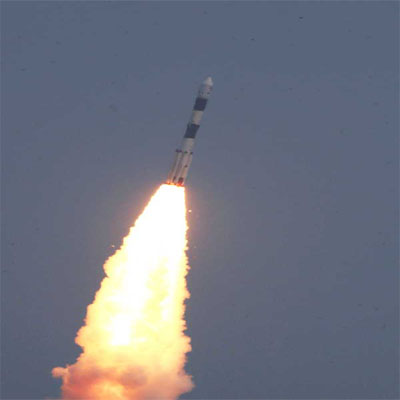
    In its 31st flight (PSLV-C30) conducted today (28 September, 2015), India’s Polar Satellite Launch Vehicle (PSLV) successfully launched Astrosat – multi wavelength space observatory and six foreign customer satellites into a 644.6 X 651.5 km orbit inclined at an angle of 6 deg to the equator. The achieved orbit is very close to the intended one. This was the thirtieth consecutive success for PSLV.


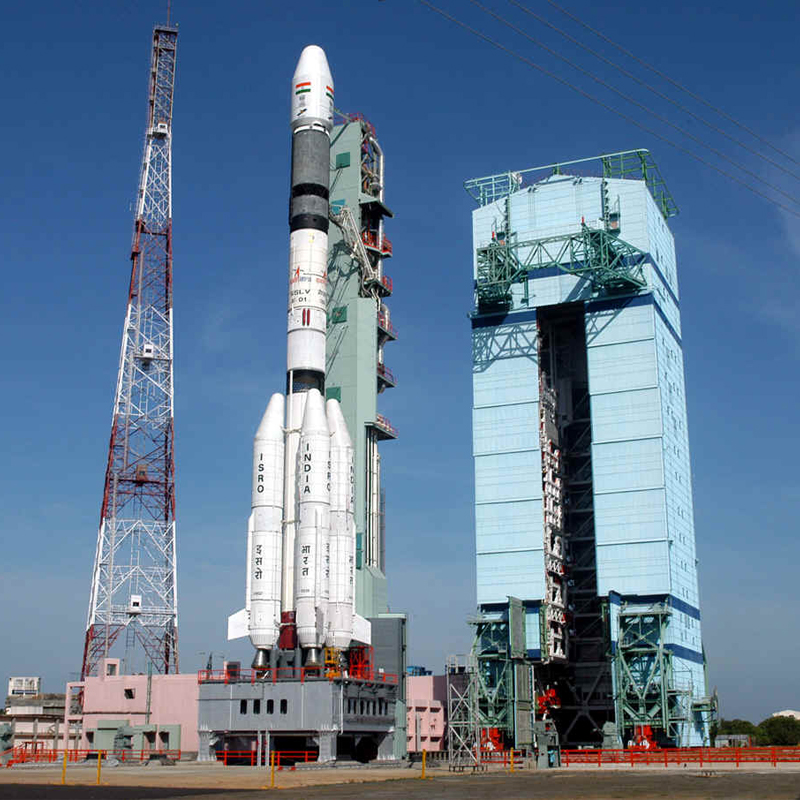
    PSLV was launched in its heaviest ‘XL’ version with six strap-on motors of the first stage. The launch took place from the First Launch Pad at the Satish Dhawan Space Centre SHAR (SDSC SHAR), Sriharikota, the spaceport of India.


    The 320 tonne, 45 m tall PSLV-C30 carrying seven satellites including the 1513 kg Astrosat, lifted off at 10:00 Hrs IST. About 22 minutes after lift-off, Astrosat was successfully placed in orbit and separated from the fourth stage of PSLV-C30. The separation of all the six co-passenger satellites was completed in the subsequent three minutes. The seven satellites carried by PSLV-C30 together weighed about 1631 kg at lift-off. 


    After a 50 hour smooth count down, the 320 ton PSLV-C28 was launched with the ignition of its first stage. The important flight events included the ignition and separation of the strap-ons, separation of the first stage, ignition of the second stage, separation of the payload fairing after the vehicle had cleared the dense atmosphere, second stage separation, third stage ignition and third stage separation, fourth stage ignition and fourth stage cut-off.  


    Through 30 successful flights during 1994-2015 period, PSLV has launched a total of 84 satellites including the seven satellites successfully launched today. The vehicle has repeatedly proved its reliability and versatility by successfully launching satellites into a variety of orbits including polar Sun Synchronous, Geosynchronous Transfer and Low Earth orbits of small inclination thereby emerging as the workhorse launch vehicle of India. 


    So far, 51 satellites have been launched by PSLV for customers from abroad. Today’s launch of six co-passenger satellites by PSLV-C30 was facilitated by Antrix Corporation Limited, the commercial arm of ISRO, a government of India Company under the Department of Space (DOS). 


    Soon after its separation from PSLV-C30, the two solar arrays of Astrosat were automatically deployed and the Spacecraft Control Centre at the Mission Operations Complex of ISRO Telemetry, Tracking and Command Network (ISTRAC) at Bangalore took control of Astrosat.


    Astrosat is India’s first dedicated multi wavelength space observatory. This scientific satellite mission endeavours for a more detailed understanding of our universe. Astrosat is designed to observe the universe in the Visible, Ultraviolet, low and high energy X-ray regions of the electromagnetic spectrum simultaneously with the help of its five payloads. 


    Astrosat was realised by ISRO with the participation of all major astronomy institutions including Inter University Centre for Astronomy and Astrophysics (IUCAA) of Pune, Tata Institute of Fundamental Research (TIFR) at Mumbai, Indian Institute of Astrophysics (IIAP) and Raman Research Institute (RRI) of Bangalore as well as some of the Universities in India and two institutions from Canada and the UK.


    In the coming days, Astrosat will be brought to the final operational configuration and all its five scientific payloads will be thoroughly tested before the commencement of regular operations.

  • PSLV launches four new satellites

    PSLV launches four new satellites

    MUMBAI: In its 10th launch on 10 January India’s Polar Satellite Launch Vehicle (PSLV) PSLV-C7 has successfully launched four satellites namely India’s Cartosat-2 and Space capsule Recovery Experiment (SRE-1), Indonesia’s Lapan-Tubsat and Argentina’s Pehuensat-1 into a 635 km high Polar Sun Synchronous Orbit (SSO).

    Isro claims to having used a Dual Launch Adopter (DLA) in PSLV for the first time to accommodate two primary satellites in tandem.

    PSLV-C7 lifted off from the first launch pad at SDSC Shar at 9:23 am with the ignition of the core first stage and four of the six strap-on motors. The remaining two strap-on motors were ignited 25 seconds after lift-off.

    The important flight events included the separation of the ground-lit strap-on motors, separation of air-lit strap-on motors and the first stage, ignition of the second stage, separation of the heatshield at about 121 km altitude after the vehicle had cleared the dense atmosphere, second stage separation, third stage ignition, third stage separation, fourth stage ignition and fourth stage cut-off.

    Cartosat-2 was the first satellite to be injected into orbit at 981.3 seconds after lift-off at an altitude of 639 km. DLA with the 6 kg Pehuensat-1 was separated about 45 seconds later followed by the 550 kg Space capsule Recovery Experiment (SRE-1) after 120 seconds and the 56 kg Lapan-Tubsat after 190 seconds.

    The four satellites have been placed in a polar orbit at an altitude of 637 km with an inclination of 97.9 degrees with respect to the equator. The initial signals indicate their normal health.

    After its separation from the DLA, the two solar arrays of Cartosat-2 were automatically deployed to generate the electrical power for the satellite. The satellite health is being continuously monitored from the Spacecraft Control Centre of Istrac at Bangalore with the help of its network of stations at Bangalore, Lucknow, Mauritius, Bearslake in Russia, Biak in Indonesia, as well as support from Svalbard ground station in Sweden for the initial phase of the Cartosat-2 mission.

    With Isro Satellite Centre (Isac), Bangalore, as the lead Centre, Cartosat-2 was realised with major contributions from Space Applications Centre (SAC), Ahmedabad, LPSC at Bangalore, and IISU, Thiruvanantha-puram. Istrac is responsible for initial and in-orbit operation of Cartosat-2. The National Remote Sensing Agency (NRSA), Hyderabad receives and processes the data from Cartosat-2.

    Space capsule Recovery Experiment (SRE-1): Space capsule Recovery Experiment (SRE-1), developed by Isro’s VSSC and Isac, is a 550 kg capsule, intended to demonstrate the technology of an orbiting platform for performing experiments in microgravity conditions. After the completion of the experiments, the capsule will de-orbited after a few days and recovered.

    Two days before de-orbiting, SRE-1 will be placed in a Repetitive Elliptical Orbit. Subsequently, it will be reoriented and deboost rocket is fired to make it reenter the earth’s atmosphere. SRE-1 will splashdown in the Bay of Bengal, east of Sriharikota coast.

    SRE-1 is being tracked and monitored by ground stations at Bangalore, Lucknow, Mauritius, Biak in Indonesia, Bearslake in Russia, Saskatoon in Canada and Svalbard in Sweden/Transo in Norway.

    Lapan-Tubsat and Pehuensat-1 were launched under commercial agreements. Lapan-Tubsat is a cooperative venture between Indonesian Space Agency, Lapan and Technical University of Berlin. It is an earth observation satellite besides a technical demonstrator in control systems.

    Pehuensat-1 is a 6 kg Argentinean nano-satellite meant to serve educational, technological and scientific fields. Its developed by University of Comahue of Argentina, AMSAT (Amateur Satellite Association of Argentina) and Argentina Association for Space Technology and is intended to provide an experiment platform to perform amateur radio experiments between colleges and universities of Argentina.

  • GSLV to launch Insat-4C on 10 July

    GSLV to launch Insat-4C on 10 July

    MUMBAI: The countdown is on for the launch of GSLV-F02, which will be carrying the state-of-the-art communication satellite Insat-4C into space. The launch is expected to take place around 4:30 pm on Monday, 10 July, the Indian Space Research Organisation announced today.

    Preparations for the launch are proceeding satisfactorily at Satish Dhawan Space Centre (SDSC) SHAR, Sriharikota from the second launch pad. The launch vehicle systems have been integrated and checked out, Isro said in a statement issued today.

    Insat-4C was transported from Isro Satellite Centre, Bangalore to SDSC SHAR in the first week of June 2006 and since then, it has undergone detailed checks. After propellant filling, the spacecraft has been integrated with GSLV.

    The Mission Readiness Review is planned on 6 July, 2006 followed by the meeting of Launch Authorisation Board which will clear the launch. In the next few days, a complete checkout of the fully integrated launch vehicle along with satellite will be carried out. The final countdown and fuel filling for the liquid propellant stages are expected to commence on the morning of 9 July.

    Insat-4C is the second satellite in the Insat-4 series. The first, Insat-4A, was launched in December last year, from the spaceport of Kourou in French Guiana by an Ariane5 vehicle, which also carried the Meteosat weather Satellite for Eumetsat.

    Isro spokespersons have been pointing out that using indigeneous launch vehicles will result in a saving of about 30-40 per cent or Rs 1.5 billion in expenses per launch. With four satellites to be launched by GSLV Mark II and Mark III, the savings thus will be substantial. Isro will, however, be using the services of Arianespace to launch the Insat 4B satellite from Kouru next year.

    “With the commissioning of the Rs 3.5 billion ($75million) second launch pad at Sriharikota, India is the only country to have such a state-of-the-art facility to launch different types of vehicles Ranging from PSLV (polar satellite launch vehicle), GSLV Mark-1, GSLV Mark-II to the upcoming GSLV Mark-III in the four-tonne class,” a top Isro official is reported to have said sometime back.

    It’s for the first time that India’s space agency is putting into orbit a two-tonne class satellite. Equipped with 12 high-powered Ku band transponders (Like the earlier Insat-4A), the 2,180 kg spacecraft is designed for a mission life of 10 years.

    Insat-4C is designed to provide direct-to-home (DTH) television services, facilitate video picture transmission (VPT) and digital satellite news gathering (DSNG) as well as to serve the National Informatics Centre (NIC) for its VSAT connectivity. The 2,168 kg Insat-4C has a mission life of ten years.

    Insat-4C will be used for broadcasting 150 TV channels through the DTH platform. Kalanithi Maran’s Sun Group has booked space on Insat 4C for its DTH venture Sun Direct. All the Ku-band transponders on the Insat 4A satellite, meanwhile, have been leased to the Tata-Star consortium, which will soon be launching the Tata Sky DTH service.

    Other than Tata Sky and Sun Direct, there is also Anil Ambani’s DTH venture Reliance Bluemagic, which will be rolling out in due course.

    At present, DD Direct Plus managed by the pubcaster Prasar Bharati and the Subhash Chandra owned Dish TV are the two operators offering DTH services in the country.

    Salient features of Insat-4C:

    Orbit: Geostationary (74 degree East Longitude)
    Co-located with Insat-3C, KALPANA-1 and EDUSAT
    Lift-off Mass: 2,168 kg
    Mission: 10 years
    Communication Payloads: 12 Ku-band 36 MHz bandwidth Transponders employing 140 W Travelling Wave Tube Amplifiers (TWTAs) to provide an Effective Isotropic Radiated Power (EIRP) of 51.5 dBW at Edge of Coverage (EOC) with footprint covering Indian mainland; Ku-band Beacon as an aid to users to lock on to the satellite signal