Tag: SD

  • Indian pay TV ecosystem yet to optimise HD viewing opportunity

    Indian pay TV ecosystem yet to optimise HD viewing opportunity

    KOLKATA: Industry leaders have emphasised over and over again that despite recent developments and change in consumer preferences, pay TV will continue to coexist with over-the-top (OTT) platforms. On the other hand, the need for a sustainable business model is also undeniable amid the rapid flux in the media and entertainment industry. In the coming future, the conversion from standard definition (SD) to high definition (HD) can be a key growth driver, the experts said in a panel discussion at the Video and Broadband Summit (VBS) 2021. Moreover, the broadband segment will be another crucial factor, which has seen higher uptake in the last few quarters.

    ‘The leaders speak laying out a profitable future’ moderated by Indiantelevision.com founder, CEO and editor-in-chief Anil Wanvari included Indiacast Media Distribution president Amit Arora, Siti Networks CEO Anil Malhotra, Star & Disney India- India & International TV distribution president Gurjeev Singh Kapoor, Travelxp 4K founder & CEO Prashant Chothani, Fastway Transmission & Netplus Broadband group CEO Prem Ojha, and NXTDigital MD & CEO Vynsley Fernandes as panelists.

    Arora said broadcasters will always remain focused on telling new, exciting stories. But the mediums of broadcasting, distributing content will include a range of devices, TV, screens. DPOs have to look at how they can assimilate all the content assets and determine the best way of marketing those.

    “The pot of gold I see for the industry is how you can make a dollar more from the customer giving him more and more content. India will stay in a broad spectrum of free TV to $10 in the next 10 years, which segment you want to operate in is going to be your choice,” he quipped.

    Fernandes agreed to the need of looking at a wider spectrum rather than having a singular kind of telescopic lens for the distribution platform operators (DPOs) as well. In addition to that, DPOs need to bear down costs like infrastructure sharing. The important thing is how they drive out a better value for each dollar, he added.

    “Our offtake of HD in the country is very low. We have not been able to achieve a strong HD push. There is that much runaway available to us. So, can we make the transition from SD to HD as one of the key drivers going forward as there is so much runway available? The second thing we have to focus on is if we can take the second runway of a whole bunch of customers who are watching FTA content and look at them converting them to basic pay bundles, maybe from one dollar,” he stated further.

    Arora highlighted another important aspect; while HD consuming subscribers are hovering around 14-15 million, a large section of the population buys HD boxes but watches SD channels. Hence, marketing the HD proposition is very important to raise awareness.

    “We are a market of 200 million TV homes and we have 15 million homes who are watching HD channels. We have closer to 40-45 million homes that have HD TV set. The communication piece is a big issue. People don’t know when they buy an HDTV set, they also have to buy an HD set top box, along with that they have to buy a subscription for HD channels. What they think is if they have a TV set, they would get brilliant quality of channels regardless,” Kapoor detailed.

    Broadcasters and DPOs have not taken HD expansion as an agenda but it is more important than ever as OTT platforms are offering high-quality video, experts concurred. However, Travelxp’s Chothani thinks the industry needs to look beyond HD and start focusing on 4K too.

    “Five years from now, there will be 40 million 4K homes in India. MSOs and DPOs have to look at the 4K opportunity. India has a great opportunity because of the infrastructure in the cable system. If a consistent effort by MSOs, DTH platforms is taken, people will realise SD quality is not good enough,” he noted.

    On the other side, broadband looms as a highly promising prospect on top of everything, Fernandes added. Siti Network’s Malhotra is also optimistic that there is an opportunity for everyone despite the presence of players like Jio, Airtel as there are 22 million wired broadband customers compared to 650 million internet users in the country. Even if Jio subsidises as it did for wireless broadband, they might have maximum market share but would not be able to acquire all consumers, he opined. However, the home broadband rollout is slow in the country because it is physically extensive work.

    Ojha said that his organisation has already penetrated the urban consumers in its strongholds and will reach rural areas faster than Jio. “Evolution is happening in the ecosystem. There can be imperfection at every level, even at the regulation level. But we will have to look at the longest horizon where the growth engine has to be broadband driven,” Ojha commented.

  • Dailymotion announces return to normal for streaming quality

    Dailymotion announces return to normal for streaming quality

    MUMBAI: Earlier, Dailymotion made the decision to reduce the bandwidth required to broadcast videos on its platform to mitigate the risk of network saturation. The end of the confinement period in France marks a return to normal for the platform which will again broadcast its videos in UHD definition (4K), Full HD (1080p) and HD (720p).  

    "As network conditions continue to improve, we will remove the definition limitation introduced in March, country by country,” says Dailymotion COO Guillaume Clément. “The goal is to bring back the highest quality of viewing to our users worldwide by 20 May 2020.”

    To prevent network saturation during the Covid2019 pandemic, video portal Dailymotion had rolled out limits to video quality available for streaming on its platform in March. With millions of people under the shelter-at-home directive, the world's internet infrastructure was under stress. To reduce the pressure, major streaming services including Netflix, YouTube made video qualities to SD

  • FTA channel adoption shoots up post TRAI tariff order implementation; pay channels dip

    FTA channel adoption shoots up post TRAI tariff order implementation; pay channels dip

    MUMBAI: Five weeks into the new TRAI tariff regime, there seems to be some shift in viewership patterns and consumer choices. According to Chrome LIVE data, pay channels witnessed a drop of 24 per cent from week 4 to week 9 in 2019. On the other hand, FTA channels saw a spike from 21 per cent to 26 per cent in the same time span.

    Prior to the implementation of the new tariff order (NTO), DPOs and broadcasters were mostly operating on a fixed fee model. However, the new regime is showing a significant impact on the channel reach, channel share, ratings of non-driver channels and the overall revenue.

    Major fluctuations were seen across national channels over the last couple of weeks including Hindi GECs which saw a drop ranging between 0.5 to 10 per cent for pay channels and 0.1 to 5 per cent for FTA channels.

    Some passable changes enumerated in week 7 by way of reversal of the impact on connectivity of channels – exponential loss on pay had somewhat reduced owing to multiple operators putting on channels as per the old package after having switched them off. The same has also had an effect on FTA which had seen a spike.

    The second week of NTO extension continued seizing changes at PAN India level which earlier was a 3 per cent gain for pay and 5 per cent gain for FTA channels in Chrome DM’s week 7 data which in week 8 changed to 5 per cent and 4 per cent gain respectively.

    Some more interesting changes as the NTO appendage concluded its third week on ground with pay channels registering a drop of 6 per cent owing to changes in channels’ connectivity across Free Dish and FTA gaining 2 per cent across the standard definition channels in Chrome DM week 9 data.

    The key to address these challenges for securing the correct revenue share amongst other things would entail consumer education, constant monitoring of consumer preferences and realignment of the bouquet packaging strategies taking into account consumer preferences.

    Under the new regime, consumers have the option of paying only for channels they want to watch and can drop other channels from their list and hence, the subscriber base will now solely depend on the communication between the DPOs and the end consumer, and in the event of any communication gap, the last mile consumer will not subscribe to the channels and these may result in significant erosion of subscriber base impacting the revenue of DPOs and the broadcasters.

  • Star Sports 1 Bangla to be launched by 31 March

    Star Sports 1 Bangla to be launched by 31 March

    MUMBAI: Star India is all set to cater to the Bengali audience's craving for sports action. Star Sports 1 Bangla will launch or before 31 March 2019.

    The broadcaster released its rate card after amendments on 21 February 2019 and added the regional sports channel in several bouquets. Star Sports 1 Bangla has been added in the Bengali Value pack priced at Rs 49, Bengali Premium pack for Rs 79, Bengali HD Value pack at Rs 85, Bengali HD Premium priced at Rs 120.

    To cater to the diverse consumer segments based on the consumption, Star India has launched two more packs Bengali-Hindi Premium pack for Rs 85 and Bengali-Hindi HD Premium for Rs 130. Both the pack have Bengali, Hindi, English entertainment and movie channels apart from sports and infotainment channels.

    If a consumer opts for Star Sports 1 Bangla before its launch, the charges will be applicable from the date of launch.

    Star has also revealed that Star Sports 1 Bangla will be available for Rs 19 on a-la-carte basis.

    With the launch of Star Sports 1 Bangla, the broadcaster will have 37 SD channels including 11 SD sports channels. It also owns 27 HD channels including five sports HD channels.

  • ZEEL turns activist with ‘Aankhon Ka Aandolan’ driving upgrade to an HD quality viewing experience

    ZEEL turns activist with ‘Aankhon Ka Aandolan’ driving upgrade to an HD quality viewing experience

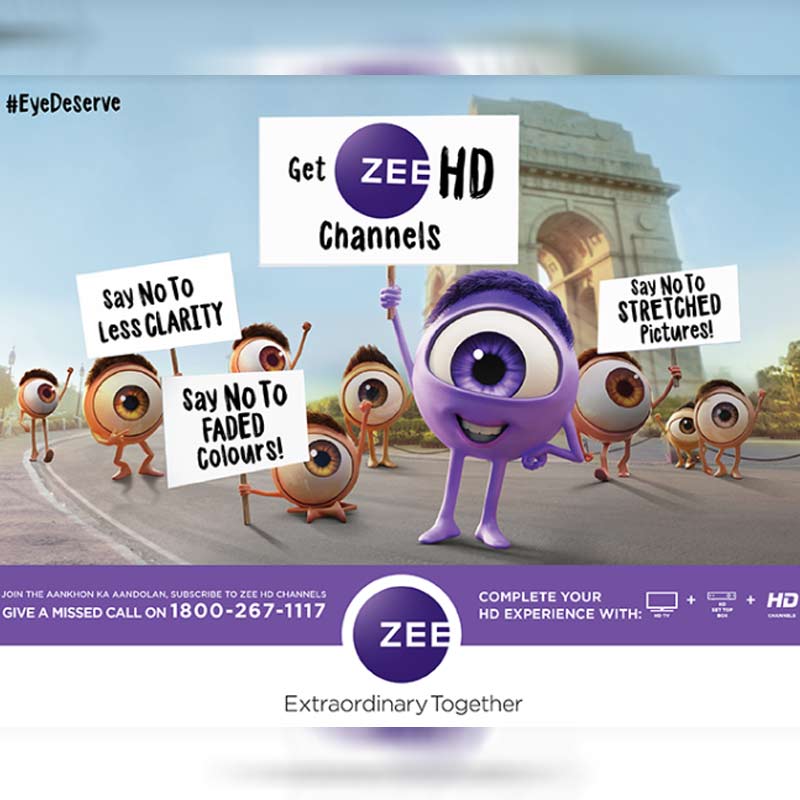
    MUMBAI: Zee Entertainment Enterprises Limited (ZEEL) the leading media & entertainment powerhouse, launched its new campaign ‘Aankhon Ka Aandolan’ to build awareness about the benefits of a High-Definition (HD) channel viewing experience and drive a behaviour change. With multiple players having pushed the HD subscription, its penetration still stands below 10%. With this new campaign, ZEEL aims to drive consideration to upgrade from SD to HD subscription amongst the current SD subscribers.

    The campaign ‘Aankhon Ka Aandolan’ showcases the trouble that the eyes go through and the reason why they are out on streets to protest. The campaign further aims to educate viewers who would have heard about the HD experience being better but are not sure how it is significantly superior to what they are currently experiencing.  Launched in partnership with the country’s top DTH platforms like Tata Sky, DishTV, Videocon d2h, Airtel and cable platforms, the campaign aims to actively drive HD channel upgrades during this festive season. Hence, the creative campaign has a clear Call-To-Action with a missed call number that will allow consumers to opt for their DTH partner or call their cable operators and enquire on the HD offers available.

    The core idea of the campaign is led by strong consumer insights that address the inferior experiences that the SD channel viewers are currently settling for – Less Clarity, Faded Colours & Stretched Pictures. Along with the SD viewers, the campaign also reaches out to those HD viewers who believe that HD viewing is only relevant for specific content, whereas HD experience is an overall upgrade to a superior quality viewing world.

    Conceptualised by the company’s creative partners Lowe Lintas, the campaign aims to be the trigger to upgrade to HD subscription by showing the consumers, the superior quality HD viewing experience that they are missing out on. ZEEL currently offers 14 HD channels. With the revised MRP price point regime that is expected to come into play in a few months from now, and the changing consumer behaviour pattern, the viewer will now be able to independently choose HD and SD channels separately giving them the power to upgrade to a superior viewing experience.

    Commenting on the launch of the ‘Aankhon Ka Aandolan’ campaign, Ms. Prathyusha Agarwal, Chief Marketing Officer at ZEEL said “At Zee, we believe in offering 'Extraordinary Entertainment' to our consumers at all levels. Where we focus on offering versatile content for consumers across age groups, we are equally invested in offering them superior quality viewing experience through our best in class HD technology. We truly believe that HD viewing experience offers our viewers better clarity, and once you get hooked on to it, you just can’t do without it! We have tailor-made our two brand films in 8 languages and given it legs to appeal to our regional viewers spread across the country. The benefits of the HD viewing experience has been brought alive through the lead protagonist across regional markets of the ZEE network.

    Sharing his views on the campaign, Sagar Kapoor, Executive Director at Lowe Lintas said – “FINALLY, THE EYES SPEAK UP! The creative idea stemmed from the very objective of magnifying the benefits of HD over the SD experience. We just shifted the lens on looking at a very apparent yet hardly spoken about TG. The eyes in this case. Hence the idea of eyes asking for HD viewing. It just made complete sense to land the advantage via someone who will benefit the most. Not to mention the cut through we get with the visual idea of creating characters out of eyes themselves.”

    Anaheeta Goenka, President at Lowe Lintas Group also expressed her views saying “In India a better service or product does not necessarily make for adoption. Especially when the comparative does not exist. That was our strategic challenge. Getting people to see the distinct value of HD vs SD. Easy to sell the product – but we refrained and instead took another journey from the ‘viewers eyes’.”

    Zee Entertainment has launched a 360-degree marketing campaign influencing the consumers across their path to purchase journey. The media mix strategically uses ‘TV, DTH and Out-of-home’ to build awareness, ‘Digital’ to influence behaviour and an aggressive ‘Retail’ promotion to trigger conversions at the point of purchase of the HD TV set. The high impact retail push is in association with the biggest electronic stores in the country such as Reliance Digital and Vijay Sales, during this festive season. Alongside, the company will also be seeding the campaign across Samsung and Panasonic stores in collaboration with Dish TV.

    The campaign is promoted through the strength of the network with 35 channels coming together to achieve a reach of 40 Mn viewers ably supported by our digital push with an estimated reach of 45 mn across the campaign period up till Diwali. The Digital campaign has been designed to reach out to the SD viewers across platforms that they have used to either show interest in purchasing HD TV sets, make subscription payments or upgrade their lifestyle. The SD & HD subscribers will be targeted not only through the DTH & cable platforms but also through our network’s vast social media assets. Innovative marketing formats have been used across social media and Out of Home to bring alive the tension points – example, usage of Uber cab windows to bring alive the ‘clarity’ difference between SD and HD channels.

  • Sony Max SD & HD’s Sultan premiere locks big ad revenues

    Sony Max SD & HD’s Sultan premiere locks big ad revenues

    MUMBAI: How much can a single telecast of a Hindi film on a channel earn in ad revenues? Well, if estimates are to be believed, it could be Rs 50 crore for the premiere of the Salman Khan starrer Sultan which aired on Sony Pictures Network India (SPN India) Hindi movie channel Sony Max on 15 October, according to a PTI report. The film focuses on Sultan Ali Khan (played by Salman Khan), a wrestling champion from Haryana, whose successful career creates a rift in his personal life

    As expected, SPN India president (sales & international business) Rohit Gupta refused to put a fix on the exact figure while speaking to PTI. All he said was : “It is one of the biggest blockbusters and it has been the biggest movie for us in terms of revenue. It is the highest grossing movie revenue which we have got, but we cant disclose the revenue.”

    SPN India business head for Hindi movies and music cluster Neeraj Vyas also highlighted that Sultan allowed it to gross its highest ever ad sales for a movie premiere on the network. But once again he provided no figures. “We’ve had a 20 per cent increase in ad rates – over the previous large movie premiere that we had sold last year around the same time for Bahubali- which is why the numbers have gone up to what they have ”

    SPN India had slapped a pricing of Rs 10 lakh per 10 second ad spot for its standard definition channel and Rs 2 lakh per 10 seconds for its Sony Max HD services. Those are the kind of numbers it charges for some of its premium IPL matches.

    Amongst the brands which hopped on board included: Chinese handset maker Oppo and Reliance Jio as the co-presenter sponsors, while FMCG megalith Hindustan Unilever and auto major Mahindra as co-sponsors. Bajaj Auto, Colgate, Mondelez, Reckitt Benckiser and Samsung Electronics chose to be signed on as associate sponsors, while brands such as Apple, eBay India, Ford India, Google India, Huawei Tele, Intel, Intex Technologies, Lenovo, Loreal, Pernod Ricard, Raymond and Vivo Mobiles brought spots.

    SPN India claimed to PTI that the inventory had been sold out days before – a bit of a first for the network.

  • Sony Max SD & HD’s Sultan premiere locks big ad revenues

    Sony Max SD & HD’s Sultan premiere locks big ad revenues

    MUMBAI: How much can a single telecast of a Hindi film on a channel earn in ad revenues? Well, if estimates are to be believed, it could be Rs 50 crore for the premiere of the Salman Khan starrer Sultan which aired on Sony Pictures Network India (SPN India) Hindi movie channel Sony Max on 15 October, according to a PTI report. The film focuses on Sultan Ali Khan (played by Salman Khan), a wrestling champion from Haryana, whose successful career creates a rift in his personal life

    As expected, SPN India president (sales & international business) Rohit Gupta refused to put a fix on the exact figure while speaking to PTI. All he said was : “It is one of the biggest blockbusters and it has been the biggest movie for us in terms of revenue. It is the highest grossing movie revenue which we have got, but we cant disclose the revenue.”

    SPN India business head for Hindi movies and music cluster Neeraj Vyas also highlighted that Sultan allowed it to gross its highest ever ad sales for a movie premiere on the network. But once again he provided no figures. “We’ve had a 20 per cent increase in ad rates – over the previous large movie premiere that we had sold last year around the same time for Bahubali- which is why the numbers have gone up to what they have ”

    SPN India had slapped a pricing of Rs 10 lakh per 10 second ad spot for its standard definition channel and Rs 2 lakh per 10 seconds for its Sony Max HD services. Those are the kind of numbers it charges for some of its premium IPL matches.

    Amongst the brands which hopped on board included: Chinese handset maker Oppo and Reliance Jio as the co-presenter sponsors, while FMCG megalith Hindustan Unilever and auto major Mahindra as co-sponsors. Bajaj Auto, Colgate, Mondelez, Reckitt Benckiser and Samsung Electronics chose to be signed on as associate sponsors, while brands such as Apple, eBay India, Ford India, Google India, Huawei Tele, Intel, Intex Technologies, Lenovo, Loreal, Pernod Ricard, Raymond and Vivo Mobiles brought spots.

    SPN India claimed to PTI that the inventory had been sold out days before – a bit of a first for the network.

  • Hathway leads in digital pay & local channels; Ortel leads in analogue: TRAI

    Hathway leads in digital pay & local channels; Ortel leads in analogue: TRAI

    NEW DELHI: The number of private satellite television channels in the country registered with the Information and Broadcasting Ministry fell by seven in the quarter ending September 2015 from 826 in quarter ending June to 819.

    However, the maximum number of pay channels carried by certain cable operators in non-conditional addressable system (CAS) rose from 214 to 233 in the same period. The maximum number of Free-to-Air (FTA) TV channels carried by certain cable operators in non-CAS areas in the period rose from 179 to 197. 

    The data is based on reports received by the Telecom Regulatory Authority of India (TRAI) from broadcasters and multi system operators (MSOs).

    In areas served by non-addressable systems, the maximum number of TV channels carried in digital form as reported by cable operator – Hathway Cable & Datacom Limited – amongst those who have reported is 458. 

    The maximum number of TV channels carried in analogue form as reported by – Ortel Communications Limited – amongst those who have reported is 100. 

    In these areas, the maximum number of FTA channels carried, as reported by Hathway Cable & Datacom amongst those who have reported is 197. 

    The maximum number of pay channels carried as reported by a cable operator (Hathway Cable & Datacom) amongst those who have reported is 233. The maximum number of local channels carried as reported by a cable operator (Hathway Cable & Datacom) amongst those who have reported is 28.

    As on 30 September, 2015, there were a total of 226 MSOs who had been granted Permanent Registration (for 10 years) by the Ministry apart from 173 MSOs who had been granted Provisional Registration (for 10 years) by the Ministry of I&B for providing Cable TV services through Digital Addressable Systems (DAS).

    There had been a total of 252 pay channels as reported by broadcasters as on 30 June. During the quarter ending September 2015, three new pay channels – Colors Infinity HD, Colors Infinity, and Zee Café HD – were launched. During the quarter, one channel – The MGM was temporarily suspended. 

    During the quarter, the transmission mode of two channels – VH1 and Comedy Central – was changed from SD to HD. The total had risen to 254 pay TV channels by September end. 

    TRAI in its quarterly report said that apart from the free DTH service of Doordarshan Freedish, there are six private DTH operators. The total number of registered subscribers and active subscribers being served by these six private DTH operators were 81.47 million and 41.05 million respectively as on 30 September, 2015. 

    The Ministry had permitted a total of 90 Teleports by September end.

  • Hathway leads in digital pay & local channels; Ortel leads in analogue: TRAI

    Hathway leads in digital pay & local channels; Ortel leads in analogue: TRAI

    NEW DELHI: The number of private satellite television channels in the country registered with the Information and Broadcasting Ministry fell by seven in the quarter ending September 2015 from 826 in quarter ending June to 819.

    However, the maximum number of pay channels carried by certain cable operators in non-conditional addressable system (CAS) rose from 214 to 233 in the same period. The maximum number of Free-to-Air (FTA) TV channels carried by certain cable operators in non-CAS areas in the period rose from 179 to 197. 

    The data is based on reports received by the Telecom Regulatory Authority of India (TRAI) from broadcasters and multi system operators (MSOs).

    In areas served by non-addressable systems, the maximum number of TV channels carried in digital form as reported by cable operator – Hathway Cable & Datacom Limited – amongst those who have reported is 458. 

    The maximum number of TV channels carried in analogue form as reported by – Ortel Communications Limited – amongst those who have reported is 100. 

    In these areas, the maximum number of FTA channels carried, as reported by Hathway Cable & Datacom amongst those who have reported is 197. 

    The maximum number of pay channels carried as reported by a cable operator (Hathway Cable & Datacom) amongst those who have reported is 233. The maximum number of local channels carried as reported by a cable operator (Hathway Cable & Datacom) amongst those who have reported is 28.

    As on 30 September, 2015, there were a total of 226 MSOs who had been granted Permanent Registration (for 10 years) by the Ministry apart from 173 MSOs who had been granted Provisional Registration (for 10 years) by the Ministry of I&B for providing Cable TV services through Digital Addressable Systems (DAS).

    There had been a total of 252 pay channels as reported by broadcasters as on 30 June. During the quarter ending September 2015, three new pay channels – Colors Infinity HD, Colors Infinity, and Zee Café HD – were launched. During the quarter, one channel – The MGM was temporarily suspended. 

    During the quarter, the transmission mode of two channels – VH1 and Comedy Central – was changed from SD to HD. The total had risen to 254 pay TV channels by September end. 

    TRAI in its quarterly report said that apart from the free DTH service of Doordarshan Freedish, there are six private DTH operators. The total number of registered subscribers and active subscribers being served by these six private DTH operators were 81.47 million and 41.05 million respectively as on 30 September, 2015. 

    The Ministry had permitted a total of 90 Teleports by September end.

  • Videocon d2h to launch Wi-Fi enabled smart HD STBs

    Videocon d2h to launch Wi-Fi enabled smart HD STBs

    MUMBAI: Direct to home (DTH) platform Videocon d2h is planning to launch HD Smart set-top-box (connected set top box), which converts existing LED TVs into a Smart TV besides showing more than 500 channels & services in High Definition (HD) and Standard Definition (SD).

    While the DTH tech in it brings television channels in SD and HD, the connected STB allows one to browse content from Twitter, Facebook, Daily Motion, video on demand sites, OTT apps, news, weather etc through applications residing on the STB. 

    The HD Smart STB will work as a tool for personalisation, engagement and new customer experiences and with internet connectivity, one can convert one’s TV into a smart TV using it. 

    With this new launch, Videocon d2h has taken a step towards providing an advanced product that delivers next generation solutions as part of the idea of Internet of Things (IoT). The feature of unlimited external recording is also available, by plugging in an external storage device for recording programs.

    The HD Smart STB can be connected to the home network of mobile internet, wifi or cable broadband connection to enable data streaming. 

    Through the Daily Motion app, one can watch the latest videos trending. Additionally, users can also connect with their social media page to tweet and post updates.

    Videocon d2h executive chairman Saurabh Dhoot said, “We are proud to announce the launch of this breakthrough technology in the DTH space. This launch of gen-next HD Smart Set Top Box demonstrates our unrivalled expertise and innovation in creation, delivery and execution of technologically advanced products. This product promises to make your existing TV into a smart TV and ensure connectivity with the world. We are enabling convergence of TV, DTH & internet all in one place.”

    Videocon d2h CEO Anil Khera added, “We aim to empower people with our connected set top boxes. Our HD Smart Set Top Box offers exceptional features like internet based apps, USB recording, HD quality viewing and reverse path which enable customers to create a unique viewing experience and also stay connected. The customer benefits from an enriched viewing experience through a new user interface allowing seamless navigation.”