Tag: Scam 1992

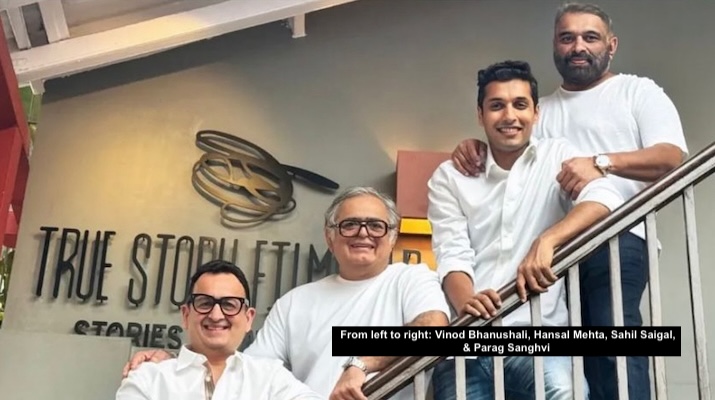
  • Vinod Bhanushali & Parag Sanghvi invest in Hansal Mehta’s &  Sahil Saigal’s True Story Films

    Vinod Bhanushali & Parag Sanghvi invest in Hansal Mehta’s & Sahil Saigal’s True Story Films

    MUMBAI: Vinod Bhanushali has got a great catch in his bag. The former T-series executive now turned producer has invested along with film producer and former managing director of K Sera Sera Parag Sanghvi in film maker Hansal Mehta and Sahil Saigal’s production house True Story Films.  No details of the amount of investment being pumped in by the two were provided but estimates are that Sanghvi and Bhanushali have committed to bring in at least Rs 75 crore in funds into the company to start with. Company officials were not available to confirm or deny the amount. 

    Hansal is known for films and series such as  Shahid, Citylights, Aligarh, Scam 1992, and Scoop, while Sahil is known for Faraaz and The Buckingham Murders. 

    True Story Films aims to deliver high-quality content across cinema and streaming platforms, with Mehta taking on the dual role of producer and director, with  Saigal handling  business operations.

    The production house plans to develop a diverse slate of projects, including feature films and digital originals, spanning genres like dramas, thrillers, romances, comedies, and inspiring real-life stories. With a commitment to innovation and collaboration, the company intends to work with both seasoned filmmakers and emerging creative talent. True Story Films has set an ambitious production target of projects worth approximately Rs 500 crores, with the first releases expected in early 2026.
     

    “True Story Films is not just a production house; it’s the realisation of a dream to craft meaningful narratives that challenge norms and resonate deeply with audiences,” said Hansal.  “With Sahil Saigal’s expertise and shared vision, we are committed to creating stories that provoke thought, entertain, and leave a lasting impact.”

    Bhanushali expressed his enthusiasm: “Partnering with Hansal Mehta is a step towards pushing creative boundaries and delivering unforgettable cinematic experiences. His visionary storytelling aligns perfectly with our passion for impactful narratives.”

    Parag Sanghvi added: “Hansal’s ability to create socially relevant and engaging stories is unparalleled. Supporting True Story Films is an opportunity to contribute to meaningful and groundbreaking content for audiences globally.”

  • “We’re looking to invest and reinvest about Rs 3000 crore over 5 to 7 years”:  Applause Entertainment CEO Sameer Nair

    “We’re looking to invest and reinvest about Rs 3000 crore over 5 to 7 years”: Applause Entertainment CEO Sameer Nair

    Mumbai: Celebrating its fifth anniversary, Aditya Birla Group’s Applause Entertainment has released over 40 shows on various OTT platforms so far. The leading media, content, and IP creation studio is all set to venture into feature films.

    Following the success of its show Scam 1992, Applause Entertainment CEO Sameer Nair is preparing for the upcoming series and movie slate, which includes Scam 2003, Gandhi, Tanaav, and the film “The Rapist.”

    Nair believes they have proven their hub-and-spoke model and anticipates that their feature films will follow suit. Applause Entertainment creates content, distributes it to OTT platforms, and licences it, he explained. He wants to increase investments five to tenfold over the next decade in order to produce six to eight films and 12 to 15 web shows per year.

    Till now, Applause has released shows that have 16 Indian adaptations, eight book-to-screen reimaginations, and 16 originals. Applause’s first film, “The Rapist,” directed by Aparna Sen, won many awards and nominations. Films like “The Rapist,” “Jab Khuli Kitaab,” “Sharma Ji ki Beti,” and three untitled films starring Bollywood actors will soon be released on OTT platforms as well.

    Sharing the excitement of expanding into regional markets with Tamil and Kannada shows, Applause has also acquired the rights to produce an animated web series from Amar Chitra Katha comics and graphic novels.

    In conversation with IndianTelevision.com, Nair spoke about a hub-and-spoke model, expansion plans, risk, content creation, and the future of OTT.

    On investments by Applause Entertainment

    Sameer: We are broadly operating this business, and we plan to invest and reinvest approximately Rs 3,000 crore in content creation over the next five to seven years. That is our broad strategy, and returns are linked to it. We want to work within industry standards, with Ebitda margins of 10 per cent to 15 per cent. But we are still in a growth phase. We are in an investment mode to build the business.

    The main revenue stream is made up of making and licencing content. We also built a catalogue. We build a reputation. We build a brand. We build up franchises and universes. We have had many seasons. So it’s making us a bigger, better company.

    On the expansion plan

    Sameer: The real expansion plan is just continuing to do what we’re doing. We’re continuing to do some bigger series and we are focusing on how we could do that. We are looking to expand into movies and build out a movie slate. We’re doing some animation. We’re also exploring the Amar Chitra Katha (ACK) animation.

    On the risk of the hub-and-spoke model

    Sameer: We knew exactly what we were doing. We knew we were going to create the series and then licence it. Therefore, no one was going to commission us, and no one was going to order us to make it. We’re going to create it, and then we’re going to show it to people.

    Therefore, at the time and still today, our main focus is on producing very high-quality content because we are taking the risk of doing so, and we can’t just produce anything because no one else is going to pay the bills. We have to pay the bill first and then licence it. That has always been a sort of focus in our heads.

    On how the pandemic helped

    Sameer: From a consumption point of view, the pandemic helped because people watched a lot more content. On the other hand, from a production point of view, the pandemic created a lot of stress and disturbance because of all the lockdowns, people falling sick, and shooting delays. All of that caused a lot of budget overruns. So a lot of our costs went up. A lot of shows and projects have been delayed.

    On the pressure to deliver content for OTT

    Sameer: When you’re trying to make anything, there’s always pressure on the content side, what’s not the main idea? It took almost 18 months for it to reach the screen. And that process of making, that overriding of always being unsure. Is this good enough? Is anyone going to like this? Is it funny enough? Is it scary? enough? No other costs? Also, the casting of actors, all of that. I don’t call these things pressure, but there is excitement and a little anxiety about all this.

    On the effect of OTT platforms cutting down on production cost

    Sameer: Well, honestly, we’ve always worked on very tight and very efficient budgets in any case. So to that extent, that doesn’t worry us too much. However, it’s a bit of a cyclical business. There are many platforms. They’re all going after the audience. There will be good and bad quarters. But by and large, I think the market is growing.

    The number of customers is growing, and now the whole IPL has moved to Viacom Voot. They will now have more aggressive plans. Everyone is doing different things. So, in general, I believe we believe the market is on the rise. And we would like to sort of float up with it.

    On the new series Gandhi

    Sameer: Gandhi is one of the most important shows that we are doing. It is an important legacy for us. And expectations will always be there. I don’t think we are too concerned about expectations. What we hope to accomplish is to tell a very important story well.

    I’m glad we have Pratik, Hansal, and Ramchandra Guha’s books, which are excellent resources. We’ve got a great plan to put it together and do it. Right now, writing is going on, and soon pre-production will start. We are in a good place and we are looking forward to it. There will be expectations from Scam 2 (Scam 2003) as well. Season two of the Scam series will have expectations, and that happens with every show.

    On the Indian OTT-business

    Sameer: The industry as a whole is under pressure. When we create a show and licence it to a platform, we want it to work on that platform. We want the platform to be known for the show receiving a large number of viewers. We want them to get subscribers, and we want them to make revenue. We all want them to give us a second season. We’re all working toward the same goal.

    So, as a studio, as production houses, as platforms, everyone has the same goal, which is entertaining customers, which is making customers pay, and which is sort of making the whole industry grow. As a result, to some extent, the pressure is on everyone to deliver good quality content, the pressure to deliver eyeballs, and the pressure to deliver revenue in various ways.

    On the gap between theatrical release and OTT release.

    Sameer: It’s a very good idea, in my opinion. All over the world, there is a window, and the bigger the window, the more chances that the theatre will work better because a lot of audiences believe that if the movie is coming on OTT or TV in three to four weeks, then why bother going to the theatre if it comes six months later or nine months later, and that gap may well make a big difference for a lot of movies. It’s a good idea. I’ve always supported the Windows system. I support theatres. All these mediums must coexist and must exist in sequence.

    On the Indian content market on OTT

    Sameer: The content market in the OTT space is still very small, even though we think there are a lot of series, so with a click, audiences consume them very quickly. If you deliver content, then they want season two quickly. So I think there’s a lot more scope to do all of that and it depends on us.

    From the business side, the better the content, the greater the number of consumers. Currently, OTT reaches about three quarters of a million people. It should reach 300 million and then 600 million in a few years.

    The future of OTT content

    Sameer: I think it will keep getting better and better because I think people are expecting better content, and it’s a good thing. They’re expecting whatever. It puts more pressure on us to do it. And it will keep improving. We’ll get better at this.
  • Vidnet 2022: ‘OTT has spurred the era of fearless storytelling’

    Vidnet 2022: ‘OTT has spurred the era of fearless storytelling’

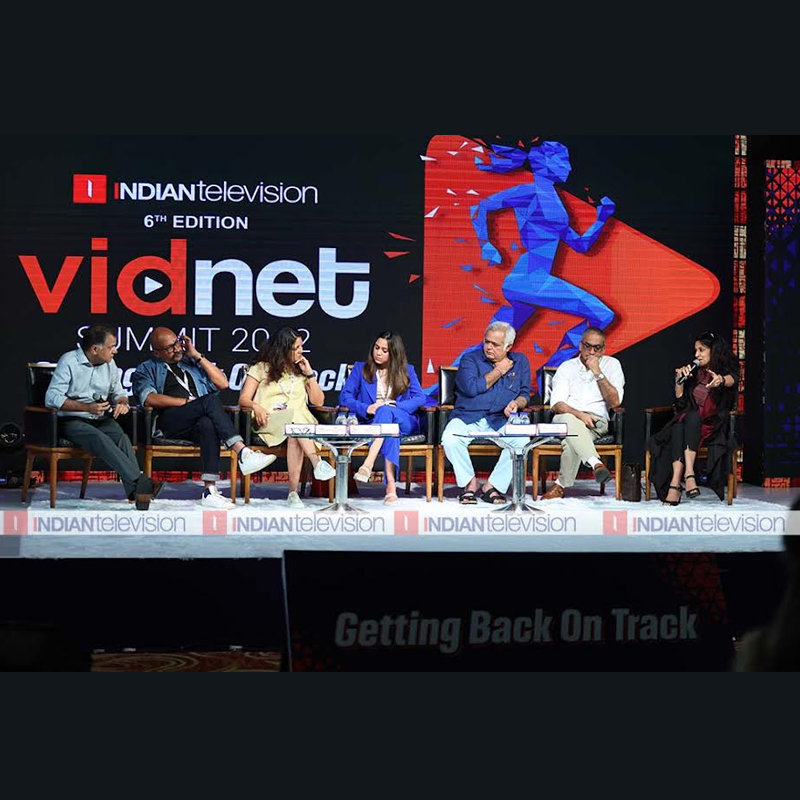
    Mumbai: India has entered a new era of creative storytelling. Whether it is the hegemony of Hindi-language content or big-name stars driving audiences to films, the rules that determined successful content have been broken. The focus in storytelling is on good writing that hearkens back to the 80s and 90s Doordarshan era with fine shows like “Wagle Ki Duniya,” “Hum Log,” or “Nukkad” to name a few. During a panel session on ‘Era of Creative Storytelling’ held recently at IndianTelevision.com’s VidNet Summit 2022, panellists affirmed that while content is governed by certain rules, the ones that have been breakthroughs have always upturned the rules.

    The two-day industry event was supported by technology partners Dell Technologies and Synamedia, summit partners Applause Entertainment and Viewlift, industry support partners Gupshup, Lionsgate Play and Pallycon, community partners Screenwriters Association and Indian Film and Television Producers Council and gifting partner The Ayurveda Co.

    The session was joined by director, writer and producer Suresh Triveni, Excel Entertainment producer Rucha Pathak, Applause Entertainment head of content Deepak Segal, Banijay Asia executive vice president – business and content Mrinalini Jain, film director, writer and producer Hansal Mehta, and Zee Studios head of content Ashima Avasthi Chaudhuri. The discussion was led by House of Cheer founder and CEO Raj Nayak.

    We’ve all heard of the Korean show “Squid Game” but few consumers outside of India have heard of an Indian original production that is not a film. Raj Nayak started off the discussion by asking creators why India’s content has not travelled as much as we would like?

    “I believe that stories have to stay authentic to where they originate from,” said Zee Studios Ashima Avasthi Chadhuri. “Do I need to make a story in English language for it to be accepted globally? No. Do I need to shoot the story in an international setting to make it appealing? No. It is not the language or budget of a production that determines whether the story travels but rather the emotion which must be universal.”

    “Scam 1992” director Hansal Mehta believed that, too often, creators of a show get caught up in figuring out the end result i.e., revenues. They ask complicated questions like ‘is the show accessible to a global audience?’ or ‘projected box office earnings for a film during the weekend’ rather than investing in the creative process. “When we made ‘Scam 1992,’ we didn’t think if we’re making it for Netflix or Amazon Prime Video. Nobody commissioned us to create it. We sold it after the cuts were made and it was picked up by a young OTT platform (SonyLiv). Its success proved that good content is greater than the platform and will find its way to the audience.”

    Suresh Triveni, who directed “Jalsa,” was also of the view that producing the film first and then selling it to the platform (Amazon Prime Video) gave him the creative freedom to tell the story that he wanted. But the question whether commissioned or acquired content works better is something that every creator needs to answer for themselves, he noted.  

    TV and film producers were putting content back in the box, figuratively, by looking at metrics like weekend box office projections and weekly TV ratings, according to Chaudhuri. “Film producers were looking at the Friday (weekend box office) result and TV broadcasters were looking at the Thursday result (TV ratings). OTT is a brilliant platform because the content is here to stay and the audience will find the story at some point in time.”

    There’s also the fact that writers on OTT are becoming more fearless, observed Banijay Asia’s Mrinalini Jain. “We do all sorts of shows and some have a structure that works and others are scripts that we take a punt on. There are writers who are still finding their voices and don’t have a lot of work behind them but they have the conviction. That gives me confidence that maybe I should take a punt on them. There has to be space for flaws and being judged in storytelling because that’s the society we’re living in. Fearlessness in writing is the best thing I’ve come across in the evolution of OTT storytelling.”

    Adding further, Triveni observed that movies and TV shows have been following the business of trends. “I think there is a lack of appreciation of literature in India. We’re not reading enough or going regional in terms of finding our stories. The industry that resides in Bombay is in an echo chamber and we’re busy churning out content. Our variety will come through our literature that genuinely needs to be explored.”

    Addressing the view that there is not enough variety of content on OTT platforms, Excel Entertainment’s Rucha Pathak felt that OTT platforms will undergo the same change in perspective that film creators realised many years ago. “When I was in the studio side of the business, everyone was making films with big name stars and studios realised that to differentiate the script is really important. The film industry saw a merging of commercial and non-commercial cinema and I think the same will happen in the OTT world. Now that I’m on the producer’s side, I know that a good story really depends on the showrunner’s, director’s and writer’s vision.”

    The most asked question during the session was how can writers pitch their ideas to studios and OTT platforms? Applause Entertainment Deepak Segal replied stating, “The writer who comes to pitch their story to us must have conviction. Secondly, as a studio if I’ve put out three crime thrillers then I’m not looking to create another one. During the pitching stage, we also need to understand the myriad factors that the story will bring to the table. Then it is up to the platform or studio to decide whether they have the wherewithal to do the show.”

    Speaking from personal experience, Segal also remarked, “Don’t pitch a story by saying that it is a big project because then we’ll say I’m not the studio to make this happen. Studios are never looking to undercut creators and will pay whatever cost is required to make the show. Also, don’t ever pitch a film script and say it can also be turned into a web series. There’s a different way of writing a feature film versus a web series versus a TV show. Luckily, we learnt about character arcs and tropes that are being used in the web series format from the adaptations that we created.”

  • “The idea whose time had come”: Hansal Mehta on making financial thriller ‘Scam 1992’

    “The idea whose time had come”: Hansal Mehta on making financial thriller ‘Scam 1992’

    New Delhi: When the ten-part series Scam 1992 hit SonyLIV platform last October, it captured the imaginations of millions of young Indians in no time. The financial thriller chronicling the life of Gujarat-based stock broker Harshad Mehta, and his involvement in the 1992 Indian Stock Market Scam soon became the most-viewed series on the platform.

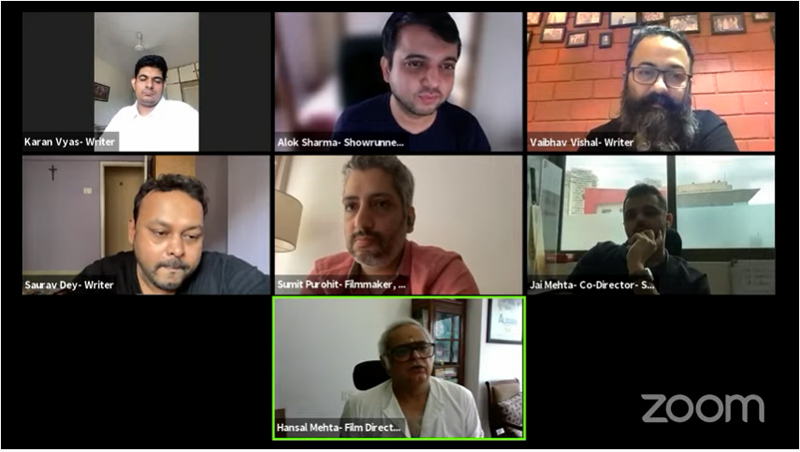
    On the last day of fifth edition of the Content Hub 2021 -TV, Film, Digital Video, and Beyond’ – the makers and writers of ‘Scam 1992: The Harshad Mehta Story’ got into a freewheeling conversation with Indiantelevision.com founder and CEO Anil Wanvari and showrunner-writer Alok Sharma to discuss the making of one of the most successful digital series on an Indian platform during the pandemic.

    “Harshal Mehta’s meteoric rise and sudden downfall had captured the imagination of millions, especially Gujaratis in the 90s. I was fascinated by his journey ever since I read Sucheta Dalal’s book in 2003-04, and wanted to tell the story. But that was the era of six-pack abs and shirtless songs, and I couldn’t even consider making it, until years later, when Samir Nair (Applause Entertainment) pitched the story to me and I jumped at it,” recalls director-producer Hansal Mehta, “It was the idea whose time had come.”

    The series went LIVE on the SonyLIV platform in October, 2020 when the first wave of the pandemic had begun to ebb away. The show was lauded for its tight screenplay and sparse writing by a team led by Sumit Purohit, Saurabh Dey, Vaibhav Vishal and Karan Vyas.

    The protagonist played by Pratik Gandhi hit it off with the audience with his one-liners, so whether it was ‘Risk hai to, Ishq hai’ which went on to become the tag-line of the series, or ‘Success kya hai, failure ke baad ka chapter’. These were also some of the lines that Hansal Mehta wanted to scrap out of the script believing them to be too filmy.

    “I found these lines to be too naïve and filmy at first. Par writers ka kamaal hai, wo kaise dikhate hain. Pratik (Gandhi) delivered those dialogues with such conviction and belief, that the audience connected with them. Wo daur filmi bhi tha,” smiles Mehta. Such one-liners were also used by stock brokers then, he adds.

    “It was also a casting feat,” quips co-director Jai Mehta. “Pratik (Gandhi) lent authenticity to the dialogues. Both of us had met several brokers on Dalal Street to get those nuances, and gestures right. It was unreal. Also, most actors in the series, including Gandhi understood finer nuances of the language, as they had done Gujarati theatre or stage plays early in their career.”

    Harshad Mehta’ character in the series represented the angry young man, the writers say, drawing inspiration from Amitabh Bachchan of the 70s. All through the series, he is seen, relying on his family for support.

    Delving into the writing process for a financial thriller, replete with several technical terms, filmmaker-writer Sumit Purohit says, the team made a conscious attempt not to dumb down the script to make it look simple. “We wanted to ensure that it looks authentic- whether it was the way the stock brokers were talking, or bankers discussing the financial transactions. It’s like science fiction. It’s not necessary that people understand the terms, for as long as they are emotionally invested with the characters,” he elaborates.
    Saurav Dey concurs, “That’s exactly the brief we got. We could tell the story as it is, and don’t have to spoon-feed the audience. They can use their judgment and draw inferences.”

    The story also carried a deep political undercurrent, with several scenes raising questions over alleged involvement of political leaders during that time. When asked about treading the fine line, Dey says, “We wanted to be responsible about what we show on screen. So, we retained only those parts, which we could substantiate with evidence. Rest was speculation, and we steered clear of that, or it would have irresponsible filmmaking.”

    The team began with the simple idea of telling a human story. “It was a volatile time, and we showed as much as we could do within the limits of the current time. We focussed on the bigger picture, and did not want that it should get impacted by any kind of outrage,” shares the ace director, who won the National Film Award for directing 2013 movie Shahid.

    However, for this series, Mehta says, he acted more like a motivator, than a writer. “I see my job as that of a motivator, who brings a pool of talent together, and ensures they move in a single direction. The biggest thing in long-form writing is patience and discipline, and the team had that,” he shares.

    Also, like his previous movies – Shahid or Omerta, the series Scam 1992 also did not have a lead actor who shared physical resemblance with the lead character in real-life. “My approach is driven by instincts and trust. That’s how I get writers and actors on-board. The physical likeness is not as important as it is to convey the spirit of the character on screen,” he opines.
    The ace-director also credits his association with Applause Entertainment, CEO Sameer Nair, who he says, ‘gave him the freedom to choose and trusted his choices.”

    Among those choices, were also several famed actors from the 90s, including Mamik Singh aka ‘Rattan’ from the iconic movie – Jo Jeeta Wahi Sikandar who played the Citibank chief Rao in the series. The series also had Anant Mahadevan, playing RBI Governor, S Venkitaramanan and Satish Kaushik as the foul-mouthed stock market kingpin Manu Mundra. “It was a masterstroke,” says Mehta emphatically.

    Another crucial element was planning the locations for the series, set in the 90s – ‘Bombay’ that most members of the team had not seen. “We went through books, pictures and did our research to recreate that era. We even got the original CBI office opened for a few scenes we shot there. It has been lying closed for over two decades,” recalls Jai Mehta.

    After the success of Scam:1992, Hansal Mehta is now back on the sets for his next – a crime thriller based on a true incident.

    The fifth edition of the Content Hub 2021 was co-presented by IN10 Media Network and ZEE5, and co-powered by Applause Entertainment and Tipping Point, the digital content unit of Viacom18 Studios. PTC Network was the supporting partner.

  • SonyLIV ramps up content portfolio with live sports, dubbed regional show

    SonyLIV ramps up content portfolio with live sports, dubbed regional show

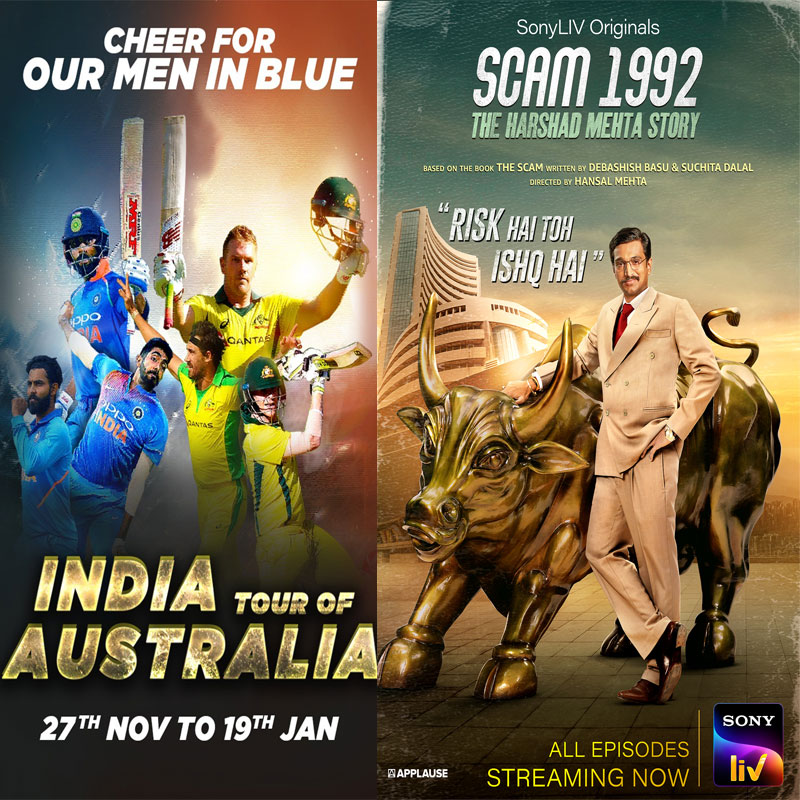
    KOLKATA: After months of waiting to see Team India in action, SonyLIV is here with a breather for all cricket lovers. The much-hyped India Tour of Australia will go live on the platform starting 27 November. In one of the most high-octane series in international cricket, Kohli’s Men in Blue will take on the Aussies for three ODI’s, three T20’s and four test matches on their home turf till 15 January 2021. With simultaneous feeds across four languages, the much-anticipated tour will be available for viewing to SonyLIV’s premium subscribers.

    Post a successful period of quarantine, the teams are now set to lock horns this Friday onwards across venues in Brisbane, Adelaide, Sydney, and Melbourne. Team India will begin with a slight edge over the hosts in the ODI’s, with a 12-10 win-loss record against them in the recent past. However, Australia, who recently defeated world champions England on their home turf, will look to replicate the victory, led by Aaron Finch. Premium subscribers will get access to the live feed without any delay.

    There’s a lot to rejoice for soccer fans as well on SonyLIV with the popular UEFA Champions League 2020-21, the 66th season of Europe's premier club football tournament along with UEFA Europa League and Serie A matches going live on the platform. 2021 brings another sporting spectacle – Australian Open with Rafael Nadal headlining the event next year in Melbourne.

    And there’s more in store for SonyLIV’s patrons. Following its stupendous success amongst audience and critics, Scam 1992 – The Harshad Mehta Story will now be available for regional audiences with dubbed versions in Tamil, Telugu, Malayalam and Kannada; along with a host of other titles like Avrodh: The Siege Within, Your Honor, Undekhi, and more.

    In addition to this, the platform has recently launched titles like Uncommonsense by Saloni, Daan Sthapana hosted by author and speaker Devdutt Pattnaik and Mahabharat- Ant ya Aarambh, an 11-episode animation series.  Highly acclaimed English shows like The Good Doctor S4 and For Life S2 are also up for viewing for the Indian audience. So, whether you are a cricket lover or a football enthusiast, an ardent fan of stand-up comedy or a devout believer in mythology, SonyLIV is the place to be.

  • Applause Entertainment releases 18 premium drama series in 19 months

    Applause Entertainment releases 18 premium drama series in 19 months

    MUMBAI: The content ecosystem has witnessed a boom with the advent of streaming services and an upsurge in non-linear content consumption. Amidst the creative revolution, Applause Entertainment has produced 18 diverse shows in multiple languages in a short span of time.

    Spearheaded by the media veteran Sameer Nair, the content creation studio has focused on a combination of smart originals of international formats, book to screen adaptations, and Applause Originals. It has created the official Indian adaptations of popular international shows including The Office, Criminal Justice, Hostages and Your Honor.

    Applause is presently developing Indian versions of the hit series Call My Agent, Fauda and Luther. The studio’s latest offering, Scam 1992 The Harshad Mehta Story, is currently the highest rated show on IMDB in India (9.6) and #21 amongst the top 50 television shows globally. Shows produced by Applause are currently streaming on leading global video streaming services including Disney+Hotstar, Amazon Prime Video, Netflix, SonyLiv and MX Player.

    Applause Entertainment CEO Sameer Nair said, “We are truly humbled by the phenomenal response from audiences for all our content. From Criminal Justice to Scam 1992, it’s been a delightful journey creating our shows, collaborating with best in class talent, creators and business partners! We are here to dazzle, delight, disturb and disrupt, and this is just the beginning.”

  • Digital expansion is beneficial for broadcast industry: Deepak Segal

    Digital expansion is beneficial for broadcast industry: Deepak Segal

    MUMBAI: Deepak Segal has over three decades experience in the film and television industry. His repertoire of work includes key positions to drive content strategy across media giants like Fox Television Studio India, Sahara Motion Pictures, Star India and Star Plus. Now, as head of content at Applause Entertainment, Deepak Segal drives the studio’s vision of building a content hub that tells great stories across mediums, catering to millions.

    Apart from creating good content, Segal is extremely passionate about aeroplanes. In fact, he has an encyclopaedic knowledge of aircraft – be they World War II fighters or more modern airplanes. Segal was in the air force before he ventured into the broadcast industry. As the son of prolific Bollywood director Mohan Sehgal (who launched Rekha in Sawan Bhadon), he had film-making in his veins, and eventually decided to follow in his father’s footsteps.

    With Applause Entertainment riding high on the success of Scam 1992: The Harshad Mehta Story, Segal spent some time with Indiantelevision.com’s Shikha Singh, sharing his thoughts on OTT content and the broadcast industry, how it has evolved, and much more.

    Excerpts from the interview:

    On handling Covid2019:

    The Covid2019 pandemic is disrupting every industry. Due to the lockdown we stopped filming Criminal Justice. We have restarted the shoot 15 days back by strictly adhering to all the protocols laid down by the government. The pandemic has slowed down the overall process. We coordinated post production work over Zoom calls. The editing and soundtrack was completed remotely.

    For Scam 1992, we had barely finished the shooting when the virus struck; all the additional work like audio, soundtrack, visual effects and sound design happened during the lockdown. The team that was working on it stepped up during this new norm and we delivered the story in record time. The Applause Entertainment and SonyLiv teams did a brilliant job to make it happen.

    On the studio’s content strategy:

    At Applause Entertainment, we made a conscious decision to invest in creative content rather than make a pilot, develop concept around it and commission it. We have put all our creative and financial minds to make it work. Also, it is like a new way of working in the industry where you get the confidence in the platform as they are investing huge money into it. Now, we are in a position to partner with OTT platforms for scripted shows. In a way, you have proved to them that you can create a premium drama that India requires. So far we have 15 shows on air and it has worked for us in many ways. We are also in the process of developing the Indian version of the super hit British psychological drama series Luther. Currently, we are in the writing process. We are also developing The Seeker, it’s a bigger project than we’re used to and we are working with international writers for this.

    On upcoming original series Call My Agent:

    Call My Agent is the Indian adaptation of French workplace comedy Dix Pour Cent (Call My Agent), originally created by Fanny Herrero and showrunner Cedric Klapisch and represented by TF1 Studio and France TV Distribution. Narrated through the POV of four high-profile agents of celebrities, Call My Agent will tell the behind-the-scenes stories of the magic and the madness that keeps the star system running. Fragile egos, manipulation, shenanigans and insecurities come to the fore as the agents traverse the world of glitz and glamour. The series stars Rajat Kapoor, Soni Razdan, Aahana Kumra and Ayush Mehra and each episode will feature real-life celebrities who play a fun and exaggerated version of themselves. After having directed several films across genres featuring A-listers, Shaad Ali has decided to helm this project and leap into the world of premium drama storytelling. As far as the acquisition is concerned, we get formats from all sorts of markets. Acquiring an international series and adapting it to the taste of Indian audiences is also challenging. The show is set to go on the floors late October.

    On the challenges of adapting foreign IP:

    OTT has created a new set of audience that is looking for premium content. A lot of people have graduated from viewing daily soaps.

    While adapting international shows, you need to conceptualise it a little longer. The scale at which international content is filmed is very different from our scale. Every show has its own challenges. We need to adapt the characters and make it more relatable to Indian audiences. Apart from the main characters we also need to keep minute details in consideration like background, language and people. References have to be appropriate. A lot of things depend on the writing. The challenge is to make the script resonate with viewers by adding local elements. Our primary objective is to stick to the original story line. We want the story to travel across India, which is why understanding the universality of the story is crucial. 

    On the original vs adaptation conundrum:

    From the beginning we have been creating original shows. It is not like we only do adaptations, it is generally a mix of both. Undekhi, Avrodh and many other shows were original. Even when you buy the rights to a book and adapt it, you need to build the characters first and make the storyline impactful.  

    On collaborating with Banijay Asia:

    Banijay is the producer of the show Call My Agent. We are the studio and they are the producer. We have worked with them on Hostages and there are other shows in the pipeline as well. By now we have teamed up on a lot of projects, so there is a trust factor involved. For Call My Agent, Applause Entertainment holds the IP.

    On the rise in demand for OTT:

    OTT got a big boost due to the pandemic. Theatres were shut down, TV production was halted, so the only source of entertainment was OTT content. We churned out content during this period also. There are many studios who are capable of producing a huge volume of content, Applause is one such platform.
     
    On production houses shifting from linear TV to OTT:

    Yes, people are flocking to OTT content, but television shows are still immensely popular in India. Both mediums have different sets of audiences but they are not mutually exclusive. A viewer who watches linear television also watches OTT content. Various streaming platforms have become hugely popular among the Indian audience due to a number of reasons. For production houses it is always beneficial to diversify the segment and expand their footprint in the digital medium. Any expansion of the process helps to maximise the industry. Acting talent emerging on OTT content is quite phenomenal which is usually not available on film.

    On identifying stories:

    Story is one of the key factors, which is followed by the relevance and connectivity of the subject. Then we discuss with the creative team how we pan it out into 8-10 episodic series, keeping the audiences engaged and entertained with strong storytelling at its core. We observe how the characters scale and how much potential it offers us to create shades for them/build room for innovation.

    The irony is, there is nothing easy about selecting stories and how you want to tell them. While family dramedies are highly appreciated in our country, timing the witty remarks and the dynamic of character, the premise sets etc, make it imperative that they flow well. Else the simplest constructs can go unnoticed or not create an impact on the viewer.

    On picking genres:

    We are looking at all sorts of genres as we want to reach out to all buckets of audiences. Today the viewers are open in exploring different genres and as creators we want to have diverse content. With Scam 1992 – The Harshad Mehta Story we have created a financial thriller, Avrodh is a gritty and realistic account of the surgical strike, Mannphodganj Ki Binny is a dramedy set in the heartland and Hello Mini is a thriller. We are open to all sorts of genres.

    Of course, we listen to what the audience has to say. Digital has become a great way to gather insights, understand consumer psychology and their points of view on topics. It gives a leverage to mould out setup, characters and story telling.

    On competition in the content creation space:

    Competition is there in every field; you have to make sure your product stands out above all. A strong content is the deciding factor. If you are telling great stories, you will have an audience.

  • TV will grow, but digital is where the money’s at: SPNI’s NP Singh

    TV will grow, but digital is where the money’s at: SPNI’s NP Singh

    MUMBAI: Sony Pictures Networks India MD and CEO NP Singh has always believed in looking on the bright side. After the network lost the IPL media rights to arch rival Star Sports, Singh claimed they were better off and more profitable without the league. When the Covid2019 pandemic struck, he was optimistic that the nationwide lockdown would boost viewership. By now, it's evident that both his projections were bang on the money. While Star reported a loss of Rs 1,216 crore in FY2018-19, Sony stayed in the green. And in the last few months, the broadcaster's digital and cable businesses have clocked a significant surge in engagement.

    Now, as Sony Entertainment celebrates 25 years in India, Singh talked about the organisation's journey, his vision going forward, and the challenges that lie ahead at the ‘visionary talks’ series hosted by Governance Now MD Kailashnath Adhikari.

    Currently, the thing that sparks the most joy for Singh is the success of Scam 1992, SonyLiv’s tentpole show that has proved to be a gamechanger for the streaming platform.
    On the back of Scam 1992, the platform has seen an uptick in the number of paid subscribers, said Singh. And because it was SPN’s own production house Studio NXT which produced the series, this success tastes all the more sweeter to him.

    Singh highlighted that apart from working on premium originals, the platform is working towards bringing in live sports content. SonyLiv currently streams the UEFA Champions League and UEFA Europa League. It also recently finalised the India tour of Australia, beginning 27 November. In addition to this, the OTT platform has a slew of global content line-up.

    When asked about SonyLiv’s revenue model, whether it will be a subscription-based or hybrid model (AVOD vs SVOD), Singh explained that the network’s primary focus is to deliver a subscription-driven platform that also offers AVOD content. Said he: “After the relaunch (in May 2020) we have introduced a premium plan of Rs 999 for one year. It is completely SVOD and has all the content that we can offer to subscribers. We have also brought out two new annual subscription plans – Liv special and Liv special+ which are priced at Rs 199 and Rs 399 respectively. The plan offers access to all shows at the same time as TV, downloading of episodes, and live sports preview up to 10 minutes. It is completely AVOD. So, yes we are sharply focusing on both SVOD and AVOD models.”

    During the conversation, Singh shed light on how the media and entertainment sector is coping with the disruption caused by the pandemic. With the unlock phase the sector is beginning to see early signs of economic revival. As far as the network is concerned, he stated that SPNI’s ad-revenues have reverted to the pre-Covid2019 levels.

    Further, Singh was confident that the festive season will provide additional impetus to the M&E sector, with many traditional and new categories like ed-tech and online gaming freely wielding their advertising budgets.
     
    However, the pandemic was not without its setbacks for the broadcast industry. Several niche TV channels have shut down. Monetisation has also been an issue. While it’s good to be an optimist, it’s equally important to take cognisance of the current environment, said Singh. “Sony had shut down channels even before the pandemic started, because I believe in observing strong fiscal discipline. We at SPN take very measured risks and we always keep an eye on ROI. So, we have invested where we have seen strong strategic and economic value, and at the same time we have exited from properties and channels which appeared unviable in the long run.”

    When it comes to the overall market, Singh mentioned that the television industry will continue to grow but not at the same pace as it used to. Content consumption is up and viewers are evolving rapidly. The sign of the times is the paradigm shift from TV to digital – with creators and broadcasters also moving to where the audience is.

    Given this scenario, there is a possibility that the content budget for TV will shrink or be diverted to creating content for streaming platforms. Singh, however, contended that ever since the network positioned itself as a content company three years ago, it aims to create high quality content across segments. “I believe that consumer needs will define the content strategy for each segment. It will help us to find the budget for that segment. I don’t think our budget for TV content will dwindle but we will be seeing huge investments in OTT.”

    Singh, who has frequently aired his concerns regarding the NTO, emphasised that a stable and consistent regulatory regime is necessary for the media and entertainment industry to recover. Further disruptive changes in regulations would be inimical to the sector as it tries to find its feet in the new normal. But even as the NTO case is up in the air, Singh is doing what he’s good at – hoping for the best while preparing for the worst.