Tag: Saudi Arabia

  • Ceuticoz promotes Arvin Mondal to head of marketing as global push accelerates

    Ceuticoz promotes Arvin Mondal to head of marketing as global push accelerates

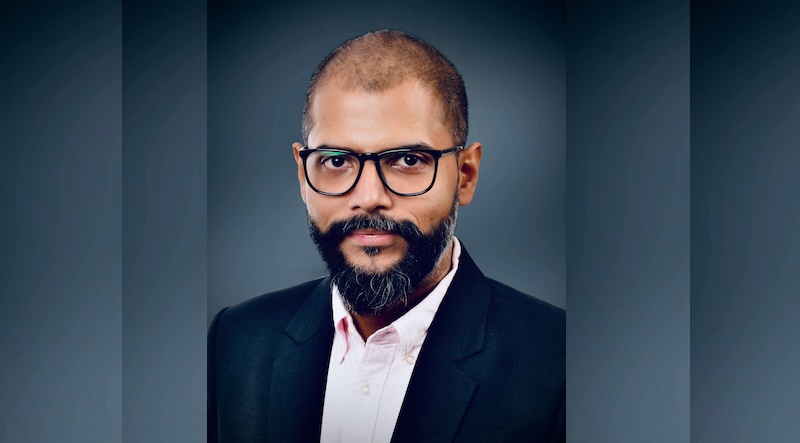
    MUMBAI: Ceuticoz is gearing up for a growth spurt. The medical-grade skincare brand has promoted Arvin Mondal to head of marketing, tasking him with building a global footprint as the company chases revenues of Rs 150-200 crore by financial year 2029-30—a compound annual growth rate of 30-35 per cent.

    Mondal, who previously steered the brand’s international expansion, will oversee marketing across retail and e-commerce whilst leading regional campaigns in Britain, the European Union, the Gulf Cooperation Council states and south-east Asia. His brief: turn a dermatologist-trusted label into a household name.

    Ceuticoz projects revenues of Rs 50 crore in FY 2025-26, up from a record monthly turnover of Rs 4 crore in November-December 2024. The brand already operates in over 10 countries, including Canada, Kenya and South Africa. America, the United Arab Emirates and Saudi Arabia are next on the list, with a target of 25-plus markets by 2030.

    “Arvin has played a vital role in the company’s international expansion,” says managing director Sukhbir Singh Chimni. “His new role allows him to craft our brand’s story as we move towards becoming a globally acclaimed skincare brand, driven by science and authenticity.”

    Founded in 2005, Ceuticoz positions itself as evidence-based and clinically proven—skincare that doctors recommend rather than influencers hawk.

    Whether that pitch resonates beyond dermatology clinics will determine if Mondal’s targets are ambitious or merely optimistic. Either way, he’s got skin in the game.

  • Nat geo’s ‘postcards from Saudi Arabia’ paints a new picture of travel

    Nat geo’s ‘postcards from Saudi Arabia’ paints a new picture of travel

    MUMBAI: Talk about a trip worth writing home about. National Geographic is sending viewers on an unforgettable journey with its new four-part travel series Postcards from Saudi Arabia, streaming on Jiohotstar and airing on Nat geo channel from 6 September.

    Hosted by actor and presenter Ridhi Dogra, the series peels back the curtain on Saudi Arabia’s hidden gems, from ancient wonders to modern marvels. The show takes viewers across three Unesco world heritage sites such as Jeddah’s Al-Balad, Riyadh’s At-Turaif and Diriyah, and AlUla’s awe-inspiring Hegra.

    In Aiuia, audiences encounter iconic landmarks such as Elephant Rock and Old Town, where local crafts, music and desert luxury blend seamlessly. Jeddah offers a different rhythm with souks, vibrant street art, and sunsets over the Red Sea, while Riyadh balances tradition and innovation, showcasing bustling markets, art galleries and a city on the rise.

    For Dogra, the series carried a personal resonance. “As a woman travelling through the location, I felt an unexpected sense of freedom, warmth, and welcome,” she shared. “I hope viewers, especially women, see this as an invitation to explore freely.”


  • West Asia cinema market to get growth urge from Saudi Arabia

    West Asia cinema market to get growth urge from Saudi Arabia

    MUMBAI: For movie lovers in the middle east north Africa (Mena) region, this is great news. And for Indian movie producers and distributors it is probably even better news. Analysis by London-based research outfit Omdia has revealed that the Mena cinema market is poised to catapult to new heights with revenue growing from $900 million in 2024 to $1.5 billion by 2029. The main driver of this growth is going to be Saudi Arabia which will account for almost two-thirds of the region’s cinema revenue. 

    West Asia, according to Omdia, has emerged as the fastest cinema building market, adding 1,000 new screens, starting 2019 to reach 2.500 screens by end 2024. Saudi Arabia, which is on aggressive city and entertainment hub building spree is expected to lead the additions, reaching 803 screens by year end 2024. The UAE is expected to be next in the pecking order with 734 screens.

    To top that, OMDIA says that even though west Asia is focusing on local productions, expanding its theatre count, and spreading cinema culture there is still much work to be done to sustain interest in local films and broaden their appeal.

    Beyond cinema, the online video streaming market in Mena is also on a strong growth trajectory, projected to reach $2.7 billion by 2029. This reflects the region’s evolving entertainment landscape, where audiences are embracing both traditional cinema and digital streaming platforms, creating a diverse and dynamic entertainment ecosystem.

    Says Omdia senior  director of media & entertainment  Maria Rua Agute: “With films no longer made solely for cinema; streaming platforms play a major role in financing and offer audiences a great variety of films, including those that might not reach traditional cinemas due to cost or limited availability of screens. In a region with relatively few arthouse cinemas in the region, there is a growing need for more diverse venues and programming to reflect the evolving film culture and cater to different tastes and genres. Expanding the availability of diverse cinema will be key to meeting demand.

    “The growth of cinema in the Mena  region, particularly in Saudi Arabia, signals a major shift in both the regional entertainment landscape and global filmmaking. Investments in infrastructure, local film production, and streaming are helping diversify cinema offerings. As audiences embrace both traditional theater and digital platforms, the region’s film culture has immense potential to flourish and gain international recognition.”
     

  • Sony Sports channels to broadcast ‘WWE Crown Jewel’ on 21 October

    Sony Sports channels to broadcast ‘WWE Crown Jewel’ on 21 October

    Mumbai: Sony Pictures Sports Network (SPSN) will telecast the return of ‘WWE Crown Jewel,’ the final event before the changes of the WWE draft goes into effect for both ‘Raw’ and ‘SmackDown.’ The mega-event will take place in Saudi Arabia on 21 October and the live studio show will be broadcasted at 8:30 p.m IST and the main event will begin at 9:30 p.m IST, shared the channel. 

    “The event will be broadcasted live on Sony Ten 1 channels in English, Sony Ten 3 channels in Hindi and Sony Ten 4 channels in Tamil and Telugu as well as livestreamed on OTT platform SonyLIV. The main event will be preceded by a live studio show “Extraaa Dhamaal” which will feature WWE Legend and hall of fame, Booker T, who will interact with fans and answer their questions on ‘WWE Crown Jewel,’ live on the show,” said the statement.

    The third installment of the WWE pay-per-view (PPV) event will see the return of WWE superstar, Brock Lesnar after he challenged Roman Reigns at the end of ‘SummerSlam 2021.’ Both superstars will be seen in the title match of ‘WWE Crown Jewel 2021’ with Roman Reigns defending his universal championship title.

    The event also provides for an interesting match card with another championship match where SmackDown women’s champion Becky Lynch will engage in a triple threat bout with Bianca Belair and Sasha Banks. The Scottish warrior, Drew McIntyre will also seek to reclaim his lost WWE title against the current title-holder, Big E, who will defend his title for the first time at a major PPV event, making it an explosive showdown. Goldberg and Bobby Lashley will also be seen in a no-holds-barred match. Viewers will also witness yet another Raw tag team match between SmackDown winners RK-Bro (Randy Orton and Riddle) and former winners AJ Styles and Omos at the event.

    Apart from the above matches, the event will also feature an iconic hell-in-a-cell match between long-standing rivals, Edge and Seth Rollins. ‘WWE Crown Jewel 2021’ will also host the finals of the ‘King of the Ring’ tournament as well as the ‘Queen’s Crown Tournament,’ making it symbolically apt to crown the new king and the queen at the kingdom of Saudi Arabia.

  • FIFA legal action against BeoutQ for WC piracy

    FIFA legal action against BeoutQ for WC piracy

    MUMBAI: FIFA will be taking legal action against Saudi Arabia-based BeoutQ, a pirated TV service operating in the Middle East and North Africa (MENA), which continues its illegal piracy of 2018 FIFA World Cup broadcasts, according to an official statement, carried by the Saudi Press Agency (SPA).

    This will be the first time where FIFA has recognised Saudi Arabia’s role in the service. FIFA has urged the authorities of Saudi Arabia and of the different countries where these illegal activities have been observed to support it in the fight against piracy.

    Saudi Arabia has consistently denied its involvement with BeoutQ and the country’s media ministry released a statement last week condemning suggestions that it has been complicit in the operation of the service. However, BeoutQ broadcasts from a Riyadh-based Arabsat satellite.

    According to FIFA’s official statement, “It is observed that the pirate entity named ‘beoutQ’ continues to use illegally the 2018 FIFA World Cup broadcast signal. Accordingly, FIFA has engaged counsel to take legal action in Saudi Arabia and is working alongside other sports rights owners that have also been affected to protect its interest.”

    Although FIFA has now acknowledged the Arab nation’s contribution to BeoutQ, it has also called on other countries to join the fight against piracy. One of the biggest victims of BeoutQ has been Qatar-back broadcasting giant BeIN Sports, which has had its World Cup feeds stolen throughout the tournament.

    Last week, tennis governing bodies also issued a joint statement condemning BeoutQ’s pirated coverage of major tennis tournaments across the MENA region over the past year.

  • Indias economic confidence revives says Ipsos study

    Indias economic confidence revives says Ipsos study

    MUMBAI: India’s economic confidence revived substantially due to healthy farm output, a sharp boost in exports and narrowing of current account deficit, according to a report by global research firm Ipsos.


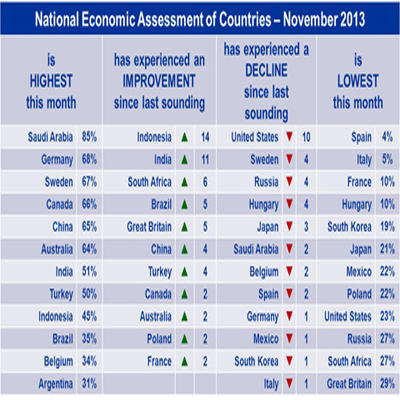
    According to the “Ipsos Economic Pulse of the World” study, India’s economic confidence jumped sharply by 11 points to 51 per cent in the month of November compared to the month of October 2013. India now stands as the seventh most economically confident country in the world after Saudi Arabia, Germany, Sweden, Canada, China, and Australia.


    Three in ten (32 per cent) Indians believe a health increase of five points. Indians are very hopeful about stability and growth in future with general election in the first half of 2014; four in ten (42 per cent) people expects that the economy in their local area will be stronger in next six months, a slender rise of one point.


    “Indian economy has bottomed out after a two-year slump and it is likely to see a positive growth trend from here on with positive indicators like narrowing CAD, revival of exports, growth of manufacturing sector and increasing investor confidence,” said Ipsos in India CEO Mick Gordon.


    “Good Monsoon resulted in bumper crop output, which in turn generated rural demand for goods such as tractors, motorcycles and consumer goods leading to growth of the manufacturing sector,” added Gordon.


    The online Ipsos Economic Pulse of the World survey was conducted in October 2013 among 18,083 people in 24 countries.


    After a significant decline last month, the average global economic assessment of national economies surveyed in 24 countries took a one-point turn for the better this month as 37 per cent of global citizens rate their national economies to be “good.”


    Saudi Arabia (85 per cent) continued to dominate the global ratings of national economies, followed in a distance by Germany (68 per cent), Sweden (67 per cent), Canada (66 per cent), China (65 per cent) and Australia (64 per cent). Once again, only a handful of those in Spain (four per cent) rate their national economies as ‘good’, followed by Italy (five per cent), Hungary (10 per cent), France (10 per cent), and South Korea (19 per cent).


    Countries with the greatest improvements in this wave were Indonesia (45 per cent, 14 points), India (51 per cent, 11 points), South Africa (27 per cent, six points), Brazil (35per cent, five points), Great Britain (29 per cent, five points) and China (65 per cent, four points).


    Those from Brazil (62 per cent), once again, hold the strongest future outlook for their local economy in the next six months. The other high-ranking countries, which followed at a distance, were: Saudi Arabia (48 per cent), India (42 per cent), China (39 per cent), Indonesia (37 per cent) and Argentina (37 per cent).

  • 69% Indians feel SMS is an easier way to express than in person: Ipsos Study

    69% Indians feel SMS is an easier way to express than in person: Ipsos Study

    MUMBAI: Seven in ten (69 per cent) Indians admit they say things in that they would not say voice-to-voice or person-to-person; compared to 43 per cent globally, finds a new poll conducted by Ipsos OTX – the global innovation center for Ipsos.


    “Text or Email is comparatively an impersonal medium and people feel less hesitant to speak their mind. Perhaps that is the reason why majority of Indian would rather avoid saying things in person or over phone,” said Ipsos – head marketing communication Biswarup Banerjee.


    “For example people prefer to share sensitive comments like – “I love you.” “Our relationship is over.” “You are fired.” “I failed in exam.” in writing rather than saying over the phone or face-to-face to avoid embarrassment when they are physically involved,” added Banerjee.


    Demographically in India, age appears to be the most significant variable as those under the age of 35 (75 per cent) are considerably more likely than those aged 35-49 (67 per cent) and those 50-64 (52 per cent) to text/email things they won’t say out loud. Education is also a significant factor as seven in ten (69 per cent) of those with a high level of education say they do so compared with 100 per cent among those with low education. Both Indian women (70 per cent) and men (68 per cent) feel more comfortable texting or emailing sensitive subject rather than voicing it out.


    Strong majorities in China (90 per cent) and South Korea (80 per cent) say they text or email things they would not say over the phone or in person. Seven in ten of those in Indonesia (76 per cent), India (69 per cent) and Saudi Arabia (67 per cent) say so. Following next are Turkey (58 per cent), Brazil (48 per cent), Japan (46 per cent), South Africa (45 per cent), Argentina (42 per cent), Mexico (42 per cent) and Russia (39 per cent). Only three in ten or less in most of the countries surveyed say they reserve some communication for text or email: Canada (34 per cent), Australia (33 per cent), France (33 per cent), Great Britain (32 per cent), Poland (32 per cent), Belgium (31 per cent), Italy (31 per cent), United States (30 per cent), Germany (25 per cent), Hungary (24 per cent), Spain (24 per cent), Norway (22 per cent) and Sweden (22 per cent).


    Ipsos conducted this study among 18,502 adults in 25 countries in the month of August.

  • Bollywood war breaks out over Middle Eastern skies

    Bollywood war breaks out over Middle Eastern skies

    MUMBAI: Very soon, Hindi film fans in the Middle East are going to be spoilt for choice. Here’s how.

    After launching Zee Aflam in 2008, Zee Entertainment Enterprises yesterday premiered the Dubai-based Zee Film Hindi, which boasts a repertoire of over 500 movie titles and up to 1,500 hours of entertainment every year. Zee Film Hindi has an operational office in the Kingdom of Saudi Arabia and can be accessed through the Arabsat Badr-4 satellite on frequency 12111. What’s more, mid-October will see the Middle East Broadcasting Centre (MBC) launch MBC Bollywood, a free-to-air channel available via Nilesat and catering to the MENA (Middle East and North Africa) region, with a portfolio of over 300 Hindi films – dubbed in Arabic or sub-titled.

    While this promises a visual feast for Bollywood fans, what cannot be ruled out is the severe competition it will spark.

    About Zee Film Hindi, Zee Entertainment president – Middle East, North Africa, Turkey & Pakistan Mukund Cairae says: “Since its inception, Zee has worked towards widening the reach of Indian cinema to audiences across the world. We started Zee Aflam five years ago to re-introduce Bollywood to the Arab world. The acceptance from the viewers has led to a huge growth of the genre itself. The launch of ‘Film Hindi’ is a testament to our efforts to continue to bridge and unify audiences in the Middle East, by building on the similarities with the Indian Subcontinent.”

    Cairae points out that  between Zee Aflam and Film Hindi, Zee plans to offer a variety of movies straddling Bollywood and Indie cinema.

    About MBC Bollywood, which is expected to give other Bollywood channels a run for their TRPs, a Dubai-based source says: “With the MBC group already capturing 80 per cent of the advertising market in the Middle East, the new entrant may impact the fortunes of  even Zee Aflam and B4U Aflam.”

    The latest addition to MBC’s existing bouquet of 10 channels, MBC Bollywood, promises to cater to the huge demand for Bollywood movies in the Middle East.

    “Zee Aflam is presently the number one bollywood movie channel in the Middle East, with an estimated $ 9 million per annum  advertising revenue. This will surely get impacted with MBC Bollywood,” the source said. And if reports are to be believed, MBC Bollywood may be one of the reasons why  UTV Movies Arabia could be going off-air by the end of this month.

    A trip down MBC lane

    Historically speaking, the satellite transmission for MBC first started from London in September 1991, making it the first-ever, independent Arabic satellite TV station, and a market leader – delivering news and quality, family entertainment programming to over 130 million Arabic speaking people around the world.

    The channel recently moved its headquarters to Dubai Media City, bringing production closer to its Arab viewers.

    The group’s channel bouquet reach out to nearly 300 million Arabs across the Middle East, Europe, Africa and South America.

    Among these figure: MBC1 (general family entertainment), MBC2 and MBC MAX (24-hour movies), MBC3 (children’s entertainment), MBC4 (entertainment for new Arab women), MBC Action (action series and movies), MBC Persia (24-hour movie channel dubbed in Persian), Al Arabiya (the 24-hour Arabic language news channel), Wanasah (24-hour Arabic music channel) and MBC Drama (Arabic drama).

    The group also has two radio stations: MBC FM (Gulf music), and Panorama FM (contemporary Arabic hit music) and O3 Productions (a specialised documentary production unit).

    For all purposes, it is the Goliath of the middle east. Can the Davids measure up?

  • Indias Economic Confidence Uncomfortably Uncertain: Ipsos Study

    Indias Economic Confidence Uncomfortably Uncertain: Ipsos Study

    MUMBAI: India’s economic confidence recovered marginally but it remains uncomfortably uncertain as food inflation remains sky high and economic growth dwindling, according to a report by global research firm Ipsos.


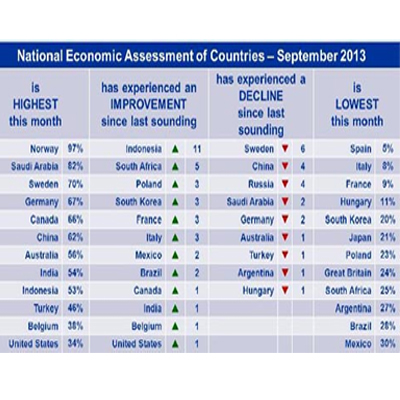
    According to the “Ipsos Economic Pulse of the World” survey, India’s economic confidence increased by only 1 points to 54 percent in the month of September compared to the month of August 2013, however its rating further got pulled down to eighth most economically confident country in the world, as sentiments in G8 and other developed countries improve.


    Thirty four percent Indian Citizen believe a further decline of 2 points. However, what is alarming is generally optimist Indians have turned pessimist, with only 40 per cent people expecting that the economy in their local area will be stronger in next six months, a drop of further 3 points.


    Mick Gordon, CEO, Ipsos in India said, “India’s sizable current-account deficit compared to its economic output, nearly double-digit inflation in consumer prices and dwindling economic growth is making India’s economic sentiments uncomfortably uncertain.”


    “Perhaps the crucial general election next year is limiting governments’ ability to make politically unappetizing economic decisions to implement drastic reforms to revive economic growth and to boost the weakening rupee,” added Gordon.


    The online Ipsos Economic Pulse of the World survey was conducted in August 2013 among 18,503 people in 25 countries.


    After a stagnant June/July, the average global economic assessment of national economies surveyed in 25 countries takes a turn for the better this month as 39% of global citizen’s rate their national economies to be ‘good.’ This shift largely reflects the inclusion of Norway in the global aggregate. Without Norway, the average is 37%, up one point from last sounding.


    Source: Ipsos
    A substantial margin continues to exist at the top of the global ratings between global leader Norway (97%), and runners-up Saudi Arabia (82%), Sweden (70%), Germany (67%), Canada (66%), China (63%), Australia (56%) and India (54%). Only a handful of those in Spain (5%) rate their national economies as ‘good’, followed by Italy (8%), France (9%), and Hungary (11%)


    Countries with the greatest improvements in this wave: Indonesia (53%, 11pts), South Africa (25%, 5pts), Poland (23%, 3pts), South Korea (20%, 3pts), France (9%, 3pts) and Italy (8%, 3pts).


    A strong majority of Brazilians (64%) continue to indicate they predict their local economies will be stronger in the next six months. A gap persists in between Brazilian ratings and the rest of the highest-ranking countries: Saudi Arabia (51%), Argentina (41%), India (40%), Indonesia (37%) and China (35%).

  • First ever Saudi Arabia entry in Oscar – ‘Wadjda’

    First ever Saudi Arabia entry in Oscar – ‘Wadjda’

    MUMBAI: Wadjda is the first film that is shot entirely in Saudi Arabia as well as by a female director Hanifaa Al Mansour, has earned the name of being the first ever Oscar entry from the kingdom. Produced by Rotana Studios, the film debuted in Venice last year.

    Mansour said that at times she had to give instructions through the phone to direct because as per Saudi law she cannot be interacting with men outside.  The film talks about a young girl in the country who is out to challenge deep rooted traditions to buy a bicycle.

    The picture was acquired by Sony Pictures Classics. The movie has won several awards since release. Oscar 2014 will be held on 2 March with Ellen DeGeneres as host.