Tag: satellite launch

  • SES entrusts Arianespace with SES-12 launch

    SES entrusts Arianespace with SES-12 launch

    MUMBAI: SES has selected Arianespace to launch the powerful new hybrid communications satellite, SES-12, on board an Ariane 5 booster from the European Space Center in Kourou, French Guiana, during Q4 2017. This will be the 40th launch of an SES spacecraft on board an European Ariane launch vehicle.


    The new satellite will expand SES’s capabilities to provide direct-to-home (DTH) broadcasting, VSAT, Mobility and High Throughput Satellite (HTS) data connectivity services in the fast growing Asia-Pacific region, including rapidly growing markets such as India and Indonesia.


    The spacecraft will be positioned at the well-established SES orbital slot of 95 degrees East, providing incremental as well as replacement capacity with excellent view angles across the Asia-Pacific region. SES-12 will replace SES’s existing NSS-6 satellite and will be co-located with SES-8. Today, SES serves close to 20 million DTH households in India and Indo-China from this orbital slot.


    SES-12 is being built by Airbus Defence and Space based on the highly reliable Eurostar E3000 platform. The satellite is designed to operate for 15 years, with a payload comprising 68 high-power physical Ku-band transponders and eight physical Ka-band transponders. The spacecraft will be equipped with an electric plasma propulsion system for orbit raising and on-orbit manoeuvres.


    The payload of the hybrid SES-12 satellite consists of two distinct but complementary missions: first, traditional wide beam coverage, and second, a high-powered Ku-band multi spot beam payload (HTS).


    The traditional wide-beam mission consists of 54 (36 MHz equivalent) transponders that will provide state-of-the-art replacement and growth capacity for SES’s existing DTH, government and VSAT customers, allowing for a seamless transition from NSS-6 to SES-12. In addition, the design provides incremental growth capacity to support new DTH platforms and other services targeting the Asia-Pacific region.


    The second mission consists of 70 Ku-band spot beams and 11 Ka-band spot beams delivering over 14 GHz for VSAT, Enterprise, Mobility and Government applications. This mission also includes a Digital Transparent Processor (DTP), which provides anti-jamming capabilities as well as increased payload flexibility in order to provide customized bandwidth solutions to SES customers.

  • Launch Satellite for benefit of SAARC countries: Modi

    Launch Satellite for benefit of SAARC countries: Modi

    NEW DELHI: Prime Minister Narendra Modi  has asked the Indian Space Research Organisatinon to develop a satellite that India can gift to the South Asian Association for Regional Cooperation (SAARC) region.


    He asked ISRO to expand navigation system to all of south Asia.


     Speaking at Sriharikota spaceport, around 100 km from Chennai, after witnessing the launch of PSLV C23, Modi said, “India’s space programme is driven by a vision of service to humanity. Not by a desire of power.”


    He added that the country must share the fruits of its technological advancements with those who do not enjoy the same – the developing world and India’s neighbours in particular.


     India is already sharing disaster management data with over 30 countries and provides benefits of telemedicines to Afghanistan and African countries. “But we must do more,” said the Prime Minister.


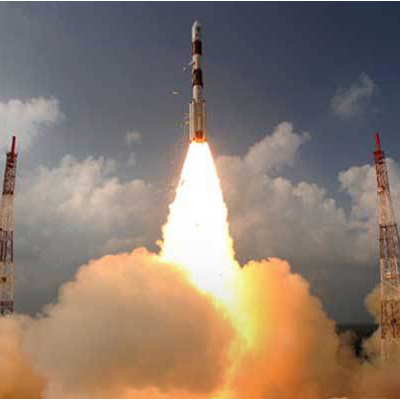
     Earlier, Modi saw the launch of the Polar Satellite Launch Vehicle PSLV-C23 which successfully lifted off from the first launch pad of Sriharikota space station at the Satish Dhawan Space Centre.


     The launch vehicle PSLV-C23, with a height of 44.4 metres and a vehicle lift-off mass of 230 tonne, is carrying SPOT-7, a 714 kg, French earth observing satellite as the main payload, which will be injected into a 655 km Sun Synchronous Orbit (SSO). Other satellites include 14 kg AISAT of Germany, NLS7.1 (CAN-X4) & NLS7.2 (CAN-X5) of Canada each weighing 15 kg and the 7 kg VELOX-1 of Singapore.


    PSLV has had 26 consecutive successful flights till date. The PSLV-C23 will be the tenth flight of PSLV in “core-alone” configuration, which means a configuration without the use of solid strap-on motors.


    After an estimated time of 20 minutes, ISRO’s workhorse PSLV separated all five satellites — one by one into their intended orbit.


    During his first visit to the facility, the Prime Minister took a tour of the facilities, including the launch pad. He was also briefed by ISRO scientists and its Chairman K Radhakrishnan.


    NLS 7.1 and NLS 7.2 are from the University of Toronto, Institute of Aerospace Studies/ Space Flight Laboratory. Canada.


    Both payloads would fly in precise formation using differential GPS with centimeter-level accurate position control system.


    VELOX-1 from Nanyang Technological University, Singapore is a technology demonstrator for design of image sensor, MEMS-based attitude determination and control system and inter-satellite RF link.


    These five satellites are being launched under commercial arrangements that ANTRIX, ISRO’s commercial arm, has entered into with the respective foreign agencies.


    Isro earlier delayed the launch by three minutes due to the threat of space debris getting into the way of the satellites. The PSLV C23 lifted off from the spaceport at 9.52 am on Monday instead of 9.49 am as decided when the launch plan was announced.


    One of the debris objects could have come as near as 40 metres from the spacecraft and by delaying the launch ISRO wanted to avoid the objects by thousands of kilometres as debris move at a velocity of several kilometres per second, said Isro officials.


    A report quoting experts stated that the debris from the 2011 collision of a US satellite and a Russian satellite were found at altitudes above 600 km.


    Until now, the largest number of foreign satellites launched by PSLV was from Germany. In the first launch of satellites of other countries, PSLV-C2 has launched the German satellite with a mass of 45 Kilogram, along with a KITSAT-3 with 110 Kg mass were the payloads. Including this, till April, 2014, eight satellites of Germany reached their destination in space through the launch vehicle of Isro. Canada has sent five satellites till April, 2014 through PSLV while Japan has sent three satellites using the service.