Tag: Sanjay Singal

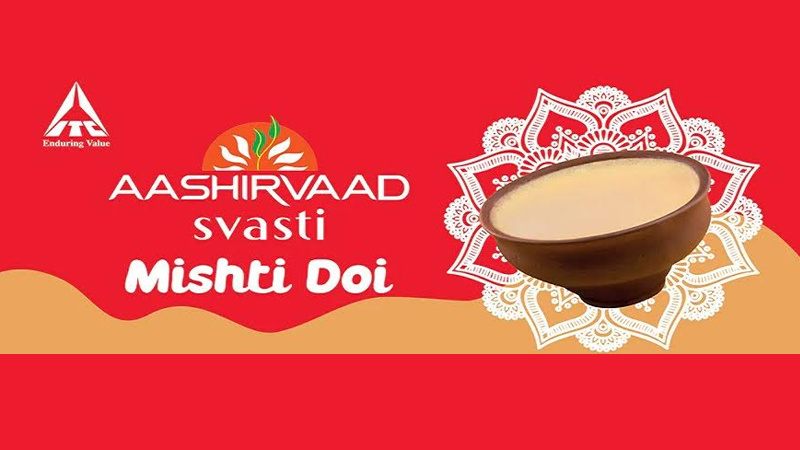
  • ITC’s Aashirvaad Mishti Doi revives ‘Doi-walas’ this festive season

    ITC’s Aashirvaad Mishti Doi revives ‘Doi-walas’ this festive season

    Mumbai: This Durga Puja, ITC’s Aashirvaad Mishti Doi rekindled timeless memories and left an indelible mark in the hearts of Bengalis. The brand brought back the memorable ‘doiwalas’ from the pages of rich Bengali literature, who were once the heart and soul of Kolkata’s streets spreading joy with their delectable mishti doi, calling out in their signature tune- ‘Doi Chaaai Dooooiii…’

    Only this time, it was Aashirvaad Mishti doi coming out of their earthen pots rekindling the heart-warming emotions tied to this timeless tradition and delighting people with the same rich and creamy taste. Actors in the attire of ‘Doiwalas’, wearing dhotis and gamchhas, walked around the streets with a wooden plank (baank) on their shoulders containing Aashirvaad Mishti doi in earthen pots.

    A Musical treat accompanied these doiwalas, with Aashirvaad Mishti Doi song, exclusively sung by Aritra Dasgupta. Inspired by Bengal’s culture, the song gained popularity with almost more than a lakh views on YouTube in a week. The joyous ‘doiwalas’ also joined in celebration, swinging to this tune at popular locations such as Hindustan Park Purbachal and New Town Sarbojanin. Aashirvaad Mishti Doi was also served at a few pandals as ‘sesh paate doi,’, giving attendees the opportunity to savour the delicious mishti doi during the auspicious celebrations.

    ITC’s Aashirvaad Mishti doi, which is available in over 2000 general stores, modern trade stores across Kolkata and on ITC estore. has always associated itself with Bengali nostalgia bringing back timeless memories of yesteryear with its delicious taste. This campaign had the iconic ‘Doi-walas’, as a vehicle to bring back these cherished memories by reaching out to newer generations and providing them an experience of the treasured past.

    Commenting on the campaign, ITC Ltd chief operating officer – dairy and beverages Sanjay Singal said, “Mishti Doi is one of the most loved desserts in West Bengal and is also considered to be a must have during special occasions. It gives me immense pleasure that during the festive days we were able to bring the taste of this iconic dessert to our consumers through none other than the iconic doi-walas. They brought alive a lot of nostalgia and cherished memories associated with the dessert.”

    In addition to these heartwarming efforts, Aashirvaad Mishti Doi hosted a digital contest, ‘#MishtiSwaaderSmriti,’ encouraging participants to share their cherished Durga Puja memories in creative ways. The contest winners received exciting prizes, adding to the delight of the festivities. Overall, Aashirvaad Mishti Doi engaged with over 33,000 consumers through various activations during this period, bringing a delightful taste of old memories to the streets of Kolkata during Durga Puja.

  • Jharkhand consumers can savor ITC’s innovative Aashirvaad dairy products

    Jharkhand consumers can savor ITC’s innovative Aashirvaad dairy products

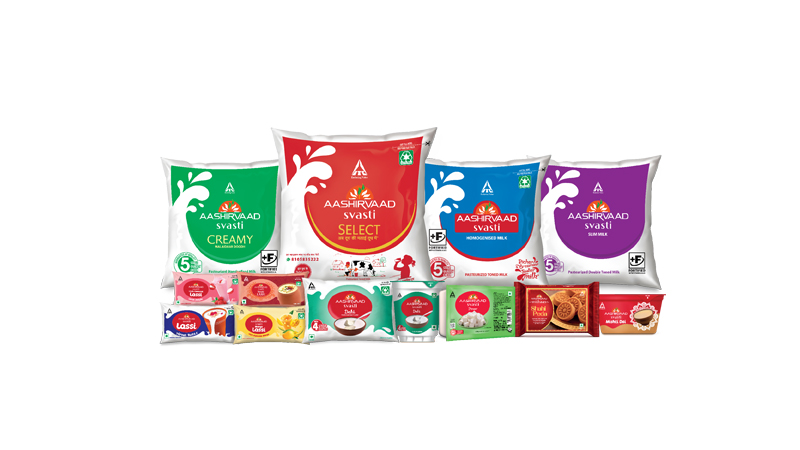
    Mumbai: ITC Ltd’s Aashirvaad Svasti, a leading dairy brand in East India, today announced the extension of its fresh dairy portfolio to the state of Jharkhand. The brand enjoys strong consumer franchise across Bihar and West Bengal and with its launch in the state, Aashirvaad Svasti is set to delight consumers of Jharkhand with a slew of dairy offerings which includes select milk, creamy milk, toned milk, as well as curd, paneer, lassi, mishti doi and peda. Through this portfolio launch in Ranchi and beyond, the brand aims to bring the goodness of fresh dairy products to consumers across the state.

    Aashirvaad Select Milk – the flagship pouch milk variant will be made available to consumers of Jharkhand from today.  This milk is homogenised which ensures milk cream is evenly distributed throughout the milk thus making it thicker and tastier, hence standing true to its brand proposition of “Doodh Ki Malai Doodh Mein”. Further, to maintain complete transparency, for the first time, consumers can check quality quotient of their milk packet everyday through “Doodh ka Report Card”, an industry-first unique feature.

    The ‘Doodh ka Report Card’ consists of 28 quality parameters which are checked at five stages including some of those most relevant for milk like adulterants (urea, starch, vegetable oil, detergents), preservatives etc. thereby assuring consumers of superior quality, thick, tasty, nutritious milk every day. Consumers can access the report by just sending the code number of their milk pack on WhatsApp number 810-583-5222.

    Commenting on the launch of the dairy portfolio in Jharkhand, ITC Ltd chief operating officer – dairy and beverage Sanjay Singal said, “We are excited to embark on this journey of expansion into Jharkhand, introducing Aashirvaad Svasti’s differentiated and innovative dairy offerings to consumers in the region. Aashirvaad Svasti’s success story in Eastern India stems from our unwavering commitment to ensuring the highest benchmarks of quality and consumer delight through product differentiation. Our consumers have embraced our products, making Aashirvaad Svasti a leading dairy brand in Eastern India in a short span of five years. With this launch, we aim to redefine the dairy experience for the people of Jharkhand, similar to what we have done in Bihar and West Bengal”.

    Aashirvaad Svasti fresh dairy products will be available across over 2000 general trade and modern trade outlets across the state.

  • ‘Enormous opportunity’: Brands upbeat about TV advertising in 2021

    ‘Enormous opportunity’: Brands upbeat about TV advertising in 2021

    MUMBAI: It would be safe to conclude from the BARC TV Universe 2020 figures that television remains our favourite form of video entertainment across India. The report, which showed that the number of TV viewers had gone up by more than 50 million to 892 million in the last couple of years, highlights how the power of television and consequently, television advertising remains steadfast and there’s nothing to halt its run! Little wonder then that advertisers are ready to bet big bucks on this old-fashioned medium. As these growing numbers prove, the ‘idiot box’ has proven remarkably resilient in an era of immense disruption, despite the threat of pandemic and emergence of new SVoD platforms.

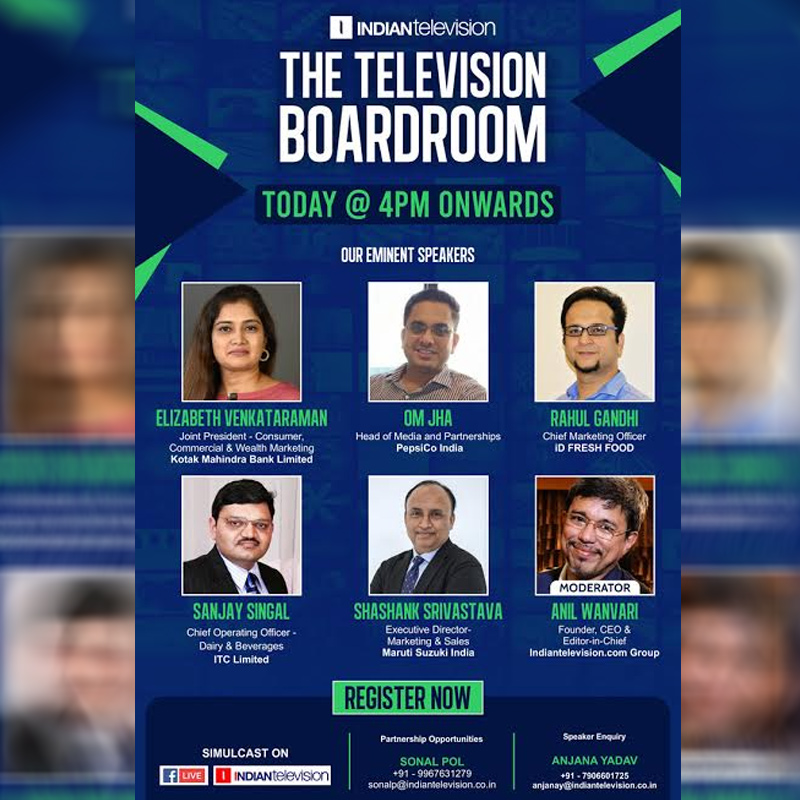
    At the virtual panel discussion The Television Boardroom- organised by Indiantelevision.com Friday, brands across sectors ranging from F&B to automobiles spoke about the whys and hows of TV still taking the biggest slice of the advertising pie. The panel, moderated by Indiantelevision.com's Anil Wanvari  comprised Kotak Mahindra Bank’s Elizabeth Venkataraman, PepsiCo India’s Om Jha, id Fresh Food’s Rahul Gandhi, ITC’s Sanjay Singal and Maruti Suzuki India’s Shashank Srivastava. 

    Brands buoyant about 2021

    While the uncertainty and turmoil caused by the pandemic leading to a virtual halt of film and television shoots in the country was a dampener, marketers remained optimistic about prospects of advertising on television, especially as compared to 2020. The panel tried to explore the mindsets of the TV-viewing consumers and also shared what their expectations from the medium are.

    Kotak’s Venkataraman made note of the unusual consumer viewing behaviour in the year gone by, which needed to be watched carefully to learn whether it sustains going ahead, as we come out of the pandemic. So while all agreed that TV viewership will be higher than 2019, there was a doubt on whether the levels that we see now would continue going ahead, with lockdowns being phased out and work and life calling.

    Srivastava shared his data on projections for TV ad spend in 2021 which are 12 to 13 percent higher than previous year’s. Overall hope and optimism from this year was that it will not be an out and out disruptive year like the year before. With expectations from vaccination drives and/ or herd immunity impact, the world is expected to settle in by mid-2022. Consequently, both viewership and marketer’s spending should improve this year on, was the general opinion.

    Role of branded content & impactful advertising

    Discussions also revolved around the roles branded content and impactful advertising can play in upping the television adex game. ITC’s Singhal spoke about its tie-up with Star during the pandemic called ITC Masterchef, which had insights from five star hotel chefs on how to cook up five-star-like fare, using ingredients already available in one’s kitchen. This got a lot of mileage, so there is definitely a space for branded content, but the need has to be there first, or it could fall flat, he felt.

    TV advertising consists of very short formats of 30-odd-seconds slots, hence to convey a larger picture of what the brand wants to talk about, branded content could help weave a brand story within the content very subtly so that the brand appears organically to the viewer. Brand integration can make it more relatable, without making it look like marketing -oriented.

    Brand association, integration and branded content gives one extra arsenal to marketers to push your product and gain brand recall, while telling the story of the brand, Srivastava said.

    However, contextual or relevance value along with understanding consumer’s needs is crucial for branded content to succeed. So, while TV offers the opportunity, for a brand to make it work is the challenge. That fear needs to be addressed for investment to come in this area. The impact also needs to be felt in numbers for it to be feasible.

    TV stands out for marketers with its impact and reach, and with third party organisations like BARC doing the measurement for the brand on TV modelling analytical capability on television has evolved to a different level. All the impactful advertising in IPL is a case in point – brands associated with IPL 2020 have become household names. Srivastava cited the IPL viewership touching a high of 400 billion viewing minutes in 2020. “There is no debate on the glory and size of TV advertising’s impact” stated Kotak’s Elizabeth.

    Alongside hard data it is also heavily intuitive, while being dependent on the brand objective. Hence there is also a role for a marketer’s gut instinct alongside the measurable impact was agreed overall.

    On looking at sports content beyond cricket

    Nothing beats or even comes close to cricket when it comes to sports in India is unanimously accepted. For television or brands to pick a sport and develop it, the nation must first adopt that sport, opined Jha. He cited instances to prove his point. Sony has been broadcasting football leagues for ages, while Star did a fantastic job with pro-kabaddi but the viewership is nowhere comparable to that of cricket.

    Panelists concurred that brands have been shy of investing in other sports for the same reason, unless it’s a niche region. There were hopes from Football and Kabaddi in this context. Maruti Suzuki is eyeing football as the next massy sport to look forward to in TV advertising, Srivastava shared. Venkataraman deemed Kabaddi as a local sport and also showed promise. There was a feeling that building up hype and hoopla around a sport league could help the sport, as transpired with kabaddi.

    All said and done, TV remains the best pick for a marketer today in India for ROI. And while it may not always be cheap, it is cost efficient for the kind of scale and resilience that the medium offers.

    Also, with television reinventing itself by evolving into smart TVs, which can be connected to the home Wi-Fi or an Amazon firestick, it will continue to remain relevant to consumers and the viewership can only grow from here. And with 90 million households yet to own a TV set in India, according to BARC data, that indicates enormous opportunity for brands in times to come.

  • Why TV remains the preferred mode of advertising for brands

    Why TV remains the preferred mode of advertising for brands

    MUMBAI: Cord-cutting may be a thing in the west, but in India, television still rules the roost when it comes to at-home entertainment. Consequently, there’s a tremendous amount of money spent on TV content and advertising on the medium. However, the Covid2019 pandemic altered this TV-centric state of affairs; now, with changing world scenarios and consumer behaviour, we have already seen and can expect further shifts in the way viewers and advertisers interact with content on TV. 

    Indiantelevision.com organised The Television Boardroom- a virtual panel discussion that explored how to fully understand TV audiences as well as the brand journey through TV today.

    The panel comprised esteemed representatives from the industry – Kotak Mahindra Bank joint president-consumer, commercial & wealth marketing Elizabeth Venkataraman, PepsiCo India head media and partnerships Om Jha, id Fresh Food chief marketing officer Rahul Gandhi, ITC chief operating officer- dairy and beverages Sanjay Singal, Maruti Suzuki India executive director – marketing and sales Shashank Srivastava and Indiantelevision.com's founder, CEO and editor-in-chief Anil Wanvari presided over the session.

    Why TV takes biggest slice of brands’ adex pie

    Maruti Suzuki’s Srivastava took the discussion ahead, sharing the company’s advertising spend – the auto-maker blows 40 per cent of its budget majorly on print, television is a close second at 30 percent and digital is at 25 per cent with the balance being split by radio, OOH and cinema.

    “We are using TV at the top end of the funnel for the reach, brand awareness and brand salience KPIs. Clearly television stands out as a huge medium of importance when it comes to these points,” he added.

    The executive director also shared how the growth in TV audience has been all-encompassing – not just in rural but also urban regions. Citing the example of how e-commerce giant Amazon was the third largest spender in advertising on TV in 2017-18 in India, he asserted that India is proving to be different from other countries when it came to the reach of television.

    Id’s Rahul Gandhi spoke about how the rhetoric question of ‘Who even watches TV?’ should be done away with because “out of the 133-crore people in India a sizeable 100 crore use TV as their primary source of entertainment still”. Thus, “there are many Indias within India with different indicators, which could come as a shock to the naysayers.”

    Also, with television reinventing itself by evolving into Smart TVs, which can be connected to the home wifi or an amazon firestick, it will continue to remain relevant to consumers and the viewership can only grow from here, was Gandhi’s opinion.

    Pepsi’s Jha agreed that “TV remains indispensable to not only consumers but also to marketers” who wish to leverage their brand’s advertising. A large part of marketing that happens in India is centred around TV, for most of the brands and product categories. Speaking about the soft drink brand, Jha said they cater to both spectrums of consumers- from the lowest socio-economic strata to the deepest pockets of our society. And television helps them to reach the last mile of this wide-ranging audience from the two ends of the spectrum. Hence the bulk of the beverage company’s spends would remain in television, he said.

    Where would a brand prefer to advertise on TV

    Recently released BARC stats have shown an upward mobility in TV viewing. The panel theorised that the pandemic seems to have increased the value consciousness of the average Indian. Jha pointed out that “if one had to communicate with 90 per cent of the audience in this country” you will have to go to a mass-heavy medium like television. And that this will only further improve with improving affluence of societies in lower GDP markets like Jharkhand, Bihar and Orissa – which presents a great opportunity for brands like Pepsi for which these are untapped markets.

    Even when it came to high value items like automobiles, Srivastava said that they still prefer television for more strategic brand building, launch and reaching even the interior vernacular regions, while print would be for tactical and lower end of the funnel. All agreed that these stats are highly encouraging, even for high value products. As, not only have the numbers but also the viewing time has spiked.

    “Which is a big vindication of the automaker’s investment of 300 crores currently in television- of which GEC takes up 100-120 crores,” Shashank shared, referring to the IPL viewership touching a high of 400 billion viewing minutes.

    Kotak’s Venkataraman made note of the unusual consumer viewing behaviour in the year gone by, which needed to be watched carefully to learn whether it sustains going ahead, as we come out of the pandemic. So while all agreed, TV viewership will be higher than 2019, but it will probably not remain at the levels that we see now.

    Perspective on TV advertising in 2021

    The jury is out on how many more covid waves the world has to contend with, before it can settle back into pre-Covid “normalcy”. It is apparent we need to learn to manage the waves, while learning to live with it without letting economic activity come to a complete standstill.

    The outlook for 2021 is more optimistic, that it will be more like 2019 rather than the previous year. Herd immunity or vaccination impact also bodes well for settling in by mid-2022. So both viewership and marketer’s spending should improve this year on, was the general opinion.

    “Projections for spending on TV adverts this year is 12 to 13 percent higher than previously,” Srivastava shared. There was overall hope and optimism from 2021 that it will not be an out and out disruptive year like the year before.

  • How brands view television advertising in 2021

    How brands view television advertising in 2021

    New Delhi: Television has been one of the most resilient and strongest mediums of communication, especially in India. Unlike other countries, where an increasing number of people are cutting the cord with pay-TV, India’s reach in television is only growing. Around 210 million households in India now own a TV set, an increase of 6.9 per cent from 197 million in 2018, according to the latest estimates released by TV monitoring agency Broadcast Audience Research Council (BARC) on Thursday.

    But the fast adoption of video streaming services has no doubt changed the dynamics of advertising on television. So, what are the factors that brands now take into consideration when they choose to advertise on general entertainment channels? Does the content matter or is it just the reach? What is the perspective on sports content? Other than cricket what sports content are brands looking at?

    Some of these questions will take centre stage at The Television Boardroom- a virtual panel discussion being organised by Indiantelevision.com at 4 pm on Friday, where some leading brands and advertisers will talk about the different genres of television (movies, infotainment, GEC, news, kids) and their thoughts on them. The event will explore various issues related to the future of television and how the expectations of advertisers from TV have evolved over the years.

    The panel will comprise esteemed representatives from the industry – Kotak Mahindra Bank joint president-consumer, commercial & wealth marketing Elizabeth Venkataraman, PepsiCo India head media and partnerships Om Jha, id Fresh Food chief marketing officer Rahul Gandhi, ITC chief operating officer- dairy and beverages Sanjay Singal, Maruti Suzuki India executive director – marketing and sales Shashank Srivastava and Indiantelevision.com's founder, CEO and editor-in-chief Anil Wanvari.

    The event will be streamed LIVE on the social media platforms of Indiantelevision.com. To join us for stimulating conversations and interesting insights on the issue, register at https://www.indiantelevision.com/television-boardroom/login-system/registration.php

  • ITC’s B Natural celebrates the spirit of ‘Indianness’ by launching a new digital campaign

    ITC’s B Natural celebrates the spirit of ‘Indianness’ by launching a new digital campaign

    MUMBAI: Adding a little music to the patriotic fervor that engulfed the nation on its 71 Republic Day, India’s own, ITC’s B Natural fruit beverages in collaboration with Alive India, has released a multilingual music video celebrating the power of India and showcasing the diversity of its talent and resources. Through its narrative, B Natural celebrates the idea of ‘One Nation One Music’ and promotes the feeling of ‘Indian-ness’, an attribute, in which the brand takes pride, as it facilitates the same by sourcing 100 per cent Indian fruits, only from Indian farmers to deliver 100 per cent Indian taste to delight Indian consumers with high-quality fruit beverages.

    Released on its digital and social media platforms, the emotionally stimulating video, ‘We Are India’, features singers from across the length and breadth of the country, who pay tribute to the nation in 26 different languages. The celebration of India is in line with the ethos of the brand, B Natural, which recognizes the immense contribution of Indian farmers and seeks to empower them by sourcing fruits solely from different parts of the country for its range of beverages.

    The video begins with a baritone voiceover outlining the identity of a true Indian, who believes in and celebrates India’s diversity in its true sense. The view spans out taking the viewer through myriad landscapes, heritage, and culture, with each locale representing the land of the artist in the frame. Through their music, the artists pay homage to their homeland. The video juxtaposes Indian fruit farmers from the same regions which further establishes the connection between B Natural Fruit Beverages and the musical narrative while evoking the patriotic fervor and conveying the concept of unity in diversity.

    Commenting on the initiative, ITC Limited chief operating officer dairy and beverages Sanjay Singal said, “This musical ensemble very aptly reflects B Natural’s ethos of celebrating Indianness, an attribute which the brand takes pride evidenced by our proposition as we bring to consumers the fruits of the labor of our Indian farmers through our beverages. We hope this video inspires the feeling of pride and gratitude among the consumers towards our country and help build this ethos.”

    Link to the YouTube video: https://www.youtube.com/watch?v=9_Efb8VI_w8

    Link to the Instagram video: https://www.instagram.com/tv/B70tuC1BAsR/

    Link to the Facebook video:

    https://www.facebook.com/BNaturalFruitBeverages/videos/589869918257069/

  • Fem Bleach to launch ad campaign created by Law & Kenneth

    MUMBAI: Dabur India‘s facial bleach brand Fem has launched a new ad campaign that features Bollywood actor Sonakshi Sinha and her mother Poonam Sinha.

    To be launched in early December, the new ad campaign of Fem has been created by Law & Kenneth.

    The campaign aims to promote the new range of facial bleaches under the brand Fem.

    Dabur India marketing head (skin care) Sanjay Singal said, “Sonakshi Sinha has been advocating the benefits of Fem Bleaches as the route to healthy and safe fairness for over two years now, and has successfully helped in getting more and more people to switch to Fem Bleaches. Fem Bleaches today stand for giving healthy fairness through natural ingredients like Saffron and Pearls. With this campaign, we are establishing Fem‘s new range as being so natural and safe that even mom‘s recommend it for their daughters beauty care needs.”

    In the new TVC, Poonam Sinha is seen sharing her natural beauty secrets with Sonakshi Sinha. The duo takes forward Fem‘s message of ‘Long Lasting Healthy Fairness‘ which comes from natural ingredients like Saffron, Pearls and Milk.

  • Sonakshi Sinha is Gulabari brand ambassador

    MUMBAI: Rose-based skin care brand Dabur Gulabari from the Dabur stable has signed on Bollywood actor Sonakshi Sinha as its new brand ambassador.

    Sinha will be the face of the rand in its soon to be launched 360-degree multimedia campaign with print, electronic and online media initiatives. She will share her tips on using Dabur Gulabari for daily skin care as part of the campaign.

    Under this initiative, Dabur Gulabari will also be launching a coffee table book – Beauty Secrets of Beauty Queens. The book will feature the secret beauty tips by Sinha and her skin care routine.As a means of consumer engagement, the company shall also encourage consumers to write in their secret beauty recipes and how they incorporate rose water in their daily skin care regime.

    Sinha said, “Dabur Gulabari is synonymous to pure rose water in India. For years now, I have been a loyal user of the Dabur Gulabari. After a long, hard day of shoot, I always cleanse my face with the Dabur Gulabari Rose Water to get back that Rose Glow on my face. Gulabari is also a must-have ingredient for my face packs. The Dabur Gulabari Face Freshener spray is another favorite as I can carry it in my purse while am out shooting in the Sun. I spray it on my face and get refreshed instantly. Dabur Gulabari, in fact, has always been an essential part of my daily skin care routine.”

    Dabur India Ltd head of marketing-skin care Sanjay Singal said, “The over a decade-old Dabur Gulabari has been cherished by women across India as the only brand that offers the goodness and lingering fragrance of rose. Sonakshi, with her natural elegance, charm, confidence and grace, was the natural choice as a brand ambassador for Dabur Gulabari.”