Tag: Sangeetha N

  • WhatsApp ads to test targeted marketing, user readiness and data security

    WhatsApp ads to test targeted marketing, user readiness and data security

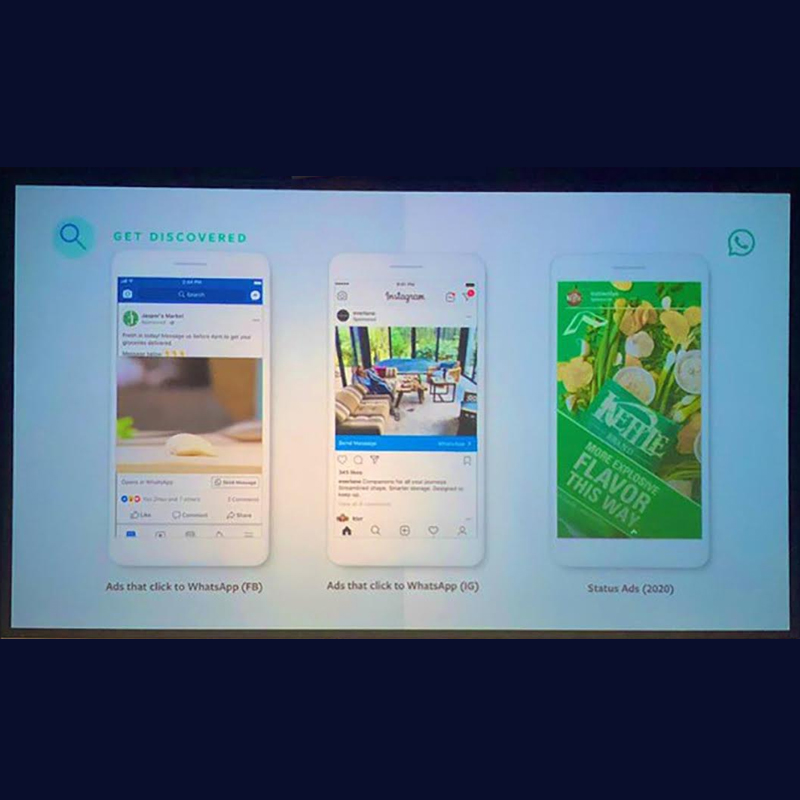
    MUMBAI: Ever since Facebook acquired WhatsApp, people have been expecting the popular chatting app to move towards an ad-based model. Recently, a tweet from an attendee at the Facebook Marketing Summit Rotterdam confirmed that WhatsApp intends to launch ads soon in the status/stories section and will also be connected to its sister sites like Instagram and Facebook.

    This started a fresh conversation around two major topics; are the users ready and what about data security on an ‘encrypted platform’? Indiantelevision.com interacted with some marketing and digital experts and sought answers to these two very pressing questions.

    While users on all social media platforms have become used to seeing ads, a similar pattern on WhatsApp is difficult to follow. As it is a more personalised platform used for chats with close peers, unlike the Facebooks and Instagrams of the world, which people use to follow a global base of users who might not be directly related to them, introducing ads will seem like an intrusion in the personal space.

    ADOHM chief executive officer Kuldeep Chaudhary says, “While the content consuming pattern in the audience is evolving and they are getting used to seeing ads on multiple platforms, having ads on WhatsApp may not be welcomed easily. The reason being WhatsApp has a very large user base in the masses, for whom ads will be an intrusion. This step will see a similar reaction like how it was during the initial days of YouTube ads. While platforms need to take this step from a revenue perspective, audiences are not yet ready for the move as from consumer point of view it is another bombardment from advertisers.”

    Vertoz founder and CEO Ashish Shah also advises brands to be cautious. “Ads showing up on WhatsApp might be looked upon as an intrusion into the users’ private space, considering the highly personal and very private environment of this communication tool. It is imperative for brands to ensure that the ads are non-intrusive in nature and do not irk off the users or disturb their privacy.”

    Though feature ads are going to be a new addition to the chatting platform, WhatsApp has already been active in giving some brands a chance to interact directly with the consumers. Be it delivering e-tickets like MakeMyTrip and BookMyShow do, or sharing timely updates of order deliveries like Ajio does, many brands are active on the platform to offer their customers a more personalised and seamless experience.

    Havas managing director Mohit Joshi notes, “Currently WhatsApp is a great space for two-way communication between the consumer and the brand. Marketers are creating WhatsApp brand profiles and then integrating them with their product/service offering across verticals. Many brands like MakeMyTrip, Ixigo and Milap have already started using this platform as a substitute/addition to email/SMS to connect with consumers once they have interacted with their platform. Currently, there is merit in using the platform more from an ‘owned media’ standpoint.”

    However, any of these activities do not rely directly on the data from the app. But with advertisements from sources that are not connected to the users coming in place, a huge pile of data and information will be required by the advertisers to create a targeted reach. Users, in the past, have moved away from platforms like parent Facebook after cases of data breaches came to light.

    NeoNiche Integrated Solutions Pvt Ltd MD and CEO Prateek Kumar mentions, “WhatsApp has always tried to ensure security between users for their conversations with end-to-end encryption being introduced in 2016. The announcement of ads on the platform seemed inevitable but the true extent of targeted marketing will only be realised after the full release. However, the extent of data shared with companies is probably the most contentious issue in this scenario.”

    Also, getting data out of an encrypted platform seems quite impossible. Carat SVP Mayank Bhatnagar says, “Right now, it (ads on WhatsApp) is just to drive the reach. I will not forward my tickets to anyone else, and thus there is no engagement parameter in place. It is just to help consumers. Once they open the full-fledged advertising solutions, it will be helpful in garnering that reach but I am not sure how will they measure the engagement.”

    However, Chaudhary states that Facebook can access keywords from WhatsApp chats despite encryption being in place. “In spite of the fact that WhatsApp states that they cannot access users’ data due to end-to-end encryption but in order to run targeted ads, access to data specific to individuals is required. Security researchers have pointed out that even with encryption in place, it will be possible for Facebook to derive keywords from people’s messages and use them to impose an ad-targeting model on the app. These ads will be showcased on WhatsApp stories and in-message advertising for WhatsApp business accounts.”

    Kumar further shares, “It seems more likely that while chatting with other users, WhatsApp will showcase ads of particular brands that might be most relevant to you depending on the topic of conversation or particular keywords. One of the best-case scenarios for users would be if sponsored ads were only displayed after the use of keywords or syntax based content to drive clicks where individual, demographic and chat-based data would not be shared. However, understanding the growing prominence of target marketing and its effectiveness in the digital world, the on-ground scenario may differ greatly.”

    Another way to access relevant data could be through telecom companies, as shared by RK Swamy BBDO president and director Sangeetha N. She notes, “Telecom companies do provide data based on gender, age, make of phone, average billing per month, location, post-paid/pre-paid, etc. While we’ve used this data in the past to send out SMS’es, we can surely use the same data to send out WhatsApp messages.”

    Shah vouches on the importance of programmatic methodology to drive successful ads on WhatsApp as he notes, “WhatsApp can build the users’ profile using the information gathered directly from the platform and elsewhere. If WhatsApp is using programmatic advertising, then it will be the smart choice for these requirements. Programmatic advertising uses Data Management Platforms (DMPs) that help advertisers to analyse, process and structure the user’s data. DMPs can be used to get relevant audience profiles and to deliver personalised and relevant ads to them. Further, using the different targeting options like interest-based targeting, behavioural targeting, contextual targeting and many more, advertisers can deliver relevant and targeted ads to their customers on platforms like WhatsApp.”

  • Agencies, advertisers weigh in on BARC India filtering out outlier data

    Agencies, advertisers weigh in on BARC India filtering out outlier data

    MUMBAI: Recently, The Broadcast Audience Research Council India (BARC) announced that it is reverting to its earlier process of treatment of landing pages and filtering out outliers from the data as it released its week 23 ratings. This came just a week after the Telecom Disputes Settlement and Appellate Tribunal (TDSAT) verdict allowing broadcasters and distributors of television channels to place registered satellite television channels (whose TV rating was measured by BARC India) on the landing page or boot up screen.

    This frequent change in the measurement module might have led to some confusion within the advertising community that relies heavily on BARC data for its marketing planning on television. Marketers Indiantelevision.com spoke to said that they prefer this data filtered out.

    MediaCom general manager Sudipto Chatterjee explained that any sudden spike in the reach or viewership of a channel is termed as an outlier. Citing an example of English news channels, which have comparatively lesser sampling than any other news channels, he elaborated, “Let’s say it has a base of 1000 subscribers and even if 150-250 more people view it, the range will look like it has shot up greatly, thus being counted as an outlier.”

    Placing channels on the landing page may lead to such outlier spikes but the viewership might not follow since it depends on the content that a channel features and that’s what media planners and marketers look at while strategising their plans.

    Chatterjee added, “We need to understand that in overall media planning, the outliers might just amount for 5-10 per cent of investment. It will not add anything to the GRP or reach. It is based on your consumer affinity. For media planners like us, we do not really buy numbers. It is more about content and what kind of audience I am looking at. Nobody looks at the minimal up and down in the ratings.”

    RK Swamy BBDO president and director Sangeetha N also mentioned that the landing page strategy is generally adopted by channels with very low ratings and any surges, even due to calculation errors, on such low bases, will be insignificant.

    She said, “For how long can a channel with poor content but deep pockets hold viewer attention by forcing landing page viewing? Only good content will define where the target audience will move to.”

    Carat India SVP Mayank Bhatnagar also shared similar views as he noted, “I feel that landing page is a mechanism to get people to sample a channel. If the content is good, one will continue to watch the channel or else they will move on. It doesn’t matter if the channel has the landing page rights for a month or even a year. Content is the key to get the viewership.”

    Advertisers also share a similar view. Angel Broking chief marketing officer Prabhakar Tiwari shared, “In our view, landing page is a purely promotional exercise. As per some industry data, a channel may get an increased viewership between 4 to 18 per cent subject to target demographics of a particular cable operator by investing in landing page-based promotions. We also have our internal research to guide us, as we take channel-specific media calls. Media decisions are taken after a lot of deliberation and we measure all factors before coming to a decision.”

    Although the data, filtered or unfiltered, does not really impact the marketing strategies, experts prefer having filtered statistics at their hands as it is more transparent and reliable, and thus feel that BARC India’s decision is a welcome move.

    Sangeetha noted, “The resuming of outliers being filtered out – whether manually or through automation – will mean more meaningful data, closer to reality, and hence will be welcomed. By this method, no channel gets preference over another by getting the landing page rights through the purchase of the same, hence prima facie no channel can have an unfair advantage.”

    Bhatnagar said, “By eliminating the outlier data, all channels are now on the same platform and can have an end-to-end comparison. Now it all depends on content.”