Tag: Samsung

  • Cheil Worldwide SW Asia launches TVC for Samsung Hero 3G

    Cheil Worldwide SW Asia launches TVC for Samsung Hero 3G

    MUMBAI: Cheil Worldwide SW Asia has released a new 30-second television commercial for the Samsung Hero 3G enabled handset.

    The ad aims to change the perception that 3G-enabled handsets are very expensive.

    The Samsung Hero 3G is a 3G enabled phone with features such as video calling and mobile TV providing access to social networking sites, and priced at Rs 4,000.

    In the spot, a group is seen enjoying various aspects of the phone such as its camera, music download, video download, mobile TV and video telephony, whilst they are in the sky.

    In this commercial Cheil aims to highlight the excitement of discovering the new technology and brings alive the fun of living life on the 3G super-highway.

    In the days to come Samsung has lined up a range of products and Cheil Worldwide is involved in building communication across 360-degree consumer touch points, for creating buzz for the brand.


  • Elkana Ezekiel is Samsung CMO

    Elkana Ezekiel is Samsung CMO

    MUMBAI: Consumer electronics company Samsung India has appointed Elkana Ezekiel as its chief marketing officer.

    In this role, Ezekiel will be heading the corporate marketing function for Samsung India as well as developing and executing corporate marketing strategies in order to support the company to achieve its targeted sales.

    Prior to joining Samsung, he was with Johnson & Johnson for over 16 years. He was regional franchise director (Baby Care) – Asia Pacific Region, based at Singapore where he was responsible for marketing of Johnson‘s Baby products, handling marketing, brand strategy and business development for the brand covering 15 countries including Japan, China, India, Korea, ASEAN and Australia.

    Ezekiel said, “My mandate will be to take the Samsung brand to the next level in terms of consumer connect by fully leveraging the Samsung brand and product strengths across the different business verticals of the Company.”

    Samsung, which achieved a Sales turnover of $3.5 billion in India, is targeting sales growth of 40 per cent in the Indian market in the year 2011.”

  • Marching to a new tune

    Make no mistake about it, 2007 was a b-a-a-a-d year for the industry.

    That’s no doomsayer sounding the deathknell for the music industry, but one of the opening remarks of a series of year end insights put out on MTV.com. Globally, the biggies of the music industry have had to contend with dipping physical sales graphs, even as the indies and sharp eyed innovators in the digital world have been snapping up the advantages offered by the Internet, live performances and merchandise.

    The low tide hit Indian shores too in 2007. Internet downloads however did not hit the Indian industry as hard as did the rapidly growing mobile phone industry, where music entertainment was one of the prime drivers of the value added services industry here. FM, which boomed this year, was one of the biggest applications utilised over the mobile phone, aided in no small measure by scaled down prices for FM enabled mobile phones.

    Physical sales plummet…
    Indians purchased more music on their mobile phones than they did physical music products like CDs and cassettes in 2007, says a Soundbuzz report. Mobile music products, in fact, will be purchased nine times more often than physical within the next 18-24 months, the report adds. One doesn’t need to look far for the reason. The region is experiencing an exploding mobile market, virtually dominated by consumers under the age of 30 who are generating and sharing content on a spectrum ranging from pure entertainment, to self projection, to self expression and self actualization.

    While experts within the industry differed on the quantum of mobile music sold during the year, claiming that it could not have surpassed the Rs 600 crore worth of physical sales, most agreed that India is now part of the Asian juggernaut – 50 per cent of all music purchases in Asia in 2006 were digital – online or mobile, and the figures only spiralled in 2007.

    Hardly surprising, considering industry estimates that in the next 12 months, 12 per cent of the world’s population will comprise of young singles in Asia who will command a purchasing power of about US$150 billion.

    The mobile industry taps into music to grow
    Music in 2007 became one of the key value adds that helped the mobile phone industry to grow.

    By the end of July 2007, India had 192.98 million wireless subscribers, a number expected to grow to 250 million handsets by the year end. As if the rapid penetration of the mobile in the country wasn’t enough, global companies like Nokia, Sony Ericsson, Motorola and Samsung strove neck-to-neck to come up with handsets loaded with FM radios, MP3 players and a good memory capacity.

    Today, around 35 per cent of their Indian handset products feature downloadable music applications and Sony’s Walkman phone accounts for 65 per cent of total revenues. Sony is also toying with expanding its chain of Expression Stores, which feature phones and music download stations.

    Nokia too set up college sponsorship deals and collaborated with music companies to buy the rights for free downloadable songs on some of their handsets to encourage the use of digital music. Some of Nokia’s N-series handsets, with a 3,000 song capacity, offer 100 preloaded songs free; just to make a mark, and money of course, in this segment. Most of the major handset makers have tie-ups with music content sites such as Soundbuzz.com and OnMobile.com as well as revenue-sharing deals with local telcos and music companies.

    VAS – the big deal
    Mobile value added services (VAS) in India stood at Rs 2850 crore at the end of 2006, and according to a IAMAI and IMRB study, by end 2007 it stands at nearly Rs 4560 crore, a growth of 60 per cent. Ringtone downloads contribute over 35 per cent of the whole. These comprise the spectrum of mono and polyphonic ringtones, apart from caller ring back tones, true tones – all of which borrow heavily from either Bollywood, devotional or regional music.

    The innovations
    While the industry lamented the downward trend in sales, labels continued to innovate, expand and diversify, tapping into newer arenas.

    Companies like Saregama introduced mobitune cards for ringtones, a pilot project across Bangalore, Chennai and Hyderabad, for music downloads at Nokia outlets. The company said there were 8000 music downloads against 4000 handsets sold at the 25 Nokia outlets during the trial period.

    Companies also tried to expand by signing exclusive deals with mobile operators and others in this segment, with everyone realising that five years down the line, this segment will be a very important source of income and revenue.

    Companies like T-Series and Yash Raj turned out to be key players in the digital music segment, with Yashraj beginning to offer music downloads online. Other music labels like Saregama also launched its own online music store. Others may follow suit in the coming year, although the domestic market for net downloads is still abysmal.
    Regardless of the discovery of new artistes and tuneful Bollywood compositions that made their mark in 2007 – compilations of old Bollywood music continued to contribute significantly to companies’ bottomline. 2008 should see the witness the continued slow but steady rise of spiritual music, which many leading labels tried their hand at.

    The new launches
    Despite sluggish revenues, the industry perceived enough to launch some new labels. Reliance’s Big Music and Home Entertainment was the first off the block early this year. Starting off with Bollywood music, Big Music now plans to reach into regional music in a big way next year. Regional music will also be the focus of Times Music’s new label, Junglee music that launched at the fag end of the year with the music of Nadiadwala’s Welcome. After a fallout with Big, UTV decided to go ahead and launch its own music label for its forthcoming production, Jodhaa Akbar.

    Piracy – the demon’s talons refuse to get trimmed
    Pirated music CDs and illegal Net downloads apart, mobile chip piracy became the latest demon to haunt the Indian music industry. The Indian Music Industry estimates that the size of the music market on mobile phones is around Rs four billion, including products like ring tones – monophonic and polyphonic; True Tones; Ring back Tones; Full song mobile downloads; Music videos.

    Considering royalty, for the music industry, on products like full songs download at approximately Rs five per download and assuming one illegal transfer per phone per month, the loss amounts to Rs 12.5 million per month, says the IMI. Digitized music can be easily copied from any storage device like computer hard disc or USB drive, mobile phone with stored music etc. into the built in memory of a mobile phone or on memory cards or chips which can be further inserted into other mobile phones.

    Individual companies like Shemaroo continued their own campaign against piracy, raiding illegal CD burning outfits and bringing culprits to book with the help of the police. The Phonographic Performance Limited, the licensing wing of the IMI, also did its bit by launching awareness campaigns about the need to procure licenses to play music at events and venues.

    India – the new destination
    The number of international artistes wanting to perform live in India continues to grow. Nelly Furtado kicked off the year’s musical proceedings by performing at the Nokia New Year’s Night eve in Mumbai. Shortly thereafter, Shakira, Aerosmith, Beyonce, 50 Cent, Iron Maiden, America and the Scorpions, among others, performed to packed crowds in venues as diverse as Shillong and Chennai. Obviously, the music lovers’ demand here is huge – Iron Maiden will start their ’08 world tour with a performance in Mumbai.

    The new tunes in ’08
    Globally, music delivered to mobile phones via operators’ networks (mobile music) will jump from the current 13 per cent of global recorded music retail value to 30 per cent by 2011.

    “Looking to emerging markets, mobile could become the number one platform for music, where packaged CDs haven’t gained traction due to piracy and lack of hardware ownership,” says a recently released report by Understanding & Solutions.

    Experts say that in India, ringtones which are the dominant digital format, will continue to remain so till 2009. Mobile music growth will however be fuelled by additional formats, including ringback tones, caller id tones plus full track audio adn video downloads. These forms of mobile music will grow dramatically to achieve 3.9 billion USD in sales in Asia by 2009, up from 210 mn USD in 2005. Online sales will remain relatively static in the coming three years, point out experts.

    Regional could well be the new flavour for music labels, that want to tap the huge interiors. They could well be wary of artistes and music directors, who are slowly taking the production route themselves – turning producers or launching their music directly on the Internet a la Radiohead. As technolgy advances by leaps and bounds, the sky’s the limit for the creators of music in the country.
  • ‘Corporate Olympics’ to get execs on the run on 7 March

    ‘Corporate Olympics’ to get execs on the run on 7 March

    MUMBAI: Fountainhead Promotions and Events Pvt. Ltd, along with their partners the Aditya Birla Group and The Times of India Group has announced the launch of the Corporate Olympics 2007, the first ever games series where executives across the corporate spectrum will participate. The 10-day mega sports festival will kick off on 7 March and end on 17 March.

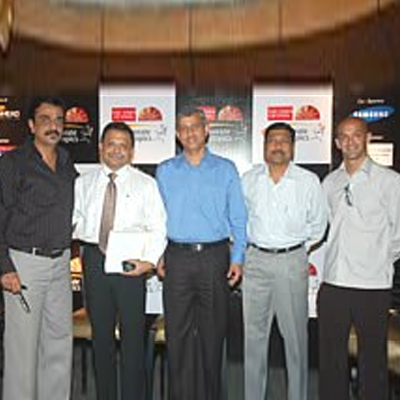
    Brian Tellis, Adille Sumariwalla, M M Somaiya, Mervyan Fernandes & Viren Rasquinha.

    The objective of Corporate Olympics is to take executives from the boardroom to the playing field. The event has a range of activities from cricket, football, tennis, squash, to various other sports lined up, informs an official release.

    The entry process for the event will be organization driven; every organization forms a contingent that will participate in the games. An organization can participate in all disciplines – however, participation is limited to two individual entries / one team entry per sport.

    Corporate Olympics Brian Tellis chairman of Fountainhead and convener believes, “Corporate Olympics, a unique and exciting concept, is all set to engage every corporate sportsman’s attention and create a sense of true and healthy competition. It will be fascinating to watch them battle it out on the playing field for a change, rather than the business arena.”

    The Times of India, Aditya Birla Corproate Olympics is co sponsored by Radhakrishna Hospitality Services and Samsung. While the Proline is the fitness partner.
     

  • RPG Cellucom makes quiet entry with select stores

    RPG Cellucom makes quiet entry with select stores

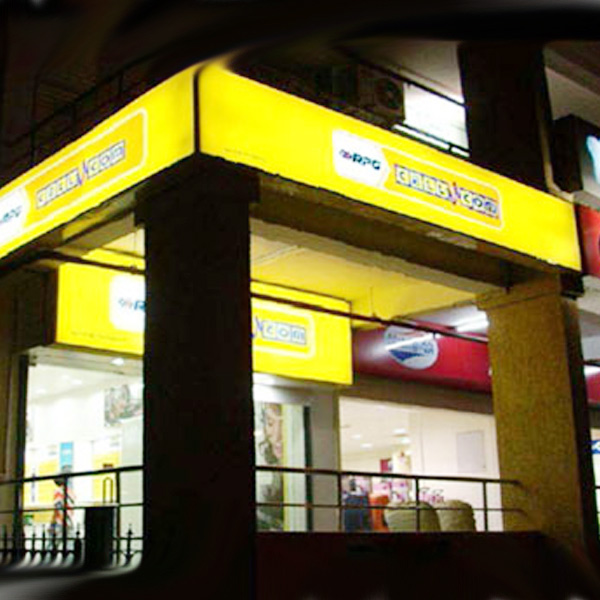
    MUMBAI: RPG Cellucom, a part of RPG group retail sector has made a quiet entry into the growing mobile and IT products retail market in India.

    An official press release, RPG Cellucom has developed a distinctive retail concept directed at engaging the consumer and expanding their knowledge of mobile technology.

    SRPG Cellucom has also made a quiet entry with the launch of its retail outlet in Gurgaon. The company plans to open over 500 exclusive retail outlets by end 2007.

    The retail outlets will be in stand-alone as well as shop in shop formats. The chain recently opened its first stand-alone outlet in Sahara Mall, Gurgaon and has identified several other properties in the capital to expand the retail chain.

    Through phased expansion, RPG Cellucom aims to cash on the growing mobile and IT products market in India. The company has opened its shop-in-shop format at Shopper’s Stop in Mumbai and Spencer’s in Pune.

    ERPG Cellucom outlets will showcase a wide variety of mobility products in the communication space from leading brands like Nokia, Motorola, Acer, HP, Samsung and Sony Ericsson amongst others.

    The retail outlets will offer customers a wide range of hi-tech and state of the art technology products ranging from mobile phones, laptops, accessories, pen drives and various other IT peripherals. In addition to showcasing these products, RPG Cellucom retail outlets will also offer customers after sales service and exclusive product demonstrations.

    Says RPG Cellucom CEO Sunil Bhagat “RPG Cellucom stores are a one stop shop for all techno-savvy customers. Along with providing the customer with a wide range of IT and communication products from different brands, we also provide them with after sales services and product demos at our exclusive showrooms across the country. So now the customers will not have to run around the city to make choices.”

    Cellucom was set up as an exporter of leading mobile phone brands, with operations in Dubai and East Africa. Today, thanks to the keen attention and rapid response to the customer’s needs, the company has evolved to become one of the largest distributors of digital devices and mobility solutions in the Middle East and Africa region.

  • Samsung strengthens DTV position in the US

    Samsung strengthens DTV position in the US

    MUMBAI: Electronics major Samsung captured the number one market share position for digital televisions in the US in 2006, according to The NPD Group’s retail tracking service.

    NPD VP industry analysis Stephen Baker says, “The industry’s overall DTV unit sales have grown 54 per cent and three million more digital TVs were sold in 2006 than 2005; and within 2006, Samsung sold more digital televisions than anyone else in the industry.

    “Samsung is the only television manufacturer that demonstrates market strength in all four digital TV categories, which includes LCD, plasma, Microdisplay and Flat Tube. According to NPD’s monthly sales data Samsung’s share position improved throughout the year with Samsung leading the market in units and dollars within the second half of the year.”

    Samsung became America’s choice for digital TVs in 2006 with total Digital TV unit share of 20 per cent, which is a significant lead on the competition. In addition, Samsung demonstrated strong category leadership in Flat Panel TVs with number one unit share of 21.5 percent and number one dollar share of 25.1 percent; Samsung grew its LCD market share (10″ and larger) to the number one position in 2006 (from the number four position in 2005) with a market share of 15.1 per cent; and its SlimFit™ line of flat tube CRT TVs claimed an overwhelming 46.1 percent unit share and a 43.7 per cent dollar share in 2006, according to NPD data.

    Samsungsays that it is the only manufacturer that produces, and is committed to leading, in all four major digital television technologies: LCD, Microdisplay, Plasma, and Flat Tube. Strong 2006 sales across each category catapulted Samsung to the number one position.

    Samsung Electronics America executive VP, consumer electronics division Tim Baxter says, “Achieving a number one market position is a significant milestone for Samsung and we are very proud that for the first time, the American public has made us their first choice for digital televisions.

    “Samsung has demonstrated its growth to demand-brand status within the highly competitive Digital TV landscape. We attribute our success to a combination of manufacturing strength, commitment to all four digital television technologies and our leading product designs.”

    In 2006, Samsung launched its 51/52 series of LCD HDTVs, which the company nicknamed Bordeaux for its wine-glass curve at the bottom of the sets. For the first time, Samsung’s TVs offered consumers a choice of luxurious lacquer-like piano-black or smooth white-pearl exterior that not only complemented consumers’ home design but enhanced it as well.

    People the firm says no longer had to hide their TVs inside bulky, space-consuming furniture; Samsung provided them with design choices that accented their home décor.

    Samsung adds that it is one of the largest panel manufacturers in the world. In fact, the company consistently increases its R&D investments each year. In 2005 alone, Samsung’s R&D investments reached 5.41 trillion KRW. Recently, Samsung SDI (one of Samsung’s group affiliates) expanded the capacity of its plasma development facility in Cheonan, Korea.

    Samsung Electronics is currently planning to open a Gen8 LCD manufacturing facility in TangJeong, Korea. Because the company designs and manufactures most of its own components, it can maintain the utmost control over production quality and manufacturing costs, giving the company a distinct market advantage.

    About five years ago, Samsung decided to focus its TV resources almost exclusively on its digital television product line. The company recognized that each of the four digital TV technologies brought different advantages – and price points – to consumers and it decided to invest in each of them.

    The firm says that due to its manufacturing strength it is able to bring price-competitive televisions to market while maintaining our profitability. So its early decisions and investments are paying off.

    Samsung attributed its success to a combination of manufacturing strength, commitment to all four digital television technologies and product designs

  • Alcatel, Samsung to develop mobile TV handsets in the S-Band

    Alcatel, Samsung to develop mobile TV handsets in the S-Band

    MUMBAI: France based comunications services provider Alcatel and Samsung Electronics have signed an agreement to develop mobile handsets compatible with the evolution of the DVB-H standard in the S-Band. This is part of Alcatel’s Unlimited Mobile TV solution.

    The two parties will collaborate on interoperability testing in order to deliver a seamless end-to-end solution to operators and a high quality Mobile TV service to end-users. Both companies will support the standardization process of this solution in the DVB Forum undertaken in the DVB-SSP (Satellite Services for Portable devices) Ad-Hoc Group, and join forces to market their combined solution. In a first step, this agreement covers Europe, where the S-band spectrum is available today.

    The solution in the S-Band allows complete territory coverage for Mobile TV at the scale of a country or even a continent, including inside buildings. Besides, this solution is compatible with DVB-H in UHF, which also enables the development of dual-mode UHF/ S-Band Mobile TV terminals.

    Samsung senior VP Kwang Suk Hyun says, “Samsung values its new cooperation with Alcatel for handsets in the S-Band, as it opens the door to a significant new business opportunity for Samsung in Europe. S-Band is a solution of choice in Europe for Mobile TV deployment and Samsung intends to be a major player in this business.”

    Alcatel’s mobile broadcast activities president Olivier Coste says, “We welcome Samsung as a new key stakeholder in the S-Band ecosystem for broadcast Mobile TV, as they enjoy a track record in fast Mobile TV handset development and go-to-market capability. Samsung’s endorsement of our hybrid mobile TV solution in the S-Band also demonstrates the attractiveness of this option for the Mobile TV industry at large.”

    The goal of Alcatel’s “Unlimited Mobile TV” solution is to make television available on mobile phones throughout rural and urban areas, including indoors, with a wide range of programming options and excellent image quality, regardless of the number of viewers simultaneously watching the same programme.

    This universal broadcast coverage is possible thanks to the unique combination of a high-power geo-stationary satellite for cost-effective nationwide coverage and a network of low power repeaters, co-located with mobile base stations, to provide urban and indoor coverage. This innovative solution uses an evolution of the DVB-H standard in the 2 GHz band (S-Band), a telecom frequency band between 2.17 and 2.2 GHz associated with satellite usage, which is adjacent to the 3G/UMTS band. This 30MHz band is currently available all across Europe.

  • Siemens to showcase potential of IPTV, mobile TV at Berlin trade show

    Siemens to showcase potential of IPTV, mobile TV at Berlin trade show

    MUMBAI: When the international consumer electronics trade show IFA opens its doors in Berlin on 1 September, 2006, visitors will experience the look and feel of the new world of television at the Siemens Communications booth.

    Siemens says that with its mobile TV service via DVB-H, customers of communications companies can be more than just passive viewers of TV programs on their mobile phones. The company says that with services such as music voting, it is easy to let consumers have a say in shaping what they watch. IPTV in HDTV will mean a new era of home media use.

    The living room media center is supplied with programming from the Internet via DSL and has an intuitive user interface. At IFA Siemens will be using the example of the Dutch carrier KPN to show how an IPTV interface works.

    Traditional television Siemens says is entering a new era. Mobile TV and IPTV offer network operators a way to compensate for the drop in revenue stemming from falling prices for voice connections in wireless and fixed networks and to win customers with new media offerings. At IFA 2006 Siemens Communications will show how the new offerings can be structured and how the technology behind them works.

    Mobile TV via the DVB-H standard enables mobile operators to offer services. They include interactive television programs that let viewers participate in votes and surveys, access to information in the Internet at a click of the mouse, interactive games for several players and real-time traffic reports that integrate navigation systems are just a few examples.

    While the market for Mobile TV is still in its infancy, market researchers at Informa believe that by 2011 some 210 million people around the world will be using their portable devices as interactive TV sets and that around ten percent of all mobile handsets will have a TV receiver integrated in them.

    At IFA, Siemens will show that its own mobile TV solution already runs on a wide range of common mobile phones (e.g. BenQ-Siemens, LG, Samsung), on PDAs with special SDIO cards and on state-of-the-art UMPCs from Samsung with Intel technology – perfectly and in high quality. Siemens will be showing programs from various broadcasters in Berlin, including RTL Television, nt-v and Super RTL.

    Stefan Schneiders who is an expert for Mobile TV at Siemens says, “One thing is sure – carriers are very interested in tapping new revenue streams and winning their customers for trendy services that offer added value. Initial results from field trials, for example in Spain, show that Mobile TV has what it takes to fulfill the expectations of carriers and their customers.”
    Siemens will be showcasing the IPTV offering of its Dutch customer KPN at IFA 2006. KPN customers in the Netherlands who have a DSL connection can receive TV from their phone socket and use numerous additional services such as a personal video recorder or TV of Yesterday. In Berlin, visitors will be able to try out KPN’s user interface, as well as getting an impression of how intuitive and simple the user guidance is from other examples, and discover that PC expertise is by no means a must.

    They can also see what TV via DSL in high-definition quality using the compression standard H.264 looks like. Siemens says that it is committed to open standards for IPTV via HDTV. That also goes for the set-top boxes that are required for receiving IPTV and of which a selection will be shown in Berlin.

  • Samsung develops 70 inch LCD panel

    Samsung develops 70 inch LCD panel

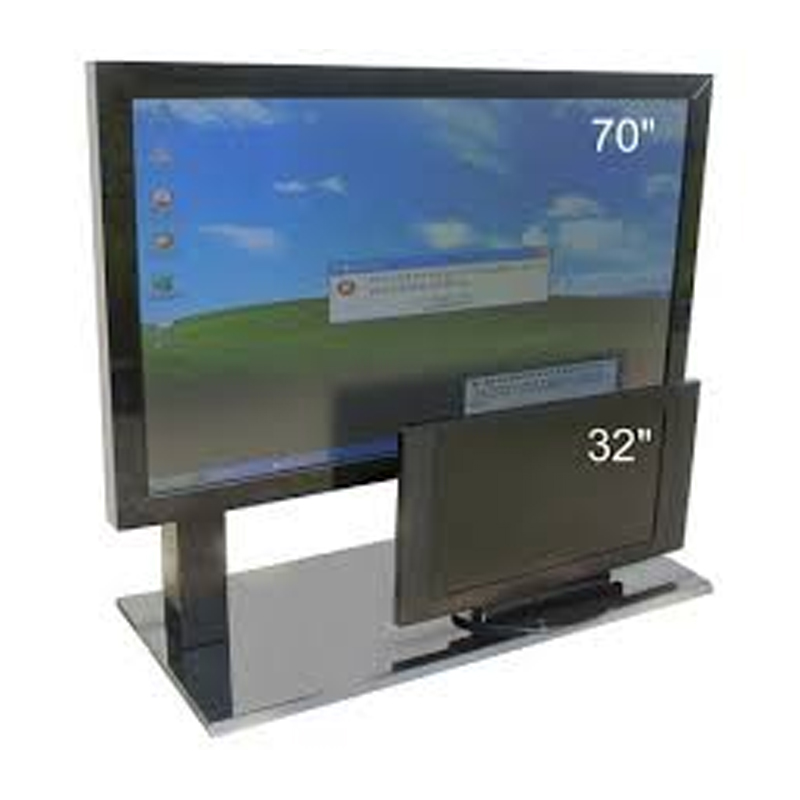
    MUMBAI: Samsung Electronics, which claims to be the world’s largest provider of thin-film transistor, liquid crystal display (TFT-LCD) panels, has developed the first 70-inch LCD panel for use in the consumer TV market.

    Currently, the largest LCD TV screen size is 65 inches in diameter.

    Samsung Electronics executive VP Kim Sang-Soo said, “Our new 70-inch LCD is not only significantly larger, but also sets a new benchmark of excellence in terms of video image reproduction, viewing angle and image quality. We’ve designed it to dramatically enhance the large screen LCD TV user’s viewing experience. ”

    Samsung’s latest LCD panel boasts full high-definition resolution (1080p) and a conical viewing angle of 180 degrees for multi-viewing audiences. In addition, its video signal is reproduced at 120Hz, compared to a video signal of 60 Hz for a conventional Full HD LCD panel, enabling rapidly moving video images to be reproduced with crystal clarity.

    Samsung will begin producing the new 70-inch LCD during the first half of next year, bolstering its position in the ultra-large-screen TV segment. With the introduction of the 70 inch LCD TV, the company will be in a position to compete head-to-head with plasma display panel and projection TV makers.

  • Samsung targets 70% growth in digital media business

    Samsung targets 70% growth in digital media business

    MUMBAI: Samsung India is aiming to achieve a 70 per cent growth in its digital media business this year. The digital media business, which is a new thrust area within the company’s audio video portfolio, includes products like digital still cameras, digital camcorders, digital audio players (MP3 players) and DVD players.

    “We plan to grow our digital media business by launching wow, aspirational products like the NV Series as well as by creating new product segments like the 6-in-1 multifunction camcorders within the digital camcorder segment,” said Samsung India deputy managing director R. Zutshi.

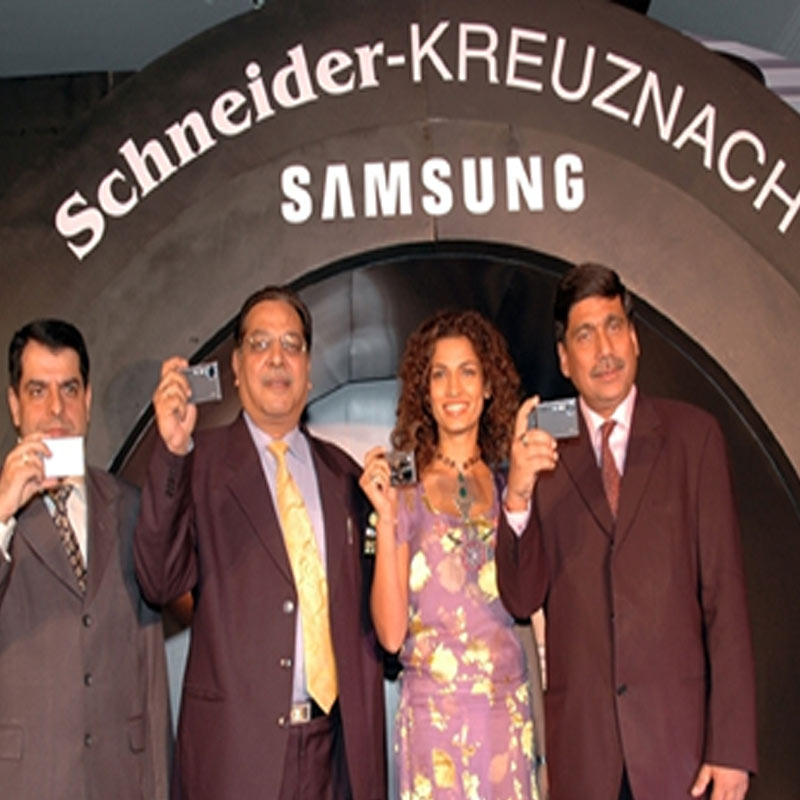
    (L to R) Samsung India general manager audio – video business Rajiv Kenue; director sales Pradeep Tognatta; model Kamal Siddhu; deputy managing director R Zutshi at NV -Series digital camera launch
    The Samsung ‘NV’ series in digital still cameras launched today comprises NV10: the world’s first 10 mega pixel digital still camera (DSC); NV7: slim camera with 7x zoom; and NV3: world’s first camera with MP3 and stereo speaker in-built functionality.

    In addition to the NV Series, Samsung has also launched three more products in the DSC category — Digimax i6: the world’s first camera with portable media player feature in a digicam; Digimax L-85: the world’s first HDMI camera and Digimax L60: a six mega pixel camera with MPEG4 VGA recording (30fps movie clip).

    With the introduction of the new DSC range, Samsung has 11 DSC models priced in the range between Rs 8,990 and Rs 49,990.

    “Our strategy to grow our DSC business is to help the existing analogue consumers to upgrade to Digital Still Cameras on the strength of our aspirational products and attractive pricing. We will also be enhancing our channel presence for this category by tapping both the existing CE Channel as well as strengthening our presence in the photographic channel,” said Samsung India director sales Pradeep Tognatta.

    Samsung is targeting a 400 per cent volume growth in its DSC business this year.

    Samsung India also announced its foray into the fast growing DVD camcorder category by launching its VP-DC 163i and VP-DC 565wi DVD camcorders with optical zoom.

    MS-11, the ultra compact memory player from Samsung represents a new segment within the existing digital camcorder category with its 6-in-1 functionality – webcam, storage, camcorder, digital still camera, MP3 player and voice recording functions.

    Samsung India has priced its VP-D363i Digital camcorder model at an introductory price of Rs 17,990. With the introduction of the new digital camcorder range, Samsung has eight digital camcorder models priced in the range between Rs 17,990 to Rs 39,990. Samsung is targeting a 200 per cent growth in its camcorder business this year.

    The company is also strengthening its Plasma lineup by launching its Q7 series of Plasma TVs in 106 cm (42″) and 127 cm (50″) screen size segments. These HD ready Plasma TVs are differentiated on account of their FilterBright technology for sharper, deeper and brighter display in any lighting condition; Smooth Motion Driver for clear and smooth image even in fast moving scenes and their 13-bit processing capability for an amazing display of 549 billion colours.

    With the launch of these new Plasma models, Samsung now has a lineup of four Plasma models in 42″ (2 models), 50″, and 63″ screen sizes, priced in the range between Rs 99,000 – Rs 700,000.

    Samsung India is expecting to grow its audio video business (AV) by 50 per cent in the July – December 2006 period based on its range enhancement in key AV product categories like flat panel TVs and digital media products, enhanced channel presence and awareness creation through Samsung Dream Home Roadshows.

    Zutshi added, “Our considerably enhanced sales infrastructure coupled with our new product launches should help us successfully optimize our festival sales in the second half of this year.”