Tag: Sameer Nair

  • Industry remembers Rajjat Barjatya

    Industry remembers Rajjat Barjatya

    MUMBAI: Roman philosopher Marcus Tullius Cicero was on the button when he said: “The life of the dead is placed in the memory of the living.”

    29 July shook the entire entertainment industry with the sudden demise of Rajshri Entertainment managing director and CEO Rajjat Barjatya. Barjatya had been battling a cancer relapse since March. He was first detected with lymphoblastic leukemia in 2010. He fought and conquered the life-threatening disease but unfortunately succumbed to it on 29 July evening.

    Barjatya is remembered as a digital pioneer and stalwart and the one who played a large role in taking digital content mainstream. Though his presence will be missed big time, but he still remains an integral part of the industry through his excellent work. No sooner did the news surface through various news agencies, than condolences started pouring in. His former colleagues and well wishers within the industry have also taken to social media to express their loss.

    A+ E Network managing director and TV 18 strategy, product and alliances president Avinash Kaul tweets, “ Saddened beyond words to hear of #RajjatBarjatya passing away. Finest human being I have come across and a very dear friend. RIP.”

    RBNL CEO Tarun Katial also tweeted saying, “Life seems short and extremely unpredictable! RIP #RajjatBarjatya”

    Filmmaker, Shirish Kunder who had worked with him for a very long time says, “Nothing shakes you up more than when someone your age dies. RIP Rajjat Barjatya. A dear friend, since I edited a film for him 13 years back.”

    Speaking to Indiantelevision.com, Balaji Telefilms group CEO Sameer Nair shared, “It’s really unfortunate to hear about his death. I was really shocked because I know him from many years. Just two days back at a CII meeting we were discussing about him and such news is a real shock. He was a true pioneer in the video online space. I remember my first meeting with him in Star India in 2005. We were talking about Rajshri.com and what he plans to do with it. 2005 was the pioneer days for online video and nobody knew at that time that where it will go and the online digital world is really going to miss him.”

    Universal Music Group and EMI Music, South Asia managing director & CEO Devraj Sanyal expressed, “I just remember him as the nicest people I know. Every interaction I had with him – discussion about work, music matter or about the industry. He was one those who really want to change the industry and do it decently not like a typical Bollywood type. He will be remembered as a person who always looked for good in each and everyone he met. It’s a terrible loss for the industry.”

    “It’s a deep shock for all of us. He was more than a boss for the entire team and we lost a genuine person today. He always wanted us to have a very large vision for Rajshri and we are very hopeful and passionate about making his dream true,” recounts Rajshri Entertainment content alliances general manager and his close friend Inderpal Singh Jaggi.

    Hotstar creative director and Barjatya’s old friend Siddhartha Jain states, “I shared a great friendship and relationship with him. He was one of the finest human beings I know in this industry. He was also the pioneer in the internet content space and first one to buy into internet content when nobody knew about it. It’s a big loss for the family and as well as for the industry.”

    Indeed, a loss it is.

    As indiantelevision.com joins the industry to mourn for this great loss, we leave our readers with this old interview that Barjatya had given us a year ago

    Note: A prayer meet to remember Rajjat Barjatya is to be held on 31 July 2016 at Rangsharda, Bandra, Mumbai between 3-5 pm.

  • Industry remembers Rajjat Barjatya

    Industry remembers Rajjat Barjatya

    MUMBAI: Roman philosopher Marcus Tullius Cicero was on the button when he said: “The life of the dead is placed in the memory of the living.”

    29 July shook the entire entertainment industry with the sudden demise of Rajshri Entertainment managing director and CEO Rajjat Barjatya. Barjatya had been battling a cancer relapse since March. He was first detected with lymphoblastic leukemia in 2010. He fought and conquered the life-threatening disease but unfortunately succumbed to it on 29 July evening.

    Barjatya is remembered as a digital pioneer and stalwart and the one who played a large role in taking digital content mainstream. Though his presence will be missed big time, but he still remains an integral part of the industry through his excellent work. No sooner did the news surface through various news agencies, than condolences started pouring in. His former colleagues and well wishers within the industry have also taken to social media to express their loss.

    A+ E Network managing director and TV 18 strategy, product and alliances president Avinash Kaul tweets, “ Saddened beyond words to hear of #RajjatBarjatya passing away. Finest human being I have come across and a very dear friend. RIP.”

    RBNL CEO Tarun Katial also tweeted saying, “Life seems short and extremely unpredictable! RIP #RajjatBarjatya”

    Filmmaker, Shirish Kunder who had worked with him for a very long time says, “Nothing shakes you up more than when someone your age dies. RIP Rajjat Barjatya. A dear friend, since I edited a film for him 13 years back.”

    Speaking to Indiantelevision.com, Balaji Telefilms group CEO Sameer Nair shared, “It’s really unfortunate to hear about his death. I was really shocked because I know him from many years. Just two days back at a CII meeting we were discussing about him and such news is a real shock. He was a true pioneer in the video online space. I remember my first meeting with him in Star India in 2005. We were talking about Rajshri.com and what he plans to do with it. 2005 was the pioneer days for online video and nobody knew at that time that where it will go and the online digital world is really going to miss him.”

    Universal Music Group and EMI Music, South Asia managing director & CEO Devraj Sanyal expressed, “I just remember him as the nicest people I know. Every interaction I had with him – discussion about work, music matter or about the industry. He was one those who really want to change the industry and do it decently not like a typical Bollywood type. He will be remembered as a person who always looked for good in each and everyone he met. It’s a terrible loss for the industry.”

    “It’s a deep shock for all of us. He was more than a boss for the entire team and we lost a genuine person today. He always wanted us to have a very large vision for Rajshri and we are very hopeful and passionate about making his dream true,” recounts Rajshri Entertainment content alliances general manager and his close friend Inderpal Singh Jaggi.

    Hotstar creative director and Barjatya’s old friend Siddhartha Jain states, “I shared a great friendship and relationship with him. He was one of the finest human beings I know in this industry. He was also the pioneer in the internet content space and first one to buy into internet content when nobody knew about it. It’s a big loss for the family and as well as for the industry.”

    Indeed, a loss it is.

    As indiantelevision.com joins the industry to mourn for this great loss, we leave our readers with this old interview that Barjatya had given us a year ago

    Note: A prayer meet to remember Rajjat Barjatya is to be held on 31 July 2016 at Rangsharda, Bandra, Mumbai between 3-5 pm.

  • Great Grand Masti….Greater disappointment!

    Great Grand Masti….Greater disappointment!

    MUMBAI: Indra Kumar acted in and made a few Gujarati films in the era of tax exemption and subsidy offered by the Gujarat government to promote Gujarati films. Indra’s forte in those days was to thrive on vulgar gestures and double meaning dialogue. It worked because Gujarati films catered mainly to a certain level of audience. He also came to be called the Dada Kondke (the legendary Marathi filmmaker) of Gujarati films. Indra directed some notable films in Hindi with top stars.

    With corporate studios calling shots and stakes gone sky-high, survival for independent filmmakers became impossible. Indra decided to go back to his Kondke style of film making starting with Masti (2004), followed by Grand Masti (2013) to now come up with the third part of his Masti series with Great Grand Masti.

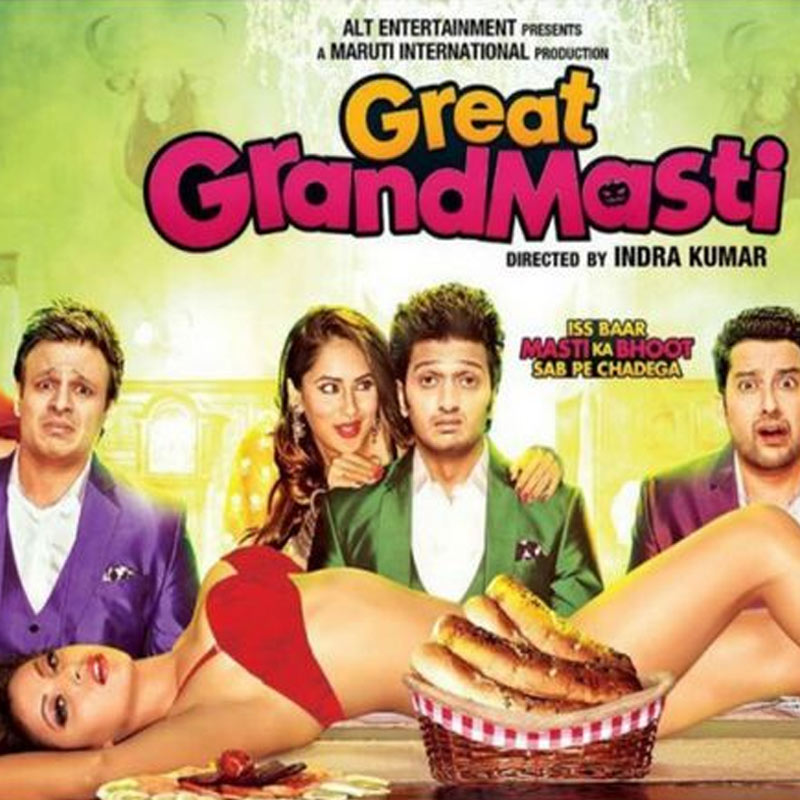
    The Great Grand Masti has the same agenda as its earlier versions which is to weave a comedy around vulgarity. The male and female anatomy is the theme around which the makers plan to play. To this end, Indra lets loose his three generally out of work male characters from his earlier films, Riteish Deshmukh, Aftab Shivdasani and Vivek Oberoi. All that these three have in mind is sex 24×7. It oozes from all their actions.

    All three are married to very revealing and willing girls but all three girls carry excess baggage which keeps the trio from getting anywhere close to their spouses. Since the lads are desperate for sex and their own women are not available to them, they need to look elsewhere. They decide to embark on a village where Riteish has a palatial property to sell.

    The makers think it is time to make this film hattke from the earlier two. So the angle of paranormal is added to consolidate the comedy. This is rare because paranormal on its own has few takers in Hindi films, let alone with a blend of comedy. Last one in memory is late producer-actor Deven Verma’s Bhaago Boot Aaya, inspired from a James Hadley Chase novel, Miss Shumway Waves A Wand. But, to a disastrous results.

    In absence of a script or good gags, Indra lets his three non-actors loose on the screen as they start with trying to seduce the sexy maid, Urvashi Rautela, at the palatial house and, later, to save their lives when they realize that the maid is a ghost waiting to be seduced for the last 50 years! The hide n seek between the guys and ghost is meant to be funny but it is not and falls flat. In its 127 minute duration, the only funny scene the film has is of Viagra aftereffect which, again, has been lifted from Mel Brook’s comedy, History Of The World (1981). And, that too has been killed by stretching it too far.

    The film is a poor specimen of comedy, entertainment or whatever it may be called. Nothing works here. The performers keep to their reputation and don’t act; over two hours of buffoonery is what they resort to.

    The film is poor on all counts and has no hopes at the box office.

    Producers: Shobha Kapoor, Ekta Kapoor, Sameer Nair, Aman Gill, Ashok Thakeria, Sri Adhikari Brothers, Anand Pandit.

    Director: Indra Kumar.

    Cast: Ritesh Deshmukh, Vivek Oberoi, Aftab Shivdasani, Urvashi Rautela, Pooja Bose, Amar Saxena, Sanjay Mishra, Shreyas Talpade.

  • Great Grand Masti….Greater disappointment!

    Great Grand Masti….Greater disappointment!

    MUMBAI: Indra Kumar acted in and made a few Gujarati films in the era of tax exemption and subsidy offered by the Gujarat government to promote Gujarati films. Indra’s forte in those days was to thrive on vulgar gestures and double meaning dialogue. It worked because Gujarati films catered mainly to a certain level of audience. He also came to be called the Dada Kondke (the legendary Marathi filmmaker) of Gujarati films. Indra directed some notable films in Hindi with top stars.

    With corporate studios calling shots and stakes gone sky-high, survival for independent filmmakers became impossible. Indra decided to go back to his Kondke style of film making starting with Masti (2004), followed by Grand Masti (2013) to now come up with the third part of his Masti series with Great Grand Masti.

    The Great Grand Masti has the same agenda as its earlier versions which is to weave a comedy around vulgarity. The male and female anatomy is the theme around which the makers plan to play. To this end, Indra lets loose his three generally out of work male characters from his earlier films, Riteish Deshmukh, Aftab Shivdasani and Vivek Oberoi. All that these three have in mind is sex 24×7. It oozes from all their actions.

    All three are married to very revealing and willing girls but all three girls carry excess baggage which keeps the trio from getting anywhere close to their spouses. Since the lads are desperate for sex and their own women are not available to them, they need to look elsewhere. They decide to embark on a village where Riteish has a palatial property to sell.

    The makers think it is time to make this film hattke from the earlier two. So the angle of paranormal is added to consolidate the comedy. This is rare because paranormal on its own has few takers in Hindi films, let alone with a blend of comedy. Last one in memory is late producer-actor Deven Verma’s Bhaago Boot Aaya, inspired from a James Hadley Chase novel, Miss Shumway Waves A Wand. But, to a disastrous results.

    In absence of a script or good gags, Indra lets his three non-actors loose on the screen as they start with trying to seduce the sexy maid, Urvashi Rautela, at the palatial house and, later, to save their lives when they realize that the maid is a ghost waiting to be seduced for the last 50 years! The hide n seek between the guys and ghost is meant to be funny but it is not and falls flat. In its 127 minute duration, the only funny scene the film has is of Viagra aftereffect which, again, has been lifted from Mel Brook’s comedy, History Of The World (1981). And, that too has been killed by stretching it too far.

    The film is a poor specimen of comedy, entertainment or whatever it may be called. Nothing works here. The performers keep to their reputation and don’t act; over two hours of buffoonery is what they resort to.

    The film is poor on all counts and has no hopes at the box office.

    Producers: Shobha Kapoor, Ekta Kapoor, Sameer Nair, Aman Gill, Ashok Thakeria, Sri Adhikari Brothers, Anand Pandit.

    Director: Indra Kumar.

    Cast: Ritesh Deshmukh, Vivek Oberoi, Aftab Shivdasani, Urvashi Rautela, Pooja Bose, Amar Saxena, Sanjay Mishra, Shreyas Talpade.

  • Balaji Telefilms completes fund raise of Rs 150.08 crore for Alt Digital Media

    Balaji Telefilms completes fund raise of Rs 150.08 crore for Alt Digital Media

    MUMBAI: Balaji Telefilms Limited (Balaji Telefilms) has completed the fund raising exercise of Rs. 150.08 crore for its digital venture ALT Digital Media. 1,07,20,000 equity shares  representing 14.1 per cent of  the  equity share  capital of the  company, each having  face  value  of  Rs. 2  each,   have   been   issued   and  allotted  on preferential basis  at  a price  of  Rs. 140  each  for  a total consideration of  Rs. 150.08 crore The shares were issued to  Atyant Capital India Fund  – I, Vanderbilt University, GHILTP Ltd., GHIHSP Ltd. and  GHIERP Ltd. 

    The equity shares   will be locked-in for  a period  of one year  from the  date  of trading approval.

    The proceeds of the issue will be used to catapult the launch and growth of ALT Digital Media Entertainment Limited (ALT Digital Media), Balaji Telefilm’s foray into the B2C digital content business segment touted as the next growth driver for the Company. The board of  directors of  the  company has approved investment of  Rs. 150  crore  in  ALT Digital Media ALT Digital Media  will create  its own  highly differentiated, original digital content platform for the  entire connected ecosystem spanning mobiles, computers, tablets, smart TVs and  game  stations.

    Commenting on the completion of the fund raise, Balaji Telefilms group CEO  Sameer Nair, said, “We are delighted to have completed this fund raising to  support our  growth aspirations through ALT  Digital Media. 

    We are now on a fast track mode to roll out the ALT Digital OTT platform which is set to redefine the entertainment viewing experience of Indian in India and  across the globe.”

    The transaction was facilitated by Axis Capital Limited, being the sole investment banker and advisor for the fund raise.

  • Balaji Telefilms completes fund raise of Rs 150.08 crore for Alt Digital Media

    Balaji Telefilms completes fund raise of Rs 150.08 crore for Alt Digital Media

    MUMBAI: Balaji Telefilms Limited (Balaji Telefilms) has completed the fund raising exercise of Rs. 150.08 crore for its digital venture ALT Digital Media. 1,07,20,000 equity shares  representing 14.1 per cent of  the  equity share  capital of the  company, each having  face  value  of  Rs. 2  each,   have   been   issued   and  allotted  on preferential basis  at  a price  of  Rs. 140  each  for  a total consideration of  Rs. 150.08 crore The shares were issued to  Atyant Capital India Fund  – I, Vanderbilt University, GHILTP Ltd., GHIHSP Ltd. and  GHIERP Ltd. 

    The equity shares   will be locked-in for  a period  of one year  from the  date  of trading approval.

    The proceeds of the issue will be used to catapult the launch and growth of ALT Digital Media Entertainment Limited (ALT Digital Media), Balaji Telefilm’s foray into the B2C digital content business segment touted as the next growth driver for the Company. The board of  directors of  the  company has approved investment of  Rs. 150  crore  in  ALT Digital Media ALT Digital Media  will create  its own  highly differentiated, original digital content platform for the  entire connected ecosystem spanning mobiles, computers, tablets, smart TVs and  game  stations.

    Commenting on the completion of the fund raise, Balaji Telefilms group CEO  Sameer Nair, said, “We are delighted to have completed this fund raising to  support our  growth aspirations through ALT  Digital Media. 

    We are now on a fast track mode to roll out the ALT Digital OTT platform which is set to redefine the entertainment viewing experience of Indian in India and  across the globe.”

    The transaction was facilitated by Axis Capital Limited, being the sole investment banker and advisor for the fund raise.

  • Who defines prime time – Advertisers or viewers?

    Who defines prime time – Advertisers or viewers?

    MUMBAI: For those who have wondered and often cribbed about why popular channels have mostly nothing original to offer in the afternoon, and later had reluctantly resigned to watch re-runs of shows, The Content Hub 2016’s session on ‘Redefining Primetime’ was the place to be.


    The question of the hour was whether there is a need to redefine what we call ‘prime time’ on television. And who better to answer it than those who dabble in the general entertainment channels’ (GEC) prime time of Indian television i.e, Doordarshan ADG Mukesh Sharma, Colors CEO Raj Nayak, Balaji Telefilms CEO Sameer Nair, Reliance Broadcast Network CEO Tarun Katial and Havas Media Group CEO – India and South Asia Anita Nayyar.


    Moderator for the session and Indiantelevision.com founder, editor-in-chief and CEO Anil Wanvari struck at the nerve of the issue by posing the pertinent question — What defines the prime time of a Hindi GEC channel? 


    While most viewers are oblivious to it, there is a whole science — or as Nayak had pointed out during the discussion — ‘pure economics’ to it. 


    “The phrase ‘Kill for prime time’ is what we broadcasters are often heard using. As we don’t have the budget to program for all 24 hours of the day, we prepare content for five to six hours and that becomes our prime time. If we can get good traction for a new show during that time, it may also get an equally good viewership ratings for its reruns as well,” said Nayak.


    “There isn’t anything fixed called prime time. It is how broadcasters define it. When we started off, 8 pm to 10 pm was prime time, then we stretched it to 8 pm to 11 pm, and now 6.30 pm to almost 11.30 pm is what we define as prime time. It is a question of content and the availability of a large section of the audience in front of the television. Therefore, by definition it is post evening hours,” he added.


    With the advent of digital however, this staple idea of prime time is changing as the audience has access to entertainment media almost all hours of the day at their own convenience via the second screen. “The prime time we are talking about is a very TV thing. OTT audience is not defined by prime time although there are surges in viewership at certain times of a day. For them, anytime is prime time. But that ‘anytime’ isn’t a feasible option for advertisers,” opined Nair.


    Getting into the crux of the matter, it is the advertiser who defines the prime time. Because depending on whether a show is coming on prime time or not, the advertising rates are decided. Throwing light on how premium rates for ad slots are determined, Nayyar shared, “The logical way an advertiser defines the prime is when there is content and there is an audience for it. A cricket tournament for example, which can happen at 4 pm in the afternoon will have traction and therefore will attract advertisers as well. So prime time is basically where the eyeballs are. From an agency perspective as well, we look at where and when content is viewed the most and that becomes prime time.”


    On the prospect of growing the time band of ‘prime’ shows, Nayak retrospected, “There was a time when Doordarshan used to air only India cricket matches. When ESPN and Star Sports launched, none of the advertisers initially were willing to pay for the non-India matches and test matches. Until in 1996, during the Safari India South Africa series, we decided we will not sell any slots until advertisers are willing to buy it all in a package. For the first three days of the tournaments there were no advertisers. But things have changed now, haven’t they?”


    One would think that going by the same logic of ‘viewers will lap up any good content,’ if creativity is not a hindrance with several content creators and writers waiting to get exposure, broadcasters can find reason in allowing relatively small budget shows to redefine a new prime time band with day part programming.


    Television being an advertiser dependent medium where a 3 rating in the evening is worth 10 times that of the same rating in the afternoon, broadcasters, especially that of Hindi GECs find the stakes to be too high to take the risk.


    “At Star TV there were some original shows in the afternoon time band, which got even better ratings than the evening prime time shows. While the shows worked, its return on investment did not because irrespective of viewership ratings, advertisers were attracted to only to shows aired from 6 pm onwards. The fact remains that the same advertisers, for the same rating at two different times of the day were not willing to pay the same price for the ad slots,” Nayak stated. 


    This also paints a sad picture of the broadcast business in south India where there is an ongoing trend of remaking Hindi TV shows into regional languages. Producers are asked to create the same content for half, or even one fourth of the production cost that the same Hindi GEC show had incurred as advertisers are not willing to pay for that region, observed Nair.


    “Down south they are remaking Hindi shows at approximately Rs 1 – 1.5 lakh per episode. In the Bengal and Marathi regional markets, it’s even lesser. All this brings me to the advertisement driven industry we have, which eggs on this unfair practice. This in turn makes me wonder how advertisers categorise their consumers in the market and where they place them in terms of ad spends,” said Nair.


    Bringing a whole new perspective to it was RBNL’s Katial, whose comedy channel Big Magic is largely dependent on kids for viewership and ratings and therefore the channel’s definition of prime time also varies. 


    “We have two channels, which are both very unique in their target audiences. One targets Bihar and Jharkhand, which are mostly dominated by semi urban and rural landscapes. People essentially wake up early and go to bed early, therefore 70 per cent of our GRPs comes from the morning programming. While infrastructure too plays a role, I feel it is our viewers who ultimately define our prime time,” Katial informed.


    Citing another example of a non-traditional concept of prime time, Katial added, “On our comedy channel our entry point is kids. We feel it is a good way to expand visibility with mothers and other family members. Therefore we have to build a prime time where there are more kids available than others. Therefore once you define your audience and geography, you have your prime time.”


    Taking a queue from Katial and concurring, Nayyar said that from a media planner’s perspective, there are times when it’s more efficient to buy an afternoon ad slot for an advertiser at a lower rate than prime time slots.


    “For a client of ours, McDonald’s, we used to buy afternoon time slots because it was far more cost efficient. We were catering to the housewives and mothers, who watched TV shows with their kids. I feel that it rides a lot more on how broadcasters pitch or sell shows. I feel the media industry needs to come together and give the products what they deserve,” quipped Nayyar.


    As the panelists dived deeper into the issue, several varying perspectives ruled the discussion, each leading to a different conclusion. However, media heads present on the panel unanimously agreed that even though Indian television was one of the cheapest markets for advertisers to operate in, it was undervalued, be it from talent or financial standpoint. 


    The consensus was that rather than thinking of how to get production costs down, the way to bring a change was by coming up with ways to increase ad rates as well as by investing more in original content leading to more hours of it on television, which in turn would lead to a redefined prime time.
  • Who defines prime time – Advertisers or viewers?

    Who defines prime time – Advertisers or viewers?

    MUMBAI: For those who have wondered and often cribbed about why popular channels have mostly nothing original to offer in the afternoon, and later had reluctantly resigned to watch re-runs of shows, The Content Hub 2016’s session on ‘Redefining Primetime’ was the place to be.


    The question of the hour was whether there is a need to redefine what we call ‘prime time’ on television. And who better to answer it than those who dabble in the general entertainment channels’ (GEC) prime time of Indian television i.e, Doordarshan ADG Mukesh Sharma, Colors CEO Raj Nayak, Balaji Telefilms CEO Sameer Nair, Reliance Broadcast Network CEO Tarun Katial and Havas Media Group CEO – India and South Asia Anita Nayyar.


    Moderator for the session and Indiantelevision.com founder, editor-in-chief and CEO Anil Wanvari struck at the nerve of the issue by posing the pertinent question — What defines the prime time of a Hindi GEC channel? 


    While most viewers are oblivious to it, there is a whole science — or as Nayak had pointed out during the discussion — ‘pure economics’ to it. 


    “The phrase ‘Kill for prime time’ is what we broadcasters are often heard using. As we don’t have the budget to program for all 24 hours of the day, we prepare content for five to six hours and that becomes our prime time. If we can get good traction for a new show during that time, it may also get an equally good viewership ratings for its reruns as well,” said Nayak.


    “There isn’t anything fixed called prime time. It is how broadcasters define it. When we started off, 8 pm to 10 pm was prime time, then we stretched it to 8 pm to 11 pm, and now 6.30 pm to almost 11.30 pm is what we define as prime time. It is a question of content and the availability of a large section of the audience in front of the television. Therefore, by definition it is post evening hours,” he added.


    With the advent of digital however, this staple idea of prime time is changing as the audience has access to entertainment media almost all hours of the day at their own convenience via the second screen. “The prime time we are talking about is a very TV thing. OTT audience is not defined by prime time although there are surges in viewership at certain times of a day. For them, anytime is prime time. But that ‘anytime’ isn’t a feasible option for advertisers,” opined Nair.


    Getting into the crux of the matter, it is the advertiser who defines the prime time. Because depending on whether a show is coming on prime time or not, the advertising rates are decided. Throwing light on how premium rates for ad slots are determined, Nayyar shared, “The logical way an advertiser defines the prime is when there is content and there is an audience for it. A cricket tournament for example, which can happen at 4 pm in the afternoon will have traction and therefore will attract advertisers as well. So prime time is basically where the eyeballs are. From an agency perspective as well, we look at where and when content is viewed the most and that becomes prime time.”


    On the prospect of growing the time band of ‘prime’ shows, Nayak retrospected, “There was a time when Doordarshan used to air only India cricket matches. When ESPN and Star Sports launched, none of the advertisers initially were willing to pay for the non-India matches and test matches. Until in 1996, during the Safari India South Africa series, we decided we will not sell any slots until advertisers are willing to buy it all in a package. For the first three days of the tournaments there were no advertisers. But things have changed now, haven’t they?”


    One would think that going by the same logic of ‘viewers will lap up any good content,’ if creativity is not a hindrance with several content creators and writers waiting to get exposure, broadcasters can find reason in allowing relatively small budget shows to redefine a new prime time band with day part programming.


    Television being an advertiser dependent medium where a 3 rating in the evening is worth 10 times that of the same rating in the afternoon, broadcasters, especially that of Hindi GECs find the stakes to be too high to take the risk.


    “At Star TV there were some original shows in the afternoon time band, which got even better ratings than the evening prime time shows. While the shows worked, its return on investment did not because irrespective of viewership ratings, advertisers were attracted to only to shows aired from 6 pm onwards. The fact remains that the same advertisers, for the same rating at two different times of the day were not willing to pay the same price for the ad slots,” Nayak stated. 


    This also paints a sad picture of the broadcast business in south India where there is an ongoing trend of remaking Hindi TV shows into regional languages. Producers are asked to create the same content for half, or even one fourth of the production cost that the same Hindi GEC show had incurred as advertisers are not willing to pay for that region, observed Nair.


    “Down south they are remaking Hindi shows at approximately Rs 1 – 1.5 lakh per episode. In the Bengal and Marathi regional markets, it’s even lesser. All this brings me to the advertisement driven industry we have, which eggs on this unfair practice. This in turn makes me wonder how advertisers categorise their consumers in the market and where they place them in terms of ad spends,” said Nair.


    Bringing a whole new perspective to it was RBNL’s Katial, whose comedy channel Big Magic is largely dependent on kids for viewership and ratings and therefore the channel’s definition of prime time also varies. 


    “We have two channels, which are both very unique in their target audiences. One targets Bihar and Jharkhand, which are mostly dominated by semi urban and rural landscapes. People essentially wake up early and go to bed early, therefore 70 per cent of our GRPs comes from the morning programming. While infrastructure too plays a role, I feel it is our viewers who ultimately define our prime time,” Katial informed.


    Citing another example of a non-traditional concept of prime time, Katial added, “On our comedy channel our entry point is kids. We feel it is a good way to expand visibility with mothers and other family members. Therefore we have to build a prime time where there are more kids available than others. Therefore once you define your audience and geography, you have your prime time.”


    Taking a queue from Katial and concurring, Nayyar said that from a media planner’s perspective, there are times when it’s more efficient to buy an afternoon ad slot for an advertiser at a lower rate than prime time slots.


    “For a client of ours, McDonald’s, we used to buy afternoon time slots because it was far more cost efficient. We were catering to the housewives and mothers, who watched TV shows with their kids. I feel that it rides a lot more on how broadcasters pitch or sell shows. I feel the media industry needs to come together and give the products what they deserve,” quipped Nayyar.


    As the panelists dived deeper into the issue, several varying perspectives ruled the discussion, each leading to a different conclusion. However, media heads present on the panel unanimously agreed that even though Indian television was one of the cheapest markets for advertisers to operate in, it was undervalued, be it from talent or financial standpoint. 


    The consensus was that rather than thinking of how to get production costs down, the way to bring a change was by coming up with ways to increase ad rates as well as by investing more in original content leading to more hours of it on television, which in turn would lead to a redefined prime time.

  • ‘KBC’ signs off in style… with Star promising to bring it back

    ‘KBC’ signs off in style… with Star promising to bring it back

    After over 300 episodes on air, nearly 3000 contestants, over 500 people on the hotseat, a more than 60,000 studio audience, over 90 million phone calls, and more than Rs 260 million given away as prize money, Kaun Banega Crorepati, the show that resurrected a channel and a fading Bollywood superstar, signed off today. With a promise that it would be back.

    KBC, the show that Star licenced from Celador’s Who wants To be a Millionaire and launched in June 2000, not only raised Star to the No. 1 position but also gave actor Amitabh Bachchan a fresh lease on superstardom.

    Said Sameer Nair, executive V-P, content & communication, Star Network: “We’ve enjoyed every moment of the show, shooting with Amitabh Bachchan, guests stars, interacting with audiences, and basking in the unprecedented success of the show. Every, such show needs a small break and now it’s time for Kaun Banega Crorepati too. Come, July-August, and watch out we’ll be back with Amitabh Bachchan and a big, brighter and bigger show.” 

    Whether Bachchan will be back in the hot seat if and when the show returns only time will tell; but the Big B did, during the course of the show, leave that particular issue open ended.

    And as the guest on the grand finale show, Star Plus brought back Harshvardhan Nawathe, KBC’s first ‘crorepati’ (10 millionaire?).

    From next week (16 January), Cinevista’s Sanjivani, a hospital drama with actor Mohnish Behl in the lead, goes on air. And Star’s rivals can get set for a channel stakes battle with a far more level playing field – without the Big B’s shadow hanging over the proceedings.

  • Balaji Motion Pictures ropes in Aman Gill as the new CEO

    Balaji Motion Pictures ropes in Aman Gill as the new CEO

    MUMBAI- Balaji Telefilms Limited has roped in Aman Gill as the CEO of Balaji Motion Pictures. Gill, in his new role, will assume all responsibilities spanning film development ranging from creative, production, marketing, distribution, syndication and will have all division heads report directly to him. He will take up the new position from early December 2015.

    Talking about the new appointment, Balaji Telefilms Ltd. group CEO Sameer Nair asserted, “Aman brilliantly balances creativity with commerce and is most deserving of this position and role. He has vast experience in developing, producing, marketing, distributing and syndicating films in the past with various studios and has worked closely with talent in the agency business”.

    Aman will be serving out his notice period with Junglee Pictures in the interim, where he was the chief content officer since June 2014. In his tenure the company successfully released two of the most critically and commercially acclaimed films of the year Dil Dhadkane Do and Talvar. Gill has also setup in the past, the film talent and literary business at CAA-KWAN from June 2012 to June 2014. He also headed the acquisition and domestic distribution functions at Viacom 18 Motion Pictures.

    Gill started his career with Applause Entertainment, where he was AVP Content. Here he earned his first film credit as an executive producer for Sanjay Leela Bhansali’s critically acclaimed film Black.

    “Aman is a wonderful addition to the management bandwidth we’re building at Balaji. Several exciting projects are already in the pipeline over the next few months, which are in various stages of production and we also plan to scale up our movie business in the coming years. With several very interesting initiatives underway, I believe Aman is the ideal professional to lead the charge”, said Balaji TelefilmsLimited joint managing director Ekta Kapoor.

    Speaking about his new hiring Gill added, “I’m honored that Ekta and Sameer have entrusted me with this responsibility and position. I look forward to work together with a highly talented team to further the formidable brand that Balaji Motion Pictures has built over the years and take it to greater heights.