Tag: Saiyaara

  • What has made Saiyaara a Rs 300 crore box office wonder?

    What has made Saiyaara a Rs 300 crore box office wonder?

    MUMBAI: The box office success of Saiyaara has been a topic of wide discussion over the past month. The film has performed exceptionally well, crossing Rs 300 Cr at the domestic box office, and becoming the second-highest grosser of 2025 in India, behind Chhaava, at the time of writing this report. A popular theory attributes this success to the influence of Gen Z (those born between 1997 and 2012, currently aged 13-28). It’s an easy conclusion to draw, given the film’s genre and debutant cast. But is it really true? Can one audience segment alone propel a film with no franchise or star value to cross the Rs 300 Cr mark? This analysis explores that question.

    According to Ormax Media analysis, the remarkable box office success of Saiyaara is less about a single generation’s love affair with a fresh romance and more about how different cohorts engage with emotion on screen. On paper, the culprit seemed obvious. Gen Z—those aged 13 to 28—looked tailor-made for the film’s youthful leads, moody soundtrack, and breakneck visuals. Social chatter, sneaker fashion and music streams all suggested the movie was “their” moment. But Ormax Media’s data complicates the narrative.

    The firm’s proprietary OPR (Ormax Power Rating), a 0–100 index that tracks likeability and advocacy, is a trusted predictor of word-of-mouth and sustained collections. A score above 60 typically signals robust engagement, translating into strong box office legs beyond opening weekend. Over four weeks of tracking, Saiyaara notched a sturdy OPR, with Gen Z audiences scoring it at 68 and those aged 29+ close behind at 63. A respectable gap, but not wide enough to explain the runaway commercial phenomenon.

    Saiyaara

    The real story, says Ormax Media, emerges when the data is split by gender. Women across generations responded almost identically strongly, suggesting that themes of love, empathy and sacrifice cut across age barriers. Among men, however, the divergence was stark. Gen Z men mirrored women’s enthusiasm, while older men slipped sharply, delivering an OPR of just 56.

    Why does this gap matter? For Ormax analysts, it reflects shifting life priorities. Gen Z men—many still students, young professionals or in early relationships—saw in Krish Kapoor, the protagonist, an avatar of their own anxieties and aspirations. At 22, Krish is all swagger and style: racing bikes across Mumbai flyovers, flaunting Air Jordans, and smoking defiantly. But when his girlfriend Vaani is diagnosed with Alzheimer’s, he doesn’t flee. Instead, he pauses his rising music career to stay by her side. The arc resonated with younger men who are wrestling with questions of identity, love and loyalty in their own lives.

    “Cinema becomes a tool of self-discovery for this cohort,” Ormax Media notes. “It validates emotions that are difficult to articulate, reassuring them that ‘forever’ love is not entirely a myth.”

    Older men, by contrast, appear to want films to serve as escape hatches from the daily grind of careers, mortgages, and parenting. For them, Saiyaara may be admirable cinema, but not essential viewing. As Ormax points out, this explains the 10-point OPR gap between the two male groups.

    For women, the generational divide all but vanishes. Ormax’s data highlights how relationship-driven storytelling continues to resonate across age brackets, aligned with academic research suggesting women are both socialised, and to some extent biologically primed, to prioritise empathy and relational bonds in narrative consumption. Saiyaara capitalised on this, shaping Krish’s trajectory not as a melodramatic sacrifice but as a nuanced portrait of resilience and commitment.

    The outcome: a Rs 300 cr-plus blockbuster that defied industry cynicism around non-franchise, debutant-led films. Saiyaara’s triumph is not solely Gen Z’s doing. Rather, it is the uncharacteristic enthusiasm of young men—an audience often elusive for romantic dramas—that Ormax Media credits with tipping the film from respectable hit to cultural juggernaut.

  • Saiyaara soars as July box office scripts 2025’s biggest blockbuster month

    Saiyaara soars as July box office scripts 2025’s biggest blockbuster month

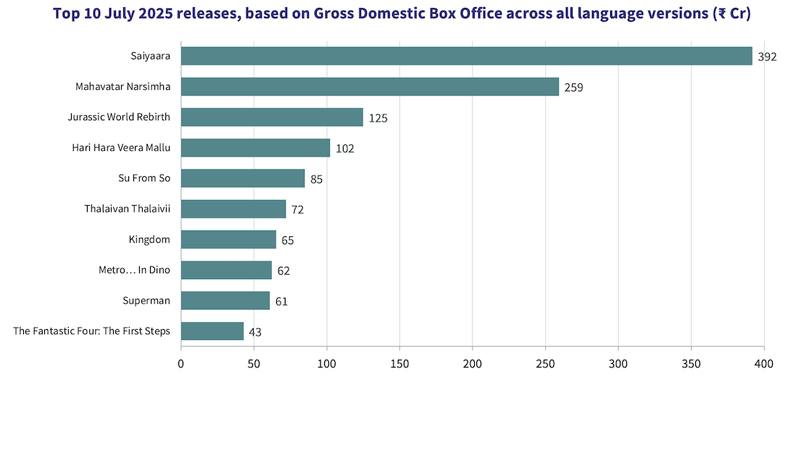
    MUMBAI: The Indian film industry found its monsoon magic in July and the box office is dancing in the rain. After a lukewarm June, July 2025 stormed ahead to become the year’s strongest month yet at the Indian box office, powered by two juggernauts: Hindi romance-drama Saiyaara and the animated epic Mahavatar Narsimha. Together, the duo accounted for more than 45 per cent of the month’s total collections, proving that love stories and mythological action still bring audiences to the theatres in droves.

    Leading the charge, Saiyaara grossed a staggering Rs 392 crore, making it the second-highest earner of the year so far, behind only Chhaava. Close on its heels, Mahavatar Narsimha roared to Rs 259 crore, with the Hindi version alone contributing 75 per cent of the take. Add in Hollywood’s heavyweights Jurassic World Rebirth and Superman & The Fantastic Four: The First Steps and the July box office became a truly global playground.

    The cumulative box office tally for 2025 releases has already climbed 22 per cent higher than the same period last year, keeping the industry firmly on track to cross the Rs 12,000 crore mark by year-end. That would put 2025 in contention to dethrone the all-time record set in 2023 at Rs 12,226 crore. Language-wise, Hindi continues to dominate with five titles in the year’s Top 10, while Hollywood has clawed up to a 12 per cent share of the pie, its best since 2022. Kannada too got its moment with horror-comedy Su From So, lifting its share from under 1 per cent in June to more than 2 per cent in July, while Malayalam slipped from 10 per cent to 8 per cent.

    If July is any indication, 2025 could well end up rewriting the box office record books with Bollywood, Hollywood, and even regional cinema scripting their own plot twists along the way.

  • Capping ticket prices could be the blockbuster move India needs

    Capping ticket prices could be the blockbuster move India needs

    MUMBAI: Lights, camera… exit? For many Indian cinemagoers, that’s the current script thanks to ticket prices that have crept from “reasonable” to “ridiculous.” With average Hindi movie tickets hovering around Rs 203, a family outing to the movies now rivals a restaurant bill. It’s no surprise then that India’s total cinema footfalls in 2023 dropped to 88.3 crore, down six per cent year-on-year despite record-breaking hits.

    Now compare that to states that have capped ticket prices. In Karnataka, a Rs 200 ceiling (inclusive of taxes) has been formally introduced across all formats, aiming to widen access and stabilise footfalls. Tamil Nadu continues to enforce an effective price limit of Rs 150 (excluding GST), especially for regional films. Andhra Pradesh has a structured pricing framework where regular seats are capped at Rs 177 and recliners at Rs 295, with special government permissions needed for hikes. Meanwhile, Telangana sets Rs 295 as the multiplex cap, but with a softer hand that allows occasional hikes.

    These capped states, many of which are strongholds for south Indian cinema actually offer a crucial insight. Despite lower average ticket prices (ATP- as low as Rs 94–Rs106 for Telugu and Tamil films), these industries continue to deliver some of India’s highest-grossing films. Pushpa, RRR, and Leo weren’t powered by premium pricing they were powered by massive turnout. Volume over margin, and accessibility over exclusivity, has been the winning formula.

    Now contrast that with the Hindi film industry’s ATP of Rs 203. While Bollywood does see big openings, the high price point restricts repeat viewing and deters casual audiences. When a movie ticket costs nearly as much as a one-month OTT subscription, families weigh their choices and increasingly choose the sofa.

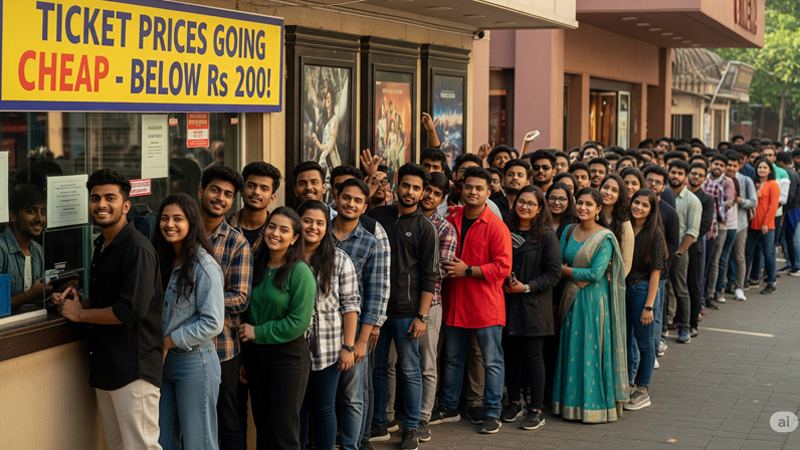
    A nationwide cap  of Rs 150 for regular seats, Rs 200 for premium, across all languages wouldn’t just level the playing field, it could dramatically boost footfalls for Hindi films, which continue to rely heavily on urban, multiplex markets. Lowering the barrier to entry could reopen the gates to India’s vast middle-class audience. Let’s not forget: a single Rs 100 ticket sold to 1,000 people earns more than a Rs 300 ticket sold to 200.

    Even with a cap on ticket prices, theatres and multiplexes can continue to thrive by shifting focus from high-margin tickets to high-volume footfalls and diversified revenue streams. More affordable prices draw in larger crowds, especially families and repeat viewers, creating consistent occupancy rates across weekdays and not just weekends. Multiplexes can optimise profits through premium experiences charging modest surcharges for IMAX, recliner seats, or 4DX formats while also driving revenue through food and beverage sales, branded partnerships, and on-screen advertising.

    Additionally, bundled offers, loyalty programmes, and dynamic pricing during off-peak hours can further boost margins. With lower pricing unlocking access to wider audiences, the overall revenue pie can grow not shrink by getting more bums in more seats, more often.

    An excellent case in point is Saiyaara, the breakout romantic drama that is shattering expectations at the box office not by charging more, but by charging smart. Yash Raj Films rolled out discounted pricing strategies from day one, offering Buy 1 Get 1 free deals, Rs 99 weekday tickets, and up to 50 per cent off on early bookings, particularly targeting youth and family audiences. Far from cannibalising revenue, this pricing hack did the opposite Saiyaara earned over Rs 105 crore in just four days, with weekday occupancy soaring to 80 per cent in some centres, a rare feat for non-franchise films.

    The promotional pricing widened the film’s reach beyond urban cinephiles to first-time and return viewers alike. It proved that lower prices didn’t shrink earnings, they supercharged them. Instead of relying on premium ticket margins, Saiyaara leaned on volume, accessibility, and buzz making a powerful case for why affordable cinema might just be the industry’s best blockbuster strategy.

    Hindi films once thrived in single screens packed with cheering crowds. But rising costs and shifting consumption habits have turned cinema into a weekend indulgence rather than a weekly ritual. Reintroducing affordability could revive that mass magic, bringing back the audiences who made the movies matter.

    The numbers don’t lie: when tickets are cheaper, people come in droves. And that’s a happy ending the Indian film industry desperately needs.