Tag: Sachin – A Billion Dreams

  • Nitin & Nitanshi Khare Gupta’s Neelkamal Creations partners with 200 Not Out Films for television shows

    Nitin & Nitanshi Khare Gupta’s Neelkamal Creations partners with 200 Not Out Films for television shows

    MUMBAI:  Creative producers and directors Nitin Gupta and Nitanshi Khare Gupta  – the two co-founders of  Neelkamal Creations –  have announced a partnership with 200 Not Out Films to produce innovative and impactful television content. With over 31 years of experience between them as creative heads, director, producers, writers  on some of Indian television’s most prominent shows, the Guptas aims to push the boundaries of storytelling in this new venture.

    Nitin and Nitanshi  shared their enthusiasm about the collaboration on Linkedin, highlighting plans to develop, produce, and deliver fresh, engaging narratives that resonate with audiences globally.

    “Our mission is to create exceptional stories that combine creativity and professionalism, setting new benchmarks in television production,” they said.

    200 Not Out Films, known for its dynamic approach to filmmaking, has an impressive portfolio of over 150 TVCs and short films. The company has worked with top brands such as Colgate, ICICI Bank, Royal Challenge, and Chevrolet. Its most notable achievement is Sachin – A Billion Dreams, an acclaimed biopic on cricket legend Sachin Tendulkar, directed by award-winning London-based filmmaker James Erskine.

    This partnership between Neelkamal Creations and 200 Not Out Films promises to bring a new wave of creativity to the television industry. Gupta encouraged fans to “stay tuned” for updates on upcoming projects, signalling exciting developments ahead for the entertainment landscape.


  • Biopics & sports-based films help popularise sporting culture in India

    Biopics & sports-based films help popularise sporting culture in India

    MUMBAI: “Sattar minute, sattar minute hai tumhare paas … shayad tumhari zindagi ke sabse khaas sattar minute … (Seventy minutes, seventy minutes is what you have … may be the most important seventy minutes of your life..)”.

    These famous lines spoken in true Shah Rukh Khan style and many other such nuggets woven into a drama with various twists and turns, and ups and downs went on to make the 2007 Hindi film Chak De India — loosely based on real life incidents highlighting the Indian women’s hockey team’s journey from outcasts to gold and glory having being coached by a disgraced goalkeeper — one of the biggest hits of that decade. It also gave India an iconic phrase: ‘chak de India’, denoting winning against odds.

    Though India is primarily a cricket-crazy nation and success of sports theme based films like Chak De and later Pan Singh Tomar (a national athlete’s life story from the sports tracks to that of an outlaw ultimately shot down by police) notwithstanding, the local film industry put more faith in action and romantic flicks. Unlike Hollywood that always turned to the sports field to get inspiration for gut-wrenching and raw drama. Remember Raging Bull, the Rocky series or flicks based on boxing legend Muhammad Ali’s life and footballer Pele? Or, for that matter, Escape to Victory?

    However, India has witnessed a trend of late: movies being made on both popular and not-so-popular sports and sports personalities. The rationale being viewers convert into fans boosting the popularity of non-cricket sports desperately needed in India. 

    Bollywood suddenly discovered that biopics of sports personalities do get the cash registers ringing in theatres and, later, when the rights were sold to TV channels. Stars who won medals to empty stands or forgotten are now getting the glory they deserve.

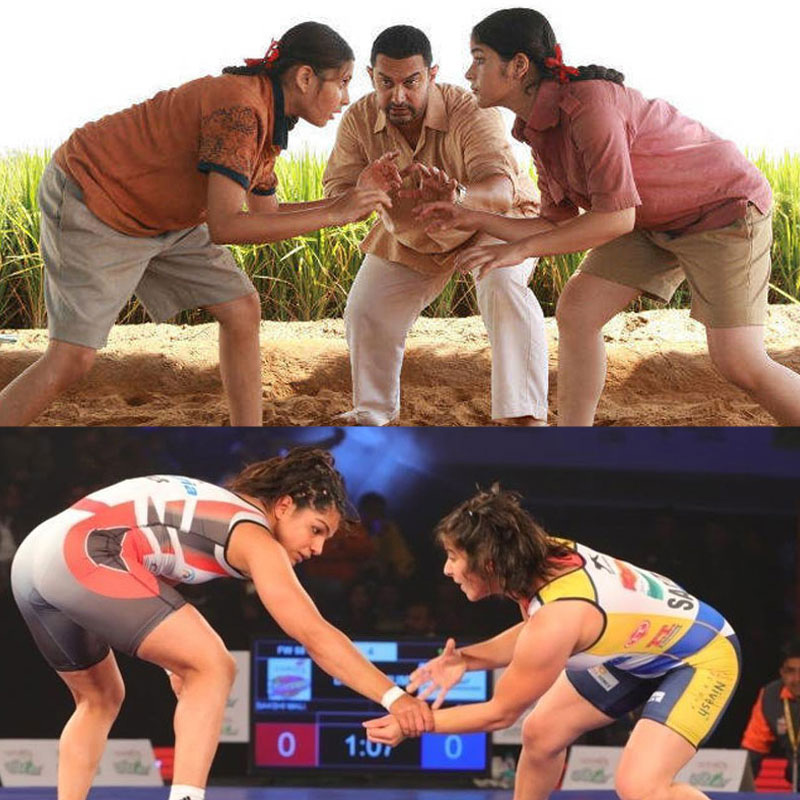
    If Chak De India pitchforked the much-neglected-in-need-of-a-boost hockey into limelight and also conceiving of fast-paced hockey leagues with foreign and domestic players, films like MS Dhoni, Sachin: A Billion Dreams,Azhar and Jannat capitalised on popular cricketers and the darker side of betting and match-fixing, respectively. Dangal and Sultan (wrestling), Mary Kom (boxing), Bhaag Milkha Bhaag (athletics) not only turned out to be box-office hits, but also did a lot of good to lesser followed sports, creating newer fan bases.

    “Sports biopics have played an important role in inspiring generations of youth not just in India, but globally. They help in channelising youth’s energies positively and in a way that contributes towards society building. It also drives home a deeper message on life and showcases the pain and toil that go behind the achievement of fame, popularity and, above all, respect,” says Sportscomm Co-Founder Abhoy Chattopadhyay.

    In recent years Dangal, undoubtedly, is the most popular sports films, highlighting the travails and glory of Haryana’s Phogat sisters, trained by their former national champ wrestler-father for the big stage and medals. Launched in December 2017 with a budget of Rs 70 crore, the box office collection went to clock Rs 2,122 crore worldwide, out of which more than Rs 1,300 crore was made only from the Chinese market where most viewers saw sub-titled versions to experience the true flavour and energy of the local language. The film has also been watched over 345 million times on Chinese streaming platforms.

    The Broadcast Audience Research Council viewership of some of the top sports biopics premiered on TV includes Dangal (16.2 million impressions) followed by MS Dhoni (8 million impressions).

    The movie Mary Kom helped boxing increase its reach and popularity in India as people started watching and following the game more fervently as they connected with players like Mary Kom and now-turned pro boxer Vijender Singh.

    According to Chattopadhyay, by reproducing the life journey of a successful athlete on the silver screen, the target audience is “taught to appreciate the years of dedication and hard-work behind all that glitz and glamour” and the fact that there are no short-cuts to success – and in life.

    Said a sports executive: “In a country bereft of a sports culture, sports biopics help in creating an ecosystem for the future where parents encourage children to take up a particular sport as a career option — a support system so vital to producing sporting champions — simply because movies play a huge influencing role in society.”

    Chak De, for example, gave women’s hockey a new lease of life as well as contributed towards the growth of women sports in the country. Dangal too played a very critical role in helping wrestling reach out to various corners of the country and encourage many more girls to take up the sport in what is still a patriarchal society. Movies like MSD may not have boosted the popularity of cricket, already a craze, but, according to the sports executive, it helped many youngsters from smaller towns gather the courage to take up sports as a career option, including cricket that was earlier looked upon as an urban game with most cricketers coming from big cities and metros.

    Speaking to Hindustan Times newspaper in September last, the 43-year-old actor Farhan Akhtar, who essayed the role of the Flying Sikh Milkha Singh in  Bhaag Milkha Bhaag admitted that the film was a “turning point” for him with the rigorous training and strict diet for the shoot having positive side effects. “I have not been able to go back to the way I used to eat or drink before I started training for the film,” Akhtar explained, adding, “Working on the movie made me realise the true meaning of fitness and the value of getting enough rest.”

    More biopics and sports-based films in the pipeline include Gold and Soorma on some now-forgotten Indian hockey stars, flicks based on the life and times of Indian badminton stars Saina Nehwal and PV Sindhu, and the country’s lone individual Olympics gold-finger shooter Abhinav Bindra.

    A three-language biopic is also being readied on former badminton champ P Gopichand, the mentor of quite a few current sensations like Sindhu, Nehwal and K. Srikanth, in Telugu, Hindi and English. Another movie is dedicated to the great all-rounder and India’s first cricket World Cup lifting captain Kapil Dev.

    Viacom18 Motion Pictures last year announced that it had acquired the rights of a film on the life and times of Indian woman cricket team captain and legend Mithila Raj, who also happens to be the highest run-getter in the world. It was under her captaincy that India went to reach the final in the women’s cricket World Cup 2017.

    While Viacom18 Motion Pictures COO Ajit Andhare said the studio had always showcased content with strong women characters and was proud to be collaborating with the “young and inspirational” Raj, Varun Chopra, Director, Medallin Sports, who facilitated the Raj-Viacom association, went a step further to opine the proposed film would inspire and motivate future generations [of young girls]. 

    Sports biopics nudge people’s interest in newer sports in a cricket-crazy nation. However, the sport on which no biopic has been made yet, but the game itself is a hit on TV (Pro Kabbadi League on Star Sports) is kabbadi. We hope that too will happen soon.

    Also Read :

    The year of big switch in sports broadcasting

    PKL season 6 and 7 dates announced

    Star ushers in IPL’s new era with a bang

    Launch of 1st indian sports radio channel – sports flashes 

  • Real life-based, fiction & sequel to hit — hardly get average biz

    “Sachin: A Billion Dreams” opened with fairly decent collections. It could be because of the fact that he is an icon and that the cricket fever is in the air with the IPL just having got over even as the Champions Trophy is slated to commence come 1 June.

    The film has not been dramatised and that limits its appeal to those who are not cricket buffs. For example, the added spice of the two romance stories in Dhoni’s life added to the humane side of the protagonist’s character in M S Dhoni: The Untold Story. Here, though you are told that Sachin and Anjali’s romance lasted four years before they decided to tie the knot, there is no romance depicted on screen.

    As the film proceeds, it is as much about the rise of the Indian cricket in the last 20 or so years, as it is about the ups and downs in Sachin’s cricketing career.

    The film collected a little over seven crore on day one while the rise on Saturday was negligible. The film did its best on Sunday by collecting around nine crore to end its first weekend with Rs 23.4 crore.

    * “Hindi Medium,” following much appreciation and a positive word of mouth, has gone on to become a hit even as it entered its second week. This small budget film kept improving its collections as the week progressed and even managed to collect better figures on its eighth day compared to first.

    The film collected more in the rest of the week than it did in its opening weekend which is a rare feat nowadays. The film collected Rs 23.5 crore for the opening week and is reported to be holding well through its second weekend.

    * “Half Girlfriend” failed to appeal to the youth which it was expected to draw. The rich girl poor boy old-fashioned angle of the story, indifferently treated, had little to hold the interest of the viewer. The film dropped during the week day to end its first week with a total of Rs 44. 8 crore. The price the film’s domestic rights have been acquired at, will lead to a shortfall in the recovery of over Rs 10 crore.

    * “Meri Pyaari Bindu” emerged as an average film. Being a YRF film sans a price tag but enjoying YRF brand equity, it stands to earn little something for the company and all of that from the domestic theatrical exploitation. The film’s collection hovers around Rs 10 crore mark.

    * “Sarkar” failed miserably. Failing to provide any variety or novelty from its earlier two versions nor any continuity or link to the previous stories, it takes the viewer for granted and pays for it. The film collected around Rs 50 lakh in its second week to take its two week total to Rs 6.7 crore.

    * “Bahubali 2: The Conclusion” (Hindi-Dubbed) continues with its winning run, setting records in the process. The film collected Rs 29.4 crore in its fourth week to take its four week total to Rs 478.9 crore.

  • Sachin: A Billion Dreams….For Staunch Sachin fans.

    Films on sports did not work with the Indian audience for a long time. If at all some producers dared make a film, it would be mainly on cricket. Of the dozens of films made on sports, less than half a dozen have worked while a couple of others, like Iqbal and Budhia Singh: Born To Run, earned critical appreciation but no moolah.

    The reason was very simple. India had not learnt to win games, be it cricket or the game at which we once excelled, hockey. Things changed as the tide turned and Indian sportspersons started coming back with cups and medals in the new century.

    Yet, the trend has been on making biopics on sports for the obvious reason that with success a sportsman is elevated to a cult status. The recent hits in this genre are Bhaag Milkha Bhaag, Paan Singh Tomar, Mary Kom, MS Dhoni: The Untold Story and Dangal.

    Sachin: A Billion Dreams is not dramatized as it is done with other films. It is a linear biographical documentary on the rise, temporary fall and rise again of Sachin Tendulkar, culminating in the very dream that drew him to cricket: The 1983 World Cup victory of India and KapilDev, the then Captain, holding the World Cup ODI trophy aloft. To hold a world cup in his hands was Sachin’s dream and the Indian team realized it for him in 2011.

    Sachin announced his retirement soon thereafter in stages.

    As for the film, most of it is retrieved footage from television. While the film tells about Sachin, it is also the journey of the Indian cricket over about the last quarter century. From the days when BCCI (Board Of Control for Cricket in India) had to pay 5.5 lakh to the national TV channel, Doordarshan, to telecast cricket matches to how the post-1991 economic reforms led to the first time that a TV channel, ESPN, paid $5.5 million to BCCI for the telecast rights Indian cricket matches.

    It is about how Ajit Tendulkar sees the potential in his kid brother, Sachin, and takes him to the best cricket coach in town, RamakantAchrekar, to hone his talent. How Sachin then went on to set an interschool league match record with his schoolmate, VinodKambli, with anunbroken partnership of 664 in 1988.
    The rest is about Sachin’s selection to Mumbai Ranji Trophy team and, soon after, to the Indian team as the youngest player ever to make the cut; he was 16 years and 205 days.

    The early parts of the film deal with Sachin’s middle-class Bandra East family, his love for his family, especially his father, Ramesh, which bordered on devotion, and their support for his cricket, including how brother Ajit took him to Mumbai’s legendary cricket ground, ShivajiPark for practise sessions every day.

    So far the film is very engrossing with the proceedings having a human interest angle. Also interesting are the parts about his romance and marriage to Anjali Mehta, a qualified doctor a few years older to him.

    As the film moves in to the second half, it seems to be in a hurry to wrap it up. A montage of various matches and tournaments follow without timelines or who is playing whom. Even the World Cup that India won which fulfilled Sachin’s life ambition is shoddily projected. Who is India playing with, what is the target? No such details on screen! This despite all the records available all over the net as well as the archives. AR Rahman’s background score adds some zing to the proceedings.

    Sachin, used to facing the cameras thanks to his numerous endorsements, is comfortable telling his story.
    Sachin: A Billion Dreams is a documentary, pure and simple, sans drama. The film will find favour with his fans with its best prospects in Western India.

    Producers: Ravi Bhagchandka, Carnival Motion Pictures.

    Director: James Erskine.

    Cast: Sachin Tendulkar, Anjali Tendulkar, Sara Tendulkar, Arjun Tendulkar along with many brief appearances by celebrities.