Tag: SaaS

  • GUEST ARTICLE: Performance based tracking platforms are ensuring customer centricity and empowering them to grow their business at scale

    GUEST ARTICLE: Performance based tracking platforms are ensuring customer centricity and empowering them to grow their business at scale

    Mumbai: Across geographies, the performance marketing ecosystem is constantly growing and has become more complex over time. It has witnessed fast-tracked growth on the sidelines of both the rise of SaaS platforms and the popularity of affiliate networks. According to Emarketer, total digital ad spending is projected to reach $526.17 billion by 2024, up from $332.84 billion in 2020. The onset of the pandemic made businesses take notice of monetary resource allocation like never before. As a result, in the post-pandemic era, new age tracking platforms enable businesses to make data-driven decisions and scale their operations at the most competitive price points. All this has been made possible by offering the highest level of automation, which continues to empower companies and ventures of all sizes with the tools they need to stay competitive and scale their business.

    Need for tracking platforms to put customers at the centre of all of their actions

    The current market offerings provide limited data insights and require substantial manual work. There are still ample numbers of cases where account managers spend a large extent of their working time conducting repetitive tasks such as approving offers, notifying clients, or creating Excel tables to derive insights. Performance tracking platforms need to listen to customer feedback and, based on that, build their technology stack. Equally important is to remember that every client has different needs and requirements, and they need to be provided with tools so that marketers can successfully measure and optimise campaigns at an affordable price.

    Understanding the four key ways of demonstrating customer centricity and its impact on business growth.

    Never before has it been more important for performance tracking platforms to give customers the freedom to adapt technology to their needs while also reacting to post-pandemic changing environments. This includes modifying, filtering, and enhancing events in real-time.

    Businesses should be given a broad range of tools instead of a one-size-fits-all solution. At the same time, providing clients with full control over their traffic to prevent fraud is indeed the need of the hour.

    Clients should have all their marketing needs in one platform. Automation is key to streamlining processes and giving clients more time to focus on high-value tasks that will grow their business.

    In this regard, performance tracking networks should make critical analytics consistently available on a marketer’s dashboard, making it easier and faster to view performance and take action when necessary. By ensuring customer data reliability through the platform’s comprehensive data display, tracking networks can enable agency partners to have all their data accessible from a single dashboard. They should provide customers with real-time information and innovative automation to give customers time to focus on analytics, strategy, and scaling their business.

    Tracking platforms should strive towards putting customer value at the centre of all of their actions. It is imperative to understand the needs of every customer in order to derive the potential value that they can expect from using the tracking platform.

    Last but not the least, right from onboarding to daily operations, offering customer support services at the highest standard is just as important as the innovative tools and technology that help businesses to scale. These are two sides of the same coin: the innovative technology needed to help businesses scale, and a support service that helps them get the most out of a tracking platform. The onboarding process should be personalised for each client, ensuring that they get the most out of the platform’s innovative tools. Separate dedicated onboarding sessions play a crucial role in helping customers get familiar with their way around the tool from the very beginning. Once clients get familiar with the tool, focus should be put on understanding their use cases to help reiterate key features (such as the automation engine and optimization features) that set the chosen platform apart from other market players. Providing short explainer videos that directly showcase certain features—from how to set them up to refining them for a client’s specific purposes and more – is yet another useful route.

    Time and again, it has been proven that a customer-centric approach empowers marketers to scale their companies, resulting in satisfied customers. If tracking platforms can continue to focus on innovating reliable technology while also putting in place excellent customer service, they can certainly help in accelerating their clients’ business growth.

    The author of this article is Yogeeta Chainani, co-founder & chief executive officer (CEO), Swaarm.
  • WebEngage raises $20 mn in Series B round led by Singularity Growth & SWC Global

    WebEngage raises $20 mn in Series B round led by Singularity Growth & SWC Global

    Mumbai: WebEngage announced a $20 million Series B round led by Singularity Growth Opportunities Fund and SWC Global, with participation from existing investors India Quotient, Blume Ventures, and IAN Fund recently.

    The round also saw participation from a few family offices, including the likes of Unmaj Corporation, NB Ventures, Shashwat Nakrani (cofounder of BharatPe), and Gopal Srinivasan (chairman, TVS Capital), amongst others.

    WebEngage has showcased unusual frugality and resilience in its 11-year journey filled with ups and downs, burning only six million dollars in capital to reach a $20 million annual revenue run rate, an enviable position to be in.

    Peers in SaaS spend about 3x to 5x more to get to the same scale. The company is working with over six hundred clients, including new-economy and internet-first businesses, as well as propelling the digital transformation journey for enterprise clients.

    The funds will be used to maintain WebEngage’s rapid growth—it is up 100 per cent year-on-year and has expanded operations to India, the Middle East, and Southeast Asia. The company’s team strength has increased 2.5x since 2020 with strategic high-profile hires across the marketing, sales, product, engineering, and support functions. Recent customer wins like Adani Group in India and IKEA in Saudi Arabia have validated enterprise acceptance of the WebEngage offering.

    Speaking about this new milestone, WebEngage co-founder and CEO Avlesh Singh said, “We are absolutely delighted to have Singularity Growth Opportunities Fund and SWC Global as our new partners and are blessed to have existing partners double down on their confidence in us. The ride has just begun and we have the tickets to the front row seats for anyone who wants to join our journey of simplifying retention for the world.”

    Commenting on the engagement with WebEngage, Singularity Growth Opportunities Fund managing partner Apurva Patel said, “WebEngage’s comprehensive customer engagement platform truly empowers companies to listen to their customers better, to understand their behaviour deeply by smartly segmenting customers, and to act on that knowledge in a way that is personal. What fascinated us about Avlesh and his team is their ability to gain traction with not only digital businesses, but also with large traditional enterprises. We were also very impressed with customer feedback on the company’s superior customer service and support, and believe this to be their key competitive advantage. Singularity Growth is thrilled to be part of WebEngage’s growth journey in both India and overseas.”

    “We have always believed that the best teams build the best products, and in the long run, it’s the best product that wins. This is our 4th investment in WebEngage and we will continue to back them as far as we can. WebEngage also demonstrates our belief that companies that win SaaS in India can go global and repeat their performance,” concluded India Quotient founding partner Anand Lunia.

  • DigiBoxx onboards Mohua Mitra as chief product officer

    DigiBoxx onboards Mohua Mitra as chief product officer

    Mumbai: India’s leading indigenous digital asset management platform Digiboxx has announced the appointment of Mohua Mitra as the chief product officer. 

    In her new role, Mohua will focus on strategy, execution, attaining higher efficiency levels, further innovation and automation into the core product offerings at DigiBoxx. She brings over 21 years of experience in SaaS (Software as a Service), PaaS (Platform as a Service) and BI (Business Intelligence).

    Prior to joining DigiBoxx, Mohua Mitra has been associated with Hitachi Consulting (IN, UK & UAE) for eleven years as a technical architect and manager.

    On this new appointment, Digiboxx CEO Arnab Mitra said, “We are excited to have Mohua join DigiBoxx. She brings with her technical prowess and expertise in implementing solutions in international markets, which will help us take our product offerings to the next level.” 

    Mohua has majored in Physics from Jadavpur University, with a post graduate degree in Radio Physics & Electronics from the Institute of Radio Physics and Electronics (INRAPHEL), Calcutta University. She found her calling in IT consulting very early in her career, working for companies like TCS, Oracle, PwC and IBM as a techno-functional consultant before moving to Hitachi Consulting and now DigiBoxx.

    “It has been a long rewarding career, spanning various geographies including the US, UK, and the UAE. I think it was time for me to embark on a new journey where I can lend my experience to a Made in India service and make it a global product. I thank the DigiBoxx leadership for their confidence in me and look forward to working with the vibrant team,” Mohua Mitra said on her appointment.

  • NFTICally unveils Comearth to drive e-commerce in the Metaverse

    NFTICally unveils Comearth to drive e-commerce in the Metaverse

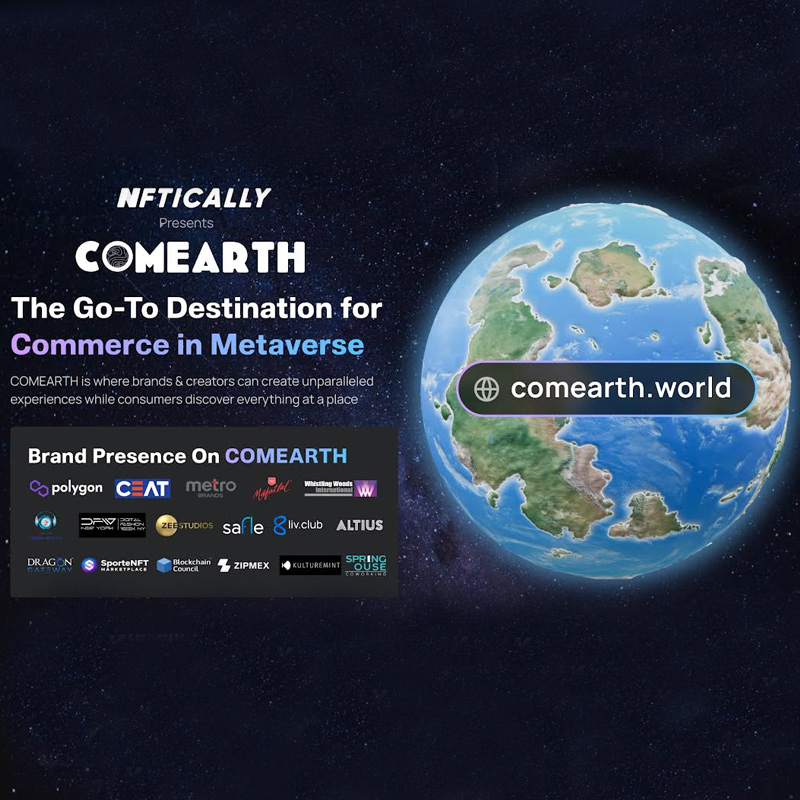
    MUMBAI: Global Web3 E-Commerce SaaS platform NFTically has launched  Comearth. This is a destination for commerce in the Metaverse. Comearth, a 3D immersive virtual environment, will be powered by NFTically’s “Web3 E-Commerce Engine ” & backed by the trust and decentralization of the Polygon Blockchain. In Comearth, brands, enterprises, content creators, and celebrities will be able to purchase their virtual spaces / virtual real estate as Comearth’s “Citizens” and launch the e-commerce experiences for their customers, consumers and followers.

     The metaverse has the potential to be a $13 trillion ecosystem within a decade. The e-commerce industry also is expected to expand at a CAGR of 22.9 percent between the years 2020-2027 to size over $16.2 trillion. Exploring the intersection of two burgeoning markets, Polygon co-founders Sandeep Nailwal & Jaynti Kanani, Coinbase CPO Surojit Chatterjee, Unacademy co-founders Gaurav Munjal, and Roman Saini, Indian film-maker Subhash Ghai, Actor Kunal Kapoor, Capital X’s Cindy Bi, Nazara’s Nitish Mittersain have invested in NFTICALLY to build a 3D immersive metaverse ecosystem that would power e-commerce for 100,000 brands & individuals by 2025.

    NFTically founder & CEO Toshendra Sharma said, “Web3 is the next generation of the internet, which will profoundly impact e-commerce solutions. Comearth will bring a fully-immersive DIY layer to e-commerce and enable immersive hyper-personalisation for everyone. We intend to democratise and facilitate mass Web3 adoption & bridge the gap between web3 and web2 E-Commerce.”

     The launch was graced by NFTICALLY’s advisors and partners including film writer-director, producer, Subhash Ghai, Mafatlal Group vice-chairman Priyavrata Mafatlal, Kulturemint director Govind Singh Sandhu and The Blockchain Council CEO Pradeep Aswal. They reflected upon the perspectives of brands getting empowered with Comearth for augmenting retail and consumer experiences.

     Comearth comprises different sizes of land parcels that cater to businesses and industries ranging from large to small enterprises, celebrities, and individuals. It will act as a global marketplace for goods (digital, physical, and phygital) and services (within and outside of the Metaverse) & facilitate e-commerce and lead generation. The land parcels can be purchased as NFTs and are governed by the smart contracts deployed on top of Polygon Blockchain. The comprehensive DIY tools empower the landowners to start their metaverse venture in minutes and will be accessible by mobile, laptops, and VR devices.

     Polygon Studios Metaverse lead Brian Trunzo said, “Polygon Studios is pleased to welcome Comearth as a valued partner into the ecosystem. Their easy-to-use and powerful suite of tooling brings brands and rights holders closer to their audiences — a key aspect of facilitating broader Web3 adoption”.

  • GUEST COLUMN: Why Software as a Service puts video service providers in control

    GUEST COLUMN: Why Software as a Service puts video service providers in control

    How can we increase market share? Can we meet the demands of consumers who want to watch high-quality video on any screen, anywhere, anytime? What should we do to protect our content, and build new revenue streams?

    These are some of the critical questions video service providers are continually asking themselves and us. And the Software as a Service (SaaS) model is proving it has what it takes to address these burning issues by allowing providers to quickly launch, scale and update streaming services and keep focusing on the right questions to stay competitive.

    Scaling ambition

    SaaS puts customers firmly in the driving seat. Flexible, affordable, and scalable – with the onus on the software provider to host and maintain the service – it means providers can start small and pay as their ambitions scale, whilst reaping the benefits of new product enhancements, features and functionality added as frequently as multiple times a day.

    Some early adopters are already turning their backs on inflexible, bespoke technology deployments and instead embracing SaaS solutions. Interestingly, we are finding these are not just those born-in-the cloud streaming services that might first spring to mind but also more traditional pay-TV providers and telcos.

    One particular factor driving SaaS demand is the increased appetite for TV advertising. Where once the focus was on subscriber acquisition and market share, broadcasters and other service providers are now demanding the flexibility to create new Avod and Fast services that help counter the cost of content. For example, a leading provider in southeast asia is deploying Synamedia Iris, our SaaS addressable advertising solution, to manage, deliver and measure advertising consistently across its entire subscriber base including set-top boxes with one-way connectivity. Synamedia Iris is a key area of focus at our R&D centre in Bengaluru along with the development of our other SaaS solutions, including Synamedia Go.

    Increasing modularity

    Until now, service providers have had little alternative to customised, complex deployments involving heavy Software Design Kits and pre-defined, sequential phases of testing with no overlap between phases. It sometimes takes many months for acceptance testing to support the launch of a single feature or a new device. In today’s rapidly evolving business and technology environment, that’s simply unsustainable.

    By contrast, the SaaS model offers flexibility, agility and Opex models that come with public cloud, service-based delivery and DevOps. With a modular suite of solutions, providers can start small, only paying for what they need, then easily add more packs or services as their needs evolve.

    And SaaS isn’t just for the big players. Its effects are disruptive because the entry barrier to these new levels of experimentation and creativity has been lowered and its modular nature opens up opportunities for smaller and non-conventional businesses.

    Our SaaS transformation

    At Synamedia, we are living and breathing multi-tenant SaaS internally and witnessing its power first-hand. As one example, in just the first six weeks of 2022 we made 130 discreet feature drops into production in our Synamedia Iris addressable advertising solution. In the previous generation software-based solution, we had releases every six months and our customers typically added two or three months of testing on top of that.

    In a rapidly changing world, this velocity and agility is game changing for us and more importantly for our customers. It has impacted every department in our company including the way we sell, support, and contract with customers. Where once our platform deployments were bespoke for each customer, with the SaaS model any customisation now only needs to happen at the edges.

    The result is our pace of change of product delivery has increased an order of magnitude over the last year. Importantly, we have also evolved our development approach to one that considers the complete customer experience. We are now more focused and efficient when releasing new features and everything is delivered with built-in market validation.

    Keeping pace with change

    Our industry is a late adopter of SaaS and one of the main reasons is that it requires changes not just within the vendor community but also within the user community. Put simply, users cannot realize the benefits of SaaS without changing their operating model to accommodate a high velocity and multi-tenanted approach, most notably acceptance testing.

    Those that don’t change will be outmanoeuvred by more agile competitors, maybe not in the short run, but inevitably over time. Those that adopt SaaS will give their subscribers a better service and will benefit from a much lower cost of ownership.

    Importantly, the product won’t just be better from a user experience and feature functionality perspective: releasing software in small batches that can be easily verified and backed out as necessary dramatically increases quality as well.

    And, finally, well-designed cloud-based APIs support a new level of openness that gives users the option of integrating point solutions or procuring suites of solutions from their preferred software suppliers. This openness is something that Synamedia has embraced strongly for its own solutions.

    Delivery the SaaS way has shifted Synamedia’s cultural mindset, and our internal teams have had to reorganise to support different priorities and responsibilities. In this golden age of content, where consumers want to change what and how they watch in the blink of an eye, it’s time for video service providers to buckle-up, rev-up the SaaS engine and make sure they’re not lagging behind.

    The author is Paul Segre, CEO, Synamedia

  • The Increasing Use of SaaS in the Healthcare Industry

    The Increasing Use of SaaS in the Healthcare Industry

    Highlights

    ●  According to recent reports, SaaS is taking over the cloud computing business, particularly in the healthcare sector.
    ●  SaaS has been used by healthcare businesses to expand the variety of their software, a trend that is expected to develop and evolve.
    ●  SaaS helps healthcare systems and domains in a variety of ways.

    In today’s economy, healthcare is a critical industry. In light of the present epidemic, its relevance has been made clearer than ever. Soaring growth in SaaS is affecting the healthcare industry as well as breakthroughs in medical and scientific technologies.

    The advent of SaaS apps in the healthcare industry comes at a critical juncture. According to a LabRetriever study from 2017, when it comes to healthcare, the adoption rate of SaaS was lower in 2011-2012 at only 4%; however, since then, it has grown at a pace of roughly 20% each year. By 2024, the healthcare cloud computing industry is expected to be worth $51.9 billion, according to predictions. Health care providers will soon be relying more heavily on SaaS cloud computing solutions as the market leader.

    SaaS, according to a post by Covetus LLC, will become an essential part of healthcare in the future because of its cheap cost and scalability features. SaaS solutions may help healthcare companies increase revenue and improve the efficiency of their business processes. These advantages are augmented by the fact that HIPAA-compliant SaaS solutions save implementation time in integrating application delivery services across data centres. There are even more benefits to be mentioned.

    One thing to keep in mind is how SaaS adoption has led to new developments in the healthcare business. According to Linchpin, a digital marketing problem-solving tool, the healthcare sector will be shaped in a certain way by key developments in 2021. These are a few examples:

    Vertical SaaS is on the growth

    The rise of vertical SaaS, which focuses on certain industry verticals and provides services, is a development that has a lot of promise. Vertical SaaS is poised to overtake horizontal SaaS due to its ability to target particular businesses and supply chains. The healthcare industry stands to benefit greatly from vertical SaaS.

    Workflows will be able to track and evaluate their long-term results using the KPIs and preset metrics provided by this solution. They may swiftly and easily obtain industry-specific knowledge and patient data to better comprehend patient insights. Furthermore, vertical SaaS may help firms better manage data governance processes because of its industry-specific compliance and transparency capabilities. For healthcare firms to deliver high-quality services while also increasing business value, vertical SaaS is an option worth considering.

    Micro-SaaS is becoming more popular

    It is very uncommon for micro-Saas companies to be run by only one person or a small group of people, sometimes no more than two people. It would be helpful if their teams added more features to their current projects and existing platforms. In the healthcare industry, such add-ons might be beneficial. In 2021 and beyond, data shows that small SaaS products will be more successful.

    Result of AI

    Successful IT companies are using AI to change their operations, enhance efficiency, and improve production, according to data from the research firm Gartner. Artificial intelligence (AI) has the potential to greatly enhance SaaS applications and how they operate. 

    SaaS-based healthcare systems are reaping several benefits, notwithstanding the current state of healthcare trends. Simplified collaboration, improved learning management systems for healthcare training, and better patient-doctor engagement and patient care approaches are just some of the benefits of SaaS in the healthcare industry.

    Healthcare SaaS may assist in the following areas:

    ●  Using Telemedicine

    The use of telemedicine is on the rise. A CAGR of 37.2% is predicted for the worldwide telemedicine industry, which was valued in 2019 at $27 billion and is forecast to reach $171.81 billion by 2026. Using telemedicine, patients may get more convenient and accessible treatment. Medical facilities and their patients may benefit from telemedicine thanks to SaaS technology.

    In this way, healthcare systems may be improved, made more accessible, and extended to more people, even those living in remote places, so that they can get the treatment they need when they need it. With the help of medical specialists, those who are bedridden may get care from anywhere in the world.

     Improved internal communication and coordination

    Healthcare businesses, like any other, need to improve communication among their many divisions. SaaS software, such as Hospital Management Software systems (HMS), helps hospitals streamline their processes and keep track of critical data. Better revenue management is one of their claimed benefits.

    HMS makes it easier for healthcare workers to communicate with one another and for patients’ vital information to be sent more promptly and efficiently. If the number of medical workers in a country is large, or if there are disparities in data management and exchange, this might be useful.

    ●  Enhanced openness

    To provide the best possible care to their patients, physicians and other medical professionals must have complete access to their patient’s medical records. Situations, when the patient is physically incapacitated and unable to provide essential medical information, are even more critical. There is an increase in the openness of patient data inside an organisation because of SaaS and electronic health records (EHRs).

    ●  Updating one’s knowledge

    Throughout their careers, medical professionals must stay abreast of new developments in their industry and expand their knowledge base. This demand may be hampered by their hectic schedules.

    The Bottom Line

    It’s also worth noting how big digital companies like Icloudhospital are pushing into the healthcare industry. Icloudhospital is a major participant in the healthcare cloud, and the company is quickly expanding its reach. iCloudHospital, a worldwide leader in medical concierge services, makes it possible for clinics and hospitals all over the globe to serve their patients with the utmost efficiency. 

    iCloudHospital’s unique technology enables hospitals and clinics to focus on what they do best—treating patients—while iCloudHospital handles all the system integrations, communications systems embedded with the website, and helps produce traffic with videos and articles—all in a reliable enterprise-level firmware and internet presence with high uptimes and throughput.
     

  • Pickrr appoints Sandeep Dinodiya as SVP & head of Engineering

    Pickrr appoints Sandeep Dinodiya as SVP & head of Engineering

    Mumbai: SaaS-based logistics start-up Pickrr has announced the appointment of Sandeep Dinodiya as the senior vice president and head of engineering. In this role, Dinodiya will spearhead the whole engineering spectrum by driving various software development strategies, tech initiatives, projects, etc.

    A seasoned professional who holds more than 11 years of rich experience in the industry and carries in-depth knowledge and expertise in e-commerce, technology, and product, Dinodiya is well-versed in other areas like CRM, fraud management systems, data science, and big data for both B2B & B2C, which perfectly complement the business requirement of Pickrr, said the statement.

    Sharing his views on the appointment, Pickrr co-founder and CEO Gaurav Mangla said, “We are immensely thrilled to onboard a valuable asset like Sandeep, who has a proven record of success in the tech domain. Pickrr is on its next phase of growth, and we believe Sandeep’s rich experience, achievements, and remarkable skills in the required genre will support us in achieving new heights.”  

    Dinodiya has worked with conglomerates like Wipro, Lenskart, Cisco, Sonus Networks, and Oyo, having steered the entire wheel of Engineering and successfully led teams across India (Gurgaon, Bangalore, Hyderabad), US (Seattle), Netherlands (Amsterdam) and Japan (Tokyo) for the brands.  

    Speaking on his appointment, Sandeep Dinodiya said, “ It’s a privilege to join Pickrr, and I look forward to working very closely with the leadership team. The brand has the most dynamic team and talented leaders in our industry. I aim to nurture the company’s growth-oriented work culture and the quest for unlocking the next stage of growth by constantly developing and delivering innovative solutions to provide the best experience to our users.” 

  • Koo inks partnership with CleverTap to engage more users

    KOLKATA: Homegrown micro-blogging platform Koo has announced its partnership with CleverTap, a SaaS-based mobile marketing company. The decision follows a steady success of Koo’s partnership with CleverTap for their first product, Vokal.

    This partnership is aimed at engaging app users via push and in-app notifications using CleverTap’s real-time, data-driven insights promising high user engagement and retention.

    According to the Contribution of Smartphones to Digital Governance in India report by The India Cellular and Electronics Association (ICEA) in partnership with KPMG India, India is expected to hit 829 million smartphone users by 2022. This increased mobile adoption presents marketers and brands with a massive opportunity to not only reach out to current and potential customers but also enhance their engagement and deepen loyalty by delivering a seamless brand experience.

    Riding on this opportunity, CleverTap is aiming to leverage artificial intelligence and machine learning to personalise the customer experience using real-time behavioural data. CleverTap’s technology offers live user segmentation, sophisticated omni channel campaigns, and deliverability of 23 million push notifications a minute. Furthermore, the company offers 12 different channels for engagement, it said on Tuesday.

    CleverTap co-founder and CEO Sunil Thomas says, “Koo’s understanding of user experience and expertise in promoting regional content is uniquely complementary to CleverTap’s omnichannel marketing platform. With our passion for enabling brands to deliver highly successful marketing campaigns and delightful end-user experiences, we are excited to help Koo gain a deeper understanding of user behaviour that will help them achieve their goal of connecting with 100 million users this year.”

    As per the Google KPMG report, the Indian internet user base will increase to 735 million by the end of 2021. Indian language internet users are expected to grow at a CAGR of 18 per cent to reach 536 million by the end of 2021, while English users are expected to grow at only three per cent reaching 199 million within the same period.

    In a market dominated by global apps like Twitter and Facebook, Koo is trying to emerge as a differentiator by promoting vernacular content while reaching out to multilingual audiences across the country.

    Commenting on the partnership, Koo’s co-founder, Mayank Bidawatka said, “Our partnership with CleverTap will be instrumental in creating actionable user segments and keeping users engaged on our platform. We believe that CleverTap’s real-time insights and omnichannel solutions will not only help us establish a stronger connection with our existing users, but also attract more customers. Through this partnership, we are confident in our ability to increase clickthrough rates and achieve a double digit increase in the overall app sessions”.

  • Ooyala hires Syncplicity’s Mike Nikzad as COO

    MUMBAI: Ooyala, leading provider of software and services that simplify the complexity of producing, streaming and monetizing video, has appointed Mike Nikzad as its chief operating officer (COO). With more than 25 years of business operations and engineering leadership experience, Nikzad will be responsible for leading daily operations of the business with emphasis on Ooyala’s product lifecycle, including inception, development, delivery, support, and all customer deployments.

    Prior to Ooyala, Nikzad was the COO of Syncplicity, a prominent software-as-a-service (SaaS) company for enterprise file collaboration, where he achieved substantial transformation across the business in under two years resulting in a significant growth in sales. He also held COO positions with EMC’s Consumer and Small Business division and NewNet Communication Technologies.

    Focused on customer engagement, support and success, Nikzad has built his career, and subsequent business growth, by ensuring customers are center to all strategic, product, and corporate decisions.

    Ooyala COO Mike Nikzad said, “With our portfolio of IVP solutions, backed by analytics and strong partnerships—including Microsoft and Adobe—I’m confident in our ability to generate tremendous value for our customers.”

    “We will work to forge strong customer partnerships driven by leading edge solutions and a customer first ethos,” said Ooyala CEO Jonathan Huberman.

  • Telecom cloud market to be worth US$ 31 billion by ’21: Report

    Telecom cloud market to be worth US$ 31 billion by ’21: Report

    MUMBAI: The telecom cloud market is expected to expand from USD 10.92 billion in 2016 to USD 30.79 billion (Rs 2098.5 billion) by 2021, at a compounded annual growth rate (CAGR) of 23.0% during the forecast period.

    This is according to a market research report “Telecom Cloud Market by Type (Solution and Service), Application (Billing & Provisioning and Traffic Management), Service Model (SaaS, PaaS, and IaaS), Organization Size, Vertical, and Region – Global Forecast to 2021,” published by Pune-based MarketsandMarkets.

    The major drivers of this market include the need for lower operational and administration costs, as telecom cloud is hosted on cloud platform. It offers flexible pricing for products & services and allows managing various types of revenue without constraints, a news release from PRNewswire stated.

    The Unified Communication and Collaboration (UCaaS) solution segment is estimated to dominate the Telecom Cloud Market share during the forecast period

    UCaaS is estimated to have the largest market share in the telecom cloud market. Various features, such as multimedia, unified messaging, conference bridges, presence management, and Customer Relationship Management (CRM) integration are helping improve business functions. Therefore, with its increasing demand, Telecom Service Providers (TSPs) are providing UCaaS solutions in the market.

    Network services are expected to capture the highest market share during the forecast period.

    The network services of the telecom cloud market is witnessing a potential growth, in comparison to other services, owing to the benefits, such as Local Area Network (LAN)/Wide Area Network (WAN)/Wireless Local Area Network (WLAN) management, Voice over Internet Protocol (VoIP), managed network services, Internet Protocol (IP) contact centre management, network integration, and network implementation services.

    North America is the leading region, in terms of market share in the telecom cloud market space.

    North America is expected to hold the largest market share and dominate the telecom cloud market in 2016. North America has a huge penetration from large enterprises with technically-sound employees providing continuous innovative technologies. This has led to the growing Telecom Cloud Market. These are some of the major driving factors contributing to the growth of cloud-based services and solutions in North America.

    Major vendors covered in the telecom cloud market for the study are AT&T, Inc. (Dallas, Texas, U.S.), BT Group PLC (London, U.K.), Verizon Communication, Inc. (New Jersey, U.S.), Level 3 Communications, Inc. (Broomfield, Colorado, U.S.), Deutsche Telekom (Bonn, Germany), NTT Communications Corporation (Tokyo, Japan), CenturyLink, Inc. (Louisiana, U.S), Singapore Telecommunications Limited (Singapore), Orange Business Service (Paris, France), and Ericsson (Stockholm, Sweden).

    M&M claims to be the largest market research firm worldwide in terms of annually published premium market research reports. Serving 1700 global fortune enterprises with more than 1200 premium studies in a year, M&M is catering to a multitude of clients across eight different industrial verticals.