Tag: SAARC

  • Convergence ’17: Planetcast plans virtualised broadcast, Cyient lauds JAM

    MUMBAI: Convergence India 2017 presented a complete picture of the current industry landscape and emerging technologies in the ICT, broadcast and digital media sectors. The inspiring keynotes and tech workshops on timely topics, led by industry experts encourage innovative thinking.

    Every year technology czars and startups alike descend on New Delhi to either showcase the amazing products and solutions or to clinch deals behind the scene at Convergence India. Planetcast, a leading provider of technical services and solutions in the Indian broadcasting sector, will soon roll out virtualised broadcast services to provide seamless and secure remote access to customers so that they can monitor and control processes wherever they are.

    Covering a broad set of topics, starting from ‘Digital India campaign’ to ‘How Internet of Things is Transforming Business for Enterprises’ to ‘Why Adoption of Cloud Technology is Important’ to ‘5G-The Next Big Step in Mobile Communication Technologies and How It will Revolutionise the Customer Experience’ to ‘Digitisation Challenges in India’ to ‘Next Gen TV’, the sessions engage in discussions crucial to the advancement of the ICT, broadcast and digital media sectors.

    ‘Digital India’ discussions focused on the Digital India 2020 priorities and building a successful digital service ecosystem.

    Cyient India founder & executive chairman BVR Mohan Reddy said, “One of the biggest examples of Digital India is JAM, i.e. Jandhan , Adhaar and Mobile connectivity. With such initiatives, we can see direct benefit being transferred to the end user. The biggest challenge in India is a lack of quality education and therefore many people still cannot use any of the digital platforms. Additionally, there is an urgent need to address cyber security issues.”

    Stating that the three pillars of the Digital India campaign include vision of the government, policy matters, and user behaviour, CISCO India & SAARC MD Sanjay Kaul said, “Digitisation will impact all industries and it may seem as a disruption in the beginning, but at the end it will be valuable for the progress of the country.”

    The session, ‘Mobile Phone Industry – Torch bearer of the Make in India and the Digital India initiatives,’ witnessed discussions aimed at strengthening the Indian mobile phone manufacturing ecosystem in sync with Prime Minister Narendra Modi’s ‘Make in India’ and ‘Digital India’ initiatives.

    Intex India senior advisor Ramesh Vasvani said, “Mobile phones have created a great success story in India and are a boon to our economy. The mobile handset manufacturing industry has emerged as a platform for schemes like Make in India and Digital India, which has helped in increased transactions through e-wallets.”

    Xolo India business head Sunil Raina added, “One of the greatest advantages is that most of the software for mobile phones is created in India.”

    Elemental, an Amazon Web Services Company, empowers media companies to deliver premium video experiences to consumers. At the booth, visitors learned about how the company provides media organisations with a family of on-premises, hybrid, and cloud-based solutions for Internet-based video delivery.

    The ‘open’ part of the new platform will allow data owners, developers and others to add, mix, and manipulate data for themselves. Content providers to the platform might be car manufacturers, business owners, transit authorities, government agencies, and more.

    The latest innovative and ground-breaking release of Skyline Communications’ global leading end-to-end network management platform DataMiner makes it possible to manage operations more easily and efficiently. DataMiner 9.5 provides unprecedented visibility on user experience, and enables unrivaled orchestration in the most complex and versatile technology ecosystems.

    At the Centre for Development of Telematics (C-DOT) booth, see how C-DOT’s GPON (Gigabit Passive Optical Network) solution is fueling the backbone of BharatNet, the prestigious nationwide optical fibre based network connecting 2.5 lakh Panchayats in the nation with high speed broadband. C-DOT’s unflinching determination towards promotion of “Digital Literacy” is well reflected in its unique innovation, GyanSetu, that is capable of extending the benefits of Internet to the illiterate populace of India including the specially abled in an easy and convenient manner thus spurring the socio-economic growth.

    Verimatrix, which specialises in securing and enhancing revenue for multi-network, multi-screen digital TV services around the globe, showcases the Verimatrix Verspective™ Intelligence Center that offers a cloud-based security platform.

    UNLIMIT, the first dedicated business unit, is completely focused on providing Internet of Things (IoT) services to enterprise customers throughout India. The company is working on some very interesting new products which will be rolled out as services.

    LaCie, the premium brand from Seagate Technology plc, announced the LaCie® 12big Thunderbolt 3 and 6big Thunderbolt 3, aimed at helping video professionals excel with ultra high-resolution footage. With up to 120TB of massive capacity, the breakthrough performance of Thunderbolt 3 and RAID 5/6, the LaCie 12big and the LaCie 6big help video professionals meet the data demands of 4/5/6K cameras.

    AJA Video Systems introduced the Ki Pro Ultra – a next generation file-based 4K/UltraHD and 2K/HD video recorder and player with a built-in HD LCD monitor. Ki Pro Ultra is capable of capturing edit-ready 4K (4096 x 2160), UltraHD (3840 x 2160), 2K (2048 x 1080) and HD (1920 x 1080) Apple ProRes files. Ki Pro Ultra also supports a range of video formats and frame rates up to 4K 60p, and offers flexible input and output connectivity.

  • ‘Don’t be a spectator!’ says Bausch and Lomb

    ‘Don’t be a spectator!’ says Bausch and Lomb

    MUMBAI: Bausch and Lomb, a leading global healthcare company, touches upon an interesting twist in their new campaign crafted by FCB Ulka. The twist of being in close proximity to what one really wants, and yet eventually missing out on them. Hence leaving one a spectator in certain situations, when they could have clearly been an active participant.

    Talking to young life enthusiasts, who are out there grabbing opportunities, packing their days and their nights, the Campaign makes this point with wit and humor. Through two situations – a mega sale offer, and a high octane rock show, the idea is brought to life.

    Bausch & Lomb managing director India & SAARC Sanjay Bhutani said, “By introducing ‘IConnect’ contact lenses we are targeting at bottom of the pyramid to expand the overall category. Bausch & Lomb brand is a great asset and this campaign would further help to build & take the brand to the next stage.”

    Bausch & Lomb commercial director, business unit head, vision care Indranil Chakravarty added, “The contact lens user base is low in India due to various myths and perception which are far from reality. We are trying to expand the category and create awareness.”

    FCB Ulka national creative director Surjo Dutt said, “Bausch &Lomb breaking a TV campaign after eight years made the challenge juicier. The objective was very clear – reach out to the youth and bring them into the category. So we created communication based on the simple insight that in today’s world, it doesn’t take more than a second to miss a great opportunity,” he added.

  • ‘Don’t be a spectator!’ says Bausch and Lomb

    ‘Don’t be a spectator!’ says Bausch and Lomb

    MUMBAI: Bausch and Lomb, a leading global healthcare company, touches upon an interesting twist in their new campaign crafted by FCB Ulka. The twist of being in close proximity to what one really wants, and yet eventually missing out on them. Hence leaving one a spectator in certain situations, when they could have clearly been an active participant.

    Talking to young life enthusiasts, who are out there grabbing opportunities, packing their days and their nights, the Campaign makes this point with wit and humor. Through two situations – a mega sale offer, and a high octane rock show, the idea is brought to life.

    Bausch & Lomb managing director India & SAARC Sanjay Bhutani said, “By introducing ‘IConnect’ contact lenses we are targeting at bottom of the pyramid to expand the overall category. Bausch & Lomb brand is a great asset and this campaign would further help to build & take the brand to the next stage.”

    Bausch & Lomb commercial director, business unit head, vision care Indranil Chakravarty added, “The contact lens user base is low in India due to various myths and perception which are far from reality. We are trying to expand the category and create awareness.”

    FCB Ulka national creative director Surjo Dutt said, “Bausch &Lomb breaking a TV campaign after eight years made the challenge juicier. The objective was very clear – reach out to the youth and bring them into the category. So we created communication based on the simple insight that in today’s world, it doesn’t take more than a second to miss a great opportunity,” he added.

  • DAS Phase III drives STB demand in Q3 2015; India accounts for 97% shipments

    DAS Phase III drives STB demand in Q3 2015; India accounts for 97% shipments

    MUMBAI: The set-top-box (STB) market in the SAARC region has registered record growth in third quarter of 2015, as rapid digitisation in the Phase III cities of Digital Addressable Systems (DAS) in India is driving the demand for STBs. 

    With pay-TV industry in all major SAARC countries moving toward digitisation – mandatory or voluntary – STBs of all kind from SD to HDTV and hybrid boxes are witnessing steady and robust growth.

    According to new research report from Dataxis, “The STB Market in SAARC countries (Bangladesh, Nepal, India, Pakistan and Sri Lanka)-Q32015,” STB shipments to SAARC countries have witnessed 73 per cent quarter-on-quarter growth during the Q3 2015. In the quarter under consideration, 7.34 million STBs were shipped in the SAARC region with an estimated value of $176 million. 

    India leads the STB shipments for the period, accounting for about 97 per cent of the total shipments to the SAARC region in the September ended quarter of 2015, according to Dataxis. 

    Skyworth tops the STB shipments to SAARC in the Q3 2015. The company reportedly has plans to locally manufacture STBs for the Indian market. 

    Local manufacturing in India, which accounted for just five per cent of total STBs sold during the first and second phase of seeding, is showing steady growth in the third phase. Dataxis estimates that the sale of made-in-India STBs will witness growth up to 15 per cent in the fourth phase of digitisation.

    “Local STB manufacturing in India has increased almost fourfold in the third quarter of 2015, and this is in line with our expectations. As the deadline for the third phase digitisation nears, there is high demand for STBs from the MSOs and most of the independent and small size operators are coming forward to partner with indigenous brands,” said Dataxis media analyst Sreeja VN.

    The Indian government was also proactive during the period by promoting the make in India campaign in the sector. The decisions by three major DTH players namely Airtel Digital TV, Dish DTH and Videocon D2H to opt for indigenous brands have also boosted the Indian STB industry.

    Another notable trend, according to the Dataxis Research, is the increase in demand for High-Definition (HD) and Ultra HD STBs in the region. Dataxis’s analysis of STB shipment for the Q2 2015 and Q3 2015, depicts steady growth in the volume of HD STBs shipped to India. The rise in the number of HD and UHD STBs has also contributed to a rise in the average selling price of STBs to the country. 

    The key STB vendors for the quarter are Technicolor, Skyworth, Changhong, Huawei and Coship (international vendors), and Mybox, One-eIGHT technologies, Trend Electronics, Ridsys, and Willet Communications (domestic vendors).

  • Godrej launches ad campaign for dengue awareness

    Godrej launches ad campaign for dengue awareness

    NEW DELHI: Godrej Consumer Products has launched a new nationwide campaign with the tagline ‘Subah Bolo Good Knight’ to create awareness about the seriousness of dengue.


    GCPL business head – India and SAARC Sunil Kataria said, “Understanding that awareness around the dengue menace is the need of the day, we commissioned a survey to gauge its prevalence. The report has revealed startling facts, the most significant being the vulnerability of kids to get affected. Based on the findings we intend to launch ‘Subah Bolo Good Knight,’ an awareness campaign that aims to reach out to 10 million school-going kids across the country. We aspire to sensitise parents to adopt preventive measures against the spread of dengue.”


    The campaign will run through the TV, print and social media platforms. However, GPCL wants to run the campaign in the rural areas through the usage of mobile phones and Facebook. “As above-the-line activities are not much effective in the villages, the company is planning for below-the-line activities and also focusing on around 3,000,000 rural outlets through hoardings and billboards. In the rural areas, shopkeepers are playing effective role in convincing consumers. Thus, we are focusing on them to aware people about the disease,” Kataria added.


    GPCL and Nielsen conducted a survey across 16 cities, from metros to tier-1 cities. This was to assess perceptions of dengue, its causes and how people in the country cope with the disease. Based on that survey, the Good Knight Dengue Awareness Report reveals that 85 per cent of the respondents know dengue is a life-threatening disease, but around 92 per cent population is unaware that day mosquitoes cause dengue. What’s even more startling is that 80 per cent population agrees that mosquitoes are visible during the day but only eight per cent use any repellent format during daytime.


    The report conducted further states that 76 per cent parents think that children are most vulnerable to dengue, while 70 per cent are of the opinion that their child was more prone to dengue in their classrooms but only 28 per cent mothers believe that their child’s school uses mosquito repellents in the classes. Further, 87 per cent mothers want the child’s school to take the responsibility of educating children about the risks of dengue.


    “As a conscious corporate, it’s not only our duty but our responsibility to champion the cause of eradicating dengue. I would urge each and every Indian to collectively confront the spread of this disease by creating more awareness,” Kataria added.

  • India early adapter of new technology but not IPTV: Dataxis

    India early adapter of new technology but not IPTV: Dataxis

    NEW DELHI: India stands out as an early adapter of latest technology despite being a price sensitive market, according to a Dataxis Research report.


    While on the one hand, India has the highest DTH subscribers as well as HDTV subscribers, on the other, public sector companies MTNL and BSNL have given up their hopes on IPTV. Airtel, ACT and Reliance are retaining the service only in few circles.


    India, Pakistan and Sri Lanka are the three countries with active IPTV subscriber base in the SAARC region.


    IPTV is still evolving and is not widely accepted as a pay-TV model by SAARC countries. The total active IPTV subscriber base in SAARC (adding these three countries) will be around 270,000+.


    Sri Lanka’s IPTV subscriber base contributes to nearly 48 per cent of the overall SAARC IPTV subscribers, followed by Pakistan and India with about 33 per cent and 18 per cent respectively.


    Sri Lanka and Pakistan are showing high interest in pushing IPTV. On the other hand, Nepal’s internet service providers are planning to launch commercial IPTV services by the end of 2015.


    Meanwhile, the video markets of 12 East Asia Pacific countries tracked by Dataxis are forecast to generate total digital video revenues of $4.31 billion in 2017 – surpassing the physical video market for the first time driven by fast-growing, high-speed broadband penetration.


    APAC Video Market 2015 analyses the transformation of the video market across the 12 countries covered over the period 2007-18, including physical and digital video unit sales, rentals, revenues and forecasts, as well as profiling each market and the individual digital video services available.


    The four main markets in the region (Australia, Japan, New Zealand and South Korea) together accounted for about 96 per cent of total digital and physical video revenues end-2014, with Australia and Japan alone generating about $5.4 billion in physical video revenues, representing more than 90 per cent of total physical revenues across the region.


    However, South East Asia is plagued by piracy and the official physical video market is almost negligible. Unauthorised CDs, VCDs, DVDs and CD ROMs proliferate due to the lack of affordable digital content and low disposable incomes. Indonesia, for example, had 5.75 million Pay-TV subscribers by end-2014, but only two Pay-TV players offered VOD services and Dataxis estimates that just 1.5 per cent of Indonesian TV households will be VOD-enabled by 2018. 

  • Ecstatic India is all set for World Cup 2015

    Ecstatic India is all set for World Cup 2015

    MUMBAI: New Zealand Prime Minister John Key declared the World Cup open on 12 February, 2015 in Christchurch. With thousands in attendance and millions watching around the world, the ICC Cricket World Cup 2015 opened in spectacular fashion with star-laden events in both Christchurch and Melbourne.

    Featuring sporting and entertainment icons, cultural performances and impressive pyrotechnic displays, the opening event has set the right tune for the 2015 World Cup.

    With digital being the theme for 2015, a giant robot lit with LED lights is the mascot for this edition of the World Cup.

    The ceremony did not become a talking point in India and the World Cup enthusiasm was missing the ignition, which finally came from none other than the digital savvy Prime Minister of India, Narendra Modi. He used Twitter to infuse the World Cup enthusiasm in players and spectators’ mind with his emotional tweet, “As the 2015 Cricket World Cup begins, my best wishes to the Indian Cricket Team. Khelo Dil se World Cup Lao phirse.” The rhythmic Hindi line may give tough competition to Star Sports’ campaign slogan We won’t give it back.

    Modi also used the social media platform to convey his best wishes to each and every member of the team by tweeting individually to them. His tweet to captain Dhoni read, “My best wishes to captain cool @msdhoni. Play hard, lead well & make India proud. Knowing you, I am sure you will.” The humorous tweet dedicated to Ravindra Jadeja said, “Who is not a fan of Sir Jadeja? We all look forward to seeing your all round performances take India to victory! @imjadeja.”   

    Modi also took the opportunity to reach out to the leaders of South Asian Association for Regional Cooperation (SAARC) region. In a series of tweets the PM mentioned, “Spoke to President @ashrafghani, PM Sheikh Hasina, PM Nawaz Sharif & President Sirisena. Conveyed my best wishes for the Cricket World Cup. 5 SAARC Nations are playing & are excited about the World Cup. Am sure WC will celebrate sportsman spirit & will be a treat for sports lovers. Cricket connects people in our region & promotes goodwill. Hope players from SAARC region play with passion & bring laurels to the region.”


    Not only the Prime Minister but the entire media fraternity is also buoyed by the World Cup. Indiantelevision.com took the opportunity to know media stalwarts’ plan for the flagship tournament.

    When asked about the Word Cup plans NDTV executive vice-chairperson K.V.L. Narayan Rao replied, “I am highly excited about the tournament and I will cheer my heart out for India.  I will rate India as my favourites despite their current poor performances. Star India’s ‘We won’t give it back’ campaign was a positive one, it sends a good message to both players and audiences. The players would be playing in Australia and New Zealand and it is very important for us to support them from here in India. Our loyalties will make them stronger.”

    Multi Screen Media president Rohit Gupta added, “Though I don’t follow 50 overs cricket a lot, I will try to catch as much action as possible. The team that plays good cricket throughout the tournament will win. I want the best team to win.”

    Hats Off productions founder J D Majhetia said, “I am ecstatic about the World Cup. Though my heart is always with India, I am supporting Australia and South Africa. It’s high time South Africa wins a World Cup if not India. I have travelled all across to catch World Cup actions live. World Cup is a celebration and I will celebrate with fans and families.”

    Madison Communications COO Karthik Lakshminarayanan asserted, “I am definitely excited about the tournament and will try to see all the India matches. I will support the team that plays good cricket throughout the tournament. I expect this tournament to be one of the finest in terms of discipline and sportsman spirit.”

  • Britannia to invest up to Rs 200 crore to be market leader

    Britannia to invest up to Rs 200 crore to be market leader

    KOLKATA: Fast moving consumer goods (FMCG) company Britannia Industries is planning a capital expenditure between Rs 150 crore and Rs 200 crore over the next two years, informed its chairman Nusli Wadia at the company’s AGM.


    Wadia said the capital expenditure would be made on two counts namely, up-gradation and innovation for creating new capacities.


    He also said that the company was willing to have a good market share in the south Asian association of regional cooperation (SAARC) countries. “Earlier we had plans for Bangladesh. But it did not work out for some reason. But we can always revisit our plan for Bangladesh,” he said. 


    Besides Bangladesh, going forward Sri lanka is also on the radar.


    According to Wadia, the company aims to be the number one player in the biscuits segment over the next three years. Currently, Parle occupies the number one spot.


    He said this year the company had gained market share by 1.2 per cent and outgrown the market. “In three years, we want to be the market leader,” he added stating that the company’s margins were affected by rising prices of milk, he added.

  • Launch Satellite for benefit of SAARC countries: Modi

    Launch Satellite for benefit of SAARC countries: Modi

    NEW DELHI: Prime Minister Narendra Modi  has asked the Indian Space Research Organisatinon to develop a satellite that India can gift to the South Asian Association for Regional Cooperation (SAARC) region.


    He asked ISRO to expand navigation system to all of south Asia.


     Speaking at Sriharikota spaceport, around 100 km from Chennai, after witnessing the launch of PSLV C23, Modi said, “India’s space programme is driven by a vision of service to humanity. Not by a desire of power.”


    He added that the country must share the fruits of its technological advancements with those who do not enjoy the same – the developing world and India’s neighbours in particular.


     India is already sharing disaster management data with over 30 countries and provides benefits of telemedicines to Afghanistan and African countries. “But we must do more,” said the Prime Minister.


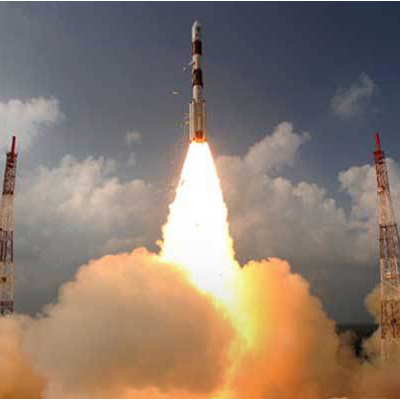
     Earlier, Modi saw the launch of the Polar Satellite Launch Vehicle PSLV-C23 which successfully lifted off from the first launch pad of Sriharikota space station at the Satish Dhawan Space Centre.


     The launch vehicle PSLV-C23, with a height of 44.4 metres and a vehicle lift-off mass of 230 tonne, is carrying SPOT-7, a 714 kg, French earth observing satellite as the main payload, which will be injected into a 655 km Sun Synchronous Orbit (SSO). Other satellites include 14 kg AISAT of Germany, NLS7.1 (CAN-X4) & NLS7.2 (CAN-X5) of Canada each weighing 15 kg and the 7 kg VELOX-1 of Singapore.


    PSLV has had 26 consecutive successful flights till date. The PSLV-C23 will be the tenth flight of PSLV in “core-alone” configuration, which means a configuration without the use of solid strap-on motors.


    After an estimated time of 20 minutes, ISRO’s workhorse PSLV separated all five satellites — one by one into their intended orbit.


    During his first visit to the facility, the Prime Minister took a tour of the facilities, including the launch pad. He was also briefed by ISRO scientists and its Chairman K Radhakrishnan.


    NLS 7.1 and NLS 7.2 are from the University of Toronto, Institute of Aerospace Studies/ Space Flight Laboratory. Canada.


    Both payloads would fly in precise formation using differential GPS with centimeter-level accurate position control system.


    VELOX-1 from Nanyang Technological University, Singapore is a technology demonstrator for design of image sensor, MEMS-based attitude determination and control system and inter-satellite RF link.


    These five satellites are being launched under commercial arrangements that ANTRIX, ISRO’s commercial arm, has entered into with the respective foreign agencies.


    Isro earlier delayed the launch by three minutes due to the threat of space debris getting into the way of the satellites. The PSLV C23 lifted off from the spaceport at 9.52 am on Monday instead of 9.49 am as decided when the launch plan was announced.


    One of the debris objects could have come as near as 40 metres from the spacecraft and by delaying the launch ISRO wanted to avoid the objects by thousands of kilometres as debris move at a velocity of several kilometres per second, said Isro officials.


    A report quoting experts stated that the debris from the 2011 collision of a US satellite and a Russian satellite were found at altitudes above 600 km.


    Until now, the largest number of foreign satellites launched by PSLV was from Germany. In the first launch of satellites of other countries, PSLV-C2 has launched the German satellite with a mass of 45 Kilogram, along with a KITSAT-3 with 110 Kg mass were the payloads. Including this, till April, 2014, eight satellites of Germany reached their destination in space through the launch vehicle of Isro. Canada has sent five satellites till April, 2014 through PSLV while Japan has sent three satellites using the service.

  • CISCO sees major opportunities in India, shakes-up top posts

    CISCO sees major opportunities in India, shakes-up top posts

    NEW DELHI: In a major shake-up, three new presidents have been appointed in Cisco by splitting up responsibilities in the enterprise IT vendor.


    This follows the exit of, Cisco president of India & SAARC, Jeff White, after a dismal performance in some of the recent quarters.


    Cisco India posted 1 per cent decrease in revenue in Q3 fiscal quarter and 18 percent dip in the first quarter of fiscal 2014. Cisco recently said it is expecting a decline in its global revenue in the current quarter.


    The new leadership team includes India & SAARC sales president Dinesh Malkani; India Site leader and Engineering president Amit Phadnis; and India and CIO, Asia Pacific and Japan and Greater China strategy planning & operations president VC Gopalratnam..


    Earlier, White was responsible for Cisco’s sales and operations in the region. White had the role of leader of a new India Board, which comprises executives from Cisco headquarters as well as India. Earlier, White was reporting to Cisco in Asia Pacific, Japan and Greater China (APJC) president Jaime Valles.


    White was supposed to partner with Industry Solutions and India Site leader and industry solutions senior VP Faiyaz Shahpurwala, to drive innovation and talent in alignment with the national agenda to transform the economy through technology.


    The mandate for White was to support the growth by strengthening local innovation, and continuing to forge strong relationships with customers, partners and the government.


    The new team will accelerate Cisco’s momentum by strengthening its focus on innovation to lead market transitions.


    Dinesh Malkani, who takes over from White, will report to Cisco president Asia Pacific & Japan Irving Tan


    Malkani’s main responsibility will be to lead the company’s efforts to help transform the country’s economy through technology. He will drive Cisco’s senior level external engagement, including those with government and industry associations, to drive growth and market leadership in India and SAARC, according to Cisco sources which also said the IT vendor was expecting more work with Prime Minister Narendra Modi emphasizing on new technologies.


    As the new India Site leader, Phadnis will lead Cisco’s focus on innovation, ecosystem and talent development in the country. He will focus on strengthening the interlock between Cisco’s teams, including engineering and sales, and customers and partners and employee engagement.


    Phadnis will continue to report into the organisation led by Enterprise Networking Group isenior VP and GM Rob Soderbery in the US.


    In the newly created role of president of strategy, planning and operations for Cisco India, Gopalratnam will help create synergies between Cisco’s internal IT organization and the company’s technology roadmap as well as drive infrastructure development and operations to facilitate growth and productivity.


    He will continue to report to Cisco’s global CIO Rebecca Jacoby.