Tag: RR

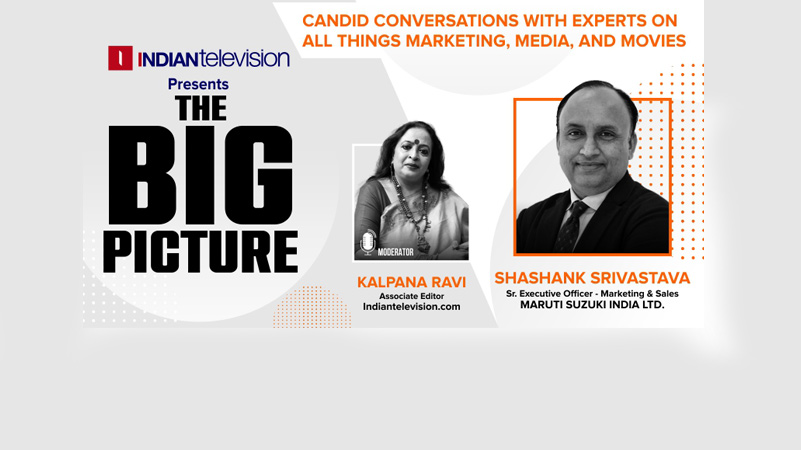
  • The Big Picture with Shashank Srivastava, as he shares insights on Marketing, Media & Movies

    The Big Picture with Shashank Srivastava, as he shares insights on Marketing, Media & Movies

    Mumbai: The power of movies on television, often referred to as “The Big Picture”, has impacted how we consume entertainment, making it an essential part of our lives. Not only that, the synergy of Movies and TV has also proven to be lucrative for brands who want to reach India at large and impact their daily lives. In a series of chats with marketers and media veterans, we discuss all things related to marketing, media and especially movies. I am your host, Kalpana Ravi, Associate Editor Indiantelevision.com and today my guest today is Shashank Srivastava – Senior Executive Director of Sales and Marketing – Maruti Suzuki India Ltd.

    Edited excerpts

    On your early life, about how you grew up and what has been your experience.

    My hometown is Bhopal and I did my initial schooling there. Then I did my engineering, I was always out of Bhopal after that. I did my MBA from IIM Ahmedabad, post which I joined Maruti Suzuki. And that was a long time back, just out of college. And this is actually 33 years I have been in this industry. People asked me this question as to why the how, and why this long innings in Maruti Suzuki? The clear answer is that this is one industry, which I really love. It’s always cars, it has always been my passion, starting from my school days. Therefore, I wanted to join an organisation, which was in this industry. Maruti Suzuki, of course, has been leading organisations for a very long time. That’s how I came into Maruti Suzuki. It gave me a lot of good experiences across different areas of work. That’s how I kept on with Maruti Suzuki. I’m glad because we did contribute a lot to the industry. I feel that I have also been a part of that contribution to the Indian economy.

    On your connection with cars

    I started driving the car when I was in the seventh standard. My father used to have an Ambassador car. In those days, cars had these radiators, so we had to fill the water to cool the engine down. I was given the task of cleaning the car every morning and putting that water on the radiator. Once in a while I started, I started the car as well, and started driving a little bit just about 10 metres. I’m not sure that my father ever knew about this. But my mother clearly knew about this activity of mine. I’m not sure whether she told this to my father because he didn’t say anything. That’s how I started driving the car and started getting to have the feel of the car.

    On choosing to be a marketer in the automobile sector.

    It’s basically a consumer perspective and I thought that as a consumer, what should be what product it should be, what it should mean to a consumer. So, I got interested in the technicalities of the car in the mind of the consumer of the car, and that is how I started thinking about the products especially automobiles from a consumer perspective. For that obviously, during my course, in my MBA at the at IIM Ahmedabad but I mastered in you know, there was a subject I had to choose to specialise in and I chose marketing and it gave a very structured sort of knowledge a very structured approach to the entire consumer behaviour, consumer mind and how companies should make products and how to market them and that is how I chose marketing.

    On sharing some highlights from your journey so far

    There are many actually. Starting from the early 90s, you had a very high tax structure, the penetration of cars was just around two cars per 1000 people. Today it is 32. When I joined Maruti Suzuki, we had two other car manufacturers in the industry, the total sale was about 50,010 per annum. Today, we are selling 50,000. Maybe in the industry, we are selling almost 40 lakh this year. From about 50,000 to 40 lakhs, I have seen these changes happening in the last 30 years, not only in terms of volumes, which I just mentioned, also in terms of the different segments which emerged earlier. The Maruti 800 was being used by everybody, the bureaucrat, the businessman, the family guy, the young boys and the girls. But today, you see a lot of segmentation. So, you have family cars like the Ertiga, the Sedan’s then you have the SUVs, which were earlier a rougher sort of thing as technology has changed immensely. While volumes have changed, segments have changed and the consumers themselves have changed. You see a lot of digitalization in the industry today, which means the consumer buying process itself has changed. The type of buyer also has changed and the income level of the buyers has changed. In that sense, there has been a complete change from what it was 30 years ago, and each of these changes has been a highlight. For example, when the new Swift came in, it started a new segment which people thought would never exist, but it did then we had the Esteem. It was also a segment which suddenly came in. Therefore, each of these moments are like highlights of the last 30 years and I have been very lucky to be a witness to almost all of them.

    On some of the memorable campaigns you have worked on work

    One good thing about the large experience is also that I have been part of most of the memorable campaigns actually, because Maruti’s a 40-year-old company and I have worked for more than 33 years. In essence, the theme of those campaigns also defines how the consumer has been changing. So initially, there was a campaign about fuel efficiency. There was one Sardar Ji campaign that became a rage because it really defined in a very nice way how fuel efficiency is so dear to consumers. Those times consumers were obviously the first criteria for car purchase was the running cost and therefore, the second campaign on the network, which was about a guy who goes up to Ladakh somewhere, and he says, Is there a hotel? There is no hotel and he says there is a Maruti Suzuki service station. And they say yes, there is. So even in remote areas, that was a great campaign on fuel efficiency. Of course, some really good campaigns on the products as well. Like the new alto campaign, we had a blue-eyed boy campaign and so on and so forth. So, there are and there is one other campaign which is the corporate car campaign, which was about how Maruti Suzuki cars are integral to Indian consumers. It was a campaign which had a lot of elements of the brand being ubiquitous as it was everywhere. So that was another campaign, which I really loved and the consumers loved them too. And it became a talking point in the advertising world as well. So, some of these campaigns are really memorable. Even after 20-25 years, when I think about them, they really lift my spirits, because I’ve been part of them.

    On your thoughts on Bollywood movies making record-breaking numbers this year

    Indian consumers are really big movie fans. If you see this year, some of the movies have really done well in the theatres like Pathaan, Gadar 2, Jawaan, Kantara etc. Then down south KGF and RRR, have all done business in excess of 500 crores. So it’s encouraging not only for the film industry but also if you look at it from an advertisers’ point of view, it’s really very encouraging. In fact, when a movie does well at the theatre, you also have a high anticipation of the OTT and Television as well, because there will be a World TV premiere of these blockbusters as well. They tend to garner a lot of buzz because of them doing well in the theatre. Some of the movies have delivered extremely good numbers on television. Obviously, in a media strategy, we have tried to leverage these movies for our brands and going forward, I think we will continue to do that. One point about this is obviously the evolution of the OTT, there is a lot of content which are now available to consumers. So of course, he’s spoilt for choice in that sense, but even OTT premieres are big, and hence for the advertisers, I think we need to analyse the ROI very diligently and invest on both TV and OTT to get the best ROI. And that’s what Maruti Suzuki has been doing.

    On watching movies on television creating value and impact that offer your brands?

    It creates immense value because it is about memory structure as they say. It is not just about one advertisement or FCT that you put on. Of course, if you look at marketing as an investment and not as an expense, then what it does is build a longer-term brand value and these values come from these memory structures like watching a movie together with the family so, that becomes a brand conversation, which happens because of the family watching together. There are other memory structures like logos for example, or the packaging design, or, the visual treatment of the product itself, if you look at our Maruti Nexa product, for example, the design language is different. So there is also brand communication through the design language, we call it crafted futurism. So, therefore, I think these memory structures are extremely powerful, and very valuable for any brand. So, therefore, these memory structures are extremely powerful and very valuable for any brand. What it does is, it probably requires a small investment to keep the brands on top of the mind, because the investments have grown over time. That’s how those memory structures have evolved. These are the things which have a greater cultural relevance. Brands that see the advantage of this approach, will succeed and their ROI will grow. And we at Maruti Suzuki, feel that these occasions such as the ones that you mentioned, are really great opportunities for marketers.

    On the current media spectrum of TV and digital contributing a winning mix for a marketeer and on the overall effectiveness of TV plus digital advertising

    I’m glad that you said what is the ideal mix, rather than a lot of people who asked this question, which is better, is it TV or is it digital, because obviously, you have to strike the right balance between television and digital and find out the best way to reach the TG. For example, television is great, because for automobiles, if you really want to create imagery, the stickiness of the imagery is good on television, because you can have a large video format there. That’s essential, especially when you are launching a product. Also, the television media today in India has got a larger reach. So, if you’re trying to build a quick reach, and if you want to create imagery for brand positioning, initially, television is a great medium. However, in the funnel, if you look at the marketing funnel, as you go down for consideration and the actual conversion, then you need to have a more personalized message for consumers, their digital becomes more accurate, better, and less wasteful. Therefore, digital platforms obviously have got unparalleled, targeting capabilities because it allows marketers to reach specific audience segments and send personalized messages. That’s great for converting to an actual sale. And therefore, you need to have a mix of both television as well as, digital. It depends on the product category. A category such as car, imagery is very important. Because the category is different from the finance product, it also depends on the specific target audience, if you’re looking at really young consumers, who consume a lot of media in the digital sphere, obviously, you have to spend more money on digital. It also depends on your campaign objective, or even on the creative integration, the creative which is there. If you’re looking at performance measurement, obviously, that’s also one important thing because you can have a better measurement of the digital thing. It also depends on budget constraints. So, I would say that the media effectiveness and the mix are determined by the reach & engagement, if you want reach then TV. It definitely provides that broader reach and mass appeal, digital channels offer targeted engagements and personalised interactions. If you look at brand building, obviously, TV excels in brand building and emotional storytelling, digital platforms, drive performance marketing and maybe measurable results. So, a synergistic effect is what we are looking at. Therefore, a mix is good. In our case, the mix currently is about 30 per cent digital, television is about 40 per cent and the rest is print, radio, OOH and cinema.


  • IPL Governing Council proposes 2 new teams; total 10 teams after CSK, RR ban lifts

    IPL Governing Council proposes 2 new teams; total 10 teams after CSK, RR ban lifts

    MUMBAI: A moment of respite and glory may come for Multi Screen Media (MSM) – the official broadcaster of the Indian Premier League (IPL) as the league’s governing council floated a proposal of adding two new teams to replace the suspended Chennai Super Kings (CSK) and Rajasthan Royals’ (RR) spot. 


    Additionally, the IPL governing council also proposed that after the two year ban was lifted from both the teams, the IPL will be a 10 team affair.


    “One suggestion is to have two new teams only for two years and replace them with CSK and RR in 2018 when they come back,” an IPL GC member told PTI today (27 August).


    “The second suggestion is to make it 10 teams from 2018 onwards once the two suspended franchises complete their sentence,” he added.


    The council’s two proposals will be put forward to the BCCI Working Committee on 28 August.


    MSM holds the broadcasting rights of IPL till 2018, which means that the last season of its IPL broadcasting tenure will be an elongated one with 10 teams. Trade media experts and economists believes that the MSM will make a profit from the revenue generated in the 2018 edition. If the proposal is accepted, it will be icing on the cake for MSM as 10 teams means more number of matches and subsequently a longer time span to monetise.


    The broadcaster raked in more than Rs 1000 crore in 2015 edition of the multi million dollar tourney. It may be recalled that MSM bagged the IPL broadcasting rights for a whopping $1 billion.


    Broadcasters, who are gearing up to bid for the IPL telecast rights when it comes up for grasp again, are making their permutations and combinations to bid for the tournament. It’s no rocket science that they will be following the developments closely.


    Now it remains to be seen whether CSK and RR players are relieved by their respective franchises and are allowed to participate in next edition of IPL.

  • IPL opening eight days total 74.7 million live impressions: Twitter Brand index

    IPL opening eight days total 74.7 million live impressions: Twitter Brand index

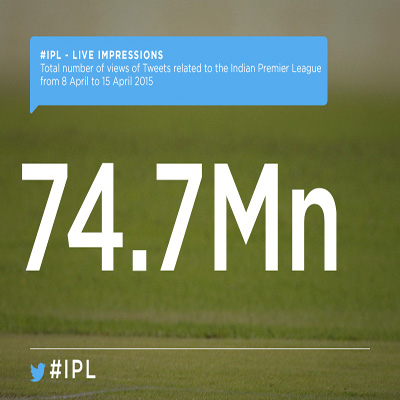
    MUMBAI: With 74.7 million live impressions during the opening eight days of the eighth season of the Indian Premier League (IPL), Twitter is abuzz with excitement. While defending champs Kolkata Knight Riders (KKR) have had a stop-start beginning, the Rajasthan Royals (RR) rushed out of the gates and the Indian captain led Chennai Super Kings (CSK) continued to be crowd favourites as there was hardly any surprise on their first match versus Delhi Daredevils (DD) being the most talked about game on Twitter between 8 – 15 April, 2015.


    Below are the games ranked in descending order of the most live impressions: 


    1. #KKRvMI (8 April 2015)

    2. #CSKvDD (9 April)

    3. #KKRvRCB (11 April)

    4. #CSKvSRH (11 April)

    5. #RCBvSRH (11 April)

    6. #MIvKXIP (12 April)

    7. #RRvMI (14 April)

    8. #DDvRR (12 April)

    9. #KXIPvRR (10 April)

    10.  #KXIPvDD (15 April)


    Top Moments, on the basis of Tweets Per Minute, between 8 – 15 April, 2015 were: 


    1. Chennai Super Kings beat Delhi Daredevils by one run.

    2. Royal Challengers Bangalore defeats Kolkata Knight Riders by three wickets.

    3. Kolkata Knight Riders defeats Mumbai Indians by seven wickets

    4. Chennai Super Kings’ Brendon McCullum brings up his century off 56 balls against Sunrisers Hyderabad.

    5. Kings XI Punjab defeats Mumbai Indians by 18 runs.


    #Orangecap & #Purplecap


    Most mentioned batsmen and bowlers on Twitter during the Live Match Windows with the hash tags #OrangeCap and #PurpleCap are:


    Batsmen:

    1. Yuvraj Singh (Orange Cap) (@YUVSTRONG12)
    2. Rohit Sharma (@ImRo45)
    3. Chris Gayle (@henrygayle)

    Bowlers:
     

    1. Harbhajan Singh (Purple Cap) (@harbhajan_singh)
    2. Morne Morkel (@mornemorkel65)
    3. Ashish Nehra


    Ranking of Most Mentioned IPL Teams on Twitter from 8 – 15 April:


    1. Kolkata Knight Riders
    2. Chennai Super Kings
    3. Mumbai Indians
    4. Delhi Daredevils
    5. Kings XI Punjab
    6. Royal Challengers Bangalore
    7. Rajasthan Royals
    8. Sunrisers Hyderabad


  • Indian leg of the IPL to begin from 2 May

    Indian leg of the IPL to begin from 2 May

    MUMBAI: There is good news for Indian cricket fans, who were left disheartened after the news hit that the first 20 matches of this edition of the Indian Premier League (IPL) will kick-off in UAE.


    IPL is set to return to Indian shores on 2 May for the remaining 36 matches, including four play-offs, which will be played in the home-leg.


    The Board of Control for Cricket in India (BCCI) after having successive discussions with the authorities at home, decided that the IPL can be played at home beginning from 2 May. The first leg of the IPL will be held in UAE from 16 to 30 April due to the general elections in India.


    In the home-leg, each franchise will play nine matches and five of the eight teams will be playing at least four matches in their home stadium.


    Chennai Super Kings will play two matches at Ranchi, while Kings XI Punjab will play two games at Cuttack. Rajasthan Royals will play four matches at Ahmedabad. There will be no matches on 1 May and 17 May.


    The schedule of the UAE leg has also been tweaked to suit the franchises. The evening match slated for 26 April in Abu Dhabi, between Kings XI Punjab (KXIP) and Kolkata Knight Riders (KKR), will now be designated as a home match for the Knight Riders and the 28 April match in Dubai, between Royal Challengers Bangalore (RCB) and KXIP, will be designated as a home game for Kings team.


    “Following on from the launch of ticket sales for the UAE leg today (3 April), I am pleased that we are now able to confirm the dates for the rest of the season,” said BCCI-IPL interim president Sunil Gavaskar in a press statement.


    “It is great news that the fans back home in India will be able to watch a large part of the Pepsi IPL 2014. Given the various challenges and the logistical complexities, we have spent a considerable amount of time in crafting a balanced schedule,” he added.


    IPL governing council chairman Ranjib Biswal said, “We are delighted to have the season back in India at the start of May. Organising an event of this scale at multiple venues in two countries is an enormous organisational undertaking and we are very grateful to the Government of India, the Ministry of Home Affairs and the police authorities in the various states for their support.”


    Hosting IPL involves elaborate planning on several fronts, logistics included and it is critical that there is surety on the availability of the match venues, for a tournament of this magnitude. The BCCI has tried to work with various franchises and stakeholders to get confirmations to host matches in the cities.

    The Rajasthan Royals have indicated to the BCCI that they are pleased to play their four home matches of the India leg of the 2014 season, at Ahmedabad, to avoid any uncertainty to their home matches. KXIP and CSK will be playing some of their home matches outside Mohali and Chennai respectively, due to non-availability of their home venue, for a large portion of May 2014.

    Looks like the IPL will continue to look at as many venues as possible to play the tournament in forthcoming seasons, and that’s a good sign for smaller states and regions to come to the forefront.

  • IPL6: Controversies drag down average TVRs to lowest in history

    IPL6: Controversies drag down average TVRs to lowest in history

    MUMBAI: The verdict is out and it clearly shows that this time around the cash rich league which was in the news for all the wrong reasons appears to be losing its brand value.

    The tournament – if ratings made available to indiantelevision.com by a channel are to be believed – generated an average cumulative (both Max and Sony Six) TVR of 3.1 in Hindi speaking markets (HSM) and 3 in C&S 4+ all India. This was much lower than the 3.45 HSM average TVR it reported last year, and probably the lowest in its six year history. In 2010, the average TVR was 4.65, and in the inaugural year the number was 4.81 TVR.

    There is much more in store. The IPL final between CSK vs MI also saw a dip in ratings this year as compared to last year. It recorded a TVR of 5.4 on Max alone; the cume rating (with Six and Max included) looks a lot more respectable at 7.3 for HSM and 6.9 all India CS 4+.

    As a comparative, the 2012 final between KKR and CSK registered a TVR of 8.92; the 2011 final between RCB and CSK saw a 6.44 TVR; the 2010 final between MI and CSK reported 10.48; the 2009 final between DC and RCB ran up a 9.92 TVR and finally the first season final between RR and CSK had a very healthy rating of 9.81 (The ratings for the previous year‘s are for Max only and do not include Six as there was no such channel in the Sony Entertainment Network then).

    What goes? Is the loaded with money league beginning to sag? Madison Media CEO Karthik Lakshminarayan believes it is. “The brand and the image of the IPL has definitely taken a beating. The rating numbers that have been thrown up are very surprising.”

    “The IPL ratings have certainly not come up to our expectations,” expounds Vivaki Exchange CEO Mona Jain. “The controversy surrounding the IPL this time around also is a cause for the same.”

    Max executive VP & business head Neeraj Vyas says the Sony Network management is fairly satisfied with the ratings the tournament has generated.

    “I am not over the moon,” he expresses. “But I am fairly satisfied. Let me state that it would be grossly unfair to compare this year‘s ratings with earlier years. It would be rather silly. Remember LC1 has been given a 25 per cent weightage by TAM earlier this year. These LC1 towns have power cuts 12-14 hours a day. Then the TAM universe changed about a month or so ago. All these factors make it appear as if you are comparing watermelons and lemons.”

    “Last year the tournament witnessed a strong viewership base of 162 million, we had managed to increase that number to 176 million viewers halfway into the tournament and it could well have crossed the 200 million barrier had TAM not changed its universe a month ago on 5 May,” he further states.

    Other views that are being put forth to explain the dip in ratings include the fact that ennui is developing among cricket watchers on account of the cricket glut on TV.

    Another view is that the spot-fixing controversy put off many viewers from the action on the field.

    The third perspective that is being silently spoken of is that the switch off and switch on in phase I and II of the government mandated cable digitisation process has dampened the ratings.

    Be that as it may, it remains to be seen whether advertisers‘ annoyance with lower ratings leads to any other action from their side.

  • IPL’s brand value up by 4%; CSK replaces Mumbai as the most valuable: Brand Finance

    MUMBAI: The Indian Premier League (IPL)‘s brand value has grown for the first time in four years to $3.03 billion, up from $2.92 billion last year a rise of four per cent. But it is still a far cry from $4.13 billion in 2010. The nine franchisees‘ total brand value has reached $325.8 million this year from $321.12 million last year.

    The bigger question though is whether the league is fit for the long run. Also sweeping ethical infractions under the carpet is not an option according to a brand valuation report on the IPL made by consulting firm Brand Finance. The lacunae in transparency and accountability in the IPL ecosystem which drives trust and alignment amongst stakeholders remains to be addressed in full measure and lies beneath the waters as a significant unmitigated risk.

    The Chennai Super Kings (CSK) is the most valuable IPL franchise. Their value has grown to $45.42 million up slightly from $45.28 million last year. There are three pillars that brand finance used for evaluating a franchises‘ brand value – cricket excellence, corporate governance and marketing excellence and commercial strategy. India Cements joint president marketing Rakesh Singh noted that the franchise aims to be active throughout the year. “”Our aim is that at least every second month there should be an activity. The Chennai Super Kings cannot be just about two months. So we do things across the year that touches different segments of society”.

    CSK‘s aim is to look at the bigger picture and be a sports brand by going beyond just cricket. “We feel that it is important that when the CSK brand engages with constituents it should not be only about cricket. This way CSK will be built as a sports brand” said Singh.

    The franchise that has grown the most in value has been the defending champions Kolkata Knight Riders (KKR) which saw a 15.2 per cent jump to $44.98 million from $39.03 million last year putting it in second spot compared to fourth last year. In an interview with Indiantelevision.com KKR CEO Venky Mysore said that the aim over the past two years had been to function like a corporate. That meant bringing in systems and processes and having more transparency. The last two years have seen a dramatic change in fortune of the franchise on the field which has translated into better off the field perception and value.

    On the other hand the brand value of Mumbai Indians and the Royal Challengers Bangalore has fallen. The Mukesh Ambani owned franchise has seen its value fall to $44.62 million from $48.21 million last year. Last year it was in the top spot. Nonetheless Brand Finance maintains that the franchise along with CSK and KKR is leading in terms of value creation. Meanwhile the Vijay Mallya owned franchise‘s value has fallen to 37.81 million from $41.15 million but it nonetheless holds a lot of promise. These are the only two franchises whose brand value has fallen.

    Delhi Daredevils which is currently struggling on the field holds promise as their brand value jump to $34.22 million from 32.19 million last year. The new franchise Sunrisers Hyderabad, owned by Sun TV is valued at $31.49 million and also holds promise.

    Kings XI Punjab which has sorted out its legal issues with the BCCI saw a 7.4 per cent jump in value to $30.78 million from $28.68 million. But Brand Finance notes that it continues struggling to create value. The franchise expects that now that things are sorted out the future will be better in terms of areas like sponsorship revenue. The franchises CEO Colonel Arvinder Singh says that all its marketing programmes as well as media and social interactions are positioned keeping in mind the loyal Punjabi Fan. “We have concentrated on being a fan centric team not only through regular engagement but also through on ground social programs such as women‘s empowerment. It is this fan centric approach that has resulted in an increase in brand value for the franchise. We shall also be doing a lot more in this field to further enhance our brand value.”

    The Sahara owned Pune Warriors India‘s brand value is also struggling. Its brand value is up marginally by two per cent to $29.45 million. The Rajasthan Royals continue to languish in last position with their value being practically flat at $27.05 million.

    Brand Finance global strategy director M Unni Krishnan said that after having witnessed a steep fall in its long-term value of over a billion dollars from its peak, IPL‘s trust capital seems to hold steady at $3.03 billion compared to $2.9 billion last year.

    “The relative stability at these lower levels can be largely attributed to efforts being put in by the BCCI as well as the franchisees to bring consistency in the cricketing product enhance fan engagement and loyalty through wide spread marketing efforts. The learning curve has been steep and some clubs seem to have cracked the code across various marketing, cricketing and business performance drivers.”

    He adds that with the franchisees entering the sixth year of its operations, they face an acid test of commercial sustenance. Their destiny is intertwined with the IPL‘s as a whole.

    He noted that the league is trying to claw its way back with operational improvements. But the trust flows with stakeholders will eventually determine the health of the IPL‘s long-term cash flows. He warns that while the short-term operational improvements are encouraging, they need to be aligned to the strategic canvas of what IPL really means for the emerging Indian identity and cricket as an international sport which can spread opportunity and value in a fair and equitable way.

    “IPL is a means towards this greater good and not an end in itself. Whilst all organisations go through highs and lows the real question to be asked is one of sustainability and endurance. Is IPL able to rise to its higher calling and is it fit for the long run?”