Tag: RIO

  • Pay channel’s a la carte rate to not exceed two times its RIO rate: TRAI

    Pay channel’s a la carte rate to not exceed two times its RIO rate: TRAI

    NEW DELHI: The Telecom Regulatory Authority of India (TRAI) today said that the a la carte rate of a pay channel forming part of a bouquet offered by any digital platform should not exceed two times its RIO order rate offered by the broadcaster for addressable systems.


    TRAI also said that the sum of a la carte rates of all channels in the bouquet should not exceed three times the bouquet rate. 


    This applies to all multi-system operators (MSOs), direct to home (DTH) operators, internet protocol service (ISP) providers and Headend in the Sky (HITS) operators providing broadcasting services or cable service to its subscribers using a digital addressable system (DAS) and offers pay channels or pay and free-to-air (FTA) channels as part of a bouquet.


    These provisions are contained in the draft Telecommunication (Broadcasting and Cable) Services (fourth) (Addressable Systems) Tariff (Amendment order), 2015 that TRAI has prepared consequent to an order of the Telecom Disputes Settlement and Arbitration Tribunal (TDSAT) of 13 July.


    TRAI has also given the definitions of RIO and RIO rates in the draft, to which comments can be filed by 14 October with counter-comments if any, by 21 October.


    TRAI defines “RIO” as Reference Interconnect Offer published by a service provider specifying terms and conditions on which other service providers may seek interconnection from the service provider making the offer. On the other hand, “RIO rate” is the rate specified by the service provider in its Reference Interconnect Offer.


    The a-la-carte rates of all the channels offered by the service provider should be same for all the bouquet of channels formed by the service provider.


    The matter had gone to TDSAT as some platforms had objected to the “twin conditions” that were prescribed at retail level pricing of TV broadcasting services in order to link the a-la carte rates of channels to the bouquet rates in the Tariff order of 20 September, 2013.


    TDSAT, while disposing off the appeal vide its order of 13 July, stated that the Authority will consider the concerns of the appellants and take a final decision on the matter within four months from the date of the order.

  • TDSAT asks TRAI to examine HITS operators’ inter-connect agreements

    TDSAT asks TRAI to examine HITS operators’ inter-connect agreements

    NEW DELHI: The Telecom Regulatory Authority of India (TRAI), has now been asked to examine whether a broadcaster’s RIO should form the basis for negotiations to enter into an interconnect agreement with the distributor of signals.


    The Telecom Disputes Settlement and Arbitration Tribunal (TDSAT), which had earlier asked TRAI to re-examine the issue of Digital Addressable System (DAS) tariffs, also wants to know if the RIO is only a fall back basis in case the negotiations between the broadcaster and the distributor for entering into interconnect agreement otherwise fails.


    Summing up the issues that came up for consideration in two cases, the Tribunal asked whether an interconnect agreement between a broadcaster and a distributor of signals on a fixed fee basis, completely dehors the broadcaster’s RIO, can be said to be in accordance with the provisions of the Regulations.


    It also asked if it is open to the broadcaster to give discounts, concessions and facilities to distributors of signals on a deal to deal basis or is the broadcaster obliged to frame a standard scheme of discounts, concessions and facilities and make it public so that it may be available to all similarly situated distributors equally.


    The Tribunal also asked the status of a Headend In The Sky (HITS) operator vis-a-vis a broadcaster for the purpose of inter-connect arrangements, and whether a HITS operator is comparable to a large MSO operating on a pan India basis.


    TDSAT chairman Justice Aftab Alam along with members Kuldip Singh and B B Srivastava were examining two cases filed by Noida Software Technology Park Ltd against Media Pro and Taj Television.


    The Tribunal wanted a clear stand from TRAI and also directed that this order should be placed on the Tribunal website in the form of a notice with copies being sent to the Indian Broadcasting Foundation (IBF), MSO Alliance and DTH Operators’ Association, as any adjudication of these questions is likely to affect the broadcasting sector as a whole fundamentally.


    The Tribunal said it would be open to any stakeholders to intervene and address the Tribunal on the issue.


    Listing the matter for further hearing on 11 August, it said any applications for intervention may be filed within one week from today (30 July). 

  • What’s in store for the Indian broadcast industry?

    What’s in store for the Indian broadcast industry?

    MUMBAI: The Indian media and entertainment industry is on the cusp of growth with phase-III and IV digitisation underway. However, even as the government is optimistic about meeting digitisation deadlines, multiple stakeholders are of the opinion that to meet the 2016 yearend deadline is unrealistic and far-fetched to say the least.

    Reiterating the sentiment is a research report by Bank of America-Merrill Lynch, which says that digitisation will be a slow process and will be complete only by FY2020-21. 

    The Bank of America-Merrill Lynch lists out four things that the Indian media industry should watch out for. They are as follows:  

    1) Digitisation: A Slow Process

    Even though the government has mandated full digitisation by December 2016, the research says that digitisation will be a slow process as on-ground checks show that it is nearly impossible for stakeholders to stick to the deadline. Bank of America-Merrill Lynch expects the entire roll out to be complete only by FY2010-21, with bulk of the benefits flowing in FY’18-19.

    Larger MSOs don’t have a local presence: In phase-I and II DAS-mandated areas, the large MSOs already had their infrastructure laid out and had knowhow of the local conditions. However, phase-III and IV are more remote areas where the MSOs do not have an established network, and hence will take time to rollout their network. These areas have been dominated by the local/ smaller MSOs, who may not have the wherewithal to invest capex and fund set-top-boxes (STB) for consumers. The report says that if digitisation happens slowly, the local MSOs will be able to capture this market (wherever analog cable is present), thus limiting the land grab of DTH operators.

    Government has reasons to be ambivalent on digitisation: The government benefits from digitisation in way of increased tax collections. At the same time, it will be vary of making voters pay a higher tariff for Pay TV bills. The ARPUs for phase-III and IV areas are lower; and a move to digital TV will entail a significant rise in their pay TV bills. Considering that TV is the main source of entertainment for Indians, the government may look to ease the digitisation roll-out slowly, rather than sticking to tight deadlines.

    ARPUs are lower: The phase-III and IV DAS-mandated areas have a lower ARPUs compared to phase-I and II geographies, which would make it difficult for MSOs and DTH companies to push through a premium ARPU product. As per the research, more innovations like Dish’s low-ARPU Zing proposition (focusing on low-cost local content), lower price points and differential geographical pricing to drive adoption are likely to be seen.

    2) Ad revenue growth to be strong in FY2016

    Advertisement revenues strong: Ad revenue growth is expected to be strong in FY16, on back of: 1) A pick up in economy and the resultant rise in ad spends; 2) Increased ad spending by e-commerce companies; and 3) Television maintaining its share of the advertisement pie. Ad spends have a strong correlation with nominal GDP. Considering that the economy is expected to pick up going forward, the Bank of America-Merrill Lynch report forecasts 13 per cent ad revenues growth for the industry, which is in line with industry estimates. (Source: KPMG-FICCI Annual report 2015).

    Implementation of BARC: The prevalent industry TV rating data (TAM) has often been cited for inconsistencies by broadcasters and advertisers. Hence, the industry bodies representing the three key stakeholders – broadcasters, advertisers, and advertising and media agencies – launched a new rating system – BARC India. Since it has the support of the industry, the report suggests that it will eventually replace TAM as the industry standard for determining TV ratings. Given that the new rating uses different methodology and sample set, the status quo TV ratings is at a risk of being upset. Though Zee has managed to hold on to third spot among Hindi GECs in the recently released data, as BARC moves towards a countrywide coverage, volatility in future ratings will remain a concern.

    Smart devices will lead to increasing viewership and ad revenues: With increasing penetration of smart devices, overall video consumption will increase. Since Indians are quite willing to watch ad-supported free content, the ad revenues will increase with the rise in online viewership.

    3) DTH: Factoring ARPU hike for 2-3 years

    Impending move to RIO to increase ARPUs: Star India has made the first move by completely moving its channel bouquets to RIO pricing, without materially impacting its viewership. Even as other broadcasters are still debating on whether to move to RIO, according to the Bank of America-Merrill Lynch report, Star’s successful move makes it only a matter of time before other broadcasters move to RIO pricing as well. Moving to RIO will increase the content cost for MSOs, necessitating an increase in tariffs to protect profitability. This does not factor in the RIO sing-ups in the base case. As per the report, an upside to subscription revenue estimates will be seen for both broadcasters and DTH operators in case market moves to RIO pricing.

    Subscribers in low-ARPU areas may opt for ala carte subscription: Unlike in the West, regulation in India mandates broadcasters to make available their channels on a piece meal basis. Since the average Indian watched just 17 channels, there is a risk of consumers in the low ARPU phase-III and IV DAS- mandated areas shifting to subscribe on a per-channel basis to reduce their monthly bills.

    Reduction in carriage and placement fees: Digitisation of Pay TV will reduce the carriage and placement fees (C&P fees) that are paid to MSOs for beaming their content. Digitisation mandates complete removal of the placement fees. Additionally, digitisation of the channel signals has resulted in a 3-4x decrease in the bandwidth needed to broadcast individual channels, allowing MSOs to beam as many as 2,000 channels within the allotted bandwidth, and thus weakening the case for MSOs to charge for a non-existent constraint. While the broadcasters are still paying carriage charges, the charges on a per-channel basis have been reducing. According to the report, this trend is expected to continue in the future.

    HD channels to increase ARPUs: Subscription to HD channels have increased in recent months, due to: 1) HD content being made available; 2) Costs of HD STBs have fallen and the non HD boxes point that distributors have stopped procuring non-HD boxes; and 3) Penetration of HD-enabled television sets have increased. As per the estimates by Bank of America-Merrill Lynch, HD subscribers on an average have ARPUs higher by about Rs 100. And with the HD take-up increasing up to 22 per cent for the DTH operators, HD is expected to positively drive up ARPUs.

    4) Fragmentation of channels & content costs

    Ad cap and the fragmentation of channels: The government has recently implemented the 12-minute ad cap (per hour). As a result, the sector has seen a slew of new channel launches and increase in ad rates to offset the impact. The report expects that investment in new channel launches will continue in the near term.

    Content to become increasingly more important: In a digitised world, quality content is going to be increasingly more important. With the likely kicking in of RIO pricing, and possible move to ala carte packages, broadcasters will need the content “hook” to lure the subscriber to pay a higher price for the same content.

    Content costs to rise: As more channels compete for the revenue pie, and channels move to RIO pricing, broadcasters are likely to increase their investments to produce quality content. In this context, the larger broadcasters will be in a better place to cope with the change with them having deeper pockets to invest in new content.
  • Hathway launches campaign for new channel packages

    Hathway launches campaign for new channel packages

    MUMBAI: Multi system operator (MSO) Hathway Cable & Datacom is out on a mission: to educate cable TV subscribers about their new power – ‘The power to choose.’ And to spread this message the MSO has come out with three TVCs, print ads and radio jingles. 


    The campaign will use multiple media to inform and educate consumers about the different packages that the MSO has created. The move comes in the wake of broadcaster Star India’s decision to enter into only Reference Interconnect Offer (RIO) deals with MSOs. 


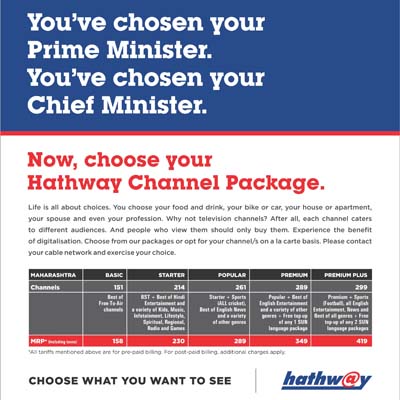
    The five packages for Maharashtra that have been rolled out by Hathway include: 


    · Basic Pack priced at Rs 158: This will have the best of all the free to air channels.


    · Starter priced at Rs 230: This will have best of Hindi entertainment and a variety of kids, music, infotainment, lifestyle, spiritual, regional, radio and games. 


    · Popular priced at Rs 289: This will have channels from Starter pack + sports (all cricket, best of English news and a variety of other genres).


    · Premium priced at Rs 349: This will have channels from Popular pack + bets of English entertainment and a variety of other genres + free top up of any one Sun language package.


    · Premium Plus priced at Rs 419: This will have channels from Premium pack + sports (football, all English Entertainment, news, best of all genres + free top up of any two Sun language package. 


    Conceptualised and created by Gasoline, while one of the TVCs has life reference, the other two are animated. Speaking to Indiantelevision.com, Gasoline founder and chief creative officer Anil Kakar says, “The brief given to us was that the MSO wanted the power of choice to be in the hands of consumers.” 


    The campaign highlights the five different packages as well as the a la carte prices being offered by Hathway. 


    Incidentally, the work on the campaign started in October, which is the same time when Star announced its plan to enter into RIO deals. “While the client wanted life reference, we wanted to bring in animated characters. The reason being that while the message is hard selling, animation makes it light,” informs Kakar. 


    The ad film draws an analogy from contexts wherein a consumer makes a choice. For instance, the first film opens on a lady buying a soap in a soap store. The salesman is seen pushing various soap brands on offer. The lady quips, ‘You aren’t trying to sell the whole store, are you?’ and smiles. Cut to a CG section wherein we see a host of channel logos and a voiceover, which says, ‘We choose everything in life, why not television channels?’  


    The strategy is to communicate the cost-effectiveness of a Hathway package subscription. The campaign extends with a couple of animation films, which demonstrate how a subscription is reasonably priced vis-a-vis other things in life. In the first film, we see a young character in a cafe going through his mobile bills, only to find his café bill more expensive, thus communicating the fact that a monthly subscription to a Hathway channel package is still cheaper than two cups of coffee and a sandwich.


    The radio spot extends the idea further with a groom who is choosing a bride and in another, a waiter rattling off the menu in a rapid-fire sequence. The radio jingles have been co-produced by 94.3 Radio One. 


    The print ad is topical and captivating. It reads: ‘You have chosen your Prime Minister. You have chosen your Chief Minister. Now choose your Hathway channel package.’


    While the TVC will be aired on the Hathway channels, radio ads will be played in Kolkata, South Indian states (except Chennai), Mumbai and Delhi and the print ad will also be published all over India in the mainline newspapers. 


    “The campaign has been designed to ease the life of cable operators, who are facing issues in informing consumers about the packages and its pricing,” concludes Kakar.

  • DTH could push HD penetration in next one year: MPA

    DTH could push HD penetration in next one year: MPA

    MUMBAI: As the year comes to an end, the multi system operators (MSOs) have finally come out with their packages and the pricing module for the Star India channels, after the broadcaster decided to give its channels only on Reference Interconnect Offer (RIO) basis.


    But according to Media Partners Asia (MPA) while Star has the right intent, it has to remain flexible on the incentives offered for better ground adoption. From the operator’s viewpoint, the Star scheme needs to address the following issues:


    1. Despite availing of the maximum discount on the scheme, the content cost for operators remains higher than previous CPS deals, exacerbated as operators are not receiving any carriage fees.


    2. The scheme does not factor in volume discounts on the basis of an absolute number of subscribers offered through a given operator network.


    3. Channel pricing is based on filed RIO rates. These are not reflective of consumer preferences. For instance, Star Plus which enjoys 2x the viewership of Life OK, has a lower price than Life OK.


    4. To generate higher discounts, the scheme demands carrying maximum channels with 90 per cent penetration. This will result in a rich basic pack offering which will disincentivise future upselling to an operator’s high value packages.


    5. Even if operators are able to pass through content costs to subscribers, MSOs face the risk of paying more and collecting less as the current backend systems for operators are not robust and transparent enough to collect and pass on revenues for channels on an a-la carte basis.


    6. The scheme does not factor in HD channels. MSO action plan and execution risk Star has been transparent on rates and discounts for its channels. Some national MSOs have accordingly started to work on their blueprint of tiering channels through a broad revenue share arrangement with local cable operators (LCOs). On the backend, according to MPA, the operators now critically need to have their technology systems in sync with consumer preferences, collected through KYC (Know Your Customer) forms. They will also need to decentralise control by extending their consumer databases to respective LCOs to enable the upgrading and downgrading of packages as per consumer choice. As backend systems get re-engineered, MSOs will need to concurrently conduct roadshows and training programmes for LCOs. MSOs will also need to undertake marketing campaigns to create awareness on a consumer’s need to make choices on revised cable packages.


    MPA also feels that MSOs intend to pass their increase in net content cost to consumers by undertaking an average price hike of Rs 40-60 ($0.7-1) per month. Even if consumers accept the price increase, the risk to MSOs lies in collecting their legitimate share of incremental revenues from LCOs. In order to offset this, MSOs plan to shift to trade prepaid services, which should have positive consequences.


    Long term implications for the Pay TV industry


    Broadcasters: Currently, all broadcasters are looking to reduce carriage fees and bring it to parity with DTH in terms of total payout. A number of broadcast networks are taking a wait-and-see approach. Having already eliminated carriage in DAS markets, if Star manages to obtain reasonable viewership for its driver channels with a nominal growth in subscription revenues, MPA believes that others too will broadly follow Star’s approach.


    According to MPA, non-carriage discounted rate schemes could become the template for future content deals. This will have direct implications on several advertisement-skewed and reach-dependent genres, such as news and music. Channels in such genres might then remain feasible by converting to free-to-air. Launching new channels will become difficult and as a result, the industry could see rebranding and a frequent change in the programming mix of existing channels.


    MSOs: As carriage and placement revenues start to dry up, the priority for MSOs for the next 12 months will be to shift to establishing robust back-end systems for better subscription monetisation in phases I and II. Consequently, voluntary digitisation and reach expansion in phases III and IV could take a back seat. MPA in its report also points out that national MSOs have already invested and outsourced backend systems to renowned IT vendors, which need to now streamline the secondary point network in order to attain authenticated customer information and deliver strong customer support services.


    “Critical is the increasingly important need to successfully rollout trade prepaid services and rationalising content cost by identifying active paying subscribers which will address the current cash flow crisis and determine the future feasibility of an MSOs business model.


    As the industry shifts gears, we may see more consolidation of cable players which fail to invest and execute on establishing B2C processes,” says MPA.


    DTH: Over the last 30 months, the DTH industry had implemented a 53 per cent increase in its base pack pricing. Just when it seemed that rate hikes on base packs had hit a ceiling, the price hikes implemented by MSOs provided the DTH industry with additional headroom to undertake further price increases. In addition, with tiering of channels on cable, the value gap in the form of realisation per channel between cable and DTH operators will narrow, feels MPA.


    As per MPA, a lighter base pack for both cable and DTH will gradually result in the upselling of subscribers to high value packs, thereby boosting ARPU growth.


    Moreover, Star’s entertainment and sports channels have been key drivers for HD in India.


    MPA in its concluding remarks points out that acquiring Star’s HD channels on RIO makes it unfeasible for cable and thus enables DTH operators to push HD penetration aggressively for the next one year. Through attractive pricing and marketing, DTH operators could leverage HD to win some subscribers from cable.

  • Star’s RIO approach should form template for other broadcasters: MPA

    Star’s RIO approach should form template for other broadcasters: MPA

    MUMBAI: Leading broadcaster Star India’s move towards a more transparent and uniform template for distribution deals with cable multi-system operators (MSOs) should form a template for other major broadcast groups (i.e. Zee, Network 18 / IndiaCast, Discovery) to follow over 2015.

    According to a report released by Media Partners Asia (MPA), over the next few months, all eyes will be on the MSO’s readiness to rollout channel packages and related consumer acceptance of price increases as well as potential churn to DTH.
    Also critical will be the rollout of prepaid services for legitimate pass through of subscription revenues to MSOs and broadcasters. “If executed successfully, these new mechanisms will help bring in long-awaited addressability across the cable industry, reduce dependence on carriage fees while also drive ARPU growth to improve economics for all industry stakeholders,” the MPA reports says.

    Star’s decision of providing channels on Reference Interconnect Offer (RIO) came after the Telecom Regulatory Authority of India (TRAI) came up with its regulation to unbundle channel aggregators, which further raised the prospect of a level playing field between broadcasters and distributors.

    The unbundling of aggregators, according to MPA, exposed platforms favoured by vertically aligned broadcasters, thereby bringing to the fore the disparity of content costs amongst operators.

    In the midst of the dissolution of top channel aggregator MediaPro in April 2014, major MSO Hathway levied a charge of disparate pricing by MediaPro in DAS (Digital Addressable System) markets, offering favourable channel rates to Den, which had an effective 25 per cent stake in MediaPro, as well as Siti Cable, a sister concern of the Zee group. “Hathway, despite having more digital subscribers in DAS markets than both Den and Siti Cable was asked to pay a ~15 per cent higher cost per sub or CPS (at Rs 35 per sub per month) for MediaPro channels,” the report reveals.

    Hathway referred the matter to Telecom Disputes Settlement and Appellate Tribunal (TDSAT), claiming a refund of Rs 700 million from MediaPro.

    It was In November that Hathway, which had been receiving channels from Zee on a RIO basis, settled with Zee and signed a CPS-based agreement.

    Star, however, to bridge the divide on disparate pricing for operators, subsequently filed an affidavit making all its channels (including sports channels) available only at RIO rates. And since 10 November, all Star channels have been available, on a RIO basis, for cable operators.

    Implications of Star’s distribution strategy for DAS markets

    According to MPA, Star’s filed RIO rates are steep and are not reflective of the actual fees collected from subscribers. As a result of this Star rolled out an incentive scheme (based on number of channels carried, logical channel number and channel penetration) for MSOs. “The existing DAS markets remain characterised by an absence of tiers and limited addressability to monetise on subscription income; therefore, MSO dependence on carriage in these markets remains high,” says the report.

    As per MPA, Star’s “RIO-only but incentivised distribution approach” is a bold step as it deprives cable operators of carriage fees. “In addition, we expect Star’s content cost for all MSOs to increase by at least 15-20 per cent, at a minimum. Therefore, in order to absorb the increase in net content costs and benefit from available price incentives, MSOs have been forced to introduce tiering and implement rate hikes in DAS markets,” highlights the report.


  • RIO to affect Star’s sports and niche channel distribution: MPA

    RIO to affect Star’s sports and niche channel distribution: MPA

    MUMBAI: Star India’s new distribution approach has been the talking point for the industry. And now highlighting the same is Media Partners Asia (MPA) in its new report.

    Post the announcement of Reference Interconnect Offer (RIO) deals by Star, most multi system operators (MSOs)in order to keep both content cost and churn under check, opted to carry Star’s key Hindi channels on the base pack, along with free-to-air channels and lower RIO rate channels such as Nat Geo. In certain markets, 1-2 relevant regional channels have been bundled in the base pack.

    Not only this, many of the niche channels (English cluster) have been moved to higher or expanded basic tiers or available on a-la-carte basis.

    “This will adversely impact channel reach and viewership. However, the revenue losses on these channels will be partially compensated by reduction in carriage fee costs,” says MPA in its report.

    MPA, however sees a bigger risk, potentially to Star’s sports channels, as sizeable investments have already been made to creating non-cricket sports leagues leveraging Indian soccer and badminton.

    “These leagues are still in their infancy and require maximum distribution reach,” points out MPA.

    It further goes on to say that in cricket too, Star will broadcast the ICC World Cup in February 2015. However, according to MPA, with all India matches, semis and finals also available to viewers on public broadcaster Doordarshan, Star may have to rethink its incentive schemes in order to maximise its distribution of sports channels.  

    MPA estimates that the commercial rollout of package could take at least two to three months (completing in the early half of Q1 2015) and in the meantime, the delay will put pressure on the distribution of Star’s niche channels.

    “New channel launches for Star could also become equally challenging as it loses the luxury of having 100 per cent sampling on the cable platform,” it reports.

    In conclusion, Star’s new distribution strategy, will be a true acid test of consumer demand for its portfolio of channels. Viewership trends over the coming weeks will reflect such demand.

    “On a positive note, the outcome will help Star to prioritise and rationalise its content budgets, which have swelled across multiple genres, in recent years,” opines MPA.

  • Chrome Data: A reality check for Star’s RIO?

    Chrome Data: A reality check for Star’s RIO?

    MUMBAI: In a move that was bound to give birth to a whole new module of distribution, Star India, after deciding to enter only into Reference Interconnect Offer (RIO) deals, in late October this year, decided to give incentives to the multi system operators (MSOs) for carrying its channels.

    With a promise to empower the viewer and platforms, usher in a new era of transparency, and boost the entire digitisation eco-system, the broadcaster decided to incentivise platform operators, if they meet the three criteria: firstly, provide more Star channels on its platform; secondly, give it to as many subscribers as it can; and thirdly, give easy access by placing the channels in the top LCN on its platform.

    However, the shift didn’t go down well with the multi system operators (MSOs). Voices were raised; only to go down with a pinch of salt as slowly they agreed to put all Star channels on a la carte. With IndusInd Media and Communications Limited (IMCL) being the first one to agree to the demands of Maharashtra Cable Operators Federation (MCOF), the others including Den Networks, Digicable and Siti Cable also agreed to give the Star network channels only on viewer’s choice.

    Hathway Cable & Datacom joined the bandwagon after almost a month, by coming out with its new pricing and packaging system.

    And now with everyone toeing the same lines, one would expect things getting in place, if not perfect. However, a look at the opportunity to see (OTS) collated week-on-week by Chrome Data Media & Analytics tells another story.
    If numbers are to be believed, the OTS of channels from the network have seen a setback after the announcement of RIO. There has been a certain percentage difference between the pre and the post RIO era. And suffering the most are the niche and sports channels from the network’s stable.

    Sports channel s across India saw a drop of 9.5 per cent OTS. Channels impacted by this drop are Star Sports 1, 2, 3 & 4. Similarly, English entertainment and movie channels too have felt the heat. With 27.7 per cent OTS drop and 11.7 per cent OTS loss, channels like Star Movies and Star Movies Action and Star World and Fox Crime are losing out in their respective genres.

    The only channels which haven’t seen much impact from the RIO deal belong to the general entertainment category. It has seen a marginal drop of 0.5 per cent OTS from 81.76 per cent to 81.39 per cent, thanks to high demand of channels like Channel V, Star Utsav and Star Plus.

    To fix the damage done, the network will have to work hand-in-hand with the MSOs and advertise as much as possible to let consumers want to avail all its channels.


  • Hathway’s googly; comes up with new Star packaging

    Hathway’s googly; comes up with new Star packaging

    MUMBAI: A month after Star India’s reference interconnect offer (RIO) deals came into effect in the DAS areas, multi system operator (MSO) Hathway Cable & Datacom has come out with its new pricing and packaging system.


    Hathway has been conducting meetings with operators in various areas, the last ones being in Aurangabad, Pune and Pimpri. As per cable operators, who were a part of the meetings, Hathway has said that it will be empowering and training the operators to run the business of collection from subscribers.


    Four new packs have been introduced. The first is the ‘Basic Pack’ for Rs 230 that will, along with other channels, have seven Star channels. These are: Star Plus, Life OK, Star Gold, Movies OK, Channel V, NGC and Star Pravah, for Marathi regions and Star Jalsha in Bengal. This will depend on the stronghold of Hathway in the states.


    The second pack is for Rs 289 and called ‘Popular Pack’. This will have, in addition to the above, a choice of one out of the two sports channels from Star Sports 1 or Star Sports 3. Both these channels show the same content in English and Hindi respectively.


    The third pack will be for Rs 349 and will have Star Movies, Star World, Movies Action and FX while the last ‘Premium Pack’ for Rs 419 will consist of an addition of its other niche channels such as Fox Crime, Nat Geo Music, Nat Geo Wild, Nat Geo People, Fox Life etc.


    Regional channels such as Asianet, Asianet Suvarna and Star Vijay have been kept out of packs and will be available on a-la-carte while all of Star’s channels will be available on a-la-carte as well.


    Hathway will embark on a big marketing campaign to inform viewers about this and viewers can immediately switch over to new packs. For now, the MSO is not disconnecting signals to its subscribers. 


  • IMCL has agreed to give Star channels on a la carte, says Arvind Prabhoo

    IMCL has agreed to give Star channels on a la carte, says Arvind Prabhoo

    MUMBAI: When Maharashtra Cable Operators Federation (MCOF) stepped into the office of IndusInd Media & Communications Limited (IMCL) today the agenda was clear: to get the Star network channels on a la carte and to get them to sign the interconnect agreement. 


    “We had a very positive and fruitful meeting with IMCL,” informs MCOF president Arvind Prabhoo.  The multi system operator (MSO) has not only agreed to give Star channels on a la carte, but has decided to even let go of its share on the channel’s pricing. “The MSO has said that until the consumers take the channels, the a la carte price of Star channels will be as per the price mentioned by the broadcaster in its RIO,” says Prabhoo adding that the last mile owner is free to either add his 33 per cent share to the channel pricing or give it to subscribers at subsidized rates.


    The a la carte availability of the Star channels to IMCL subscribers will start immediately. “Since InCable has decided to forego its share, subscribers can get Star Plus at around Rs 15-18, which otherwise could have gone up to Rs 27,” he informs.


    Starting 1 December, MCOF will come up with the exact pricing for the channel. “We will be meeting Siti Cable and Den Networks on 26 November and based on the meeting with them, we will work out a strategy to come up with the exact pricing of the channel,” he says, adding that only 15-16 Star channels are viewed by 75 per cent of the cable TV subscribers in Mumbai.


    “Each LMO is surveying their customers to know the channels of their choice,” informs Prabhoo who has done the same for his 300 customers. The result shows that while 80 per cent of those surveyed want Star Plus, 75 per cent want Star Pravah and 60 per cent want Life OK.


    Not only this, IMCL has also agreed to sign the interconnect agreement. “They could sign it as early as next week,” says Prabhoo. 


    MCOF also met Hathway Cable and Datacom and submitted its charter of demands. “They haven’t revealed their strategy as yet,” he says adding that Hathway will sign the interconnect agreement towards January.