Tag: Revenue

  • Hathway reports 19.6 per cent y-o-y revenue growth, lower loss in Q2-2015

    Hathway reports 19.6 per cent y-o-y revenue growth, lower loss in Q2-2015

    BENGALURU: Indian multi system operator (MSO) Hathway Cable and Datacom Limited (Hathway) reported 5.3 per cent growth in Q2-2015 with total Income from Operations (TIO) of Rs 263.51 crore versus the Rs 250.22 crore in Q1-2015 and 19.6 per cent more than the Rs 220.28 crore in Q2-2014. HY-2015 TIO at Rs 513.73 crore was 11.9 per cent more than the Rs 459.23 crore in HY-2014.

     
    The company reported loss of Rs 39.26 crore in Q2-2015, as compared to the loss of Rs 0.927 crore in the immediate trailing quarter. The current quarter’s loss was lower than the loss of Rs 44.45 crore for Q2-2014. The company’s HY-2015 (year to date) loss increased slightly to Rs 40.19 crore from Rs 39.13 crore in HY-2014.

     
    Note: 100,00,000 = 100 lakh = 10 million = 1 crore

     
    Hathway’s EBIDTA calculated based on the figures submitted by the company in Q2-2015 fell 8.8 per cent to Rs 40.03 crore (15.2 per cent of TIO) from Rs 43.87 crore (17.5 per cent of TIO) in Q1-2015 and was 4.2 per cent more than the Rs 38.41 crore (17.4 per cent of TIO) in Q2-2014. EBIDTA for HY-2015 fell 30.6 per cent to Rs 83.9 crore (16.3 per cent of TIO) from Rs 120.80 crore (26.3 per cent of TIO) in HY-2014.

     
    Let us look at the other figures reported by Hathway:

     
    Total Expenditure (TE) in Q2-2015 at Rs 274.27 crore (104.1 per cent of TIO) was 7.9 per cent more than the Rs 254.1 crore in Q1-2015 and was 17.6 per cent more than the Rs 233.19 crore in Q2-2014. HY-2015 TE at Rs 528.37 crore (102.9 per cent of TIO) was 22.5 per cent more than the Rs 431.29 crore in HY-2014.

     
    A major fraction of TE is the pay channel cost for Hathway. The company’s pay channel cost in Q2-2015 at Rs 96.81 crore (36.7 per cent of TIO) was 12.8 per cent more than the Rs 85.81 crore (34.3 per cent of TIO) in Q1-2015 and 41.7 per cent more than the Rs 68.30 crore (31 per cent of TIO) in Q2-2014. HY-2015 pay channel cost at Rs 182.61 crore (35.6 per cent of TIO) was 44.1 per cent more than the Rs 126.75 crore in HY-2014.

     
    The company reported 6.3 per cent higher depreciation and amortization expense (depreciation) in Q2-2015 at Rs 50.78 crore versus the Rs 47.75 crore in Q1-2015 and was 1.1 per cent lower than the Rs 51.32 crore in Q2-2014. Depreciation in HY-2015 at Rs 98.54 crore was 6.1 per cent more than the Rs 92.86 crore in HY-2014.

     Hathway’s finance cost in Q2-2015 at Rs 30.39 crore (11.5 per cent of TIO) was 4.2 per cent more than the Rs 29.17 crore (11.7 per cent of TIO) and was 28.2 per cent more than the Rs 23.71 crore (10.8 per cent of TIO) in Q2-2014. Finance cost for HY-2015 at Rs 59.56 crore (11.6 per cent of TIO) was 31.4 per cent more than the Rs 445.32 crore (9.9 per cent of TIO) in HY-2014.

     
    Employee Benefit Expense (EBE) in Q2-2015 was Rs 16.03 crore, for Q1-2014 it was 14.55 crore and for Q2-2014 it was Rs 14.58 crore.

     
    Hathway says that it is continuing aggressive plans to digitise its CATV customer base and has further seeded 250,000 boxes in the current quarter taking its digital subscriber base to 84 lakh and has seeded nearly 72 per cent of its subscriber base. It says that it has nearly 700,000 STB’s in stock.

     
    The company says that its content deals with the major broadcasters is in place now and it will use the stability in its content contracts to push for an increase in the ARPU realised from the markets it serves. While ARPU increase took a pause in current quarter, phase 1 ARPU remained close to Rs 90, while it was close to Rs 55 in the phase 2 areas.

    Hathway has informed BSE that the Board of Directors of the Company at its meeting held on 13 November 2014, inter alia, has considered and approved the Subdivision of face value of Equity Shares into Equity Shares of smaller amount than is fixed in the Memorandum of Association; i.e. to subdivide 1(One) equity share of Rs. 10/- each to 5 (Five) equity shares of Rs. 2/- each, subject to approval of shareholders.

     
    Click here to read the full financial report


    Click here to read the unaudited financial release
     

  • “I don’t see a revenue stream from digital for 2-3 years”: Kartikeya Sharma

    “I don’t see a revenue stream from digital for 2-3 years”: Kartikeya Sharma

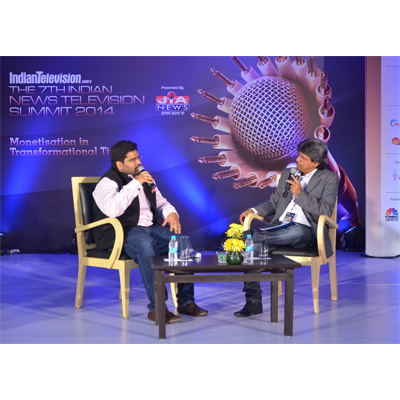
    MUMBAI: At the Seventh Indian News Television Summit, ITV Network managing director Kartikeya Sharma took the stage to speak about the success of his network and the future plans. Hailing from a political family, Sharma was adamant that he did not want to get into politics.


    It was while he was studying in London that he got attracted to the media industry. “When I was studying, the only way of being in touch with home was television with the first channel that came on Sky. That drew me into the space,” he said while speaking to indiantelevison.com founder, CEO and editor in chief Anil Wanvari. He added that what affected him was the rise of primetime during 2004-05 and the way India was reacting to the world while it was fresh off the boat.


    On being asked about the difference in running his hospitality business vis a vis media business, he said that the two cannot be compared. “News is definitely a tough business and there isn’t any particular revenue model that works well. You have to improvise. Circumstances are also important. So at what point a channel is being launched and the policies at that time is crucial,” he said.


    Speaking about the growth of his Hindi News channel, India News, Sharma said that the initial projected benchmark was 6-7 per cent market space but it actually went to 11 per cent within a span of six to eight months. “We don’t fight for filling ad slots on the channel anymore,” he said.


    The growth of the ITV Network has been a combination of both internal accruals and external debt. It will be going after a few more acquisitions and product launches in the regional space in the coming months. “By 2016 we want to be the largest and most profitable news network in the country,” he added.


    Responding to Wanvari’s question about whether syndication of news was an alternative means of revenue for sustaining the business, Sharma said that surely that will bring in a new source of revenue. “There is enough content floating around with 400 channels but the true value of syndication is debatable and I don’t think you can look at it vis-?-vis subscription or ad sales,” he said.


    While digital is touted as the ‘next big thing’, according to Sharma it is still too early to predict its fate. “In foreign countries, people aren’t able to monetise the digital platform as expected. There has been very little work done in research and development. I am not very optimistic about a revenue stream coming out of digital for the next two-three years,” he said adding that there is a need to look at digital as a synergy between evolution of content and technology.


    According to him, evolution of digital does not mean the old world will end. “I am a big fan of digital myself but we are being bullish when we talk of this medium. It is a matter of fact that it is the future but the timing is important. We have made huge errors of calculating that in the past and we are doing the same again,” he said.


    Talking about his tenure as Association of Regional TV Broadcasters (ARTB) president, Sharma said that the main aim was to help regional broadcasters since he realised that they needed a voice. “I managed to get 40 per cent of revenue for broadcasters from the government,” he stated.


    For the industry to progress, Sharma said that unity was necessary but collective decision doesn’t last long. “DD Freedish has pushed up its rates from Rs 50 lakh to Rs 5 crore in five years because of GECs wanting to get onto it. We all decided that we won’t go on the platform but then some of us ended up breaking that decision,” he shared with the audience.


    While the news space was cluttered, he believes that there is space and chance to be a number one in news.

  • DD appoints Tauquir Zaidi as ad sales head

    DD appoints Tauquir Zaidi as ad sales head

    MUMBAI: The public broadcaster has added another executive to strengthen its advertising and sales division. Tauquir Zaidi has been appointed as network sales head.


    The move is in coherence with its aim to roll out its full fledged professional advertising and sales team. Zaidi will be based in New Delhi.


    He said, “Most of us have grown watching DD and the programs are still fresh in our minds. Serials like Buniyad, Mahabharat, Humlog, Nukkad and so many others are still a cult of this industry. This is the only organisation that believes in ‘finite fiction’ without falling into the trap of TVTs. Today all GECs start a fiction without planning its end /climax. The length of the serial depends on the ratings it gets, which does no justice to the story. Call of the hour is to put an effective strategy and recruit right team to implement those strategies.”


    He will be first developing a promotional strategy to identify core target markets and setting measurable goals to multiply revenue. According to him, the success of an organisation is to implement a well-thought marketing plan by providing feasible solutions to clients.


    Zaidi has over 17 years of experience in the field of ad sales with companies such as Star India, NDTV and Times Television Network

  • Q1-2015: HT Media reports flat results and pared profits

    Q1-2015: HT Media reports flat results and pared profits

    BENGALURU: HT Media (HT Media) reported almost flat revenue in Q1 2015 at Rs 540.51 crore, just 1 per cent more y-o-y than the Rs 540.93 crore in Q1 2014 and 0.5 per cent more than revenue of Rs 543.84 crore in Q4 2014.


    Note: (1) Rs 100 lakh = Rs100,00,000 = Rs 1 crore = Rs 10 million.


    (2) All figures in this report are consolidated figures filed by the company, except for Advertising & Sales Promotion (ASP), which are the standalone figures filed by HT Media.


    The company’s Q1 2015 PAT fell 6.2 per cent q-o-q to Rs 32.67 crore as compared to the Rs 34.84 crore in Q4 2014 and was 36.7 per cent less than the Rs 51.58 crore in Q1 2014. Q-o-q PAT was affected by higher employee benefits, higher other expense, higher depreciation and amortisation (depreciation) and higher loss from its digital and unallocated segment and lower operating results from its printing segment.


    HT Media’s radio segment, which contributed just 4.4 per cent to the total revenue in Q1 2015, saw a rise of 4.8 per cent in operating revenue to Rs 23.97 crore as compared to the Rs 22.88 crore in Q4 2014 and a rise of 12 per cent as compared to the Rs 21.41 crore in Q1 2014. The radio segment’s operating result dipped 5 per cent in Q1 2015 to Rs 4.57 crore as compared to the Rs 4.81 crore in Q4 2014 and was 24.5 per cent more than the Rs 3.67 crore in Q1 2014. The company operates four radio stations in the country under the brand Fever 104 FM.


    HT Media’s printing segment which contributes to more than 90 per cent of its top line and bottom line saw an increase of 1.2 per cent in its revenue to Rs 501.54 crore in Q1 2015 from Rs 495.65 crore in Q4 2014 and was 0.6 per cent less than the Rs 505.58 crore in Q1 2014. The segment reported a 17.3 per cent drop in operating results to Rs 64.55 crore in Q1 2015 from Rs 78.04 crore in Q4 2014 and a 20.8 per cent fall as compared to the Rs 81.46 crore in Q1 2014.


    HT Media’s digital segment operating revenue grew 8.7 per cent in Q1 2015 to Rs 23.72 crore from Rs 21.82 crore in Q4 2014 and was 39.1 per cent more than the Rs 17.05 crore in Q1 2014. The segment’s operating loss widened from Rs 7.58 crore in the last quarter to Rs 12.19 crore in Q1 2015.


    Loss from the unallocated segment also grew in Q1 2015 to Rs 22.28 crore from Rs 21.49 crore in the immediate trailing quarter.


    HT Media’s employee benefit expense in Q1 2015 was Rs 125.16 crore, in Q4-2014 it was Rs 105.76 crore and in Q1 2014, it was Rs 105.52 crore. Depreciation figures were Rs 27.34 crore in Q1 2015; Rs 21.61 crore in Q4 2014 and Rs 21.86 crore in Q1 2014.


    The company’s advertisement and sales promotion expense (standalone basis) in Q1 2015 at Rs 25.85 crore was 1.1 per cent more than the Rs 25.26 crore in Q4 2014.

  • Q3-2014: Raj TV reports 43 per cent growth in revenue; 54 per cent growth in PAT

    Q3-2014: Raj TV reports 43 per cent growth in revenue; 54 per cent growth in PAT

    BENGALURU: Raj Television Network (Raj TV) reported 42.75 per cent growth in total revenue to Rs 24.92 crore during Q3-2014 from the Rs 17.46 crore during the corresponding quarter of last fiscal and 35.82 per cent higher than the Rs 18.35 crore for Q2-2014.


    The company reported an equally stellar 53.98 per cent growth in PAT during Q3-2014 at Rs 4.99 crore (20.01 per cent of revenue of that quarter) as compared to the Rs 3.24 crore (18.55 per cent of revenue of that quarter) during Q3-2013, and 44.13 per cent more than the Rs 3.46 crore (18.86 per cent of revenue for that quarter) during the immediate trailing quarter.


    Let us look at the other results reported by Raj TV during Q3-2014


    Raj TV reported total expense at Rs 18.58 crore (74.58 per cent of revenue of that quarter) for Q3-2014 was 38.93 per cent more than the Rs 13.38 crore (76.62 per cent of revenue of that quarter) during Q3-2013 and 42 per cent more than the Rs 13.09 crore (71.33 per cent of revenue of that quarter) during Q2-2014.


    The company doesn’t report a breakup of various costs. It is being assumed that costs towards content are included under the heading Cost of Revenues, which is a major cost head. During Q3-2014, Raj TV’s Cost of Revenue at Rs 7.62 crore (41 per cent of total expense during that quarter) was 5.81 per cent higher than the Rs 7.20 crore (53.82 per cent of total expense for that quarter) during Q3-2013 and 47 per cent more than the Rs 5.18 crore (39.6 per cent of total expense for the quarter) during Q2-2014.


    Another major chunk of Raj TV’s expense is Employee Benefits. During Q3-2014, the company spent Rs 6.88 crore (37.03 per cent of total expense during that quarter) towards this head, more than double (2.24 times) the Rs 3.07 crore (22.96 per cent of total expense of that quarter) during Q3-2013, and almost double (1.91 times) the Rs 3.60 crore (27.50 per cent of total expense of that quarter) during the immediate trailing quarter.


    Administrative Cost at Rs 3.13 crore during Q3-2014 was 46.26 per cent more than the Rs 2.14 crore during Q3-2013 and 2.41 per cent more than the Rs 3.06 crore during Q2-2014.


    Finance cost during Q3-2014 was up 46.5 per cent to Rs 1.3878 crore as compared to the Rs 0.9474 crore during Q3-2013 and 42.85 per cent more than the Rs 0.9715 crore in Q2-2014.


    Click here for full report

  • Sun TV reports PAT of Rs 169.16 crore for Q2-2014; encores interim dividend

    Sun TV reports PAT of Rs 169.16 crore for Q2-2014; encores interim dividend

    BENGALURU: A media conglomerate with one of the largest Indian television networks, Sun TV Network Limited (Sun TV) reported a PAT of Rs 169.16 crore, up 11.5 per cent as compared to the PAT of Rs 151.65 crore for the corresponding quarter of last year (Q2-2013) and 2.9 per cent higher than the Rs 164.44 crore for the immediate preceding quarter, Q1-2014.


    Last quarter (Q1-2014), the board of directors of the company had declared an interim dividend of Rs 2.25 per share (45 per cent). This quarter the board has declared interim dividend of Rs 2.50 (50 per cent) per share of Rs 5 each.


    Let us look at the other Q2-2014 figures reported by Sun TV


    The company reported Rs 466.41 crore as income from operations for Q2-2014 up 7.6 per cent as compared to the Rs 433.34 crore for Q2-2013, and lower by 22.5 per cent as compared to the Rs 601.85 crore for Q1-2014. It must however be noted that Rs 98.54 crore revenue came from the company’s IPL franchisee Hyderabad Sunrisers in Q1-2013 as compared to the Rs 5.43 crore for Q2-2014.


    Sun TV reported a total turnover of Rs 504.21 crore for Q2-2013, up 13.8 per cent as compared to the Rs 44.95 crore for Q2-2013. The company had reported total turnover of Rs 615.24 crore including IPL Franchisee turnover for Q1-2014.


    Sun TV reported total expense of Rs 246.29 crore (NIL IPL franchisee fee) for Q2-2014, 12.9 per cent higher than the Rs 218.17 crore for Q2-2013, but 32.6 per cent lower than the Rs 365.59 crore (this includes IPL franchisee fee of Rs 85.05 crore) for Q1-2014. The expense of Rs 246.29 crore includes expense of Rs 8.51 crore of its Sunrisers Hyderabad IPL team.


    Of the major expense heads, Sun TV has reported Rs 48.27 crore as employee benefit expense for Q2-2014, as compared to the Rs 42.89 crore for the corresponding quarter last year and the Rs 44.21 crore for Q1-2014. Other expenditure at Rs 36.51 crore was almost a third more (32 per cent more) than the Rs 27.66 crore for Q2-2013 and less than half (49.4 per cent of) the Rs 73.94 crore for Q1-2014.


    The company has not reported the breakup of its revenue and expense as has been its norm in the past.

  • Spectrum is a valuable national revenue and cannot be given free, says apex Court

    Spectrum is a valuable national revenue and cannot be given free, says apex Court

    NEW DELHI: Holding that spectrum is a valuable national resource and not meant for charity, the Supreme Court has asked the government to explain reasons allocating additional spectrum to GSM telecom operators allegedly free of cost.

    A bench headed by Justice G S Singhvi said: “Spectrum is taken by the Centre from the army on the name of developing telecom sector and to provide service to the common man.”

    “The price of spectrum is thousands of crores. It is a national resource and it cannot be alloted free of cost. You must follow due procedure for allocation of natural resources,” the bench said.

    It also imposed a cost of one lakh rupee each on Centre and seven telecom companies, including Bharti, Vodafone, Reliance and Idea Cellular, for not filing their response during the last one year on a plea challenging allotment of excess spectrum.


    “More than a year has passed but you have filed counter. The issues raised in the petition are serious and requires serious consideration,” the bench said asking the parties to deposit the money in the Supreme Court Legal Services Authority.

    The court was hearing a petition seeking cancellation of 2G spectrum beyond 2×4.5 MHz for metros and 2×4.4 MHz for other circles allocated since 1996 to the telcos without charging additional fee.

    The petitioner alleged that while allotting additional spectrum, the Centre ignored its own order of 1 February 2002, which said that “additional allocation could be considered only after a suitable subscriber base, as may be prescribed, is reached.”
    In another case, the Court rejected several petitions seeking recall of its 11 April 2011 order that barred the Delhi High Court from entertaining any plea against orders of Special CBI court hearing 2G cases.

    Pronouncing the judgment, Justice Radhakrishnan said it would be in the larger public interest and in the interest of the accused as well that the trial should proceed unhampered on day-to-day basis.

    Rejecting the pleas of Shahid Balwa, Vinod Goenka, Rajiv Agarwal, Asif Balwa and Ravinder Kumar Chandolia, a bench comprising of Justice G.S. Singhvi and Justice K.S. Radhakrishnan also rejected the plea for framing guidelines on the monitoring of investigations by the apex court. The court said it was only monitoring the investigation being undertaken by the Central Bureau of Investigation and the enforcement directorate and not monitoring the trial in 2G cases.

    The apex court by its April 2011 order had said: “We also make it clear that any objection about appointment of Special Public Prosecutor or the Assistant Advocate or any prayer for staying or impeding progress of the trial can only be made before this court and no other court shall entertain the same. The trial must proceed on a day-to-day basis.”

    The petitioners have sought the recall of the latter part of the order which had said: “…any prayer for staying or impeding progress of the trial can be made only before this court and no other court shall entertain the same. The trial must proceed on a day-to-day basis.”

    The petitioners had also sought vacation of a 9 December 2012, order by which the apex court had stayed all the proceedings before Delhi High Court arising from the order of the 2G special court. The apex court had reserved its order on 21 August 2013.

  • Esha Media Q1 net profit swells to Rs 62.14 lakhs on revenue rise from web-monitoring solutions

    Esha Media Q1 net profit swells to Rs 62.14 lakhs on revenue rise from web-monitoring solutions

    MUMBAI: India’s premier media monitoring agency – Esha Media Research Ltd has posted a robust rise in Apr-June net profit to Rs 62.14 lakhs, up over 4 times from the corresponding quarter last year and over seven times from the immediate preceding quarter of Jan-Mar.

    The profit for the first quarter was driven by 142% rise year-on-year and 18.7% rise quarter-on-quarter in net sales to Rs 702.39 lakhs, aided by the positive impact of the web-media solutions launched during the quarter under review.

    Total expenditure for the quarter grew by 134% year-on-year and 9.6% on quarter to Rs 640.25 lakhs.

    Commenting on the quarter performance, Esha Media Research, Managing Director, RS Iyer said, “The launch of the web monitoring solution of TV content has received a phenomenal response from the corporate world as well as media agencies leading to an increase in revenue during the quarter. The web-based solution has been a win-win situation as it brought down the per unit cost for the subscriber as volume increased for a fixed price while Esha Media was assured of revenue subscription.”

    Going forward, we are hopeful that more corporates and agencies would subscribe to our web-based services and the trend set in the first quarter is expected to continue in the subsequent quarters, Iyer said.

    Esha Media is also in the process of expanding the ambit of its coverage by increasing the number of television channels monitored by it, he added.

  • Pay-TV revenue surpasses FTA TV turnover in Spain

    Pay-TV revenue surpasses FTA TV turnover in Spain

    MUMBAI: Spanish pay-TV revenues outrun free-to-air (FTA) TV services in terms of revenues in 2012. Pay-TV turnover amounted to €1.7 billion in 2012, surpassing for the first time in its history, FTA TV revenues which amounted to €1.6 billion, advanced television reports, citing data released by Spanish telecoms regulator CMT. Pay-TV revenues grew by 2.5 per cent year-on-year, while FTA TV services dropped 17.9 per cent in 2012.

    Satellite pay-TV revenues climbed 8.4 per cent year-on-year to €1.06 billion in 2012. Mobile TV and IPTV revenues increased by 14.6 per cent and 11.6 per cent respectively; whereas cable and pay-DTT sales fell 11.6 and 19.3 per cent respectively.

    Spain‘s pay-TV user base dropped by 351,636 subscribers or 7.5 per cent in the period. Spain ended 2012 with 4.3 million pay-TV users, with satellite technology accounting for 41.3 per cent, followed by cable with 32.7 per cent, IPTV with 18.8 per cent and pay DTT with seven percent. The IPTV user base saw the most dramatic decline, shedding 126,566 subscribers in the period, followed by cable with 97,665 and pay-DTT with 93,157.

  • India, China prime drivers of pay-TV revenue growth in Asia, says MPA

    India, China prime drivers of pay-TV revenue growth in Asia, says MPA

    MUMBAI: Asian tigers China and India together are expected to contribute almost 69 per cent of pay-TV revenues in the Asia Pacific from 2012 to 2020, according to findings of a new report by Singapore-based pay-TV research firm Media Partners Asia (MPA).

    MPA analysis shows that China and India will contribute 46 per cent and 23 per cent respectively to pay-TV industry revenue growth between 2012-20. Excluding China, India‘s contribution grows to 42 per cent, followed by Korea and Japan at 12 per cent and 13 per cent respectively, and Australia at 7 per cent.

    According to MPA, India‘s contribution reflects large volumes, a significant growth in accessible digital subscription revenues (distributed evenly across the value chain) and a large local advertising pie.

    In Southeast Asia, Malaysia leads with a 5.5 per cent contribution to revenue growth, driven by the growth of ARPUs and ad sales. Advertising revenues will also experience significant growth from a low base in key Southeast Asia markets such as Indonesia, Philippines, Thailand, and Vietnam.

    MPA forecasts indicate that Asia Pacific pay-TV industry revenues will grow at a 7.6 per cent CAGR between 2012 and 2020, doubling from $48 billion to $86 billion.

    Within this segment, subscription fees will grow at a 7.4 per cent CAGR, rising from $37 billion to $65 billion over the same period while net advertising revenues, calculated after estimated discounts, will grow at 8.1 per cent CAGR, reaching $21 billion in 2020 versus $11 billion in 2012, the report says.

    The digital pay-TV homes in Asia are projected to reach 696 million by 2020 from 444 million in 2012 driven by strong subscriber growth in India and China. Asia Pacific is expected to have 631 million digital pay-TV homes by 2017.

    The report adds that China and India will contribute 66 per cent and 21 per cent respectively to Asia Pacific pay-TV subscriber growth between 2012 and 2020.

    According to MPA, the Asia Pacific pay-TV subscriber growth is expected to witness robust growth with 13-14 million new subscribers added every year between 2013 and 2016, moderating thereafter though still adding close to 7 million subscribers per year by 2020.

    In Asia excluding China, India accounts for a massive 63 per cent of new subscriber growth between 2012 and 2020, underlining its huge importance to the pay-TV ecosystem, while Southeast Asia will contribute 16 per cent led by Indonesia at 7 per cent.

    Adjusting for multiple connections or homes, pay-TV penetration in Asia excluding China will grow from 53 per cent in 2012 to 61 per cent by 2020.

    Net new subscriber additions totaled 31 million in 2012, with year-on-year customer growth at 8 per cent. Excluding China, new pay-TV subscribers came in at a somewhat milder 13.4 million in 2012, taking the overall Asia ex-China subscriber base to 211 million.

    The growth in Southeast Asia was strong with 3.5 million new subscribers. India experienced a slowdown but managed to add close to 6 million new subscribers.

    Driven by digital TV (DTV) transition in China, India, Korea and Taiwan and the steady growth of DTV pay subs in Southeast Asia, MPA sees total digital subscribers growing from 257 million in 2012 to 539 million in 2017, and 626 million by 2020. Digital penetration of total pay-TV subs will grow from 58 per cent in 2012 to 90 per cent by 2020.

    After adjusting for multiple connections in a household, the MPA forecasts indicate that pay-TV penetration will climb from 51% in 2012 to 68% by 2020.

    The HD pay-TV subscriber universe is expected to rise exponentially to 160 million by 2020 from 37 million subscribers in 2012, while DVR subscribers will grow to 18 million from 6 million over the same period.

    China will be the major contributor to HD growth, followed by India, Japan, Korea, Australia, Taiwan and Malaysia, the report explains.

    The projections are published in a new report called Asia Pacific Pay-TV & Broadband Markets, an analysis of consumption, investment and revenue generation across pay-TV, broadband, digital TV and interactive value added services in 18 Asia Pacific markets.

    Commenting on the findings, MPA director Vivek Couto said, “A steady growth in population and a young demographic, combined with a rising middle class and the spread of wealth amongst local groups, is driving strategic decisions and execution in the pay-TV industry. These factors, in turn, will help boost household formation and consumer spends. This will also help grow pay-TV consumption and investment.”

    According to Couto, subscriber growth and revenue generation will be driven by: (1) Continued investment in local content, and the growth of localization among global and regional brands; (2) Digitalization in emerging markets; and (3) The growth of HD, premium and on-demand services in more mature markets.

    Significantly, the MPA report also notes: The growth of mobility and broadband penetration (with fiber expected to play a larger role in the future) is also influencing pay-TV strategy, execution and consumption.

    Fragmentation of eyeballs is growing with the proliferation of multiple devices. This is also driving consumption of illegal online video in many territories. The response of pay-TV companies has been defensive and aggressive in equal measure, the report notes.

    In 2012, TV Everywhere (TVE) type solutions with improved windows have been deployed across most of the region largely authenticated to customers with a pay-TV connection.

    Arguably, the most aggressive responses have come from content powerhouses that own most of their IP with clear packaging and a commitment to product innovation, the report concludes.