Tag: Revenue

  • Dentsu Group records organic revenue growth of 15% for Q2

    Dentsu Group records organic revenue growth of 15% for Q2

    New Delhi: Dentsu Group has witnessed a significant rebound in performance for the quarter ended June, recording organic revenue growth of 15 per cent. The Group has announced its results for the first half as well as the second quarter of 2021.

    Dentsu Japan Network grew by 12 per cent while Dentsu International registered a growth of 17 per cent, showing strong sequential improvement over Q1 decline of 2.4 per cent.

    “As we pass the anniversary of the start of the pandemic, revenues continue to recover across all regions with strong growth in digital solutions. Client confidence is restoring with spending levels more resilient and predictable,” said the group in its earnings statement. “Operating margin improvement continues to exceed expectations, substantially ahead of the prior year, with Q2 improving by 370 basis points year on year, showing the gearing effect of higher revenue together with cost reductions being implemented.”

    The Group expects high single-digit organic growth for FY2021, with a line of sight to delivering the long held 2022 margin targets of 20 per cent for Dentsu Japan Network and 15 per cent for Dentsu International one year early. 

    “Dentsu Group delivered a strong second quarter performance, reflecting the growing consumer and client confidence we see across all regions. Underlying profit growth continues to be strong, exceeding our expectations, and demonstrates our commitment to our margin targets,” said Dentsu Group Inc, CEO and president, Toshihiro Yamamoto. 

    APAC (excluding Japan) recorded a growth of 3.6 per cent. The APAC region reported double digit growth in the second quarter driven by double digit growth from Australia, Indonesia, South Korea, Singapore and Thailand. EMEA reported 8.7 per cent organic growth in H1, FY21, and 22 per cent in Q2, FY21. 

    “Whilst the future path of the pandemic remains uncertain, our full year guidance confirms our confidence in the outlook for the second half of FY2021, as well as our ability to meet our medium-term targets by 2024,” added Yamamoto.

  • Zee Media Corp revenue rises 28.8 % to Rs 170 crore in Q1

    Zee Media Corp revenue rises 28.8 % to Rs 170 crore in Q1

    Mumbai: Zee Media Corporation’s operational revenue was up 28.8 per cent to Rs 170.18 crore for the quarter ended in June 2021 as against Rs 132.14 crore in the corresponding period of the previous fiscal.

    The network has reported a consolidated net loss of Rs 9.06 crore for the quarter under review on account of exceptional items. The company has posted a net profit of Rs 12.26 crore during the April-June quarter of the previous fiscal, Zee Media Corporation Ltd (ZMCL) said in a regulatory filing.

    ZMCL’s total expenses were at Rs 157.70 crore, up 35.16 per cent Q1/FY 2021-22, as against Rs 116.68 crore. The company suffered a loss of Rs 17.11 crore for exceptional items and tax for April-June quarter.

    ZMCL comprises of 14 news channels, including one Global, three National and ten Regional/language channels – Zee News, Zee Business, WION, Zee Hindustan, Zee Punjab Haryana Himachal, Zee Madhya Pradesh Chhattisgarh, Zee 24 Taas, Zee 24 Ghanta, Zee Odisha, Zee Bihar Jharkhand, Zee Rajasthan, Zee Salaam, Zee 24 Kalak, and Zee Uttar Pradesh Uttarakhand.

    The company said its digital news portfolio continues to witness growth across the properties. The language news properties spanning 16 brands in 12 languages received 1.9 billion views in Q1 FY22 compared to 1.6 billion views in Q4FY21. Monthly Average Users (MAUs) grew from 107.7 million in Q4FY21 to 141.9 million in Q1FY22.

    Meanwhile, the company has appointed Swetha Gopalan as an Independent director of the company for a term of five consecutive years with effect from 1 August. Gopalan started her career in 2010, when she joined Johns Hopkins Medicine International, USA, and has worked with Parkway Health and The Noble Group, both in Singapore. She also worked as a Business Analyst with Tata Consultancy Services in the USA from 2015 to 2016.
     

  • PM’s ‘Mann Ki Baat’ generated over Rs 30.80 cr revenue since 2014: I&B ministry

    PM’s ‘Mann Ki Baat’ generated over Rs 30.80 cr revenue since 2014: I&B ministry

    New Delhi: Prime minister Narendra Modi’s monthly radio show, Mann Ki Baat has generated over Rs 30.80 crore as revenue since it began in 2014, with the highest of over Rs 10.64 crore earned in 2017-18, according to the ministry of information and broadcasting.

    The data was shared by union minister Anurag Thakur in Rajya Sabha on the first day of the monsoon session. Thakur said, 34 DD channels and around 91 private Satellite TV channels broadcast this radio program throughout India. “Mann Ki Baat has achieved 11.8 crore viewership and 14.3 crore reach in 2020. This has created renewed interest and awareness in traditional radio,” he told the Parliament.

    According to data shared by the ministry, the programme fetched Rs 1.16 crore as revenue in 2014-15, which rose to Rs 2.81 crore in 2015-16. The overall revenue crossed Rs 5.14 crore in 2016-17 and reached the highest mark of Rs 10.64 crore in 2017-18. However, the revenue has fallen since then. In 2018-19, it generated Rs 7.47 crore revenue in 2018-19, which came down to Rs 2.56 crore in 2019-20. In the pandemic torn 2020-21, it collected an overall revenue of Rs 1.02 crore, the lowest since 2014.

    The programme is broadcast at 11 am on the last Sunday of each month through various channels of the All India Radio and Doordarshan. Prasar Bharati has broadcast 78 episodes of the programme till date on its AIR and Doordarshan network. It has also undertaken the translation and re-broadcast in 51 languages/dialects, he added.

    As per the audience data measured by the Broadcast Audience Research Council (BARC), the cumulative reach of viewership of the programme has been estimated to range from approximately six crore to 14.35 crore during the period 2018 to 2020.

    “The main objective of ‘Mann Ki Baat’ programme of the prime minister is to reach to the masses across the country through the radio,” said Thakur, “The programme also provides every citizen the opportunity to connect, suggest, and become part of participatory governance through the prime minister’s radio address.”

    The minister said Prasar Bharati produces ‘Mann ki Baat’ leveraging existing in-house resources with no additional expenditure. “In-house staff is leveraged for production and existing translators engaged on assignment basis for language versions,” he added. 

  • Print media will reach only 75 % of its pre-pandemic revenue this fiscal, says report

    Print media will reach only 75 % of its pre-pandemic revenue this fiscal, says report

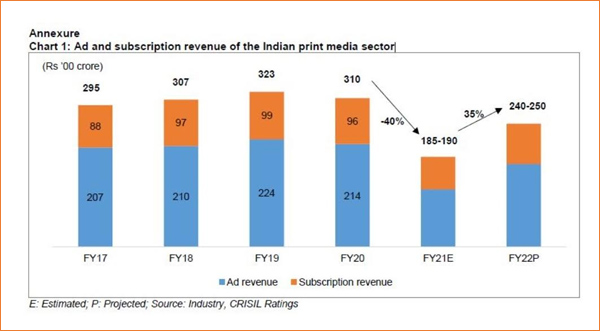
    New Delhi: Despite 35 per cent on-year growth this fiscal on a low base, the country’s print media sector will reach only three-fourths of its fiscal 2020 revenue, according to a new CRISIL report.

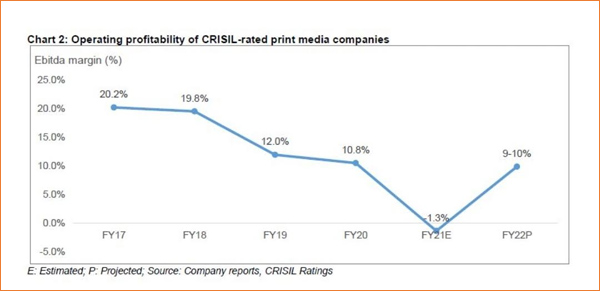
    While the cost of newsprint continues to remain high, there is a good probability that profitability will revive to 9-10 per cent driven by sharp cost rationalisation measures and digitalisation of content, shows the report. The analysis assumes the impact of the second wave to continue to subside, as is seen currently.

    According to CRISIL, the credit profiles of large print media companies will be resilient, cushioned by healthy liquidity and strong balance sheets, while for the remaining ones, liquidity management will be crucial, shows an analysis of CRISIL-rated companies that account for roughly 40 per cent of the sector’s revenue.

    The sector’s revenue of Rs 31,000 crore in fiscal 2020, split 70:30 between advertisement (ad) and subscription revenue, had declined 40 per cent last fiscal amid the first wave. However, it is expected to reach to Rs 24,000-25,000 crore this fiscal, notwithstanding the second wave.

    “The second wave has impacted ad revenues in the last quarter, as it correlates strongly with economic activity,” CRISIL Ratings, director Nitesh Jain said, “We expect ad revenues to recover from the current quarter as economic activity revives. But it would still reach only 75 per cent of the pre-pandemic level this fiscal, as seen during January-March 2021, before the second wave took hold.

    As for subscription revenue, the sector is witnessing a structural change with a shift in consumer preference towards digital news, from physical newspapers. This is more prominent for English newspapers, which have a higher share in metros and Tier-1 cities, where digital adoption is also higher. These companies are, therefore, focusing on monetisation of content by putting premium news behind paywalls and pushing digital subscription along with print subscription. Non-English newspapers, on the other hand, had relatively resilient subscription revenue even in the first wave because of their strong roots in the hinterland.

    “We believe, unlike western countries, print media will remain popular in India. Besides low cover price and the convenience of home delivery, it benefits from the ability to provide original and credible content, and people’s habit of reading physical newspapers,” stated the report, according to which, the overall sector’s subscription revenue loss this fiscal should be restricted to 12-15 per cent of the pre-pandemic level.

    That said, printing physical copies of a newspaper requires newsprint – a key raw material that accounts for 30-35 per cent of the total cost for print media companies. Over the past six months, newsprint prices have risen 20-30 per cent

    The run-up in cost notwithstanding, the operating margin is expected to reach 9-10 per cent this fiscal, or 100-200 basis points lower than the pre-pandemic low of fiscal 2020. This is because of sharp cost rationalisation measures undertaken by the companies, such as reduction in pagination, employee cost and other expenses.

    Last fiscal, retailers strengthened their balance sheets through equity infusions of Rs 2,000 crore, which reduced overall debt for CRISIL-rated apparel retailers by 30 per cent.

    CRISIL Ratings associate director, Rakshit Kachhal said, “Credit profiles of large print media companies will continue to be supported by ample liquidity and sustained strong balance sheets, with most being net-debt free. However, for the smaller ones, whose interest cover has declined to 1.6 times as on 31 March from 2.1 times a year ago, ability to manage liquidity amid the second wave and rising newsprint prices will still be crucial.”

  • GUEST COLUMN: How Telegram is fuelling streaming piracy

    New Delhi: The popular messaging app, Telegram, is fast becoming the leading source of pirated content throughout Asia – and the cause of substantial revenue loss for content providers and operators.

    Users of the platform, which provides end-to-end encryption, can conceal their identity to share texts, videos, or other files relating to copyrighted content. Given that Telegram is popular with millions of active users, intuitive, and offers its users privacy, it is no surprise that streaming pirates exploit Telegram.

    The latest Telegram statistics reveal that in January 2021 it had over 500 million monthly active users – 38 per cent from Asia – and it was also the most downloaded app across both the App Store and Google Play globally with more than 63 million downloads. According to App Annie, it is the most popular social networking app in Malaysia and ranks third in India.

    Telegram appeals to pirates because it allows them to disseminate information easily and speedily to huge, encrypted private chat groups – as large as 200,000 people – and its channels can attract millions of subscribers. Video and movie channels are amongst the most popular with pirate sites like Hindi HD Movies attracting well over two million followers.

    From newly released movies and popular live sporting events to lesser-known, critically acclaimed documentaries with subtitles, pirates have circulated, exchanged, and sold illegal copies and video clips on Telegram. The scale of this for-profit piracy is siphoning off billions of dollars that rightfully belong to content and streaming providers and rights holders. Analyst firm Nera Consulting places the global TV industry’s revenue losses from digital piracy at between $39.3 to $95.4 billion per year while a recent global study conducted by Ampere Analysis for Synamedia found that sports streaming piracy alone is worth over $28 billion.

    Synamedia has been fighting TV and video piracy for decades, providing services and technology to protect $70 billion in operator revenue every year. By adopting an intelligence-first security model, marrying the very best human intelligence with

    cutting-edge cybersecurity and AI technologies, we have disrupted pirate services and brought many criminals to the attention of law enforcement officials.

    Gaming the system

    Tackling Telegram streaming pirates is a 24×7 battle, requiring continuous monitoring and intelligence gathering not just within Telegram but across all social media platforms to profile rogue players and detect connections and cross-platform relationships. Armed with these insights, Synamedia employs AI-based content recognition crawlers to infiltrate Telegram channels, tracking and identifying specific pirate streams by combining the metadata of a target video – and/or live feeds via platform APIs – with advanced deep machine learning models.

    Here, we can share some of our observations about how streaming pirates exploit Telegram:

    Prized Piracy Booty:

    Hotly anticipated Bollywood blockbusters, newly-released content, and live events – particularly sports fixtures stolen from legitimate streaming sites – are the main attractions. One live sports event can spawn several hundreds of pirated channels with links to watch the illegal streams. But older VOD content is still valuable, as we witnessed during lockdowns when live events were on hold.

    Masters of Disguise:

    With no embedded player inside the platform, pirates use Telegram channels and groups to distribute text and M3U links to consumers and to upload videos for free to Telegram’s hosted cloud services. To maximise appeal, pirates even include subtitles in different languages and use legitimate payment systems like PayPal and Bitcoin. Pirates hide keywords relating to the event they are stealing or use code words to weave a web of intrigue by embedding references to new private pirate channels inside their messages.

    Masters of Strategy:

    Pirates act fast, in real-time. Minutes ahead of a live sporting fixture, for example, they will proliferate new channels on Telegram with new links to illegitimate content. They have backup channels ready to switch up at a moment’s notice – sometimes pre-warning consumers which channel to use should the first pirated live stream be removed. They even have their own virtual crow’s nest or ‘lookouts’ for monitoring during an event. We saw a case where a streaming pirate changed the name of the video midstream due to a tip-off from others in the chat group.

    Jumping Ship:

    Pirates will flaunt that a Telegram channel has been disrupted due to copyright and distribute guidance on how to follow a new one. They also encourage consumers to jump ship to other platforms and pirate sites, providing links to the open web or links to other platforms with players.

    Stealing the stream:

    Not satisfied with stealing streams of live or on-demand content, pirates also offer OTT subscribers’ stolen credentials, pirated APKs, and hacked IPTV emulator channels which give consumers a link to live channels without the need for a set-top box.

    Anti-piracy game-changer

    Fighting streaming piracy requires solutions that demotivate pirates at every point along the video distribution chain. That’s why Synamedia’s anti-piracy monitoring solutions extend far beyond social media platforms to the outer reaches of the openw web– as well as closed subscription-based IPTV networks.

    Building an anti-piracy strategy requires a painstaking, forensic, intelligence-led approach to map out the increasingly intricate and sophisticated pirate ecosystem in multiple layers to cross-reference data, spot piracy behavioural patterns, unravel approaches, and understand trends. And to win against the pirates, the media and entertainment industry needs to collaborate not just with tech providers but also with governments, regulators, and law enforcement bodies. It requires governments across the globe to mandate the use of technologies such as watermarking and introduce tougher legal penalties.

    Streaming piracy is an existential threat. In light of the eye-watering amounts of money spent on producing content and purchasing sports rights, providers have a right to be confident that they are covering their costs and bringing in enough revenue to build sustainable business models because revenue leakage due to piracy is simply not viable in the long term.

    As well as deterring and disrupting piracy, using a model that offers incentives encouraging viewers of pirate streams to move back to legitimate services is often overlooked but equally important. With an appealing mix of access and payment models, content providers, and operators can turn the tables on the pirates and play the system to their advantage, encouraging consumers to pay for legitimate services instead.

    (Avigail Gutman is the vice-president of Intelligence & Security Operations at Synamedia. The views expressed in the column are personal and Indiantelevision.com may not subscribe to them.)

  • India’s ad-revenue to rebound over 2020-25 with 13 % CAGR : MPA

    New Delhi: After a 27 per cent plunge in 2020, ad revenue in India is forecast to rebound strongly over 2020-25 with a CAGR of 13 per cent, said a new report released by Media Partners Asia (MPA) on Monday.

    According to the report- Asia Pacific Advertising Trends 2021, digital advertising is expected to benefit from India’s expanding digital economy across online gaming, ed-tech, food and delivery platforms, outgrowing television to become the largest advertising segment by 2024.

    Overall, APAC advertising expenditure is forecast to grow at 5.4 per cent CAGR to reach $245 billion by 2025, powered by growth across key markets such as China, India, Japan, and Korea, says the report.

    Digital ad-revenue most resilient

    According to the report, digital ad revenue remained most resilient through the pandemic, with consumers across APAC spending more time online and brands accelerating digitization efforts. The medium is projected to contribute 67 per cent of APAC ad revenue in 2025, eating into TV’s share (18 per cent), it said.

    The role of e-commerce in advertising surged in 2020, with e-commerce contributing an estimated 39 per cent of China’s ad revenues, while growing significantly, albeit from a small base, in India, Indonesia, Japan and Korea. Search and social advertising benefited as well. As per MPA’s projections, digital advertising’s share of net advertising spend is likely to grow from 59 per cent in 2020 to 67 per cent in 2025.

    TV ad-spend to rebound in 2021 growing 4.6 per cent Y/Y

    Television advertising faced further pressure in 2020 as advertisers accelerated their transition to digital, declining 15 per cent Y/Y to $43.3 billion.

    While the dips in TV ad spend are expected to be permanent in mature markets such as Australia and Japan, the medium remains important in key markets like India, Indonesia, the Philippines and Thailand where it retains its position as the largest ad segment as of end-2020. Overall, TV advertising is expected to rebound in 2021, growing 4.6 per cent Y/Y, before secular decline sets in again in 2023, according to the report.

    MPA projects total Asia Pacific TV advertising spend to grow at a CAGR of 0.7 per cent over 2020-2025 to reach $44.8 billion in 2025.

    Online video advertising to grow $ 33.3 billion in 2025

    TV broadcasters are growing online video ad market share through catch up and dedicated AVOD streaming services, particularly in connected TV markets such as Australia, Japan and Korea. MPA estimates online video advertising, led by YouTube, contributed 16 per cent to APAC digital ad revenue in 2020. With various local and regional AVOD and freemium platforms, including broadcaster-led platforms driving growth, online video advertising is forecast to grow to $33.3 billion in 2025, representing 20 per cent of the APAC digital ad pie while topping 40 per cent in emerging markets such as India & Indonesia.

    Ad-spend to exceed $ 200 billion by end-2021 in Asia-Pacific

    According to the report, net advertising expenditure in Asia Pacific, calculated after discounts, declined 4.3 per cent Y/Y in 2020 as Covid-19 ravaged the countries across the globe. Pandemic-induced macroeconomic uncertainty softened advertiser demand in the first half of 2020.

    However, as economies rebound, recovery is underway with ad spend forecast to exceed $200 billion by end 2021, topping pre-pandemic levels for the region. China was the single largest contributor to advertising expenditure, with 55 per cent share of APAC ad spend. The growth was largely led by digital advertising, which accounted for 70 per cent of China’s total ad spend, anchored to short video, live streaming, social, and e-commerce platforms. Ad markets in Korea and Vietnam will also return to pre-pandemic net ad spend levels by end-2021.

    Most other countries including India will follow in 2022, bolstered by the growth of digital advertising; TV advertising will return to pre-pandemic levels in India, Thailand and Vietnam, it said.

    KOREA: Ad spend fell one per cent in 2020, with a 9 per cent decline in TV advertising and bolstered by 12 per cent growth in digital advertising, led by mobile, display and search ads. The Korean advertising market is forecast to grow at 6 per cent CAGR over 2020-25. TV has bounced back strongly in Q1 2021 and digital advertising, including video, continues to maintain double digit growth levels.

    JAPAN AND AUSTRALIA: Ad spend is projected to grow by 2 per cent over 2020-25, led by digital. TV remains scalable in both markets. Video’s share of digital advertising is growing in both markets with global tech majors dominant though broadcasters are growing rapidly from low base through dedicated streaming platforms.

    SOUTHEAST ASIA (INDONESIA, PHILIPPINES, THAILAND AND VIETNAM): Ad markets are recovering rapidly with TV & online benefiting. Indonesia remains Southeast Asia’s largest advertising market and is projected to grow at 4 per cent CAGR over 2020-25, powered by digital (including video) and free TV.


  • Bob Bakish, ViacomCBS and the streaming war

    New Delhi: Over the last few weeks, a spate of mergers and acquisitions has taken the media and entertainment industry by storm. First WarnerMedia and Discovery, then Amazon and MGM – as the streaming war intensifies, US media giant ViacomCBS is also gearing up for a tough race, building one of the largest and diversified content slates.

    “We have what it takes to succeed in streaming. We spend about $15 billion a year on content, which makes us one of the largest producers of content on the planet. And all of that increasingly feeds our streaming ecosystem,” said ViacomCBS president and CEO, Bob Bakish at the first inaugural TMT Conference held virtually on Monday.

    The short and stocky Bakish said that ViacomCBS is in a good place in the streaming space. Free advertising-supported streaming television (FAST) service Pluto is on course to cross a billion dollars in revenue in 2021, despite all the scoffing from critics, who said he was putting $340 million into a lousy investment two years ago, as it had just 12 million monthly actives and $70 million in revenues then. Today, it has more than 50 million monthly actives and is present in more than 25 markets in the US, and is expected to roll out in more cities and states soon, and internationally thereafter.

    Of course, its Paramount+ (earlier called CBS All Access) premium service added six million new streaming subscribers in the first quarter of 2021, reaching a total of 36 million global streaming subscribers. While Pluto and Paramount+ delivered streaming revenue growth of 65 per cent year-over-year, the company expects the income uptick to accelerate in the second quarter, based on its differentiated strategy and tremendous momentum.

    Bakish is also quite sanguine that the recently launched Paramount+ Essential plan priced at $4.99 (which will show ads to viewers) will help expand its user base as well as give a leg up to advertising revenues going forward. Said he: “..given what we know about elasticity, we feel this lower price point of $4.99 will broaden the addressable market for Paramount+. …it also offers us another opportunity to serve the rapidly growing premium digital ad market… as we look at this product and the dynamics of the ad market, we actually believe analytically that the $4.99 version can generate higher average revenue per user (ARPU) over time than our $9.99 product. So we think that’s tremendously compelling because it – again, it broadens the consumer base and it drives higher ARPU.”

    Streaming is still an early stage media business in general and certainly for ViacomCBS and the company’s strategy is to focus on usage, then revenue. “Right now, we’re building the base”, he said. “The ad growth has increased in the last three quarters and expect another quarter of strong double-digit ad growth in Q2 largely because the demand continues to improve and scatter pricing is really at all-time highs.”

    A proven hit-maker when it comes to content across formats and genres, ViacomCBS has been investing heavily in content. Its content production capability is driving the rapidly growing slate of exclusive originals on Paramount+.

    “We have talked about these numbers even before our capital raise, 36 original series this year, going over 50 next year, a large volume of movies, particularly in ‘22. And its content at that level of quality and scale is ultimately what drives success in streaming. It is an extremely scarce and valuable asset and it is the core of what ViacomCBS is,” averred Bakish.

    ViacomCBS is driving significant subscribers and increasing engagement, but it is also seeing churn come down and the average age comes down materially, according to Bakish. All of those metrics have improved since our Paramount+ launch, he added.

    Sports continue to be an important part of its strategy, which includes the NFL, the SEC on the football side, golf, UEFA, women’s soccer on the European football side. Most recently, it added some incremental international soccer rights. “We just had Paramount+ the UEFA 2021 Champions League Final. It was the most streamed non-NFL sporting event ever for us,” he added.

    Amid the increasing transformation from the linear to the digital side, Bakish said, all of its cable brands have exclusive originals in linear, including events, which supports the value proposition. “We closed multiple deals, including with Comcast, with Verizon, with YouTube, with Hulu. None of these are walk-in-the-park companies,” he added.

    With an incredible slate coming, and many more originals and films ramp up, the entertainment giant is expecting streaming revenue growth to accelerate in Q2 relative to what was posted in Q1 to compete with the likes of Netflix and Disney+ in the streaming arena. A part of its ambitious plan is to make Paramount+ available in 45 markets by the end of 2022 and have up to 75 million streaming subscribers globally by 2024. 

    “And in addition to the general market, we are seeing the benefit of truly going to market as a combined company. And that creates a real advantage for us because we have the scale and reach both in high-quality, brand-safe, digital environments and in the linear side. And in addition to that, we have these must-have offerings, the NFL, Primetime, Late Night, tentpoles, diverse audiences. So the ad market is looking very good to us. Our company is connecting with it. Our IQ product is a big part of our strategy, and that combines all our high-quality digital. We’re seeing tremendous growth there,” said the ViacomCBS president.

  • Facebook now has 2.85 billion MAUs, income skyrockets 94%

    Facebook now has 2.85 billion MAUs, income skyrockets 94%

    New Delhi: Facebook on Thursday reported stronger than expected financial results for the first quarter with soaring ad revenue during the pandemic. The social media giant said it earned $9.5 billion in the January-March quarter, a pole vault of 94 per cent from $4.9 billion last year. The total revenue grew 48 per cent from $17.44 billion to $26.17 billion in the previous fiscal, backed by a surge in digital ad spending during the pandemic when consumers mostly shopped online.

    The main driver of this growth was Facebook’s advertising business.

    “We are pleased with the strength of our advertising revenue growth in the first quarter of 2021, which was driven by a 30 per cent year-over-year increase in the average price per ad and a 12 per cent increase in the number of ads delivered. We expect that advertising revenue growth will continue to be primarily driven by price during the rest of 2021,” said Facebook CFO David Wehner as the company reported first quarter results.

    Wehner added that the company expects its year-over-year revenue growth rate for the period “to remain stable or modestly accelerate relative to the growth rate in the first quarter of 2021 as we lap slower growth related to the pandemic during the second quarter of 2020.”

    Facebook now has 2.85 billion monthly active users (MAUs), an increase of 10 per cent year-on-year. Concurrently, its daily active user base has reached 1.88 billion on average, an increase of eight per cent. The company currently employs 60,654 people, bolstering its workforce by 26 per cent year-over-year.

    Looking ahead, the world’s largest social network will focus on expanding its e-commerce offerings to strengthen its ad business. “We will continue to invest aggressively to deliver new and meaningful experiences for years to come, including in newer areas like augmented and virtual reality, commerce, and the creator economy,” said Facebook CEO Mark Zuckerberg in a statement.

  • Password sharing costs US streamers $25 bn every year, report says

    Password sharing costs US streamers $25 bn every year, report says

    KOLKATA: Several reports suggested recently that Netflix is testing a feature to curb widespread password sharing. It makes sense for the streaming giant, as it is losing about $6.2 billion each year due to the prevailing trend of multiple unauthorised people using the same account. Overall, the issue has led to a loss of $25 billion for US streaming platforms.

    According to media reports, Citi Global Markets analyst Jason Bazinet said in a note it is going to be an important issue for HBO Max, Disney+, Peacock, Spotify as well. “As streaming services move to center stage, thwarting this theft will be of growing importance for shareholders,” he wrote.

    Research firm Magid recently said that Netflix could significantly increase its slow domestic subscription growth by cracking down on password sharing. It also added that 33 per cent of US SVoD subscribers share passwords.

    Recently, another research note from Bank of America also said that a significant portion of users share their passwords with non-subscribers. Hence, an attempt to curb the practice will be definitely helpful.

    “In our streaming survey, we asked a pool of Netflix subs if they shared the service with another household…and 26 per cent said they did, and 50 per cent of these said it was shared with family in multiple locations,” it added.

    Last week, reports emerged that Netflix is in the process of trialling a crackdown on ineligible users who access the streamer's content through password sharing. Some users have reported seeing a screen saying, "If you don't live with the owner of this account, you need your own account to keep watching." Studies over the years have estimated that the number of password freeloaders on Netflix number in the millions.

    "This test is designed to help ensure that people using Netflix accounts are authorised to do so," the BBC quoted a Netflix spokesperson as saying.

  • TV Today Q2 results: Broadcast ad revenues grow marginally

    TV Today Q2 results: Broadcast ad revenues grow marginally

    KOLKATA: TV Today Network has posted an operating revenue of Rs 176.71 crore in Q2. The company has posted a net profit of Rs 27.40 crore.

    Although the operating revenue is up on a like-to-like basis, it has declined compared to the corresponding quarter last year. In Q2 FY 20, the company reported Rs 180.45 crore operating revenue.

    It further reported that the net profit grew by 13.5 per cent. The media company posted a net profit of Rs 23.70 crore in the Q2 2019-20.

    TV broadcasting revenue grew 0.9 per cent YoY to Rs 143. 6 crore led by strong recovery in ad spends across major verticals post the unlock along with the positivity around festive season. It posted a net revenue (in the broadcasting business) of Rs 142.28 crore in the same period in 2019.

    Radio broadcasting segment witnessed a negative growth of 65.7 per cent YoY to Rs 0.95 crore. TV Today posted a net revenue (in the radio broadcasting business) of Rs 2.77 crore in Q2 2019-20.

    Newspaper publishing segment witnessed a decline of 87.1 per cent YoY to rupees one crore. It posted a net revenue (in the print publishing business) of Rs 7.75 crore in Q2 2019-20.

    The company has further realigned its senior management with key elevations.