Tag: research

  • UK TV industry sees revenue growth: Ofcom report

    UK TV industry sees revenue growth: Ofcom report

    MUMBAI: The Communication Market 2014 report of Ofcom, an independent regulator and competition authority for the UK communications industries, highlights that TV industry generated ?12.9 billion in revenue during 2013, an increase of ?426 million (3.4 per cent).


    The increase was driven by growth in subscription revenues and net advertising revenues. However, there was a small decline in publicly-funded television programming in 2013, following an eventful year in 2012, including the London Olympic and Paralympic Games.


    The report examines the key developments and trends seen in the UK television market during the past year. Some of them include:


    Pay-TV subscription revenue continues to drive the growth as subscription revenues increased by 6.7 per cent in 2013 to reach almost ?5.9 billion. Subscriptions now account for 46 per cent of all television industry revenues in the UK.


    As far as broadcast-based TV advertising income is concerned, it returned to growth in 2013, increasing by 4 per cent (or ?146 million) to reach almost ?3.7 billion, its highest level in the past five years. The largest proportional growth was in the commercial PSBs’ portfolio channels, where revenues increased by 14 per cent to reach a combined total of ?669 million.


    Online TV revenue saw an increase of 41 per cent in 2013 to reach ?364 million. The subscription model saw the steepest growth; revenue rose by 76 per cent to ?112 million, possibly indicating that online streaming services are gaining traction in the UK market.


    Spend on content by all UK TV channels rose by 3.7 per cent to reach ?5.8 billion. In a year  of English Premier League broadcast rights renewal, spend on sports programming grew by 19 per cent to reach ?1,808 million or 59.1 per cent of all programme spend on commercial non-Public service broadcasting (PSB) channels. Spend on BBC digital channels and the other PSBs’ portfolio channels also increased, rising by 6 per cent and 4 per cent, respectively. However, spend on first-run originated programming for the main five PSB channels declined by 5 per cent; from ?2,588 million in 2012 to ?2,451 million in 2013, partly due to there being no major sporting events that year.


    In Q1 2014, 12 per cent of TV households had a smart TV, an increase of five percentage points on the previous year. Among smart TV owners, use of the internet functionality is increasing. 82 per cent used the internet connection on their TV in 2014 compared to 77 per cent in 2013 and 65 per cent in 2012.


    Nonetheless, the TV viewing has remained resilient, although there was a decline in 2013 across all age groups. According to broadcaster audience research board (BARB), average viewing dropped from 241 minutes in 2012 to 232 in 2013 among all individuals, with all age groups experiencing declines. This may be due in part to changing media habits, but it might also have been influenced by the hotter summer in 2013 and a lack of ‘event’ viewing – in previous years viewing was boosted by major sports events such as the 2010 Football World Cup or the Olympic Games in 2012. However, among 16 to 24 year olds viewing has declined for three consecutive years: from 169 minutes in 2010 to 148 in 2013.


     

    Click here to read the finer details

  • IPSOS Study: Watching ‘Live TV’ mainstay, but other forms of viewing catching on

    IPSOS Study: Watching ‘Live TV’ mainstay, but other forms of viewing catching on

    BENGALURU: Though a majority of Indians prefer watching ‘live TV’, other forms of content viewing such as streaming or downloading from a computer, internet TV, etc., are catching up reflect a new online poll of 15,551 adults in 20 countries conducted by Ipsos OTX – the global innovation centre for Ipsos, a global market and opinion research firm.


     “With so many new ways to view television programming, it might come as a surprise that 82 per cent of TV watchers in India still watch their shows “live on TV” – that is, on a regular television at the time they are programmed to appear. The indication, then, would be that television is still a prime venue for marketers to advertise,” said Ipsos in India head marketing communication, Biswarup Banerjee.


     “That is, of course, unless those couch-comfortable viewers are attached to their remote control devices and start surfing every time commercials come on or if they reach for their mute buttons when commercials are airing. What is clear is that while new televisions are capability-packed, most people watch TV as they are used to watching it – live,” added Banerjee.


    Most (82 per cent) Indian respondents who watch TV indicate they usually watch TV programming “live”, although other popular modes of watching are catching on like streaming or downloading from a computer (40 per cent), streaming from the internet to TV (23 per cent), using a DVR or other recording device attached to a TV (16 per cent), and on mobile device (21 per cent) says the study.


    Traditional ‘live’ TV watching is significantly more popular among Indian respondent’s ages 50-64 (89 per cent) compared to those 35-49 (88 per cent) and under 35 (76 per cent). Other modes of watching TV programming are more popular among younger respondents: on computer and laptop – under 35 (35 per cent), 35-49 (25 per cent), 50-64 (17 per cent); streaming from the internet – under 35 (20 per cent), 35-49 (16 per cent), 50-64 (11 per cent); on mobile device – under 35 (15 per cent), 35-49 (10 per cent), 50-64 (5 per cent). Using a DVR or other recording device attached to a TV is most popular with those 50-64 (18 per cent) compared to 35-64 (16 per cent) and under 35 (15 per cent).


    TV watching across geographies

    Live TV

    Those most likely to choose watching TV programming on live TV are from France (93 per cent), Spain (93 per cent), Germany (92 per cent), Turkey (90 per cent), Argentina (89 per cent), Sweden (89 per cent), and Australia (89 per cent). Those rounding out the middle of the pack are from: Brazil (89 per cent), Italy (89 per cent), South Korea (87 per cent), Great Britain (83 per cent), Mexico (82 per cent), Poland (82 per cent), and India (82 per cent). Those least likely to watch TV programming live are from: Japan (82 per cent), Russia (81 per cent), South Africa (81 per cent), United States (81 per cent), China (80 per cent), and Canada (77 per cent).


    TV on computer or laptop

    Watching TV on computer or laptop is chosen most often by those from: China (52 per cent), Russia (43 per cent), Turkey (42 per cent), India (40 per cent), Sweden (35 per cent), South Korea (31 per cent), and Great Britain (29 per cent). Those clustering around the center of the list are from: Poland (27 per cent), South Africa (26 per cent), Canada (26 per cent), Germany (24 per cent), Mexico (24 per cent), Spain (23 per cent), and Brazil (21 per cent). Those from Argentina (20 per cent), the United States (20 per cent), Australia (19 per cent), Italy (17 per cent), Japan (14 per cent) and France (12 per cent) are least likely to watch TV on computer or laptop.


    Streaming from the internet

    Streaming from the internet to TV is most popular among those in Turkey (44 per cent), Russia (36 per cent), China (33 per cent), South Korea (25 per cent), India (23 per cent), Sweden (19 per cent), and Great Britain (17 per cent). Those in the middle of the pack are from: Canada (17 per cent), the United States (17 per cent), Brazil (15 per cent), Mexico (13 per cent), Spain (12 per cent), Italy (11 per cent), and Australia (10 per cent). Those from South Africa (9 per cent), Argentina (9 per cent), Poland (7 per cent), Germany (5 per cent), France (5 per cent), and Japan (3 per cent) are least likely to choose streaming from internet to TV.


    DVR or other recording devices attached to a TV

    Those who are most likely to use a DVR or other recording devices attached to a TV are from Japan (45 per cent), the United States (40 per cent), Canada (32 per cent), Great Britain (31 per cent), South Africa (27 per cent), and Australia (25 per cent). Those in the middle of the pack are from Poland (18 per cent), India (16 per cent), Germany (11 per cent), France (11 per cent), China (10 per cent), Mexico (9 per cent), and Sweden (8 per cent). Respondents from Turkey (7 per cent), Brazil (7 per cent), Spain (7 per cent), Italy (7 per cent), Argentina (6 per cent), South Korea (5 per cent), and Russia (4 per cent) are least likely to use a DVR or other recording devices.


    TV on mobile device

    Watching TV programming on mobile device is most popular among respondents who are from South Korea (26 per cent), China (25 per cent), India (21 per cent), Turkey (20 per cent), Mexico (13 per cent), Great Britain (12 per cent), and Sweden (12 per cent). Those in the middle are from the United States (10 per cent), Australia (9 per cent), Spain (9 per cent), Brazil (8 per cent), Canada (7 per cent), South Africa (7 per cent), and Italy (7 per cent). Least likely to watch TV on mobile device are respondents from Argentina (7 per cent), Japan (6 per cent), Poland (5 per cent), Russia (5 per cent), Germany (4 per cent), and France (4 per cent).

  • Spends on in-app advertising to be $17 billion by 2018: Juniper Research

    Spends on in-app advertising to be $17 billion by 2018: Juniper Research

    MUMBAI: The times are changing and so is advertising. Today, the line between traditional advertising and digital advertising is blurring. A new report, Mobile Advertising: In-App, Mobile Internet & Messaging Strategies 2013-2018, by Juniper Research has found In-app mobile ad spends will reach $16.9 billion by 2018, up from $3.5 billion last year.


    According to the report, growth will be driven by several key factors including improved targeting capabilities, as well as a trend for more effective interactive rich media ads to be deployed in preference to traditional static display advertising.


    Tablets close the adspend gap on smartphones


    The report argues that while smartphones currently account for approximately 70 per cent of in-app ad spend, the growth in tablet users and usage would propel greater medium-term spend. It observed that tablet in-app ad spend would be further fuelled by the fact that CPMs (Cost per 1,000 impressions) are significantly higher than those for smartphones, particularly for rich media ads, which also have higher CPMs than static display ads. By 2018, the tablet/smartphone ad spend split will be almost 50/50.


    Location, Location, Location


    It also observes that although app downloads will increase exponentially to 2018, the majority of in-app advertising expenditure is likely to be spent on advertising with social mobile giants such as Facebook and Twitter. Nevertheless, report author Sian Rowlands remained optimistic about the opportunities for smaller developers: ‘As the mobile advertising industry matures, more sophisticated advertising solutions are being installed by leading players, with a clear trend towards utilising location-based advertising to drive greater relevance. These new technologies and formats will benefit stakeholders across the mobile advertising value network.’


    Other key findings from the report include:


    • Global mobile ad spend will surpass $39 billion in 2018, up from $13 billion in 2013.

    • Rich media ad spend will surpass display ad spend in apps by 2018, as more engaging ad formats see huge uptake.

    • Advertisers can increase conversions by simply adding mobile optimised features, for instance a ‘click to call’ button, or by linking to the relevant app store.

  • Analog Terrestrial TV Homes to decline 24 per cent by 2008

    Analog Terrestrial TV Homes to decline 24 per cent by 2008

    LONDON : New research from Strategy Analytics, the global analyst and consulting firm, quantifies the steady decline of analog television broadcasting and the progress towards so-called ‘Analog Switch-Off’.
     

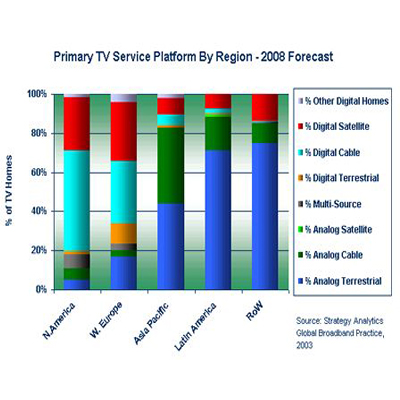
    The report, published to subscribers to the Broadband Entertainment Strategies service, shows that 597 million homes worldwide used analog terrestrial broadcasting as their primary TV service in 2002. With the growth of digital television services offered by satellite, cable and terrestrial operators, this number is forecast to decline by 24 per cent to 455 million by 2008.

    North America and Europe will be the most advanced markets in the digital TV transition by 2008, but the majority of homes in the rest of the world will still use analog terrestrial TV as their primary service. Even in the most advanced markets, however, a realistic analog switch-off strategy will have to account for the additional costs of converting hundreds of millions of secondary TV sets and VCRs.

    Analog switch-off is seen as a key policy goal by most governments. Releasing this valuable spectrum could ultimately lead to major new commercial and public revenue opportunities. The report suggests that few, if any, countries will be 100 per cent digital until well into the next decade. Some countries, such as Germany, will instead seek to use analog platforms such as cable as an alternative to terrestrial broadcasting. The report recommends that broadcasters relying strongly or wholly on analog terrestrial broadcasting for access to viewers must consider implementing alternative strategies and distribution partnerships in order to safeguard their long term position.

  • Cyber Security violations should be dealt with: Sibal

    Cyber Security violations should be dealt with: Sibal

     NEW DELHI: Even as National Security Adviser Shivshankar Menon feels that the issue needs to be settled in international law, Communications and IT Minister Kapil Sibal said Indian authorities should have the jurisdiction to deal with cyber attacks against the country irrespective of their source.

    Sibal said that there should be “accountability and responsibility” in the cyber space. “If there is a cyber space violation and the subject matter is India because it impacts India, then India should have jurisdiction. For example, if I have an embassy in New York, then anything that happens in that embassy is Indian territory and there applies Indian Law.

    “If the impact of such a violation is on India, then Indian courts must have the jurisdiction. That should apply across the world,” he said.

    When it was pointed out at an Observer Research Foundation seminar on cyber security that the American National Security Agency was accused of spying on Indian and other missions there, Sibal said, “Do not trivialise the issue.”

    Menon said, “It is not a settled issue in international laws. That is why you need an agreement and consensus on it.”

    Sibal said: “The issue of identity in cyber space is of enormous importance. There must be accountability and responsibility in the cyber space.”

    He said the government believed in complete freedom of cyber space. “Freedom of expression is central to our ideological stand on cyber space but at the same time, there should be a de facto recognition of threats that are there in cyber space.”

    “We need to deal with those threats locally and globally. We need a consensus on those. What we don’t need is a governed space. I think governance in cyber space is oxymoron,” he said.

  • Ofcom Board appoints Ed Richards as CEO

    Ofcom Board appoints Ed Richards as CEO

    MUMBAI: The Ofcom Board has appointed Ed Richards as its Chief Executive Officer with immediate effect.

    Prior to his appointment to Ofcom, Ed was the Prime Minister’s Senior Policy Advisor on Media, Telecoms, Internet and e-Government. He has also worked as the Controller of Corporate Strategy at the BBC.

    On his new appointment, Ed Richards said, “This is a fascinating job in a fascinating and fast changing area. We have a strong organisation, committed people and a track record that we intend to build on. I am thoroughly looking forward to the challenges.”

    “Ed has played a critically important role in the establishment of Ofcom. He has a profound understanding of the markets we regulate and is ideally placed to lead the organisation into the future,” said Ofcom Chairman David Currie.

    Ed Richards joined the Ofcom Board in March 2003. In July 2005 he was promoted to Chief Operating Officer, in which his responsibilities included strategy, research, consumer policy, business planning, finance, human resources and Ofcom’s functions in the Nations and Regions.

    Ofcom is the independent regulator and competition authority for the UK communications industries, with responsibilities across television, radio, telecommunications and wireless communications services.