Tag: research

  • Deepali Jain gets expanded insights head role at Marico

    Deepali Jain gets expanded insights head role at Marico

    MUMBAI: The fragrance of promotion and greater responsibility on most occasion smells good. As it has in the case of Deepali Jain who has been promoted and seen an expansion  in her role  to partner – head consumer technical insights + perfumery + design (India + international businesses) at Marico.

    A hard core-research oriented professional, Deepali, has progressed in a sustained manner over the 10 years and eight months she has been at the firm. Beginning as a consumer insights manager – innovation and technology she was promoted to principal manger – consumer science after a period of nearly five years. Another four years of consistency saw her being promoted to head consumer insights for hair care, personal care  and male grooming – a position from which she got another promotion.

    Before joining Marico Deepali spent three and a half years as group project director at TNS Global and nearly seven years at Nielsen beginning as a research executive and rising to consumer insights manager working on some of the top FMCG brands.

    “A big thank you to my incredible insights, perfumery, and design team, members at R&D and across geographies for their invaluable support. Looking forward to work for together to drive Marico’s success. Here’s to many more exciting milestones and achievements,!” said Deepali while announcing her expanded role at the Harsh Mariwala-founded company. 

  • Urban Indians are most likely to notice endorsements of mobile phones and clothes on social media

    Urban Indians are most likely to notice endorsements of mobile phones and clothes on social media

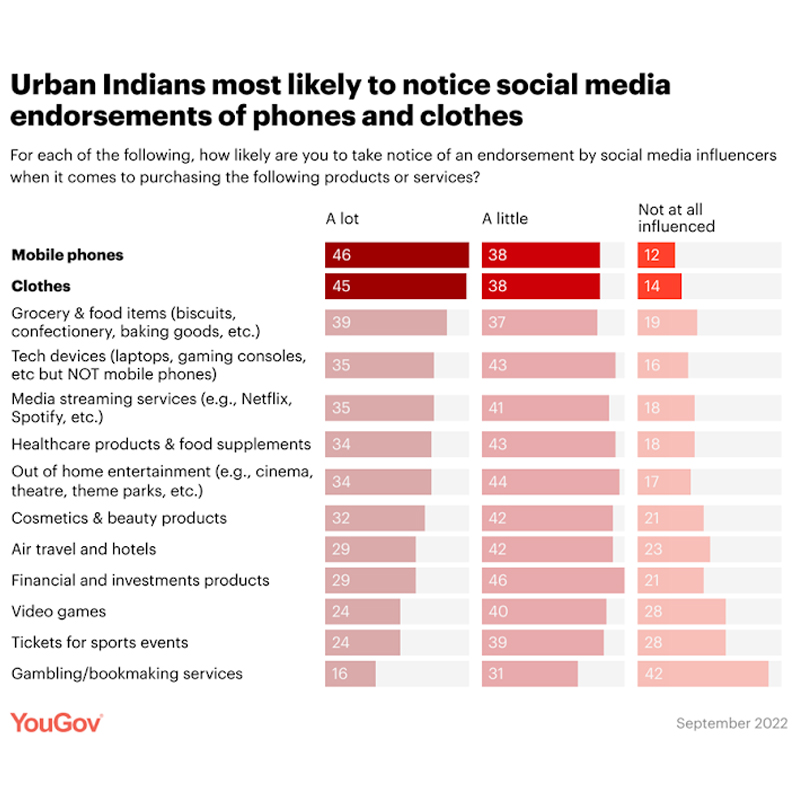
    Mumbai: Among the various categories of products and services endorsed by social media influencers, YouGov’s new research found that urban Indians are “a lot likely” to notice endorsements for mobile phones (46 per cent) and clothes (45 per cent).

    In comparison to this, each of the 38 per cent think they are a little likely to notice such endorsements, while 12 per cent and 14 per cent, respectively, think they are not at all influenced by such testimonials.

    25- to 34-year-olds are most likely among the different age groups to notice mobile phone endorsements by social media influencers (53 per cent); those in the age group of 35 to 44 years are most likely to take notice of endorsements for clothes (at 54 per cent).

    When it comes to groceries and food items, 39 per cent urban Indians claim they get influenced a lot by influencer endorsements, while for 37 per cent the influence is a little.

    For other categories, such as tech devices, media streaming services, healthcare products, out-of-home entertainment, cosmetics, air travel, and financial investments, the influence is more likely to be little than a lot.

    Data shows there is some polarity visible for categories such as video games and tickets for sporting events. While 24 per cent of urban Indians say they are very likely to notice such endorsements for each of the categories, just as many (28 per cent each) say they do not get influenced at all.

    Gambling and bookmaking services are the only categories where 42 per cent respondents are more likely to say they do not get influenced at all than the respective 31 per cent and 16 per cent say they get a little or a lot.

  • Hindi news tops news genre’s ad volumes in H1 FY’22: TAM Media report

    Hindi news tops news genre’s ad volumes in H1 FY’22: TAM Media report

    Mumbai: TAM media research’s subdivision AdEx India has released the half-yearly report for advertising in the new genre. According to recent data, Hindi news tops with more than 20 per cent share for ad volumes in H1 FY ’22, and observed indexed growth of 33 per cent.

    As per the data recorded last year for the same period, ad volumes grew by 33 per cent as compared to H1 FY ’20 and five per cent growth was reported as compared to H1 FY 2021. The month of March 2022 saw the highest ad volume share of 19.5 per cent.

    H1 FY ’20 saw the highest share of ad volumes, that is, 31 per cent followed by H1 FY’22 and H1 FY ’21 with 28 per cent share each.

    The prime time slot is the most preferred band, followed by the afternoon and morning in the news genre, and during H1 FY ’21 and H1 FY ’22, for each slot Hindi news topped with a 20 per cent share of ad volumes.

    Three out of the top five subgenres, which include Hindi news, Bengali news, Tamil news, Telugu news, and others, have retained their ranks in H1 FY ’22. During H1 FY ’21 and H1 FY ’22, the top five subgenres accounted for more than 55 per cent of the ad volume.

    The number of news genre categories increased by four per cent in H1 FY ’22 as compared to H1 FY ’21. The spices category led with a three per cent share of ad volume in H1 FY ’22.

    The top ten list included two categories each from the food & beverage, building, industrial, and land materials/equipment industries.

    Corporate/brand image, range of OTC products, building materials/systems, and pan masala were the new entrants among the top 10, out of which seven categories observed positive rank shifts.

    The service industry topped with a 17 per cent share of the news genre’s ad volumes, followed by F&B with 14 per cent.

    Corporate/brand image saw the highest increase in ad seconds with 74 per cent, followed by ecom-gaming three times during H1 FY ’22 as compared to H1 FY ’21.

    In terms of growth per cent among the top 10 categories, vocational training institutes topped with the highest growth of 3.9 times, followed by face wash with 3.2 growth.

    Reckitt Benckiser, GCMMF (Amul), and LIC were the top three advertisers in H1 FY’22. Ultratech Cement, Mahashiya Di Hatti, and Think & Learn were the new entrants among the top 10. Ultratech Cement moved up by 24 positions to achieve the seventh rank.

    Roop Mantra cucumber herbal face wash and Lizol All-in-One are the latest brands in the list, with Hari Bhoomi Communications being the top exclusive advertiser, followed by ITV Network.

    The report further mentioned that in H1 FY ’22, 20 to 40 seconds witnessed a 10 per cent growth in ad volumes compared to H1 FY ’21. Advertising commercials of 20 to 40 seconds were most preferred for advertising on news channels during both periods.

    More than 3,200 advertisers advertised exclusively in the news genre from H1 FY ’22. 2,800 plus advertisers & 4.5K+ brands exclusively advertised in the news genre during Jan-Jun’22. Playgames 24×7 and Roop Mantra Cucumber Herbal Face Wash were the top exclusive advertisers and brands, respectively, during H1 FY ’22 compared to H1 FY ’21.

  • GUEST ARTICLE: 96% of NFT projects will fail, and why?

    GUEST ARTICLE: 96% of NFT projects will fail, and why?

    Mumbai: The year 2020 was unprecedented in many ways, but what was undeniably phenomenal was the rise of the crypto world, drawing new users to it. However, this dramatic escalation of the crypto world has seen another new market in the digital sphere-the NFTs, which has gathered much attention and somewhat spread like wildfire, which no one can stop. Nowadays, it can be seen that celebrities from around the world are getting into the NFT space and the press is flooded with success stories.

    It may seem that investing in NFTs is the quickest way to earn money. But, just like any other thrilling experience, there will definitely be challenges involved. As per various reports, it has been analysed that 95 per cent of investors lose money since they lack proper research and, therefore, they follow short-term projects which have no value. Amidst the crypto crash this year, it appears that the bloodbath in the crypto market has affected NFT sales too. According to a report in The Guardian, NFT sales reached a 12-month low mark in June 2022.

    Reasons why most NFT projects will fail

    A majority of NFTs (about 96 per cent) will come crashing down hard, not just temporarily, but permanently, because the creators lack experience in implementing their roadmap in the proper way or are unable to cope with emerging issues in order to establish a long-term and sustainable business. Several NFT projects are just a quick way to grab the cash with no real value or utility backing the digital asset. The main issue with the NFT marketplace is poor marketing strategy; the supply presently outweighs demand, as does the lack of actual value and utility backing NFTs, which in turn will affect the sentiment around the project.

    While large brands, companies, and innovators start exploring the NFT space and incorporating the technology themselves, they will soon begin to realise what a valuable NFT looks like when compared to all the useless NFTs presently overflowing the markets.

    The reality that modern-day NFT creators and investors fail to recognise is that, with the help of NFTs (a digital technological space), one can either build a brand from the ground up or increase the trust, value, and transparency of existing brands. In contrast, NFT creators have created nothing more than just a picture, which has little to no actual value or utility at all. The creators are not even building a brand or developing a strong intellectual property, failing to deliver quality, and even providing nothing to their customers besides the NFT itself. People need to understand that just because someone is an artist doesn’t mean the person will be a successful NFT project person.

    In addition to that, these days’ news regarding NFTs that are making headlines are mere stories about people making huge profits by selling and purchasing NFTs. These types of news tend to create the impression that either NFTs are a get-rich-quickly scam or that any NFT can easily make you a million dollar profit, while both are just untrue to a certain degree. It requires a lot of hard work and talent to benefit from the NFT business.

    There’s more to understand on NFTs!

    Going by the present market scenario, it seems that rug pulls have become the go-to scam of the NFT ecosystem, and as a result, several projects are facing difficulty in gaining the community’s confidence. Moreover, projects are failing due to a poorly organised team with no experts, poor synchronicity, and also a lack of adequate financial planning. Many NFT ventures are unable to maintain an engaged and vibrant community of supporters, which is probably the numero-uno factor behind building a project. Plus, there is a lack of uniqueness when a project is simply a copy of an existing one with the same features, benefits, and processes or if it does not grab the attention of the audience; thus, they are not able to make it to the live market.

    Currently, the NFT space is a perfect example of an overhyped market driven by greed. It’s not an easy task to head an NFT project, and in most cases, it is a tough grind to stand out and survive past launch. NFTs are just going to be another way of branding and marketing a business. Although most NFT projects are failing, that doesn’t imply that all of them are worthless. There are still some projects worth your attention, and you can definitely make profits if you understand the logic behind failing projects so that you can act in the opposite way.

    Therefore, the next time someone is thinking about purchasing an NFT, the advice is to do the research, don’t spend more money than you can afford to lose, and only purchase NFTs that spark interest. You must have the ability to build a legit business out of social media. All you need is to be extra careful when diving into this unregulated platform.

    The author of the article is JorrParivar creator, founder, and operator Digital Pratik.

  • Global ad expenditure to grow 8% in 2022: Zenith’s Report

    Global ad expenditure to grow 8% in 2022: Zenith’s Report

    Mumbai: Global advertising expenditure is expected to grow 8 per cent in 2022, according to Zenith’s latest Advertising Expenditure Forecasts report, which was released on Wednesday. This represents a minor downgrade from a little over 9 per cent growth rate provided by Zenith in December 2021. 

    The Winter Olympics, the mid-term US elections, and the soccer World Cup, which will be held for the first time in the most advertising-intensive period of the year, the run-up to Christmas, will all help to boost growth. Faced with this difficult comparison, the growth will slow down to 5.4 per cent in 2023, before the Summer Olympics and US presidential elections help boost it to 7.6 per cent in 2024.

    Zenith’s forecasts for North America, MENA and Western Europe this year are unchanged at 12 per cent, 7 per cent and 6 per cent growth respectively. Latin America was downgraded slightly from 9 per cent to 8 per cent, but the Asia Pacific was upgraded from 6 per cent to 7 per cent, thanks to a very strong performance from India. 

    Severe disruption in Russia and its closest trading partners after the invasion of Ukraine will lead to a 26 per cent decline in ad spend in Central & Eastern Europe, even though most other markets in the region will continue to grow.

    Ad spend has remained on track despite the macroeconomic headwinds that emerged this year. High inflation, concentrated in essentials like heating, petrol, and food, is forcing consumers to reprioritise their spending, particularly the less well-off, and has led to a drop in consumer confidence. 

    But for now, consumer spending continues to grow, as consumers demonstrate their strong appetite for the travel and entertainment experiences that were denied to them over the pandemic. Business confidence is generally high, corporate investment is rising, and there is little evidence of widespread cost-cutting.

    India to lead growth with 21 per cent expansion this year

    Global ad spend is expected to increase by $58 billion in 2022, rising to $781 billion from $723 billion in 2021. Most of the new ad dollars will come from the US, which is forecast to expand by $33 billion in 2022, driven by continued, rapid digital transformation, accounting for 57 per cent of all the money added to the ad market this year. 

    China, Japan, and the UK come next, supplying 9.1 per cent, 6.2 per cent, and 5.8 per cent of new ad dollars, respectively. India is in fifth place, accounting for 4.6 per cent of the growth in ad spend this year, even though it is only the 12th largest ad market. India will be the fastest-growing market in percentage terms, expanding by 20.8 per cent, driven by election advertising and the resumption of festivals that were cancelled at the height of the pandemic.

    Zenith India chief executive officer Jai Lala said, “India continues to have a robust adex growth on the back of digital and TV. Key categories continue to be led by FMCG and the new app-based clients in the area of fintech, edutech, food tech amongst others.”

    Higher prices in traditional channels accelerate shift to digital alternatives

    The sustained growth in demand from advertisers is pushing up media inflation, particularly in television, where the supply of audiences is falling steadily as viewers switch to alternatives. Price rises vary widely for different audiences in different countries, but the global average cost of television advertising across all audiences is expected to rise by 11 per cent-13 per cent this year. 

    Online video prices are expected to increase by about 7 per cent, although in this case the supply of audiences is rising. Other digital channels where supply is climbing and volumes are flexible are inflating only modestly, with three per cent average price rises forecast for social media and other digital displays. 

    Out-of-home and radio prices will go up about four per cent this year, while print prices will remain stable, because demand for advertising in printed publications is falling as rapidly as readership.

    Brands that simply buy broad audiences to reach targets will not be able to avoid having to spend more to reach the same audiences. But brands that use first-party data to identify their most profitable customers, and combine it with third-party data to target their best prospects in the most efficient channels, will be able to mitigate much of the effect of media inflation. 

    The huge and growing volume of digital content consumption is making it more effective for brands to scale by aggregating digital audiences. Zenith predicts 62 per cent of ad budgets will be spent on digital media in 2022, up from 59 per cent in 2021, and that this proportion will reach 65 per cent in 2024. 

    Zenith Global Chief Strategy Officer Ben Lukawski said, “In a world where trading is becoming dominated by auctions, competitive advantage is achieved not by scale, but by data.”

    “Inflation will hit cheap reach buyers hard, but brands that make smart use of their data will manage costs and grow their business at the same time,” he added.

    Online video overtakes social media as the fastest-growing channel 

    Online video is now predicted to be the fastest-growing channel over the next three years: Zenith forecasts it will grow 15.4 per cent a year on average between 2021 and 2024, driven by the rapid development of connected TV, ad-funded video-on-demand, streaming and other video formats. 

    Connected TV is now a mainstream video platform in the US, with a higher penetration than cable TV, and is becoming established in other markets, especially in Western Europe and Asia Pacific. The introduction of cheaper ad-funded tiers by SVOD services like Netflix and Disney+ will boost growth further by providing new high-quality environments for brand communication. 

    Mixed video-on-demand models that combine subscriptions with advertising will also help online video audiences continue to grow across the world by recruiting consumers unwilling or unable to afford the growing roster of subscription-only services. Zenith expects online video ad spend to rise from $62 billion in 2021 to $95 billion in 2024.

    Online video will overtake social media, the fastest-growing channel for the previous nine years. Social media ad spend (which includes video ads in social media feeds) is still forecast to grow at an average rate of 15.1 per cent a year between 2021 and 2024, propelled by rising competition among platforms that is driving continued innovation on formats and closer integration with commerce. 

    Meta’s share of social media ad spend outside China has been falling steadily since it peaked at 89 per cent in 2019, reaching 85 per cent in 2021 as TikTok, Snapchat, LinkedIn and Pinterest gained market share. Zenith forecasts social media ad spend will rise from $153 billion in 2021 to $187 billion in 2022, when it will account for 25 per cent of expenditure on advertising across all media.

    Cinema and out-of-home will take third and fourth place among the fastest-growing media, averaging 11.9 per cent and 8 per cent annual growth between 2021 and 2024, respectively. 

    These are still recovering from the deep losses they suffered in 2020 and 2021 when cinemas were closed, and consumers were confined indoors. Cinema and out-of-home have a lot of ground to make up, however, and are taking their time to do so. Many brands that were forced to find alternatives, often digital, have found them effective, and see little need to shift their budgets back again. 

    Zenith expects cinema ad spend to reach $3.9 billion in 2024, well below its pre-pandemic level of $4.8 billion in 2019, while out-of-home will reach $45.0 billion in 2024, exceeding the $42.3 billion it achieved in 2019 for the first time.

    Linear television advertising will grow by 1.1 per cent a year on average between 2021 and 2024, from $173.6 billion to $179.2 billion, as price rises continue to compensate for loss of audiences. This ongoing decline in reach and efficiency will drive brands to digital channels, however, including online video. Television’s share of total ad spend is forecast to fall from 24.6 per cent in 2021 to 20.8 per cent in 2024, while online video’s share increases from 8.8 per cent to 11.1 per cent.

    “Online video is growing by creating new opportunities for building brand awareness, complemented by social media’s capacity for cost-effective targeting with low barriers to entry,” said Zenith Head of Forecasting Jonathan Barnard. “Online video is steadily narrowing the spending gap with television, and will be half as large as television by 2024.”

  • By 2022, hyperlocal commerce shoppers to grow by 52% to reach 214 mn: WATInsights

    By 2022, hyperlocal commerce shoppers to grow by 52% to reach 214 mn: WATInsights

    Mumbai: WATConsult, an Isobar Company and the globally awarded hybrid digital agency from dentsu India, has released the fifth report of WATInsights – digital commerce series. Titled ‘Digital Commerce in India – Hyperlocal Commerce’, the report is by WATConsult’s research division, Recogn. The report shares insights on the demand for hyperlocal delivery, the effects of the pandemic on the hyperlocal usage and captures the benefits & challenges of the model.

    The hyperlocal space has seen a rise in the number of niche brands across categories like home décor, home services, groceries, essentials and pharmaceutical sectors. Since the country has witnessed growth, traditional brands have shifted their focus towards hyperlocal and direct-to-consumer business models. This transition has been accelerated further due to increased internet usage and evolved consumer behaviour.

    It is pertinent to note here that the hyperlocal approach enables the brands to reach out to their target customers directly, removing the middlemen and retail stores as part of the traditional business model. This provides customers with a better shopping experience as it offers convenience and quick delivery, especially in the areas of logistics, food, pharmaceutical and groceries. Some examples of hyperlocal commerce include Dunzo, 1mg, UrbanCompany, BigBasket, to name a few.

    According to the report, this format of e-commerce has seen a huge surge of customers in both metros and beyond. Currently, there are around 141 million hyperlocal commerce shoppers in India, which is 48 percent of all e-commerce users. This number of hyperlocal commerce shoppers will increase by 52 percent to reach 214 million by the end of 2022.

    The report further reveals that while Zomato tops the list of the most used hyperlocal apps, SwiggyGo, Amazon Fresh & BigBasket are some of the popular choices among consumers. This is followed by 1mg, Grofers and UberConnect.

    The report additionally sheds light on the consumer demographic of the hyperlocal commerce users. While most females have used services from Zomato, BigBasket and Grofers, some males have used services like Zomato, SwiggyGo, BigBasket and 1mg, highlighted the study. On the other hand, the majority of young customers belonging to the age groups of under 18 years, 18 years to 24 years and 25 years to 34 years, have been seen using Zomato, SwiggyGo, and Amazon Fresh.

    Commenting on the latest issue of WATInsights – Digital commerce in India – Hyperlocal commerce, Isobar India group CEO Heeru Dingra said, “Hyperlocal businesses have been rapidly growing with the potential of expanding exponentially. There has been an increase in the number of brands emerging in this space and it will consolidate even further, over the next few years. Hyperlocal’s collaboration with local stores and the connection they build with their customers digitally is benefitting all the stakeholders as now they are all connected to the supply chain model.”

    The hyperlocal space has seen a rise in the number of niche brands across categories like home décor, home services, groceries, essentials, and pharmaceutical sectors. Since the country has witnessed growth, traditional brands have shifted their focus towards hyperlocal and direct-to-consumer business models. This transition has been accelerated further due to increased internet usage and evolved consumer behaviour.

    WATConsult managing partner Sahil Shah added, “Businesses, more than ever, are leveraging digital channels to reach out to consumers with a faster go-to-market, controlled brand perception, and increased direct-to-consumer (D2C) interactions. The pandemic has impacted many sectors and as a result, India’s retail market has gone through many changes; the biggest change being the adoption of technology in enabling more digital touchpoints. Amidst this shift, hyperlocal has been one of the top priorities for all D2C brands as well as marketplace-heavy businesses. This new model of hyperlocal has enabled local retailers to increase their market share. Especially the FMCG brands have been able to push their inventories and effectively scale the business.”

    It is pertinent to note here that the hyperlocal approach enables the brands to reach out to their target customers directly, removing the middlemen and retail stores as part of the traditional business model. This provides customers with a better shopping experience as it offers convenience and quick delivery, especially in the areas of logistics, food, pharmaceutical, and groceries. Some examples of hyperlocal commerce include Dunzo, 1mg, UrbanCompany, BigBasket, to name a few.

  • There is a growing awareness of Metaverse and it is the future, reveals Wunderman Thompson Intelligence’s survey

    There is a growing awareness of Metaverse and it is the future, reveals Wunderman Thompson Intelligence’s survey

    Mumbai: There has been an increasing awareness of the metaverse recently. It was revealed in Wunderman Thompson Intelligence’s latest survey ‘New Realities: Into the Metaverse and Beyond’, that 76 per cent of people feel the metaverse will allow authentic self-expression and however, the market is becoming aware of the advantage of it.

    The survey shows brands and agencies a clear direction in a tech field where 74 per cent of people feel metaverse will be the future. The analysis presents a roadmap for adland which expands upon the groundbreaking into the metaverse study.

    Its 2022 metaverse survey ‘New Realities: Into the Metaverse and Beyond’ for which research was fielded in March – from over 3,000 people aged 16-65 in the US, UK and China – shows that awareness of the metaverse has more than doubled in less than a year. While less than a third (32 per cent ) had heard of the term in July 2021, by March 2022 almost three quarters (74 per cent) had heard of the term.

    Although awareness has increased, understanding remains low. The research also finds that there is a lack of clarity around what the term means, with only 15 per cent stating that they know what it is and can explain it to someone else.

    Despite being unable to explain the metaverse, consumers believe that it promises to impact our lives significantly and among those who know what the metaverse is, two-thirds believe it will be life-changing.

    Wunderman Thompson Intelligence’s global director and author of the report Emma Chiu said, “As ever-greater portions of our lives move into the virtual realm, it’s becoming increasingly clear that the metaverse will be instrumental in our collective future, with our follow-up survey uncovering widespread expectation that the metaverse heralds enormous changes to almost all industries.”

    Areas in which consumers are expecting to see innovation include entertainment where 90 per cent of respondents held this belief, followed by advertising and retail. Meanwhile, 85 per cent believe the metaverse will impact the fashion industry and also the world of work.

    With many still assessing the impact of new screen-based habits, alongside the continued blurring of the virtual and physical worlds, the latest, companion report includes fresh data and several other critical insights:

    • Retail brand analysis shows the development of digital and physical shopping alongside one another, sharing case studies including Nike in Roblox, Forever 21’s Shop City and Fred Segal’s Artcade.

    • The finance section of the report outlines the top banks, credit companies and crypto literacy projects along with research into the growth of virtual currencies. The outcome is that these currencies are becoming a significant economic force both for business and for countries as several get involved in experiments with nationally regulated crypto.

    • Health and Wellness shares insights into deepening connections between digital and physical care for bodily and mental health. Explore case studies from Sims to CVS.

    • Food brands have jumped into the metaverse with restaurants and beverage brands leveraging the link between food and social connection. From Coca-Cola’s Indian wedding to the Flyfish member’s only restaurant where NFTs are exchanged as verification, this sector shows real creative flair.

    Wunderman Thompson Global Chief Marketing and Growth Officer Naomi Troni said, “Brands must establish a roadmap for entry into the metaverse. However, there are concerns too around privacy, security, and safety.”

    “So, while our latest findings indicate almost limitless opportunities for brands — enabling them to re-imagine what their products, services and consumer engagement could and should look like – they must also enter this new world carefully,” she added.

  • The number of voice commerce shoppers in India poised to grow at a rate of 103%: WATInsights report

    The number of voice commerce shoppers in India poised to grow at a rate of 103%: WATInsights report

    MUMBAI: Voice Commerce is making its way into the Indian customers’ shopping habits faster than ever. The number of voice shoppers in India is poised to grow at an impressive rate of 103 per cent by the end of 2022 to reach 168 million voice shoppers, according to the latest report of WATInsights – Digital commerce series. For the record, there are 83 million voice shoppers in India presently, suggesting that it has already seen an uptick.  

    WATConsult, an Isobar Company & hybrid digital agency from dentsu India, has released its fourth report on the digital commerce series, titled ‘Digital Commerce in India – Voice Commerce’. The report by the agency’s research division, Recogn, shares insights on the ever-increasing adoption of Voice Commerce, the evolution of conversational AI solutions, challenges associated with voice-activated assistants and sentiments of consumers towards using this emerging branch of digital marketing.

    There is a paradigm shift in the way searches are performed as users turn to voice for searching and shopping for products online. As per the report, 42 per cent of the females have used voice assistants for online shopping, while most youngsters belonging to the age group of 18-24 years have frequently used the assistant enabled devices to shop online. Additionally, the majority of the working professionals residing in the top four metros and next five metros have also used voice assistants for online shopping.

    It is pertinent to note here that, in India, the use of voice technology for shopping is at a nascent stage and only one-third of the users have used voice assistants to purchase products online, as per the report.

    The report stated that most female voice commerce shoppers are concerned about the privacy and security of the financial data while shopping online using voice, withstanding the benefits of the platform. However, the challenge for older customers belonging to the age group of 65 years and above is the inability to break through the habit of typing and searching for products online.  

    Commenting on the latest issue of WATInsights, Isobar India group CEO Heeru Dingra said, “Voice integrated with online commerce is transforming the future of digital commerce and revolutionising the B2B and B2C e-commerce in India. With artificial intelligence and native language processing undergoing a massive transformation, voice commerce will help a great deal in increasing consumer confidence and improve conversion prospects for brands and businesses.”

    Voice simplifies the online shopping experience, enabling voice-enabled searches to be immensely popular and widely adopted. Voice commerce offers a natural user interface and experience, thus, making it appear as a game-changer for retail and e-commerce brands. To offer a personalised digital shopping experience, retailers are optimising their stores for voice commerce by further investing in upgrading their e-commerce capabilities, technology & platforms. Over time, voice shopping has influenced the way customers purchase online. It has also affected their shopping behaviour, making it even more crucial for businesses to include a voice in their marketing strategies.

    WATConsult managing partner Sahil Shah added, “I vividly remember ordering from Amazon Alexa device for the very first time. It was an extremely smooth and native experience, compared to what I had thought it would be. With the ecosystem developing at breakneck speed, including both hardware and software, voice commerce is here to stay and scale-up for sure. What is exciting to see is who wins the race and commands a significant pie of the voice commerce market; also, how brands scale up their voice-led experiences in a digital-first world? And no, it is not just the basic things one can order, it is everything from paying bills to buying groceries to booking a movie ticket to ordering for a hyperlocal delivery; all with the power of your voice.”

    WATInsights are periodically published reports based on primary research conducted by Recogn, the agency’s research division that provides consumer and business insights to its audience. WATInsights delve into the different aspects of the digital industry, consumer behaviour, and more. Additionally, the research also covers topics like Instagram in India – users’ perspective, voice technology in India, and the usage of the internet in the local language.


  • Wow Skin Science onboards Varman M as GM – media, research & corporate comms

    Wow Skin Science onboards Varman M as GM – media, research & corporate comms

    Mumbai: FMCG personal care brand Wow Skin Science has announced the onboarding of Varman M as general manager – media, research and corporate communications. 

    In this role, Varman will be responsible for defining a media investment plan to drive maximum ROI for Wow Skin Science, Wow Life Science and Body Cupid. “His role will also entail amplifying the corporate communications for all the brands through brand awareness, brand messaging and capitalising on opportunities to elevate the positioning of the brands,” said the company in a statement.

    “We welcome Varman to the Wow family,” said Wow Skin Science co-founder Manish Chowdhary. “With his hands-on experience and knowledge in establishing strategies, I believe his leadership skills will help Wow Skin Science in the path of growth, innovation, creativity and development.” 

    In his career spanning over 13 years, Varman has donned multiple hats from the agency to the advertiser side of the business. His core competencies lie in developing a data-driven media strategy for FMCG, automobile, e-commerce and electronics industries. 

    He has led both offline and digital media to drive integrated media planning and delivered investment strategies for clients like TVS Motor Company, Cadbury, and Flipkart. He also led the media and brand PR for Himalaya Wellness Company prior to joining Wow Skin Science.

    “With the escalation of social media and the exponential rise in content generation across platforms, what sets a brand apart, is the strategic planning, data-driven multimedia approach that ensures a holistic growth, thus driving maximum eyeballs,” said Varman M. “I am looking forward to building Wow Skin Science in a way that helps us elevate our positioning through trends and analytics and of course creativity.”