Tag: Report

  • Kantar: Consumers in India are taking up ‘offers’ faster online than offline

    Kantar: Consumers in India are taking up ‘offers’ faster online than offline

    Mumbai: Kantar, a marketing data and analytics company, has launched ‘Uncovering Consumer Decision Making in Digital Commerce’ a comprehensive report collating multiple studies done across various categories, to help marketers formulate winning strategies for digital commerce.

    The research reveals a significant difference in availing offers online and offline by consumers. 86 per cent of online consumers are willing to take up offers while the offline offer uptake stands at 60 per cent which is a wide gap. Online buyers are more price sensitive and avail more offers compared to offline buyers. Therefore, it is important for marketers to optimise discount and promotion offers (own and with partners) considering channel dynamics and to understand the psychological thresholds to pricing.

    Other key findings of the report include:

    When it comes to selecting a digital payment instrument, brand reputation dominates as the primary factor, standing at the highest (index of 100) while other parameters such as ‘interest on earning’, ‘platform Fee & charges’ and ‘cashbacks on all transactions’, lags behind at 47, 43 and 18 (indexed to brand reputation) respectively.

    While selecting the e-commerce platform for online purchases, consumers’ look for foundational needs being met and hence delivery type & delivery charges stand highest (index of 100), followed by ‘discounts’ and ‘delivery time’ (61 and 52 respectively- indexed to delivery type & charges). This gives a clear indication to brands to keep a stronghold on these basics for customer loyalty and understand consumer’s maximum thresholds for delivery charges, delivery time and minimum thresholds for discounts.

    While consumers may expect to have many services and features available on the app, they would be willing to pay only for the services and features which fulfils an unmet need or have a tangible benefit. Kantar points out that it is important to estimate consumer’s willingness to pay for each service and feature, in order to construct subscription packages and to monetize profitably.

    A key aspect of consumer decision-making on digital platforms is Priced offers vis- a – vis free service/content. The report points out that while constructing and pricing subscription packages / offer bundles and monetizing services and features in digital commerce space, it is important to consider (and not ignore) free services and content available on the web as real competition because in consumer’s mind, these are relevant options and something they can easily switch back to.  Explaining this further, the report highlights that discounts on medicines are already available on many sites and thus, willingness to pay for it in a subscription plan is very low. The same is true for services such as nutritional / diet advice which are available for free on many health-related sites and platforms.

    Lastly, the report points out that loyalty program subscribers expect higher tangible rewards in return. This can vary by category. For one category, the expectation from the conversion rate for reward points to cash for loyalty program subscribers was 1.17 times that of the conversion rate for regular users and for another it was 1.31. Kantar recommends that in order to balance between consumer loyalty, rewards payout based on loyalty programs and profitability, it is important to estimate and optimize the reward-to-cash ratio and benefit from the difference in these expectations across program subscribers and regular users (to get them onboard) by different categories.

    Commenting on the report, Kantar MD & chief client officer, insights division, South Asia Soumya Mohanty said, “India’s online shopper base is to be the 2nd largest globally by 2030, with nearly 500-600 Mn shoppers, as per Invest India*. To capitalise this massive growth and be future-ready, it becomes even more important to listen to what consumers want from your category, brand, and those you partner with.

  • Flipkart unveils #FlipTrends report 2024

    Flipkart unveils #FlipTrends report 2024

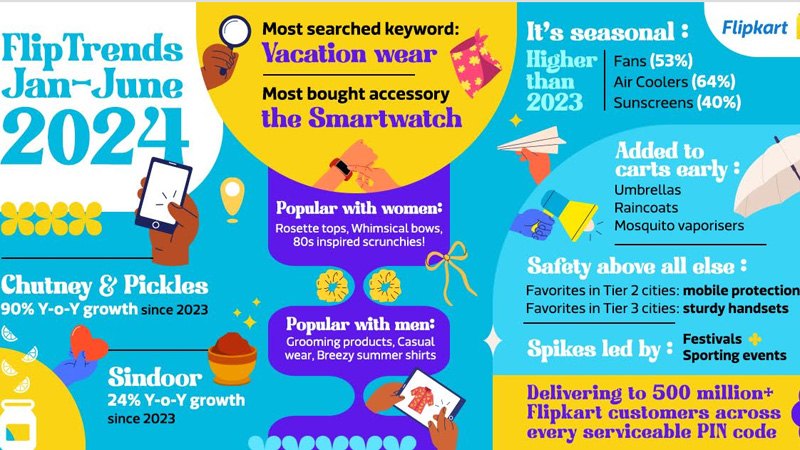
    Mumbai: In the run-up to this year’s festive season, Flipkart presents its H1 edition (January to June 2024) of the much-awaited ‘#FlipTrends’ report, which presents an interesting analysis of the shopping habits of 500 million+ registered Flipkart users.

    What are the most popular choices in metros vs tier-three regions? What are the common and daringly different shopping habits between customers in these regions?

    What are some of the unexpected purchases that peaked during certain seasons in 2024 so far?

    Are ‘seasonal trends’ still in or are year-long trends ruling the roost?

    Were there any premium products which saw an uptick during the months?

    All this and more is presented in this latest edition of the FlipTrends Report by Flipkart.

    The FlipTrends report reveals insights into an array of consumer shopping trends – some expected and many that come as a surprise.

    FlipTrends 2024 findings:

    India ka lifestyle and fashion destination – there’s something for everyone!

    ‘Vacation wear’ was one of the most searched keywords in the first half of 2024, especially during summer. Women embraced feminine fluidity, defying singular trends by opting for whimsical bows, rosette tops, chic bandeau tops, dresses, comfortable mules, 80s-inspired scrunchies, and a palette bursting with gelato pastels. Men opted for casual wear like round-neck t-shirts, open-knit and textured shirts, zipper polos, and parachute trousers. Other top choices included comfort clothing, resort wear such as printed co-ord sets and breezy summer shirts. Additionally, men’s grooming products saw a significant increase compared to 2023.

    Women’s western wear and women’s ethnic wear were top choices in Bangalore, Chennai, Hyderabad, Kolkata and New Delhi; while women’s sarees were at the top of the fashion charts in cities like Agartala, Bhagalpur, Medinipur, Muzaffarpur and Puri.

    Coming to traditions — there was also an unexpected demand for ‘sindoor’, almost 24 per cent y-o-y growth in 2024 so far, compared to last year.

    Nostalgic flavours fuel modern palates

    While modern gastronomy and fusion foods are all the rage, who says that age-old flavors aren’t that popular anymore? This year, Indians rediscovered their passion for classic recipes, stocking up on chutneys and achars. An almost 90 per cent y-o-y growth has been clocked for ‘Pickles & Chutneys’ alone, compared to 2023.

    Speaking about food, ‘Food & Nutrition’ was on number two on the shopping list of customers in cities such as  Bhubaneswar, Cuttack, Dehradun, Gorakhpur and Guwahati in 2024 so far.

    How has India been beating the heat?

    In the midst of sweltering temperatures, consumers are prioritizing freshness and comfort. Fans have surged in demand by 53 per cent on Flipkart from last year, reflecting the quest for cooling solutions. Sunscreen purchases have also increased by 40 per cent, clearly reflecting how people are prioritising sun protection. Air coolers, another key essential for beating the heat, have witnessed a significant 64 per cent increase in demand compared to the previous year. Cities like Bangalore, Bhubaneshwar, Cuttack, Gorakhpur, Hyderabad, Kolkata and New Delhi have shown a higher demand for personal care essentials such as hair oil, face wash, shampoo, and deodorants, emphasizing consumer focus on staying cool and refreshed.

    Monsoon musings

    In preparation for this year’s monsoon season, shoppers stocked up on essentials like umbrellas, raincoats, and mosquito vaporizers. While beauty and skincare remain top priorities for Flipkart customers throughout the year, makeup kits and fragrances observed a surge in popularity, in the run-up to monsoon.

    Smartwatches continue to top the wearables charts

    FlipTrends showcases a thriving consumer fascination across India with cutting-edge tech innovations. From the fitness enthusiast, and fashion lover to the on-the-go professional who wants to be always connected, the smartwatch remains a coveted accessory, leading the wearable tech trends in 2024. Other popular choices were Smart Bands and TWS Earphones which saw a notable surge in demand.

    Shoppers from emerging cities lead the way for ‘safe gadget shopping’

    In emerging tier-three markets, where 72 per cent of consumers opt for mobile protection, safeguarding mobile devices is not just a choice – it is a strategic necessity driven by the high stakes of device investment, critical data security and the quest to enhance both longevity and resale value. Bhubaneswar, Cuttack, and Guwahati emerged as top tier two cities and showcased a noticeable preference for such items. Meanwhile, in tier three plus cities Agartala, Medinipur, and Muzaffarpur shoppers primarily opted for sturdy handsets and plain mobile protection cases.

    Topical shopping driven by sports fever and festival frenzy

    Sports holds a special place in many Indians’ hearts, as seen through their shopping habits on Flipkart in the run-up to and during popular sporting events. Searches spiked for items like tennis kits, while sports merchandise and men’s tracksuits were top choices as fans nationwide rallied behind supporting their favorite players.

    Another aspect that led to spikes in demand is festivals. Traditional wear and puja essentials witnessed strong demand during festivals like Navratri, Ugadi and Eid al-Fitr. Specifically, products such as sindoor, havan chowki and diyas saw a surge in demand during the festive season of Navratri.

    Speaking about the H1 2024 FlipTrends report, Flipkart senior vice president – analytics and data science Ravi Vijayaraghavan said, “Consumers today are more discerning and mindful of their choices, gravitating towards seasonal and personalized preferences. At Flipkart, we are delighted to present our FlipTrends H1 2024 report which not only reflects interesting shopping trends but also showcases growth opportunities for e-commerce at large. Our commitment to customer-centricity remains unwavering as we strive to anticipate and fulfill the evolving demands of our diverse customer base. As we move into the festive spirit of things, our focus remains on fostering trust, convenience, and affordability, ensuring that Flipkart remains the ultimate destination for customers evolving shopping needs.”

    #FlipTrends findings continue to showcase how millions of shoppers from both metros and tier-three regions continue to choose Flipkart as their preferred shopping destination.

  • MiQ unveils global report on advanced TV advertising

    MiQ unveils global report on advanced TV advertising

    Mumbai: MiQ, the world’s largest independent programmatic media partner for brands and agencies, unveiled its global Advanced TV research report, which surveyed 7,000 consumers and 1,100 decision-makers from brands and agencies across eight countries, including India, the US, UK, Canada, Germany, Australia, China, and Singapore.

    The report reveals that TV viewing habits have become more fragmented globally, with average daily watch time across linear TV and OTT being 2 hours and 53 minutes, and watch time on streaming platforms surpassing linear TV by 22 per cent. Cord trimmers (those who watch OTT and linear), cord cutters (a little linear, mainly OTT), and cord nevers (OTT-only) outnumber those who only watch linear TV three-to-one globally.

    The report highlights the following trends in global TV consumption:

    ●    Consumers subscribe to three streaming services on average
    ●    10 per cent of viewers jump from subscription to subscription based on what they’re watching
    ●    93 per cent of consumers are re-evaluating their subscriptions, and 33 per cent of those are looking at ad-supported platforms.

    With a clear shift towards streaming, marketers need to include connected TV as a key pillar of their advertising strategy. The report also points out that consumers aren’t giving their full attention to just one screen; in fact, 45 per cent of viewers often (or almost always) use a second screen while streaming videos or watching content on TV.

    Viewership insights from India reveal that:

    ●    Attention is split – 56 per cent of consumers use a second screen frequently when streaming videos or watching TV
    ●    Price is more important to consumers than content – 42 per cent of consumers claim that cost is a bigger consideration on streaming platforms than content.
    ●    Ad tolerance is high – 37 per cent of viewers would consider a cheaper ad-supported streaming (AVOD) platform

    Brands and media agencies are optimistic about increasing ad spends on Connected TV with:

    ●    59 per cent of Indian brands and agencies anticipate a rise in their CTV marketing spend over the next 12 to 24 months
    ●    74 per cent of CTV advertisers measure the success of their campaigns through reach/frequency towards the intended target audience

    Commenting on the global report, MiQ global commercial board member and managing director Siddharth Dabhade said, “Consumer and advertiser insights from our report indicate that connected TV advertising is poised for robust growth in India. With the highest ad engagement rate in the world, CTV advertising presents a huge opportunity for brands to make an impact on the biggest screen in the household by taking a data-driven approach to TV planning and activation. Trends like cord-cutting and second-screening are on the rise, which implies that advertisers need to focus on mobile retargeting and competitive conquesting to supplement their CTV strategy.”

    According to the report, only 15 per cent of the respondents who have executed CTV ad campaigns consider themselves a CTV ‘expert’ owing to the cost and creative challenges advertisers face when planning and executing a CTV campaign.

    To gain more insights on CTV advertising in India download the report: https://marketing.wearemiq.com/advanced-tv-report

  • Consumer sentiment improves for urban Indians in December 2023: Refinitiv-Ipsos PCSI monthly India report

    Consumer sentiment improves for urban Indians in December 2023: Refinitiv-Ipsos PCSI monthly India report

    Mumbai: Consumer sentiment shows recovery and uptick of 1.2 per cent points for urban Indians in December 2023, according to the Refinitiv-Ipsos Primary Consumer Sentiment Index (PCSI).

    The monthly PCSI result, which is driven by the aggregation of four weighted sub-Indices, displays a mixed response across the four sub-indices. The PCSI Current Personal Financial Conditions (“Current Conditions”) Sub-Index is up 3.2 per cent points; the PCSI Investment Climate (“Investment”) Sub-Index improves and is up 3.0 per cent points. On the contrary, PCSI Economic Expectations (“Expectations”) Sub-Index is down 0.1 percentage points and the PCSI Employment Confidence (“Jobs”) Sub- Index has dipped 1.9 percentage points.

    Ipsos India CEO Amit Adarkar said, “We see a slight recovery and upturn in consumer sentiment in December, after November’s downturn. The RBI has left the Repo Rate unchanged in its recent Monetary Policy, which means no hike in interest rates on home loans, vehicle loans, borrowings etc., which should have brought some cheer to consumers. Improvement in sentiment is seen more around the 2 sub-indices of current financial conditions and investments, which shows consumers do not need to observe frugality in their spending and savings. Sentiment around jobs and the economy continues to be pessimistic as the two wars in Israel and Ukraine and a significant slowdown in the global economy continue to impact most global markets, especially now that we are seeing job cuts by major global companies.”

    Consumer Sentiment in 29 Countries

    Among the 29 countries, India (64.3) holds the highest National Index score this month. Indonesia (63.9) and Mexico (60.0) are the only other countries with a National Index score of 60 or higher.

    Six other countries show a National Index above the 50-point mark: Thailand (58.1), Singapore (57.5), Brazil (56.5), the Netherlands (52.2), Poland (51.5), and the U.S. (51.1). For Poland, this month’s score is the country’s highest since November 2019.  

    In contrast, five countries now show a National Index below the 40-point mark: Chile (39.9), South Korea (39.1), Japan (37.5), Hungary (36.6), and Türkiye (35.5).

    https://lh7-us.googleusercontent.com/5xO87cdvNbhHl9HDHtm4WFTDVB7B6v_Xy2UT_51B8636SIBhhu2wUu4B2j0cgI7pC2bBJq-d1jDinzJjVsxZkRRNNPEQn8jii-aJj0ab2Tr2cmIJryEnhr6YWu3wmjx9l7iApwhGcLY561HR1u-gRg

    These findings are based on data from a monthly 29-country survey conducted by Ipsos on its Global Advisor online survey platform and, in India, on its IndiaBus platform. They are first reported each month by LSEG as the Primary Consumer Sentiment Index (PCSI).

    The results are based on interviews with over 21,200 adults aged 18+ in India, 18-74 in Canada, Israel, Malaysia, South Africa, Türkiye, and the United States, 20-74 in Thailand, 21-74 in Indonesia and Singapore, and 16-74 in all other countries.

    The monthly sample consists of 1,000+ individuals each in Australia, Brazil, Canada, France, Germany, Great Britain, Italy, Japan, Spain, and the U.S., and 500+ individuals in each of Argentina, Belgium, Chile, Colombia, Hungary, Indonesia, Israel, Malaysia, Mexico, the Netherlands, Peru, Poland, Singapore, South Africa, South Korea, Sweden, Thailand, and Türkiye. The sample in India consists of approximately 2,200 individuals of whom 1,800 were interviewed face-to-face and 400 were interviewed online.

    Samples in Argentina, Australia, Belgium, Canada, France, Germany, Great Britain, Hungary, Italy, Japan, the Netherlands, Poland, South Korea, Spain, Sweden, and the U.S. can be considered representative of their general adult populations under the age of 75. Samples in Brazil, Chile, Colombia, Indonesia, Israel, Malaysia, Mexico, Peru, Singapore, South Africa, Thailand, and Türkiye are more urban, more educated, and/or more affluent than the general population. The survey results for these countries should be viewed as reflecting the views of the more “connected” segment of their populations. India’s sample represents a large subset of its urban population — social economic classes A/B/C in metros and tier 1-3 town classes across all four zones.  

    The data is weighted so that the composition of the sample in each country best reflects the demographic profile of the adult population according to the most recent census data. The global indices and averages reported here reflect the average result for all the countries and markets in which the survey was conducted. They have not been adjusted to the population size of each country or market and are not intended to suggest “total” results.

    Sample surveys and polls may be subject to other sources of error, including, but not limited to coverage error and measurement error. The precision of Ipsos online surveys is calculated using a Bayesian credibility interval with a survey of N=1,000 being accurate to +/- 3.5 per cent points and a survey of N=500 being accurate to +/- 5.0 percentage points. For more information on credibility intervals, visit this page.

    The LSEG/ Ipsos Primary Consumer Sentiment Index (PCSI), ongoing since 2010, is a monthly survey of consumer attitudes on the current and future state of their local economy, personal financial situation, savings, and confidence to make major investments. The PCSI metrics reported each month for each of the countries surveyed consist of a “Primary Index” based on all 10 questions below and of several “sub-indices” each based on a subset of these 10 questions.

    The concerned publication of these findings abides by local rules and regulations. 

  • For Circa 2024, 87 per cent expecting better year: Ipsos Global Predictions 2024

    For Circa 2024, 87 per cent expecting better year: Ipsos Global Predictions 2024

    Mumbai: Ipsos Global Predictions for 2024 shows a positive outlook emerging for the year 2024 with 87 per cent urban Indians and 70 per cent global citizens predicting it to be a better year.

    And 8 in 10 urban Indians (84 per cent) say they are willing to make personal resolutions and specific changes for themselves in 2024. And 85 per cent Indians are also hopeful of the global economy doing better in 2024.    

    2023 was a bad year

    The local and global verdict on the year 2023 shows a great deal of disappointment, with 65 per cent of urban Indians pronouncing it a bad year for India and 64 per cent calling it a bad year for them and their family. 70 per cent global citizens felt it was a bad year for their country and 1 in 2 global citizens (53 per cent) felt it was a bad year for them and their family.

    The markets unhappy with 2023 were Argentina (88 per cent), Sweden (84 per cent), Turkey (84 per cent), Great Britain (per cent), Portugal (82 per cent), South Korea (82 per cent) and Hungary (82 per cent).

    The survey captured views of citizens on a host of issues, with their predictions for 2024.  

    Economy

    Most urban Indians expect cost of living to go up, with 71 per cent believing prices in the country will increase faster than people’s incomes.79 per cent global citizens echo similar views

    7 in 10 urban Indians (70 per cent) further believe inflation will be higher in 2024 as compared to 2023. 68 per cent urban Indians expect interest rates to be higher in 2024 as compared to 2023. 66 per cent expect unemployment to be greater in 2024 versus 2023.

    Technology

    Impact of technology in 2024 is likely to be a mixed bag. 61 per cent urban Indians expect artificial intelligence leading to loss of many new jobs in the country. 56 per cent Indians fear their personal data being leaked on the internet in 2024. 67 per cent urban Indians expect doctors in India to use artificial intelligence regularly, to decide on treatments for their patients. Interestingly, 61 per cent urban Indians believe in 2024, robots will look, think and speak like humans. The biggest upside, 65 per cent urban Indians polled believe artificial intelligence will lead to many new jobs being created in the country. And 57 per cent urban Indians plan to use social media less in 2024.

    Environment

    Climate change has been wreaking havoc around the globe.

    In 2024, 65 per cent urban Indians expect more extreme weather events in the country than seen in 2023. 60 per cent Indians also fear a natural disaster hitting a major city. And 70 per cent urban Indians expect the average global temperature to increase.

    At the same time 67 per cent urban Indians polled expect the govt to introduce more demanding targets for reducing carbon emissions quickly in 2024. While 63 per cent urban Indians expect more restrictions to be introduced to reduce the amount people drive in their cars in the country.    

    Society

    Predictions for 2024 are optimistic. 71 per cent urban Indians expect women to be paid the same as men for the same work. 71 per cent expect India to win more medals in the 2024 Summer Olympics than the last one. 66 per cent Indians believe people in the country will become more tolerant of each other.

    69 per cent urban Indians predict office workers spending more time in the office than at home, in 2024. 86 per cent Indonesians held this view, 78 per cent Malaysians and 76 per cent Chinese.

    63 per cent Indians expect the level of immigration into the country to increase in 2024. Markets predicting the most influx included Portugal (87 per cent), Turkey (82 per cent), Singapore (82 per cent) and Italy (79 per cent).

    And 1 in 2 Indians (53 per cent) expect the total size of the population of the country to fall in 2024. For a country that has become the world’s most populous nation.

    Ipsos India CEO Amit Adarkar said, “Majority of our citizens have a positive outlook for 2024, predicting it to be a better year for them. Though they are bracing themselves up for a tougher year in terms of inflation, rising prices, higher interest rates and higher unemployment. Year 2023 was a bad year is the majority verdict. The year saw many upheavals due to inflation, rise in prices of essential commodities, yo-yo of fuel prices, drought and floods and violence in certain parts of the country. The predictions for 2024 hinge a lot on optimism, of office workers going more often physically to work, govt taking stringent measures to reduce the carbon footprint, pay parity of women with men doing the same work, citizens becoming more tolerant of one another and India bagging more medals in its kitty in the summer Olympics. AI is expected to stave off some jobs and create new ones, so this will put a lot of emphasis on reskilling. Cautious optimism is the approach for 2024, as there is also fear of a new more severe pandemic and natural disasters.”      

    About the study

    These are the results of a 34-country survey conducted by Ipsos on its Global Advisor online platform and, in India, on its IndiaBus platform between Friday 20 October to Friday 3 November, 2023.

    For this survey, Ipsos interviewed a total of 25,292 adults aged 18 years and older in India, 18-74 in Canada, Malaysia, New Zealand, South Africa, Turkey, and the United States, 20-74 in Thailand, 21-74 in Indonesia and Singapore, and 16-74 in all other countries.

    Africa, Turkey, and the United States, 20-74 in Thailand, 21-74 in Indonesia and Singapore, and 16-74 in all other countries.

    Read the full report here:

    https://www.ipsos.com/en-in/optimism-rife-among-urban-indians-circa-2024-87-expecting-it-be-better-year-ipsos-global-advisor

  • ShareChat & Moj Festive Report 2023: 47 per cent Indians to Surpass Rs 10,000 in festive spending

    ShareChat & Moj Festive Report 2023: 47 per cent Indians to Surpass Rs 10,000 in festive spending

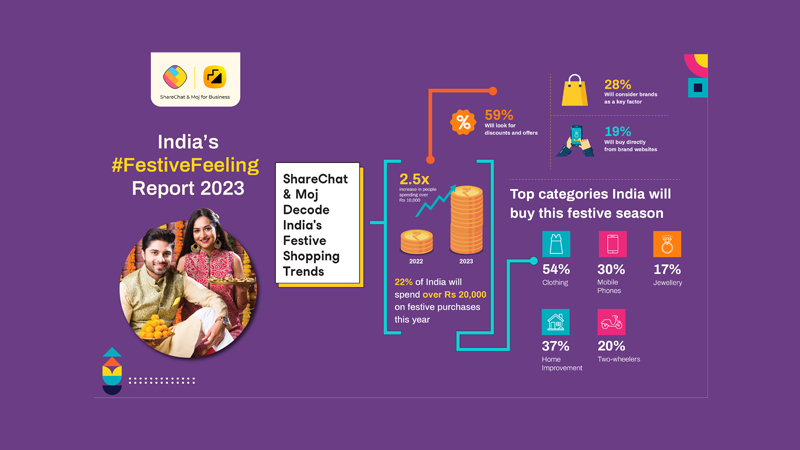
    Mumbai: Capturing India’s shopping sentiment this festive season, ShareChat and Moj, India’s leading homegrown social media and short video platforms, today released a report titled India’s #FestiveFeeling Report 2023. The findings in the report are based on primary data collected through an in-app survey among 2355 respondents aged between 20 to 50 years, across India. The survey decodes the festive outlook and shopping sentiment of Indians ahead of the festive season and deep dives into specific categories such as mobile phones, automobiles, and beauty products, that the users will be spending most on this year.

    The report foresees a significant jump in the spending plans of Indians this year during festivities. 47 per cent of Indians are expected to spend over ₹ 10,000 on festive purchases, which is about 2.5 times more than last year. Of the people spending a minimum of ₹10,000, 48 per cent will spend ₹20,000 or more. This year, home improvement has made a strong entry into the top three product categories that Indians are likely to spend on, clothing and mobile phones continue to dominate the purchase categories. 66 per cent of Indians will use their savings to make these purchases. Discounts will drive a large percentage to choose brands and products, with 59 per cent prioritising the offers, especially for consumers in the age group of 26 to 35.

    For the upcoming festive season, going a level up in their lifestyle will be among the top priority for Indians. Of the Indians looking to buy home appliances, 19 per cent would want to buy a new television and 18 per cent, a new washing machine to spruce up their homes. Amongst consumers planning to invest in a new mobile phone, 44 per cent are seeking an upgrade for a better camera, while 34 per cent aim to stay up-to-date with technological advancements by choosing a 5G-enabled device.

    Within beauty products, perfumes and makeup will take the top spot in the shopping cart of Indians. Surprisingly, 14 per cent more males plan to buy perfumes this festive season than females. Social media remains the number one tool to research beauty products for Indians, with 34 per cent relying on it to find the products they love or would want to consider.

    The festive season is a time for many Indians’ automobile dreams to come to reality. Among Indian vehicle buyers, when it comes to four-wheelers, 41 per cent intend to upgrade to larger vehicles this festive season. Interestingly, a significant portion of these buyers are embracing sustainability, with nearly a quarter planning to make the switch to electric vehicles.

    There is also a marked shift in Indians considering brands as a crucial factor while making festive purchases, with 28 per cent saying that they will buy from a brand they love and prefer, with 19 per cent showing keen interest in buying directly from brand websites owing to more product choices, competitive pricing and trust.

    Commenting on the launch of this year’s report, ShareChat & Moj chief revenue officer Udit Sharma said, “At ShareChat and Moj, we know India’s content preferences and how they love to express and celebrate, especially during festivities. Social media and short form videos have been a game-changer in driving user preferences and purchase decisions. For the second year in a row, our report India’s #FestiveFeeling 2023, unravels India’s shopping sentiment ahead of the festive season, giving marketers crucial insights which can help them build an effective strategy to reach India’s diverse population. With India looking to spend more and upgrade their lifestyle this season, brands can harp on platforms such as ours, with deep understanding of culture and language, a strong mobile-first approach and the best of creativity, to gain significant leverage.”

    Social media and short-form video platforms, today, offer brands an innovative means to tap into a much larger target audience, especially during the festive season when user engagement is at an all-time high.  With over 325 Mn monthly active users, ShareChat and Moj have become ideal destinations for brands to form a deeper connection with India’s diverse and culturally rich population. Users actively look for products in-app in categories such as beauty, electronics, food, and automobiles. By leveraging popular creators, branded hashtag challenges, brand takeovers, studio ads, etc., brands can make a compelling case to their audiences via a platform that they are spending the most time on.

    Click here to read the full report: India’s FestiveFeeling 2023

  • Dish TV India’s consolidated net profit declines 64.47% in Q1 FY23

    Dish TV India’s consolidated net profit declines 64.47% in Q1 FY23

    Mumbai: Dish TV India on Wednesday announced their financial results for the first quarter of the financial year 2022–2023. The company’s reported net profit declined 64.47 per cent to Rs 17.85 crore in the quarter ended June 2022 as against Rs 50.24 crore during the previous quarter ended June 2021.

    Operating revenues for the quarter stood at Rs 608.6 crore. For the same period, the earnings before interest, taxes, depreciation and amortization (Ebitda) was Rs 323.8 crore with a margin of 53.2 percent and profit after tax was Rs 17.8 crore.

    In the quarter ended June 2022, sales fell 16.74 per cent to Rs 608.63 crore, compared to Rs 730.97 crore in the previous quarter ended June 2021.

    The company paid-off Rs 90.3 crore of debt during the quarter, thus reducing its overall debt to Rs 285.3 crore at the end of the first quarter of 2023 as compared to Rs 375.6 crore at the close of fiscal 2022.

    The first quarter of the current fiscal, to some extent, was an extension of the fourth quarter of the previous fiscal. Not only did inflation-linked cautiousness in viewers remain intact, the changing landscape of the entertainment industry continued to influence subscriber retention and growth.

    Dish TV chose the middle path and maintained a moderate pace of capital expenditure while prioritising debt repayment over new acquisitions.

    External factors dominated and impacted the recharge behaviour of DTH subscribers, with top-end consumers swapping between DTH and streaming content and bottom-end subscribers alternating between free-to-air and pay DTH, thus affecting revenues and net base.

    With a growing number of subscribers having access to OTT subscriptions, India’s streaming video market is expected to garner a revenue of Rs. 490 billion by 2027, up from Rs. 210 billion in 2022, according to the latest industry report.

    Speaking about the results, Dish TV India Group CEO Anil Dua said, “In the changing industry landscape, Dish TV is committed to exploring and embracing new possibilities that would enable it to offer a more contemporary and bespoke service bouquet. As an entertainment distribution company, we would want to be a one-stop destination for viewers seeking video content and continue working towards that objective.”

    Dish TV India chairman Jawahar Goel commented, “The company has been actively pursuing relevant technological developments in the business space and looks forward to aligning with those that will help it achieve its strategic and commercial goals.”

    “As an industry, we also continue to seek and hope for a level playing field in the distribution space, by way of uniform application of licence fees to either all players or to none of them, as Free DTH, Headend in the Sky (HITS), OTT and cable TV still remain outside the ambit of licence fees,” added Goel.

  • India’s OTT video market to reach $3 bn in 2022; estimated to double by 2027: Report

    India’s OTT video market to reach $3 bn in 2022; estimated to double by 2027: Report

    Mumbai: India’s OTT video market will reach total revenues of $3 billion in 2022 and is expected to more than double to $7 billion by 2027, according to Media Partners Asia (MPA).

    In the recent analysis, MPA looks at the online video and broadband distribution trends in the Asia Pacific (APAC) market.

    The online video market in APAC is expected to grow 16 per cent year-on-year to reach $49.2 billion by the end of 2022. MPA forecasts that the industry will continue to grow by 8 per cent YoY to reach $72.7 billion by 2027.

    Subscription video-on-demand (SVOD) is expected to contribute 50 per cent to overall revenues, followed by user-generated-content (UGC) advertising video-on-demand (AVOD) platforms which will contribute 37 per cent and premium AVOD that will contribute the remaining 13 per cent.

    “APAC’s largest markets including India, Indonesia, Japan, Korea and Thailand will be increasingly important to global platforms,” observed MPA executive director Vivek Couto. “Each of these markets require local content and distribution strategies with long-term investment.”

    The APAC region remains the largest contributor to global online video customers and its users are emerging as a significant contributor to revenue growth. In its recent quarterly results, streaming giant Netflix reported a loss in subscribers in every market (United States-Canada, Europe Middle East and Africa, Latin America) except APAC where it reported paid net additions of one million.

    Also Read: Netflix to launch cheaper ad-supported plan for early 2023

    Indian Scenario

    As per the analysis, India’s OTT video market is in the second phase of its growth as competitive intensity is set to grow between global giants and newly capitalised local players. Telco reach remains critical in the market along with AOVD business models and low-average revenue per user (ARPU), high volume SVOD services.

    In terms of SVOD business, Netflix, Disney and Amazon lead, with the three players having 56 per cent aggregate of the APAC market excluding China in 2022. Netflix will have 33 per cent share followed by Amazon Prime Video at 12 per cent and Disney+ including Disney+ Hotstar at 11 per cent.

    Netflix’ s share of online video subscription revenues has declined from 35 per cent in 2021 while Disney+ and Disney+ Hotstar services are building scale, local content investment and monetisation in markets such as Australia, India, Indonesia and Thailand while also expanding in high ARPU, strong local markets such as Japan. A third of Disney+ revenues come from India, however, where it has recently lost digital rights to the highly successful Indian Premier League (IPL) cricket franchise to Viacom18.

    Prime Video leads the Japan SVOD category while also growing rapidly in India and is now set to expand in key Southeast Asia markets in the fourth quarter 2022.

    In India, new local players with deep pockets are gearing up to grab market share, led by a newly recapitalized Viacom18, backed by strategics Reliance, Bodhi Tree and Paramount while domestic incumbents Zee and Sony are merging to create a strong TV/online video business.

    Going forward, Viacom18’s new streaming platform, leveraging IPL cricket and local entertainment, will emerge as an important player in the AVOD space in particular, grabbing material share over time as it leverages massive reach via Jio mobile and connected TV.

    Ad-supported SVOD models will launch across Asia Pacific in 2023-24, led by Netflix and Disney+.

    Broadband distribution landscape

    The total addressable market (TAM) for high-speed broadband continues to expand rapidly in Asia Pacific with greater 4G, 5G and fiber-enabled connectivity.

    Excluding China, the combined 4G and 5G users will reach 78 per cent of the population across APAC in 2022 while fiber-driven fixed broadband penetration will reach 31 per cent.

    Teclos, connected TV (CTV) operators and pay TV operators remain important aggregators of SVOD, freemium and AVOD services, contributing between 20 to 80 per cent to OTT video platform reach, depending on the market.

    The rising CTV penetration and big screen consumption of online video content is helping fuel advertising growth across YouTube and premium SVOD platforms, led by broadcast video-on-demand (BVOD) players in particular, while also bolstering demand and monetisation at SVOD platforms.

    “Investors are increasingly focused on enhanced scale, improved monetization and real profitability across global, local and regional online video platforms. In this context, the role of Asia Pacific continues to have a critical role in the future of the global online video industry,” said Couto.

  • Indian sports media market to touch $13.4 bn by 2027: Report

    Indian sports media market to touch $13.4 bn by 2027: Report

    Mumbai: The Indian sports media market is expected to grow to over $13.4 billion by 2027, as per a report by investment consultants Anand Rathi Advisors (ARAL).

    The report finds that the global sports media rights market was estimated at $52.1 billion in 2021. Considering that the Indian sports media market was estimated at ~$1 billion in 2020, it shows a tremendous potential for growth in future, according to the report by investment consultants Anand Rathi Advisors.

    The share of cricket in the global media rights mix grew from 2.7 per cent in 2019 to 3.0 per cent in 2020. However, football continued to occupy pole position in terms of media rights investments with 42 per cent share, earning just under $20.8 billion in 2021.

    The Indian sports sector has seen a total of $4 billion in terms of investments between 2015-2021, out of which 30 per cent of the investments have gone to acquiring media rights. Over the past ten years, Disney-owned Star India has invested nearly $10 billion in cricket broadcasting rights. In 2013, Star India invested $325 million in the Indian Super League (ISL), while it recently renewed its Pro Kabaddi League rights at $24 million a year.

    On average, 90 per cent of most-watched broadcasts in India are live cricket. Two other sports on the radar of the Indian consumer are soccer and kabaddi. The Indian Premier League with a record 9 million+ viewership per match has shown the path for successful commercialisation of sports in India, as per the report. The BCCI securing landmark multi-million-dollar media rights agreements earlier this month evidences the robust growth trajectory of Indian sports, it adds.

    The report hypothesizes that the sports industry in India will be driven by its gigantic youth population of 400 million and rapidly improving economic conditions.

    “At Anand Rathi, we aim to provide thought leadership and information that will assist the investment community in identifying macro trends and compelling investment ideas in consumption driven niche segments. In this regard, we have lined up a host of informative reports that will be released periodically,” said Anand Rathi Advisors CEO – investment banking Samir Bahl.

    “We have taken a deep look at the Indian sports sector. We are confident that our report would provide potential investors with an incisive look into the potential of the country’s sports economy. We believe that it is poised for a giant leap. Undoubtedly, India would soon become a sporting superpower,” added Anand Rathi Advisors director – investment banking Atul Thakkar. 

  • FY 2022-23 will be a transformational year for the company: Hathway Cable & Datacom MD Rajan Gupta

    FY 2022-23 will be a transformational year for the company: Hathway Cable & Datacom MD Rajan Gupta

    Mumbai: On building a profitable business, Hathway Cable and Datacom managing director Rajan Gupta stated that he believes FY 2022–23 will be a transformational year for the company.

    The provider of Cable and Internet services in its annual report mentioned the annual gross revenue up by 4 per cent to Rs 1,793 crore in FY 2022 as compared to FY 2021. After this, Gupta seems confident in increasing the company’s market share.

    Gupta said that with the worst of the pandemic effect seemingly behind us, and sports & other live entertainment events fully back in action, the environment looks favourable for the revival of the cable TV business currently.

    The company is confident that the efforts being made to prepare the platform for making deeper inroads into the market will significantly yield benefits in the increasing market share in the cable TV segment, going forward. It is focussed, committed and motivated to play a pivotal role in helping India’s media and entertainment industry bounce back, stronger than ever.

    Simultaneously, he also mentioned that the company acknowledged the current business environment has changed dramatically in the post-Covid world. In this difficult year, the company invested in building organisational competencies to align them with the evolving market and consumer demands & aspirations. “We have focussed on developing our capabilities in crisis management, enterprise agility, cost management, workforce resilience and innovation, which we believe to be the pillars of our growth-centric business model. Initiatives are also underway to leverage digital platforms to enhance the competencies of our partners in the cable TV business, as more than 90 per cent of our consumers in this segment are being serviced through our local cable operators,” Gupta added.

    He further noted that with the pandemic catalysing a new surge in demand, the FTTH (fiber to the home) segment of the business saw a healthy 20 per cent growth in revenue earning customers in these challenging times. “However, our cable TV business health was challenged due to a multitude of extraneous consumer and environmental factors. Limited original content, financial stress experienced by consumers in the Covid world, and multiple lockdowns led to many of them moving from metros to their home towns in this period. This, in turn, caused the bottom of the pyramid consumers to shift to value offerings, thereby limiting our ability to monetise this business,” Gupta said.

    Armed with in-depth industry knowledge and consumer understanding, Hathway responded to the situations with a powerful thrust on cable TV network expansion and transformation. Coupled with digital innovation, customer delight and workforce agility, the company is able to navigate successfully these unprecedented times.

    In line with this strategy, the company rolled out more than 140 new towns and added more than 3,000 kms of fibre network during the year under the community antenna television (CATV) business. With innovative next-generation high-definition (HD), high-efficiency video coding (HEVC) and over the top media service (OTT) set-top boxes delighting customers, Hathway scaled its consumer proposition for millions of new TV consumers. “These boxes host many new exciting industry-first features, such as time-shift – enabling users to watch a programme on one channel while recording a programme on another, radio channels, among others. We have also initiated a cable TV network transformation project, aimed at ensuring that our network is benchmarked to telco standards in terms of uptime, redundancies, resiliency and proactive monitoring,” he said.

    In the annual report, the company said that at the heart of its strategic thrust on continuous innovation lies a strong ambition to empower customers. “We invest in modern technologies, including artificial intelligence (AI) and machine learning (ML) applications and tools, to stay connected with our customers at all times. This helps us foster meaningful interactions with our customers,” he quoted.

    Taking its local cable operators (LCO) partnerships to the next level, the company also noted that amid the challenges of the year, Hathway’s marketing team pushed its efforts to improve communication with its LCO partners and assist them in growing the business. As part of these efforts, it identified the pain points of its LCOs, devised exciting ideas to pique their interest, and launched initiatives to raise awareness of its products and services.

    As part of these efforts, it identified the pain points of its LCOs, innovated exciting ideas to grab their attention, and took initiatives that helped create awareness about its products and services. According to the report, this triggered a new level of LCO activation and re-energisation of the stalled engagement.

    On the content front, the company plans to launch Kflicks, a dedicated channel for Korean content with dubbing in Kannada and Telugu languages for Karnataka, Andhra Pradesh, and Telangana markets. There will be English subtitles for the rest of the markets.

    The move is aimed at catering to the high demand from the new generation and the millennials. It also plans to launch an app, LCO LightHouse, to raise awareness about the LCO portal’s underutilised features, provide the necessary information, promote new or existing schemes & increase engagement.